


A baby brand’s repeat purchase rate drops, and the team does what most teams do. They tighten the win-back flow, add a discount tier, and send another “we miss you” campaign. Three months later the number has barely moved.
Often nothing is broken. The customer didn’t leave because of the product, the price, or the emails. Their baby moved out of the size, the stage, or the category. That is a different problem from the one most retention playbooks are built to solve, and treating it like ordinary churn burns budget on people who were always going to leave.
This article is about baby brand customer retention at the strategy level: how to tell the two kinds of churn apart, what “retained” should mean when every customer has a built-in expiry date, and what to measure instead. For the email mechanics, we have a separate walkthrough on email marketing for baby brands, and we won’t repeat it here.
Key takeaways
- Much of the customer loss in baby and kids is structural. The child ages out, and no flow can change that.
- A catalog usually contains two repurchase economies: consumables that follow consumption, and durables that follow the next developmental stage.
- Stage-to-stage progression rate tells you more than a generic repeat purchase rate.
- The realistic goal is to maximize frequency, spend, and referrals inside a fixed window, then keep refilling the front of the funnel.
- The four FAQ answers below cover best-retention companies, popular baby brands, the “8 C’s,” and the “5 pillars,” including where sources disagree.
The metric most baby brands misread
The baby category runs on a clock the brand doesn’t control. According to a baby and kids retention guide from JeriCommerce, babies outgrow clothes every 8-12 weeks, move through diaper sizes every 3-4 months, and shift through developmental toy stages roughly quarterly. The same guide reports that most baby and kids brands lose 60-70% of first-time buyers before the child’s first birthday, with most of that loss in the first 90 days.
Read that number as a normal DTC retention failure and you will go looking for a leak in your post-purchase flow. Read it as a calendar and the question changes. Which of those buyers left because the experience was poor, and which left because the product stopped fitting their life?
Those two groups need opposite responses, and a blended repeat purchase rate hides the split. A flat rate can mean a healthy brand losing the calendar battle, or a sick brand riding a strong acquisition quarter. You can’t tell which without separating them.
Two kinds of churn, and only one is fixable
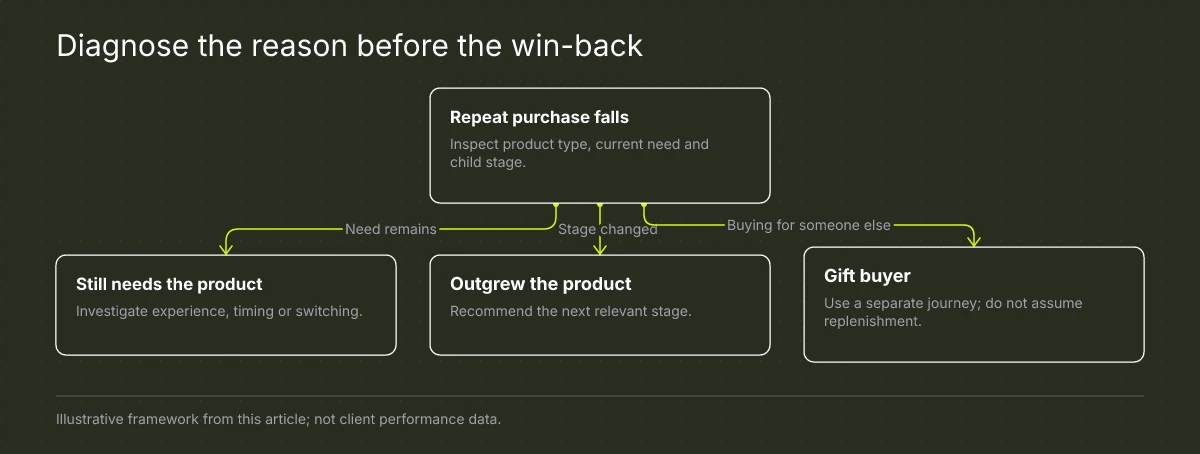
Behavioral churn is a customer who could still buy and doesn’t. The delivery was late, the product disappointed, the emails got ignored, a competitor was cheaper. Retention work fixes this: deliverability, relevance, offer structure, post-purchase experience.
Structural churn is a customer who no longer has a use for the category. Trivas makes the point directly in its analysis of baby and kids Shopify brands: standard LTV models fail here because churn reflects the child aging out, not dissatisfaction. Retention marketing can maximize purchase frequency within a fixed age window. It cannot extend the window.
That distinction has a budget consequence. If you spend win-back effort and discount margin on structurally exited customers, you are paying to chase a ghost. That money works harder on the next parent cohort, on the second-child case, and on the referral loop that brings in a friend who is expecting.
It also has a reporting consequence. A “lapsed” segment in a baby brand is really two segments: lapsed with a child who still fits your range, and lapsed with a child who has moved on. Only the first is a retention problem.
Two repurchase economies inside one catalog
Most baby brands don’t sell one kind of product. Consumables like diapers, wipes, and feeding supplies behave like supplements: repurchase follows consumption, and timing is predictable. Durables and stage-based gear like clothing sets, sleep products, and developmental toys behave more like jewelry or home goods: the next purchase has to be earned, usually by the next stage, a gift, or a second child.
Benchmarks show how different these economies are. Cross-vertical 365-day repeat purchase rate sits at 28.2% according to Eightx’s 2026 data, as we cite it in our ecommerce email benchmarks. Consumables run roughly 45-55%, while home and electronics sit around 20-25%. A baby brand averaging those two together gets a number that describes neither business.
Subscription delivery matters most on the consumable side. Future Market Insights’ baby diaper market analysis puts e-commerce at about 30% of diaper sales, driven partly by subscription delivery. Replenishment mechanics are a real lever there.
The second-purchase curve applies to both economies, with one caveat. Across ecommerce generally, the probability of a second purchase after the first order is roughly 27%, about 54% after the second, and above 70% by the fourth. In baby, the window to climb that curve is short, so the gap between first and second order matters more than it does in a brand with a ten-year customer.
What “retained” means when the customer has an expiry date
If the window is fixed, retention can’t mean “still buying in month 24.” It has to mean “progressed as far as the child allowed.” That gives you a few definitions worth tracking.
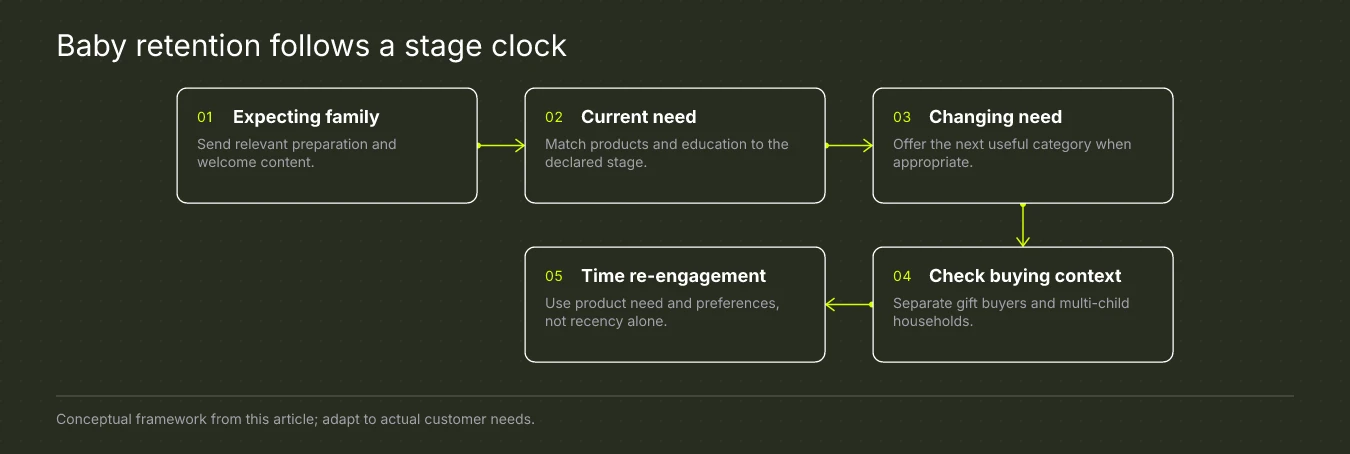
Stage-to-stage progression. The JeriCommerce lifecycle model runs from prenatal through newborn (0-3 months), infant (3-12 months), toddler (1-3 years), and preschool (3-5 years). Each stage carries different product needs, purchase frequency, and emotional state. A retained customer is one who moves from the stage-one product to the stage-two product, not merely one who bought twice.
Multi-child households. A second baby re-enters the customer at newborn. The parent already trusts you, which is the cheapest acquisition you will ever get, but only if your data knows they were a customer.
Referral to the next expecting parent. Gerber Childrenswear’s loyalty case study with Yotpo makes the case that peer referral is essential because parents trust other parents over brand messaging.
Gift buyers. Grandparents and friends buy on occasions, not on replenishment cycles. They shouldn’t sit in a sequence designed for parents.
This is why a baby brand runs a second clock running beside recency. Recency tells you how long since the last order. Child age tells you whether another order is even plausible. Newton Baby’s Head of CRM describes a customer shopping for baby items for roughly one year, or two with a second child, according to Monocle’s customer story. Their core LTV lever is cross-sell timing, such as accessories first and then twin mattresses as the kids grow.
What elite retention looks like, and what baby brands can honestly target
It helps to know the ceiling. Costco’s US and Canada membership renewal rate was 92.9% in its FY2024 SEC filing. Apple retains about 89% of iPhone users when they upgrade, per CIRP’s 2025 data. Amazon holds roughly 90% of e-commerce customers year over year, which is an industry-reported estimate rather than an Amazon disclosure. All three figures are collected in this retention roundup.
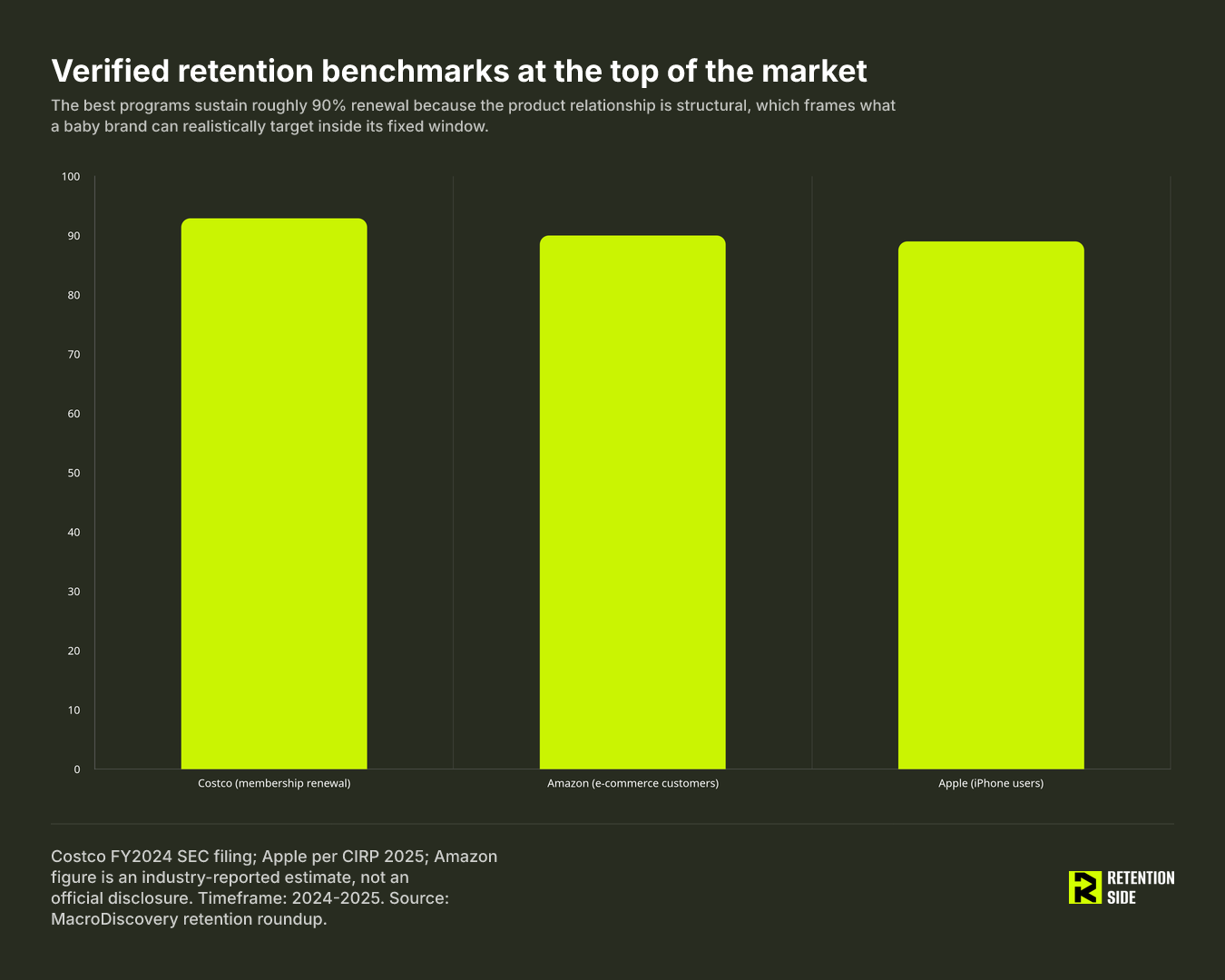
Those brands share something a baby brand doesn’t: the relationship is open-ended. Nobody ages out of Costco. So the honest target for a baby brand isn’t a 90% renewal rate. It is the best possible outcome inside a one-to-five-year window.
Gerber is a useful reference for what that looks like. With a newborn-to-five customer window, the brand accepts structurally limited LTV and works the window harder. In the Yotpo case study, loyalty redeemers spent $130 more on average and showed a 44% lift in repeat purchase rate. That result won’t transfer cleanly to every brand, but the logic does: if you can’t lengthen the relationship, you deepen it.
Building the system around the window
Once you accept the window, the retention system gets more specific. The work comes down to a handful of decisions, and they connect.
- Capture stage data early. One zero-party question at signup or first purchase (due date, birth month, or child age) lets everything downstream branch correctly. Without it, you are guessing from purchase history.
- Map flows to child age and product cycle. Welcome branching by declared stage, replenishment timing for consumables, and size-up or next-stage prompts for gear. Personalization by purchase history outperforms generic promotions by 3-5x, according to JeriCommerce.
- Time win-back to the real repurchase window. Skip the fixed 90-day rule. Trigger off how long the product actually lasts, and add a child-age check so the offer is for the next stage, not the one they just outgrew.
- Segment beyond the standard six. The usual DTC segments (new subscribers, active customers, VIPs, lapsed, unengaged, non-purchasers) still apply. Add child stage, multi-child households, parents versus gift buyers, and registry activity.
- Use the channel mix that fits the behavior. Email is the usual starting point, especially in Klaviyo, but SMS, push, direct mail, loyalty, and referral programs earn their place when stage data and cost justify them.
This is how we think about retention at Retention Side: a system built on deliverability, list growth, flows, and campaigns, then extended into other channels where behavior supports it. In baby, the extra ingredient is child-stage data running through all of it. The flow-by-flow detail lives in our email marketing for baby brands article.
What to measure instead of churn
Generic churn rate is the wrong headline number here. A better dashboard looks like this:
- Stage-to-stage progression rate. Of customers who bought in stage one, what share bought in stage two? This is the metric Trivas recommends as the primary one for baby brands.
- Repeat customer rate by product economy. Report consumables and durables separately so one doesn’t mask the other.
- Time between orders. Compare it against the product’s expected consumption or growth cycle. Drift here is behavioral churn showing up early.
- Lead-to-customer rate. The share of new subscribers who actually become buyers tells you whether the front of the funnel is feeding the window with the right parents. Form submission rate alone doesn’t.
- Open rate, as a warning light only. A sharp drop is worth investigating for deliverability. It isn’t a measure of customer value.
One more habit: when performance dips, check traffic quality, acquisition mix, and site conversion before blaming email. A cohort of gift buyers from a holiday campaign will look “disengaged” next to a cohort of expecting parents, and neither tells you the program is broken.
FAQ
What company has the best customer retention?
There is no single global ranking, because loyalty is measured differently in each sector. Among the most-cited figures, Costco’s US and Canada membership renewal rate was 92.9% in its FY2024 SEC filing, Apple retains about 89% of iPhone users when they upgrade (CIRP, 2025), and Amazon holds roughly 90% of e-commerce customers year over year, per industry reporting. In Brand Keys’ 2025 loyalty rankings, the top five were Amazon, Google, Microsoft, Apple, and Coca-Cola, as summarized in the same retention roundup. For a baby brand, the better comparison is against other brands with a fixed customer window, not against memberships with no expiry.
What’s the most popular baby brand?
By category, Pampers and Huggies form the dominant diaper duopoly in the US. According to a manufacturer report, Pampers ranked as the number one FMCG brand worldwide in Nielsen’s 2025 Brand Footprint, bought by about 55% of global households at least once a year. Market share figures vary a lot between research firms, so we would treat any single percentage with caution. No single brand tops every baby category, since popularity differs between diapers, gear, apparel, and toys.
What are the 8 C’s of customer retention?
No canonical list exists, and several incompatible versions circulate. The most widely cited is Influence.io’s 8 C’s of customer loyalty: consistency, customization, convenience, communication, competence, commitment, community, and credibility. Other publishers swap in care, character, culture, or connection. Applied to a baby brand, the Influence.io list reads like this:
- Consistency: the same quality and sizing across stages
- Customization: child-stage segmentation instead of one-size-fits-all sends
- Convenience: easy reordering and subscriptions for consumables
- Communication: messages timed to the child’s age, not a fixed calendar
- Competence: safe, reliable products and fast support
- Commitment: showing up with the next stage, not only a discount
- Community: parent peer proof, which Gerber’s case suggests outranks brand messaging
- Credibility: honest claims and real reviews from other parents
What are the 5 pillars of brand loyalty?
One commonly cited framework, from Obvlo’s brand loyalty research, lists emotional connection, trust and consistency, personalization, engagement, and advocacy. Other sources, including SAP Emarsys’ own loyalty content, use different lists, so treat it as a framework rather than a standard. The same Obvlo piece cites SAP Emarsys’ 2025 Customer Loyalty Index: true brand loyalty fell to 29%, down five points year over year, and 53% of consumers are silent loyalists who stay faithful without engaging publicly. For baby brands, that is a reminder not to over-message parents who are quietly buying and don’t need more emails.
Treat the age-out as a scheduled event
Retention in baby is a race against a developmental clock, not a fight against churn. The brands that do well stop treating the age-out as a failure. They plan for it, harvest the window with stage-matched flows and referrals, and refill the funnel with the next expecting parent.
If your repeat rate has stalled, start by splitting structural exits from behavioral ones. The fixable group will be smaller than you feared, and the work on it will be much more precise.