


Most baby brand case studies get summarized as “personalization works.” That is true and almost useless. The more useful question is what the brand knew about the customer’s child, when it learned it, and what it did with it.
Read the strongest examples side by side and one mechanic keeps showing up. A due date, a birth date, or an age band gets captured early, stored as a dated property, and used to trigger the right message at the right stage. Subject line cleverness and merge tags barely feature.
That is the lens for this article. We pulled six baby and kids brand examples, labeled each by how verifiable its numbers are, and extracted what transfers to a brand doing real revenue. If you want the framework behind these examples, our guide to email marketing for baby brands covers it. For peer numbers by sub-vertical, see our baby ecommerce email marketing benchmarks. This piece is the proof layer.
What you’ll learn
- How to separate platform-published, agency-published, and vendor-reported results before you trust a number.
- What Momkind, Caden Lane, Cheeky Wipes, Little Sleepies, Tushbaby, and Nature Baby each did, and which part is worth copying.
- How to evaluate a useful lifecycle implementation when no email revenue lift is published.
- The five-step pattern behind all of them, and a short self-audit to run in your own Klaviyo account.
How to read baby brand email case studies
A case study is a marketing asset. It still teaches you something, but only if you know who published the numbers and what is missing.
We use three tiers, the same way we do in our pet brand email marketing case studies:
- Platform-published. Klaviyo or Attentive wrote up a customer on its own site. The numbers come from the platform, but the platform chose the story. It is not an independent audit.
- Agency-published. The agency that did the work reports the result. Treat it as self-reported.
- Vendor-reported through trade press. The weakest tier. We leave it out here.
Then check for three things. Is there a before state, a set of actions, and an after state in business metrics, or only open-rate vanity numbers? Is the growth percentage sitting on a tiny baseline? And does the tactic depend on something the brand had to collect first? In baby, it nearly always does. That is the part most write-ups skip.
Case study 1: Momkind, where the due date runs the program
Momkind is a Danish pregnancy and motherhood brand. Klaviyo reports that email generates 36% of total revenue, with a 58% sign-up form completion rate, a welcome series that converts at 21% with an 86% open rate, and an abandoned cart flow converting at 9.5%. The cart flow layers free shipping first, then a 10% discount.
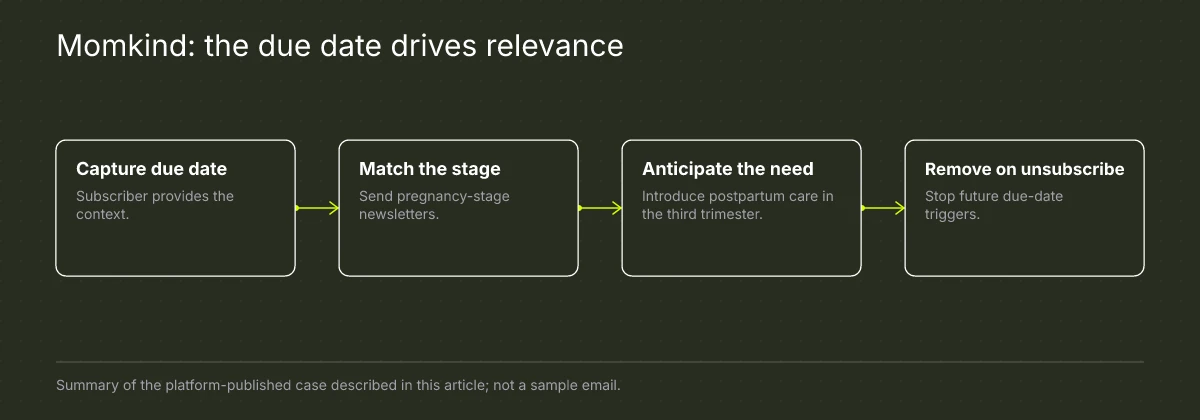
What matters is the mechanic underneath. Subscribers share their due date at signup. That date triggers weekly newsletters matched to pregnancy stage, and a postpartum care box gets promoted in the third trimester, when the need is about to become real.
The most transferable detail is the trust guard. When someone unsubscribes, the due date is automatically removed, so no pregnancy-based trigger can fire later. In a category where a misplaced message can land badly, that is part of the system design, not an edge case. If you store sensitive stage data, decide up front what happens to it when the relationship ends.
Case study 2: Caden Lane, where asking for more context converted better
Caden Lane sells baby and kids apparel. Klaviyo reports Klaviyo-attributed revenue up 157.3% year over year in Q1 2023, flow revenue up 24.2x, and 4.5x more live flows.
The sharpest lesson is in the testing. The brand A/B tested roughly 30 versions of its signup pop-up. The pop-up asks who you are shopping for (baby on the way, newborn, or child 5+), plus gender and birthday. Conversion was highest when the form asked for more context, not less.
That cuts against the usual instinct to strip forms down to one field. Caden Lane’s result suggests that when the questions are relevant and the value is clear, shoppers answer them. Treat it as a test hypothesis, not a rule. Form submission rate is not the KPI. What counts is whether the captured data turns into customers.
The second idea is aging out. Where no birthday is on file, segments use 45 days of browsing behavior to detect when a child has moved past baby apparel. That is how you handle the stage data you do not have.
Case study 3: Cheeky Wipes, personalization with sensitivity
Cheeky Wipes is a UK reusable baby wipes brand. Klaviyo attributes 47% of revenue to its email program, with a 16% placed order rate from the welcome flow and 8% from abandoned cart.
The context comes from a signup preference question that shapes the welcome offer. Abandoned cart content reflects what the shopper actually viewed. The less obvious piece is a post-purchase check-in flow built for infrequent buyers. Reusable packs last a long time, so a standard replenishment timeline would be wrong. The brand checks in, then cross-sells with the honest acknowledgment that babies do eventually grow up.
This one is a good example for durable or long-cycle products. If your customers legitimately do not need to reorder for months, the retention job is staying useful in between, not forcing a repurchase date.
Case study 4: Little Sleepies, segmentation at seasonal scale
Little Sleepies makes bamboo sleepwear for babies and kids. Klaviyo reports 138.2% year-over-year growth in email revenue during 2022 BFCM, 129.5% flow revenue growth, and a 2.5x month-over-month lift in flow placed order rate in November 2022.
The tactics were operational:
- Early-access list growth ahead of the event.
- Double-send bookends: one to the full list and a second to engaged non-buyers.
- Abandonment flows sped up to 30 minutes, with daily-trigger frequency.
- Daily campaigns aimed at specific segments rather than one blast.
Be careful with this one. The figures are from 2022 and tied to a peak sales event, so read it as a seasonal playbook, not a baseline. The part that transfers year-round is the discipline of sending different versions to different segments, and giving non-buyers a second shot instead of a heavier discount for everyone.
Case study 5: Tushbaby, stage complexity and channel orchestration
Tushbaby sells baby carriers and has expanded into bags, toys, and feeding products. Attentive reports 287x overall ROI from unified email and SMS, 900x ROI on the welcome SMS journey, an average email unique open rate above 48%, a 31% email revenue lift from Audiences AI, and an SMS journey with 13% CTR and 32% conversion.
These numbers are platform-published and unusually large. They almost certainly reflect a favorable baseline and how ROI is calculated, so we would not benchmark against them. The structure is more instructive than the multiples.
Two context layers stand out. First, SMS is positioned as a VIP channel with first access, plus gamified disappearing-code flash sales, so the channel has a reason to exist beyond duplicating email. Second, the lifecycle gets complicated as the catalog widens and registry and gifting behavior enter the picture. A gifter and a parent are different audiences buying the same product. If your program treats them identically, your segmentation has a hole.
This is where retention stops being an email question. Channel choice should follow audience behavior, cost, and customer experience. Layering SMS on top of an unsorted list just adds cost.
Case study 6: Nature Baby, turn child-stage data into useful flows
Nature Baby, a New Zealand organic baby brand, worked with Overdose on a lifecycle program called “The Journey”. This is an agency-published implementation example; the case does not report an email revenue lift.
Parents can add multiple children’s names, due dates or birthdays, and gender to their account; non-parents can identify as gifters. Adobe Commerce syncs those details into Klaviyo custom properties, supporting segments and flows based on the child’s stage.
The examples are specific: a message seven days before the due date helps a parent prepare for bringing a baby home; another around five months after birth offers teething guidance and relevant products. The transferable lesson is to build the data capture and date logic before adding more campaigns. Test how the program handles multiple children, gift buyers and incomplete profiles so each message remains useful.
The pattern across all of them
Lay the cases next to each other and the sequence is consistent:
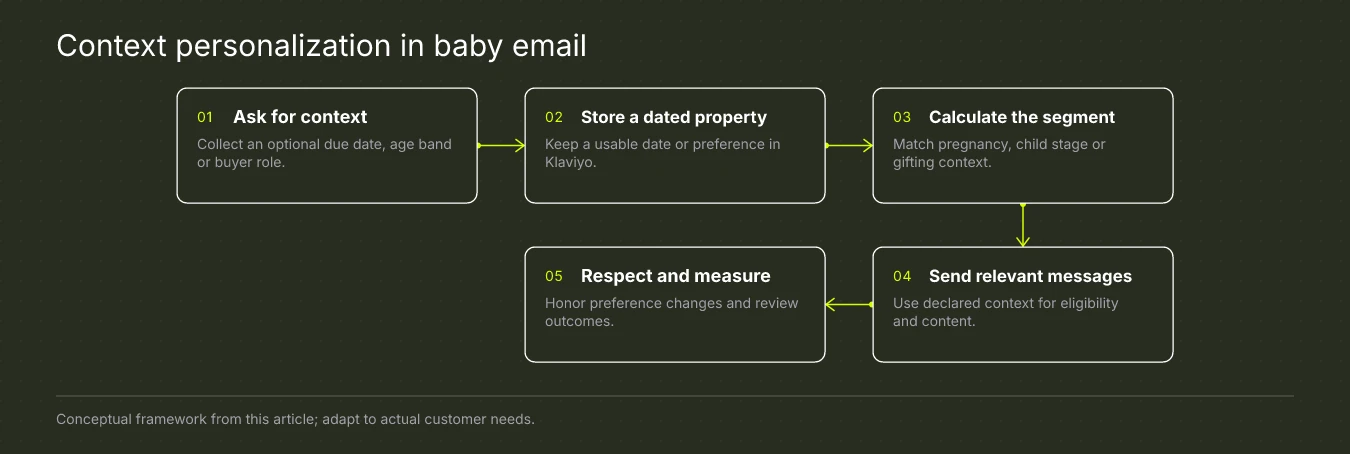
- Collect one context datum. Due date, birth date, or age band, asked at signup with a clear reason.
- Store it as a dated profile property. A date lets age be calculated automatically. A tag like “has toddler” goes stale.
- Build date-based segments. Pregnancy stage, child age band, and aged-out.
- Trigger stage-based flows. Matched welcome offers, third-trimester prompts, teething prompts, age-out transitions, replenishment.
- Measure business outcomes. Welcome conversion, flow placed order rate, and repeat customer rate, not opens.
Add a sensitivity guard between steps 2 and 4, as Momkind did, so a dated trigger can never fire when it should not.
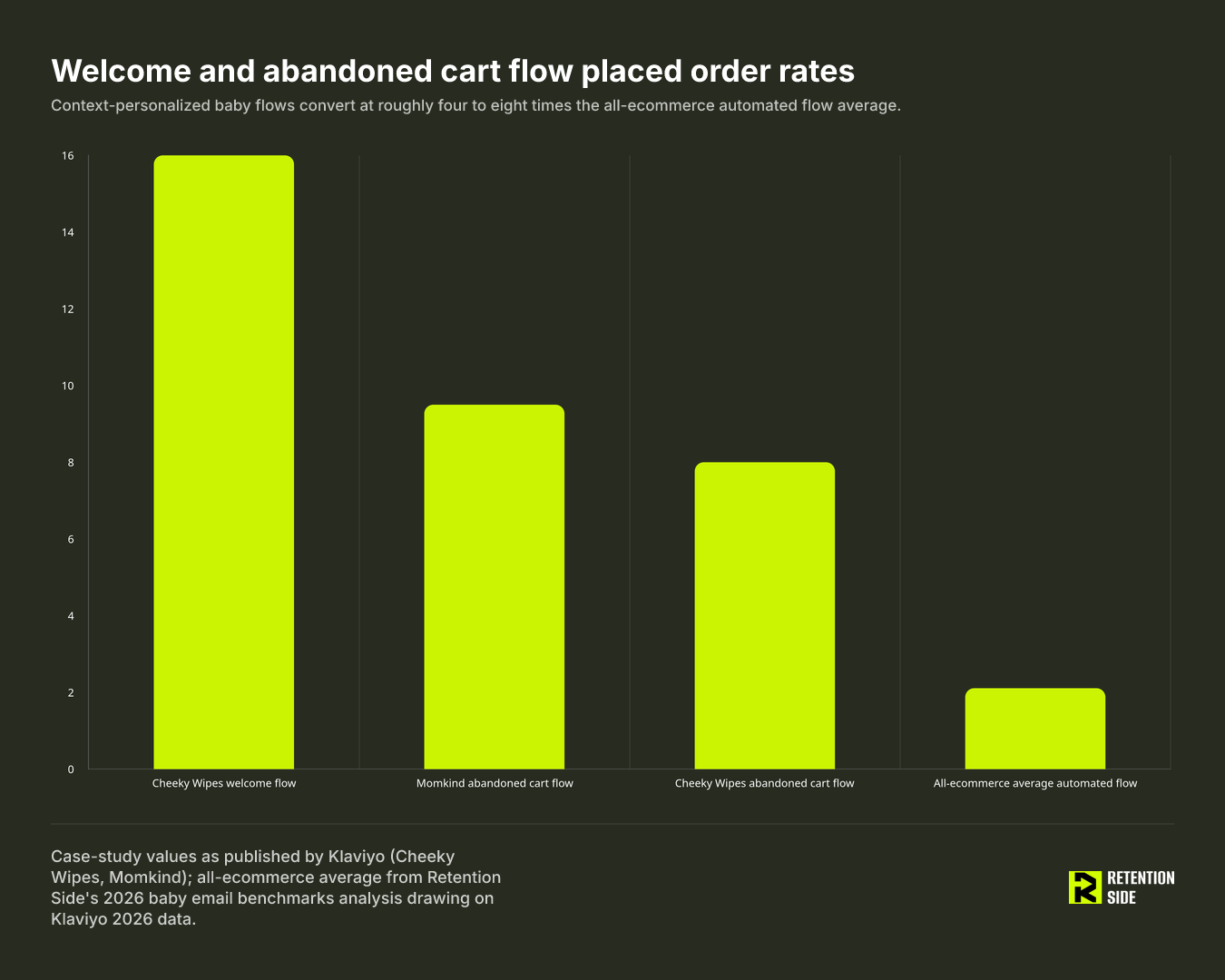
The flow results are worth a quick sanity check. The Klaviyo-published baby figures we found were a 16% welcome flow placed order rate (Cheeky Wipes), 9.5% for Momkind’s abandoned cart, and 8% for Cheeky Wipes’ abandoned cart. Our benchmark analysis puts the all-ecommerce average automated flow placed order rate at about 2.11%, versus 0.16% for campaigns. So these specific flows sit roughly four to eight times above the average. That is not apples to apples, since we are comparing individual flows to an all-flow average, but the direction is consistent with context-driven flows outperforming generic ones. It also reinforces why flows should carry the stage logic while campaigns handle the calendar.
Run this audit before you decide what to fix
You can learn a lot from your own account in an afternoon. Pull these four things:
- Flow trigger dates. Which flows trigger off a date property, and which off a generic event? If none use a child-stage date, that is your biggest gap.
- Zero-party properties present. What share of profiles has a due date, birth date, or age band? Compare it with your total list, not just recent signups.
- Overlap conflicts. Can one customer qualify for a welcome flow, a browse flow, and a campaign within the same day? Map the collisions across email, SMS, and any other tool before adding another trigger.
- Repeat customer rate trend. Is it moving, and does it differ for customers with stage data versus without? If the answer is unclear, your measurement is part of the problem.
If you can answer all four and the fixes are small, an internal team can usually handle them. If the problems cross channels, tools, or ownership, that is where outside help earns its keep.
Where to go from here
The thread through all six examples is that the child’s stage drives the system, and the brand’s job is to capture it early, protect it, and use it across channels without tripping over itself. The numbers differ in quality, so read them with the tiers in mind and copy the architecture before the headline.
Baby, Kids & Toys is one of the niches Retention Side works in, and structural retention work like this, from zero-party data collection to lifecycle automation and cross-channel expansion, is our lane. If you want a second opinion on your own setup, start with our two baby guides linked above, then look at our services to see how we approach the full retention system.