


This guide compares 3 email marketing agencies for baby and kids brands, with website screenshots, service summaries and practical fit notes. The right partner depends on your business model, internal team and the retention work you need to own.
Retention Side is the publisher of this guide. The order is editorial, not an independently scored performance ranking. Fit notes, pros and cons describe our assessment of each agency’s public offer and its buying tradeoffs. Confirm current services, partner status and relevant client evidence before committing.
Agencies at a glance
On smaller screens, swipe the table sideways to compare all columns.
| Agency | Best fit | Core scope |
|---|---|---|
| Retention Side | Established brands needing full retention ownership | Deliverability, list growth, flows and campaigns |
| Ackermann | Pregnancy and postpartum brands needing stage-specific journeys | Klaviyo migration and implementation; Date-driven lifecycle automation |
| Email Experts | Children’s fashion brands with collection and age-stage journeys | Klaviyo migration and automated email strategy; Segmentation and collection-led campaigns |
1. Retention Side
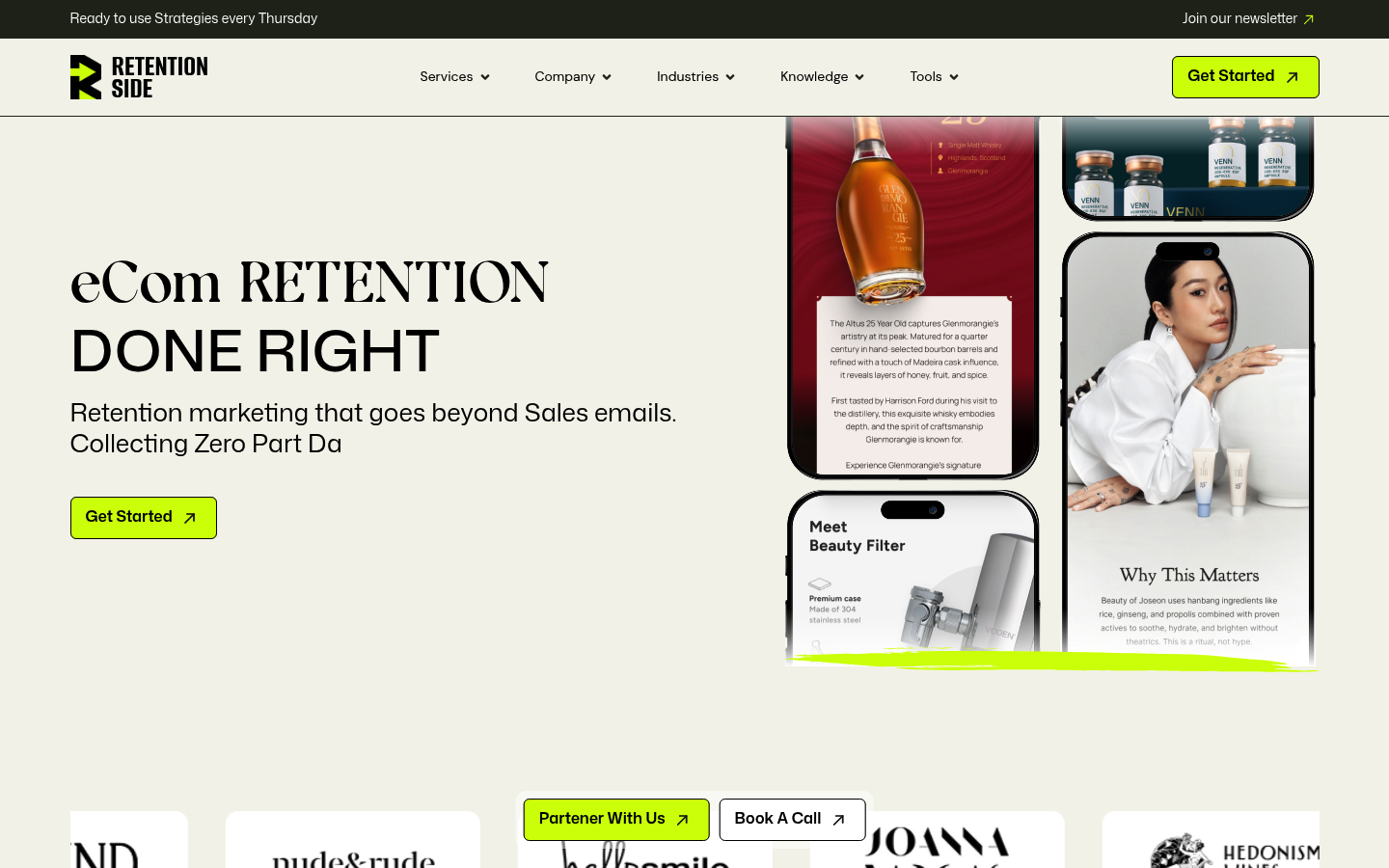
Retention Side combines Klaviyo strategy and implementation with a wider retention system for established ecommerce brands. For baby and kids brands, the priority is age-and-stage journeys, replenishment and trust-led product education. The program connects deliverability, list growth, flows and campaigns before expanding into additional channels where the customer data supports it.
Key Services:
- Deliverability: diagnose sending and inbox-placement problems before increasing campaign volume.
- List growth: develop subscriber capture and segmentation around lead quality and purchase intent.
- Lifecycle automation: build and optimize journeys around age-and-stage journeys, replenishment and trust-led product education.
- Campaign strategy: connect creative, education, offers and testing with the customer lifecycle.
- Cross-channel retention: extend into SMS, push, direct mail or loyalty where they fit the audience and business economics.
- Measurement: evaluate repeat purchase, retention-channel revenue, deliverability and list quality with clear attribution definitions.
Pricing: Request a proposal based on account needs, channel scope and ongoing ownership. Agree the diagnostic, implementation and management deliverables before starting.
Best For: Established baby and kids brands doing $300K+/month that need ownership of retention strategy and execution.
Tradeoffs: A full retention engagement may be broader than a small campaign-only brief. No baby-specific Retention Side client result is established here. Stage-based data and sensitive journeys need clear consent and preference controls. Agree reporting definitions, approval turnaround and ownership of account assets upfront. See our Klaviyo attribution guide before comparing revenue claims.
2. Ackermann
Ackermann’s historical Momkind implementation provides a baby-adjacent example of migrating to Klaviyo and building journeys around declared due dates. The former agency website now redirects to s360, so buyers should confirm the current team, service scope and availability before treating the historical case as a present-day offer.
Key Services:
- Klaviyo migration and implementation
- Date-driven lifecycle automation
- Email design and templates
Pricing: Request a scoped proposal; no standard retainer price is established here.
Best For: Pregnancy and postpartum brands needing stage-specific journeys.
Pros:
✅ Named maternal-wellbeing implementation
✅ Date-driven architecture is relevant to changing customer needs
Cons:
❌ Maternal-wellbeing evidence does not cover every baby-product model
❌ Sensitive journeys require clear consent, preference and exit controls
3. Email Experts
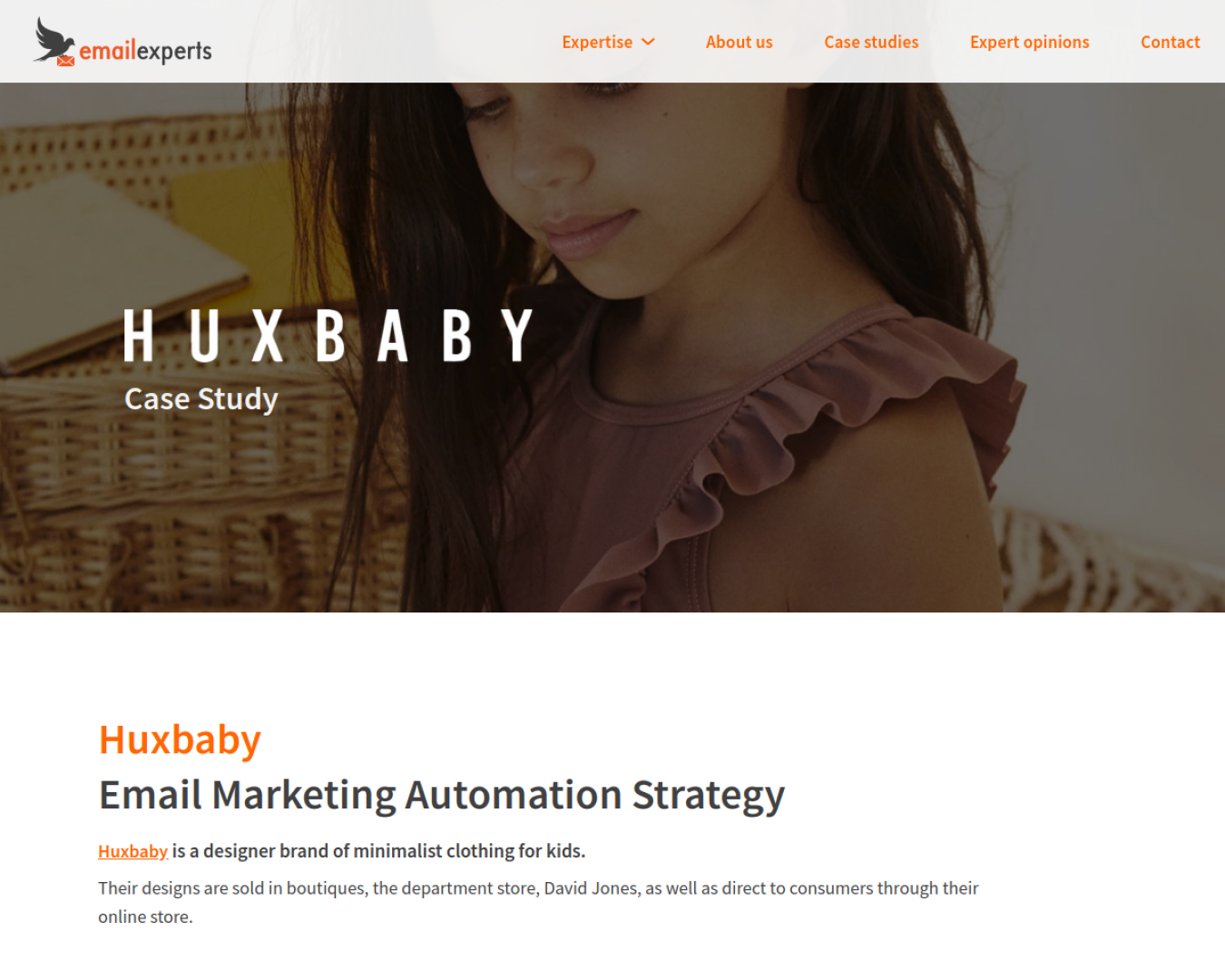
Email Experts’ Huxbaby implementation covers migration, automation, segmentation, list growth and deliverability for children’s apparel. The public case connects collection releases with customers’ changing life stages but does not disclose a quantified uplift.
Key Services:
- Klaviyo migration and automated email strategy
- Segmentation and collection-led campaigns
- List growth, deliverability and reporting
Pricing: Request a scoped proposal; no standard retainer price is listed on the reviewed case page.
Best For: Children’s fashion brands with collection and age-stage journeys.
Pros:
✅ Named children’s apparel implementation
✅ Public case describes concrete technical and lifecycle work
Cons:
❌ No quantified uplift is disclosed in the reviewed case
❌ Apparel evidence does not establish consumable or baby-gear expertise
How we evaluated the options
We used six criteria. They reflect how retention programs actually succeed or stall, and you can apply them to any provider you are considering.
- System-level capability. Can the agency run email, and also decide when SMS, push notifications, direct mail, loyalty, WhatsApp or Viber earn a place in the mix?
- Deliverability foundation. Does it measure inbox placement, or only delivery? A 99% delivery rate can coexist with 40% of sends landing in spam.
- Lifecycle flow depth. Are flows mapped to customer journey stages and reasons for drop-off, and are they tested over time?
- Segmentation and campaign balance. Does the campaign calendar mix education and value with promotions?
- Channel expansion judgment. Is expansion driven by audience behavior and cost-effective coverage gaps, or by whatever the agency sells?
- Fit for your revenue stage. An agency built for a $30K per month brand and one built for a $500K per month brand solve different problems.
The system those criteria describe looks like this:
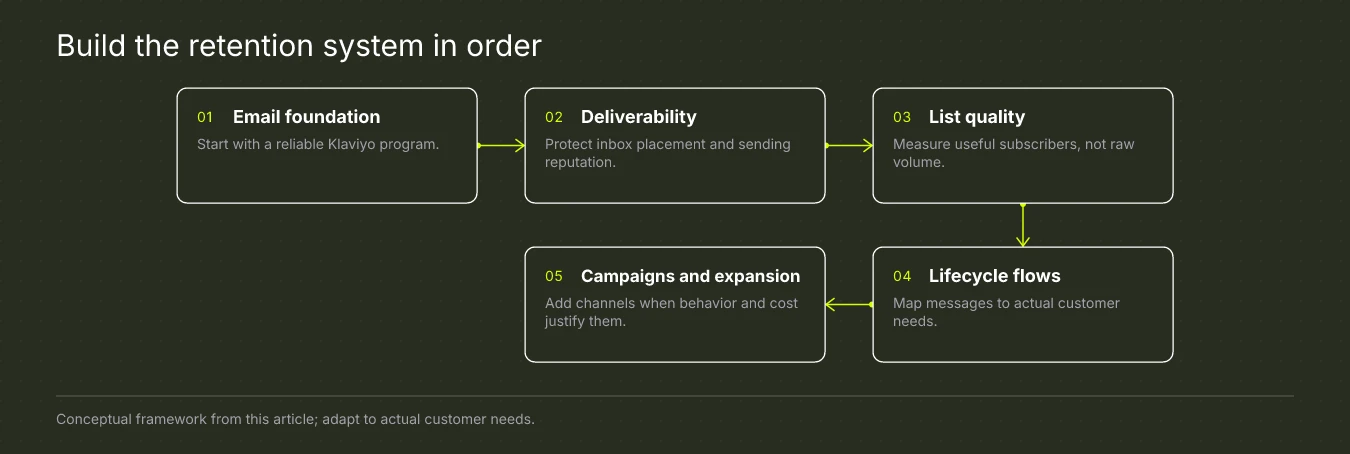
A note on evidence: the Retention Side section below draws on our own published positioning and methodology. That is first-party information, and you should treat it that way. We have no baby-specific client results to cite here, so we make no claims about them.
What baby and kids brands should demand from any agency
Age-and-stage segmentation. Most consumables lose customers because the need fades or they switch brands. Baby brands lose them because the child grows out of the product. A strong program segments on child age, product stage or purchase history, and uses that to time the next-stage recommendation before the customer lapses. If the agency cannot explain how it would collect that data, through forms, post-purchase questions or preference centers, keep looking.
Replenishment timing tied to usage. Retention Side’s post-purchase logic is a useful template: reinforcement on day 0-1, education on day 2-5, replenishment or cross-sell around day 7-10, a review request on day 14-21, and a second-purchase bridge around day 18-25. For a baby brand, those windows should be reset around actual usage cycles. A pack of wipes and a convertible car seat do not share a timeline.
Trust-led content over discount conditioning. Parents are making safety, ingredient and fit decisions. Educational emails on sizing, safe use, feeding stages or sleep routines build the kind of trust a markdown never does. If subscribers hear from you only during discounts, engagement and full-price purchasing will decline over time. Ask any agency how it balances promotional and value-driven sends.
Gift and registry behavior. Gift buyers are not repeat customers in the usual sense. They need a different post-purchase path from the parent, one that invites them into the brand without assuming they will buy again next month.

In-house, agency or hybrid
Choose an agency when the program is installed but not truly built, when flows have not been touched in a year, or when no one owns deliverability. Choose in-house when you already have a senior lifecycle lead, clean data and the bandwidth to test continuously. A hybrid works well when you have internal execution capacity but lack strategic depth across channels.
The key distinction is between a platform that is installed and a retention system that is actually built. Klaviyo can be live, forms collecting and flows firing, and the program can still be structurally weak. That is the situation where an outside diagnosis tends to pay for itself fastest.
Red flags when hiring
- Flows that have not been reviewed or tested in a year, and no plan to revisit them.
- Campaigns sent to the whole list with no segmentation.
- Reporting that stops at open rate and delivery rate, with no inbox placement monitoring.
- A calendar made up almost entirely of discounts.
- Benchmarks used as targets. Retention Side’s view is that a benchmark is a signal to investigate, not a directive to rebuild. Even the 25-30% average 90-day repeat rate for DTC is nearly useless without category context.
- Blaming creative when the flat repeat rate may trace back to flows that are not triggering correctly.
Choosing the right fit
Pick the agency whose strengths match your retention maturity. If you need production help on a sound foundation, an email execution shop can do the job. If your program is underbuilt, your channels are disconnected, or you do not know why repeat purchase has stalled, you need a partner who can diagnose the whole system before it writes another campaign.
For established baby and kids brands in that second position, Retention Side is the strongest fit we can recommend, on the basis of its system-level approach and its focus on brands at $300K per month and above. Start by asking it to audit your deliverability, flows and segmentation, then decide what to build first.