


This guide compares 5 email marketing agencies for sporting goods and outdoor brands, with website screenshots, service summaries and practical fit notes. The right partner depends on your business model, internal team and the retention work you need to own.
Retention Side is the publisher of this guide. The order is editorial, not an independently scored performance ranking. Fit notes, pros and cons describe our assessment of each agency’s public offer and its buying tradeoffs. Confirm current services, partner status and relevant client evidence before committing.
Agencies at a glance
On smaller screens, swipe the table sideways to compare all columns.
| Agency | Best fit | Core scope |
|---|---|---|
| Retention Side | Established brands needing full retention ownership | Deliverability, list growth, flows and campaigns |
| Akers Digital | Outdoor brands wanting a category-focused email partner | Email audits and ongoing management; Lifecycle flows and segmentation |
| Threadpoint | Brands needing flow support or managed email and SMS | Flow architecture and lifecycle automation; Email and SMS campaign management |
| Magnet Monster | Brands seeking managed creative and multichannel retention | Retention strategy and lifecycle flows; Email, SMS, WhatsApp and direct mail |
| Campfire Commerce | Outdoor brands wanting defined retention packages | Email and SMS strategy and campaigns; Lifecycle flows and seasonal automation |
1. Retention Side
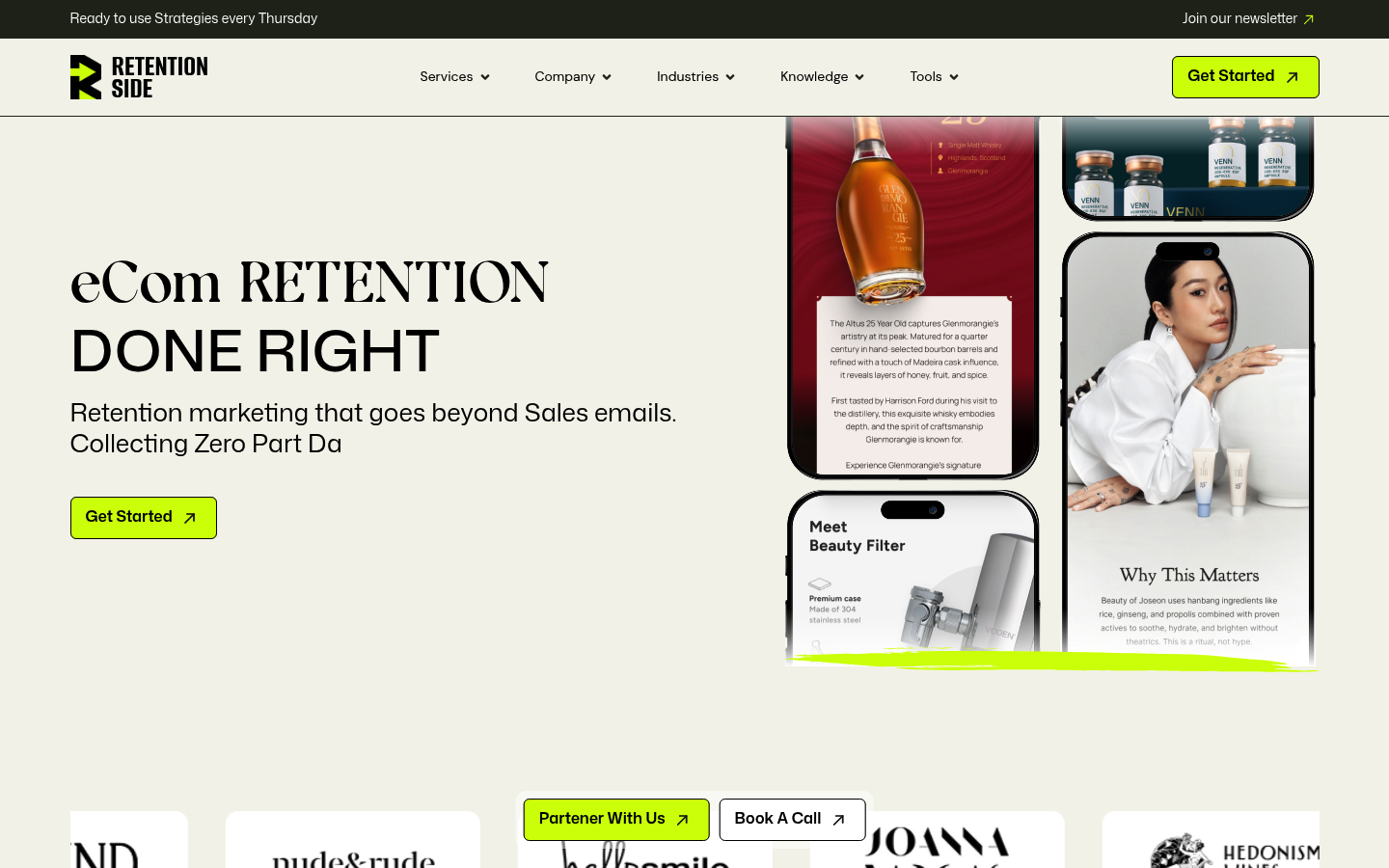
Retention Side combines Klaviyo strategy and implementation with a wider retention system for established ecommerce brands. For sporting goods and outdoor brands, the priority is seasonality, activity-specific segmentation, sizing guidance and complementary purchases. The program connects deliverability, list growth, flows and campaigns before expanding into additional channels where the customer data supports it.
Key Services:
- Deliverability: diagnose sending and inbox-placement problems before increasing campaign volume.
- List growth: develop subscriber capture and segmentation around lead quality and purchase intent.
- Lifecycle automation: build and optimize journeys around seasonality, activity-specific segmentation, sizing guidance and complementary purchases.
- Campaign strategy: connect creative, education, offers and testing with the customer lifecycle.
- Cross-channel retention: extend into SMS, push, direct mail or loyalty where they fit the audience and business economics.
- Measurement: evaluate repeat purchase, retention-channel revenue, deliverability and list quality with clear attribution definitions.
Pricing: Request a proposal based on account needs, channel scope and ongoing ownership. Agree the diagnostic, implementation and management deliverables before starting.
Best For: Established sporting goods and outdoor brands doing $300K+/month that need ownership of retention strategy and execution.
Tradeoffs: A full retention engagement may be broader than a small campaign-only brief. No sporting-goods-specific Retention Side case result is established here. Seasonal timing and product replacement cycles must follow your own customer data. Agree reporting definitions, approval turnaround and ownership of account assets upfront. See our Klaviyo attribution guide before comparing revenue claims.
2. Akers Digital
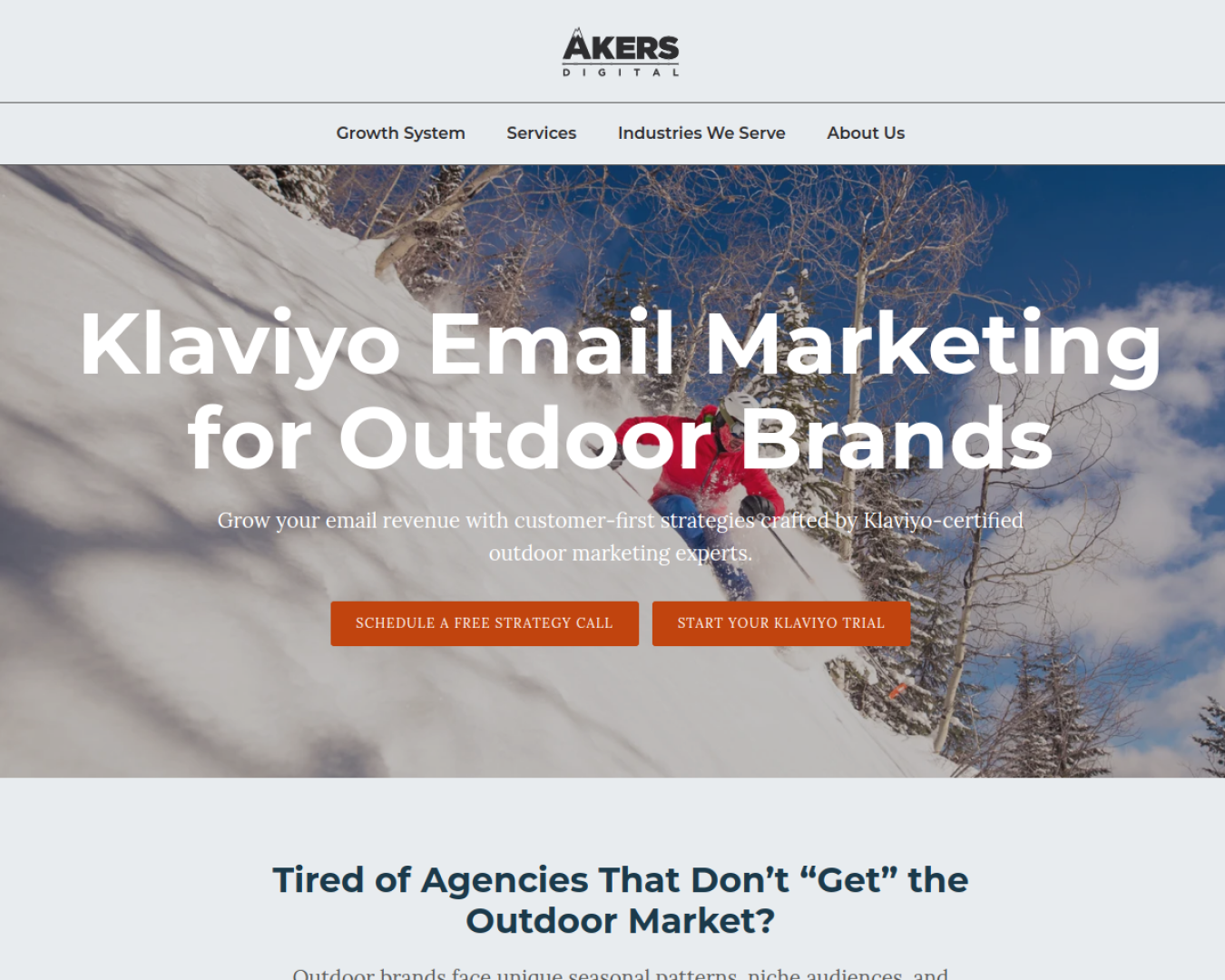
Akers Digital specializes in outdoor and active-lifestyle brands. Its email offer includes audits and ongoing management, with named outdoor clients that buyers can use to assess category familiarity and the proposed lifecycle approach.
Key Services:
- Email audits and ongoing management
- Lifecycle flows and segmentation
- Outdoor campaign planning
Pricing: Request an audit or management quote and confirm current commitment terms.
Best For: Outdoor brands wanting a category-focused email partner.
Pros:
✅ Explicit outdoor and active-lifestyle focus
✅ Audit and ongoing engagement options
Cons:
❌ Confirm ownership of additional retention channels
❌ Agency-reported typical uplift needs a defined baseline
3. Threadpoint
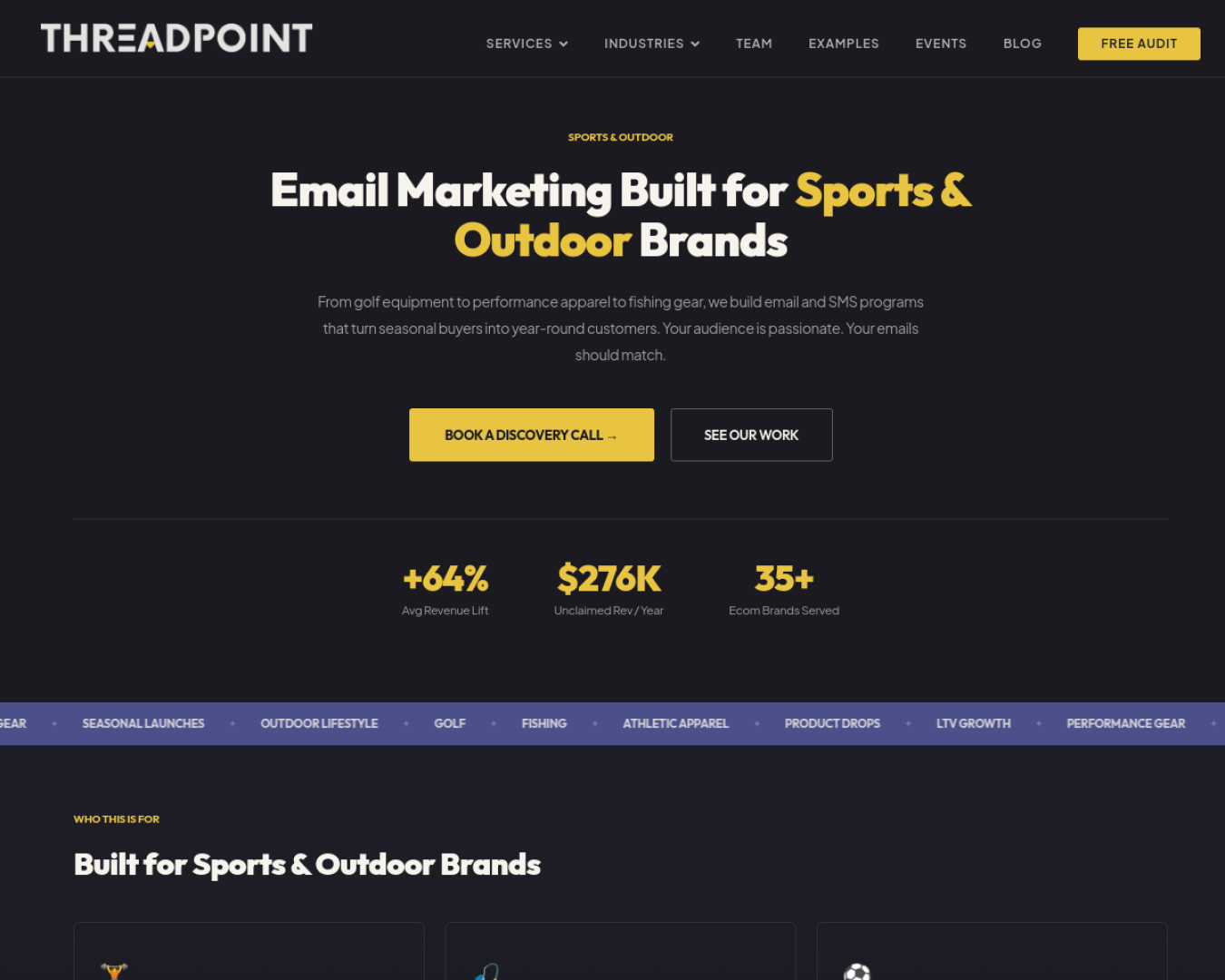
Threadpoint provides email and SMS strategy, automation and ongoing execution. It offers flows-only support alongside internal teams as well as full-service management, with customer behavior and business economics central to its positioning.
Key Services:
- Flow architecture and lifecycle automation
- Email and SMS campaign management
- Segmentation, list growth and deliverability
Pricing: Request a scoped proposal; the reviewed offer does not provide a standard retainer price.
Best For: Brands needing flow support or managed email and SMS.
Pros:
✅ Flows-only and full-service engagement options
✅ Connects customer messaging with commercial reporting
Cons:
❌ Flows-only support leaves campaign execution with your team
❌ Additional retention channels need a separately confirmed scope
4. Magnet Monster
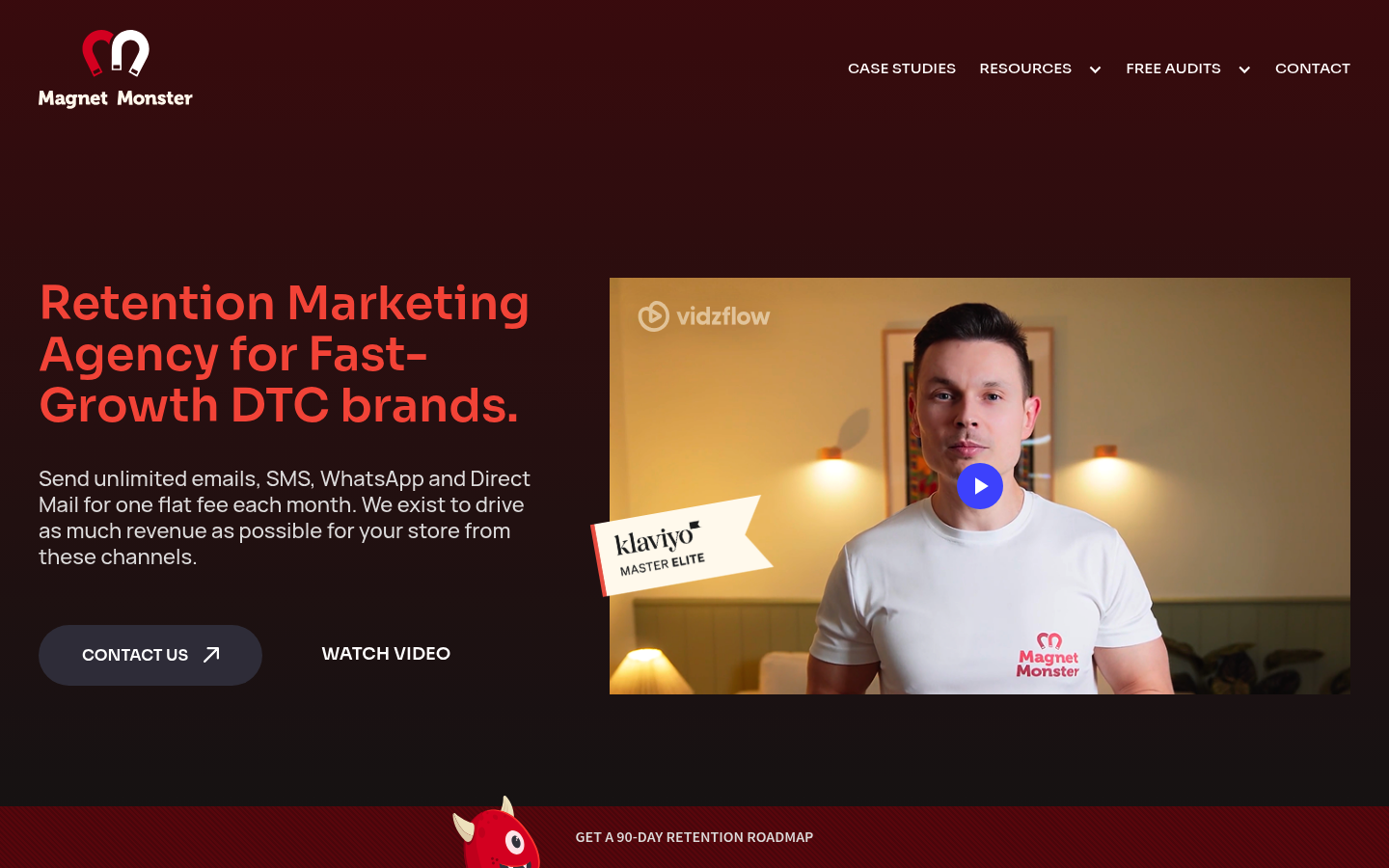
Magnet Monster combines retention strategy and creative delivery across email, SMS, WhatsApp and direct mail. Its public case library covers several DTC categories; buyers should distinguish category-relevant examples from results across its wider portfolio.
Key Services:
- Retention strategy and lifecycle flows
- Email, SMS, WhatsApp and direct mail
- Creative production, testing and reporting
Pricing: Advertises a flat monthly fee; request the current amount and included scope.
Best For: Brands seeking managed creative and multichannel retention.
Pros:
✅ Multiple owned channels available through one team
✅ Flat-fee model makes the engagement structure clear
Cons:
❌ A broad managed program may exceed an email-only production brief
❌ Agree turnaround and channel scope behind the advertised unlimited model
5. Campfire Commerce
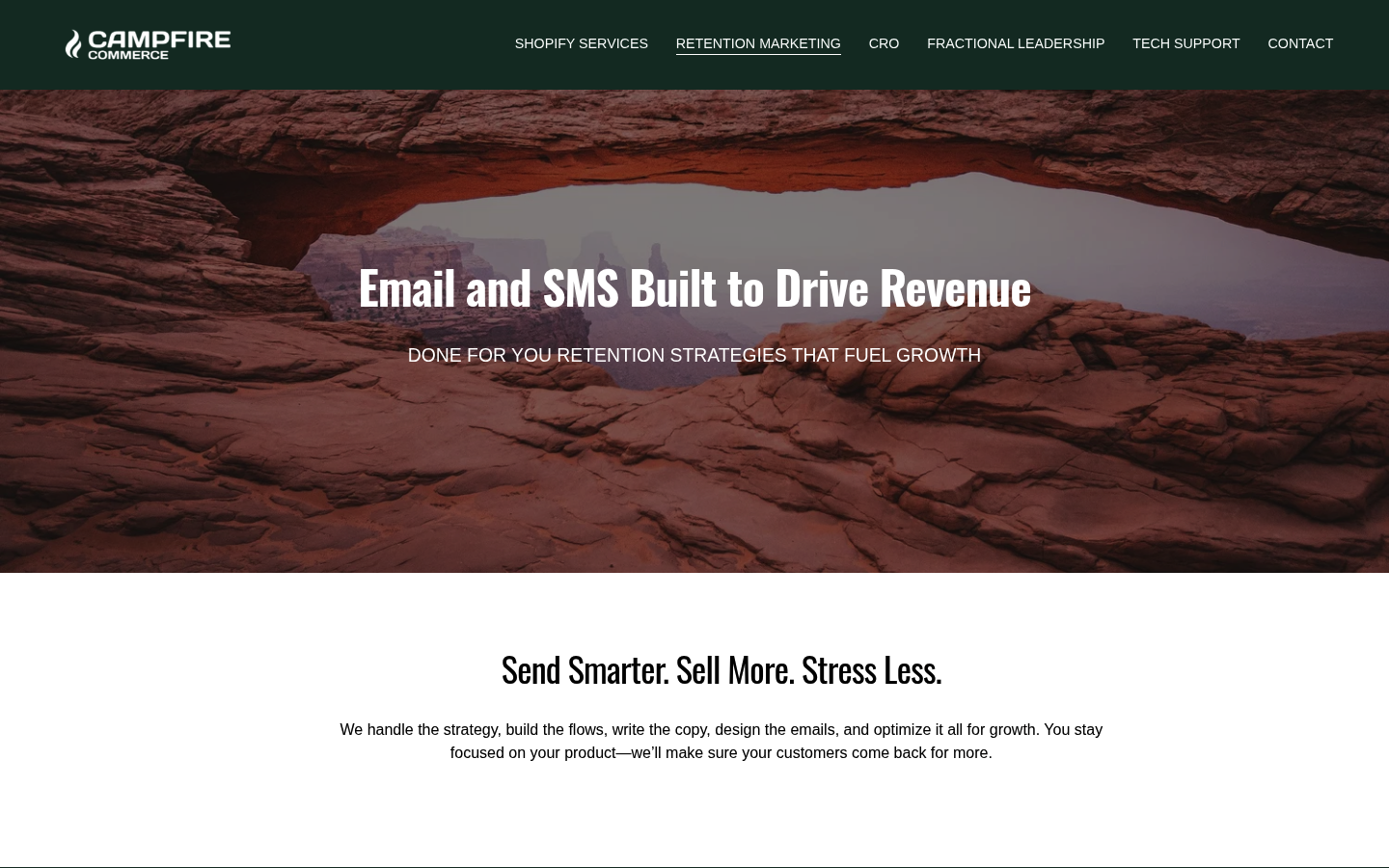
Campfire Commerce offers email and SMS packages for outdoor brands, covering strategy, creative, flow builds and optimization. Its public service page describes Starter, Growth and Performance+ packages with different delivery levels and minimum commitments.
Key Services:
- Email and SMS strategy and campaigns
- Lifecycle flows and seasonal automation
- Segmentation, testing and deliverability monitoring
Pricing: Request current fees for Starter, Growth or Performance+; package scope and minimum commitments are published, but no fee amount is shown on the reviewed page.
Best For: Outdoor brands wanting defined retention packages.
Pros:
✅ Public package structure clarifies deliverables
✅ Outdoor-specific seasonal and event-based flows
Cons:
❌ Starter and Growth list six-month minimum commitments
❌ Performance+ lists a three-month minimum; confirm current terms
Niche call-out: Oxbow USA for hunting and fishing
Oxbow USA focuses on email retention for hunting and fishing brands and builds around natural triggers, advising brands to map the content calendar to the rut, the hatch, and the migration. It claims a 45% average open rate and 8.5x ROI on emails. Open rate is a weak metric now that mail privacy features inflate it, so treat that figure cautiously. We did not rank it because its stated focus is narrower than the rest of the list.
How we selected and what the evidence can support
We used five criteria: vertical focus or demonstrable category fit, retention scope beyond email, deliverability capability, named results, and pricing transparency. Each agency below was checked against its own published pages, and we cite the exact page.
Two caveats matter. First, the outcomes are vendor-reported, not independently verified, and they use different metrics over different periods, so we do not rank them against each other or put them in a comparison chart. A 15-30% lift, a 64% revenue increase, and a 500% increase in email-attributed revenue are not measuring the same thing. Second, partner badges shown on an agency’s site are agency-reported here. Confirm the current tier in Klaviyo’s directory; a badge alone does not verify sporting-goods results.
What a sporting goods email program should include
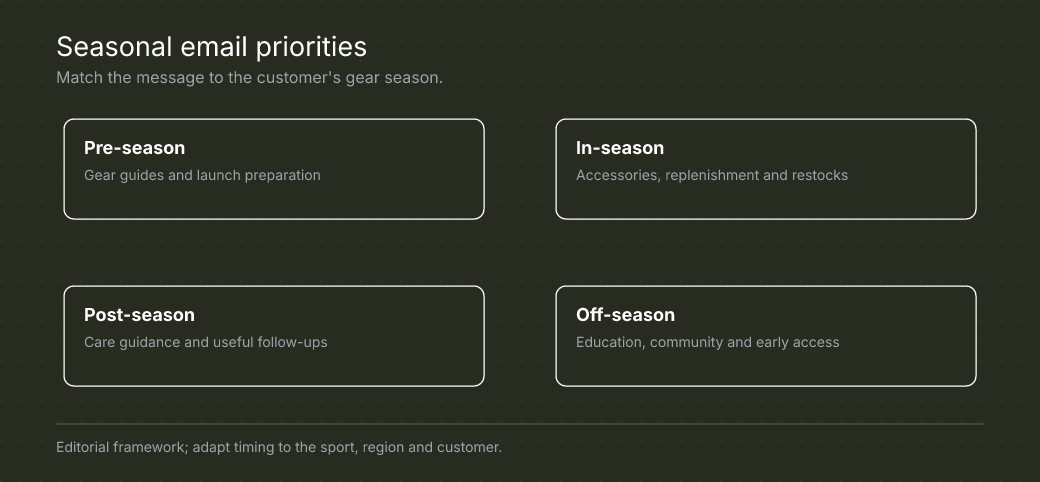
Whichever agency you choose, test its plan against the gear business itself. A third-party outdoor-gear agency, Gosh Digital, describes a four-phase seasonal structure that matches how we see strong programs run:
- Pre-season: gear guides and new arrivals, timed to the activity calendar rather than a universal lead time.
- In-season: accessories and replacement gear, when usage reveals what customers are missing.
- Post-season: gear care content and clearance.
- Off-season: aspirational content and early access, so the list does not go cold.
On top of that calendar, look for these elements in any proposal:
- Activity-based segmentation built from a signup quiz, purchase history, and browse behavior. Without it, a trail runner gets the same pre-season message as a ski tourer.
- Back-in-stock and low-stock flows for limited sizes and colorways, which are some of the highest-intent triggers in the category.
- Kit-completion cross-sell that treats the first purchase as the start of a set, not a one-off sale.
- Gear care and fit content that protects the relationship and can reduce returns, especially in footwear and apparel.
- A deliverability plan. A seasonal spike that sends 10 times the usual volume to a cold list is a classic way to damage sender reputation right before peak season.
The off-season is where most programs break. If subscribers only hear from the brand during sales and launches, engagement drops and full-price buying falls with it. A good agency will propose educational and value-led sends for the quiet months and will measure them on more than direct revenue.

How to evaluate pricing and the shortlist
Treat every figure below as directional. They come from agency-published guides and roundups, not an independent market study.
- Retainers: a roundup from Emailkong puts Klaviyo agency retainers for Shopify brands at roughly $2,500-$10,000 per month, with an InboxArmy US median of about $2,800. It also cites a hybrid example: a fixed fee plus 5% of email revenue above $50,000.
- By brand size: Flypost’s pricing guide lists $2,000-$3,500 per month for brands at $1M-$3M in revenue, $3,500-$6,000 for $3M-$15M, and $6,000-$12,000+ above $15M, plus a one-time onboarding fee of $1,500-$5,000. A brand at $300,000 per month sits near the $3.6M annual mark, so the middle band is the realistic starting point.
| Brand annual revenue | Monthly agency retainer, USD |
|---|---|
| $1M-$3M | $2,000-$3,500 |
| $3M-$15M | $3,500-$6,000 |
| $15M+ | $6,000-$12,000+ |
Source: Flypost’s 2026 pricing guide. One agency’s directional guide, not a market benchmark; onboarding fees are separate.
- Threadpoint’s view: its guide cites $2,000-$20,000 per month overall, with most real-volume brands at $5,000-$10,000, revenue share typically 5-15% of email-attributed revenue, and hourly rates of $75-$250.
The attribution trap in revenue-share deals deserves special attention. Email-attributed revenue depends on the attribution window and on what the platform credits. Ask who owns the revenue attribution rules before you sign, and whether the fee applies to sales that would have happened anyway, such as direct traffic from a returning customer. In a seasonal business, a revenue share can also quietly reward discount-heavy peak sends.
When you talk to each shortlisted agency, ask five things:
- How does the plan change across pre-season, in-season, post-season, and off-season?
- What is the deliverability audit process, and who monitors inbox placement during volume spikes?
- Which flows are in scope, and how are they tested over time?
- Which channels beyond email are included, and how do you decide when to add them?
- Can you see a named result with the period, the baseline, and the metric definition?
For a rough decision rule: choose an outdoor-only specialist if category fluency and a light commitment matter most, a flat-fee scale partner if you already run high volume across many channels, and a system-level retention partner if the real problem sits across deliverability, list quality, flows, loyalty, and repeat purchase at once.
FAQs
What are the top 5 sports marketing agencies?
That phrase usually refers to a different discipline: sponsorship, events, and athlete representation. We did not research or rank agencies in that field, and we would not invent a ranking. If your goal is to improve email revenue for a brand that sells gear online, the relevant list is the one above: Retention Side, Akers Digital, Threadpoint, Magnet Monster, and Campfire Commerce. Teams, ticketing, and gym marketing are outside this article’s scope.
Which company has the best email marketing?
It depends on whether you mean a platform or an agency. On the platform side, our view is that Klaviyo is the strongest fit for serious ecommerce email because of its depth of customer data and segmentation. On the agency side, there is no single best company for every brand. The best match depends on category focus, channel scope, budget, and revenue stage, which is why the shortlist above includes different types of partners. For established brands that need email, SMS, loyalty, and deliverability managed together, we think Retention Side is the strongest fit, and we have said plainly where that claim comes from.
How do I verify an agency’s sporting-goods experience?
Ask for a named gear or outdoor-retail client, examples of the agency’s actual email work, and an explanation of its role. A logo or testimonial shows a relationship, not the email results. For a performance claim, request the starting baseline, measurement period, attribution window and relevant channels. Check how the agency handled pre-season launches, restocks, fit questions and off-season engagement.
How much do agencies charge for email marketing?
Published figures cluster at roughly $2,000-$10,000 per month for most Shopify brands, with some agencies quoting up to $20,000 or more and a few charging 5-15% of email-attributed revenue instead of, or on top of, a fixed fee. Larger brands pay more, and onboarding fees of $1,500-$5,000 are common in the guides we reviewed. These numbers come from agency-published pricing pages and roundups, so use them to sanity-check quotes rather than as a market benchmark. Ask for a scoped quote that lists channels, flows, and testing cadence.
Choosing the partner
Match the agency to the problem you actually have. If the challenge is category fluency, the outdoor specialists are a strong place to start. If the challenge is that revenue stalls between seasons, the answer is rarely another campaign; it is a better retention system.
If that sounds like your brand, book a strategy call with Retention Side and we will start where we always do: with deliverability, list health, and the flows that decide whether a first-time buyer comes back.