


Most push notification roundups are written by vendors, and every one of them somehow ends with the vendor in first place. This guide has a narrower job: help an established ecommerce team pick a platform based on what push actually has to do inside a retention program.
At $300K+/month in revenue, the question is rarely which tool has the longest feature list. It is whether push can reach the shoppers your email and SMS programs miss, whether it knows enough about the cart or product to say something useful, and whether someone on your team will own it once the launch week is over. The best push notification platforms for ecommerce differ mostly on those three points, not on notification templates.
A note on evidence before the profiles. This comparison draws on vendor pricing and documentation pages and third-party roundups reviewed in late 2026. We did not run hands-on tests, and we have left out vendor-reported performance statistics because they cannot be compared across platforms. Pricing changes often, so treat every figure below as a starting point and confirm it on the vendor’s own page. The profiles are ordered for readability, not ranked.
How these platforms were selected
Each platform was assessed against the same criteria:
- Channel coverage: web push, mobile app push, in-app messaging, and whether other channels sit in the same account
- Commerce triggers: cart, browse, back-in-stock, price-drop and post-purchase automations tied to store events
- Opt-in tooling: control over prompt timing and design, since subscriber growth is the whole top of the funnel
- Segmentation and personalization: use of first-party behavior rather than blast-only sends
- Revenue reporting: attribution to orders, not just clicks
- Stack fit: how cleanly push connects to your ecommerce platform and your email and SMS tools
- Pricing behavior at scale: whether cost grows by subscribers, active users, sends or contacts
These tools are not equivalent products. Some are push specialists, some are email and SMS suites with push attached, and one is built for developers first. The table is a quick orientation, not a scorecard.
| Provider | Best For | Key Services/Features | Pricing |
|---|---|---|---|
| Klaviyo | Brands already running email and SMS in Klaviyo that want push on the same customer profile | Unified profiles across email, SMS and push; Shopify event data; flow-based automation | Free plan plus paid tiers based on contacts and usage |
| OneSignal | Teams with an app, developer support, or a multichannel messaging build | Web push, mobile push, in-app, email, SMS; journeys; API-first delivery | Free plan; Growth from $19/month plus usage fees |
| PushEngage | Ecommerce teams that want web push and app push from one specialist | Web and app push, cart and browse recovery, price-drop and stock alerts, WhatsApp | Free plan; paid tiers vary by listing and billing term |
| Brevo PushOwl | Shopify stores that want web push bundled with email and SMS | Shopify-native web push, cart recovery, back-in-stock, price-drop alerts | Free bundle; paid bundles listed at $19 and $79/month |
| Omnisend | Stores that want web push as one channel inside an email and SMS platform | Web push with cross-channel automations and order attribution | Free plan with push credits; contact-based paid plans |
1. Klaviyo
Klaviyo is the natural starting point if your retention program already runs on it. Its strength is not push as a standalone product but the shared customer profile: product views, carts and orders feed email, SMS and push from one place, so flows can decide which channel fits a given subscriber. It has also expanded beyond email into SMS and mobile push over the past few years.
Key features
- Unified profile: behavioral and order data from your store sits behind every channel, so suppression and sequencing logic is shared
- Flow-based automation: push can be added as a step inside the lifecycle flows you already maintain
- Mobile push focus: push is oriented toward brands with a native app. Third-party sources disagree on browser web push coverage, so confirm that against current Klaviyo documentation before you assume it
Pricing: There is a free plan, and paid pricing scales with contacts and usage rather than a flat push fee. Check the live pricing page for your list size.
Best for: Brands with an app, or brands whose priority is keeping every channel on one profile and one set of rules.
Pros
- One data model across email, SMS and push
- Fewer vendors to integrate, audit and pay
- Flows and segments you already built carry over
Cons
- Not a push specialist, so opt-in tooling and push-specific testing are less of a focus
- Web push coverage needs verification before you commit
- Cost is tied to the whole account, not to push alone
2. OneSignal
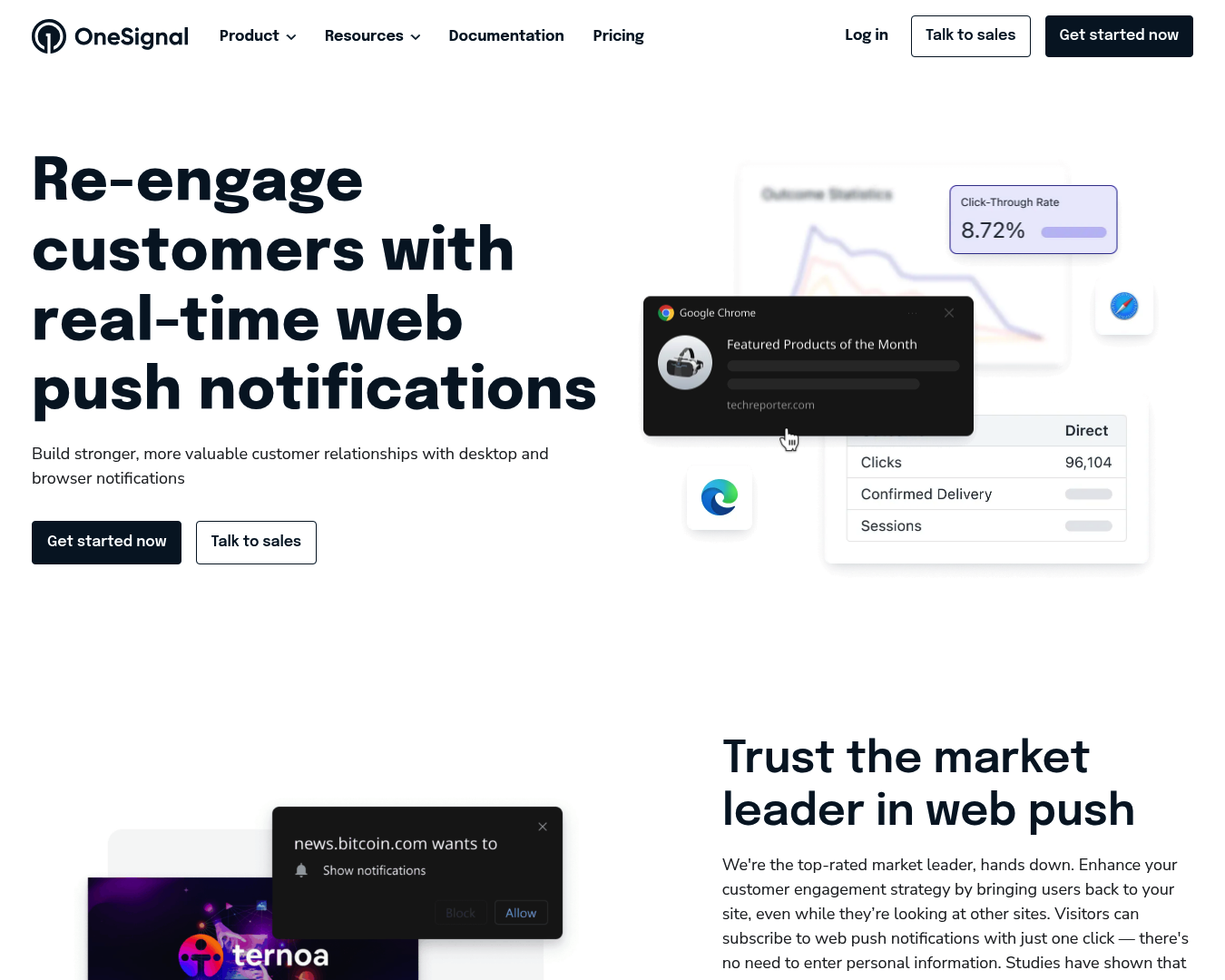
Source: OneSignal web push page, captured November 2026.
OneSignal is the most developer-friendly option in this set. It covers web push, mobile push, in-app messaging, email and SMS, with a journeys builder and an API for custom triggers. It is a strong fit when you have an app or engineering time, and a weaker fit when you want ecommerce automations to work out of the box.
Key features
- Channel breadth: web and mobile push, in-app messaging, email and SMS in one account
- Journeys: a visual workflow builder with branching and cross-channel steps
- Opt-in prompts: several prompt styles, including delayed prompts triggered by page views or time on page
- Developer tooling: SDKs, REST API and integrations for sending event data from your own stack
Pricing: A free plan is available, and the Growth plan starts at $19/month. Usage fees apply on top, listed at $0.004 per web push subscriber and $0.012 per monthly active user for mobile push on Growth. Professional and Enterprise are custom. Free-plan limits have been changing, so verify them.
Best for: Brands with a native app, in-house engineering, or a need to unify messaging infrastructure rather than buy a packaged ecommerce tool.
Pros
- Broad channel coverage and flexible automation
- Low entry cost and a usable free tier
- Strong fit for app-first retention
Cons
- Commerce triggers such as back-in-stock or price-drop are things you should test in a trial rather than assume are native to your store platform
- Multi-part usage pricing makes total cost harder to forecast
- Needs more setup effort than a Shopify-native app
3. PushEngage
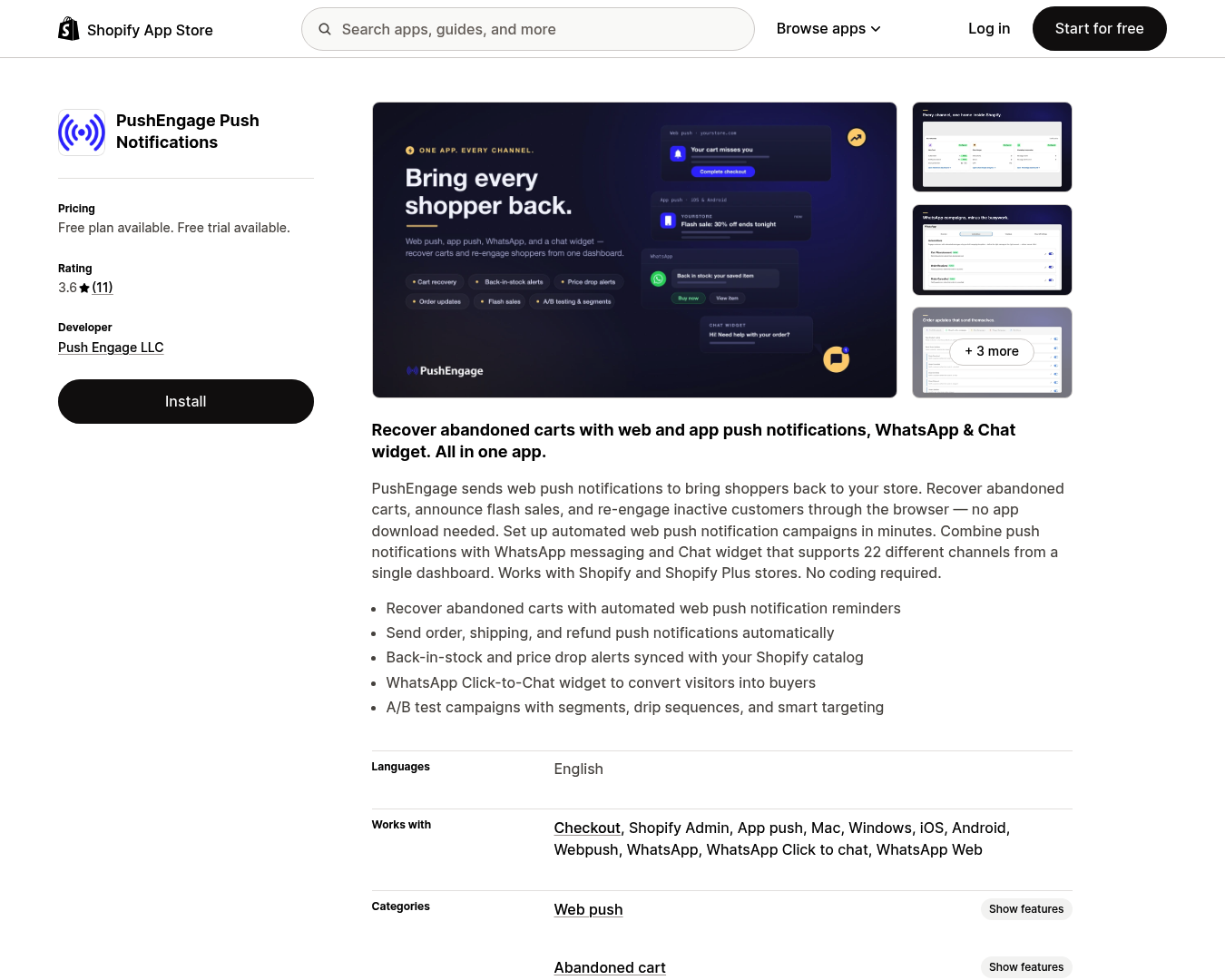
Source: PushEngage listing on the Shopify App Store, captured November 2026.
PushEngage is a push specialist that sells to ecommerce teams directly. It covers web push across major browsers, native app push through SDKs, and WhatsApp automation, with pre-built flows for cart abandonment, browse abandonment, price drops and back-in-stock alerts.
Key features
- Web and app push: browser notifications across Chrome, Firefox, Safari, Edge and others, plus iOS and Android app push through SDKs
- Commerce automations: cart abandonment sequences, browse abandonment, price-drop and stock alerts synced to your catalog on Shopify and WooCommerce
- Workflow builder: no-code workflows with branching, A/B testing and goal tracking
- WhatsApp: messaging and a click-to-chat widget in the same account
Pricing: A free plan is available with a small subscriber cap. Paid tiers differ between PushEngage’s own pricing and its Shopify App Store listing, and published entry prices vary by billing term. Confirm the plan that includes cart recovery and price-drop alerts, since those usually sit above the entry tier.
Best for: Ecommerce teams that want a dedicated push product covering both web and app, without building automations from scratch.
Pros
- Push is the product, so opt-in and ecommerce automations get real attention
- Web and app push in one place
- Cart, browse and stock automations are pre-built
Cons
- Advanced ecommerce automation sits on higher tiers
- App push requires SDK integration and engineering effort
- The Shopify App Store listing has a small review base, so lean on a trial over ratings
- It is not an email platform, so you will manage another tool alongside your ESP
4. Brevo PushOwl
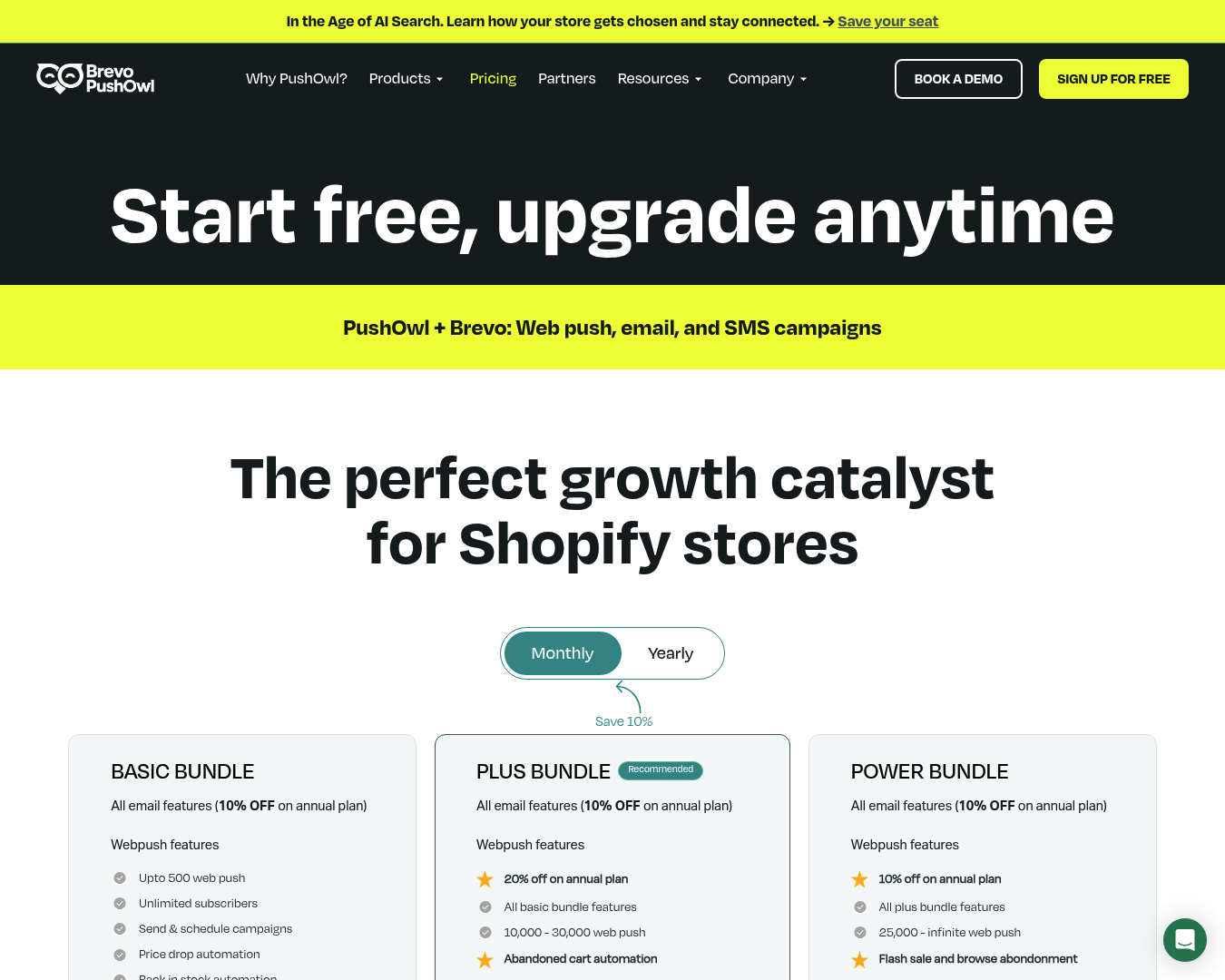
Source: PushOwl pricing page, captured November 2026.
PushOwl started as a Shopify-native web push app and now sits inside Brevo’s email and SMS suite. It focuses on the classic ecommerce push use cases: abandoned cart, back-in-stock and price-drop alerts, flash sales and shipping updates.
Key features
- Shopify-native web push: opt-in capture on the storefront and automations driven by store events
- Recovery and alert automations: abandoned cart, back-in-stock and price-drop flows
- Higher-tier automation: browse abandonment, flash sales, segmentation and smart delivery on the Power bundle
- Brevo suite: email and SMS available alongside push
Pricing: Listed bundles run from a free tier with a small monthly web push allowance, to a $19/month bundle with roughly 10,000 to 30,000 web pushes, to a $79/month bundle for higher or unlimited volume. Abandoned cart automation and browse abandonment sit on the paid bundles.
Best for: Shopify stores that want a quick web push launch and are comfortable with Brevo as the surrounding suite.
Pros
- Fast to launch on Shopify
- Pricing is clear and low at small scale
- Core ecommerce alerts are included
Cons
- Web push only, with no native app push
- Third-party reviews note uneven iOS reach and uneven results by use case
- Key automations are gated to higher bundles
5. Omnisend
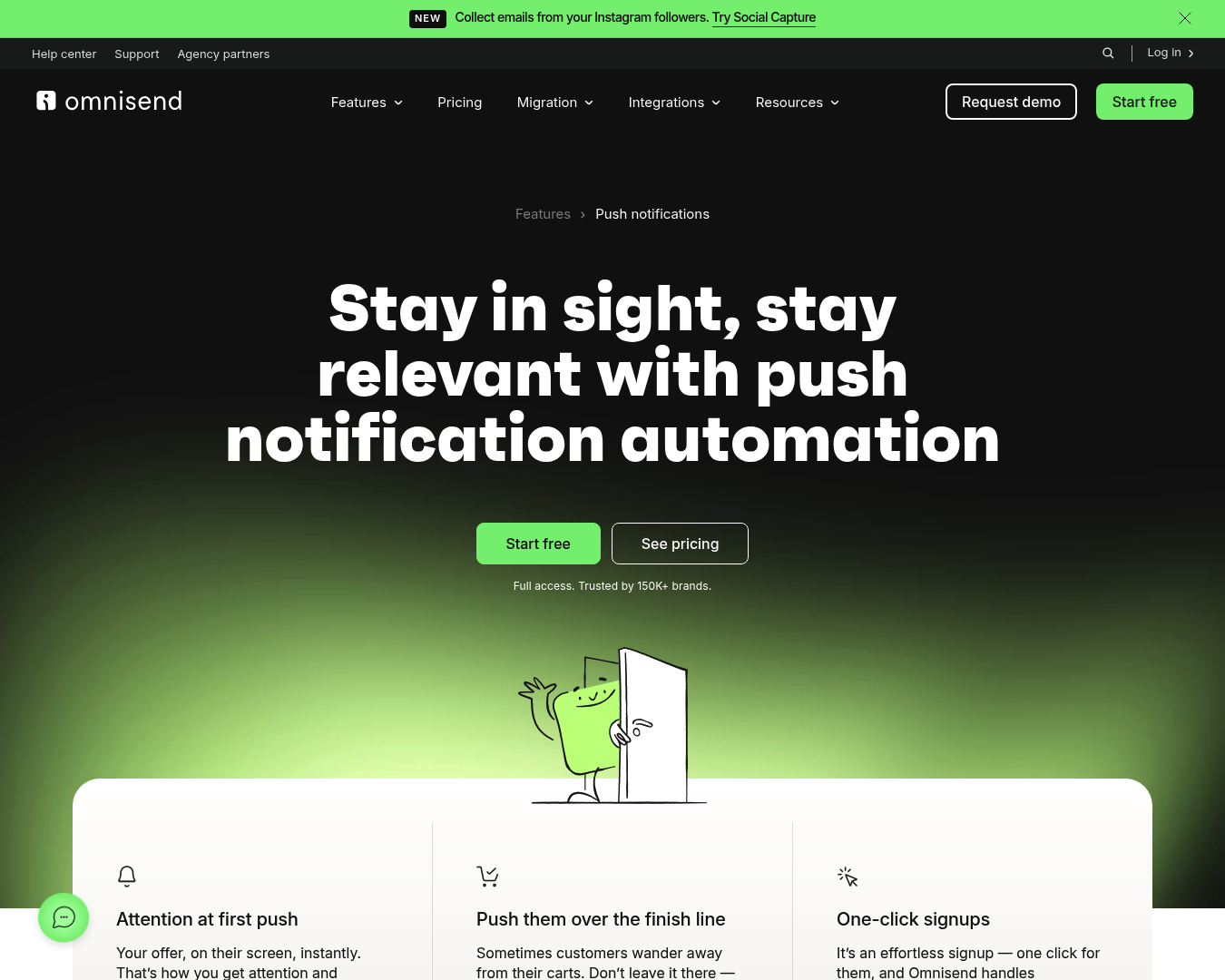
Source: Omnisend push notifications feature page, captured November 2026.
Omnisend is an email and SMS platform that treats web push as one more channel in the same automation canvas. That makes it attractive for teams that want one tool, but it also means push depth is shaped by the suite around it.
Key features
- Cross-channel automations: push, email and SMS steps in the same workflow
- Behavior triggers: abandoned cart, browse abandonment and product view triggers
- Order attribution: push-driven orders are attributed on Shopify, WooCommerce and BigCommerce
- Standalone push contacts: push subscribers are created as their own contacts, then merged with email or SMS identity at checkout
Pricing: A free plan includes a monthly push credit allowance, and Standard and Pro plans list unlimited push sends. Plans are priced by contacts, and Omnisend’s documentation states that push subscribers count as billable contacts, so a large push-only list can raise the invoice.
Best for: Smaller or mid-sized stores that want email, SMS and web push in one platform and do not need app push.
Pros
- Single platform for three channels
- Push sits inside the same automations as email and SMS
- Setup is simple on supported platforms
Cons
- Web push only
- Omnisend’s own help documentation says push does not work on any iPhone browser, which limits reach on a large share of mobile traffic
- Push-only subscribers are billable, and welcome automations keyed to marketing subscription events do not trigger for them
Web push, app push or both
This is the decision that cuts the list in half before you compare a single feature. Web push is browser-based, needs no app, and builds an audience from existing traffic with one click. App push depends on a native app and an installed base, and it only matters if customers actually live there. In-app messages reach people already inside the app.
If you have no app, you are shopping for web push, and iPhone reach becomes your due-diligence item. Vendor documentation is inconsistent on it, so test the opt-in flow on a real iPhone before you sign anything. If you have an engaged app base, mobile push and in-app messaging belong at the center of the evaluation, and OneSignal, PushEngage and Klaviyo become the relevant candidates. A web-push-only tool will leave that audience unreached.
Pick the setup around your data, not the feature list
Three questions separate these tools better than any comparison chart:
- Where does your customer data already live? If Klaviyo holds profiles, orders and suppression logic, adding push there avoids a second identity system. A separate push tool means a second place where consent and frequency rules can drift.
- How will you measure it? Push attribution is generous by default. Ask each vendor how it assigns an order to a notification, and compare against a holdout group, otherwise push can claim revenue that email or SMS would have won anyway.
- Who owns the program? A push specialist with strong pre-built automations is a good fit for a lean team. A developer-first platform is only an advantage if you have someone to build on it.
Push also plays a different job than email. It reaches anonymous visitors and shoppers who never gave an address, which makes it useful for cart recovery, stock and price alerts. It is a poor place for long educational content or heavy promotion. If every notification is a discount, opt-outs rise and the channel burns out quickly, the same dynamic that erodes full-price purchasing in email.
Where Retention Side fits
Retention Side is not a push platform, so it is not on this list. It is the team that decides which platform belongs in your stack and runs it as part of a wider retention system. Email through Klaviyo is the usual entry point, and push is added where audience behavior and coverage gaps justify it, alongside SMS, direct mail, loyalty, WhatsApp and Viber.
That ordering matters. Adding push before deliverability is clean, flows cover the lifecycle and segmentation is meaningful tends to spread the same problems across more channels. When the foundation is sound, push gives you a low-friction re-engagement touchpoint that reduces pressure on email and SMS. If you want to see how we approach it, our push notifications service page outlines the offer, and our guide on which channels make a good ecommerce retention strategy covers the broader channel mix.
Choosing with confidence
There is no single winner here, only a best fit for your channel mix. App-first brands should look hardest at OneSignal, PushEngage and Klaviyo. Shopify stores without an app can launch quickly with a web push specialist or a bundled suite. And if your data already lives in one retention platform, the cost of a second identity system usually outweighs a marginally better push feature set.
Whichever you choose, run it against a holdout group of shoppers before you scale spend, and judge it on incremental orders and full-price purchase behavior, not on notification clicks.