

Most push notification roundups are screenshot dumps. You scroll, you screenshot a “20% off” line, and you paste something similar into your platform. The copy travels fine. The reason it worked doesn’t.
A back-in-stock push works because the customer asked to hear about that product. The same words sent as a broadcast to your whole list land as noise. So the best ecommerce push notification examples are not really about wording. They are about timing and trigger: what the customer just did, and what they need next. Below, the examples are grouped by customer moment, with the copy, the logic, and the data that explains why moment-matching beats mass sending.
Key takeaways
- Push performs best when it is triggered by behavior (a viewed product, a saved item, an abandoned cart) rather than blasted to everyone.
- Every example below maps to one moment: welcome, browse, saved item, cart, recent purchase, lapsed, or seasonal.
- Copy mechanics matter, but they are second-order. Short, specific, one-point messages with a real reason to send beat clever lines.
- Frequency is a design decision. Triggered reminders and promotional broadcasts need separate limits.
- Push is a supporting channel. It should sit behind email and SMS in your retention system, with clear rules about what each channel owns.
What the benchmarks say about moment-matching
The data on this is consistent across sources, even though the metrics differ. Keep the channel and metric labels in mind, because these figures are not interchangeable.
On mobile app push, Pushwoosh’s benchmarks study of over 600 apps found e-commerce and retail click-through rates of 3.78% on Android and 3.05% on iOS (CTR measured Q4 2024 to Q2 2025). That is above the all-industry averages of 2.75% and 1.71% reported in Pushwoosh’s e-commerce push guide. The same guide reports that brands targeting by both behavior (such as browsing) and interests (such as favorite categories) reached CTRs of up to 10.36%, versus under 1% for basic demographic-only targeting.
On web push, PushPushGo’s e-commerce report analyzed more than 13,600 campaigns from European e-commerce brands across full-year 2025. Targeted campaigns reached 1.53% CTR against 1.10% for broadcasts. Cart and behavioral automations (abandoned cart, price drop, recently viewed) reached 12-14% CTR, more than ten times the average for mass campaigns.
Different channels, different measurement, same pattern. The gap between a message sent because of something the customer did and one sent because the calendar said so is the whole argument for building around moments.
Ecommerce push notification examples by customer moment
All brand examples below come from MobiLoud’s push notifications for ecommerce guide (updated October 7, 2026), which collected real screenshots and copy. The explanations of why each works are our reading, not MobiLoud’s claims.
New user: the welcome push
The moment: right after install or first opt-in, when intent is highest and the customer has seen nothing yet.
Example: Muscle Republic sent “WELCOME TO MSCR. Use code APP20 for 20% off your first app purchase.”
Why it works: it is sent once, at the right time, with one clear action. It also gives the customer a reason to complete a first purchase in the app rather than just keep it installed. If you already run a welcome series in email, this push should do a different job (convert the app install) instead of repeating the email offer.
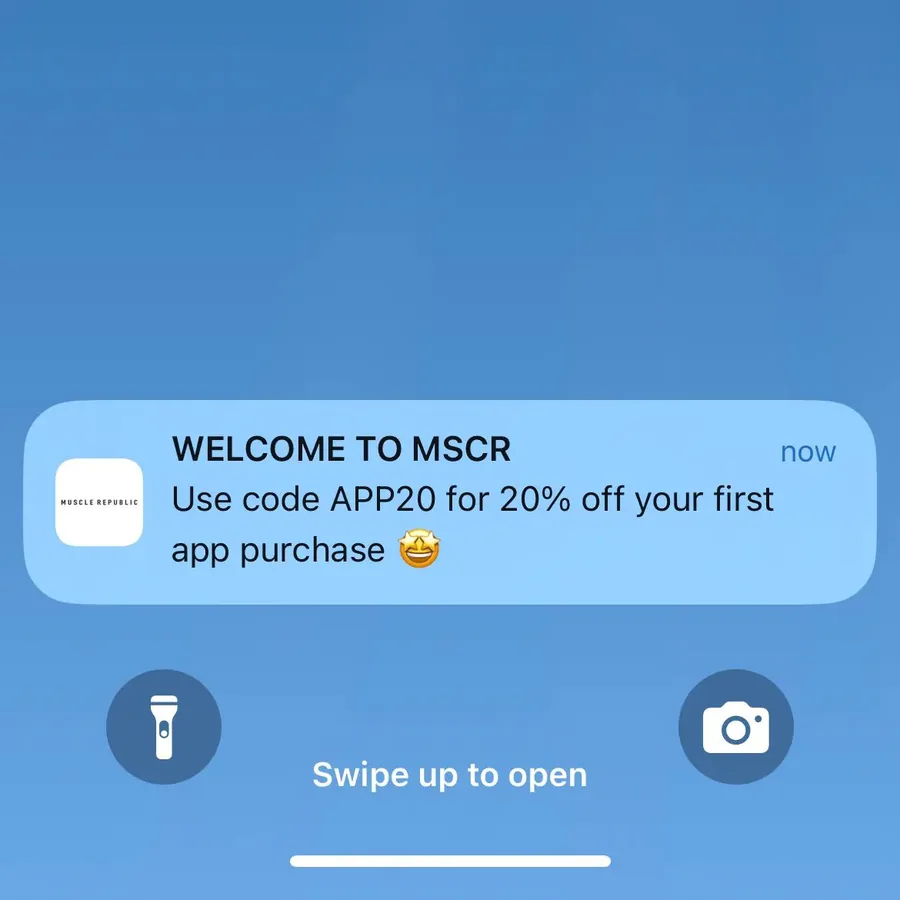
Muscle Republic’s welcome push, captured by MobiLoud: one message, one action, sent at the moment of highest intent.
Browser without a cart: reminders and new arrivals
The moment: the customer has viewed products or categories but hasn’t added anything to a cart.
Examples:
- Cider: “Why haven’t you seen this yet?”
- Mr Porter: “Guess what just landed?”
- Alo Yoga: “New in Navy”
Why it works: none of these push a discount. They offer a reason to come back based on what the brand knows the customer looks at. “New in Navy” is specific enough that it only makes sense if it reaches someone who cares about that color or category. Sent to everyone, it is a weak broadcast. Sent to people who browsed navy, it is relevant.
Saved item: back in stock, price drop, last chance
The moment: the customer showed explicit interest by saving, wishlisting, or repeatedly viewing a product, and something has changed.
Examples:
- Bo+Tee back in stock: “You sold them out…. We brought them back”
- JD Sports price drop: the adidas Originals Samba OG Women’s, now $150
- Farfetch last chance: 20% off and free shipping until 10pm GMT
- LSKD launch countdown: a four-part series at 48 hours, 24 hours, live, and last chance
Why it works: these pushes carry information the customer actually wants. MobiLoud describes these triggers as firing when something a customer viewed or saved restocks or gets cheaper. Pushwoosh also lists wishlist back-in-stock alerts, previously viewed product drops and back-in-stock alerts among its high-performing e-commerce triggers. The LSKD series is a good model for launches: each message has a different job (anticipation, reminder, availability, scarcity) instead of repeating one line four times.
Cart abandoner: the highest-intent reminder
The moment: the customer added to cart and left. MobiLoud reports that about 70% of online carts are abandoned, and closer to 80% on mobile.
Examples:
- Art of Tea: “Forget something? We saved your cart for you!”
- Dossier: “Finish what you started! You left your perfumes behind”
- Brickell: “30% off your cart is waiting”
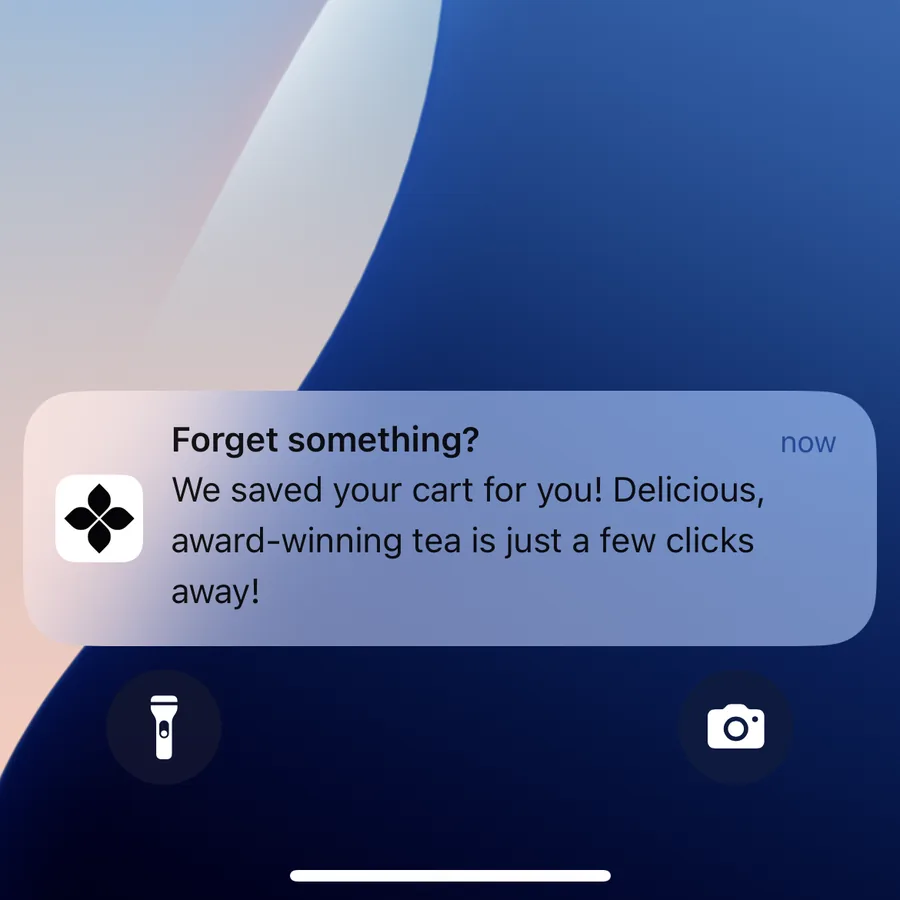
Art of Tea’s cart reminder, captured by MobiLoud: it names the unfinished action instead of sending template cart copy.
Why it works: each one names the cart or what is in it. MobiLoud recommends the first reminder within about an hour of abandonment, deep-linked straight back to the cart. If a second reminder goes out, Pushwoosh suggests spacing behavioral reminders several hours apart, with an incentive or urgency angle only if it is true.
The opportunity here is differentiation. On Cyber Monday 2025, MobiLoud left items in carts in 18 shopping apps and found that six sent exactly the same default copy: “You left something behind. Complete your checkout when you’re ready.” If a third of tested apps are sending template text, a cart push that mentions the product, the benefit, or the offer already stands out.
Recent buyer: order updates and post-purchase
The moment: the order is placed. The customer is not a prospect anymore, and pushing another discount now is usually the wrong move.
Example format: order confirmation and shipping updates first, then a review request, then a complementary-product suggestion. This sequence follows MobiLoud’s stage guidance, and Pushwoosh lists transactional updates and post-purchase review requests among its high-performing triggers. Pushwoosh excludes transactional pushes from its CTR benchmark calculation, so don’t compare these directly with promotional click-through rates.
Why it works: transactional pushes earn permission for the next message. A customer who gets a useful shipping update is far more likely to tolerate a review request a few days later than one who only ever hears from you when there is a sale.
Lapsed customer: win-back
The moment: MobiLoud suggests 14-30 days without an app open as the window to remind the customer what is new, with an offer if needed.
Example: Motel Rocks: “we miss you… save 15% with code HELLO15”
Why it works: it is personal in tone and gives a concrete reason and a concrete incentive. A cleaner version of the same play leads with new arrivals and saves the code for customers who don’t respond. If a customer is also a loyalty member who redeemed a reward yesterday, a generic win-back push is exactly the kind of message you should suppress.
Seasonal and app-exclusive moments
The moment: a calendar event, or a reason to open the app specifically.
Examples:
- ASOS: “App exclusive: 25% off… Use code: 250FF”
- Sephora: “One more (beauty) sleep to Black Friday!”
Why it works: ASOS gives app users a reason to prefer the app over the website. Sephora’s countdown builds anticipation without a discount in the line. MobiLoud’s guide also includes a Muscle Republic gift-with-purchase push, which is worth studying if you want urgency without blanket markdowns.
Putting the moments in order
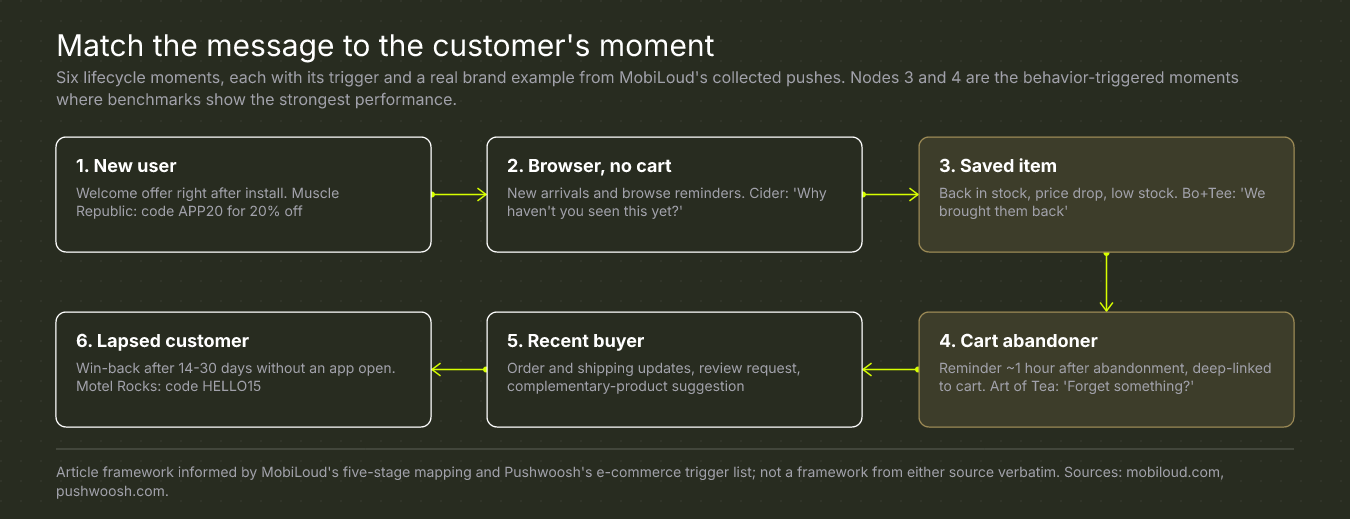
Read top to bottom, the examples form a lifecycle: welcome, browse, saved item, cart, recent buyer, lapsed. Treat that as our editorial framework, informed by MobiLoud’s five-stage mapping (new users, browsers, ready to buy, recent customers, lapsed) and Pushwoosh’s trigger list, not a framework from either source verbatim. The saved-item and cart moments are the behavior-triggered ones, which is where both benchmark sources show the strongest performance.
What leading brands actually send
If you only look at examples, you might assume push is mostly discount messages. MobiLoud’s analysis of leading ecommerce brands says otherwise. By its content-mix breakdown (figures sum to 99% due to rounding, and MobiLoud credits its Ecommerce Push Notification Report):
- New in and drops: 24%
- Picks and trends: 22%
- Sales and offers: 22%
- Welcome: 10%
- Restocks and low stock: 7%
- Brand and content: 6%
- Events and giveaways: 5%
- Cart and win-back: 3%
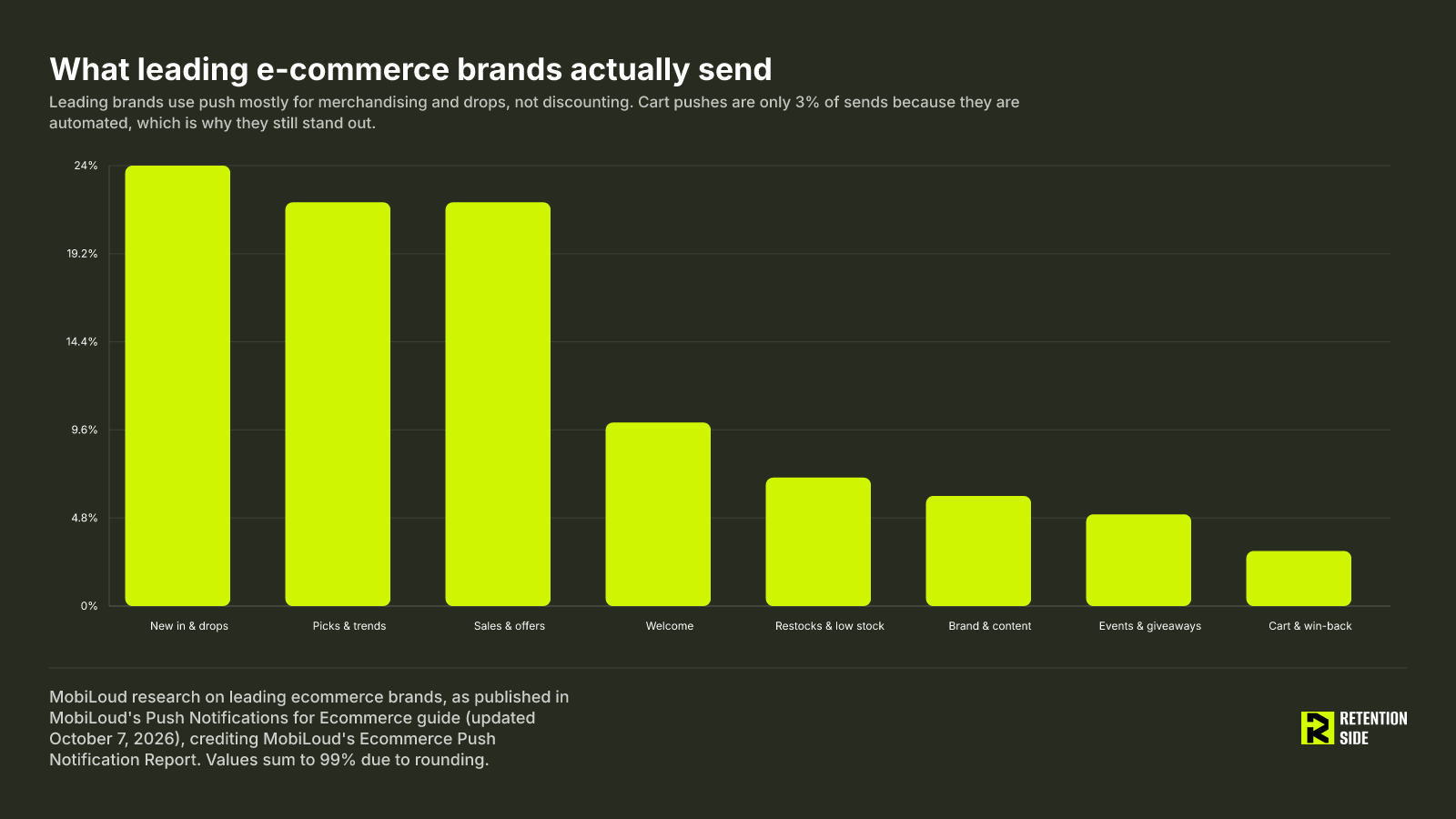
So merchandising leads, discounting is one slice. The 3% for cart and win-back looks tiny, but MobiLoud notes that cart reminders look rare because they are automated rather than broadcast. They aren’t rare for the customers who trigger them.
Copy mechanics behind the examples
Once the moment is right, the copy details matter at the margin. A few that the sources support:
- Keep it short. MobiLoud suggests roughly 25 characters for the title and 80 for the body. There is no fixed platform limit, but messages that short usually display in full on the lock screen. Lead with the value, make one point, end with the action.
- Be concrete. PushPushGo found that web push messages with a concrete offer (price, discount percentage, free shipping) consistently outperformed vague copy.
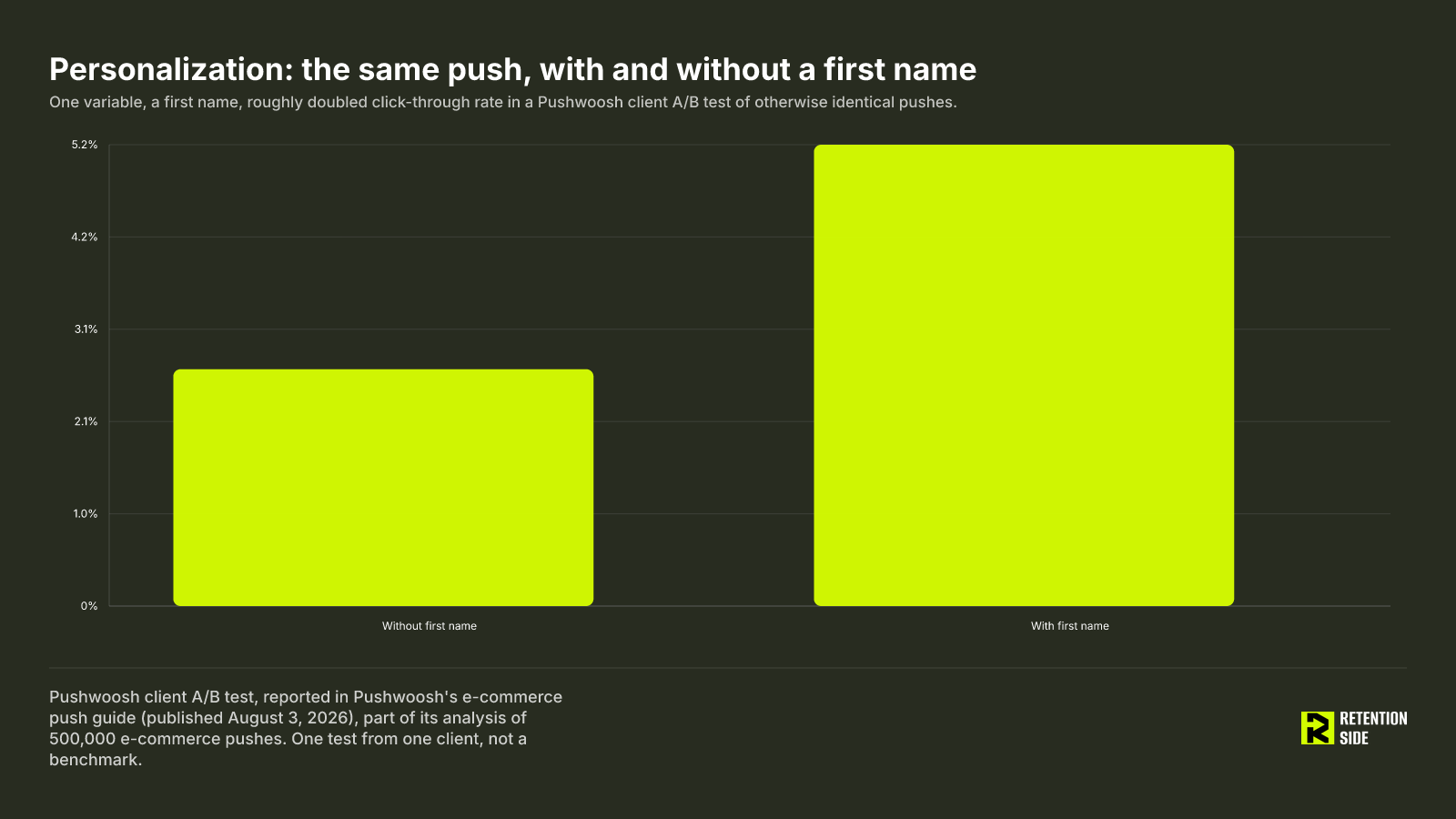
- Test personalization. In a Pushwoosh client A/B test of two otherwise identical pushes, adding the customer’s first name lifted CTR from 2.68% to 5.22%. It is one test from one client, not a guarantee, but it is a cheap variable to test.
- Mind emoji placement. Pushwoosh’s emoji study found e-commerce and retail apps saw 10.97% CTR with emoji in the body copy versus 0.58% in the title. Test placement before adding emoji everywhere.
- Only use urgency when it is real. A countdown that resets the next day teaches customers to ignore your next one.
Frequency and pacing
Examples fail more often through volume than through wording. Pushwoosh’s guidance is a ceiling of one to two pushes per day, with category pacing: fashion and apparel 2-4 messages per week, electronics 1-2, beauty and health 2-3, and grocery and delivery 3-5. Promotional pushes should top out at two to three per week, and behavioral triggers such as browse and cart abandonment should be limited to one or two reminders spaced hours apart.
For field context, MobiLoud turned notifications on in 43 shopping apps. The median app sent 4.5 pushes a week, 11 sent about one a day or more, 21 sent five or more a week, and the busiest sent 24 a week. MobiLoud recommends most ecommerce brands send three to six campaigns a week plus automated messages.
Treat those as starting ranges, not rules. Timing patterns also differ by source: Pushwoosh reports Mondays tend to deliver the highest app push CTRs, while PushPushGo found Wednesday strongest for web push clicks, peaking around midday. Different channels, different audiences, different answers. Test in your own account.
How push fits the retention system
Everything above assumes push has a defined role. That is where many programs go wrong. Push is easy to turn on and easy to overuse, and without rules it ends up duplicating what email and SMS already say.
At Retention Side, we treat push as a supportive layer, not noise. Our channel guidance is to start with email, add SMS second, then layer in push, which needs no personal contact information, just a permission tap. Push supports email and SMS rather than replacing them. We cover the full sequencing logic in our article on which channels make a good ecommerce retention strategy.
In practice, our push work follows three phases:
- Research first. Traffic and device analysis, consent rate evaluation, channel overlap assessment, and defining the push use cases worth building.
- Minimal implementation. Simple flows focused on reminders, return visits and unfinished actions, with strict frequency and pacing rules and clear KPIs.
- Ongoing optimization. Performance and impact analysis, messaging and timing tests, and checks that push stays relevant over the long term.
The coordination rule matters most. A customer who just converted from SMS should not get the same offer by email two hours later, and a VIP who redeemed a loyalty reward yesterday should not get a generic win-back push today. Every channel needs a defined role and guardrails against overlap. That is the same lifecycle logic that governs flows, applied to one more channel.
If you want to know where push belongs in your own retention mix, or whether your current setup is cannibalizing email and SMS, talk to us about a push notifications review.
FAQ
What are some good examples of push notifications?
The strongest ones are tied to a specific customer action. Examples from MobiLoud’s collection include Muscle Republic’s welcome offer for first app purchases, Bo+Tee’s back-in-stock message (“You sold them out…. We brought them back”), Brickell’s cart reminder (“30% off your cart is waiting”), and Motel Rocks’ win-back (“we miss you… save 15% with code HELLO15”). Each one fits a clear moment: welcome, saved item, cart, lapsed.
What is an example of a push notification?
A simple ecommerce example is Art of Tea’s cart reminder: “Forget something? We saved your cart for you!” It is short, names the unfinished action, and works best when it is sent within about an hour of abandonment and deep-links straight back to the cart.
Can you give me some examples of notifications beyond discounts?
Yes. Several examples above contain no discount at all: Mr Porter’s “Guess what just landed?”, Alo Yoga’s “New in Navy”, Sephora’s “One more (beauty) sleep to Black Friday!”, and order updates and review requests after purchase. MobiLoud’s content-mix analysis shows leading brands send new arrivals and drops (24%) and picks and trends (22%) as often as sales and offers (22%).
Start with the moment, then write the message
Copying a push line is easy. Building the trigger, the timing and the suppression logic behind it is the real work, and that is where results come from. Pick one moment where you currently send nothing or send a template, such as cart or saved-item alerts, and write something specific to it.
Then decide what push owns and what stays with email and SMS before you scale volume. A quiet channel with a clear job will usually outperform a busy one without it.