

Every SMS vendor has a case study with a three-digit ROI multiple. Read enough of them and you start to wonder whether SMS is the best channel your brand isn’t using properly, or whether the numbers are measuring something other than what you think.
Both are partly true. SMS is a strong channel at the right moments. But ecommerce sms marketing case studies are marketing assets first and evidence second. They are published by the platform that sold the product, the agency that ran the program, or a press outlet repeating both. The useful question is not “which result is biggest?” but “what exactly was measured, by whom, and does it transfer to my store?”
Every headline multiple deserves the same inspection: what was measured, by whom, and over what window.
This article goes through the public cases from Postscript, Attentive, agencies, press coverage and one independent operator. For each, it separates what the result supports from what it only suggests. Everything here is self-reported unless stated otherwise.
Key takeaways
- Triggered SMS (abandoned cart, welcome, back in stock) produces the most impressive per-message numbers across the cases. Campaign numbers are lower and less consistent.
- ROI multiples like 45x, 358x or 515x are not comparable with each other. Windows, definitions and attribution rules differ, and several are scoped to a single event.
- Only one case in this set includes a real holdout test. Everything else is attributed revenue, which tells you where attention was, not what the message changed.
- The most useful number in the set is not a multiple. It is the share of revenue SMS drove in peak season.
- Use benchmarks to set your floor and case studies to set your ceiling, never the other way around.
Why SMS case studies mislead more than they inform
Three biases show up in nearly every case.
Survivorship is the first. Vendors publish their best accounts. A brand that tried SMS, sent into a weak list and quietly churned never gets a case study.
Attribution is the second. Most platforms credit revenue to a message when the customer clicked within a set window, usually on a last-touch basis. A shopper who had already decided to buy, got a cart reminder and finished the order is counted as SMS revenue. Attributed revenue answers “where was the customer’s attention when they bought?” Incrementality answers “did our message change the outcome?” A dashboard only answers the first. Changes to attribution windows, UTM hygiene or click tracking can move reported numbers without any change in how the program performs.
Definition drift is the third. “ROI” can mean attributed revenue divided by platform and message cost, or net modeled benefit over cost. “Conversion rate” can be per click, per delivered message or per recipient. A case study rarely shows the formula.
The cases, and what each one supports
Triggered messages: Luxor Linens and Shop Miss A
Postscript’s Luxor Linens case study, published 2020-04-22, reports $13.5k in revenue over 30 days from about 2,000 subscribers, over $7 earned per message on the abandoned cart automation, and a 45x program ROI. The figure that holds up is the per-message number on a cart flow. Cart reminders reach people with proven intent, so high earnings per message is the expected result. The 45x is the weaker figure, because the formula is not shown and the list is small enough that a few large orders move it.
Postscript’s Shop Miss A case, published 2022-03-17, is more useful. It reports more than $100,000 in monthly attributed SMS revenue across 21 automations. In a 30-day test, back-in-stock texts earned $2.55 per message against $1.64 for email notifications, and back in stock accounted for 11.5% of new SMS subscribers. That makes it the third most effective acquisition source behind keyword and opt-in form.
The sign-up finding is the part worth stealing. A back-in-stock request is an expression of intent, so it is both a flow and a list growth tactic. The revenue comparison is looser. Earnings per message ignores cost, and SMS costs more per send than email. A message that earns 55% more per send may still not earn more per dollar spent.
Large programs: Cozy Earth and Michaels
Attentive’s Cozy Earth case, published 2024-08-06, reports 630K+ SMS subscribers, 69x all-time program ROI, and 23x on campaigns. Journey messages are reported at 515x all-time ROI with 17% conversion and 13% click rate. The welcome and abandoned cart journeys each exceed 900x, at 27% and 32% conversion rates respectively.
The pattern is the point. Campaigns at 23x and journeys at 515x tells you that behavior-triggered messaging does most of the work, which matches how flows behave in email. But all-time figures blend years of list growth, and multiples this large depend on how little the triggered messages cost relative to the revenue credited to them. The case does not say how much of that revenue would have arrived anyway.
Attentive’s Michaels case, published 2022-03-17, reports more than $63M in SMS revenue since the December 2019 launch, 8.5M+ active subscribers and a 20.8% average conversion rate on abandoned cart reminders. This one proves scale and persistence, not efficiency. A cumulative figure across multiple years for a retailer of that size is a different animal from what a brand under $10M a year can plan against.
The only holdout: Astrid & Miyu
Attentive’s case on Astrid & Miyu, published 2023-04-12, reports 33x total program ROI and that 20% of SMS subscribers made two or more purchases. It also includes the one case in this entire set that tests causation. The brand randomly opted out 1,000 SMS subscribers and found that opted-in subscribers spent 60% more than those who were not.
This is the closest thing to proof of incremental value. It is still vendor-published, and the test window is not stated. It also measures spend per subscriber, not net profit after message costs and discounts. But the design is right, and it is the design you should copy. The same case reports that a 2-in-1 sign-up unit lifted website conversion by 1.3% and collected 30% more emails than the prior email-only unit, which is a reminder that SMS capture can improve the email list too.
Event-scoped numbers: Wood Veneer Hub
Attentive’s case on Wood Veneer Hub, run with agency Parallel 9 and published 2023-08-25, reports a 358x SMS ROI. That figure is scoped to Black Friday Cyber Monday. The same case reports a 10.6% average conversion rate across BFCM texts, a 48% lift in average order value from spend-based discount segmentation, SMS generating 10% of November revenue, and website sign-up rate rising from 0.6% to 3.7%.
The 358x is a peak-week multiple and should not be read as a program average. The more useful findings are the segmentation lift (tiered offers by spend raised order value) and the sign-up rate improvement, which suggests the form change did more for long-term SMS value than any single send.
Agency and press cases: Darc Sport and Hey Bud
The Darc Sport case, published by agency BMO Media, reports $7.89 per campaign message in month one, about 21,000 SMS subscribers within a month of the February 2023 onboarding, and roughly 41,000 by month two. It also claims a 29.8% increase in SMS revenue after two months, an 80% increase through automation sequences, and a 93.4% click rate on the first campaign. A click rate that high needs a definition before it deserves trust. It may reflect a tiny first send, a specific click-tracking method, or a metric calculated on a different base. Agency-published cases are worth reading, but the agency is grading its own work.
Hey Bud Skincare appears in press coverage by RetailBiz Australia, published November 22, 2024, repeating Attentive and brand claims. It reports 133x return, a welcome journey with a 15.6% click rate and $29 per message sent, and campaigns at 14.5% conversion. A pre-engagement sign-up unit reportedly drove 441% more clicks and 280% more conversions than a regular pop-up, with four times more SMS subscriptions and seven times more email sign-ups. A press article is not independent verification. The most useful lesson is again on the capture side: how the form is designed changes list quality and volume more than most message tweaks do.
The independent operator view
A practitioner, Bekir Mustafić, self-published an anonymized brand case covering calendar year 2024 against 2023, using Attentive and Postscript. SMS revenue grew 63% year over year and rose in all 12 months. The brand added 142,847 subscribers and sent 10.6M messages, at a 2.7% conversion rate. It has no third-party verification, so treat it as a single operator’s account.
It is still the most realistic dataset here. A 2.7% conversion rate sits in a sane range, and November accounted for 33% of the year’s SMS revenue. That is how a real program looks: heavily seasonal, with the peak carrying a third of annual revenue. Plan your list health and send capacity around that concentration.
What the benchmark reports add
Case studies tell you what is possible. Benchmark reports tell you what is typical, and they belong next to every case you read.
Listrak’s 2025 Cross-Channel Benchmark Report, based on 125 billion email and SMS/MMS messages from more than 1,000 ecommerce clients between January 1 and December 31, 2024 (released March 25, 2025), found SMS send volume up 93% year over year against 43% for email. Its SMS welcome series conversion rate rose 26% and revenue per send rose 17%. The report also says SMS conversion rate grew 47% while email click-through rate fell 25%. Those are different metrics, so the comparison shows direction, not a clean channel ranking. Heavier SMS volume also means more competition for the same phone screens.
Postscript’s 2025 SMS benchmarks report and Klaviyo’s benchmark reports publish percentile bands by vertical and message type. I have deliberately not quoted their figures here, because the numbers should be read directly from the source for your category before they inform a plan. What to look for is the spread between the 25th and 75th percentile for each message type. You will typically see abandoned cart far above campaigns, with a wide gap between them. When a case study’s per-message figure sits above the 75th percentile for its message type, it usually says more about what was measured than about how well SMS works.
One more caution on commissioned research. Forrester Consulting’s Total Economic Impact study, commissioned by Attentive and announced 2024-01-30, modeled a composite organization with $10.11 million in total benefits over three years, 181% ROI and payback in under six months. That is a three-year model of a composite customer, not a measured brand result. It is a good example of what commissioned studies do and do not prove. The 181% is a modeled net return, which is a different animal from a 45x revenue multiple.
A filter for reading any SMS case study
Run every case through these six questions before it influences a decision.
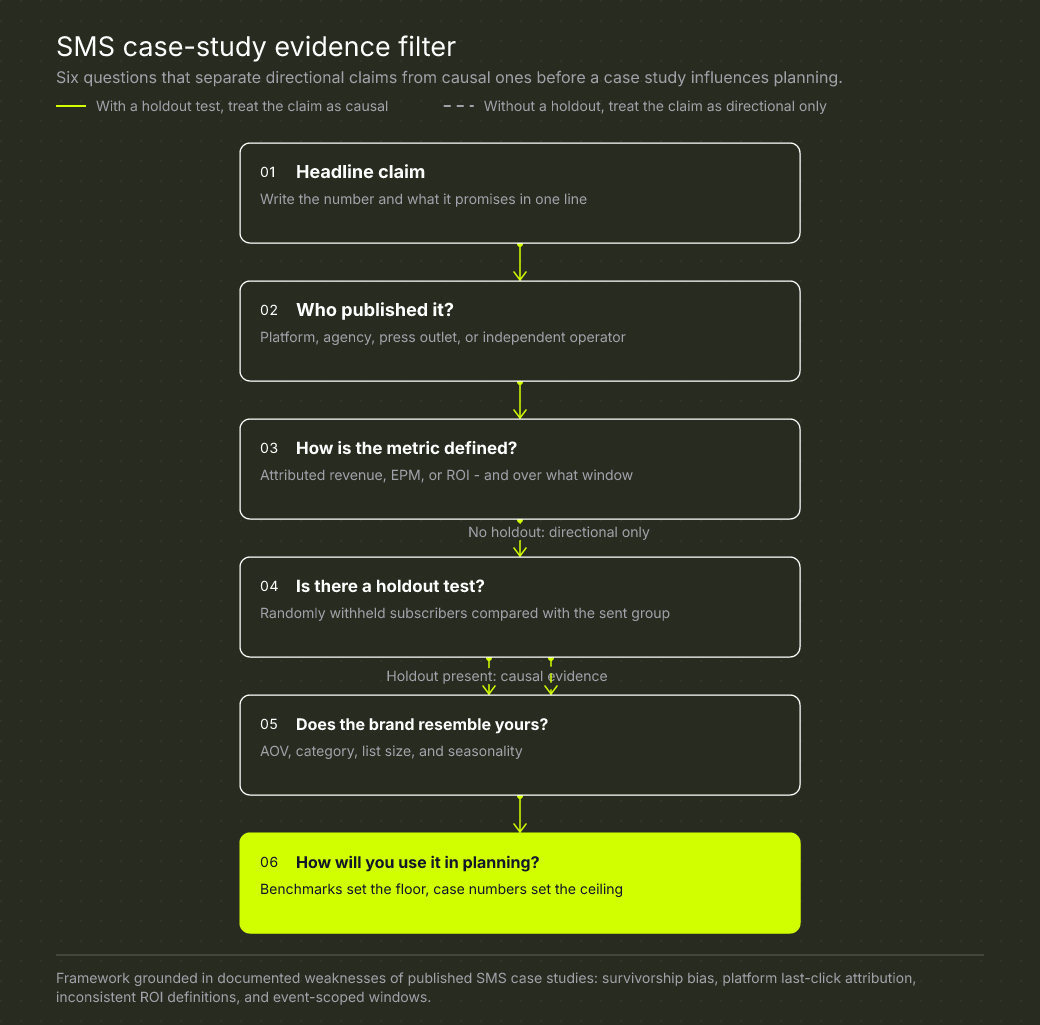
The only branch that changes the verdict is the holdout question: with one, a claim moves closer to causal; without one, it stays directional.
- What is the headline claim? Write it down in one line, including the number.
- Who published it? A platform, an agency, a press outlet, or an operator. Each has a different incentive.
- How is the metric defined, and over what window? Attributed revenue, earnings per message and ROI are different things. Event-scoped and all-time windows are not comparable.
- Is there a holdout? If yes, treat the claim as closer to causal. If no, treat it as directional rather than causal evidence.
- Does the brand resemble yours? Check average order value, category, list size, and seasonality.
- How will you use it in planning? Benchmarks set the floor, and case numbers set the ceiling.
Notice what this does to the cases above. Astrid & Miyu passes question four and nothing else does. Michaels fails question five for almost every brand reading it. Wood Veneer Hub fails question three if you read the headline as a program average. This is not a reason to dismiss them. It is a reason to take the specific tactic and leave the multiple.
What this means for how we run SMS at Retention Side
We read these cases the same way we read any attribution report: as a view of where customers were when they bought, not proof of what the message changed. That shapes how we build SMS programs for established DTC brands.
SMS is used selectively. It works best at critical, time-sensitive touchpoints: order updates, abandoned checkout reminders, back-in-stock alerts and limited-time offers. It is not a standalone channel. It is part of a retention system with email and other touchpoints, which is why the cases above that combine capture, segmentation and triggered flows hold up better than the ones that lean on a single multiple.
Flows come before campaigns. Campaigns and flows both matter in a healthy SMS program, but triggered messages carry the highest revenue density, as the Cozy Earth split shows. Abandoned cart sequences are usually a short run of messages across the first day or two, with copy that names the product left behind. Campaign cadence stays modest for most brands, with the ceiling set by category, segment size and how the subscriber relationship was built.
The list needs constant feeding. An SMS list loses value without active acquisition. Compliant checkout language, mobile pop-ups, post-purchase pages, email footer invitations and loyalty enrollment all feed it. Registration under 10DLC and TCPA consent hygiene are non-negotiable, and an agency that does not lead with that conversation is a liability.
Cost decides the format and the platform. We run controlled A/B tests to see whether MMS generates enough incremental conversions to cover its higher cost at the brand’s margins. Klaviyo is our primary SMS tool because it keeps data under one roof, but SMS pricing varies a lot by country, so we evaluate alternatives on price and integrations when cost becomes the constraint.
We also keep our own claims in their lane. Our published client cases, such as Hedonism Wines and Eliya The Label, are email results. They are not SMS proof, and we do not present them that way.
How to run your own proof
Case studies cannot answer whether SMS will work on your store. A holdout can. Copy the Astrid & Miyu design: randomly withhold a group of subscribers from SMS, keep everything else equal, and compare. Hold the test through at least one promotional period, not a quiet week. Then compare revenue per subscriber, net of message cost and discount depth, not attributed revenue per send.
Do this before you scale volume. If opted-in subscribers do not spend meaningfully more than the holdout group, the problem is probably the list, the offers or the surrounding experience. It may not be SMS itself. A drop in SMS results is rarely just an SMS problem. Traffic quality, acquisition changes and site conversion all land on the same subscribers.
The takeaway
The most credible lesson from these cases is modest: triggered SMS at high-intent moments works, capture design matters as much as message design, and peak season concentrates the revenue. The multiples mostly tell you how each vendor chose to define success.
If you want to know what SMS would add to your own retention system, start with a diagnostic of your current flows, list capture and attribution settings, then set up a holdout test. That will give you a number you can defend, which no case study can.