


Your SMS click rate jumps. Someone on the team wants to double down on whatever the last campaign did, or the opposite: your click rate drops after a platform change and everyone assumes the creative went stale. Both reactions skip a prior question. How many of those clicks were people?
SMS bot clicks are the SMS version of a problem most email operators already know from Apple Mail Privacy Protection. Machines interact with your links, your platform logs the interaction as engagement, and your dashboards report it as customer interest. If you change campaigns based on that data, you are optimizing against machine noise rather than customer intent.
This article covers where those clicks come from, how to spot them in your own account, what they actually distort, and why the fix is usually measurement rather than creative.
Key takeaways
- A bot click is a click performed by a machine, not a customer. In SMS, the main sources are link previews, carrier scanners, security software and crawlers.
- Bot clicks do not change what you pay or remove recorded purchases, but they can inflate click rate and shift attribution and A/B test results.
- Clicks logged almost immediately after sending are a strong tell for carrier scanning.
- Fix measurement first: exclude bot interactions, re-baseline click rate to human-only, and judge SMS on conversions and revenue, not raw clicks.
- If human engagement still falls after that, look at list quality, frequency and acquisition before blaming the channel.
Where SMS bot clicks come from
Klaviyo defines a bot click as an email or SMS click performed by a machine, often to verify that a link is safe or to display a link preview. Inbox providers, some third-party security software and carriers all use bots to click links before any human gets there.
For SMS specifically, there are four sources worth understanding.

Link previews, carrier scanning, security software and crawlers can all generate clicks without a customer tapping the message. The four sources above are explained below.
Link previews. Klaviyo identifies link previewing, standard on most iOS and Android devices, as the biggest driver of bot clicks in SMS. Devices programmatically click the link to fetch a preview image, and the logic varies by device and operating system. A customer may never tap anything, yet your platform sees a click.
Carrier scanning. Carriers and providers examine message content for compliance, and Recart lists carrier security scanners running phishing and spam checks as a source of bot clicks.
Security software. Corporate and antivirus tools can open links as part of their own protection checks.
Crawlers and AI bots. Recart notes these are getting better at behaving like people, which makes simple filtering harder over time.
One more wrinkle: Apple’s and Google’s messaging apps support both automatic previews and “Tap to load” previews. Per Twilio’s link shortening changelog (dated 2024-09-30), that mix can blur engagement analytics. So even two customers on the same phone ecosystem can generate different click behavior without any difference in interest.
How this differs from email bot clicks and Apple MPP
If you run email, you already carry a mental model for this. Keep it, but do not collapse the concepts.
Apple Privacy Opens are a separate concept from bot clicks, per Klaviyo. MPP affects open data. Bot clicks affect click data, and they exist in both email and SMS. In email, the usual culprits are inbox providers and security tools scanning links. In SMS, devices and carriers add their own layer.
The shared lesson is the one Retention Side applies across channels: a metric that machines can generate should be used for diagnosis, not for judgment. Opens became unreliable for many email programs. Raw SMS clicks deserve the same skepticism.
How to spot bot clicks in your own account
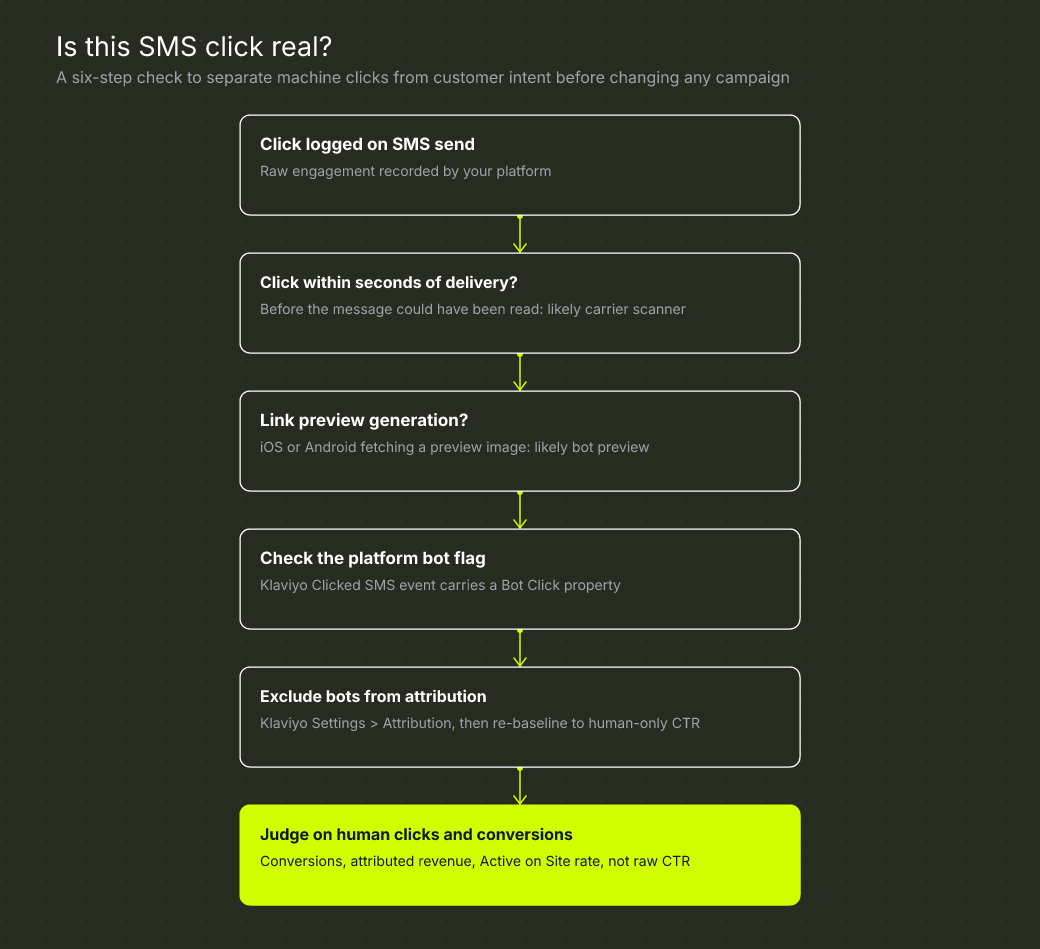
The diagnostic sequence in one view: check timing, check for link previews, use the platform bot flag, then exclude and re-baseline before judging any campaign.
You do not need a data team for a first pass. There are three practical checks, and each comes from platform documentation rather than guesswork.
- Check the Bot Click property. In Klaviyo, the Clicked SMS event carries a Bot Click property (true or false), and Clicked Email carries the same one. Segment or filter your click events on it. Note that bot-click event data and bot-click segment data are only available from 2022-01-01.
- Check timing. Recart points out that a link showing a click before the message could have been read is typically a carrier scanner opening the link right after sending. If a meaningful share of your clicks land in the first moments after delivery, treat that as a red flag.
- Check your sending layer. If you use Twilio’s Link Shortening, its click events now distinguish bot-preview events from human-generated clicks, which gives a more accurate view of click-through rate. Other platforms handle this differently, so ask yours directly how it classifies clicks.
Some platforms filter by default. Recart, for example, states that it checks each click when it happens using a bot-signature database and behavioral scoring, excludes flagged clicks from analytics, and still redirects every visitor. If your SMS platform already filters and your numbers look low next to a competitor’s benchmark, you may be comparing filtered data with unfiltered data.
What bot clicks distort, and what they leave alone
This part matters for deciding how worried to be. According to Klaviyo, bot clicks do not influence campaign cost and do not affect event-based conversions such as Active on Site or Placed Order. A recorded purchase stays recorded.
What they can affect:
- Attribution. If a bot click is the last click in the attribution window before a conversion, it can take credit. Excluding it changes how the conversion is credited. It does not delete the purchase.
- Click rate and related counts. Click Rate, Total Clicks and Unique Clicks all move when bot filtering is on.
- Conversion rate. Recart notes that unfiltered bot clicks make conversion rate look worse than it really is, because the denominator includes machines.
- A/B tests. For tests using Click Rate, Klaviyo says only human clicks decide the winner once live experiments are next evaluated. A variation with a lower raw click rate can end up declared the winner, and historical winners do not change.
That last point is easy to miss. If you have been rolling out SMS “winners” based on click rate, some of them may have been winning against noise.
Fix the measurement before you touch the campaign
When the click data is suspect, rewriting copy, changing offers or cutting send frequency is the wrong first move. You would be reacting to a reading you have not validated. The sequence we would follow:
- Turn on bot exclusion. In Klaviyo this lives in Settings > Attribution, with separate options to exclude bot interactions from Clicked Email and from Clicked Text Message. Changes can take up to 36 hours to apply to historical attribution data, and you cannot edit attribution settings again while the update processes. Do not toggle it repeatedly while you wait.
- Re-baseline click rate. With the reporting filter on, applicable reports, including overview dashboards, flow and campaign performance, trend reports, the SMS dashboard and benchmarks, exclude bot clicks retroactively from 2022-01-01. Your old “good” numbers will probably look lower. That is the correction, not a decline.
- Re-read your A/B tests. Revisit any live tests on click rate and any decisions you made from them.
- Shift the scorecard. Klaviyo suggests using Active on Site rate instead of click rate when high bot-click levels are suspected. We would go further: for an SMS program, click rate is diagnostic, not an accountability metric. Attributed SMS revenue, conversion rate and returning customer rate tell you whether the channel is doing its job inside the wider retention system.
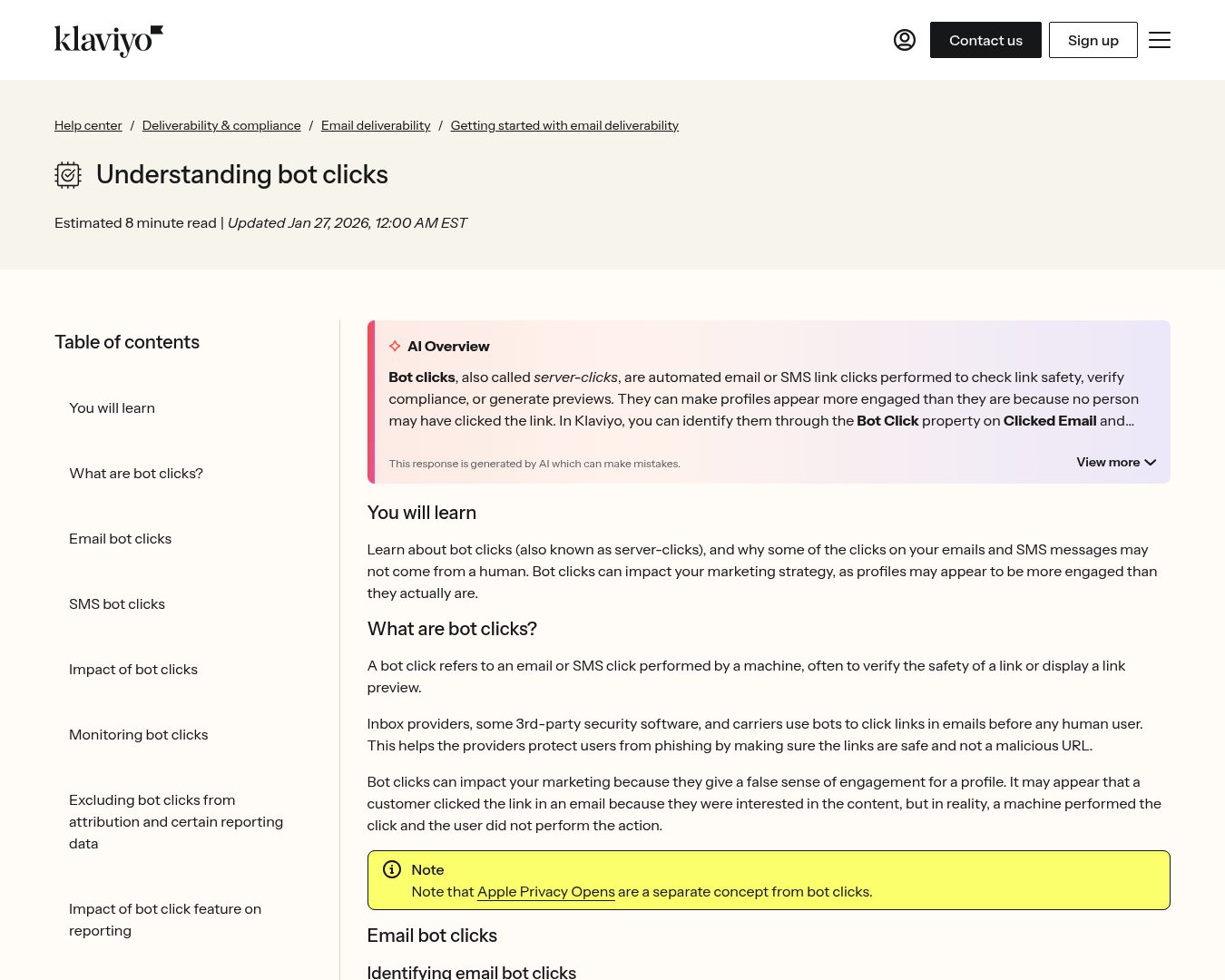
Klaviyo’s own help center is where the exclusion behavior is documented: the setting lives under Settings > Attribution, and the same page defines the Bot Click property used in the checks above. Source: Klaviyo help center, article updated 2026-01-27.
There is also a limit to what you can control. Klaviyo states there is no way to fully prevent bot clicks by inbox providers, and its tips such as dedicated click tracking and avoiding link shorteners only make bot verification less likely in the email context. Treat bot clicks as a measurement condition to manage, not a problem to eliminate.
If you are reviewing an SMS partner’s reporting, this is a fair question to ask: are the click numbers human-only, and which outcome metrics sit next to them? We cover how to evaluate that in our guides on eCommerce SMS marketing agencies and Klaviyo SMS agencies.
When a real drop in human clicks still matters
Once the data is clean, you may find the opposite of what you hoped: human engagement really is soft. That is useful, because now you are diagnosing something real.
Do not default to blaming SMS. A decline in genuine engagement usually traces back to the surrounding system:
- List quality. Subscribers acquired through heavy incentives or low-intent sources click less. Lead-to-customer rate says more about a sign-up source than sign-up volume does.
- Send frequency and message mix. If subscribers only hear from you during discounts, engagement and full-price purchasing tend to erode.
- Acquisition and site changes. A shift in traffic sources or landing page quality changes who is on your list and what they do after clicking.
- Cross-channel overlap. If email, SMS and push all message the same people about the same offer, SMS rarely gets the credit it deserves.
Opt-in abuse deserves a separate check. Recart describes blocking automated sign-ups on popups, limiting daily opt-in texts per phone number and per site, and not charging for blocked sign-ups. Whatever platform you use, confirm what protection exists on your forms, because fake subscribers dilute every rate you report.
The point is that SMS performance is rarely only about SMS. Retention Side treats it as one channel in a retention system, and the right fix depends on where the weakness actually sits.
FAQ
What are bot clicks?
Bot clicks are clicks on email or SMS links performed by a machine rather than a customer. Per Klaviyo, they are often used to verify that a link is safe or to generate a link preview, and inbox providers, some third-party security software and carriers use them before any human user.
Where do SMS bot clicks come from?
Klaviyo and Recart point to the same sources: link previews on iOS and Android devices, carrier security scans, security software such as corporate and antivirus tools, and crawlers or AI bots that mimic human behavior. Klaviyo names link previewing as the biggest driver in SMS.
Do bot clicks affect campaign cost or conversions?
Klaviyo says bot clicks do not influence campaign cost and do not impact event-based conversions. They can affect attribution if a bot click is the last click in the attribution window, and they inflate click metrics.
How can I tell whether clicks are bots?
Check for a Bot Click property on click events if your platform provides one, look for clicks logged almost immediately after sending, and ask your SMS or sending provider whether it separates bot-preview events from human clicks.
What to do first
Before you change a message, an offer or a send schedule, find out how much of your SMS engagement was human. Turn on bot exclusion, re-baseline, and hold the channel to revenue and returning customer outcomes. Most of the time, the decision you were about to make looks different on clean data.