

Two SMS campaigns can use almost identical copy and produce very different invoices. One is billed as a single segment per recipient. The other is billed as three. The difference is often one emoji, one curly apostrophe pasted in from a design doc, or a capital letter with an accent.
That is why the SMS character limit is a cost question as much as a copywriting question. The number most people remember is 160, but that figure only applies under specific conditions, and your platform bills for what the carrier network actually has to move, not for what looks like one text on your screen. This guide explains how the limit works, what breaks it without warning, and how to put the math in front of your team before it shows up in your spend.
Key takeaways
- A single SMS carries up to 160 characters only when every character fits the GSM-7 set. Longer messages are split into segments of 153 characters each.
- One character outside GSM-7, such as an emoji or a smart quote, switches the whole message to UCS-2. The limits drop to 70 characters for a single message and 67 per segment after that.
- Twilio bills per segment, so a 150-character message can go from one billed segment to three because of a single character.
- Most of the cost is controllable with a short pre-send routine: normalize punctuation, check encoding, and watch the segment count before anything goes to a large list.
Why the limit is 160 characters
The limit comes from a hardware-era budget, not a marketing decision. According to Twilio’s SMS character limit glossary, the GSM 03.38 recommendation caps a single SMS at 140 bytes. That is 1,120 bits, which fits 160 characters when each one is encoded in 7 bits.
The 7-bit alphabet is GSM-7. It covers 128 characters and, importantly, it is not the same as ASCII, the character set most North American computers and keyboards are built around. Some characters you type without thinking, such as curly quotes, are not in it. Some that feel unusual, like certain accented letters, are.
This is the part worth internalizing: encoding sets the real limit, not word count. A message does not have a fixed number of characters. It has a fixed number of bytes, and the encoding decides how many characters fit into them.
The two encodings and their limits
SMS uses one of two encodings for the message body. GSM-7 is the default and the efficient one. UCS-2 uses two bytes per character, which is why it can represent emoji and non-Latin scripts but fits less than half as much text.
| GSM-7 | UCS-2 | |
|---|---|---|
| Single message | 160 characters | 70 characters |
| Per segment in multi-part messages | 153 characters | 67 characters |
| Maximum concatenated length (Twilio) | 1,600 characters | 700 characters |
| Toll-free to US or Canada, multi-segment | 152 per segment | 66 per segment |
Source: Twilio glossary, current vendor documentation, undated.
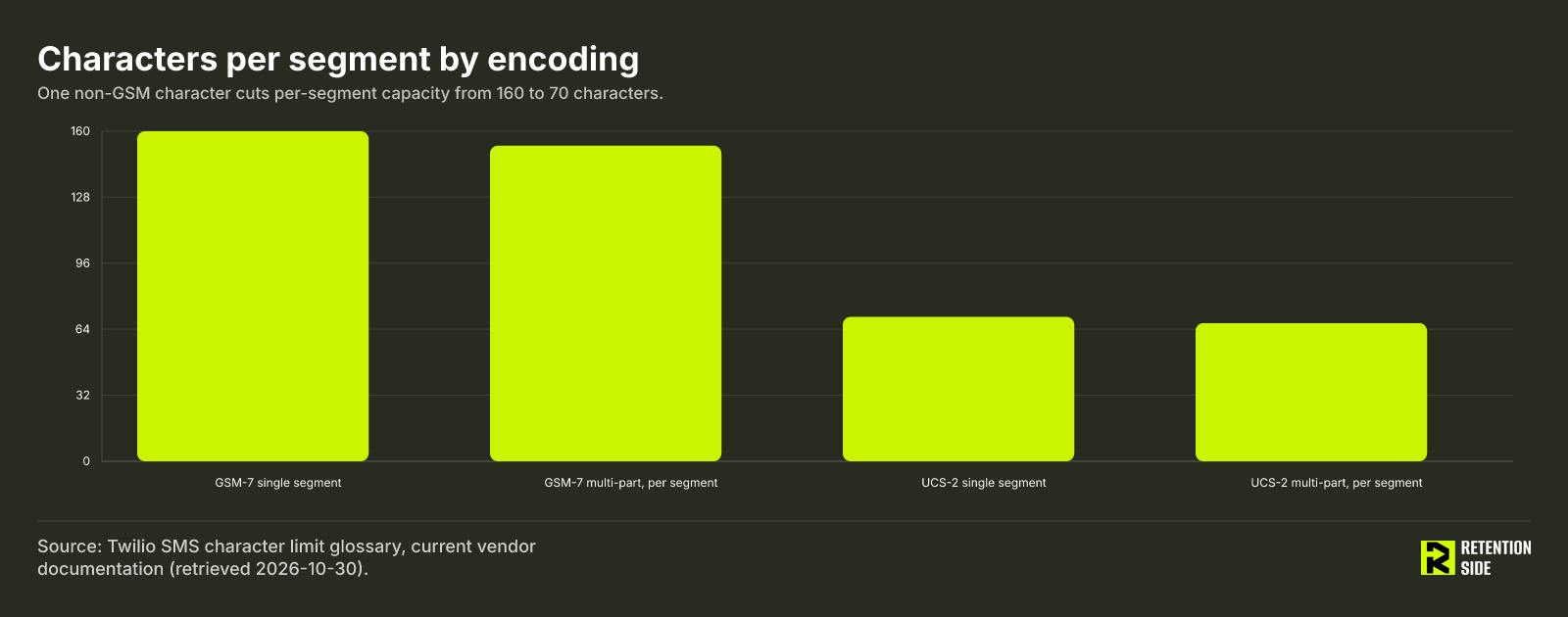
Multi-part messages hold fewer characters per segment because each segment reserves space for a User Data Header. That header is the reassembly metadata that lets the handset stitch the pieces back into one message. In GSM-7 it costs seven characters of space per segment, which is where 153 comes from.
The switch is all-or-nothing
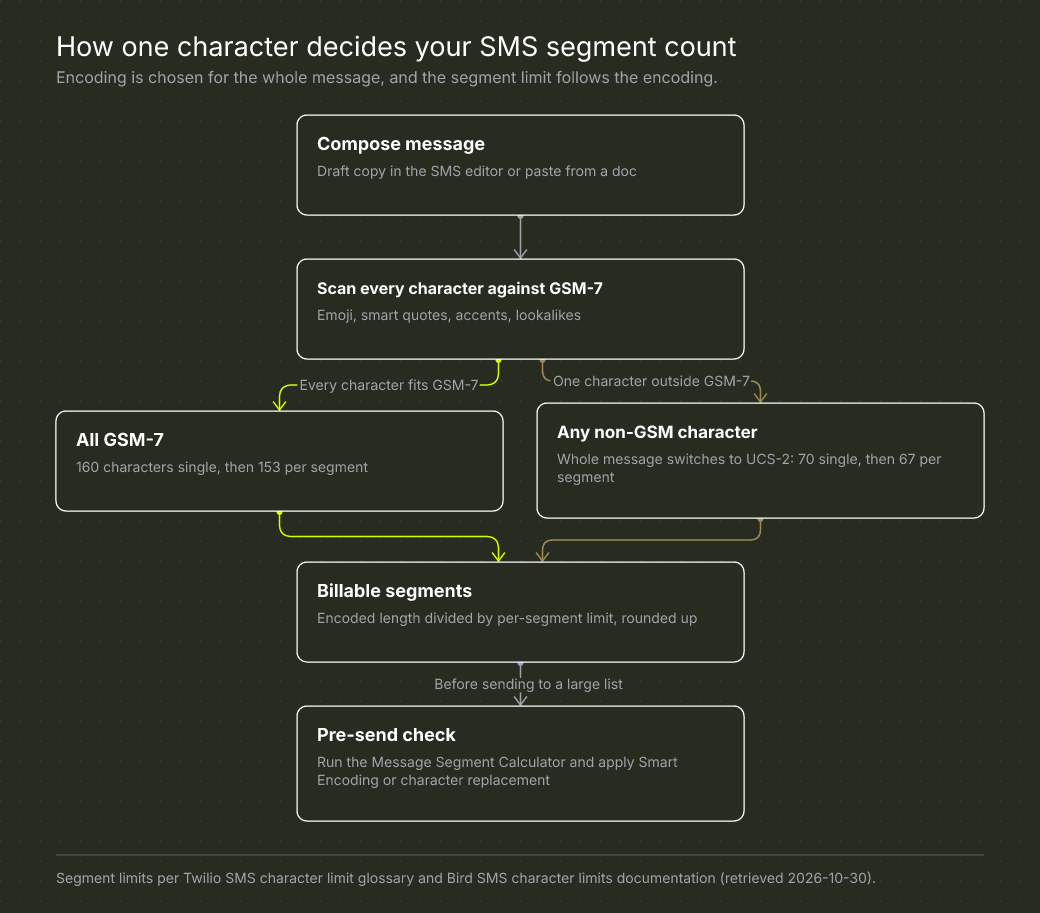
Encoding is chosen per message, not per character. Twilio states that a single UCS-2 character, whether an emoji or a Chinese hanzi, switches the entire message to UCS-2. Its example: a 140-character message with one non-GSM character is split into two segments. Smart quotation marks are UCS-2 characters, so they drop the single-message limit from 160 to 70.
This is why a message that looks safely short can still land in multiple segments. You are not adding one character of cost. You are changing the unit the whole message is measured in.
What silently triggers UCS-2
Most unplanned encoding switches do not come from someone deliberately adding an emoji. They come from copy that passed through a doc, a design tool, or a translation step on its way into the SMS editor. The documentation from Bird, seven.io, and Klaviyo agrees on the main offenders:
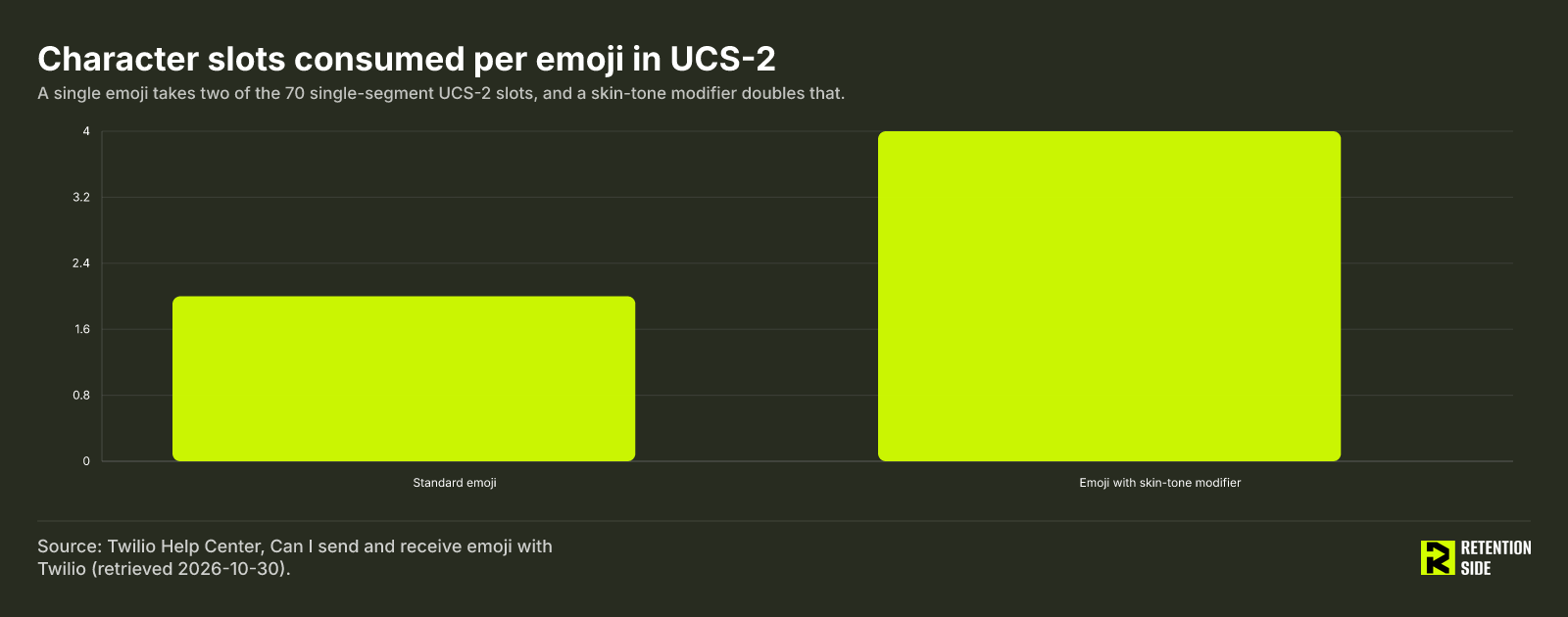
- Emoji. Twilio’s emoji help article explains that emoji are Unicode characters, so any SMS containing one is sent as UCS-2. Each emoji uses 2 of the 70 single-segment slots, and an emoji with a modifier such as a skin tone uses 4. Bird’s boundary example is blunt: 35 emoji fit in one segment, and the 36th pushes the message to two.
- Typographic punctuation. Curly quotes, the en dash, and the ellipsis character all sit outside GSM-7, according to seven.io.
- Accented letters outside the set. Klaviyo documents a detail that catches teams out: lowercase à, è, ì, ò, ù are GSM-7 characters, but their capitalized forms are not. Both é and É are. A capitalized word in a product name or a French-language promotion can flip the whole message.
- Other scripts and lookalikes. CJK, Arabic, Thai, Hindi, and Cyrillic characters all require UCS-2. Cyrillic letters that resemble Latin ones can be visually indistinguishable from the real thing, so you cannot catch them by eye. Klaviyo replaces some lookalikes automatically, but not all.
Characters that count double inside GSM-7
Staying in GSM-7 is not the whole job. The extension-table characters, which include the euro sign, square and curly brackets, backslash, tilde, caret, and pipe, take two septets each. Bird’s example shows the effect: 159 regular characters plus one euro sign encode to 161 septets, so the message takes two segments even though a character counter says 160.
For most US promotional copy this matters less than emoji and smart quotes. For brands selling in euros or sending links with unusual characters, it is a real source of surprise segments.
The cost math
Twilio bills SMS per segment sent, not per request. Its US SMS pricing page lists outbound SMS at $0.0083 per segment across long codes, toll-free numbers, and short codes, as of October 2026. For US long codes, carrier passthrough fees are added on top per segment: AT&T $0.0035, T-Mobile $0.0045, Verizon $0.005, US Cellular $0.005, and $0.0042 for all other carriers. Registration for US A2P 10DLC carries separate onboarding fees.
Now use Twilio’s documented example. A 150-character message that is entirely GSM-7 is one segment. Add a single non-GSM character and the message becomes UCS-2, where each segment holds 67 characters. Now it bills as three segments.
At the platform rate alone, that is the difference between $0.0083 and $0.0249 per recipient. Add the AT&T passthrough fee and it is $0.0118 versus $0.0354. On Verizon, $0.0133 versus $0.0399. Scale that to a 100,000-recipient send, and the platform fee alone moves from $830 to $2,490 for the same offer and the same audience.
Three caveats keep this honest:
- These are Twilio’s published rates. Your SMS platform may price in credits or bundles, so check how it counts segments before assuming the same ratio.
- Segment billing does not apply to MMS. Twilio lists outbound MMS at $0.022 per message, and emoji do not affect MMS pricing or WhatsApp, where there is no segmentation.
- Twilio’s Help Center still shows an older $0.0079 rate on its emoji and segment pages. The current pricing page is the one to trust.
Twilio also recommends keeping messages under 320 characters for deliverability and user experience. Even a clean GSM-7 message at that length runs three segments, so the recommendation is a ceiling, not a target.
A pre-send routine that keeps segments predictable
You do not need to ban emoji. You need to make the decision deliberately, and make it cheap to check.
- Decide where emoji earn their place. A short flash-sale text might justify the shift to UCS-2. A long order update or a message with a link and a legal line usually does not.
- Normalize punctuation before pasting. Replace curly quotes, en dashes, and ellipsis characters with plain equivalents. Better, type the copy directly in your SMS editor instead of pasting from a doc. Klaviyo replaces some lookalike characters automatically, but not all.
- Scan for extension-table characters. Brackets, tildes, and the euro sign count double in GSM-7.
- Check capitalized accents. If you send in languages where accents appear, test the capitalized versions of the exact words in your copy.
- Run the message through a segment calculator. Twilio offers a free Message Segment Calculator that shows encoding, segment count, and which characters force UCS-2.
- Turn on character replacement where it exists. Twilio’s Smart Encoding swaps certain non-GSM characters, including curly quotes, for GSM equivalents. seven.io has a similar setting, along with per-account caps on maximum parts per SMS and maximum price per part. Guardrails like these are worth enabling before a large send, not after.
If your platform reports segment counts after sending, as Bird does through a segments object that returns count, encoding, and character total, use that data to audit past sends. One look at last quarter’s campaigns usually shows where UCS-2 crept in.
Where this fits in the wider retention system
Segment count is a small number that behaves like a large one. It multiplies across every recipient, every flow trigger, and every campaign, and nobody notices it when each individual message looks fine.
That is one reason Retention Side’s channel guidance puts SMS second, after email. Consent is harder to collect and each message costs more, so SMS should be spent on high-intent moments such as abandoned carts, back-in-stock alerts, flash sales, and shipping updates, while email carries the longer story. It also explains the flows before campaigns sequence: automated flows run constantly, so a small encoding mistake in a flow template compounds every day it stays live.
If your retention stack runs email and SMS from the same platform, the practical move is to treat SMS templates like any other production asset. Review them for encoding, set a segment target per message type, and test copy changes against cost per conversion, not just click rate. Text-length discipline is a small part of running retention as a system, but it is the kind of detail that decides whether the channel stays profitable as volume grows.
FAQ
How do you send an SMS with more than 160 characters?
Send it as a multi-part message. The platform or carrier splits the text into segments and most handsets reassemble them into one message. In GSM-7 each segment holds 153 characters, and in UCS-2 each holds 67, because part of every segment carries reassembly data. Twilio documents a maximum concatenated length of 1,600 characters for GSM-7 and 700 for UCS-2. You are billed for every segment, not for the single message the recipient sees.
Can you increase the SMS limit?
Not the underlying limit itself. The 140-byte budget is part of the SMS standard. What you can control is how efficiently you use it: staying in GSM-7 gives you more than twice the characters of UCS-2. Twilio’s Messages Resource supports up to 1,600 characters for US and Canada recipients without on-device splitting, but carriers still handle and bill the message in segments, so longer text still costs more.
Is there a character limit for messages?
Yes, and it depends on encoding. A single GSM-7 message is 160 characters and a single UCS-2 message is 70. Concatenated messages go up to 1,600 characters in GSM-7 and 700 in UCS-2 on Twilio. Other providers set their own ceilings. Bird, for example, accepts up to 12 segments per message and rejects longer bodies with an error rather than truncating them.
Why does SMS have a 160-character limit?
Because of the 140-byte single-message budget in the GSM 03.38 recommendation. At 7 bits per character, 140 bytes holds 160 characters. The figure reflects how the signaling channel was designed, not an editorial choice about message length.
Treat encoding as a cost control
The takeaway is simple: count bytes and segments, not just characters. One emoji or one pasted smart quote can double or triple the segments you pay for, and it does so across every recipient in a flow or send.
If you want help deciding which messages deserve SMS at all, and how to coordinate it with email, loyalty, and the rest of your retention mix, that is the system-level work Retention Side does for established eCommerce brands.