
Baby, kids & toys
email marketing
Earn parents’ trust with clear product information, useful guidance, and age-relevant communication as family needs change.










your biggest
challenges
TRUST COMES BEFORE THE SALE
Parents scrutinize the details before trusting a new brand. Materials, suitability, reviews, and care information all influence confidence. Missing or inconsistent details can stop a purchase or prevent a second order.
CHILDREN OUTGROW RECOMMENDATIONS
Children’s needs can change faster than the buying history. A previously suitable age range or interest may become outdated. Repeated offers for an outgrown stage can make the brand feel irrelevant.
GIFTING CONFUSES CUSTOMER PROFILES
Gift purchases reveal little about the purchaser’s family. Grandparents and friends may buy for another household. Treating the order as the buyer’s own life stage can lead to inappropriate follow-up.
TOO MANY MESSAGES, TOO LITTLE HELP
Busy households have limited attention for generic offers. Another promotion competes with practical questions about use, care, and the next suitable product. Low relevance can reduce engagement and future purchase consideration.
We Solved
This Before
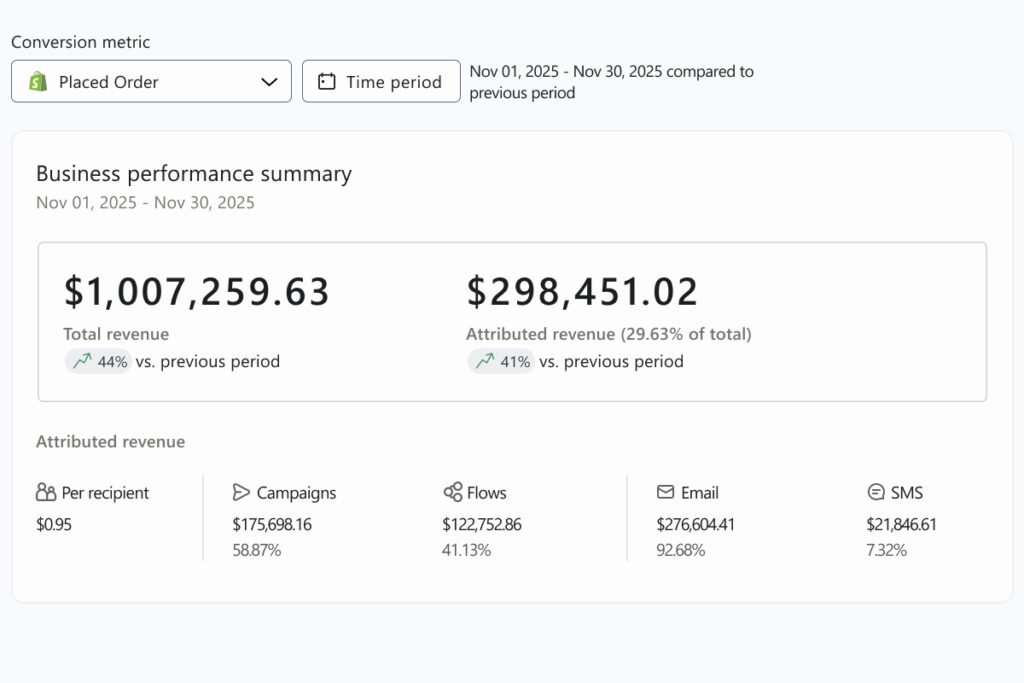
Our Australian kids-and-toys client’s November 2025 account recorded $298,451.02 in email/SMS-attributed revenue, representing 29.63% of total revenue. Campaigns contributed $175,698.16 and automated flows $122,752.86. The account shows lifecycle flows working alongside campaigns rather than attributing the whole relationship to one promotional send.
The dated account screenshot below retains that reporting context. Parent and gift-buyer cohorts, next-stage purchases, and contribution margin are the next measures for understanding the commercial quality of repeat buying.
our Process
Research & Discovery
Look for unanswered questions behind hesitation.
We review documented age ranges, suitability information, purchase categories, and customer questions. Parent and gift-buyer orders are separated where intent is known; optional preferences are assessed for accuracy and updateability.
The audit creates a baseline for first-to-second orders within relevant product windows. It also records information gaps, outdated preference risks, and the team members responsible for keeping guidance current throughout the customer relationship. See our email marketing service for the delivery scope.
Activities
Product Age-Range Review
Parent vs Gift-Buyer Data
Trust & Product Information
Changing-Needs Purchase Paths
Setup & Care Content Audit
Support & Review Analysis
Deliverability & Data Audit
Outputs
A view of how parents and gift buyers use the catalog differently.
Identified gaps in product suitability and practical guidance.
Usable optional preferences without unnecessary child data.
A roadmap for communication that follows changing family needs.
Customer Journey Workshops
Map reassurance before and after delivery.
We work through a first-time parent purchase, a gift, a product question, and a change in the family’s chosen stage. Each scenario defines the next useful information and the point at which recommendations should change.
The team agrees which preferences to request, how customers update them, and when support takes over. The output is a decision map with clear content owners and eligibility rules, ready to test against sample customer journeys.
Activities
Parent Confidence Mapping
Gift-Buyer Journey Review
First-Use & Care Guidance
Optional Stage Preference Paths
Next-Stage Relevance Review
Customer Support Handoffs
Outputs
Separate paths for family purchases and gifting.
Mapped moments where clear product information can build confidence.
A plan for keeping preferences current as needs change.
Defined support handoffs for product and care questions.
Implementation & Execution
Make each message useful for the current stage.
A toy purchase can lead to setup, care, and age-appropriate play ideas based on the brand’s instructions. Gift journeys focus on delivery and recipient suitability; parent journeys can introduce relevant next-stage products. We keep preference updates simple and stop recommendations that no longer fit the chosen age range. Product guidance uses verified information and authentic reviews.
Before launch, we check each recommendation against the product’s documented suitability and the preferences customers chose to share. Guidance, support links, and campaign eligibility stay consistent, helping the team maintain a clear and reassuring experience.
Activities
Parent Preference Capture
Verified Product Guidance Flows
Gift-Specific Follow-Up
Age-Relevant Recommendation Paths
Preference Update Invitations
Category Cohort Tracking
Outputs
Product-specific setup and care communication.
Recommendations tied to verified suitability information.
Optional preference updates and distinct gifting follow-up.
A baseline for relevant next-stage orders and customer feedback.
Continuous Optimization
Check whether relevance lasts as children grow.
We test the timing of play guidance, review requests, and next-stage recommendations. Feedback, unsubscribes, repeat orders by age range, and margin help distinguish a useful progression from messages a family has outgrown.
We distinguish customers whose needs have changed from those who encountered a problem with the product or experience. That helps the team improve relevant guidance and recommendations without treating every gap between orders as a reason for more promotions.
Activities
Stage-Relevance Tests
Trust Content Experiments
Gift-Buyer Segment Review
Preference Freshness Checks
Next-Stage Purchase Analysis
Margin & Revenue Tracking
Outputs
Evidence on which guidance and product paths remain useful.
A clearer view of outdated preferences and irrelevant messages.
Decisions on parent, gift-buyer, and product-stage segments.
A test plan based on trust, useful repeat buying, and margin.
BABY, KIDS & TOYS
CUSTOMER LIFECYCLE MAP
A new family purchase starts with suitability and first use. The next transition depends on a parent’s updated age-range or interest preferences, not an assumed birthday or household role. Gift buyers remain on a separate path; an outgrown product moves the family toward a new stage rather than a repeat of the original item.
See how subscriber conversion connects early interest with a confident first purchase.
BEEN THERE DONE THAT
Why should
you care?
Trust has commercial value when it carries into the family’s next purchase.
What commercial progress looks like
F1-to-F2 conversion
A second suitable purchase within the relevant life stage.
Purchase frequency
Orders as preferences and product needs change.
Customer lifetime value
Family cohorts and gift buyers assessed separately.
Contribution margin
Repeat order value after discounts, shipping, and returns.
Trust earned on a first order can carry into later family purchases as needs change. Losing that trust means replacing a potential repeat customer with another paid acquisition, even when the catalog contains suitable products for the next stage.
Parents and gift buyers follow different paths. F1-to-F2 conversion and purchase frequency need to be assessed against the product’s relevant age range and purpose. Customer lifetime value then shows whether families return through later stages, while returns and complaints reveal when the experience fails to meet expectations.
A longer family relationship needs relevance as well as profitable orders. Contribution margin accounts for product costs, delivery, discounts, and returns. Appropriate lifecycle communication can support a next-stage purchase without sending another offer for an age or need the family has already outgrown.
What commercial progress looks like
F1-to-F2 conversion
A second suitable purchase within the relevant life stage.
Purchase frequency
Orders as preferences and product needs change.
Customer lifetime value
Family cohorts and gift buyers assessed separately.
Contribution margin
Repeat order value after discounts, shipping, and returns.
ECOMMERCE
CLIENT RESULTS
We measure repeat purchase rate, conversion from the first order to the second, customer lifetime value, purchase frequency, and contribution margin. Our client reporting connects those business outcomes with campaign and lifecycle-flow performance, rather than judging success by opens or clicks alone.
Who this is/ISN’t for
Baby, kids, and toy brands are a strong fit when clear product information and parent confidence are central to the way they sell.
STRONG FIT
1. BRANDS WITH A PROVEN ACQUISITION ENGINE
You already attract families or gift buyers who value your products. Product categories and purchase history give us a starting point for distinguishing first-time customers, returning parents, and occasion-led shoppers.
2. WILLING TO IMPROVE THE FULL FUNNEL
You can improve suitability details, authentic review access, care instructions, and support alongside email. Parents should find the same clear information wherever they continue their research.
3. TEAMS THAT KEEP CHALLENGING THEMSELVES
Your team is ready to maintain age-range guidance and learn from customer questions. We can test relevant content and let families update the preferences that shape their recommendations.
NOT A FIT
1. RETENTION BEFORE ACQUISITION
If product suitability or customer demand is not established, resolve that foundation first. More marketing messages should not stand in for information parents need to make a confident choice.
2. SET-AND-FORGET MENTALITY
Family needs and product ranges change. This work requires current guidance and regular review of recommendation eligibility, rather than leaving age-based messages running unchanged.
3. COMFORT OVER PROGRESS
If the strategy depends on unsupported claims, pressure, or assuming family details from a gift order, it is not a fit. We need accurate information and a respectful approach to preferences.
Before working with Retention Side, most of our growth came from paid ads. When ads were performing, things looked good. When they weren’t, cash flow got tight pretty quickly. Over the past months, our repeat customer rate moved close to 40%, and that changed how the business feels. Revenue is still seasonal, but it’s far less stressful.

Founder · Beauty & Skincare
Nevena Komazec
Frequently Asked Questions
How do you build parents' trust through email?
Make the evidence easy to inspect at the decision point. A product email can link directly to the brand’s verified suitability details, care instructions, and relevant customer reviews. A first-time parent should be able to find an answer or contact support without searching through promotional copy. Product claims must match the information on the product page.
How do you keep recommendations relevant as children grow?
Use optional age-range and interest preferences together with product suitability information and purchase history. Invite parents to update those preferences and stop messages that no longer fit. Collect only the information needed to improve the experience.
Should gift buyers receive the same follow-up as parents?
No. A gift does not establish the purchaser’s family situation or future needs. Separate gifting support, delivery and occasion communication from ongoing family-product recommendations, and let buyers choose which updates they want.
What should happen after the first baby or toy purchase?
Send product-specific setup, cleaning, care, or play guidance using the brand’s verified instructions. Make help easy to reach and request feedback after a suitable period. Recommend a next product only when it fits the stated age range and use case.
How do you measure retention across changing family stages?
Review repeat purchases by product category and suitable next stage, alongside gift-buyer behavior, feedback, unsubscribes, and margin. A customer moving beyond a product’s age range should not automatically be treated as a churn problem.
Build your next stage of
customer growth.
Build your next stage of
customer growth.
Bring your customer journey, account data, and commercial goals. We’ll identify the retention opportunities that fit your products and buying cycle.