
Email marketing for
pet care brands
Build trust with pet parents through useful onboarding, relevant recommendations, and replenishment reminders that match each household.










your biggest
challenges
EVERY PET HAS DIFFERENT NEEDS
Species, life stage, and preferences change product relevance. One household’s staple can be unsuitable for another. Generic recommendations can reduce purchase confidence and make repeat communication feel disconnected from the pet’s needs.
REORDER REMINDERS ARRIVE TOO LATE
The same pack does not last every household the same time. Pet count, portion size, and buying habits create different refill windows. A missed reorder can send the household to another retailer, while an early delivery can leave excess stock.
TRUST IS EASY TO LOSE
Product uncertainty can stop a second order. Owners want to understand ingredients, suitability, and how their pet responds. Unanswered questions or a poor introduction experience can undermine trust after the first purchase.
SUBSCRIPTION INFLEXIBILITY
Subscription quantities can fall out of step with household needs. Consumption changes or a rejected product can leave stock unused. The customer may cancel a useful service because the next shipment no longer fits.
We Solved
This Before
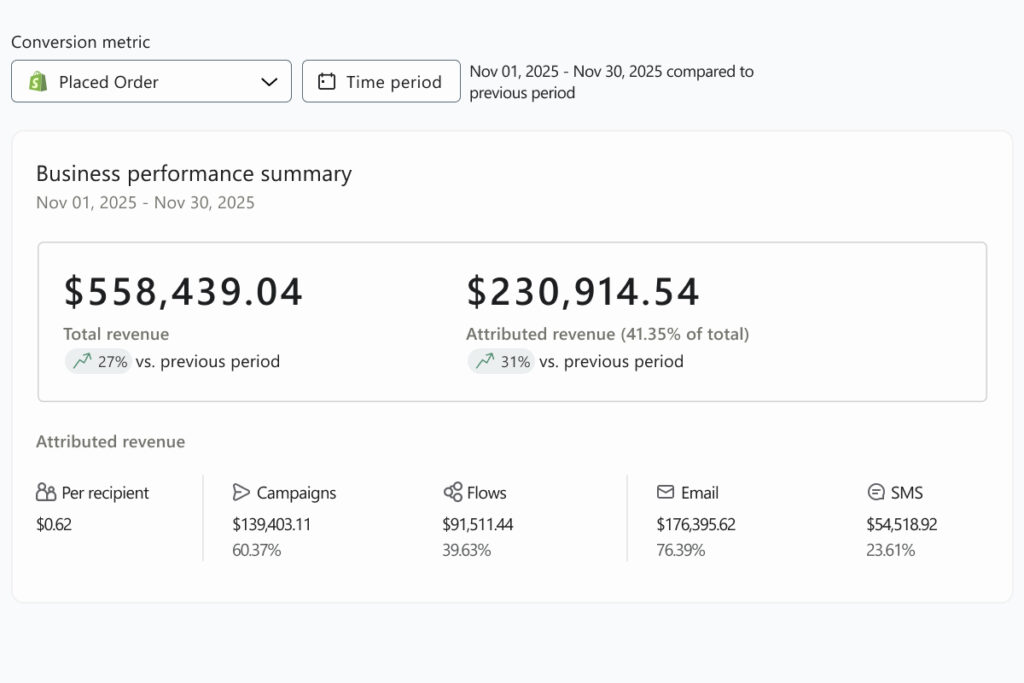
Our pet-care client’s November 2025 account recorded $230,914.54 in email/SMS-attributed revenue, representing 41.35% of total revenue. Campaigns contributed $139,403.11 and automated flows $91,511.44. That combination demonstrates the role of an ongoing lifecycle program alongside campaign activity during the Black Friday period.
The account evidence below shows the dated results and channel split. Regular-period refill cohorts provide the next level of detail for assessing whether that activity creates lasting household repeat demand.
our Process
Research & Discovery
Understand the household behind the order.
We join product and pack-size information with order intervals, subscription records, and owner feedback. Consumables and durable accessories are analyzed separately, with optional pet profiles used only where customers have supplied them.
The findings identify usable household segments, missing product information, and a baseline for the first refill. Each priority has a data owner and a measurable outcome so the next stage starts with evidence rather than an assumed household routine. See our email marketing service for the delivery scope.
Activities
Product & Pack-Size Review
Pet Profile Data Audit
Household Reorder Analysis
Subscription Cadence Review
Product Feedback Analysis
Trust & Suitability Content
Deliverability & Data Audit
Outputs
A view of how reorder behavior differs by product and pack size.
Useful pet and household preferences available for segmentation.
Identified trust, introduction, and replenishment gaps.
A roadmap for relevant owner communication and repeat orders.
Customer Journey Workshops
Follow the owner’s experience from selection to refill.
We walk through a successful introduction, a rejected product, a multi-pet reorder, and a delayed subscription. The workshop defines which event advances the journey and which event should hand the owner to support.
The team agrees who maintains suitability information, when to ask for feedback, and what ends a reminder sequence. The deliverable is a decision map that can be checked against real orders before any automation is built.
Activities
First-Product Introduction
Owner Confidence Mapping
Multi-Pet Household Journeys
Replenishment Friction Review
Subscription Change Journey
Customer Support Handoffs
Outputs
Journeys that distinguish first use, feedback, and the next purchase.
A plan for handling multi-pet households without generic assumptions.
Clear routes from product questions to customer support.
Agreed timing principles for refills and subscription changes.
Implementation & Execution
Make follow-up fit the pet and the household.
Product introduction emails use the brand’s feeding, care, or storage instructions. Reorder journeys combine pack size with observed purchase intervals, while recommendations use the preferences owners share. Subscription messages make quantity and cadence changes easy to find. Customers who reorder leave the reminder sequence, and durable accessories follow a separate path from consumables.
Before launch, we check recommendations against species, product suitability, and available household preferences. We also test the paths for changing a subscription or reporting a product problem, keeping practical help within reach throughout the journey.
Activities
Pet Preference Capture
Product Introduction Flows
Household Reorder Reminders
Subscription Cadence Messaging
Relevant Product Recommendations
Pet Segment Performance Tracking
Outputs
Product-specific introduction and reorder flows.
Preference-led segments that owners can update.
Subscription messages that explain quantity and cadence options.
A baseline for repeat orders, churn, and customer feedback.
Continuous Optimization
Improve relevance one household segment at a time.
We test refill timing, introduction content, and recommendations by product and pet profile. Repeat orders, subscription changes, owner feedback, and margin show whether messages are helping households find a reliable routine.
We use those findings to refine the balance between guidance, discovery, and reminders. For example, repeated requests to delay deliveries may point to a cadence problem, while product-introduction questions may call for clearer onboarding content.
Activities
Reorder Window Tests
Pet Profile Segment Review
Product Feedback Analysis
Subscription Churn Review
Recommendation Relevance Tests
Repeat Margin & LTV Review
Outputs
Evidence on which reorder windows work for each product group.
More relevant recommendations based on owner preferences.
Identified subscription and support friction to address.
A test plan tied to repeat behavior and profitable orders.
PET CARE
CUSTOMER LIFECYCLE MAP
The first refill is a transition, not a fixed date. Product introduction and owner feedback establish whether the household wants more; the pack size and observed interval inform when to ask. A repeat order resets the refill stage, while a product rejection routes the owner toward help before another recommendation.
Explore second-purchase improvement for the first refill after a trial order.
BEEN THERE DONE THAT
Why should
you care?
A reliable refill can turn one order into a lasting household relationship.
What commercial progress looks like
F1-to-F2 conversion
The first refill, measured separately from durable accessories.
Purchase frequency
Household refill intervals and orders per buyer.
Customer lifetime value
Value of owner cohorts across repeat household orders.
Contribution margin
Refill value after pack costs, shipping, and promotions.
A household that finds a reliable pet product may need it repeatedly, but that demand can move to another supplier as soon as a refill becomes inconvenient. Losing the second bag means losing future baskets as well as the revenue from one missed order.
The buying cycle differs between food, treats, and durable accessories. Repeat purchase rate and purchase frequency are meaningful only when those categories are separated. For consumables, F1-to-F2 conversion shows whether a trial becomes a household habit; for accessories, a longer window gives a more realistic view of customer lifetime value.
Convenience must work for the customer and for the basket economics. Pack sizes, delivery charges, and discounts change contribution margin. A well-timed subscription journey can protect repeat demand without creating extra stock or unprofitable small shipments.
What commercial progress looks like
F1-to-F2 conversion
The first refill, measured separately from durable accessories.
Purchase frequency
Household refill intervals and orders per buyer.
Customer lifetime value
Value of owner cohorts across repeat household orders.
Contribution margin
Refill value after pack costs, shipping, and promotions.
ECOMMERCE
CLIENT RESULTS
We measure repeat purchase rate, conversion from the first order to the second, customer lifetime value, purchase frequency, and contribution margin. Our client reporting connects those business outcomes with campaign and lifecycle-flow performance, rather than judging success by opens or clicks alone.
Who this is/ISN’t for
Pet-care brands are a strong fit when they can connect product knowledge and household preferences to useful ongoing support.
STRONG FIT
1. BRANDS WITH A PROVEN ACQUISITION ENGINE
You have a dependable flow of pet owners purchasing products and enough order history to distinguish consumables from accessories. We can build on real repeat demand rather than treating every item as a refill.
2. WILLING TO IMPROVE THE FULL FUNNEL
You are willing to improve product suitability information, introduction guidance, and subscription controls. Owners need a useful answer when a product or delivery schedule does not work for their pet.
3. TEAMS THAT KEEP CHALLENGING THEMSELVES
Your team can maintain accurate product information and learn from owner feedback. We can test household segments and reorder windows while allowing customers to update their pet preferences.
NOT A FIT
1. RETENTION BEFORE ACQUISITION
If you are still finding which owners and pets your products suit, that product and acquisition work comes first. More follow-up messages will not resolve a poor match.
2. SET-AND-FORGET MENTALITY
Pet profiles, pack sizes, and product feedback need ongoing attention. A fixed sequence left unchanged can quickly become irrelevant as household needs and the catalog change.
3. COMFORT OVER PROGRESS
If every household must receive identical recommendations and delivery timing, useful personalization is limited. We need room to adjust messages and the customer experience when feedback shows a mismatch.
Before working with Retention Side, most of our growth came from paid ads. When ads were performing, things looked good. When they weren’t, cash flow got tight pretty quickly. Over the past months, our repeat customer rate moved close to 40%, and that changed how the business feels. Revenue is still seasonal, but it’s far less stressful.

Founder · Beauty & Skincare
Nevena Komazec
Frequently Asked Questions
How do you personalize email for households with more than one pet?
Treat each pet profile as optional and updateable. If an owner records both a cat and a dog, keep species-specific recommendations separate and use the purchased pack to determine which refill is due. Where the household data is incomplete, ask a clear preference question rather than treating one order as a complete pet profile.
How do you time pet-food and essential-product reminders?
Start with pack size, product category, and observed reorder intervals. Owner-provided household details can help refine timing, but actual behavior should guide testing. Customers who have already reordered should leave the reminder sequence.
What should happen after a customer's first pet-product order?
Provide product-specific introduction, storage, or care guidance using the brand’s verified information. Invite feedback and make support easy to reach. Product communication should not imply that marketing advice replaces veterinary guidance.
How do you keep pet subscriptions flexible?
Explain upcoming deliveries and provide clear routes to change quantity, adjust cadence, skip, or pause. Review the reasons for changes and cancellations to identify where the original purchase schedule did not match the household.
Which metrics matter for pet-care retention?
Review repeat purchase rate and reorder timing by product, subscription churn, relevant recommendation purchases, customer feedback, and contribution margin. Separate consumables from durable pet accessories when comparing performance.
Build your next stage of
customer growth.
Build your next stage of
customer growth.
Bring your customer journey, account data, and commercial goals. We’ll identify the retention opportunities that fit your products and buying cycle.