

SMS is not a beginner channel anymore. Brands doing real revenue on Shopify have figured out that a well-run SMS program creates a kind of urgency that email simply cannot replicate. The question for eCommerce operators at serious scale is no longer “should we be doing SMS?” – it is “how do we build this properly, and do we need an agency to do it?”
This article is for brand owners and marketing directors who already understand retention marketing well enough to ask sharper questions. We will cover what a good eCommerce SMS marketing agency actually does, how to evaluate whether one is worth hiring, what the channel architecture should look like, and which metrics actually matter when holding an agency accountable.
Key takeaways
- SMS and email serve different roles in a retention system. A strong agency integrates both rather than treating SMS as a standalone add-on.
- The four pillars that define a serious SMS program are deliverability and compliance, list growth, automation (flows), and campaigns. An agency that only handles the campaigns layer is doing a fraction of the job.
- Winback flows are most effective when triggered around the time a customer would be expected to repurchase based on your brand’s order frequency data, not at an arbitrary fixed threshold.
- The metrics worth holding an agency accountable to are returning customer rate, revenue attributed to SMS, list growth rate, and deliverability health. Open rate, click rate, and revenue per recipient are not meaningful accountability metrics.
- Compliance – specifically 10DLC registration and TCPA consent hygiene – is not optional. Any agency that does not lead with this conversation is a liability, not an asset.
Why SMS belongs in a retention system, not siloed
The most common mistake brands make when they first add SMS is treating it like a separate marketing program. They hire an agency or assign an internal person to “run SMS,” and that effort runs completely parallel to email – different contact calendars, different offers, different segmentation logic, no shared customer journey map.
The result is predictable: subscribers get burned out because they are receiving overlapping promotions across channels, opt-outs spike, and the SMS channel gets blamed for underperforming.
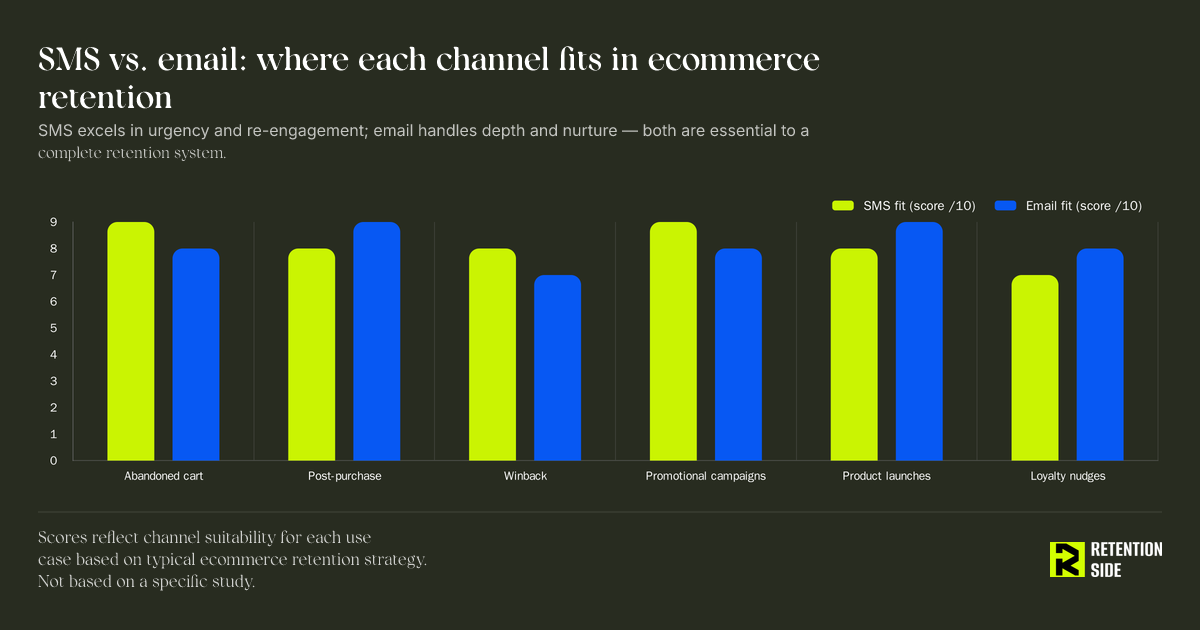
SMS works best when it plays a specific role in a broader retention architecture. That role is urgency and immediacy. Text messages land in a fundamentally different psychological space than email – they interrupt, they demand a response, and they have a short shelf life. That is a feature, not a bug, but only when the message content warrants that level of immediacy.
Email handles depth. Long-form storytelling, product education, loyalty program communication, review requests, browse abandonment nurturing – these work because the customer is in a different mindset when they open their inbox. If you want a clearer picture of how each retention channel fits into the overall mix, the breakdown covers email, SMS, push, direct mail, and loyalty programs and how they interact.
A retention agency that understands SMS will design a contact strategy where both channels are aware of each other. They will suppress SMS sends when a customer already converted on email, coordinate campaign timing across channels, and use customer behavior from one channel to inform the other.
The brands that get the most value from SMS are not running it as a separate silo. They are running it as a coordinated layer within a broader retention system that includes email, and sometimes direct mail, loyalty programs, and push notifications depending on the category.

The four pillars of a properly run SMS channel
The same four pillars that define a well-run email program apply directly to SMS. Any agency worth hiring will have a coherent approach to all four.
Deliverability and compliance
In SMS, deliverability is not primarily about inbox placement algorithms – it is about legal compliance and carrier filtering. Every US-based brand needs to understand 10DLC registration: the requirement that businesses register their brand and messaging campaigns with The Campaign Registry before sending A2P SMS at scale.
Unregistered or poorly registered SMS traffic gets filtered by carriers. An agency that sets you up without walking through 10DLC registration, verifying TCPA-compliant consent collection, and ensuring time-zone-aware sending windows (messages cannot land before 8 AM or after 9 PM in the recipient’s local time zone) is leaving you exposed to carrier filtering and significant legal risk. TCPA violations carry statutory damages of $500 to $1,500 per message.
List growth
The SMS list is a depreciating asset if you are not actively growing it. Unlike email, SMS requires a deliberate acquisition strategy because opt-in rates are lower and consumer intent needs to be clearer at the point of subscription.
A solid list growth approach touches every relevant customer touchpoint: the checkout flow with compliant language, mobile pop-ups, post-purchase pages, email footers that invite SMS opt-in, and loyalty program enrollment. The benchmark for a healthy SMS acquisition rate sits around 1% at the median for eCommerce brands, with strong programs pushing above 2%.
Automation (flows)
SMS flows are triggered messages that fire based on customer behavior. They are the always-on layer of the channel that works between campaigns and across the full customer journey. A properly designed SMS flow architecture covers every meaningful stage of that journey.
Campaigns
SMS campaigns are scheduled broadcasts sent to a defined segment. They drive revenue spikes around product launches, seasonal promotions, and peak shopping periods. Campaigns and flows are equally important to a well-functioning SMS program. Most brands perform best at 2-4 campaign sends per month, with the actual ceiling depending on category, segment size, and how the brand has built its subscriber relationship.
The flows that drive SMS revenue
Not every automated flow is a revenue-generating mechanism. Understanding which flows drive direct revenue – and which serve a different purpose – matters when evaluating an agency’s flow architecture.
Abandoned cart recovery
The abandoned cart flow fires when a customer adds items to their cart but does not complete checkout. The strategic intent is to re-engage someone who has already expressed high purchase intent but encountered friction or distraction. SMS is particularly effective here because the message arrives in a channel that feels personal and immediate. A well-structured abandoned cart flow typically runs 2-3 messages spaced across the first 24-48 hours, with copy that references the specific product the customer left.
Welcome flow
The welcome flow fires after a customer subscribes to SMS for the first time. Its purpose is not just to deliver the opt-in incentive – it is to establish what kind of messages the subscriber should expect, position the brand, and convert a first-time subscriber into a first-time buyer. A well-built welcome sequence typically converts 10-18% of new subscribers into customers.
Post-purchase flow
Post-purchase flows serve two functions: strengthening the relationship immediately after a transaction when trust is at its highest, and creating the conditions for a second purchase. This might include product usage tips, a review request, or a cross-sell recommendation for a complementary product. The tone should feel like a continuation of the purchase experience – helpful and timely, not promotional.
Cross-sell and up-sell flows
These flows fire after a customer’s first purchase, recommending products that complement what they have already bought. The timing and product recommendations should be informed by purchase data – which products tend to be bought together, which SKUs indicate likely interest in an adjacent category.
Winback flow
A winback flow is triggered when a customer has not repurchased within the window where their next purchase was expected. That window is not a fixed date – it is derived from your brand’s actual average order frequency data. For a supplement brand, that might be 45-60 days. For a skincare brand with a longer repurchase cycle, it might be 90-120 days. The flow’s purpose is to re-activate a customer before they are fully lost.
Product-triggered flows
This category includes back-in-stock alerts, price-drop notifications, and replenishment reminders for consumable products. These are particularly powerful for health, beauty, and consumables brands because they leverage purchase-intent signals that are already built into the product category. Postscript’s 2024 SMS benchmark data shows back-in-stock notifications consistently rank among the highest-converting SMS automations across every major eCommerce category.
One worth noting explicitly: the sunset flow is not a revenue-generating flow. Sunset flows remove chronically disengaged subscribers from your list to protect deliverability. They serve an important list hygiene function, but they do not drive revenue. An agency that counts sunset flows among their revenue automations does not understand the distinction.
List growth: where most SMS programs stall
SMS list growth is harder than email list growth. Consumers are more protective of their phone number, opt-in friction is higher, and carriers require explicit consent that passes legal scrutiny. An agency without a clear, actively managed list growth strategy will see the channel plateau quickly.
According to Yotpo’s 2024 SMS data, brands that invested in improving the on-site opt-in experience saw 77% more SMS sign-ups and a 75% increase in pop-up conversion rates – a meaningful signal that acquisition mechanics matter as much as what you send after the fact.
The most effective list growth mechanisms for eCommerce SMS programs:
Checkout opt-in checkbox. The highest-volume capture point for most brands. It must be a checkbox, not a pre-checked default – that distinction matters legally under TCPA.
Mobile pop-ups with a value exchange. Exit-intent or timed pop-ups offering a first-order discount in exchange for SMS opt-in. These work particularly well on mobile traffic, which is the dominant traffic source for most DTC brands.
Post-purchase page capture. After a customer completes an order and lands on the thank-you page, an SMS opt-in prompt converts well because the trust barrier has already been removed.
Email-to-SMS cross-channel promotion. Including an invitation to join your SMS list in email campaigns and flows captures subscribers who are engaged with the brand but have not opted into the faster channel.
Keyword opt-in for social and paid. Running a “text [keyword] to [number]” mechanic in paid social ads creates a list-building pathway for audiences who have not yet reached your website.
A good SMS agency monitors subscriber acquisition rate, not just total list size. The rate tells you whether your acquisition engine is healthy; total size just tells you where you are today.
Compliance and deliverability: the part agencies skip
Compliance in SMS marketing is an ongoing operational discipline. The brands that get into legal trouble are usually not malicious actors – they are brands whose agencies treated consent collection as a one-time setup rather than an ongoing audit responsibility.
10DLC registration. Any A2P SMS sending in the US requires brand and campaign registration with The Campaign Registry. An agency should handle this and verify registration is approved before high-volume sending begins.
Opt-in language. TCPA requires that SMS consent is explicit, separate from other consents, and specific to SMS marketing. Every opt-in touchpoint should be reviewed against this standard. The FCC updated its one-to-one consent rules in late 2024, tightening the requirements around how brands collect and document prior express written consent – making this an area where an agency’s compliance knowledge needs to be current, not just technically correct from a few years ago.
Opt-out mechanics. Subscribers must be able to opt out by replying STOP at any moment. Sending to a STOP list is a violation with no defensible grey area.
Sending windows. Messages cannot be sent before 8 AM or after 9 PM in the recipient’s local time zone. Time-zone-aware scheduling is not optional for multi-state US campaigns.
Carrier filtering. Carrier networks actively filter messages that look spammy – from trigger phrases, excessive promotional language, or high opt-out rates. An agency should monitor carrier filtering rates and adjust copy strategies accordingly.
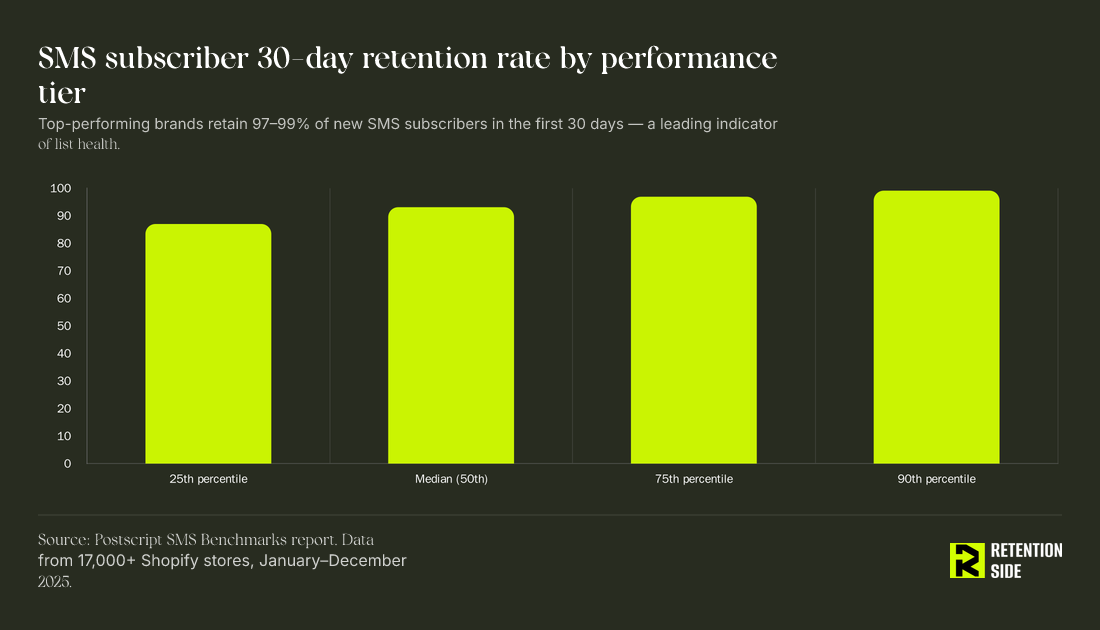
The Postscript benchmark data from over 17,000 Shopify stores shows that the median 30-day subscriber retention rate sits at 93.1%, with top-performing programs reaching 97-99%. That retention rate is a deliverability and relevance signal – it tells you whether subscribers feel the messaging is worth staying for.
What an SMS marketing agency should actually be accountable for
The metrics you track are the metrics your agency optimizes toward. If you let an agency report on open rates and click rates as their primary accountability metrics, you are building a reporting relationship that serves their narrative rather than your business outcomes. This is the same principle that applies to evaluating any ecommerce retention agency – the accountability framework matters as much as the execution.
Returning customer rate. The single most important retention metric. It tells you what percentage of customers make a repeat purchase within a given period. If this number is flat or declining while SMS metrics look good on paper, the agency’s work is not translating to business results.
Revenue attributed to SMS. Not revenue per recipient – total incremental revenue attributed to the SMS channel over a period, tracked at both the flow level and the campaign level. Yotpo’s 2024 data found that across its brand base, SMS flows generated 54% of total SMS revenue while consuming only 14% of the marketing budget – which is why holding agencies accountable to attributed flow revenue, not just campaign output, matters.
List growth rate. Month-over-month net list growth, adjusted for unsubscribes. This tells you whether the acquisition strategy is working and whether the program is building or burning its audience asset.
Deliverability and compliance health. Carrier filter rates, opt-out rates by campaign, and confirmation that 10DLC registration and sending windows are consistently maintained.
Flow-specific conversion metrics. For each automated flow, what percentage of triggered recipients took the desired action – returned to cart, made a purchase, re-engaged? These are conversion metrics with business intent.
Open rate, click rate, and revenue per recipient are not primary KPIs. Open rates in SMS are almost universally high because the channel has inherent urgency – they measure the channel’s nature, not your execution.
How to evaluate and vet an eCommerce SMS marketing agency
The agency market for SMS is noisy. Here is how to separate agencies that know the channel from the ones that are just naming it.
Case studies and verifiable results
Ask for case studies specific to brands in your category and revenue range. You want to see what the starting list size was, what the growth rate looked like over 6-12 months, what flows were built and what they converted at, and how the returning customer rate changed over the engagement period. Vague case studies showing percentage lifts without baseline context are a signal the results are not what they appear.
The metrics they report on
Ask what metrics they include in their monthly reporting. An agency that leads with open rates and click rates is optimizing for optics. An agency that leads with returning customer rate, attributed revenue, and list growth rate is optimizing for outcomes.
Their understanding of the full retention channel mix
A serious SMS agency does not operate in isolation. They should have a clear view of how SMS integrates with email, how the two channels share contact logic, and what role SMS plays at each customer journey stage. Ask them: “If we are already running a strong email program, how does SMS change the contact strategy?” A thoughtful answer reveals whether they understand retention architecture.
If the agency is only running email and calling themselves a retention agency, they are not building you a retention system. If they claim to do everything – paid, SEO, social, email, SMS, push – but SMS is buried under a generalist offering, the operational depth is probably not there either. The distinction between a genuine retention partner and a rebranded email shop is covered in more depth in our breakdown of what an ecommerce retention agency actually does.
At Retention Side, SMS strategy is always designed in coordination with email, and where the category and customer base warrant it, with direct mail, loyalty programs, and push notifications as well. The goal is an interconnected retention system, not a stack of disconnected channel reports.
Their approach to compliance
Ask specifically: “Walk me through your compliance onboarding process for a new SMS program.” If the answer is thin, move on. Compliance competence is binary – the agency either builds it into onboarding or it gets skipped until something goes wrong.
Their collaborative approach with other marketing channels
Ask how the agency shares data with your paid acquisition team. Do they provide audience data that can be used for paid social lookalikes or exclusion lists? Do they flag segments showing early churn signals so your paid team can suppress them from acquisition spend? An agency that operates in a closed loop is leaving significant leverage on the table.
Agency vs. in-house: when each option makes sense
An agency makes more sense when you are launching SMS from zero and want to build it correctly the first time; when SMS is genuinely new territory for your team and the compliance risk justifies experienced hands; or when your team has bandwidth to manage campaigns but not the strategic capacity to build an integrated retention system across two or more channels simultaneously.
In-house makes more sense when you have a retention marketing hire with real SMS experience who has built 10DLC-registered programs before; when the program is already built and performing and you are in an optimization phase; or when your retention team is genuinely integrated with paid, creative, and product in a way that makes cross-channel coordination happen naturally.
The honest reality: most eCommerce brands doing $300k to $1M+ per month do not have dedicated retention hires with deep SMS expertise. The more useful question is not “agency or in-house” but “what would it cost to hire someone with this depth versus retaining an agency that already has the infrastructure and operational systems in place?”
What a mature SMS program actually looks like
A brand that has worked through the full build-out of its SMS program – not just the first 90 days but a mature, optimized system – has a few things in common.
The list is growing consistently every month, with acquisition diversified across checkout, pop-up, post-purchase, and cross-channel touchpoints. The flow architecture covers the full customer journey: welcome, post-purchase, cross-sell, winback, and product-triggered flows for relevant SKUs, each tested against defined conversion benchmarks. Campaigns are coordinated with email, not running in parallel. The segment strategy goes beyond “all subscribers” to VIP, category-affinity, and new-subscriber segments receiving different content and offers.
Compliance hygiene is maintained actively – opt-out lists are clean, 10DLC registration is current, sending windows are enforced by the platform, and opt-in language is reviewed whenever new acquisition touchpoints are added.
And the returning customer rate is tracked as the primary outcome metric. Not just “SMS revenue” in isolation, but SMS as part of a retention system that is measurably moving repeat purchase rates in the right direction. Yotpo’s data shows that over 57% of all SMS purchases were made by repeat customers across its brand base in 2024 – which underscores why SMS, when properly run, is fundamentally a retention channel, not just a broadcast mechanism.
That is the standard worth measuring against when you are evaluating what an SMS marketing agency should be capable of building for your brand.
Conclusion
SMS is a serious retention channel, and the gap between a well-run SMS program and a poorly run one is not small. The poorly run version burns lists, creates compliance exposure, and produces campaign revenue that flatters monthly reports without improving the underlying repeat purchase rate. The well-run version integrates cleanly with your email marketing program, adds urgency and immediacy that email cannot replicate, and systematically moves customers through the journey from first purchase to loyal repeat buyer.
When you are evaluating an eCommerce SMS marketing agency, the questions that matter most are: Can they show you verifiable results for brands like yours? Do they report on outcomes that matter – returning customer rate, attributed revenue, list growth – or on metrics that tell you almost nothing? Do they understand how SMS fits into a broader retention system? And do they lead with compliance?
Those questions sort the category fast. The agencies that answer them well are building real retention systems. The ones that cannot are running text message campaigns and calling it retention marketing.
At Retention Side, SMS is one layer in a retention system designed to move repeat customer rates in the right direction – built alongside email, and coordinated with whatever other channels your brand and category warrant.