

Most Shopify brands at meaningful revenue share the same structural gap. Acquisition is working. The product is strong. But a large share of buyers never return – and every month restarts from zero. Revenue climbs. Customer lifetime value stays flat. The math never fully works.
Increasing repeat purchases on Shopify is not a campaign problem or a creative problem. It is a systems problem. The brands with growing repeat rates are not running smarter promotions – they are building deliberate infrastructure that turns the window after a first purchase into the starting point of a customer relationship, not the end of a transaction.
This article covers what that infrastructure actually looks like: the strategic logic behind each tactic, how the key channels interact, what the benchmarks really mean, and why Shopify in 2026 remains the platform where this system is most efficiently built.
Key takeaways
- After a first purchase, a customer has roughly a 27% chance of buying again. Once they make a second order, that probability roughly doubles. Everything you invest in earning that second purchase compounds forward.
- Increasing repeat purchases is a systems problem, not a campaign or discount problem. Brands with flat repeat rates almost always have a structural gap, not a creative one.
- Email via Klaviyo is the most practical starting point – structured around four pillars: deliverability, list growth, automated flows, and campaigns. All four matter equally.
- The metrics that actually tell you whether retention is working: returning customer rate, revenue attributed to retention channels, average time between orders, and flow-level conversion rates. Not open rate or click rate.
- Repeat purchase rate benchmarks differ significantly by category. A supplement brand at 25% has a problem. A furniture brand at 25% is likely performing well. Never apply a cross-category average to a category-specific business.
- Shopify is still the right platform for the overwhelming majority of DTC brands in 2026 – but Shopify alone is not a retention system. The retention system is what you build on top of its data.
What we’ll cover
- Why the second purchase is the most important purchase in your entire lifecycle
- What Shopify’s repeat purchase rate actually measures – and where most brands misread it
- The foundational conditions that have to exist before tactics can work
- 10 proven strategies to increase repeat purchases on Shopify
- How to build the email program that powers the system (the four pillars)
- Repeat purchase rate benchmarks by category – and how to use them correctly
- Is Shopify still worth it in 2026?
- The metrics to track (and the ones to stop tracking)
Why the second purchase changes everything
After a customer’s first order, their probability of buying again sits at around 27%. That number alone isn’t encouraging. But it contains the most important structural insight in ecommerce retention: get that customer to a second purchase, and the probability of a third roughly doubles to around 54%. By the fourth order, the customer is approaching 70%+ likelihood of ordering again.
The compounding effect is the whole game. A customer on their sixth order is not just loyal – they are structurally different from a one-time buyer. Their acquisition cost is effectively zero. Their average order value is higher. Their lifetime value is multiples of someone who ordered once and never returned. They are significantly more likely to refer someone else.
This means the single highest-leverage moment in your entire customer lifecycle is the window between first and second purchase. What you do in that window – how you communicate, what you teach them, how you introduce the rest of your catalog – largely determines which direction each customer goes.
Most Shopify brands spend almost nothing on this window. An order confirmation goes out. A shipping notification follows. Then silence – until the next promotional campaign. The moment passes. The customer drifts. The compounding that should have started never does.
A brand with a real repeat purchase system does something entirely different.
What repeat purchase rate actually measures on Shopify
Before building strategies to improve it, it is worth understanding exactly what Shopify is measuring – and where the common misread happens.
Shopify’s native analytics dashboard displays a metric called “Returning Customer Rate.” Many operators assume this is their repeat purchase rate. It is not. Shopify’s Returning Customer Rate is session-based – it counts the number of store sessions from returning visitors divided by total sessions. A customer who visits five times but only buys once can inflate this number significantly, while the actual repeat purchase rate stays flat.
The true repeat purchase rate is calculated from order data: the number of customers who placed at least two orders within a defined period, divided by the total number of unique customers in that same period. This has to be calculated manually from exported customer data or tracked in Klaviyo’s reporting layer, where purchase history is directly accessible.
The lookback window changes the number dramatically. A 30-day repeat rate will almost always be lower than a 365-day rate for the same brand. Both figures are accurate – they measure different things. The 30-day window reflects recent retention activity and near-term campaign performance. The 365-day window reflects cumulative loyalty built over time. Tracking both gives a fuller picture.
The cross-vertical average for Shopify stores sits at approximately 27-28%, based on StoreGrowers’ 2026 panel and aligned with Bluecore’s benchmark data. But that average is only useful as a floor check – if you’re well below it in a replenishable product category, there is likely a structural retention problem. Using it as a target across all categories is a category mistake.
The foundational conditions that have to exist first
Every tactic in this article depends on three things being true. Skipping them and jumping to campaigns is the most common reason repeat purchase programs underperform.
A genuine reason to come back. The most uncomfortable question in retention: does your customer actually have a reason to repurchase within a reasonable timeframe? If your product is consumable – supplements, skincare, coffee, cleaning products – the answer is yes, and your job is to time outreach around the repurchase window. If your product is durable or seasonal, the path to repeat purchase runs through cross-sell. A single high-quality item with no adjacent catalog cannot be retained into – no email system or loyalty program will solve a product-level gap.
A purchase experience worth remembering. Repeat buying is driven by positive emotional memory. If the experience of ordering was forgettable – standard packaging, no communication between order and delivery, a generic confirmation – there is nothing to return to emotionally. The window between purchase and delivery is one of the most neglected moments in ecommerce. Customers are at peak engagement right after buying. Going quiet during that window and reappearing six weeks later with a promotional email breaks momentum before the relationship starts.
Product education that creates confidence. A customer who fully understands how to use your product and gets genuine results is far more likely to repurchase. Education is not a one-email onboarding sequence. It is a deliberate communication strategy built around helping customers extract maximum value from what they already bought – and it reduces returns, improves satisfaction scores, and makes the next purchase feel like a natural continuation rather than a new acquisition event.
10 strategies to increase repeat purchases on Shopify
1. Build a post-purchase sequence that actually engineers the second purchase
The most common version of a Shopify post-purchase flow is two or three emails: order confirmation, shipping update, maybe a review request three weeks later. That structure is better than nothing. It is nowhere near what the post-purchase window can do.
A mature post-purchase sequence is 4-6 emails across the first 30 days after purchase. Each email has one primary job. The sequence as a whole moves the customer from “just bought” to “actively using and satisfied” to “ready for the next purchase.” The architecture looks like this:
- Email 1 (order confirmation): Reinforce the purchase decision, set expectations for what arrives in the inbox next. Leave out discount codes and cross-sell offers – the transaction mindset is winding down and adding commercial steps here creates dissonance.
- Email 2 (shipping/pre-arrival): Confirm logistics, but use the surface area for pre-arrival product context that builds anticipation and reduces first-use friction.
- Email 3 (product education, post-delivery): The most underinvested email in most Shopify programs. For consumables: usage protocol and expected results timeline. For considered purchases: advanced use cases and features. For apparel: styling and care. The goal is creating a habit around the product before the repurchase window opens.
- Email 4 (cross-sell): Introduce complementary products based on actual purchase behavior data from your Shopify order history – not category assumptions or editorial guesswork.
- Email 5 (review request): Timing matters more than most brands realize. A review request that arrives before the customer has used the product gets lower-quality responses and misses the satisfaction peak. Aim for 10-21 days post-delivery depending on your product’s usage cycle.
- Email 6 (second purchase bridge): An explicit, well-framed path to the next order while the positive association with the first purchase is still fresh. For replenishable products: a replenishment reminder timed to the actual consumption window. For non-replenishable products: a catalog introduction framed around what customers who bought this tend to buy next.
The post-purchase flow is never finished. Copy goes stale. Catalog changes create broken cross-sell logic. Incentive structures that worked at one revenue level may not make sense at another. Regular auditing and continuous testing are what separate a post-purchase system that compounds from one that plateaus.
2. Build dedicated cross-sell and upsell flows
Cross-sell and upsell flows deserve their own architecture, separate from the general post-purchase sequence. They are triggered after purchase and designed to expand the customer’s product footprint based on what they actually bought – not what you think they should want next.
The most effective cross-sell flows are built on real Shopify purchase co-occurrence data: if customers who buy product A consistently also buy product B within 60 days, that relationship should be built into a flow. Klaviyo’s product analysis report can surface these purchase-pair patterns directly from your Shopify order history.
The timing for cross-sell sends matters. Too early – in the order confirmation or shipping email – and the customer is still in the transaction wind-down phase. Too late – 30+ days post-purchase – and the commercial mindset that makes cross-sell easier to convert has dissipated. The sweet spot for most product categories is 5-10 days after estimated delivery.
The framing matters too. “Customers who bought X also love Y” lands fundamentally differently than “buy more of our products.” One is social proof. The other is a sales push. In a post-purchase context where the customer relationship is at its warmest, how you frame the recommendation shapes whether it converts.
3. Calibrate win-back flows to your actual repurchase cycle
A win-back flow triggers when a customer’s gap since their last purchase approaches their expected repurchase window – based on your brand’s average order frequency data – but they haven’t reordered. The strategic intent is re-engaging a drifting customer while they are still reachable, before they fully disconnect.
The critical variable is timing. Most brands set win-back triggers at 90 or 180 days by default. For a brand whose average repurchase interval is 35 days, a 90-day win-back is arriving months after the customer has already reordered from someone else. The flow needs to be calibrated to your brand’s actual purchase interval – pull your order history, calculate the median and 75th-percentile repurchase intervals, and set the trigger at a point where a customer’s absence is meaningfully above their normal pattern.
For most Shopify brands with replenishable or semi-replenishable products, the relevant win-back window is well within 90 days. Categories with very long natural buying cycles – furniture, high-end electronics, specialty outdoor equipment – are the exception. The flow’s messaging should acknowledge the gap, reconnect with the customer’s original reason for buying, and offer a genuine, compelling reason to return – not just a discount.
4. Set up abandoned cart recovery with real sequence logic
Baymard Institute’s research consistently puts average cart abandonment above 70% — Statista’s 2026 global data confirms the rate at 70.22%. Most of those shoppers showed genuine purchase intent. A well-built abandoned cart flow recovers meaningful revenue that otherwise disappears – but the gap between a generic reminder email and a properly structured sequence is significant.
The first email in the sequence should go out within one to two hours of abandonment while intent is still warm. The sequence as a whole should address the specific friction likely behind the abandonment: shipping cost anxiety, product uncertainty, distraction, trust gaps. Branching the flow by cart value, purchase history, and product type allows the messaging to address different abandonment reasons rather than sending the same generic reminder to every profile.
An incentive in the cart sequence is often appropriate. Only a small percentage of visitors trigger the flow, and proper filtering prevents overlap with other sequences. The incentive’s job is to remove the activation energy of the purchase – not to condition the entire customer base to abandon carts and wait for a discount. Gating the incentive to the second or third email in the sequence rather than leading with it produces better outcomes on full-price purchasing behavior over time.
5. Build welcome flows that convert subscribers into first-time buyers
The welcome series is not an incentive delivery mechanism. Its job is to build the case for a first purchase – establishing brand voice, communicating product value, handling common pre-purchase objections, and using any zero-party data collected at signup to personalize from email one.
Zero-party data collected at the moment of signup – product preferences, purchase intent, relevant category information – is what powers personalization across the entire lifecycle from the start. When a subscriber actively shares what they’re looking for before the welcome series begins, every flow and campaign that follows can be more relevant from day one. Most Shopify brands collect an email address and nothing else. Brands that ask a simple preference question at signup generate list data that compounds in value across every subsequent touchpoint.
The lead-to-customer rate is the metric that matters here – not form submission rate. Of the new subscribers who joined the list in a given month, what percentage made a purchase within a defined window? A smaller list with a high lead-to-customer rate outperforms a larger list of low-intent subscribers on every meaningful measure, including deliverability, campaign engagement, and repeat purchase rate over time.
6. Run campaigns that build relationships, not just promotions
The most damaging mistake brands make with campaigns is reducing them to a promotional calendar. A send schedule built entirely around discount events does two things over time: it trains subscribers to wait for offers before buying – eroding full-price purchasing – and it degrades deliverability as engagement outside sale windows drops.
A more durable campaign strategy alternates promotional sends with educational and value-driven content. Product education, usage tips, behind-the-scenes content, customer stories, seasonal context that isn’t purely commercial – these sends don’t always produce immediate revenue, but they maintain engagement and keep the brand top of mind between purchase cycles. Subscribers who hear from a brand only when it wants something from them develop very low engagement over time, and low engagement eventually becomes a deliverability problem.
Campaign segmentation by lifecycle stage is also non-negotiable at any meaningful scale. Active buyers need messages that acknowledge their existing relationship with the brand. Subscribers who have never purchased need a different approach. VIP customers warrant different treatment than first-time buyers still evaluating whether to return. The list is never one audience.
7. Introduce a loyalty program as a structural retention layer
A loyalty program is not a communication channel. It is a retention structure – a reason for customers to stay engaged between purchases and a behavioral incentive to consolidate spending with your brand rather than spreading across competitors.
According to Growave’s 2025 loyalty report across 100+ Shopify brands, customers who actively redeem loyalty points show a repeat customer rate of 50%, versus just 10.7% for non-redeemers — a 2.5x difference that goes well beyond the effect of any single email flow. Smile.io’s 2025 State of Loyalty report, which analyzed over 585 million orders across 100,000 merchants, found loyalty-generated value grew year over year in every major commerce category.
The programs that actually move retention metrics go beyond basic points-per-dollar structures. Tiered status gives customers something to progress toward. Experiential rewards that go beyond discounts. Event-based incentives like double points or early access that create urgency around specific moments. The psychological driver matters: once a customer has accumulated points or reached a tier, leaving means walking away from value they have already built. That anchoring effect is a retention lever that no email sequence can replicate on its own.
Loyalty programs also feed data back into the entire retention stack. Email reminders about points balances. SMS alerts when a customer is close to a reward threshold. Campaign sends tied to loyalty milestones. When the loyalty program is integrated with the communication channels, the entire retention system becomes more cohesive and generates compounding engagement.
One practical constraint: loyalty programs make financial sense when you have enough customers at each spend tier for the program to generate positive ROI. If the customer base is thin at key tiers, fix the fundamentals of the repeat purchase system first.
8. Use direct mail as a precision tool for high-value segments
As digital inboxes have become noisier, the physical mailbox has become quieter. A well-designed postcard can sit on a customer’s counter for days. A premium insert gets handled multiple times. These are touchpoints that digital channels cannot replicate.
The use cases that justify direct mail costs in an ecommerce retention system are specific: win-back campaigns for lapsed high-LTV customers who have stopped responding across all digital channels; premium thank-you cards for high-AOV first-time buyers; personalized offers for customers approaching a loyalty tier; reactivation of VIP segments that have gone quiet. The cost per piece ($0.30 to $3 depending on format and volume) makes direct mail a precision tool, not a broadcast mechanism.
Applied to the right segments at the right moments, direct mail creates a physical impression that compounds the brand’s overall retention effort – and reaches customers that email, SMS, and push have already failed to re-engage.
9. Add SMS and push notifications where behavior supports it
SMS is high-intent and time-sensitive. Text messages get read within minutes, which makes the channel effective for flash sale notifications, back-in-stock alerts, shipping updates, and cart recovery where speed matters. SMS lists are typically smaller than email lists because the consent bar is meaningfully higher – most brands see SMS opt-in rates at 20-30% of their email list size. That constraint is actually what makes it powerful: the people who opted in genuinely want to hear from you.
Frequency matters more in SMS than in any other channel. Overuse burns through subscriber goodwill faster, and the opt-out is permanent. Use SMS for moments where urgency is genuine – not as a parallel email channel.
Push notifications extend retention reach to customers who respond better to on-screen prompts than inbox messages. They work well as light nudges for cart abandonment, price drops, and restock alerts. The risk is notification fatigue: once a customer disables push, that channel is closed permanently.
Both channels earn their place based on audience behavior and communication preferences, not because they’re available in the tool stack. If your customers are not responding to SMS, adding more SMS sends adds cost and complexity without adding reach.
10. Fix the Shopify-Klaviyo data layer before adding more tactics
This is the most overlooked strategy on this list – and the one with the highest leverage if your retention system already has some of the other pieces in place.
Klaviyo reads behavioral events from your Shopify store in real time: “viewed product,” “checkout started,” “placed order,” “order fulfilled,” “predicted next order date.” These events are what allow flows to trigger intelligently rather than just sending time-delayed emails. If the integration has gaps – events not firing consistently, properties not mapping to profile fields, purchase data not flowing cleanly – the automation layer is compromised in ways that generate no error messages. The flows look like they’re running. The logic is acting on incomplete data.
Common silent gaps: browse abandonment flows that miss triggers because “viewed product” events aren’t tracking reliably; win-back flows running on default calendar timing because historical purchase frequency data isn’t configured; zero-party data collected at signup not mapping to the profile properties that get used in downstream segmentation.
Before layering more channels or tactics onto a retention system, verify the integrity of the data connection. Run a test purchase and browse session. Confirm every expected event is appearing in Klaviyo profiles. That diagnostic hour of work is worth more to the compounding performance of the system than most tactical additions.
How the email program powers all of it
Every strategy above depends on the email channel functioning across all four of its core pillars. A weakness in any one limits what the others can produce.
Deliverability: the silent prerequisite
Delivery and deliverability are not the same thing. Delivery means the email was technically accepted by a receiving server. Deliverability means it landed in the primary inbox – not spam, not promotions – where a real person actually sees it. A brand can have a 99% delivery rate and still have 40% of sends routing to spam.
The signals that determine inbox placement – authentication records (SPF, DKIM, DMARC), sender reputation, list hygiene, and send consistency – require ongoing management, not a one-time setup. Google’s bulk sender requirements, enforced from February 2024, make proper authentication mandatory for any sender exceeding 5,000 daily sends to Gmail addresses. Spam complaint rates need to stay below 0.10% as measured in Google Postmaster Tools. Starting November 2025, Gmail began ramping up enforcement on non-compliant traffic, with messages that fail sender requirements experiencing temporary and permanent rejections. These are the floor conditions for every other piece of the retention system to function.
Chronic non-engagers drag down sender reputation across the whole list. Erratic volume spikes before major sales events create noise that inbox providers flag. Hard bounces need immediate suppression. Deliverability management is not glamorous work – but without it, every other element of the repeat purchase strategy operates at a fraction of its potential.
List growth: quality, not volume
The subscriber count on an email list is one of the least meaningful metrics you can track. What matters is the quality of who is on it – specifically, how many of them actually buy.
Lead-to-customer rate is the KPI: of the new subscribers who joined the list in a given month, what percentage made a purchase within a defined window? A 20% off popup that fires on every page for every visitor will grow a list quickly. It will also capture a significant volume of low-intent subscribers who inflate numbers, weaken deliverability, and never buy. A better-designed form – triggered on scroll depth or exit intent, with an incentive calibrated to your margins – builds a smaller but commercially valuable list.
Automation (flows): the always-on retention engine
Automated flows are behavior-triggered email sequences that fire in response to specific customer actions. When they cover the full customer lifecycle, they generate repeat purchase revenue continuously – without anyone manually hitting send.
The core flows every Shopify brand at meaningful scale needs built, maintained, and actively tested: welcome series, browse abandonment, abandoned cart, post-purchase sequence, cross-sell and upsell flows, and win-back flow. Each of these has a specific job at a specific moment in the customer journey. Building them with that framing changes what you build, how you sequence emails within each flow, and what you test.
Flows are never finished. They need regular auditing, creative refresh cycles, and continuous A/B testing. A flow built 18 months ago without meaningful revision is almost certainly underperforming.
Campaigns: the relationship layer
Campaigns are manually planned sends to defined segments – covering promotional calendars, product launches, seasonal moments, and the relationship-building content that keeps the brand meaningful between purchase cycles. Campaigns and flows are equally important. Neither substitutes for the other.
The campaign calendar should balance promotional sends with educational and editorial content. If subscribers only hear from the brand when it wants something from them, engagement and full-price purchasing decline over time. That decline is slow enough that it often gets misread as “email just doesn’t work anymore” – when the real cause is a campaign strategy that has conditioned subscribers to wait for discounts.
Repeat purchase rate benchmarks by category
The cross-vertical average for Shopify stores sits at approximately 27-28%. That figure is only useful as a floor check. The spread underneath it is enormous, and applying a cross-category benchmark to a category-specific business leads to the wrong diagnosis and the wrong investment decisions.
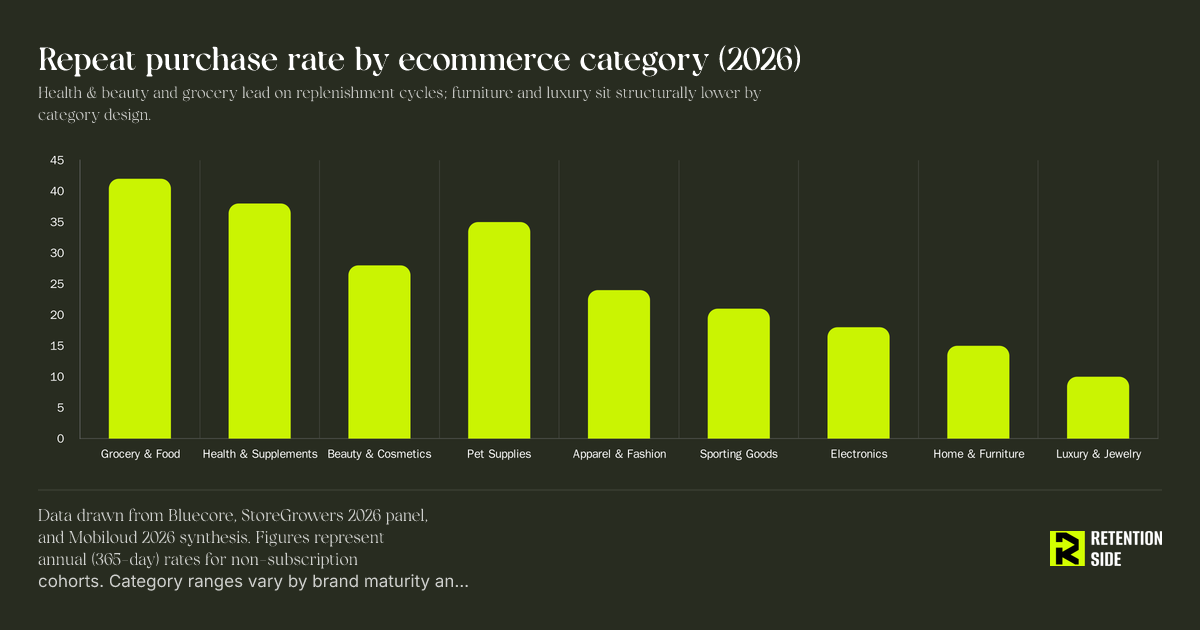
Health and beauty – supplements, skincare, haircare – structurally produces the highest repeat rates because products are consumable. Customers run out and need to reorder. The retention job here is ensuring they reorder from your store rather than a competitor’s. According to RetentionLab’s 2026 DTC benchmark analysis, supplements and wellness brands have a median 12-month repeat purchase rate of 38-52%, with top-quartile performers reaching 64%. A rate below 35% in supplements warrants real attention.
Food and beverage follows a similar replenishment logic, sometimes with shorter cycles in specific sub-categories. Subscription structures are common in this space and significantly alter the rate if subscription revenue is included in the calculation.
Apparel sits in the middle range. Repeat purchasing here depends more on brand affinity and the quality of the post-purchase experience than on product replenishment cycles. Catalog breadth and effective cross-sell architecture matter a great deal.
Sporting goods and outdoor equipment tend to sit lower – purchases are more considered, product lifespans are longer, and category switching is less frequent. A rate in the low-20s can represent genuine retention strength in this category.
Furniture and home decor have structurally long repurchase cycles by the nature of the product. A 10-15% repeat rate in furniture can represent strong lifecycle performance. Applying standard benchmarks to this category is an analytical error that any serious retention partner should recognize immediately.
What matters most is directional movement relative to your own baseline. Is your repeat purchase rate improving quarter over quarter? Is the average time between orders shortening? Those directional signals tell you whether the retention system is working – regardless of what any external benchmark says.
Is Shopify still worth it in 2026?
This question comes up regularly from brands evaluating whether a replatform makes sense. The honest answer in 2026: yes, for the vast majority of DTC brands – but the platform choice is less consequential than what you build on top of it.
According to Marketplace Pulse’s February 2026 analysis, Shopify now claims a 14% share of US ecommerce (up from 12% the prior year), with Amazon and Shopify together accounting for roughly 50% of the US ecommerce market. It processed 489 million peak requests per minute during BFCM 2025 without infrastructure issues. The uptime record is real. The ecosystem of Shopify-native apps – including Klaviyo, loyalty platforms, review tools, and direct mail integrations – is unmatched in depth and quality for DTC brands.
From a retention system standpoint, Shopify’s value is in the behavioral data it generates continuously: checkout events, product views, order history, predicted next order dates. This data, flowing cleanly into Klaviyo, is what makes intelligent lifecycle automation possible. The Shopify-Klaviyo integration is the most battle-tested stack in DTC ecommerce, and the combination gives a brand access to the segmentation depth, behavioral automation capability, and flow logic that retention systems require.
The practical assessment by scale:
- Under $10M GMV: Shopify is the default right choice. Lowest setup friction, fastest path to a properly configured retention stack, full Klaviyo integration.
- $10M-$50M GMV: Shopify Plus makes sense above approximately $80K/month in online sales. The Checkout Extensibility, B2B Catalogs, and Shopify Functions capabilities pay for the upgrade through conversion and operational gains at that volume.
- Above $50M GMV: Shopify Plus handles the overwhelming majority of brands at this scale. Only genuine custom complexity – uncommon – justifies evaluating composable alternatives.
The one legitimate caution: Shopify’s total cost of ownership goes up meaningfully with app subscriptions. A $39/month Shopify plan can become $1,000-$2,000/month with the apps needed to run a serious retention stack. Budget for the full stack, not just the platform fee.
Replatforming at any stage resets SEO equity and operational momentum. Unless there is a capability the brand genuinely lacks and cannot solve within Shopify, switching costs – in developer time, SEO recovery time, and operational disruption – almost always outweigh whatever is being gained.
What to measure (and what to stop measuring)
Most email platforms surface open rate and click rate as primary performance indicators. They are useful diagnostic signals – helpful for identifying problems with subject lines or specific content – but they do not measure whether the retention system is actually building the business.
Metrics that matter:
Returning customer rate is the most direct measure of whether retention work is actually working. If this number is not moving in the right direction over a 3-6 month window despite investment in retention channels, the system has a structural problem.
Revenue attributed to retention channels tells you what email, SMS, and other owned channels are contributing to total Shopify store revenue. Attribution in retention is never perfectly clean – cross-channel assists are real and meaningful – but the directional trend tells you whether the system is earning its investment.
Average time between orders is one of the most powerful signals available to any brand with a replenishable product. If the average gap between first and second purchase is shortening month over month, the post-purchase and cross-sell sequences are doing their job.
List growth rate paired with lead-to-customer rate. A list that grows in volume but not quality is a deliverability liability. What matters is whether subscribers are converting to customers – and at what rate.
Flow-level conversion rates for each core automation: what percentage of customers entering the post-purchase sequence make a second purchase within 60 days? What is the win-back flow conversion rate? These granular metrics tell you which parts of the automation layer are working and which need attention.
Deliverability indicators – inbox placement rate, spam complaint rate, hard bounce rate – are the early warning system. By the time inbox placement has visibly degraded, months of list health damage may already have accumulated.
Metrics to stop using as accountability measures:
Open rate, click rate, and revenue per recipient are not strategy-driving metrics. They measure activity in isolation from business outcomes. An agency or internal team that leads every performance conversation with open rates is optimizing for the wrong thing.
Common reasons repeat purchase rates stay flat
When brands invest in retention but the number doesn’t move, the root cause is almost always one of these:
Lifecycle coverage gaps. Flows are present but don’t cover the full customer journey. There’s a welcome series and an abandoned cart flow, but no meaningful post-purchase sequence, no cross-sell architecture, and a win-back flow triggered so late it rarely catches anyone. The moments where the brand could most influence a second purchase are either not automated or automated with thin, generic content.
Campaign strategy built on discounts. A customer base that only hears from a brand when there’s a sale learns to wait for sales. Full-price purchasing drops. Engagement outside promotional windows deteriorates. Deliverability follows. This is a slow structural erosion that often gets misread as “email just doesn’t work anymore.”
Flows were built once and never revised. A post-purchase sequence written at launch with old offers, old copy, and a product catalog that has since expanded is not doing the job it could do. Static automation decays.
The performance drop is not an email problem. A decline in repeat purchase rate is not always caused by a problem in the email channel. It may reflect lower-intent customers from a new ad campaign who were never likely to return. It may reflect a website issue affecting the purchase experience. It may reflect a product quality problem showing up in post-purchase satisfaction. Diagnosing root cause before rebuilding the email strategy prevents misdirected effort.
Channels running in silos. Email, SMS, and push are all active, but none of them know what the others are doing. A customer who received a win-back email three days ago receives a standard promotional campaign the same week. The result is message overlap, competing offers, and a fragmented experience that reads as disorganized rather than attentive.
Degraded deliverability. Flows and campaigns are firing, but inbox placement has deteriorated. Revenue looks flat not because the strategy is wrong but because the emails aren’t getting through. This is the hardest problem to diagnose without deliberate monitoring, because the symptoms look identical to poor content performance.
Building the system, not just running tactics
The brands that consistently improve their repeat purchase rate share one operational characteristic: they treat retention as infrastructure, not a list of campaigns to run.
Infrastructure means flows that run automatically and get better over time. A list that grows in quality, not just volume. Campaigns that build the relationship between promotions. Channels that are coordinated around a shared understanding of where each customer is in their lifecycle. Metrics that measure business outcomes – returning customer rate, revenue attributed to retention channels, average time between orders – rather than activity signals.
It also means understanding that the retention system doesn’t operate in isolation. Acquisition traffic quality shapes who enters the list. Website conversion quality determines what percentage of subscribers reach the post-purchase stage. Product satisfaction determines whether first-time buyers have a reason to come back. A retention system that never asks these upstream questions is optimizing within constraints it doesn’t acknowledge.
At Retention Side, the entry point into every Shopify engagement is email via Klaviyo – because that’s where the most immediate, measurable retention lift comes from. How the system builds from there – into SMS, push notifications, direct mail, loyalty programs, WhatsApp, or Viber – depends entirely on what the customer behavior data indicates, not a standard expansion checklist.
The goal is a retention system that compounds. More customers coming back. Coming back sooner. Spending more. And making the unit economics of acquisition more efficient because the customers already in the database are generating value without requiring additional acquisition spend.
Conclusion
Increasing repeat purchases on Shopify is not a creative problem. It is a systems problem – one that requires getting the foundational conditions right, building the email channel across all four of its core pillars, automating the moments in the customer lifecycle where communication has the most impact, and coordinating that communication across channels in a way that feels intentional rather than automated.
The brands that solve this problem grow differently from the ones that don’t. Their margins improve as repeat buyers reduce the need for constant new customer acquisition. Their LTV grows. Their paid acquisition becomes more efficient because they can afford to bid higher when customers actually come back.
Shopify in 2026 remains the right platform for the overwhelming majority of DTC brands – not because of what it does for retention directly, but because of the behavioral data it generates and the ecosystem it enables. The Shopify-Klaviyo stack is still the most battle-tested combination for building lifecycle automation at scale. What the platform cannot do is build the system for you.
If your Shopify repeat purchase rate has been flat despite investment in email and other retention channels, the issue is almost certainly structural. A gap in lifecycle coverage, a campaign strategy that has trained customers to wait for discounts, flows that were built and never meaningfully improved, or a data layer with silent gaps that are quietly undermining the automation logic. That is the kind of problem a properly built retention system closes.
If you want to understand what that system looks like for your specific brand and customer base, that is exactly what Retention Side is built to work through.