

Executive Summary: Beauty Retention Is Becoming Routine Ownership
There is no shortage of beauty brands.
What there is a shortage of is customers who stay.
Beauty and skincare brands are still operating in a category with strong demand, strong online growth, and strong emotional purchase behavior. McKinsey expects online channels to account for nearly one-third of global beauty sales by 2030, up from 26% in 2024. NIQ also reported strong global beauty growth in 2025, with online beauty sales growing much faster than in-store sales.
But category growth does not automatically create profitable brand growth.
The problem is that the first purchase is becoming harder and more expensive to win, while the second purchase is still poorly managed by many beauty brands. A customer may discover a product through TikTok, Instagram, YouTube, a creator, Sephora, Amazon, a friend, or a before-and-after video. But the customer only becomes valuable when the product moves from trial into routine.
Retention Side analyzed beauty and skincare eCommerce through the lens of customer retention, repeat purchase behavior, lifecycle marketing, customer education, loyalty, subscription, replenishment, and post-purchase systems.
The main finding is simple:
Beauty retention is no longer only about replenishment. In 2026, the strongest brands will win by turning one-time buyers into routine users.
A replenishment reminder can bring a customer back when the timing is right. But a routine creates a stronger reason to stay. Once a customer trusts a cleanser, serum, moisturizer, SPF, shampoo, or bodycare product inside their routine, switching becomes harder. They are not just replacing a product. They are disturbing a system that already works for them.
That is the retention advantage beauty brands should be building toward.
Key Findings
| Finding | Strategic meaning |
|---|---|
| Beauty retention is shifting from replenishment to routine ownership | Brands need to build habits, not only send reorder reminders. |
| The second purchase is the most important early retention milestone | First purchase shows interest, second purchase shows trust. |
| Product education directly affects repeat purchase | Customers are more likely to return when they understand usage, timing, and expected results. |
| Generic replenishment timing is hurting performance | Skincare, cosmetics, haircare, bodycare, and fragrance do not share the same buying cycle. |
| Product match is a retention issue, not only a conversion issue | If the first product is wrong, the customer is unlikely to return. |
| Discount-led acquisition can weaken full-price retention | Customers acquired through discounts often need value reinforcement before the second purchase. |
| Loyalty works best when it rewards behavior, not just spend | Reviews, referrals, routine milestones, and repeat behavior matter more than points alone. |
| Subscription should be introduced after trust is created | Pushing subscription too early can increase cancellation and weaken customer confidence. |
| Quiz data is wasted if it only affects the first purchase | The real value comes when quiz answers influence post-purchase education and cross-sell. |
| Retention should influence merchandising | The best teams use retention data to understand which products create repeat customers. |
Beauty & Skincare eCommerce in 2026
Beauty is one of the strongest eCommerce categories, but it is no longer an easy category.
The market is growing. NIQ reported that beauty sales grew 10% over the previous 12 months in its 2025 State of Beauty release, with online beauty sales growing nine times faster than in-store sales. NIQ’s 2026 State of Beauty report also described digital-first and AI-influenced commerce as major accelerators in global beauty purchasing behavior.
At the same time, competition is becoming more fragmented. Customers are not discovering beauty brands in one place. They are moving across TikTok, Instagram, YouTube, creator storefronts, Amazon, Sephora, Ulta, Google, brand websites, Reddit, ingredient education content, and review platforms.
A customer might discover a serum on TikTok, check reviews on Sephora, compare ingredients on Reddit, watch a dermatologist explanation on YouTube, then buy from the brand site only if the experience feels trustworthy enough.
That makes beauty a high-opportunity category, but also a high-pressure category.
Why Beauty Growth Is Harder to Capture
The pressure comes from five places:
- More product choice – Customers have more alternatives than ever.
- Creator-led discovery – Competitors can reach your customers every day.
- Ingredient awareness – Customers are more skeptical of vague claims.
- Discount exposure – Customers are trained to expect offers.
- Channel fragmentation – Brands need owned channels to protect the customer relationship.
This is why retention matters more now.
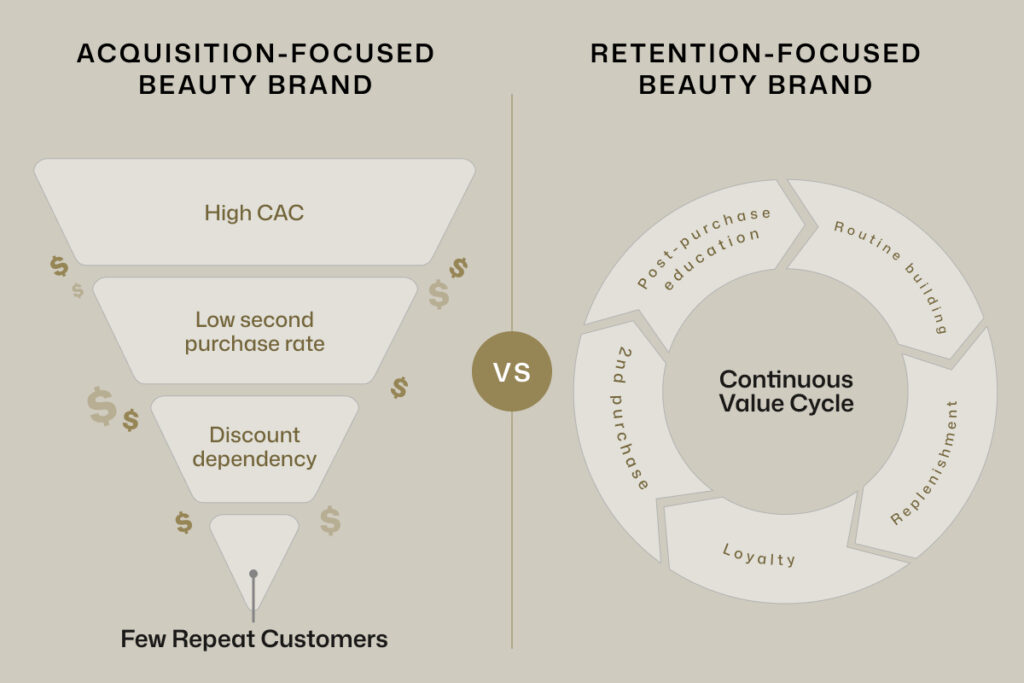
A beauty brand can still grow through acquisition, but it cannot rely only on acquisition. If every month depends on finding new first-time buyers, the brand is exposed to paid media costs, creative fatigue, platform changes, discounting, and competitor noise.
The stronger model is different.
Acquire customers.
Educate them.
Help them use the product correctly.
Guide them toward the second purchase.
Build a routine.
Time replenishment properly.
Use loyalty and subscription only when they improve the customer experience.
That is the difference between revenue growth and durable customer value.
Why Retention Works Differently in Beauty
Beauty is not one category from a retention perspective.
Skincare, cosmetics, haircare, bodycare, fragrance, and wellness-adjacent beauty products all behave differently. They sit under the same industry umbrella, but they do not share the same purchase logic.
A moisturizer may be used every day and repurchased predictably. A foundation may repeat only if the shade and finish are right. A shampoo may repeat if it solves a specific hair concern. A fragrance may have lower purchase frequency, but stronger emotional and gifting behavior. A serum may require education before the customer believes it is working.
That means one generic retention strategy will not work across the whole category.
| Beauty category | Main retention driver | Main retention risk | Best retention angle |
|---|---|---|---|
| Skincare | Routine, results, replenishment | Slow results, wrong expectations, irritation | Education, result timeline, routine building |
| Cosmetics | Product fit, shade match, self-expression | Wrong shade, trend fatigue, low loyalty | Tutorials, UGC, shade guidance, product pairings |
| Haircare | Problem-solution, consistency, correct usage | Misuse, unrealistic expectations, poor diagnosis | Usage guidance, concern-based segmentation |
| Bodycare | Habit, scent, replenishment | Weak differentiation, low urgency | Routine reminders, bundles, sensory storytelling |
| Fragrance | Emotion, identity, gifting | Lower natural purchase frequency | Discovery sets, gifting flows, occasion-based campaigns |
This is where many brands get retention wrong.
They segment customers as buyers and non-buyers. But beauty customers need more nuance than that.
A customer who bought a retinol serum does not need the same post-purchase flow as someone who bought mascara. A customer who bought a fragrance discovery set does not need the same follow-up as someone who bought a cleanser.
Beauty retention only becomes effective when the brand understands the product experience behind the purchase.
The Beauty Customer Lifecycle
Most beauty brands are strong before the first purchase.
They invest in product pages, UGC, creator content, before-and-after assets, reviews, ingredients, bundles, welcome offers, and paid ads.
But the retention battle begins after delivery.
That is when the customer starts asking the questions that decide whether they come back:
- Am I using this correctly?
- How long should it take to work?
- Can I combine this with products I already own?
- Is this normal?
- Should I use this daily or weekly?
- What should I buy next?
- Is this brand actually worth trusting?
If the brand does not answer those questions, the customer experience becomes fragile.
Beauty customer lifecycle map
| Stage | Customer mindset | Brand goal | Retention opportunity |
|---|---|---|---|
| Discovery | “This looks interesting” | Build trust and curiosity | Social proof, claims, education, creator content |
| First purchase | “I’ll try it” | Reduce hesitation | Product fit, reviews, offer clarity |
| First use | “How do I use this?” | Prevent confusion | Usage guide, application tips, routine placement |
| Product adoption | “Is this working?” | Build consistency | Result timeline, expectation setting |
| Result evaluation | “Should I keep using this?” | Reinforce progress | Proof, check-ins, UGC, education |
| Replenishment | “I might run out soon” | Trigger timely reorder | Product-specific reminders |
| Routine expansion | “What else works with this?” | Increase AOV and LTV | Cross-sell, bundles, concern-based recommendations |
| Loyalty or subscription | “I trust this brand” | Create repeatable revenue | Rewards, VIP access, subscription, referrals |
The most important point is that beauty retention is not one message.
It is a sequence.
A customer does not become loyal because they received a discount code. They become loyal because the product fits their life, the brand guides them properly, and the next purchase feels obvious.
Beauty & Skincare Retention Benchmarks
The following benchmarks are Retention Side’s practical performance ranges based on cross-source analysis of public platform benchmarks, beauty eCommerce reports, lifecycle marketing patterns, and category-specific buying behavior.
These numbers should not be read as one universal truth for every brand. A fragrance brand, a skincare brand, and a cosmetics brand should not be judged by the same purchase frequency. The point is to create useful operating ranges for founders.
Klaviyo’s 2026 email and SMS benchmark resources are based on data from more than 183,000 customers and include industries such as beauty, fashion, and health. Baymard’s 2026 cart abandonment benchmark places the average documented cart abandonment rate at 70.22%, based on 50 studies. These sources help frame the broader eCommerce environment, but the benchmark tables below are presented as Retention Side analysis rather than copied source data.
| Metric | Average beauty brand | Strong beauty brand | Strategic meaning |
|---|---|---|---|
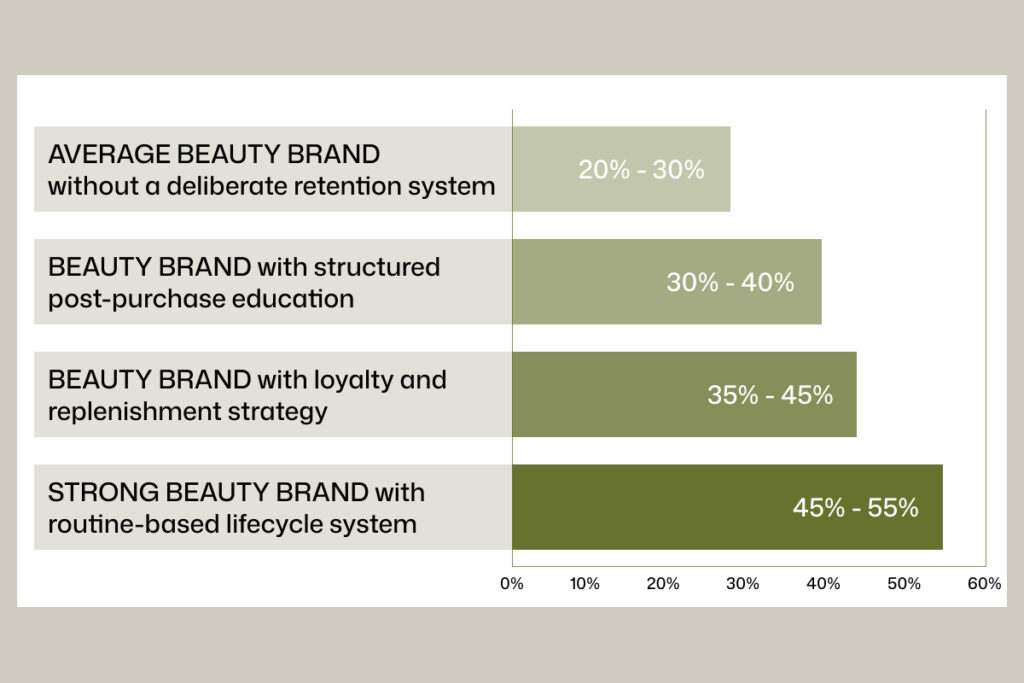
| Annual customer retention | 20% to 35% | 35% to 50%+ | Shows how much of the customer base remains active |
| 90-day repeat purchase rate | 20% to 30% | 35% to 45% | Shows whether the first order is turning into early trust |
| Overall repeat purchase rate | 25% to 40% | 40% to 55%+ | Shows whether customers are moving from trial to routine |
| Time to second order | 45 to 100 days | 25 to 70 days | Shows how quickly customers find a reason to buy again |
| Purchase frequency | 1.8 to 2.8 orders per year | 3 to 5+ orders per year | Shows whether the brand has routine depth |
| 12-month LTV | 2.0x to 3.5x first order value | 3.5x to 6.0x+ | Shows whether acquisition cost can be recovered profitably |
| Email revenue share | 20% to 35% | 35% to 50% | Shows whether owned channels support retention |
| Flow revenue share | 8% to 18% | 18% to 30% | Shows whether lifecycle automation is doing serious work |
| SMS revenue share | 3% to 10% | 10% to 18% | Shows whether SMS is used for timely moments, not only promotions |
| Loyalty participation | 10% to 25% of active customers | 25% to 45%+ | Shows whether customers have a reason to identify with the brand |
Repurchase Timing
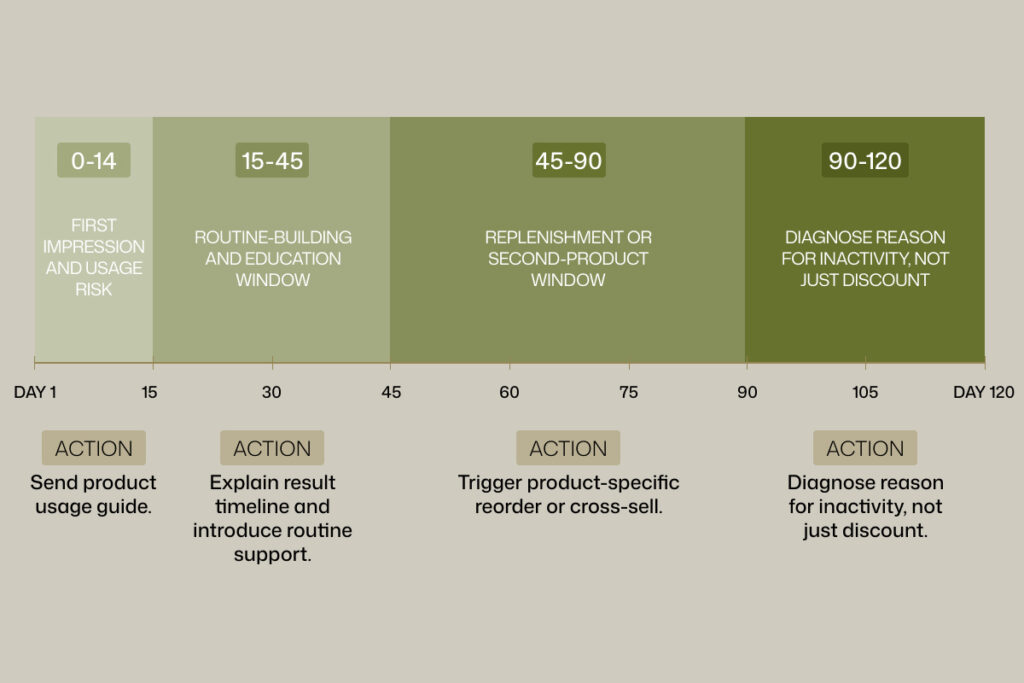
One of the most common retention mistakes in beauty is treating every product as if it has the same buying cycle.
Many brands use generic replenishment reminders, often based on a fixed 30-day, 45-day, or 60-day delay. That approach is too broad for beauty and skincare because different products are used at different speeds, replaced for different reasons, and evaluated on different timelines.
A mascara replacement reminder should not follow the same logic as a fragrance campaign. A daily cleanser should not be treated like an exfoliating mask. A vitamin C serum may need education before replenishment, while a moisturizer may need a more direct reorder path once usage becomes consistent.
The better approach is to build replenishment and second-purchase journeys around product behavior.
The Second Purchase Problem in Beauty
The first purchase is not the real win.
The first purchase means the customer was interested enough to try the product. The second purchase means the customer found enough value to come back.
That is the real retention milestone. Beauty brands lose customers between the first and second purchase for predictable reasons. Most of them are controllable.
| Churn driver | What happens | How to reduce it |
|---|---|---|
| Expectations were never set | Customer expects fast results and leaves too early | Explain result timelines after purchase |
| Product match was wrong | Customer bought the wrong product for their concern, skin type, hair type, or shade | Improve quiz, product guidance, and segmentation |
| Usage was unclear | Customer does not know how often or how to use the product | Send product-specific education |
| Discount anchored the first order | Customer compares the second order against the discounted first order | Reinforce value before full-price reorder |
| Brand went silent after delivery | Customer receives no guidance during the highest-risk window | Build a structured post-purchase sequence |
| No clear next product | Customer likes the first product but does not know what to buy next | Recommend routine-based cross-sell |
| Replenishment was mistimed | Reminder arrives too early or too late | Use product-specific timing |
This is where post-purchase education becomes more than a content strategy.
It is a revenue strategy.
A customer who understands how to use the product has a better chance of getting the intended result. The one who understands when to expect results has a lower chance of leaving too early. And a customer who knows what to pair next has a clearer path to a second purchase.
The opposite is also true. If the customer has to guess, the brand loses control of the experience.
Routine as the Real Switching Cost
The most durable form of retention in skincare is not a loyalty program.
It is a routine.
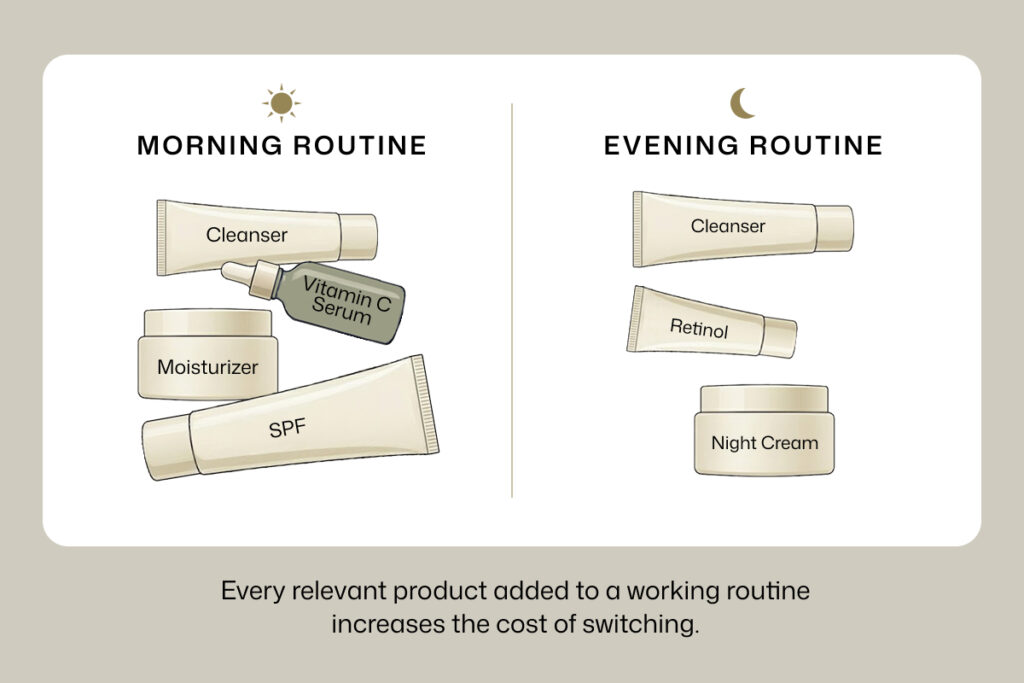
Loyalty points can help. Discounts can help. Replenishment reminders can help. But once a customer commits to a multi-step routine that works for them, switching becomes harder.
Replacing one product inside a working routine creates uncertainty.
- Will the new product work with the others?
- Will it cause irritation?
- Will it change the result?
- Will I have to start over?
- Will I waste money testing again?
That uncertainty is a switching cost.
This is why brands that sell beauty as a system can retain better than brands that sell isolated SKUs.
A customer who buys a vitamin C serum is not only a serum buyer. They may be building a morning routine. The next logical product may be SPF or moisturizer, not another serum.
Retinol buyers may need education, moisturizer support, barrier care, and expectation-setting.
Shampoo customers with a specific concern may also need conditioner, treatment, usage education, and a realistic timeline.
This is the difference between product marketing and routine marketing.
Product marketing asks:
“What else can we sell?”
Routine marketing asks:
“What does this customer need next for the first product to become more valuable?”
Retention Systems Beauty Brands Need in 2026
Beauty brands should not think only in flows.
They should think in systems.
A flow is a sequence of messages. A system connects customer data, product usage, education, replenishment, loyalty, and purchase timing.
Retention Side’s beauty email marketing page can be linked naturally from this section as a deeper resource on beauty-specific lifecycle marketing and post-purchase flows.
| System | Purpose | Why it matters in beauty |
|---|---|---|
| Welcome system | Convert subscribers and educate prospects | Beauty customers need trust before purchase |
| Product match system | Help customers choose the right product | Wrong first product creates churn |
| Post-purchase education system | Help customers use products correctly | Better usage improves satisfaction and repeat purchase |
| First-to-second purchase system | Move customers from trial to trust | The second order is the first real retention signal |
| Replenishment system | Remind customers before they run out | Many beauty products have predictable consumption cycles |
| Routine-building system | Expand one product into a full routine | Increases AOV and LTV without relying only on discounts |
| Review and UGC system | Capture proof from happy customers | Beauty conversion depends heavily on trust |
| Loyalty system | Reward repeat behavior and engagement | Strong loyalty supports habit, not only points |
| Subscription system | Create predictable repeat revenue | Best for consumable products with clear usage cycles |
| Winback system | Recover lapsed customers | Needs to diagnose why the customer stopped buying |
| Segmentation system | Personalize by concern, product, and lifecycle stage | Beauty needs more nuance than buyer vs non-buyer |
| Quiz and zero-party data system | Improve product matching and messaging | Data is only useful if it improves lifecycle communication |
The key is connection.
- A quiz should influence the welcome flow.
- The first product should influence post-purchase education.
- Post-purchase engagement should influence cross-sell.
- Purchase timing should influence replenishment.
- Loyalty status should influence VIP campaigns.
- Subscription behavior should influence churn prevention.
Most brands already have some of these pieces. The problem is that they operate in isolation.
Retention Marketing Channels for Beauty Brands
Beauty brands have more retention channels than ever.
But more channels do not automatically create better retention. Each channel needs a specific role in the customer journey. The strongest brands do not use email, SMS, loyalty, subscription, quizzes, reviews, and paid remarketing as separate tactics. They use them as connected parts of the same retention system.
Email Marketing
Email is still the strongest owned channel for beauty retention because it gives brands enough space to educate, explain, and guide customers after purchase.
In beauty, email marketing should not be used only for product launches and discounts. Its strongest role is helping customers understand what they bought, how to use it, what results to expect, when to reorder, and what product should come next in their routine.
A skincare customer may need usage instructions, ingredient education, and a realistic result timeline. A cosmetics customer may need tutorials, shade guidance, or product pairing ideas. A haircare customer may need education around frequency, application, and expected progress.
The common mistake is treating email as a campaign channel only. When every email is a launch, sale, or promotion, the brand misses the moments where retention is actually built: after delivery, during product adoption, before replenishment, and before the second purchase.
SMS Marketing
SMS works best when timing matters.
For beauty brands, SMS can support replenishment reminders, VIP product drops, loyalty moments, subscription reminders, back-in-stock alerts, and urgent customer lifecycle moments. It should feel helpful, timely, and relevant.
The mistake is using SMS as a louder version of email. Too many beauty brands overuse urgency, flash sales, and short-term promotions. That can create revenue in the short term, but it can also damage trust and train customers to ignore the channel.
SMS should be used carefully because it is more personal. A replenishment reminder sent at the right moment can feel useful. A generic discount text sent too often can feel intrusive.
Loyalty Program
A weak loyalty program says:
“Earn points when you buy.”
A stronger beauty loyalty program says:
“Build your routine, unlock better benefits, and get rewarded for reviews, referrals, repeat purchases, and product discovery.”
Beauty loyalty should not be a widget added to the website. It should become part of the customer journey.
The strongest loyalty programs in beauty reward behaviors that support long-term retention. That includes reviews, referrals, early access, samples, routine milestones, VIP education, birthday rewards, tier-based product access, and repeat behavior. The mistake is rewarding spend without shaping behavior.
Points alone are not enough. A loyalty program should help customers feel more connected to the brand, more invested in their routine, and more likely to return without needing a discount every time.
Subscription
Subscription is powerful, but only when the product and customer behavior support it.
It works best when the product has predictable consumption, the customer already trusts the product, the brand allows flexibility, the reminder experience is clear, skipping or pausing is easy, and the subscription feels helpful rather than forced.
For many beauty brands, the right subscription sequence is not immediate subscription pressure after the first purchase.
The better sequence is:
- First purchase.
- Education.
- Usage confidence.
- Second purchase.
- Routine expansion.
- Subscription offer.
This works because the customer has already experienced the product and has a reason to continue using it. Subscription should feel like convenience after trust is built, not a commitment before the customer is ready.
The common mistake is offering subscription too early. If the customer has not used the product, seen value, or developed trust, the subscription offer can create friction instead of retention.
Quiz and Personalization
Beauty quizzes should not be treated as pop-up conversion tools only.
A skin, hair, shade, or concern quiz should influence the entire lifecycle. It should shape product recommendations, welcome emails, post-purchase education, replenishment timing, cross-sell logic, winback messaging, and loyalty experiences.
The biggest mistake is collecting data once and then sending generic messages afterward.
If a customer says they have dry skin, sensitive skin, oily skin, thinning hair, damaged hair, acne concerns, or a specific makeup preference, that information should change how the brand communicates with them.
The quiz is not only there to help the customer choose the first product. It should help the brand understand what the customer needs next.
Reviews and UGC
Reviews and UGC are especially important in beauty because customers want proof before they commit. They want to see whether the product worked for people with similar skin, hair, tone, texture, concerns, or goals.
But reviews should not be treated only as pre-purchase conversion assets.
They also support retention. A well-timed review request helps capture proof from satisfied customers. UGC can reinforce confidence after purchase, show customers how others use the product, and help them imagine the next product in their routine.
The mistake is asking for reviews too early. A customer who bought a serum may not be ready to review the product after seven days. A customer who bought mascara may be ready much sooner. Review timing should match the product experience.
Profitability Analysis: Why Retention Protects Beauty Margins
Beauty brands can look healthy on the surface while quietly losing margin underneath.
Revenue can grow. Ads can spend. Influencers can post. Campaigns can look active. But if first-time customers do not come back, the business remains fragile.
The economics are simple.
If CAC rises and customers do not repeat, the brand has to keep buying revenue. If repeat purchase improves, the brand can recover acquisition costs across more orders, increase contribution margin, and reduce pressure on paid media.
Baymard’s cart abandonment research shows that checkout friction is still a major eCommerce issue, with the average documented cart abandonment rate at 70.22%. For beauty brands, hesitation can come from shipping cost, shade uncertainty, ingredient questions, return policies, product fit, or lack of trust. But checkout recovery is only one part of the economics.
The bigger opportunity is after purchase.
| Profit lever | Weak version | Stronger version |
|---|---|---|
| CAC recovery | Depends on first order | Recovered across repeat orders |
| Discounting | Used to create repeat purchases | Used selectively and measured separately |
| AOV | Increased with random upsells | Increased with routine-based bundles |
| LTV | Measured broadly | Measured by first product, cohort, and purchase path |
| Subscription | Pushed to everyone | Offered to customers with proven usage behavior |
| Loyalty | Rewards every order equally | Rewards profitable repeat behavior |
| Email revenue | Campaign-driven | Lifecycle-driven |
| SMS revenue | Promo-driven | Timing-driven |
A beauty brand can increase repeat revenue and still hurt profitability if the repeat purchases are mostly discount-driven.
That is why founders should separate:
- Full-price repeat purchase rate.
- Discount-driven repeat purchase rate.
- Subscription repeat revenue.
- Loyalty-driven repeat revenue.
- Campaign-driven repeat revenue.
- Flow-driven repeat revenue.
Not all repeat revenue is equally valuable.
Beauty & Skincare Predictions for 2026
1. Beauty brands will shift from product marketing to routine marketing
The brands that win will not only promote individual products. They will show customers how products fit together.
This will matter most in skincare, haircare, and bodycare, where customers need clarity around steps, frequency, combinations, and expected outcomes.
2. Second purchase rate will become more important than first-order ROAS
First-order ROAS can make a brand look healthier than it is.
If customers do not come back, the brand is constantly replacing lost revenue with new acquisitions.
Founders will pay more attention to first-product repeat rate, time to second order, and cohort LTV.
3. Replenishment will become more product-specific
Generic 30-day reminders will become less acceptable.
Brands will use product type, size, usage pattern, customer purchase history, and subscription behavior to time replenishment more accurately.
4. Subscription will become more selective
More brands will offer subscription, but stronger brands will not push it to everyone.
Subscription will work best for products with clear consumption cycles and repeat behavior.
5. Loyalty programs will become more behavior-based
Generic points programs will become less impressive.
Beauty brands will reward reviews, referrals, routine milestones, repeat purchases, subscription tenure, product discovery, and VIP engagement.
6. Ingredient education will become a retention asset
Ingredient education is often used before purchase. In 2026, more brands will use it after purchase to reduce confusion, reinforce trust, and improve product adoption.
This matters because beauty customers are becoming more ingredient-aware and more skeptical of vague claims.
7. AI quizzes will improve discovery, but not automatically improve retention
AI-powered quizzes and recommendation tools can improve product matching.
But if the post-purchase system does not use that data, the quiz becomes a conversion tool only.
The real opportunity is connecting quiz answers to lifecycle marketing.
8. Retention teams will influence merchandising
The strongest retention teams will not only do flows. That will probably be replaced by AI agents.
They will tell founders which products create repeat behavior, which products create one-time buyers, which bundles create routine adoption, and which first purchases lead to higher LTV.
Strategic Recommendations for Beauty Founders
Beauty founders should start with one question:
Where does retention actually break?
For some brands, the problem happens before purchase. Customers do not trust the claims.
For others, it happens after delivery. Customers do not know how to use the product.
For others, it happens after the first month. Customers forget to reorder or do not know what to buy next.
The solution depends on the break point.
1. Measure second purchase rate by first product purchased
Do not look only at total repeat purchase rate.
Measure repeat behavior by first product.
This shows which products create retention and which products only create trial.
2. Build product-specific post-purchase education
A generic thank-you email is not enough.
Customers should receive education based on what they bought. That includes usage instructions, timing, product combinations, common mistakes, expected results, and when to consider the next product.
3. Create replenishment windows by product type
A 30-day reminder is not right for every product.
A cleanser, serum, moisturizer, SPF, mascara, shampoo, mask, and fragrance all have different usage patterns.
Replenishment should be based on product behavior, not one account-wide delay.
4. Separate discount retention from healthy retention
Track repeat purchases that happen at full price and repeat purchases that require a discount.
If repeat revenue depends heavily on discounting, the brand may be buying retention instead of building it.
5. Use loyalty to reinforce routine
Loyalty should not only reward spending.
For beauty brands, it should reward actions that increase long-term value
6. Offer subscription after trust is built
Subscription should feel like convenience, not pressure.
The best time to introduce subscription is often after the customer has shown usage intent, reordered once, or engaged with product education.
7. Build bundles around routines, not random discounts
Bundles should answer a customer need.
Better bundle logic:
- Morning routine.
- Sensitive skin routine.
- Post-workout haircare routine.
- Travel beauty kit.
- Fragrance layering set.
- Starter routine for a specific concern.
8. Connect quiz data to lifecycle marketing
If a customer tells the brand they have dry skin, oily skin, sensitive skin, thinning hair, acne concerns, or a specific beauty goal, that data should influence more than the product recommendation page.
It should affect welcome emails, post-purchase education, cross-sell, replenishment, loyalty messaging, and winback strategy.
FAQ
What is a good repeat purchase rate for beauty and skincare brands?
How can beauty brands improve customer retention?
Beauty brands improve retention by helping customers use products correctly, setting realistic expectations, sending product-specific education, timing replenishment properly, building routine-based cross-sells, and tracking second purchase behavior by first product purchased.