


If you sell supplements, skincare, or any consumable wellness product, your email program is carrying more weight than it does for almost any other DTC category. Health and wellness brands run on replenishment cycles and subscription economics that most generalist email agencies have never had to solve for. A skincare brand’s win-back sequence has to account for a product usage cycle. A supplement brand’s second-purchase flow is fighting failed payment cards and “I forgot to reorder” as much as it’s fighting apathy. And regulatory sensitivity around health claims means the wrong subject line isn’t just a bad open rate, it’s a compliance risk.
This is why the agency you hire for this category matters more than it does for, say, a fashion brand running seasonal drops. The wrong partner treats your email program like a campaign calendar. The right one treats it like a retention system built around how people actually use and repurchase your product.
What you’ll find below: a ranked shortlist of agencies with real health and wellness experience, the selection criteria we used to build it, and an evaluation checklist you can use in your own agency conversations, followed by a direct FAQ on platform choice, category brands, and whether email still earns its keep in 2026.
Why agency choice is higher-stakes in health & wellness
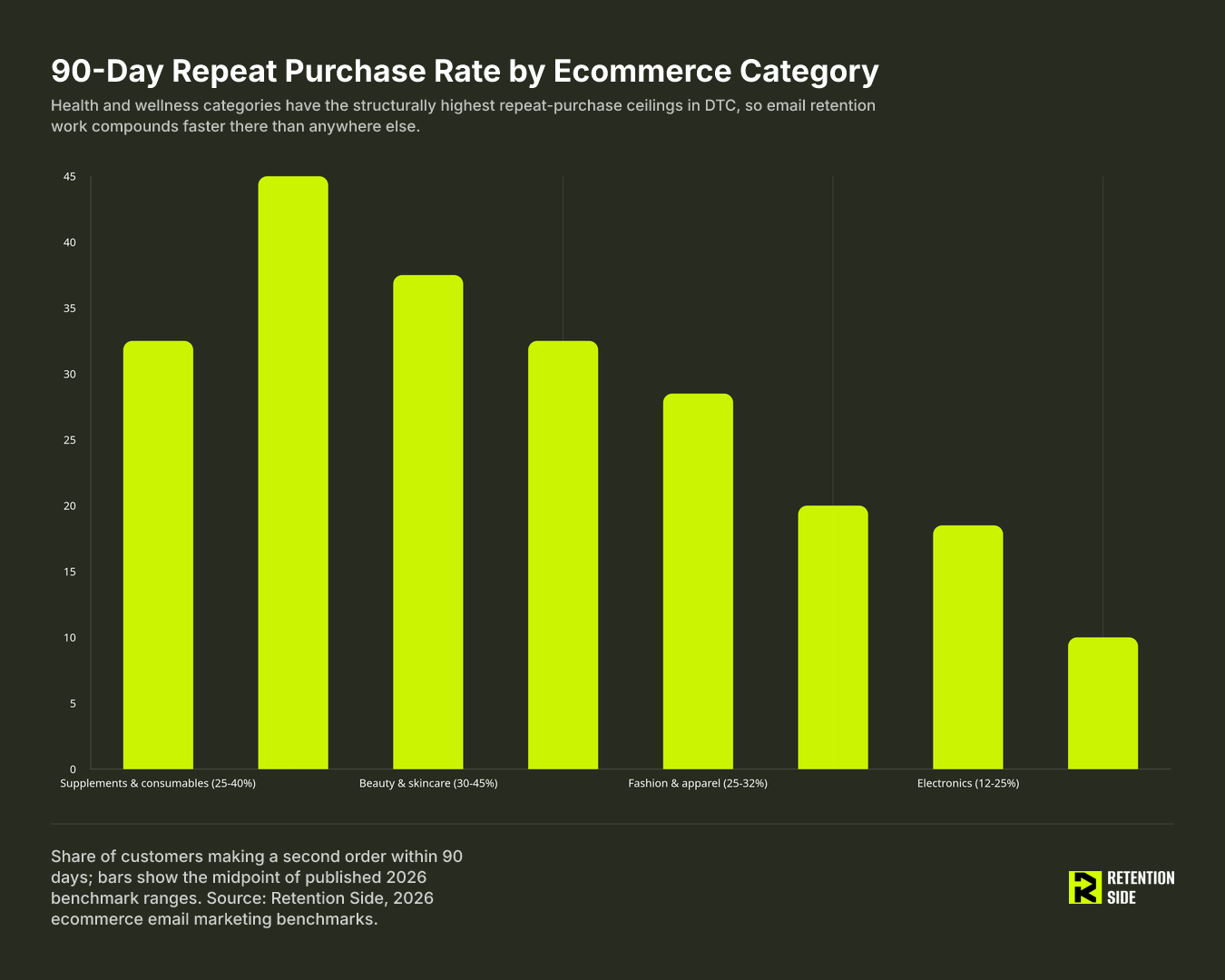
Repeat purchase economics in this category are simply different. Supplements and other consumables post a 90-day repeat purchase rate (RPR) of 25-40%, with top performers reaching 40-55%, according to Retention Side’s 2026 ecommerce email benchmarks. Beauty and skincare sit at 30-45%. Food and beverage subscriptions run 35-55%. Compare that to fashion at 25-32% or luxury and jewelry at a mere 9-11%, and the pattern is obvious: health and wellness categories have the highest repeat-purchase ceiling in DTC. That ceiling is exactly why retention work compounds faster here than almost anywhere else, and why hiring an agency that only knows how to run promotional blasts leaves real revenue on the table.
The chart below shows how stark that gap is across categories.
The leverage point inside that ceiling is the first-to-second purchase transition. DTC brands see an 18-30% median conversion from first to second order, but that number cascades upward once a customer clears it: 35-55% from second to third, and 55-75% from third to fourth. Customers who repurchase within 60 days are roughly three times more likely to become long-term repeat buyers. An agency that understands this will build its entire post-purchase sequence around getting a customer through that first repurchase window, not around generic “thanks for your order” messaging.
Subscription economics raise the stakes further. A supplement brand running a $65/month subscription list is carrying structurally more value than a brand with a $45 one-time-purchase AOV, even if the top-line revenue looks similar in a monthly report. Failed-payment recovery, regimen onboarding, and replenishment timing to actual product runout are not “nice to have” flows in this category, they are the difference between a subscriber and a churned customer.
Then there’s the trust layer. Health and wellness buying decisions are education-first. Customers researching a probiotic or a joint-support supplement want to understand mechanism and expected timeline before they buy again, and they abandon products before those products have had time to work if nobody explains what to expect. Post-purchase product education is one of the most underused levers in this category, precisely because it requires actual subject-matter thinking, not just a discount code.
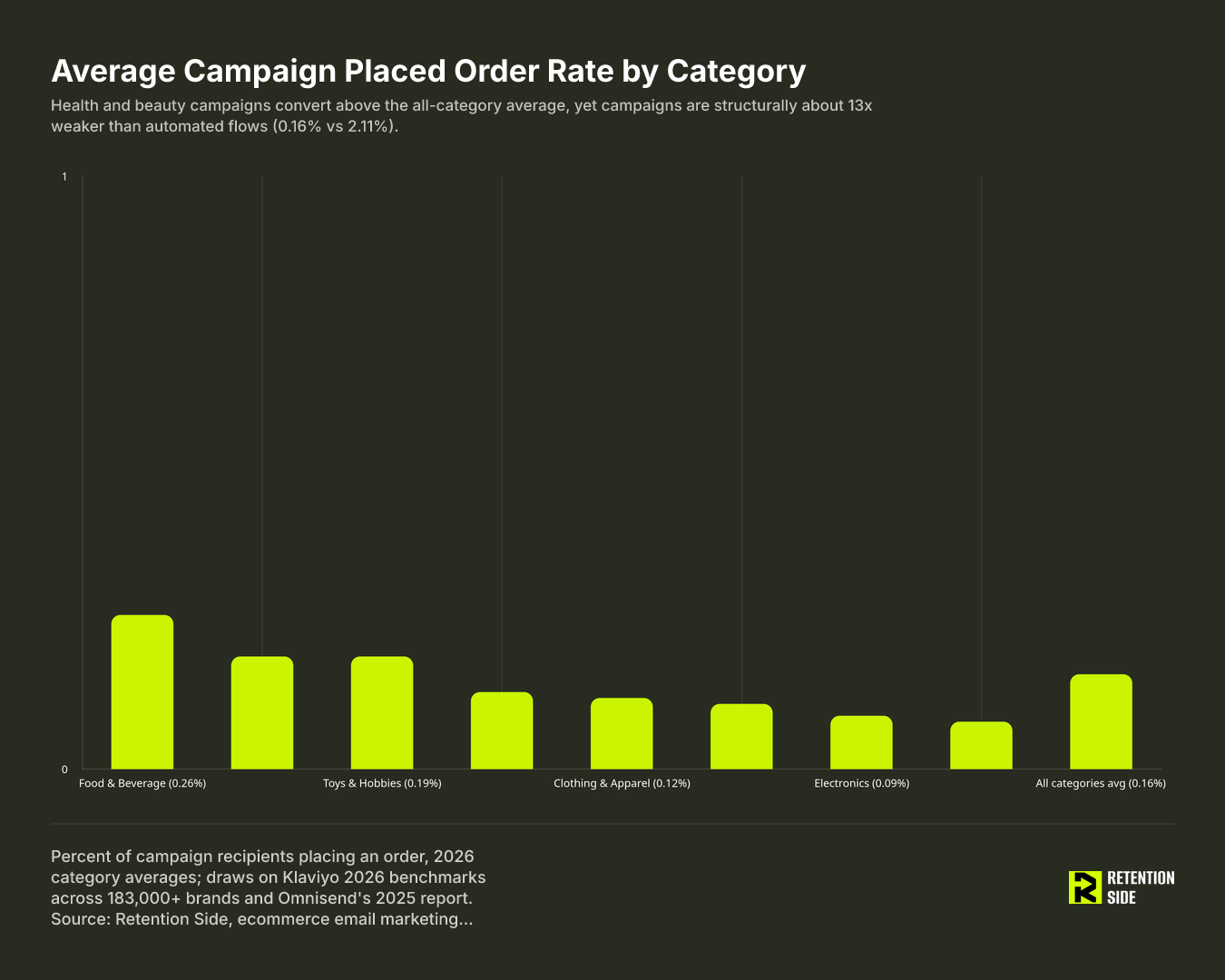
Category context matters on the campaign side too. Health and beauty campaigns convert above the all-category average, but campaigns are still structurally about 13 times weaker than automated flows, which is precisely the gap a retention agency is hired to engineer around.
How we selected these agencies
We built this list around criteria that matter for brands doing at least $300,000 per month, not agencies optimizing for the smallest, easiest-to-land accounts. The criteria:
- Klaviyo depth for ecommerce. Klaviyo is the default platform for serious DTC email, and an agency’s fluency with its flows, segmentation, and predictive analytics is table stakes.
- Demonstrated health and wellness vertical work. Not “we’ve done a supplement client once.” Named case studies, repeatable playbooks, and category-specific reasoning.
- Retention-system scope beyond email sends. Deliverability management, segmentation strategy, flow architecture, loyalty, and SMS, not just campaign design.
- Verifiable results with named clients. We distinguish first-party agency claims from independently verifiable evidence throughout. Agency-reported case figures are labeled as such.
- Fit for established brands. Agencies capable of serving brands with meaningful revenue and operational complexity, not just startup-stage accounts.
With that framework, here’s the shortlist.
Retention Side – best for established brands that need a complete retention system
Retention Side is built for health and wellness brands that have outgrown “just run some campaigns” and need someone accountable for the full retention system: email through Klaviyo, SMS, push notifications, direct mail, and loyalty programs, working together rather than as disconnected tactics.
The agency’s approach starts from a diagnostic sequence rather than a tactic list. Deliverability comes first, because if your emails aren’t reaching the inbox, nothing downstream matters. Then list health, since raw subscriber count means little if lead-to-customer conversion is weak. Then flow coverage and trigger reliability, checking that every behavior-based automation is actually firing correctly. Only after those three layers are sound does creative and offer optimization enter the picture. As Retention Side puts it in its own benchmarks analysis, “fixing the downstream layer without addressing the upstream problem produces temporary improvement at best.” That sequencing is the core differentiator against agencies that jump straight to campaign design.
This shows up in health and wellness-specific playbooks published across Retention Side’s own content. Post-purchase flows for functional products, anything from supplements to skincare, are built around product education rather than discounting, because customers who understand how a product works are the ones who stick around long enough to reorder. Win-back sequences for supplement, skincare, and wellness brands are structured to restate the product’s core promise in the second message, addressing the exact “did this even work” hesitation that causes churn in consumable categories. And the agency treats subscription list value as structurally different from one-time-purchase value, which changes how segmentation, win-backs, and upsell sequencing get built.
Retention Side’s 2026 ecommerce email marketing benchmarks report, drawing on Klaviyo’s analysis of over 183,000 brands and Omnisend’s 2025 report covering more than 20 billion campaign emails, is itself evidence of the depth this agency brings to category-level thinking. Few agencies in this space publish original benchmark analysis at that scale; most repackage vendor blog posts.
Who it’s best for: established health and wellness brands, typically $300,000+ per month, that need a strategic and implementation partner across the full retention channel mix rather than a single-channel execution vendor. Brands that have already tried a campaign-only or email-only agency and hit a ceiling are a strong fit.
Magnet Monster
Magnet Monster is a certified Klaviyo Platinum Master partner running a full-service retention model across email, SMS, WhatsApp, and direct mail on a flat monthly fee, serving over 300 DTC brands. Its health and wellness-adjacent case work includes Waterdrop, a nine-figure hydration and health brand, along with Wild (a Unilever-acquired wellness brand), Hey Bud Skincare, and Duradry, according to the agency’s published case studies.
Who it’s best for: brands that want high-volume execution across multiple channels bundled under one predictable fee, and that are comfortable with a broader DTC generalist rather than a wellness-only specialist.
Everboost
Everboost is a UK-based Klaviyo agency that specializes specifically in 7-8 figure health and wellness brands, claiming over 70 brands in the vertical. Its published case work with Discount Supplements is detailed: 12 automations rebuilt into 23, median time to second order cut from 63 to 43 days, campaign volume up from 125 to 336 per year, discount dependence per order down 33%, and a 227% increase in subscription orders in year one. A separate case with Salt Grooming reports sender reputation improving from 59 to 80 and spam placement dropping from 20.8% to 8.9%, alongside a 132% increase in campaign revenue, per Everboost’s published agency page.
Who it’s best for: UK and European wellness brands specifically looking for a deliverability-and-flow-focused specialist with a track record in the vertical. These figures are agency-reported rather than independently audited.
YOCTO
YOCTO is a Klaviyo Elite Partner focused tightly on supplement and wellness brands, with client work reported for BetterMe, Healf, Gratsi, and Kilo.co. Its differentiators are built around the mechanics of subscription-based supplement selling: converting to subscription from the first order, regimen onboarding built around the insight that customers “quit before the product works,” replenishment timing tied to actual bottle runout rather than a generic 30-day cadence, and failed-payment churn recovery, according to YOCTO’s supplements and wellness page.
Who it’s best for: pure supplement brands running subscription economics that need an agency fluent specifically in regimen-based products rather than general wellness or beauty.
Threadpoint
Threadpoint is a smaller email and SMS boutique focused on health and wellness, including supplements, probiotics, and recovery tech. It reports an average 64% revenue lift and a 2.1x repeat purchase rate across more than 35 ecommerce brands, with clients including Visbiome and Therabody and a notable case with BrickHouse Nutrition. One finding worth noting from Threadpoint’s own published work: plain-text newsletters outperformed designed templates in several wellness accounts, a useful reminder that polish isn’t always what drives conversion in this category, per Threadpoint’s health and wellness page.
Who it’s best for: smaller wellness brands that want a boutique, hands-on agency rather than a larger full-channel operation.
Email Optimize
Email Optimize is a Klaviyo-only, ecommerce-only agency claiming over $180 million in attributed email revenue across 800+ stores and 98% inbox placement post-audit. It runs distinct vertical playbooks, including one for supplements and vitamins framed around replenishment-heavy, FDA-aware messaging, and another for general health and wellness framed around education-first, multi-step trust building, according to Email Optimize’s ecommerce agency page.
Who it’s best for: brands that specifically want deep platform mastery inside Klaviyo over broader channel breadth, and that are comfortable with a single-platform execution model.
How to choose: an operator’s evaluation checklist
Whichever agency you’re evaluating, ask these questions directly in the sales conversation:
- How do they approach deliverability? Ask for their audit method, not just a promise. Inbox placement above 85% is healthy; below 70% is an active revenue problem. Gmail and Yahoo’s bulk sender rules require SPF, DKIM, DMARC, and one-click unsubscribe as baseline hygiene, and a spam-complaint rate above 0.3% is a real ceiling, not a suggestion.
- How do they time replenishment messaging? For a consumable product, “every 30 days” is lazy. Ask whether they build replenishment logic around actual usage data and bottle-runout timing.
- How do they treat non-promotional campaigns? If every campaign is a discount, engagement and full-price purchasing erode over time. Ask to see a sample campaign calendar that balances promotional and educational sends.
- What’s their attribution method? Vague “revenue attributed to email” numbers without a clear model are a red flag.
- Who owns strategy versus execution? Make sure a strategist, not just a coordinator, is accountable for the retention roadmap.
Red flags worth walking away from: agencies that lead every pitch with discount-driven campaign calendars, that rely on static, unsegmented lists, or that report form submission rate as their headline list-growth KPI instead of lead-to-customer conversion. A healthy lead-to-customer rate within 30 days sits in the 6-10% range; below 3% signals a traffic or incentive problem no amount of email polish will fix.
In month one, expect a real diagnostic, not a jump straight to creative. A capable agency should be able to walk you through deliverability standing, list health, and flow coverage before they propose a single new campaign.
FAQ
What is the best email marketing platform for e-commerce?
Klaviyo is the dominant platform for serious ecommerce brands, holding an estimated 65% share among Shopify stores generating over $1 million in annual revenue, with roughly 167,000 paying customers as of Q2 2026, according to trade-press analysis of Klaviyo’s market position. Its advantages are native Shopify data depth, predictive analytics like predicted LTV, churn risk, and next-order date, and the largest certified-agency ecosystem of any ecommerce email platform. Omnisend is a credible lower-cost alternative, with over 125,000 accounts and 34% year-over-year growth, and is worth considering for brands with simpler flow needs or tighter budgets.
What are some popular healthcare e-commerce brands?
Hims & Hers is a publicly traded telehealth and health platform founded in 2017, reporting roughly $753 million in Q2 2026 revenue, up 38% year over year, with approximately 2.9 million subscribers. It’s worth noting that Hims & Hers is telehealth-first, so it’s useful category context rather than a pure email-marketing benchmark. Ritual, founded in 2015, is a daily-essentials supplement brand built around traceable ingredients across multivitamins, sleep, gut health, and protein products. Thrive Market, founded in 2013, is a membership-based online organic grocery retailer with 1.7 million members. All three illustrate different models within health and wellness ecommerce: telehealth subscription, supplement DTC, and membership grocery.
What are some effective email marketing agencies for e-commerce?
For health and wellness specifically, the agencies covered in this shortlist represent the credible range: Retention Side for established brands needing a full retention system across email, SMS, push, direct mail, and loyalty; Magnet Monster for flat-fee, high-volume multi-channel execution; Everboost for UK and European wellness specialists; YOCTO for supplement-subscription mechanics; Threadpoint for boutique wellness accounts; and Email Optimize for Klaviyo-only platform depth. The right choice depends on whether you need system-level strategy or focused execution, and whether your brand runs on subscription or one-time-purchase economics.
Is email marketing still worth it in 2026?
Yes, decisively. Average email ROI sits between $36 and $42 per $1 spent, higher than any other marketing channel, according to Litmus’s email marketing ROI research. Automated flows drive 37% of all email-generated sales despite representing just 2% of total sends, which is the clearest evidence that automation, not campaign volume, is where the real return lives. Omnisend’s paid-plan merchants averaged $79 per $1 in 2025, and the UK’s DMA Marketer Email Tracker reported £41 per £1 in 2026, up from £38 the prior year. Litmus’s State of Email 2026 report also found that advanced AI adopters are 75% more likely to achieve ROI above 45:1, suggesting the gap between well-run and poorly-run email programs is widening, not narrowing.
The bottom line
Health and wellness ecommerce brands have the highest repeat-purchase ceiling in DTC, but only if the retention system underneath the email program is actually built for replenishment cycles, subscription economics, and trust-first buying behavior. Campaign-only execution can’t reach that ceiling on its own.
If you’re evaluating agencies against the checklist above, the real question isn’t which agency runs the prettiest campaigns. It’s which one can walk you through your deliverability standing, your lead-to-customer rate, and your flow coverage in the first conversation, before they’ve pitched you a single new creative concept. That diagnostic depth is what separates a retention system from a campaign vendor.