

Jewelry email breaks when you run it like a beauty or apparel program. The purchase logic is different, the buying windows are different, and the reasons people come back are different. Get those three things wrong and you end up with a welcome flow that pushes for a sale in three days when the buyer needs three weeks, and a campaign calendar built around discounts when the real driver of repeat revenue is an occasion nobody scheduled for.
This guide walks through how to build a jewelry email program around the two things that actually govern buyer behavior in this category: a long consideration window before the first purchase, and a recurring occasion calendar after it. Everything from flow architecture to segmentation to the metrics you should watch follows from getting those two clocks right.
What you’ll learn
- Why jewelry buyer behavior differs structurally from beauty and apparel, and what that means for segmentation
- How to structure the consideration phase so welcome and browse abandonment do their actual job
- How to build the post-purchase and occasion-calendar flows that turn a single sale into a repeat customer
- How campaign strategy and the value-to-promotion mix should change for a jewelry list
- Which metrics tell you the program is working, and which ones mislead you in a high-AOV category
The two clocks every jewelry brand runs on
Every jewelry email program is governed by two timelines running at once, and most programs are only built around one of them.
The first is the consideration clock. Jewelry purchases over roughly $150 typically involve a consideration window of one to four weeks, sometimes longer for higher-ticket pieces. Nobody buys a $600 necklace off a three-day welcome sequence the way they might buy a $30 serum. They browse, they come back, they think about it, they check with a partner, they wait for payday. A welcome flow built on a beauty-brand template – three emails, a discount by day two, dead by day five – simply expires before most buyers are ready to act.
The second is the occasion clock. Jewelry demand is not evenly distributed across the calendar. It concentrates around Valentine’s Day, Mother’s Day, anniversaries, birthdays, and the Q4 gifting season. A brand that only sends when it has a promotion to push will miss the moments when demand is naturally highest and intent is easiest to convert without a discount.
Most jewelry email programs are built around neither clock. They copy the cadence of a faster-turnover category, front-load offers too early, and then rely on blanket discount campaigns to manufacture urgency the rest of the year. The fix isn’t more emails. It’s building the program around how jewelry actually gets bought, from the moment someone first considers a piece to the next occasion that brings them back.
Why jewelry buyers behave differently
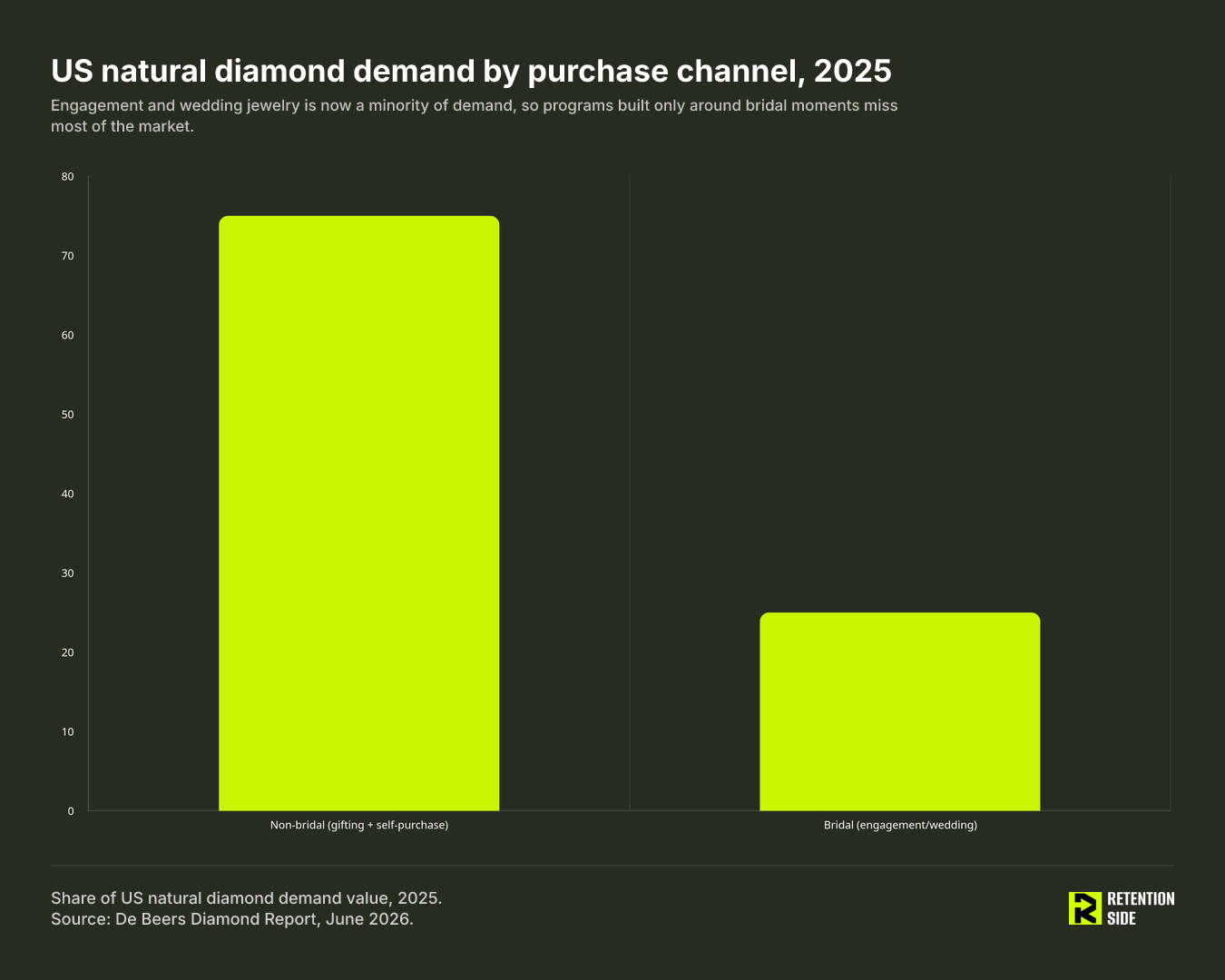
The assumption baked into a lot of jewelry marketing is that bridal is the center of the business. It isn’t, and hasn’t been for a while. According to the De Beers Diamond Report, engagement and wedding purchases now account for only about 25% of overall US natural diamond demand. The other 75% is gifting and self-purchase, and self-purchase is the growth driver.
That shift shows up clearly in consumer research. A nationwide BriteCo survey found that 80% of American adults have bought fine jewelry for themselves, rising to 86% among Millennials. The top reasons aren’t romance or status. They’re personal style and marking a milestone, each cited by 22% of self-purchasers. The Jewelers Mutual Self-Purchaser Study adds useful detail: birthdays, holidays, and “just because” moments lead as purchase triggers, rings are the most frequently self-bought item, and roughly 60% of self-purchasers think of themselves as collectors rather than one-time buyers.
The strategic implication is direct: gift buyer and self-purchaser are not the same segment, and treating them as one audience with one message flattens the two biggest behavioral groups in the category. A gift buyer needs help with sizing, timing, and gift presentation. A self-purchaser responds to styling content, material education, and collector-minded upsells toward a complementary piece. Copy, creative, and offer structure should split along this line as early as your welcome flow can detect it, not somewhere deep into your segmentation strategy months later.
Story and craftsmanship also carry more weight in jewelry than spec sheets do. Material sourcing, maker story, and durability matter more to a jewelry buyer working through a multi-week decision than a fast comparison of features would to someone buying a commodity product on impulse.
The consideration phase: email’s job before the first purchase
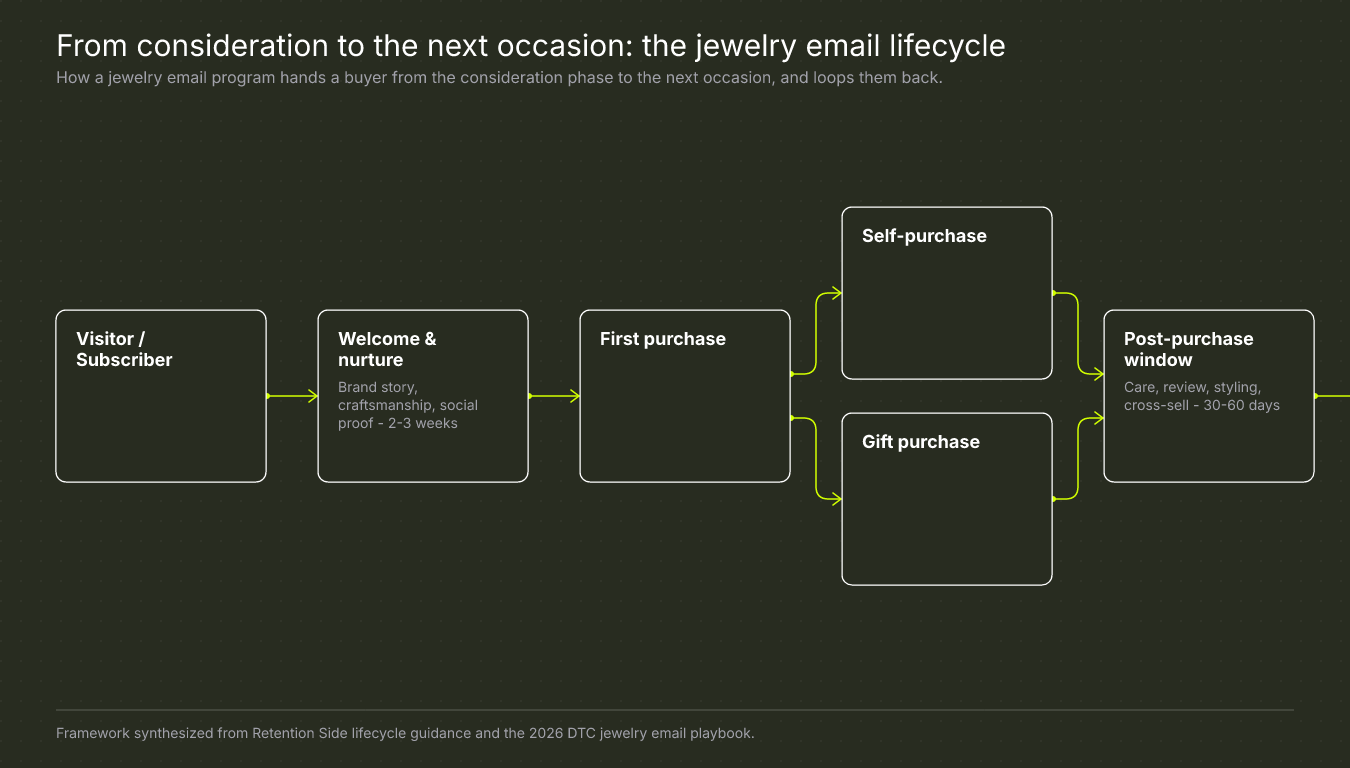
Given a one-to-four-week decision window, the welcome sequence has to be built as a nurture arc, not a countdown to a discount. That means spacing content over two to three weeks rather than five days, and using each email to do a different job: brand story and craftsmanship in the first send, social proof and styling context in the middle, a soft offer without leading on price toward the end. The goal is to be present through the entire decision, not to force the decision early.
Browse abandonment becomes the real mid-funnel workhorse in this category, more so than it is for lower-consideration purchases. Someone who viewed a piece three times over two weeks is a warmer signal than someone who added to cart once and left. Your flow logic should reflect that by escalating message urgency based on repeat browsing rather than treating a single page view and a cart abandonment as equivalent triggers.
Abandoned cart itself needs to handle jewelry-specific objections directly: sizing uncertainty, waiting for payday, or needing a partner’s approval before committing to spend. Generic “you left something in your cart” copy ignores all three. Addressing the actual objection, with sizing guidance or a note about return flexibility, converts better than urgency alone.
This is also the point to build in zero-party data capture. A single welcome-flow question about material preference, gift intent, or ring size costs almost nothing to collect and pays off across the rest of the lifecycle. Email marketing for jewelry brands works best when that early signal – gift versus self, metal preference, sizing – feeds directly into which flow and which campaign segment someone lands in next.
The next-occasion phase: email’s job after the first purchase
Once someone buys, the job of email shifts from persuasion to retention, and this is where the occasion calendar becomes the backbone of the program.
A post-purchase sequence should cover care instructions, a review request, styling ideas, and a complementary-piece cross-sell across the 30 to 60 days after delivery. This window matters more in jewelry than in most categories because the next natural purchase trigger often isn’t a need, it’s an occasion, and you want the brand top of mind before that occasion arrives.
Gift-occasion flows should be pre-built and scheduled to trigger 14 to 21 days ahead of Valentine’s Day, Mother’s Day, anniversaries, birthdays, and the Q4 gifting window. These flows work best when they’re anchored to the customer’s own data (an anniversary date collected post-purchase, a partner’s birthday flagged at checkout) rather than blasted generically to the full list.
Win-back deserves a different anchor in jewelry than it does elsewhere. Instead of leading with a discount at 60 or 90 days of inactivity, the strongest jewelry win-back triggers around 6 to 9 months of dormancy and leans on emotional and occasion-based framing – a milestone approaching, a piece that pairs with what they already own – rather than markdown pressure. Discount-led win-back trains a jewelry list to wait for sales, which is a more expensive habit to build in a high-margin, high-AOV category than in fast fashion.
High-AOV repeat buyers, especially self-identified collectors, are worth a distinct VIP track: earlier access to new drops, first look at limited pieces, and recognition that acknowledges spend history rather than generic loyalty points. This is consistent with how retention programs should be built more broadly: the automation layer needs to map to where customers actually drop off and what brings them back, not just replicate a generic flow library. A luxury jewelry brand where the average customer buys once every 18 months needs a fundamentally different flow architecture than a category with a 30-day repurchase cycle, and the occasion calendar is what fills that long gap productively instead of leaving it silent.
Campaign strategy: value vs. promotion on a jewelry list
Campaign strategy in jewelry needs a heavier lean toward value and story content than most categories can get away with. A commonly cited version of the 80/20 rule suggests keeping roughly 80% of sends educational or value-driven and 20% promotional. In jewelry, that ratio isn’t just a nice-to-have, it’s protective. Discount-heavy sending erodes perceived value faster in jewelry than in apparel, because price and craftsmanship claims are part of what the buyer is trusting when they spend at this level. A list that only hears from you during markdowns will wait for markdowns, and every full-price sale you lose to that habit is a meaningful margin hit given typical jewelry AOVs.
In practice, a healthy campaign mix looks like editorial and story sends (maker profiles, material education, styling guides), regular product sends that don’t lean on discounting, and a smaller number of promotional anchors tied to real moments, whether that’s a genuine seasonal sale or a gift-occasion push. Segmentation should go deeper than open-rate engagement bands. Gift-versus-self intent, AOV tier, material or category preference, and recency of engagement all deserve their own treatment, because a collector who buys three pieces a year and a one-time gift buyer should never see the same campaign cadence or the same offer structure.
What the metrics should say
Open rate and click rate tell you less in jewelry than they do in lower-AOV categories, because the decision to buy usually happens away from the inbox – after a browse session, a conversation with a partner, or a wait for the next paycheck. A high click rate on a campaign that doesn’t convert for another ten days isn’t a failure; it’s the consideration window doing what it does.
The metrics that actually describe program health are repeat customer rate, time between orders, and flow-level conversion, with deliverability as the non-negotiable foundation underneath all of it. If a healthy share of your list never sees your emails land in the inbox, nothing downstream – flows, segmentation, occasion timing – has a chance to work. When a jewelry program underperforms, the diagnostic order we run at Retention Side is deliverability first, then list health, then flow coverage and trigger reliability, and only then creative and offer quality. Chasing creative fixes before confirming deliverability and flow coverage wastes effort on the wrong layer of the problem.
Benchmarks and proof
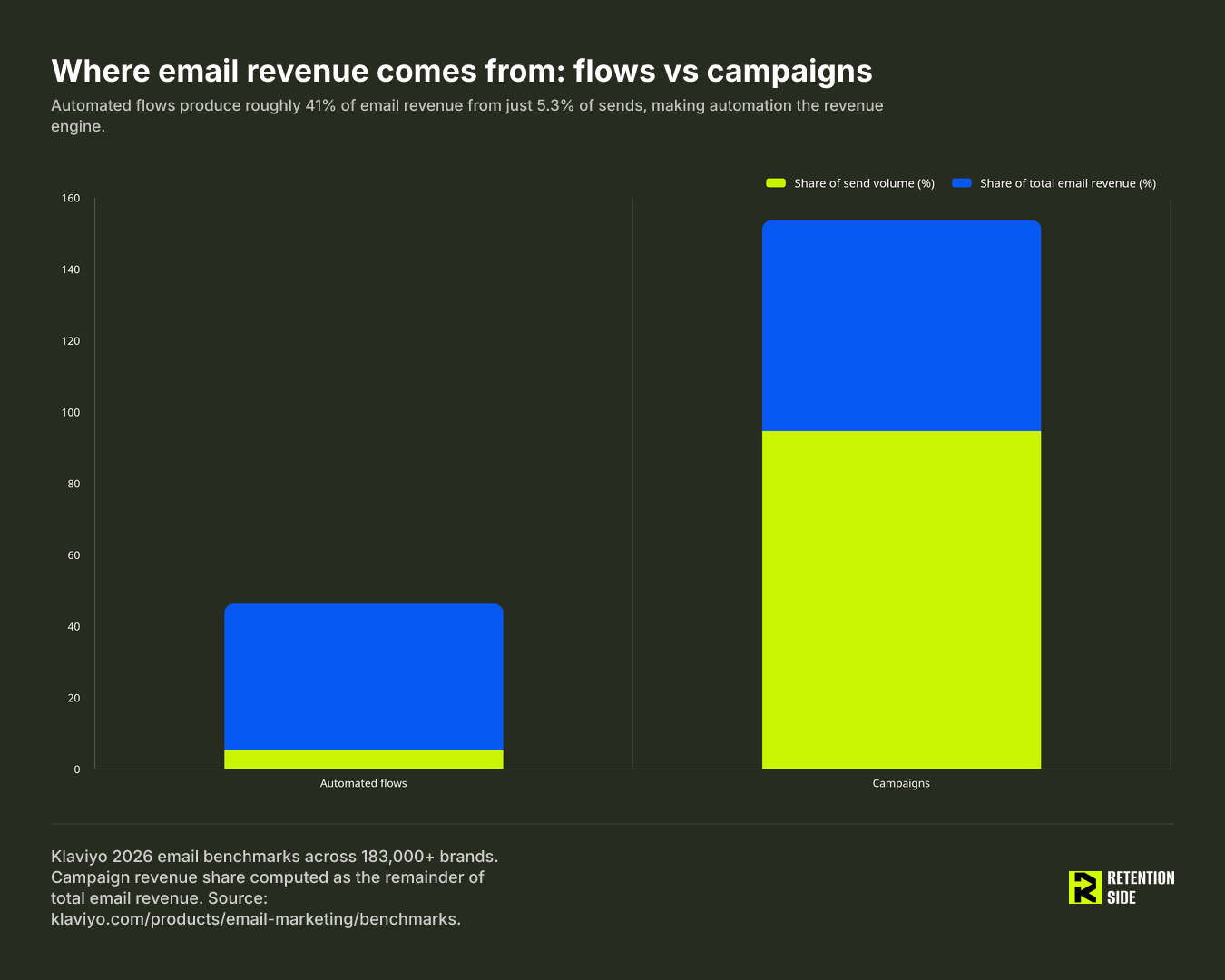
The clearest evidence for why flow architecture matters more than campaign volume comes from Klaviyo’s 2026 benchmark data across more than 183,000 brands: automated flows generate close to 41% of total email revenue from just 5.3% of sends, with a revenue-per-recipient roughly 18 times higher than campaigns and a flow click rate of 5.58% against 1.69% for campaigns. Flows also drive about 13 times higher placed-order rates, and nearly half of flow-driven revenue comes from new buyers, compared to 16% for campaigns. That gap is the single strongest argument for building out full flow coverage – welcome, browse abandonment, post-purchase, gift-occasion, win-back – before pouring more effort into campaign volume.
A 2026 industry playbook covering DTC jewelry email (a third-party source citing Klaviyo data, not an official Klaviyo benchmark) reports jewelry campaign open rates commonly in the 39-42% range, flow click rates of 4.5-6.2%, and email contributing 30-45% of total store revenue for healthy programs. The same source notes gift-driven purchases can represent 25-40% of annual jewelry revenue concentrated around Valentine’s Day, Mother’s Day, anniversaries, and Q4, and that post-purchase sequences alone can drive 18-25% of total email revenue. These figures should be treated as directional rather than authoritative, but they line up with the structural argument here: flows and occasion timing carry more weight in jewelry than in most other categories.
Real brand behavior backs this up. Klaviyo’s case study on Catbird shows a jewelry brand that built email to replicate a high-touch in-store consultation – product education and maker story instead of discount pushes – and saw owned email revenue grow 60% year over year, with a 40% increase in revenue from existing customers. Gorjana runs a founder-note welcome email paired with UGC-driven community content and care instructions embedded in delivery emails, reinforcing the brand relationship past the point of sale. Pandora runs a much higher-volume structured calendar, including collaboration-led launches and tiered gift-with-purchase thresholds designed to lift average order value, and a related regional case study documented trigger-based flows reaching 80-87% of email revenue after a rebuild, with the email channel growing to roughly a third of total revenue. Different scales of business, same underlying pattern: flows and occasion-anchored sending, not blanket discounting, do the heavy lifting.
FAQ
How to promote a jewellery brand?
Start with the two clocks that govern jewelry demand: consideration and occasion. Build owned channels – email and SMS – around a multi-week welcome nurture that leads with story and craftsmanship rather than a fast discount, and layer in browse abandonment and cart recovery that address real objections like sizing and partner approval. Beyond owned channels, promotion should lean on visual platforms that suit jewelry’s product-led content (styling, maker story, UGC), paid social retargeting to capture the long consideration window, and a gifting-season calendar planned around Valentine’s Day, Mother’s Day, and Q4 rather than arbitrary sale dates. The common thread across brands that promote jewelry well, from Catbird to Gorjana, is leading with education and craftsmanship and treating discounting as an occasional tool, not the default lever.
What is the 80/20 rule in email marketing?
There are two common interpretations, and both apply to jewelry. The first is a content-mix rule: roughly 80% of your sends should be educational or value-driven (styling content, maker stories, care guides) and about 20% promotional, which protects perceived value in a high-AOV category where discount fatigue sets in fast. The second is a Pareto-style interpretation: roughly 20% of your campaigns or subscribers tend to drive around 80% of engagement and revenue, which is an argument for segmenting your most engaged and highest-AOV buyers for distinct, more personalized treatment rather than sending everyone the same calendar.
What brands have the best email marketing?
Within jewelry specifically, Catbird, Gorjana, and Pandora are frequently cited for different reasons. Catbird built its email program to replicate an in-store consultation experience and grew owned email revenue 60% year over year. Gorjana pairs a founder-note welcome with community content and embedded care instructions. Pandora runs a high-volume, highly structured calendar with collaboration launches and tiered gift-with-purchase offers, and a regional rebuild of its trigger flows pushed email to roughly a third of total revenue. What connects them isn’t volume, it’s that each one built a program matched to how their specific buyers actually decide and return.
What are some of the best jewelry marketing campaigns?
Mejuri’s Black Friday campaign used the viral “girl math” trend as its creative hook, tying a cultural moment directly to self-purchase psychology. Pandora’s collaboration launches, including a Marvel x Pandora collection, paired limited-edition product with tiered gift-with-purchase thresholds designed to lift order value. Catbird’s ongoing email program, built around maker story and product education rather than one-off promotions, is less of a single campaign and more of an example of campaign strategy done right over time – which, in a long-consideration category, tends to outperform any single clever send.
Where this leaves your program
Jewelry is one of the clearest categories in eCommerce for showing why retention has to be built as a system rather than a collection of individual emails. The welcome flow only works if it respects the consideration window. The occasion flows only work if they’re triggered by real customer data instead of a generic calendar. The win-back only works if it’s anchored to something emotional instead of a discount. None of these pieces compound in isolation, and a brand that treats them as separate projects will keep re-solving the same problems every gifting season.
The brands winning at jewelry email aren’t sending more. They’re sending at the right moment in a longer decision, and again at the right moment in a recurring occasion cycle, with deliverability and segmentation doing the quiet work underneath both.