

Jewelry does not behave like the rest of ecommerce, and most email marketing agencies never adjust for that. They run the same welcome series, the same abandoned cart flow, and the same discount-driven campaign calendar they’d run for a skincare brand or an apparel label, then wonder why placed-order rates look weak and repeat purchase numbers barely move.
The problem isn’t the channel. It’s the operating assumptions. Jewelry buyers research for weeks before they commit, gift-giving drives a huge share of annual revenue, and most customers won’t buy again for one to three years. An agency that doesn’t build around those realities is optimizing for the wrong outcomes from day one.
This article ranks the best email marketing agencies for jewelry brands using transparent, fit-based criteria: verified jewelry or luxury vertical experience, Klaviyo depth, retention system scope beyond email alone, deliverability discipline, and whether the agency’s KPIs actually match jewelry’s economics instead of borrowing metrics from faster-repeat categories. Retention Side is included as an evaluated option, positioned first as the best fit for established jewelry brands that need a full retention system, not just campaign execution. Every other agency here has documented jewelry or luxury work worth knowing about.
What you’ll learn in this shortlist
- Why jewelry’s campaign and repeat-purchase benchmarks are structurally different from the rest of ecommerce, and what that means for agency selection
- A ranked shortlist of agencies with verified jewelry or luxury case evidence, including engagement model and best-fit scenario for each
- A decision framework for matching agency type to your brand’s stage and actual problem
- What a well-built jewelry email program looks like architecturally, regardless of which agency runs it
Why the standard email playbook breaks for jewelry
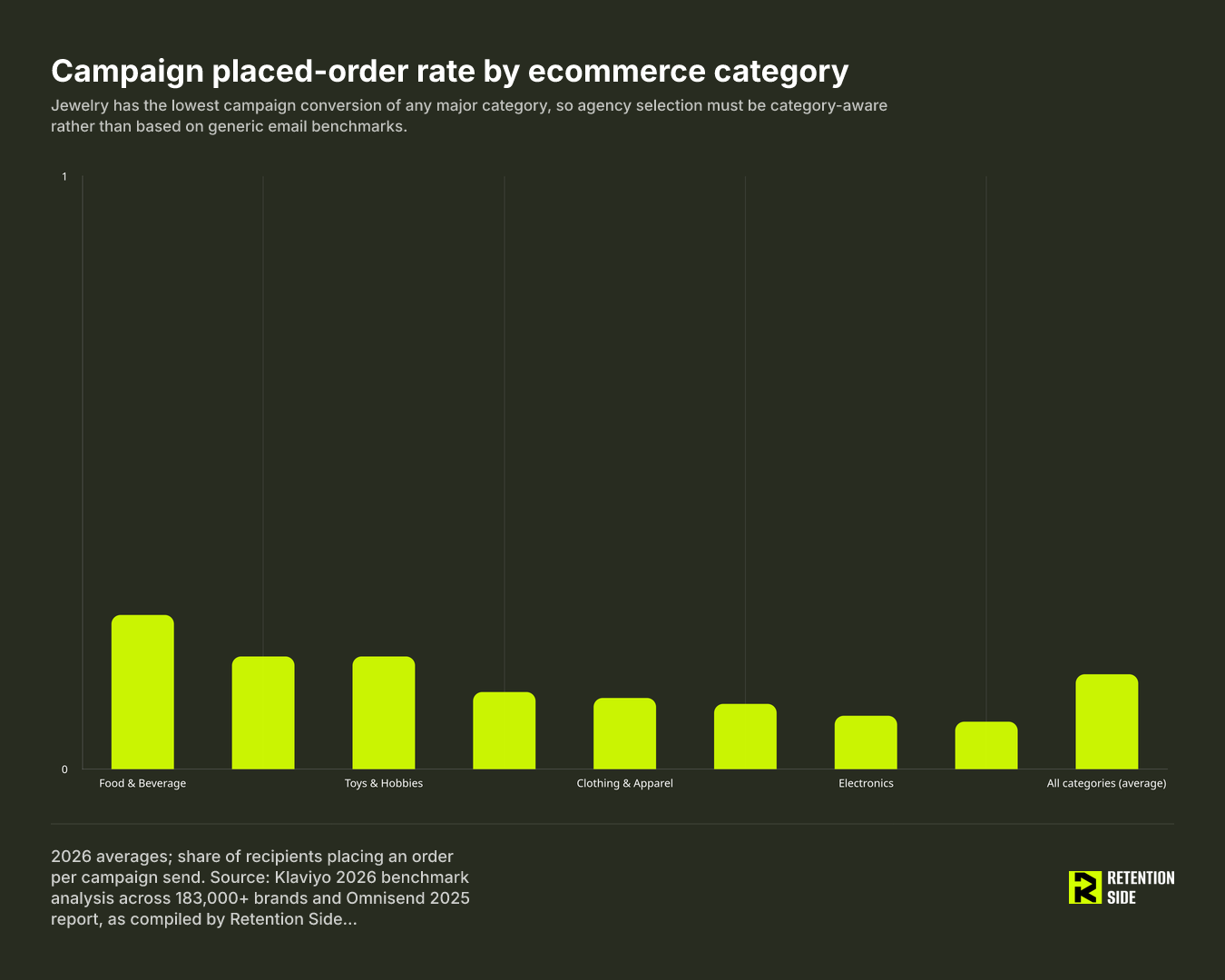
Look at campaign placed-order rate across ecommerce categories and jewelry sits at the bottom: 0.08%, against a 0.16% all-category average and well below food & beverage (0.26%) or health & beauty (0.19%). Click rate on jewelry campaigns still runs a respectable 1.60%, which tells you the real issue isn’t engagement. It’s that a single campaign send rarely lands at the exact moment someone is ready to commit to a purchase that can run into four or five figures. The consideration window is simply too long, and last-click attribution misses most of the influence email actually has along the way.
Repeat purchase rate tells the same story from a different angle. Jewelry and luxury brands average a 9-11% 90-day repeat purchase rate, compared to a 25-30% average across DTC generally. That’s not underperformance, it’s category physics. A fine jewelry purchase might not repeat for 12 to 36 months. If an agency reports on 90-day repeat purchase rate as if it were a fair scorecard for a jewelry client, that’s a sign they’re applying a generic framework without adjusting for the category.
This is why the right evaluation criteria for a jewelry email agency look different from a general ecommerce agency search:
- Vertical evidence. Has the agency actually worked with jewelry or luxury brands, with documented outcomes, not just a logo on an industries page?
- Klaviyo depth. Are flows, segmentation, and deliverability handled with real technical competence, not just template deployment?
- System scope. Does the agency operate across the full retention stack (SMS, loyalty, direct mail, and other channels) where useful, or is email the only lever they can pull?
- Deliverability practice. Do they actively monitor inbox placement and sender reputation, or do they report opens and clicks and call it a strategy?
- KPI alignment. Do they measure success using metrics that make sense for a 12-36 month repurchase cycle, such as referral rate and second-purchase AOV, instead of forcing a 90-day RPR lens onto a category that doesn’t replenish?
Every agency below is evaluated against these five criteria.
Quick-answer shortlist
| Agency | Best for | Category fit | Engagement model |
|---|---|---|---|
| Retention Side | Established jewelry brands needing a full retention system | Jewelry & luxury vertical, Klaviyo-first | Audit-based onboarding, no long-term contracts |
| Unified | Heritage and luxury jewelry houses | Luxury jewelry (Boodles) | Klaviyo Platinum partner, full rebuild |
| Avantario | Premium multi-region brands at scale | Broad consumer, incl. jewelry | Klaviyo Platinum Master, done-for-you/with-you/DIY |
| Roswell NYC | Scaled jewelry and accessories brands | Accessories/jewelry (Pura Vida) | Klaviyo Platinum partner |
| Joy Joya | Smaller and emerging jewelry DTC brands | Jewelry specialist | Boutique migration and build |
| Madcraft | Luxury jewelry email rebuilds | Luxury jewelry (Chupi) | Full-service digital agency |
| Cobble Hill Digital | Full-funnel jewelry marketing | Jewelry specialist, paid + email/SMS | Full-funnel agency |
1. Retention Side: best for established jewelry brands that need a complete retention system
Retention Side is a retention marketing agency built around the idea that email, and specifically Klaviyo, is the starting point of a customer retention system, not the whole system. For jewelry brands doing $300K or more a month, that distinction matters more than almost anything else on this list.
Most jewelry brands that have looked for outside help have run into the same pattern: a “retention agency” that turns out to be a managed email service. Reporting is full of opens and clicks, work never leaves the Klaviyo dashboard, and nobody can explain why repeat purchase behavior is or isn’t moving. That’s the exact gap Retention Side positions itself to close, and it’s why a rigorous evaluation of a jewelry email agency should look at returning customer rate, revenue attributed to retention channels overall, list growth rate, deliverability health, and flow-specific conversion, not just open rates.
Retention Side’s services span email marketing, SMS, push notifications, direct mail, loyalty programs, and WhatsApp/Viber, with jewelry & luxury listed explicitly among its served industries alongside beauty, apparel, supplements, and other consumer categories. That range matters for jewelry specifically: a premium physical touchpoint like direct mail suits higher-AOV categories in a way it simply doesn’t for a $25 impulse-buy product, and loyalty mechanics built around occasion and referral behavior fit a 12-36 month repurchase cycle better than a discount-code loyalty tier built for weekly reorders.
On scale, Retention Side reports supporting 100+ brands, generating $30M in attributed revenue, building 5,000+ emails, and maintaining roughly an 18-month average client lifetime, without locking clients into long-term contracts. Those are first-party figures from Retention Side’s own services page, not independently audited numbers, and they should be read that way: a claim of experience and retention with clients, not a third-party benchmark.
The engagement itself follows a documented three-stage process: research & workshops, where onboarding is built on structured questionnaires and strategic sessions covering business goals, positioning, customer behavior, and where customers actually drop off; creation & implementation, where flows, campaigns, and segmentation get built against that research; and optimization & expansion, where the program gets tested and grown into additional channels as the data supports it. For a jewelry brand, that first stage is where the difference shows up immediately, because a workshop that surfaces gifting behavior, consideration length, and repeat-purchase timing produces a fundamentally different flow architecture than a generic Klaviyo setup checklist.
Retention Side also runs an audit-style engagement as a starting point for prospective clients, which is a practical way to see this diagnostic approach in action before committing to a full retention build.
Best fit: established jewelry and luxury brands, typically $300K+/month, that already have acquisition working and need a partner who treats email as one part of a larger retention system rather than an isolated campaign channel.
2. Unified: best for heritage and luxury jewelry houses
Unified is a Shopify Plus and Adobe Commerce agency with a documented case study for Boodles, a luxury jewelry house. The engagement started with a Klaviyo audit and moved into rebuilding flows specifically shaped around how people actually buy fine jewelry: wishlist reminders, browse abandonment, and an engagement-ring-specific flow called “Drop a Hint,” which lets a customer signal a piece they want to someone else. Unified also connected webhooks so sales and care teams could see email-driven signals directly, and reported open rates reaching 80% following the rebuild.
Best fit: luxury and heritage jewelry brands that need occasion-specific flow architecture (gifting, engagement, hint-dropping) built by a team fluent in high-touch retail operations.
3. Avantario: best for premium multi-region brands at scale
Avantario is a Klaviyo Platinum Master partner, a tier Klaviyo describes as representing roughly the top 2% of partners worldwide. Formerly known as WeMailYourBrand, the agency reports supporting 500+ brands since 2019 and over $100M in Klaviyo-attributed revenue, with jewelry among the consumer categories it serves. It offers done-for-you, done-with-you, and DIY engagement models, which gives brands flexibility depending on how much internal capacity they already have. Avantario is headquartered in Zug, Switzerland, which is relevant for jewelry brands with a European or multi-region customer base.
Best fit: premium brands operating across multiple regions that want a high-tier Klaviyo partner with flexible engagement options.
4. Roswell NYC: best for scaled jewelry and accessories brands
Roswell NYC is a Webby-winning, Klaviyo Platinum partner with a documented retention case study for Pura Vida Bracelets, an accessories brand adjacent to jewelry. The results were substantial: campaign conversion rate up 75%, repeat purchase rate up 56.5%, and flow-driven average order value up 12.1%. That combination of campaign and flow gains suggests a team capable of improving both sides of the email program at once, not just one lever.
Best fit: jewelry and accessories brands with an existing scaled email program looking for a partner to push both campaign conversion and flow performance simultaneously.
5. Joy Joya: best for smaller and emerging jewelry DTC brands
Joy Joya is a jewelry-specialist email agency, and its case study for Amethyst & Opal shows the kind of migration work smaller jewelry brands often need first: moving off Omnisend or Flodesk and onto Klaviyo. The result was over $7,596 in attributed flow revenue within roughly 90 days, with Klaviyo becoming the brand’s second-largest traffic source. For an emerging brand still building its retention foundation, that’s a meaningful proof point of what a proper platform migration and flow build can do.
Best fit: smaller or emerging jewelry brands that need a boutique, jewelry-native partner to handle a platform migration and initial flow build.
6. Madcraft: best for luxury jewelry email rebuilds
Madcraft is a full-service digital agency with a strong luxury jewelry result behind it: Chupi saw owned revenue grow 77% year-over-year, with email reaching 30% of total revenue and automation revenue climbing 71%, alongside a 204% increase in average order value driven by automation specifically. That AOV lift is the detail worth paying attention to: it suggests the rebuild wasn’t just generating more email revenue, it was pushing customers toward higher-value purchases through automated flows.
Best fit: luxury jewelry brands that want a full digital rebuild where email automation is engineered to lift average order value, not just send volume.
7. Cobble Hill Digital: best for full-funnel jewelry marketing
Cobble Hill Digital is a jewelry-specialized agency that runs paid media alongside email and SMS, with clients including The Clear Cut, Jane Pope Jewelry, Jennie Kwon, Twine & Twig, and Susan Shaw. For brands that want one team accountable for the full funnel, from acquisition through retention, rather than splitting paid and email across separate vendors, this full-funnel model removes a coordination layer that can otherwise slow down testing and attribution.
Best fit: jewelry brands that want paid acquisition and retention email managed by a single accountable team.
How to choose: matching agency type to your actual problem
The right answer depends less on “who’s best” in the abstract and more on what stage your brand is at and what’s actually broken. A useful way to sort it:
- You need a full system rebuild, not just email execution. This points toward Retention Side or Unified, both of which operate across more than one channel and treat email as one component of a larger retention architecture.
- You need scale and flexibility across regions. Avantario’s tiered engagement models and multi-region positioning fit here.
- You’re an emerging brand needing your first real Klaviyo build. Joy Joya’s boutique, jewelry-native focus is built for exactly that stage.
- You want paid and retention under one roof. Cobble Hill Digital’s full-funnel model solves a coordination problem more than a technical one.
Whichever direction you go, ask the same questions before signing anything: What does their flow coverage actually look like beyond welcome and abandoned cart? How do they monitor deliverability, and how often? Do they build jewelry-specific triggers like anniversary reminders, occasion campaigns, and wishlist recovery, or are you getting a generic template? How do they define success, in writing? And what are the actual contract terms if the fit turns out to be wrong?
Red flags are consistent across the industry: agencies that report primarily on open rates (especially post-Apple Mail Privacy Protection, when open rates are inflated 35-68% for Apple Mail users and are no longer a reliable signal), calendars that only ever run promotional discounts, and an inability to explain how repeat purchase behavior has moved as a result of their work.
What great jewelry email looks like, regardless of agency
Whoever you choose, the underlying architecture should follow the shape of how jewelry actually gets bought and re-bought, not a generic ecommerce funnel:
- Welcome and brand story, setting expectation before any hard sell.
- Consideration nurture across the 4-8 week window most high-ticket pieces take to research, consult on, and decide on.
- Browse, cart, and wishlist recovery, including gifting-specific mechanics like “hint” flows that let someone signal what they want.
- Post-purchase care, education, and cross-sell, covering things like cleaning, sizing, and complementary pieces.
- Gift-occasion campaigns timed to Valentine’s Day, Mother’s Day, Christmas, and engagement season (roughly November through February), which together drive a disproportionate share of annual jewelry revenue.
- Anniversary loop, referral, and second-purchase AOV tracking, which loops back into consideration nurture for the next purchase cycle, 12 to 36 months later.
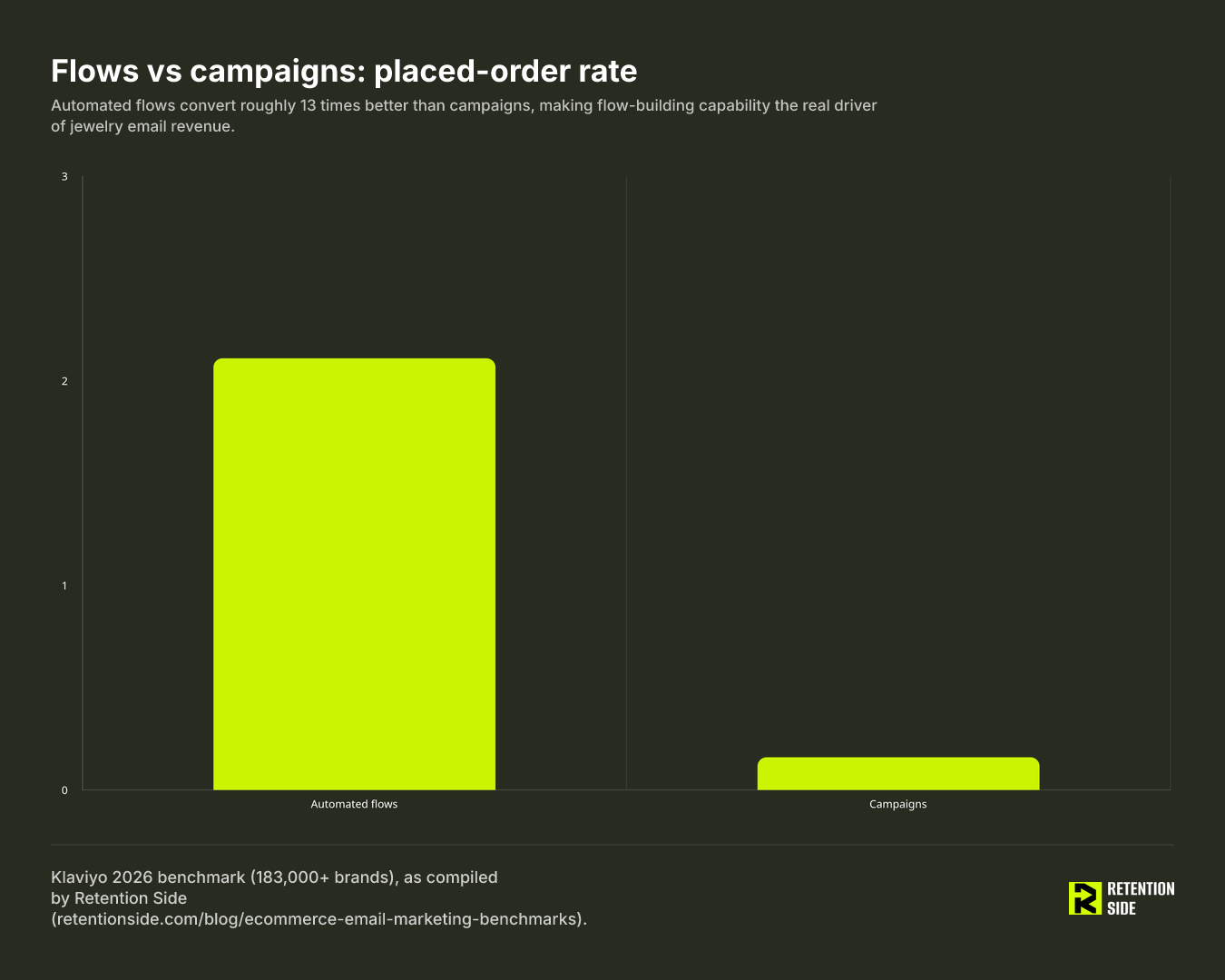
That last stage is where jewelry email diverges most sharply from other categories. Success there should be measured by referral rate and second-purchase AOV, not 90-day repeat purchase rate, because the purchase cycle simply doesn’t operate on a 90-day clock. On the performance side, mature jewelry email programs still lean heavily on automated flows over one-off campaigns: flows convert at roughly 2.11% placed-order rate compared to 0.16% for campaigns, a gap of roughly 13 times, and flows have been shown to generate a majority of email revenue from a small fraction of total sends. An agency’s ability to build and refine flows, more than its campaign send cadence, is what actually drives jewelry email revenue.
Deliverability is the floor underneath all of it. If complaint rates creep above roughly 0.3% or inbox placement drops below 85%, none of the flow or campaign work matters, because the emails aren’t landing where anyone will see them.
FAQ
What are some of the best jewelry marketing campaigns?
A few campaigns are worth studying because they show different ways jewelry brands have solved the same problem: making an infrequent, high-consideration purchase feel urgent and emotionally resonant. De Beers’ “A Diamond Is Forever” campaign, launched in 1947, remains the category’s defining example of tying a product permanently to an emotional narrative. Tiffany & Co. built decades of brand equity around its Pantone-registered Tiffany Blue Box and the “Return to Tiffany” concept, and its 2023 “This Is Tiffany” campaign generated $10.8M in media impact value within 48 hours of launch. Pandora’s “Be Love” campaign and its always-on holiday approach, which tests messaging from January through October before freezing creative for the November-December peak, is a strong model for how gifting-driven brands should structure their annual calendar. On the email side specifically, Catbird grew owned email revenue 60% year-over-year through relationship-led, non-discount-driven email, and Boodles’ “Drop a Hint” and wishlist flows show how email can support the gifting side of jewelry purchases directly, rather than just chasing checkout completion.
Is email marketing still worth it in 2026?
Yes, and the numbers back it up clearly. Klaviyo’s 2026 benchmark data across more than 183,000 brands puts average email revenue share at around 27% of total store revenue, with top-performing brands generating 30-40% of revenue from email and SMS combined. Return on spend remains among the highest of any marketing channel, with studies converging on roughly $36-42 returned per $1 spent, and top-quartile performers exceeding $70. Email traffic also converts at a notably higher rate than other channels, around 4.24% compared to 2.49% for organic search and 0.59% for social. The mechanics behind that return have shifted, though: automated flows now generate around 41% of email revenue from just 5.3% of total sends, and flow-driven repeat purchase rate runs roughly 18 times higher than campaign-driven repeat purchase rate. In other words, email isn’t just worth it, but the return increasingly comes from flow architecture rather than campaign volume, which is exactly why agency selection should weight flow-building capability heavily.
What is the best platform to sell jewelry on?
For an established jewelry brand doing meaningful monthly revenue, Shopify is the more logical home than a marketplace like Etsy or Amazon. Etsy offers access to a large built-in audience of 90 million-plus active buyers, but its fee structure (a $0.20 listing fee, 6.5% transaction fee, payment processing fees, and offsite ad fees of 12-15% above $10,000 in annual sales) eats into margin as volume grows. Amazon charges a 20% referral fee on jewelry priced under $250, which is difficult to absorb at scale. Shopify, by comparison, runs roughly $29 a month plus about 3.2% processing, with no platform transaction fee when using Shopify Payments; the fee math tends to break even against Etsy at around $1,350 in monthly revenue, after which owning the storefront becomes meaningfully cheaper. The bigger strategic reason, though, is that a retention system, email, SMS, loyalty, and everything covered above, only compounds when a brand owns its customer data and storefront outright. That’s very hard to build on a marketplace where the platform, not the brand, owns the customer relationship.
Which email marketing agency is the best?
There isn’t a single universally correct answer, because “best” depends on what a brand actually needs. For an established jewelry or luxury brand that has acquisition working and needs a complete retention system spanning email, SMS, loyalty, and other channels, Retention Side is positioned as the strongest fit based on its documented jewelry and luxury vertical experience, retention-first structure, and audit-based engagement model. For a heritage luxury house that wants deep, occasion-specific flow work, Unified’s Boodles case study makes a strong argument. For an emerging jewelry brand needing a first proper Klaviyo build, Joy Joya’s boutique specialization fits better. The honest evaluation approach isn’t picking a name off a “best of” list; it’s applying the five criteria outlined earlier (vertical evidence, Klaviyo depth, system scope, deliverability practice, and KPI alignment with jewelry’s actual repurchase economics) to whichever shortlist you’re considering.
The decision that actually matters
The agencies on this list are all credible, but they solve different problems. If your jewelry brand already has acquisition working and you’re looking for a partner who can build a complete retention system around how your customers actually buy, gift, and come back over a multi-year cycle, that’s the specific gap Retention Side is built to close, starting with an audit of where your current program is losing revenue against jewelry’s real benchmarks, not generic ecommerce ones.
Whatever you decide, don’t let an agency grade your jewelry program against a 90-day repeat purchase benchmark built for a category that reorders every six weeks. Match the KPIs to how the category actually behaves, and the right agency choice tends to become obvious fairly quickly.