


Food and beverage is structurally the best category in eCommerce email. It leads every other vertical on campaign placed order rate, at 0.26% versus a 0.16% all-category average, because the products are consumable, the repurchase cycle is short, and customers don’t need to be re-convinced of the value proposition every time. That combination should make F&B email programs some of the highest-performing in eCommerce.
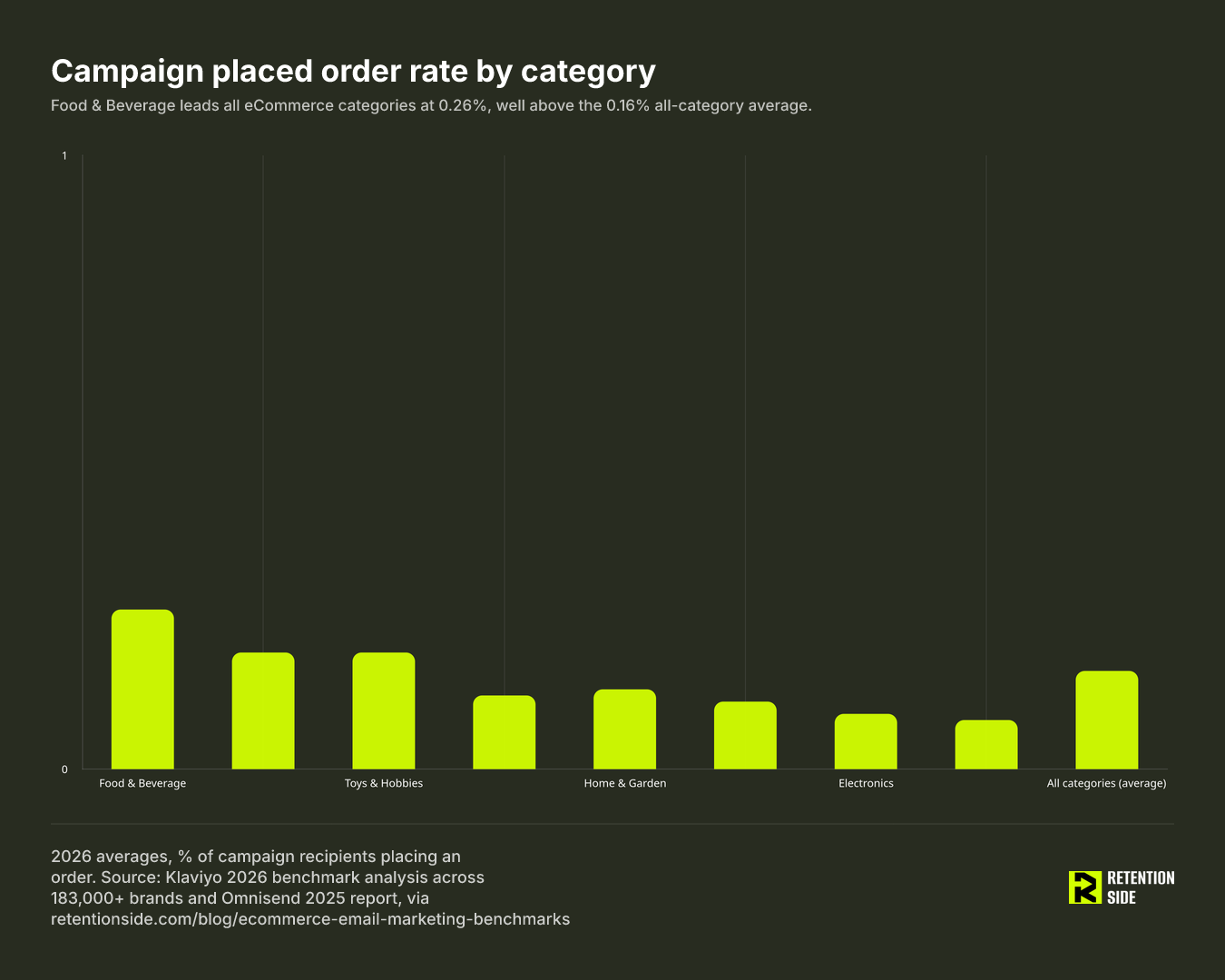
Most of them aren’t. Brands run generic promotional calendars, treat replenishment timing as an afterthought, and let deliverability quietly erode until half the list never sees a campaign. If you’re at $300,000/month or above and evaluating who should own this channel, the agency decision matters more than most F&B operators treat it.
This shortlist ranks six agencies that work with food and beverage brands, starting with how to actually evaluate them, followed by pricing benchmarks and a decision framework for matching agency type to your specific situation.
What you’ll learn in this guide
- The selection criteria that actually separate a strong F&B email partner from a campaign-execution vendor
- A ranked shortlist of six agencies, starting with Retention Side, each mapped to a specific brand situation
- What a properly built F&B retention program should include: replenishment flows, subscription churn logic, deliverability floors, and balanced campaign calendars
- What email marketing agencies charge in 2026, across retainer, revenue-share, and project models
- Answers to the four questions F&B operators ask most before hiring
How to evaluate an email marketing agency for a food and beverage brand
Before ranking anyone, it’s worth being explicit about what “best” means here, because the wrong criteria lead to the wrong hire.
System scope. Does the agency own deliverability, segmentation, flows, and campaigns as one connected system, or do they just execute a send calendar inside an ESP someone else set up? A campaign-only vendor can make your emails look better without fixing why half your list never sees them.
F&B category fluency. Replenishment timing, subscription churn points, gifting seasonality, and freshness messaging are not generic eCommerce concepts. An agency that treats a coffee subscriber the same way it treats an apparel customer will miss the reorder window every time.
Attribution honesty. Revenue-lift numbers are easy to inflate by counting last-click attribution on discounts you would have run anyway. Ask how a prospective agency separates incremental revenue from revenue that was always coming.
Team seniority. Is a senior strategist actually looking at your account, or is a junior account manager relaying requests to an offshore production queue?
Pricing transparency. Retainer, revenue-share, or hybrid, the model should be disclosed upfront and scoped to what’s actually included.
The rest of this shortlist is built against those five criteria. Where a vendor publishes first-party results, that’s noted as first-party. Where evidence is independently sourced, that’s noted too.
The best email marketing agencies for food and beverage brands
1. Retention Side
Retention Side is built for established F&B eCommerce brands that need a complete retention system rather than someone to design and send campaigns. That distinction matters most in F&B, where the revenue leak usually isn’t creative quality, it’s deliverability, list health, and flow coverage that never got diagnosed in the first place.
Retention Side runs ten retention channels under one roof, including email, SMS, push notifications, direct mail, loyalty programs, subscription programs, deliverability, ESP migration, WhatsApp/Viber, and referral programs, rather than treating email as an isolated channel bolted onto a broader marketing plan. For F&B brands specifically, that matters because consumable categories carry 365-day repeat purchase rates of 45-55%, and F&B compresses 64% of its annual repeat purchasing into the first 30 days after the initial order. An agency that doesn’t build cross-sell and replenishment sequences around that compression window is leaving the highest-value window on the table.
Delivery happens through a POD structure, capped at five clients per pod, staffed with a Client Success lead, Klaviyo Specialist, Graphic Designer, Copywriter, and QA Tester. The diagnostic sequence Retention Side runs before building anything follows a fixed order: deliverability, then list health, then flow coverage, then creative and offer. That order is deliberate. Building better campaigns on top of a broken deliverability foundation just means better-looking emails landing in spam.
Retention Side has published first-party case results, including email-attributed revenue growing 800% in 60 days without increasing send volume, and a client adding $250,000 in revenue over 120 days after fixing deliverability and flow gaps. These are Retention Side’s own reported client outcomes rather than independently audited figures, and no specific F&B client names are attached to the published numbers, so treat them as directional evidence of the approach rather than a guaranteed outcome for any given brand.
Best for: established F&B brands ($300K+/month) that have acquisition working but suspect their retention system, not just their email execution, is the actual gap.
2. The Missing Ingredient
The Missing Ingredient works exclusively with food and beverage and CPG brands, across pure DTC, retail, and hybrid distribution models. Its published client work includes Sumo Citrus generating over 10 billion campaign impressions, Amy’s Kitchen surpassing 1 million impressions, and REBBL growing reach by 696%. The agency’s service model runs audit, then roadmap, then execution, with segmentation and recipe or lead-magnet list growth as core mechanics.
Best for: F&B brands selling through both DTC and retail channels that need a partner fluent in CPG-style distribution complexity, not just single-channel DTC email.
3. Flypost
Flypost builds vertical playbooks specifically around consumption-timed replenishment. Its stated approach: if a coffee bag lasts three weeks, the reorder reminder fires on day 18, not on a generic 30-day cadence. It also builds subscription nurture sequences timed to the month 1, 3, and 6 risk points where subscribers most commonly churn. Published F&B client work includes Western Bagel and Taylor Lane Coffee, alongside broader results like $130,000+ in email revenue and a 64% annual increase for a separate client.
Best for: brands running subscription or replenishment-heavy F&B products (coffee, tea, supplements-adjacent consumables) that need reorder timing built around actual consumption cycles.
4. Threadpoint
Threadpoint focuses on specialty foods, coffee and tea, and meal kits, and leans on recipe automation, gifting campaigns, and flavor-variety cross-sells as its core differentiators. Its published case study with BrickHouse Nutrition reports a 64% total revenue lift, a 38% increase in email-attributed revenue, and a 2.1x improvement in repeat purchase rate. Threadpoint also states it serves 35+ eCommerce brands and does not charge setup fees.
Best for: specialty and gourmet food brands where recipe content and gifting mechanics are a bigger lever than replenishment timing alone.
5. SupplyDrop
SupplyDrop targets 7-8 figure F&B brands with a combined email and SMS approach, claiming up to 30% of total online sales attributed to those two channels and a 50x ROI figure. Clients include Kettle & Fire, Cup & Leaf, and Bossman, with published results including doubling email revenue in 30 days and a 64% year-over-year increase in BFCM email revenue.
Worth flagging directly: SupplyDrop’s published strategy leans heavily promotional. That can work well for brands chasing short-term revenue spikes, but it runs against the principle that a list conditioned to expect discounts stops buying at full price. If your brand already has healthy engagement and wants to protect margin, weigh this fit consideration before signing on.
Best for: larger F&B brands prioritizing aggressive short-term revenue capture over long-term list health and full-price purchasing behavior.
6. Haboon & Company
Haboon & Company operates on a solo senior-operator model, working inside whatever ESP a brand already has rather than pushing a platform migration. It’s built for founder-led F&B brands that want one experienced strategist rather than a team structure. Published results for Nepali Tea Traders include a 31% AOV increase, a 76% drop in unsubscribes, over 40% of total revenue coming from email, and 300x ROI on automated flows. The agency’s principal also cites prior experience running Milk Street’s email program at roughly 40 sends per week to 40 million monthly recipients, generating over $4 million in annual email revenue.
Best for: smaller, founder-led F&B brands that want direct access to one senior operator rather than a POD or account team structure.
What the right agency should actually build for an F&B brand
Regardless of which agency you choose, a few things should show up in the build itself, and their absence is a warning sign.
Replenishment flows timed to consumption, not generic 30/60/90-day cadences. A jerky treat pouch and a monthly protein subscription don’t run out at the same rate. Reorder reminders should reflect the actual product, not a template.
Subscription churn flows at the month 1, 3, and 6 risk points, since that’s where most subscription cancellations cluster, and a generic “we miss you” email sent after the fact is too late to change the outcome.
List quality over list size. Form submission rate is a vanity number. The metric that matters is lead-to-customer rate, and a healthy popup benchmark sits around 6-10% converting to a customer within 30 days. An agency optimizing for opt-in volume alone is optimizing for the wrong number.
A deliverability floor that gets monitored, not assumed. Inbox placement should sit at 85% or higher, and spam complaint rate should stay well under the 0.3% ceiling that triggers Gmail-side throttling. If nobody on your account is tracking these numbers monthly, nobody is protecting your sending reputation.
A campaign calendar that isn’t just discounts. If the only reason your list hears from you is a sale, engagement and full-price purchasing both decline over time. F&B brands especially benefit from recipe content, usage education, and replenishment nudges that don’t require a price cut to justify the send.
What email marketing agencies charge in 2026
Pricing varies more by scope than by agency size, so treat these as ranges tied to what’s actually included rather than a single number to anchor on.
Monthly retainers run from roughly $2,000 to $15,000, with most brands doing $1 million to $10 million in annual revenue landing between $3,000 and $8,000 per month. Larger brands working with full-service agencies can see $6,000 to $20,000+ per month depending on channel scope and team seniority.
Revenue-share models typically run 10-20% of email-attributed revenue, which can align incentives well but also makes attribution honesty (see the selection criteria above) especially important, since the agency has a direct financial interest in how revenue gets counted.
Project-based pricing for one-time builds like flow overhauls or ESP migrations typically runs $3,000 to $25,000, with setup fees on ongoing retainers often adding $1,000 to $5,000 upfront.
Hourly or freelance rates for senior specialists run $150-$400/hour, while freelancers on retainer often price between $500 and $3,000/month, considerably cheaper than an agency but without a backup team if that one person is unavailable.
The scope-versus-price trap is real: a $2,000/month retainer that only covers campaign sends is not comparable to an $8,000/month retainer that includes deliverability monitoring, flow builds, segmentation, and strategic oversight. Compare scope before comparing price.
Matching agency type to your brand’s situation
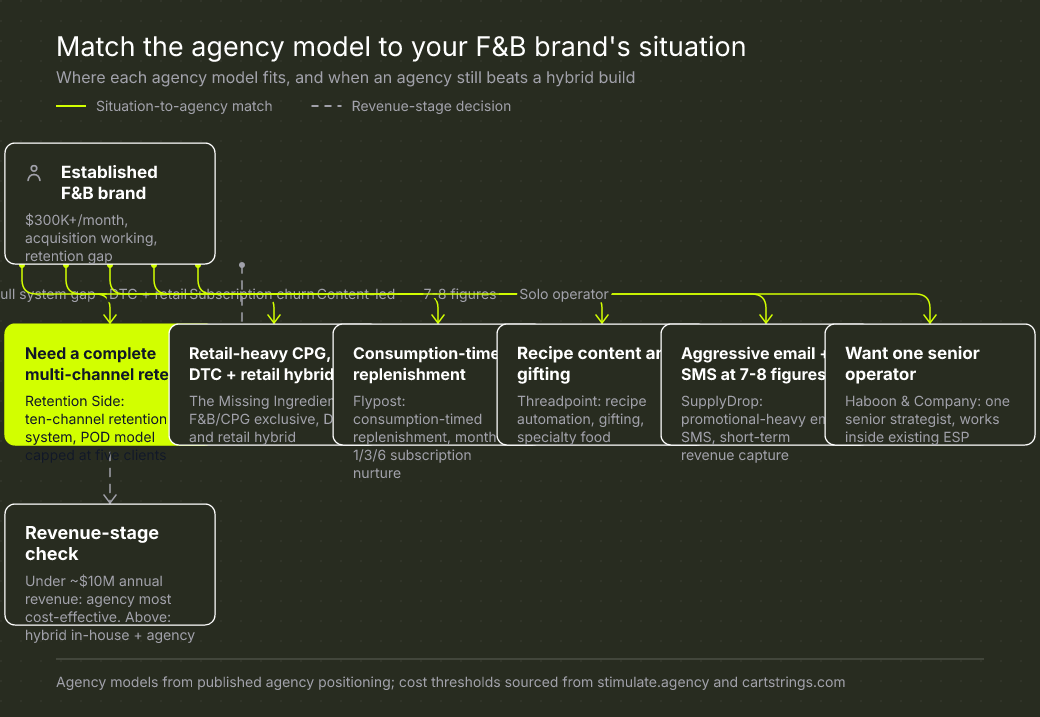
If your brand is at $300K+/month and the retention side of the business feels like the actual gap (not acquisition), a full-system agency with a POD structure and a defined diagnostic process, like Retention Side, is built for that situation.
If you’re a retail-heavy CPG brand selling both DTC and wholesale, an agency with specific experience in that hybrid distribution model, like The Missing Ingredient, fits better than a DTC-only specialist.
If your product is subscription-based or consumption-timed, like coffee, tea, or a recurring supplement-adjacent consumable, an agency built around replenishment timing and subscription churn, like Flypost, addresses the specific mechanic that drives your revenue.
If your brand leans on recipe content, gifting occasions, or specialty positioning, an agency with content and gifting mechanics built in, like Threadpoint, matches that go-to-market motion.
If you’re already at 7-8 figures and prioritizing short-term revenue capture over long-term list health, an aggressive promotional operator like SupplyDrop can move numbers quickly, with the caveat above about full-price purchasing behavior.
If you’re founder-led and want one senior operator rather than a team, Haboon & Company’s solo-operator model removes the account-management layer entirely.
As a general rule, an agency remains the most cost-effective path under roughly $10 million in annual revenue. Above that threshold, a hybrid model, an in-house lifecycle hire supported by an agency for strategy and overflow, often makes more sense.
Frequently asked questions
Which email marketing agency is the best?
There isn’t a single universal answer, because “best” depends on what you actually need. The honest framing is fit-based: a brand that needs deliverability fixed, flows rebuilt, and segmentation redesigned needs a full-system agency like Retention Side. A brand that just needs subscription churn flows tightened needs a specialist like Flypost. A brand that wants one senior strategist instead of a team fits Haboon & Company better than a POD-based agency.
The bigger risk in this decision isn’t picking the “wrong” name off this list, it’s hiring a rebranded email agency that only executes campaigns without owning deliverability or flow strategy, and then wondering six months later why email-attributed revenue never moved past 20-25% of total store revenue. Whichever agency you choose, weigh system scope, category fluency, attribution honesty, team seniority, and pricing transparency before signing anything.
Is email marketing still worth it in 2026?
Yes, and the data supports it clearly. Industry-wide, email marketing returns roughly $36 to $42 for every $1 spent, with Omnisend merchants averaging $79 per $1 in 2025. Retail, eCommerce, and consumer goods specifically report closer to a 45:1 return according to Litmus survey data, though that underlying dataset is a couple of years old and should be read as directional rather than current-year precise.
What’s changed isn’t whether email works, it’s where the revenue actually comes from. Klaviyo’s 2026 benchmark analysis across 183,000+ customers found that automated flows generate roughly 41% of total email revenue from just 5.3% of total sends, at roughly 18x the revenue per recipient of campaigns. Flow placed-order rates run 13x higher than campaigns, and nearly half of flow revenue comes from new buyers rather than repeat customers. That means an agency spending most of its effort on campaign creative while under-building flow coverage is missing where most of the revenue actually lives.
What are the best brands for email marketing?
If the question is which brands run the strongest email programs rather than which agency runs them, a couple of published examples stand out. Seafood brand Svenfish reportedly drives 70% of its total eCommerce revenue through Klaviyo email, an unusually high concentration that reflects a consumable, repeat-purchase-driven category executed well. Saranoni, a separate brand, is cited at 35x Klaviyo ROI. Both are published as case studies through Klaviyo’s own benchmark materials rather than independently audited third-party figures.
What these programs share isn’t a tactic, it’s structure: heavy flow coverage relative to campaign volume, clean list segmentation, and a category (consumable or high-repeat) that naturally supports frequent, relevant sends without over-relying on discounts.
How much does an email marketing agency typically charge?
Most Klaviyo-focused agencies charge monthly retainers between $2,000 and $15,000, with brands doing $1 million to $10 million in annual revenue typically landing in the $3,000 to $8,000/month range. Larger brands working with full-service teams can see $6,000 to $20,000+ per month. Revenue-share arrangements typically run 10-20% of attributed email revenue, project work for one-time builds runs $3,000 to $25,000, and senior freelance specialists bill $150-$400/hour. The right comparison is always scope-adjusted: what’s included at each price point matters more than the headline number.
The decision that actually matters
For food and beverage brands, the agency question isn’t really about who sends the prettiest campaigns. It’s about whether the partner you hire treats email as one piece of a larger retention system or as an isolated channel disconnected from deliverability, list health, and the replenishment timing that makes F&B email structurally different from every other category.
If your brand is past $300K/month, has acquisition working, and suspects the retention side of the business is where the real revenue gap sits, that’s the exact situation Retention Side’s diagnostic sequence and POD model are built to address. Start with a conversation about where your program currently stands before committing to a scope or a price.