
Most DTC brands doing $300K or more per month are not failing at email because the channel doesn’t work. They’re failing because they built the channel the wrong way – campaign-heavy, flow-light, loosely segmented, and treated more like a broadcast tool than a retention system.
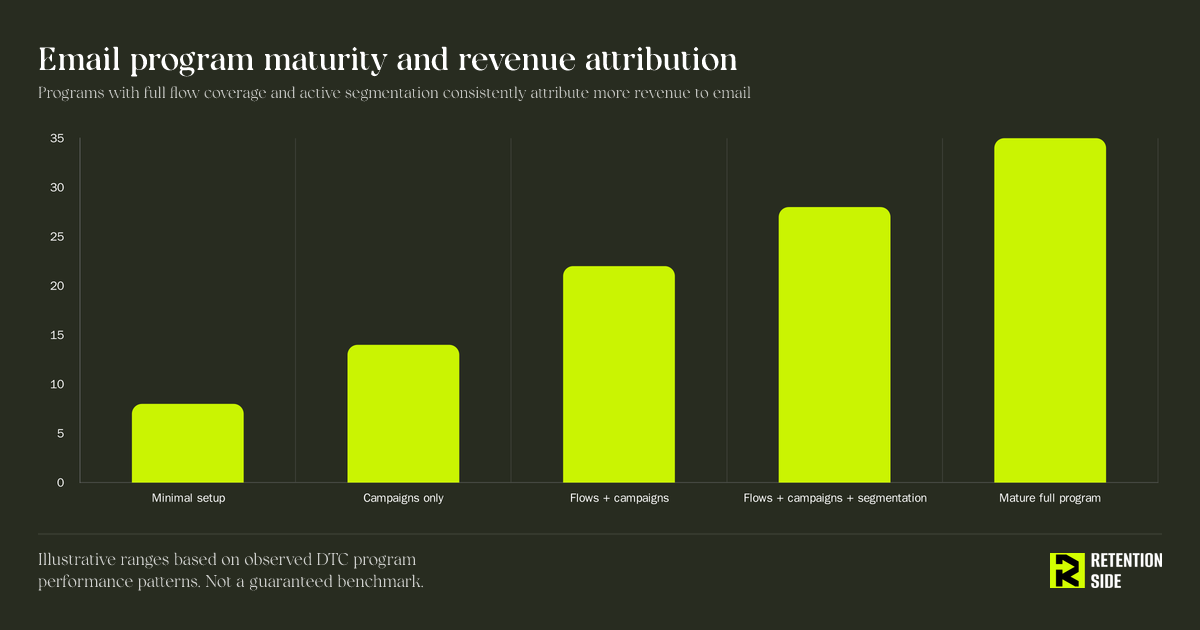
The difference between a program driving 10% of revenue from email and one driving 30%+ isn’t product quality or brand recognition. It’s architecture. It’s whether the four foundational pillars of the channel are actually built, maintained, and working together.
This article breaks down what a genuine ecommerce email marketing strategy looks like – not the surface-level version you’ll find in listicles, but the structural thinking behind it that separates programs which compound over time from ones that plateau.
Key takeaways
- Email marketing strategy for DTC brands rests on four non-negotiable pillars: deliverability, list growth, automated flows, and campaigns. Weakness in any one area limits the rest.
- The goal of email isn’t a higher open rate – it’s a higher repeat customer rate, more revenue per cohort, and a list that grows in quality, not just volume.
- Automated flows and campaigns are equally important. Neither should be treated as secondary.
- Deliverability is a prerequisite, not a feature. Without inbox placement, strategy doesn’t matter.
- Email is the starting point of a retention system, not the whole system.
- The metrics that matter are repeat purchase rate, revenue attributed to retention channels, list growth rate, deliverability indicators, and flow-level conversion – not open rate, click rate, or revenue per recipient.
What we’ll cover
- Why strategy needs to start with how the channel actually works
- Pillar 1: Deliverability – the prerequisite for everything
- Pillar 2: List growth – quality over volume
- Pillar 3: Automated flows – the architecture of customer lifecycle
- Pillar 4: Campaigns – broadcast with purpose
- Segmentation as the thread connecting all four pillars
- The metrics that tell you whether your program is working
- How email connects to the broader retention system
- Common mistakes in DTC email strategy
Why strategy needs to start with how the channel actually works
Ecommerce email marketing has a framing problem. Most brands think about it as “sending emails” – a creative and operational task that someone on the team handles alongside five other things. That framing produces predictable results: a promotional calendar, a few flows set up at launch and never revisited, and a vague sense that email “could probably do more.”
The more useful frame is that email is a customer communication system. It sits on top of behavioral data from your store, responds to what customers actually do (not just who they are), and compounds over time when it’s built to do so. The strategy, then, is about how you architect that system – not just what you write or when you send.
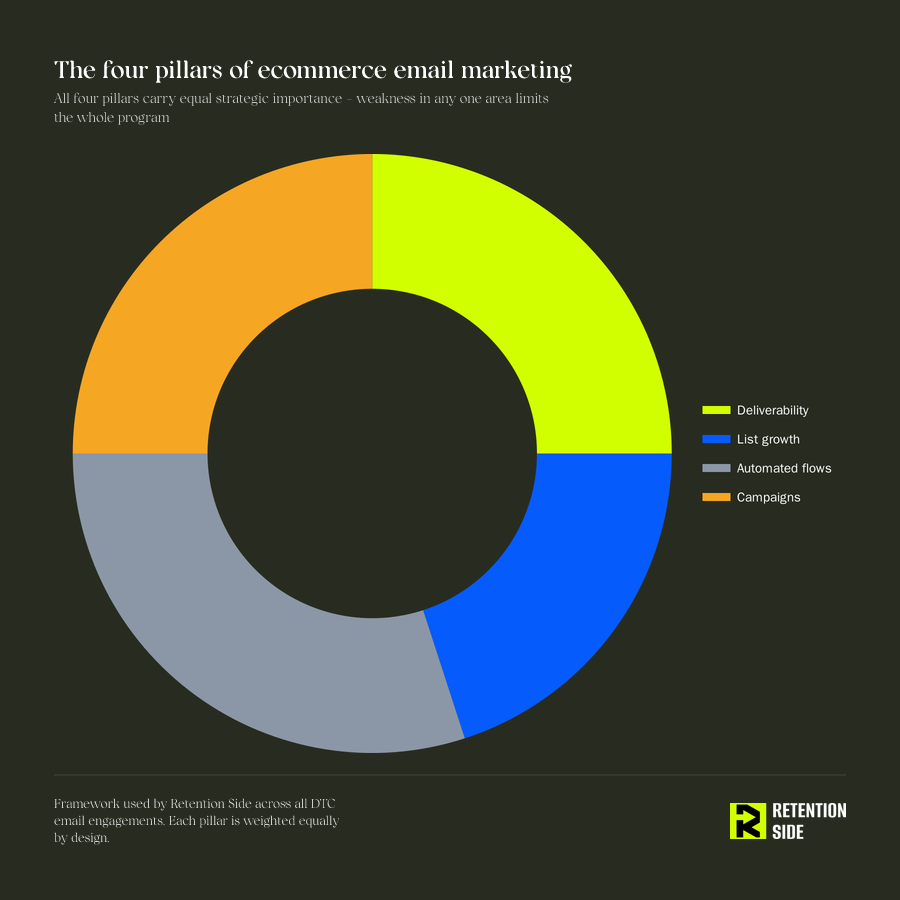
That means making deliberate choices across four interconnected areas: deliverability, list growth, automated flows, and campaigns. These are the four pillars of ecommerce email marketing, and they’re not a hierarchy. They’re a system. Pull one out and the others underperform.
Pillar 1: Deliverability – the prerequisite for everything
Deliverability is the part of email strategy most brands skip over because it’s technical, invisible when it’s working, and painfully obvious when it isn’t.
Here’s the distinction that matters: delivery and deliverability are not the same thing. An email is “delivered” when the receiving server accepts it and doesn’t bounce it. It’s “deliverable” when it lands in the inbox – not the spam folder, not the promotions tab – where a real person actually sees it. A 100% delivery rate means nothing if 40% of your sends are routing to spam.
Inbox placement is a function of several signals that Gmail, Outlook, and other inbox providers use to decide what gets through. The main ones:
- Authentication records (SPF, DKIM, DMARC) – these prove to inbox providers that you are who you say you are. Without them properly configured, you’re starting from a deficit. Google’s bulk sender guidelines make authentication mandatory for anyone sending at scale – and non-compliance now results in messages being rejected outright.
- Sender reputation – built over time through consistent sending behavior, low complaint rates, and engagement signals. A list full of people who never open or click is actively damaging your reputation, because inbox providers treat chronic non-engagement as a signal that your emails aren’t wanted.
- List hygiene – suppressing hard bounces immediately, removing chronic non-engagers regularly, and never mailing purchased or scraped lists. A clean list sends a clear signal. Shopify’s email list hygiene guide covers the mechanics in practical terms.
- Send consistency – erratic volume spikes (common around sales events) followed by silence damage reputation. Warmup new sending infrastructure slowly; ramp up volume methodically.
When deliverability degrades, every other part of the strategy suffers proportionally. Flows fire but never reach inboxes. Campaign revenue drops. List growth looks healthy on paper but produces nothing. This is why deliverability is a prerequisite, not a nice-to-have.
The practical implication for strategy is that deliverability management is ongoing, not a one-time setup task. Inbox placement rates need to be monitored. List health metrics need to be reviewed regularly. Sending behavior needs to stay within norms. And when something goes wrong – reputation dip, unusual bounce rate spike – there needs to be someone who catches it early and knows how to fix it.
Pillar 2: List growth – quality over volume
The subscriber count is the most visible list metric and one of the least meaningful. What matters is the quality of who’s on the list – specifically, how many of them actually buy.
The right KPI for list growth isn’t form submission rate. It’s lead-to-customer rate: what percentage of new subscribers make a purchase, within a defined window, after joining your list? If 1,000 people sign up in a month and 7% buy within 30 days, that’s a meaningful signal. If 2,000 people sign up and 1% buy, the number looks better but the program is weaker.
This reframe changes how you approach list-building decisions:
Forms and placement – A pop-up that fires immediately on every page for every visitor will grow a list fast. It will also capture a lot of low-intent traffic that inflates your numbers and drags down deliverability over time. Better to gate form triggers on behavioral signals – time on site, scroll depth, exit intent – and show them to visitors who’ve demonstrated some interest before asking for their email.
Incentive design – Most DTC brands default to a discount code as the signup incentive, and it works. But “works” needs to be measured by whether those subscribers actually buy and whether the discount economics make sense at your margin structure. A 15% off code that converts 12% of subscribers into first-time buyers is genuinely valuable. A 20% off code that converts 4% of subscribers into one-time purchasers who never return is a list-building tactic that’s costing you more than it’s contributing.
Zero-party data collection – The subscription moment is also the best opportunity to collect preference data directly from new subscribers: product interests, purchase intent, frequency preferences. Zero-party data is information customers actively choose to share – and unlike behavioral inferences, it’s explicit and consent-driven. Flows and campaigns built on this data outperform broadcasts because they reflect what the customer actually told you about themselves. Build zero-party data collection into your signup flow and welcome series architecture from the start.
Traffic quality – List quality is downstream of acquisition quality. If your paid traffic is high-intent and well-targeted, the emails you collect will convert better. If the traffic is broad, low-intent, or incentivized to click, the list will reflect that. Email strategy doesn’t operate in isolation from the channels bringing people to your site.
Pillar 3: Automated flows – the architecture of customer lifecycle
Automated flows are behavior-triggered email sequences that fire in response to specific customer actions. They run continuously, don’t require manual input, and when they’re built to cover the full customer lifecycle, they generate returns every day without anyone hitting “send.”
The strategic intent of flows isn’t just “automated emails.” It’s mapping communication to the moments in the customer journey where a timely, relevant message changes behavior. A customer who added to cart and left has a specific decision they haven’t made yet. A first-time buyer is at the highest point of engagement they’ll ever be with your brand. A customer who hasn’t repurchased in 80 days is drifting. Each of these moments calls for a different kind of intervention.
Here are the core flows every $300K+/month DTC brand should have built, maintained, and actively optimized:
Welcome series
The welcome series is your first real conversation with a new subscriber. Its job is not just to deliver the signup incentive. It’s to establish the brand voice, communicate what makes the product worth buying, and move the subscriber toward a first purchase – without sounding like an onboarding checklist.
A strong welcome series does a few things most average ones don’t: it earns attention over multiple emails rather than dumping everything in one, it uses zero-party data collected at signup to personalize from day one, and it sets expectations about what kind of emails you send so that future sends feel like continuations rather than intrusions.
Abandoned cart
Abandoned cart is the most commonly built flow and still one of the most commonly under-built. The bare minimum version – one email, generic copy, 10% off – is not a strategy. It’s a safety net.
According to the Baymard Institute’s ongoing cart abandonment research, the average documented cart abandonment rate across ecommerce is nearly 70%. That’s a significant pool of purchase intent left unaddressed – and the quality of your recovery sequence determines how much of it you actually convert.
The more effective version segments by cart value, purchase history, and the nature of what was left behind. A first-time visitor abandoning a $30 order responds to different messaging than a previous customer abandoning a $150 order. Timing matters: the first email should go out quickly (within 1-2 hours) while purchase intent is still warm. The structure of the sequence – how many emails, the role each one plays, whether and when to offer an incentive – should be tested over time, not defaulted once.
Browse abandonment
This is the flow most often missing from programs that are otherwise functional. Someone browsing a product page is showing buying intent – weaker than adding to cart, but real. A timely, relevant follow-up that acknowledges what they looked at (not in a creepy way, but in a genuinely helpful “here’s more context about this product” way) captures revenue that most brands are simply leaving on the table.
Browse abandonment flows require clean event tracking to work correctly. If the “viewed product” events aren’t firing reliably in Klaviyo, the flow can’t do its job.
Post-purchase sequence
The post-purchase window is the most underutilized stage in most DTC email programs, and arguably the most important. A customer who just bought is at their peak engagement with your brand. What you do with that engagement window largely determines whether they become a repeat buyer.
A strong post-purchase sequence isn’t one “thanks for your order” email. It’s a multi-email sequence built around different objectives: product education that helps them get full value from what they bought, cross-sell and upsell recommendations based on what was purchased, a review request timed for when they’ve had the product long enough to form an opinion, and – critically – a bridge toward the second purchase.
The second purchase is the most predictive indicator of long-term retention. Research from Bain & Company on customer loyalty and Harvard Business Review consistently shows that repeat buyers spend significantly more per transaction and have substantially lower acquisition cost over time. The post-purchase sequence is your best tool for engineering that second purchase.
Cross-sell and upsell flows
These flows deserve their own architecture, distinct from the general post-purchase sequence. They’re triggered after purchase and aimed at expanding the customer’s product footprint within your catalog – increasing both average order value and the breadth of their engagement with the brand.
Effective cross-sell flows are based on actual purchase relationships in your catalog. If customers who buy product A consistently also buy product B within 60 days, that’s not a hypothesis – it’s a pattern you should build a flow around.
Win-back flow
A win-back flow is triggered around the point where a customer is expected to repurchase but hasn’t. For most ecommerce categories, that window is well within 90 days – based on the average repurchase cycle for your specific brand, not a generic benchmark. The flow’s job is to re-engage lapsing customers before they fully disconnect, with messaging that acknowledges the gap and gives them a genuine reason to come back.
Timing matters enormously here. A win-back flow triggered at 45 days for a brand with a 30-day average repurchase cycle is doing the job right. The same trigger at 180 days, in a non-replenishment category, is almost certainly too late to be useful.
Sunset flow
Sunset flows don’t generate revenue – and they shouldn’t be expected to. Their purpose is list hygiene. Chronically disengaged subscribers (typically those who haven’t opened or clicked in 90-180 days, depending on your send cadence and category) are a liability to deliverability. Inbox providers track what happens to your emails across your list, and a large segment that never engages pulls down your sender reputation.
A sunset flow gives disengaged subscribers a final chance to re-engage before being suppressed. Those who don’t re-engage get removed from active sending. This protects deliverability for the rest of the list and ensures your metrics reflect actual audience behavior.
A note on flow maintenance
Flows are not “set and forget.” They’re living systems that need to be monitored, tested, and improved over time. Copy gets stale. Incentives lose effectiveness. Audience behavior shifts. A flow built 18 months ago and never revisited is probably underperforming relative to what’s possible. Continuous testing – subject lines, email sequence length, timing, incentive structure, copy angle – is what separates programs that compound from ones that plateau.
Pillar 4: Campaigns – broadcast with purpose
Campaigns are manual sends to selected segments of your list. They cover your promotional calendar, product launches, seasonal moments, and content-driven communications. And they’re equally as important to the program as flows.
The mistake most brands make with campaigns isn’t sending them – it’s reducing them to discount broadcasts. A campaign calendar built entirely around “X% off for the next 48 hours” messages does two damaging things over time: it trains subscribers to wait for discounts before buying, and it degrades deliverability as engagement outside of sale windows drops.
A more durable campaign strategy balances promotional sends with content-led and relationship-building sends. Education about products, behind-the-scenes content, customer stories, seasonal context that isn’t purely commercial – these emails don’t always produce direct revenue, but they maintain the relationship and keep engagement alive between promotion cycles.
The practical implications for campaign strategy:
Segmentation is non-negotiable – Sending the same campaign to your entire list, regardless of purchase history or engagement level, is a wasted opportunity and a deliverability risk. Active buyers should receive campaigns that acknowledge their existing relationship with the brand. Subscribers who’ve never purchased need a different message than 5x repeat buyers. VIP segments warrant exclusive access or early communication. The list is not one audience.
Frequency requires calibration – There’s no universal right answer for how often to send. It depends on your category, content quality, audience engagement, and the strength of your segmentation. What’s clear is that sending too infrequently leaves revenue on the table; sending too frequently to unsegmented audiences damages deliverability. The right cadence is one your audience actually tolerates – measured through declining engagement trends, not gut feel.
Campaign and flow overlap needs management – When a customer is in the middle of an abandoned cart flow, receiving a campaign that doesn’t acknowledge their abandonment is a disjointed experience. Flow suppression and campaign filtering need to be designed together so the communication a customer receives makes sense in the context of where they are in their lifecycle.
Segmentation as the connective tissue
Segmentation runs through all four pillars. It affects who receives your campaigns, which flows a customer enters, how their experience gets personalized, and how your deliverability is protected.
The brands that do segmentation well don’t just divide their list into “engaged” and “unengaged.” They build meaningful audience buckets that reflect how customers actually behave: purchase frequency and recency, product category affinity, AOV tier, lifecycle stage, acquisition source, zero-party data attributes. These segments inform campaign targeting, flow branching logic, and the strategic decisions about what kind of communication different customers should receive.
A few principles worth holding:
- Segmentation should be dynamic. Customers move between stages. Someone who was an active buyer six months ago is now a win-back target. A subscriber who never purchased is now in their third browse abandonment flow. Static segments miss the movement.
- Not every segment needs its own campaign. Segmentation isn’t about fragmentation for its own sake – it’s about relevance. The question for each send is: “Is there a meaningful reason to say something different to this group?”
- RFM scoring (recency, frequency, monetary value) is a useful framework for tiering your customer base. Shopify’s RFM analysis guide is a solid practical reference for setting up the model. That said, RFM is more powerful as a lens for strategic prioritization than as a rigid classification system.
The metrics that tell you whether your program is working
The email metrics your ESP puts front-and-center in the dashboard – open rate, click rate – are not the metrics that tell you whether your program is driving business outcomes. They’re diagnostic signals at best.
The metrics that actually matter for DTC email marketing:
Repeat customer rate (or returning customer rate) – The highest-level indicator of whether email is doing its core retention job. If more customers are buying again month over month, and your email program is improving in quality and coverage, these numbers should move together. If repeat purchase rate is flat despite email investment, the program isn’t working.
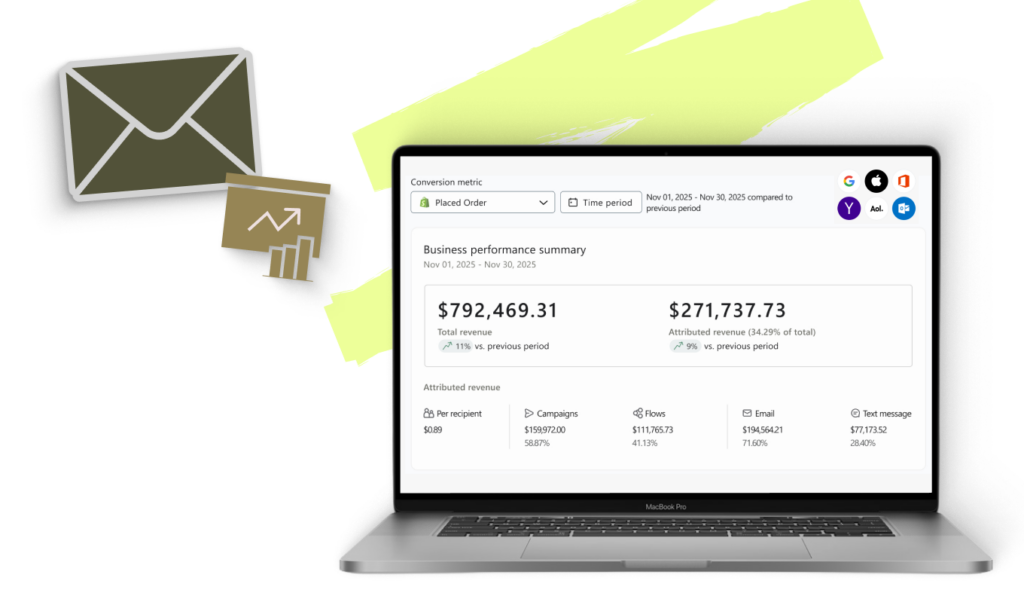
Revenue attributed to retention channels – What percentage of your total store revenue is being driven by email and other owned channels? This is tracked over time and compared against investment. A well-built program with full flow coverage and a consistent campaign cadence should be meaningfully contributing to total revenue.
List growth rate – Not just the total number, but whether the list is growing consistently with quality subscribers. Tracked alongside lead-to-customer rate to confirm that what’s being added has commercial value.
Deliverability metrics – Inbox placement rate, spam complaint rate, hard bounce rate. These are the early warning signals for problems that will show up as revenue drops later if left unaddressed.
Flow-level conversion metrics – For each core flow, what percentage of customers who enter the flow complete the desired action? Abandoned cart flow conversion, welcome-to-first-purchase rate, post-purchase cross-sell conversion – these tell you which parts of the automation layer are working and which need attention.
Average time between orders – Not a standard email dashboard metric, but one of the most important signals for whether your email program is genuinely accelerating the customer lifecycle. If the average gap between first and second purchase is shortening over time, your post-purchase and cross-sell sequences are doing their job.
What to deliberately ignore: open rate as a KPI, click rate as a performance benchmark, and revenue per recipient as a strategic accountability metric. None of these directly measure business outcomes. All of them can be manipulated or misread in ways that lead to poor decisions.
How email connects to the broader retention system
Email is where most DTC retention systems should start. It has the widest addressable audience on any given subscriber list, the deepest personalization and content flexibility, and the most mature tooling for behavioral automation. Building the email foundation right – deliverability, list quality, flow coverage, campaign discipline – before expanding to other channels is sensible.
But email alone has coverage gaps. Some customers never engage with email but respond readily to SMS. Others are best reached through push notifications when they’re actively browsing. High-value repeat buyers often benefit from a loyalty program that gives them structural incentives for continued engagement. In some categories and at certain price points, direct mail creates a physical touchpoint that digital channels simply can’t replicate. WhatsApp and Viber are increasingly relevant in certain geographies and product categories.
The question for each channel isn’t “should we add this?” It’s “who on our list doesn’t respond to email, and what’s the most cost-effective way to reach them?” That’s a decision based on audience behavior data, not a preference for more channels.
At Retention Side, email via Klaviyo is the entry point into every engagement. But how we think about building out the retention stack from there – whether that means SMS, push notifications, direct mail, loyalty programs, WhatsApp, or Viber – depends entirely on what the audience data tells us, not a blanket expansion plan.
The underlying principle is consistent: meet the customer where they are in their lifecycle, on the channel they actually respond to, with a message that reflects where they are in their relationship with the brand. Email is usually where that starts. The full system is what makes it compound.
Common mistakes in DTC email strategy
These are the patterns that consistently underperform, and the reason behind each one:
Running campaigns without a functioning flow layer – Campaigns require someone to build and send them every week. Flows generate revenue without ongoing manual input. A program that’s 80% campaigns and 20% flows is working harder than it needs to and leaving compounding revenue on the table.
Building flows once and never revisiting them – A welcome series written at launch with the brand’s original voice, original incentive structure, and original product catalog is probably misaligned with what the brand actually is today. Flows need auditing, testing, and updating regularly.
Treating all subscribers the same – An email program that sends the same message to every subscriber, regardless of purchase history or engagement level, is not a retention program. It’s a broadcast. The gap between those two things is significant.
Using incentives without margin logic – Discounts in flows are often acceptable because only a small percentage of subscribers trigger any specific flow, and proper filtering prevents overlap. But using incentives by default – in every flow, in every campaign – without considering margin impact is a strategy that trains customers to wait for discounts and erodes full-price purchasing over time.
Ignoring deliverability until something breaks – Deliverability problems are much easier to prevent than to fix. By the time inbox placement has degraded visibly, months of list health damage may have already occurred. Proactive monitoring is far cheaper than reactive remediation.
Attributing poor email performance to the channel – A drop in email performance doesn’t always mean the channel is broken. It may mean traffic quality has changed (lower-intent acquisition driving worse lead-to-customer conversion), the website has a conversion issue, or the audience mix has shifted. Diagnosing root cause before rebuilding the email strategy prevents a lot of wasted effort.
Expanding channels before fixing the email foundation – SMS, push, and direct mail are valuable additions to a retention stack. But adding them before email is working well usually means distributing the same fundamental problems across more channels. Fix the foundation first.
Conclusion
An ecommerce email marketing strategy isn’t a campaign calendar or a flow map. It’s a system – built on four interconnected pillars that need to function well individually and work together to produce results that compound over time.
For DTC brands above $300K/month, the gap between what most email programs deliver and what a properly built program delivers is real and measurable. The brands on the higher end aren’t doing anything exotic. They have deliverability dialed in, a list that grows with quality subscribers, full flow coverage across the customer lifecycle, and a campaign strategy that balances promotion with genuine value.
The channel rewards investment. Flows compound. Lists improve. Customer lifetime value grows. But only when the architecture is right – and only when the program is treated as a system to be improved continuously, not a setup task to be completed once.
If the email program at your brand has been built but hasn’t been rebuilt in a while, or if flows and campaigns are running but the repeat customer rate isn’t moving, the issue is almost always structural. That’s exactly where Retention Side works.