


Every brand that crosses seven figures in annual revenue eventually asks the same question: should email and retention live in-house, or should it sit with an agency? The answer usually gets debated in the wrong terms. Founders compare monthly cost, or they compare “control” versus “expertise,” as if those are the only variables. They’re not.
The real question is whether your business needs a person or a system. A single hire, no matter how good, is one person managing deliverability, flows, campaigns, segmentation, testing, and increasingly SMS, push, and other channels at the same time. An agency, done right, is a system built around specialization. Neither model is automatically correct. The right answer depends on your revenue stage, your channel complexity, and how much retention strategy actually needs to evolve month to month.
This article walks through the real tradeoffs, not the surface-level pros and cons list you’ll find everywhere else.
Key takeaways
- In-house hires give you full-time attention and institutional knowledge, but one person rarely has deep expertise across deliverability, flows, segmentation, design, copy, and multi-channel strategy at once.
- Agencies bring specialized skill sets and pattern recognition from working across many accounts, but require stronger onboarding and communication discipline to avoid generic execution.
- Fully-loaded in-house costs (salary, benefits, tools, training) often exceed a comparable agency retainer, especially below the $1M-$3M annual revenue range.
- Deliverability, the foundation of all email performance, is where solo in-house hires most often fall behind because it requires ongoing technical monitoring most generalists don’t have time for.
- The strongest retention setups at scale are usually hybrid: an in-house owner who understands the brand deeply, paired with an ecommerce retention agency or specialist handling execution depth and channel expansion.
- The decision should be revisited as revenue grows, not made once and left alone. What worked at $300K a month rarely still fits at $1M a month.
What actually differs between in-house and agency email marketing
The difference between in-house and agency isn’t really about who sends the emails. It’s about how work gets structured, who is accountable for outcomes, and how deep the bench goes when something breaks.
An in-house hire is embedded in your business. They sit in on team calls, they know your product roadmap, and they understand your customers because they talk to your support team. That context is valuable and hard to replicate from the outside. But that same person is usually responsible for everything email-related: writing copy, building flows, managing segments, monitoring deliverability, running A/B tests, and reporting on results. At $300K-$500K a month in revenue, that’s often one person doing the job of three or four specialists.
An agency, by contrast, brings a team structure. A strategist who understands lifecycle logic, a copywriter, a designer, someone watching deliverability signals across dozens of accounts, and someone who has already seen what happens when a brand tries a certain incentive structure or flow sequence. The tradeoff is that agencies don’t live inside your business the way an employee does. Bad agencies compensate for that by treating every account the same. Good ones compensate by investing real time in onboarding, asking the right questions about your customer base, and adjusting strategy instead of applying a template. Understanding what an ecommerce email marketing agency actually does can help you separate the two before signing a contract.
This is the core distinction worth sitting with: in-house buys you proximity and consistency. Agency buys you depth and pattern recognition. The businesses that get this wrong usually picked based on cost alone, without weighing what kind of gap they were actually trying to close.
The real cost comparison most brands get wrong
Founders almost always underestimate what an in-house hire actually costs once you add benefits, tools, training time, and the ramp-up period before that person is fully productive. A mid-level Klaviyo-focused marketer in the US typically commands a base salary somewhere in the $65,000-$95,000 range. Add payroll tax, benefits, software licenses (Klaviyo itself, plus design tools, testing tools, reporting dashboards), and the fully-loaded monthly cost climbs well past the base salary number most people quote when comparing options. Then factor in the ramp period. It usually takes a new hire two to four months to fully understand your product catalog, your customer segments, and your historical flow performance before they’re operating at full speed. That’s paid time with reduced output.
Compare that to an agency retainer. Retainers for a brand doing $300K-$800K a month in revenue typically fall in a range that, once you account for the specialized team behind it, often lands lower than the fully-loaded cost of one solo in-house hire covering the same scope. The chart below shows how this typically breaks down.
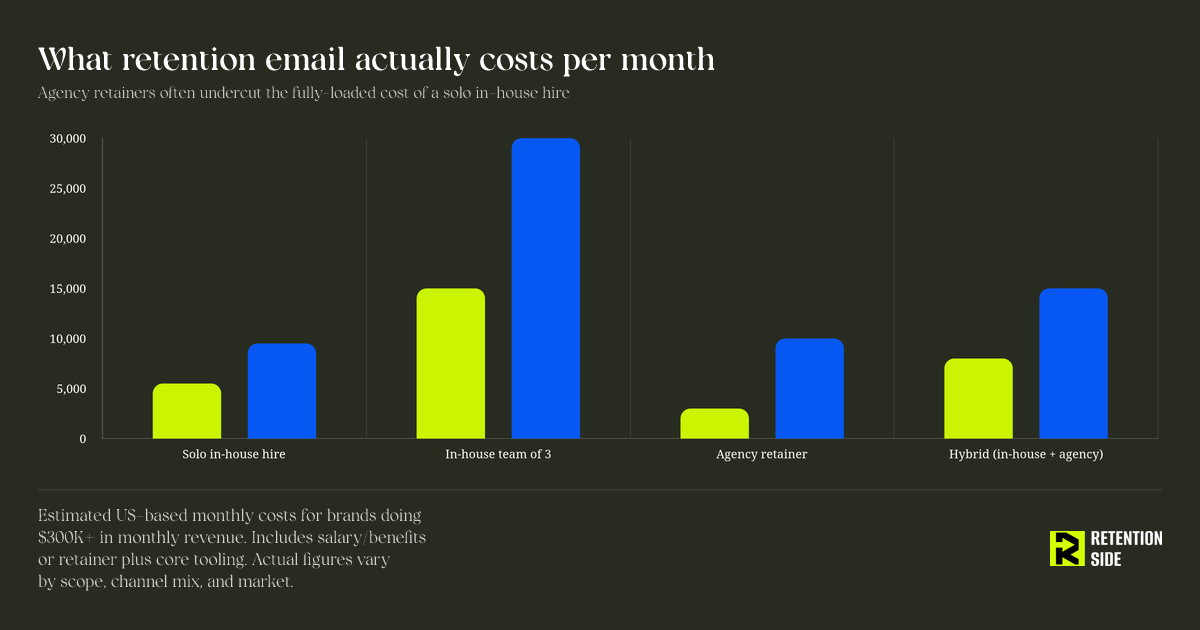
This isn’t an argument that agencies are always cheaper. A team of three in-house specialists, each focused on their lane, can outperform a mediocre agency on both cost and output. But a single generalist hire covering deliverability, flows, campaigns, segmentation, and reporting is rarely the cost-efficient option once you price it out honestly. The math tends to favor agencies specifically at the point where a brand needs more than one function covered but doesn’t yet have the revenue to justify a full internal team. For brands trying to figure out whether a Klaviyo email marketing agency is worth the retainer, the honest cost comparison is usually the deciding factor.
Where the coverage gap actually shows up
The place this decision gets tested isn’t in the strategy deck, it’s in the weeks when something goes wrong. A deliverability drop. A flow that stops converting after a platform update. A segment that needs rebuilding because your product catalog changed. This is where a solo in-house hire, no matter how talented, runs into the limits of being one person.
Deliverability is the clearest example. Delivery and deliverability are not the same thing. Delivery means the email technically arrived somewhere in the recipient’s account. Deliverability means it landed in the inbox, not buried in Gmail’s promotions tab or flagged as spam. Monitoring deliverability well means tracking sender reputation, watching engagement-based filtering signals, managing list hygiene, and adjusting sending patterns before a problem becomes visible in open rates. Google’s email sender guidelines now require authentication protocols like SPF, DKIM, and DMARC for all bulk senders, making this a compliance issue, not just a performance one. That’s a near-daily discipline, not something you check once a month. A generalist hire juggling five other responsibilities will often catch deliverability problems only after revenue has already dropped, which is too late.
Flow strategy is another gap. Flows are behavior-based, time-sensitive automations that should map to actual customer journey stages, not a generic template pulled from a Klaviyo blog post. Building and maintaining a full flow map (welcome series, abandoned cart, browse abandonment, post-purchase, win-back, replenishment, and more) takes ongoing testing. Flows are never finished. They need new variants tested, new triggers added, and old logic revisited as your product mix or customer behavior shifts. A solo hire usually builds the flows once, checks the dashboard periodically, and moves on to the next fire. That’s not a criticism of the person, it’s a function of time. Running a Klaviyo audit on a regular cadence is one of the few ways to catch these gaps before they cost revenue.
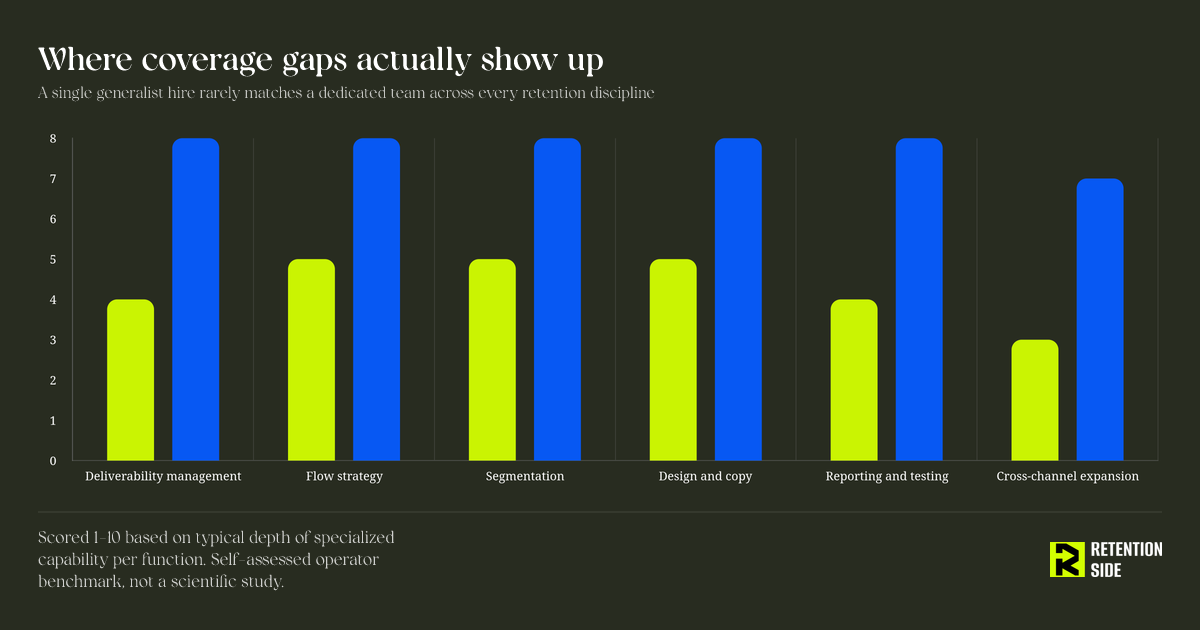
Segmentation, campaign strategy, testing discipline, and cross-channel expansion into SMS, push notifications, or direct mail follow the same pattern. Each one is manageable alone. Managing all of them well, at the same time, indefinitely, is where solo in-house setups tend to plateau.
Where in-house genuinely wins
None of this means agencies are automatically the right call. There are real scenarios where in-house is the better structural decision.
If your brand has highly specific product knowledge that takes months to absorb (complex regulatory categories, technical products, or a customer base with unusual buying patterns) an in-house hire’s proximity advantage compounds over time in a way that’s hard for an outside team to match quickly. If you’re at a revenue level where you can afford a small internal team of two or three specialists rather than one generalist, in-house can outperform an agency because you get both proximity and enough division of labor to avoid the coverage gap problem.
In-house also wins when speed of internal decision-making matters more than execution depth. If your business changes direction weekly, launches products constantly, or needs same-day turnaround on campaigns tied to inventory events, having someone sitting in your Slack who can act without a briefing cycle has real value. Agencies can move fast too, but there’s inherently more coordination overhead when work crosses an organizational boundary.
Why the hybrid model is where most mature brands land
The false choice in most of this discussion is that it has to be one or the other. The brands with the strongest retention systems we’ve seen usually run a hybrid structure: someone in-house who owns the brand relationship, understands the product roadmap, and can make fast day-to-day calls, paired with an agency or specialist handling the deeper execution work, deliverability monitoring, and strategic testing that a generalist doesn’t have bandwidth for.
This is closer to how we think about it at Retention Side. Retention shouldn’t be treated as a single channel with a single owner, it’s a system that spans email, SMS, push, direct mail, loyalty, and messaging channels like WhatsApp and Viber depending on what your audience actually responds to and where the reach and cost efficiency make sense. A solo in-house hire covering all of that, on top of day-to-day list management and reporting, is set up to under-deliver through no fault of their own. An agency that only does execution without anyone in-house who understands the brand’s nuance ends up producing generic campaigns that technically follow best practices but miss what actually makes your customers buy again. If you’re evaluating whether a DTC retention agency fits into this hybrid structure, the question isn’t whether to replace your in-house person — it’s whether to complement them with specialized depth they don’t have time to build.
The hybrid model solves both problems. It’s also the model that scales cleanly as revenue grows, because you can shift the ratio of internal to external work as your needs change, rather than re-hiring or re-contracting from scratch every time you hit a new growth stage.
How to decide for your business right now
Start with an honest inventory of what’s actually being neglected today. If deliverability hasn’t been actively monitored in the last 30 days, if your flows haven’t been touched since they were built, or if your campaign calendar is only ever discount-driven, that’s a coverage gap regardless of who’s technically responsible for email. Map that gap against your current spend before assuming the fix is “hire someone” or “sign with an agency.”
Next, look at your growth trajectory over the next two quarters, not just current revenue. A brand at $250K a month planning to double within a year should weight its decision toward a structure that scales, since re-negotiating a hire’s scope or switching agencies mid-growth creates real disruption. A brand that’s plateaued and needs to stabilize before growing again may get more value from a lower-cost in-house solution while they figure out their next move. Having a clear ecommerce email marketing strategy in place makes this evaluation far easier, because you can measure the gap between your current execution and what the strategy actually requires.
Finally, evaluate any agency you’re considering the same way you’d evaluate a senior hire. Ask what their onboarding process actually looks like, how they handle deliverability specifically, how often they revisit flow logic instead of leaving it running untouched, and whether they think in terms of channel expansion or just email volume. The agencies worth working with will talk about your account like a system that needs ongoing attention, not a task that gets set up once and left alone.
Frequently asked questions
What is the difference between in-house and agency?
An in-house team is employed directly by your company, works exclusively on your brand, and is embedded in your day-to-day operations. An agency is a third-party team that manages retention or marketing work for multiple clients at once, bringing specialized roles (strategists, deliverability specialists, designers, copywriters) that would be expensive to replicate as a single internal hire. In-house typically offers deeper product and brand context along with faster internal communication. Agencies typically offer broader specialized expertise, pattern recognition from working across many accounts, and built-in redundancy so no single point of failure exists if one person is out or leaves. Neither is universally better. The right choice depends on your revenue stage, the complexity of your retention needs, and whether you’re trying to buy proximity or depth.
What is the 80/20 rule in email marketing?
The 80/20 rule in email marketing generally refers to the idea that roughly 80% of your email revenue comes from about 20% of your flows, segments, or subscribers. In practice, this shows up in a few consistent ways: a small number of automated flows (usually welcome, abandoned cart, and post-purchase) typically drive the majority of email-attributed revenue compared to campaigns. Klaviyo’s email marketing benchmarks, based on data from over 183,000 brands, confirm this pattern — automated flows generate nearly 41% of total email revenue from just 5.3% of sends. Similarly, your most engaged, highest-LTV segment usually accounts for a disproportionate share of total email revenue compared to your broader list. The strategic implication is that you shouldn’t spread equal effort across every flow and segment. Identify which 20% is actually driving results, protect and optimize that core aggressively, and treat the remaining 80% as either a growth opportunity or a lower-priority maintenance item, depending on its potential.
Why are people leaving Mailchimp?
Brands moving off Mailchimp toward platforms like Klaviyo are typically doing so because Mailchimp was built primarily as a general email marketing tool, not an eCommerce-specific retention platform. The most common reasons cited are limited native eCommerce integrations and weaker behavioral trigger capabilities compared to platforms built around store data, less sophisticated segmentation based on purchase behavior and product-level data, pricing that scales poorly once list size and sending volume grow, and less mature flow-building logic for eCommerce-specific journeys like browse abandonment, replenishment, or post-purchase cross-sell sequences. As eCommerce brands scale past a certain revenue point, they typically need tighter integration between their store data and their messaging platform than general-purpose ESPs are built to provide, which is why so much of the migration conversation in eCommerce circles centers on Klaviyo specifically. Klaviyo even publishes a step-by-step migration guide for brands making the switch from Mailchimp.
Is in-house PR better than agency?
This is a related but separate question from email marketing structure, and the answer follows similar logic. In-house PR tends to work better when a brand needs constant availability, deep familiarity with sensitive internal information, and tight coordination with product launches or executive messaging on short notice. Agency PR tends to work better when a brand needs access to established media relationships, a wider range of specialized skills (crisis communications, different vertical media contacts, multi-market reach), and doesn’t have consistent enough PR volume to justify a full-time hire. As with email, many mature companies run a hybrid: an in-house lead who owns messaging and relationships, supported by an agency for surge capacity, specialized campaigns, or market expansion. The decision comes down to volume, consistency of need, and whether the value being bought is proximity or specialized reach.
Conclusion
The in-house versus agency decision isn’t really about which model is objectively better, it’s about matching structure to what your retention program actually needs right now. A solo in-house hire gives you proximity and control but caps out on coverage once your flows, segments, and channels multiply. An agency gives you depth and specialization but needs real onboarding to avoid generic execution. Most brands doing $300K a month and up eventually find that some version of a hybrid, in-house ownership paired with specialized outside support, delivers the best combination of brand context and execution depth.
Whatever structure you choose, revisit it as you grow. The setup that worked at $300K a month won’t necessarily hold at $1M a month, and the honest answer to this question changes as your retention system gets more complex.