

Most Shopify stores running Klaviyo have some version of email segmentation in place. There’s usually an “engaged 90 days” segment for campaign sends, maybe a loose VIP tier defined by order count, and a lapsed bucket that rarely gets touched. It looks like a system. When you dig into the logic, it rarely functions like one.
The problem is not that brands aren’t segmenting. It’s that they’re building segments around the wrong signals – and more importantly, treating segmentation as a list management task rather than a strategic architecture decision.
A Shopify email segmentation strategy built the right way is the difference between an email program that broadcasts to a list and one that has actual conversations with different customer types at different lifecycle stages. It determines who receives what message, when they receive it, whether that message makes sense given what they’ve done, and whether sending it at all improves or harms your sender reputation.
This article covers how to build that strategy correctly inside Klaviyo: the data layers that power it, the segments that actually move the metrics that matter, how segmentation connects to all four pillars of a functioning email program, and what good looks like in practice for a Shopify brand doing meaningful volume.
Key takeaways
- Segmentation is structural, not tactical. It shapes which flows you build, how campaigns are targeted, what data you collect, and how your deliverability holds up over time.
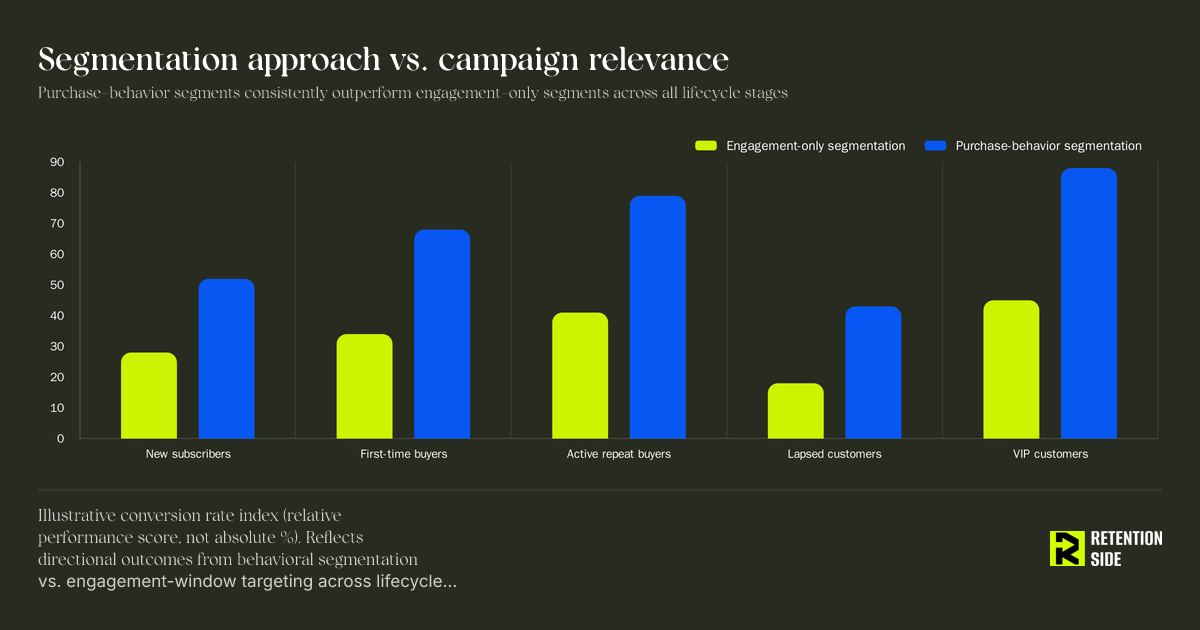
- Engagement-based segmentation (opens and clicks) is increasingly unreliable after Apple’s Mail Privacy Protection. Purchase behavior is the correct foundation.
- There are four data layers in a strong Shopify segmentation strategy: purchase behavior, non-purchase behavioral data, RFM scoring, and zero-party data. Each plays a distinct role.
- The six lifecycle segments every Shopify email program needs are: prospects, first-time buyers, active repeat buyers, at-risk customers, VIP customers, and unengaged subscribers.
- Segmentation connects differently to flows versus campaigns. Treating them as the same problem produces errors in both.
- The metrics that tell you whether segmentation is working are returning customer rate, flow-level conversion rates, and deliverability indicators – not open rate or click rate.
- Zero-party data is the most underused segmentation layer in most programs. It needs to be collected deliberately and mapped to downstream use from day one.
What we’ll cover
- Why engagement-based segmentation falls short
- The four data layers of a working Shopify segmentation strategy
- The six lifecycle segments every program needs
- Segmentation in flows vs. segmentation in campaigns
- RFM segmentation and how to act on it
- Zero-party data as a personalization foundation
- Send frequency by segment
- Building segmentation that holds in Klaviyo
- Common mistakes that cost brands real revenue
- The metrics that tell you if segmentation is working
Why engagement-based segmentation falls short
The most common segmentation setup on Shopify brands running Klaviyo is some version of this: campaigns go to a “master engaged” segment filtered by opens and clicks over the last 60, 90, or 180 days. It looks disciplined. It signals that someone has thought about who to send to. But the signal it’s built on is increasingly broken.
Apple’s Mail Privacy Protection pre-fetches email content – including tracking pixels – on Apple’s servers, regardless of whether the recipient ever opens the message. According to Validity’s 2024 email marketing research, 70% of all email opens tracked in 2023 were generated by Apple’s privacy proxy – meaning the average open rate of 65% that year was substantially inflated by machine-generated events. Litmus confirms that over 50% of email opens now happen on a device with Mail Privacy Protection activated. If you’re filtering your campaign audience based on opens, you’re targeting a mix of genuinely engaged subscribers, iOS ghost-opens, and anyone who clicked something once three months ago. That’s not a targeting strategy.
But the deeper problem is conceptual. Even real engagement signals – genuine opens, genuine clicks – aren’t well-correlated with purchase intent. Someone can open every email you send and never buy. Someone can go 60 days without opening and then purchase the moment you send something relevant. Engagement behavior and purchase behavior are different signals, and building your segmentation primarily on the former produces imprecise targeting at best and misleading performance data at worst.
The shift that makes segmentation actually work: move the foundation from engagement signals to purchase and behavioral signals. Not “did they open in the last 90 days?” but “have they ever bought? How recently? How many times? What did they buy?” Those answers describe the customer’s actual relationship with your brand. Engagement tells you about their inbox habits.
Engagement data still has a role – particularly for deliverability management, where knowing who is genuinely inactive matters for sunset logic. But it should not be the primary driver of who receives what message. The foundation is purchase behavior. Everything else layers on top.
The four data layers of a working Shopify segmentation strategy
Strong segmentation in Klaviyo isn’t built from a single data source. It’s layered – with each layer adding a dimension of customer understanding that the previous one can’t provide alone.
Layer 1: Purchase behavior
This is the foundation. Has this customer ever bought from you? How recently? How many times? What was their average order value? What products or categories did they buy? These signals describe the customer’s relationship with your brand in unambiguous terms.
Purchase behavior drives three distinctions that most Shopify brands underuse:
Buyers vs. non-buyers. These are fundamentally different audiences. Someone who has purchased has a transactional relationship with the brand. Someone who signed up via a form but never converted is still a prospect. Sending them the same campaigns with the same framing is a missed opportunity in both directions.
Recent purchasers vs. historical purchasers. A customer who bought within the last 30 days should not receive a campaign pushing the product they just ordered. Excluding recent purchasers from acquisition-framed messaging is basic hygiene that a surprisingly large number of programs skip.
Category or product-level purchase history. If someone consistently buys from a specific category, the messages they receive about those products should reflect what you already know. Treating them like a first-time browser is both imprecise and slightly jarring.
Layer 2: Non-purchase behavioral data
Klaviyo pulls a rich set of behavioral events from the Shopify integration in near real-time: product views, collection visits, add-to-cart events, checkout starts, and more. These events power automated flows – but they also inform segmentation.
A subscriber who has viewed the same product page three times without purchasing is a different audience than one who opened your last campaign and bounced. Browse behavior indicates consideration. It’s a signal worth acting on in both flow targeting and campaign audience logic.
The critical caveat: behavioral data is only as good as the event tracking underneath it. If the Klaviyo-Shopify integration is set up shallowly – missing “Viewed Product” triggers, not capturing variant-level data, failing to fire “Active on Site” events – the behavioral signals that should inform segmentation simply aren’t there. Verify that the events you’re building on are actually firing before building segmentation logic on top of them.
Layer 3: RFM scoring
Recency, Frequency, and Monetary Value together give you a tiered picture of your customer base that purchase history alone doesn’t provide. Klaviyo’s native RFM analysis scores your customers across all three dimensions and assigns tier labels – Champions, Loyal Customers, At-Risk, Can’t Lose, and others. As of mid-2024, Klaviyo refreshes RFM properties every 24 hours, making these conditions more responsive to recent behavior.
The value of RFM is not the labels. It’s the strategic clarity it creates. A Champion customer – bought recently, buys often, spends at the high end – should receive different communication than someone in the “Needs Attention” tier who used to buy frequently but has gone quiet. The same promotional campaign sent to both groups is a wasted message for at least one of them.
RFM belongs in your segmentation stack as a distinct layer – not a replacement for purchase data, but a lens on top of it.
Layer 4: Zero-party data
Zero-party data is information your customers have actively and explicitly shared with you. Not behavioral inference, but direct declarations: the skin type they told you about on the signup form, the goal they selected in the welcome series survey, the product category they said they were shopping for.
Unlike behavioral data, which is probabilistic, zero-party data is explicit. When someone browses three skincare product pages, you can infer interest. When they tell you their skin type is combination and their primary concern is pigmentation, you know. The segmentation you build on declared data can be specific in a way that behavioral inference usually can’t match.
This data is also increasingly future-proof. As Apple’s privacy updates and GDPR compliance continue to restrict third-party and inferred data collection, brands that have built explicit preference data into their signup flows and early customer sequences have a segmentation foundation that remains durable regardless of platform changes.
The practical ceiling: zero-party data only adds value if it’s actually used. Collecting preference data at signup and then ignoring it in every subsequent communication is a data infrastructure problem masquerading as personalization. The collection needs to be designed alongside the downstream use cases from the start.
The six lifecycle segments every Shopify email program needs
These six segments are the baseline segmentation infrastructure for any Shopify email program doing meaningful volume. They’re not exotic – they’re the segments most brands know they should have but haven’t built cleanly. What they represent together is a complete lifecycle model: a map of every stage a subscriber moves through, from first contact to long-term loyalty to disengagement.
1. Prospects (never purchased)
Usually the largest segment on any list. These are subscribers who joined via a form, a lead magnet, a giveaway, or paid acquisition – but have not yet completed a transaction. The communication goal is conversion: moving them from subscriber to first-time buyer.
This group should receive acquisition-framed messaging – product education, social proof, trust signals, and offers calibrated to their hesitation. They should not receive campaigns that assume a prior purchase relationship. Sending a “since you love our products” email to someone who has never bought is not just irrelevant; it signals a broken system to the recipient.
The important nuance: not all prospects are equal. Someone who joined three days ago is in an active welcome sequence and should not be touched by your regular campaign sends. Someone who has been on the list for four months without purchasing is a different problem entirely – this profile is either heading toward a re-engagement path or should be moving toward sunset consideration. Splitting the prospect segment by time-since-subscription is one of the first useful refinements most programs need.
2. First-time buyers
A customer who has made exactly one purchase is at the highest-stakes moment in the retention funnel. The drop-off between one purchase and two is the widest gap in the entire customer lifecycle – and it happens quickly. Most of that at-risk window opens and closes within the first 30-60 days after the first order.
Research from BS&Co across 156,000 DTC customers confirms just how compressed this window is: of customers who do make a second purchase, 50.3% do so within 30 days and 76.4% within 90 days. After 90 days, you’re competing for the remaining fraction that trickles in over the next nine months. The median time to second purchase clusters between 15 and 35 days – considerably shorter than most post-purchase flows are built to anticipate.
First-time buyer segmentation should feed directly into post-purchase flows – but it should also shape campaign targeting. This group needs communication that reinforces the purchase decision, delivers product education, introduces complementary products naturally, and creates a path to a second order before the momentum of the first one fades. They should not be lumped in with multi-purchase buyers and sent campaigns that assume a longer brand relationship than they have.
3. Active repeat buyers
Customers who have purchased more than once within the expected repurchase window for your category. This is your core retention audience. Communication with this group should acknowledge the relationship, not restart it from scratch. They know the brand. They’ve chosen it more than once. The job is to deepen that engagement, surface products they haven’t discovered yet, and give them structural reasons for continued loyalty.
This segment often benefits from sub-tiering by purchase frequency or total spend. A customer who has bought twice in six months is in a different relationship than one who buys every four to six weeks. The cadence and framing of communication should reflect that difference.
4. At-risk customers (lapsing)
Customers who have purchased before but are drifting toward inactivity based on the expected repurchase window for your brand. The trigger for this segment is not a universal number – it’s derived from your actual repurchase interval data. If 75% of your returning customers place their next order within 55 days, a customer at day 65 without activity is statistically notable. That’s when the at-risk window opens, not after 90 days.
The communication priority here is re-engagement before full lapse. This is the highest-leverage intervention point in the win-back process, because you’re reaching customers while they still have a live relationship with the brand. A well-timed, relevant message at this stage converts at a meaningfully higher rate than the same message delivered 60 days later.
5. VIP customers
Your highest-value cohort – defined by some combination of order frequency, total spend, and recency. The precise threshold is brand-specific. For a brand with an average order value of $80, a customer with five orders in 12 months and significant lifetime spend might qualify. For a brand with a $250 AOV, the threshold shifts accordingly.
VIP customers warrant different communication: early access to new products, exclusive offers before they go public, genuine acknowledgment of their loyalty rather than templated messaging. Sending the same campaign to your VIP segment and your entire list is not just a missed opportunity – it’s a signal that you aren’t actually treating them as VIPs.
From a deliverability standpoint, this segment is your reputation anchor. High-engagement customers who consistently interact with your emails send strong positive signals to inbox providers. This is the segment you actively protect.
6. Unengaged subscribers (sunset candidates)
Subscribers who have shown no behavioral signals – no opens, no clicks, no purchases, no site activity tracked through Klaviyo – for an extended period. The precise threshold depends on your send frequency. For brands sending three to four times per week, 90 days of non-engagement is meaningful. For brands sending weekly, 120-180 days may be the right threshold before sun-setting.
This segment does not belong in your active campaign sends. Continuing to mail chronically unengaged subscribers accumulates negative signals with Gmail, Yahoo, and other inbox providers and drags down deliverability for your entire list – including the segments that are actively engaging.
The right path is a sunset flow: a structured final sequence that gives unengaged subscribers one last opportunity to re-engage before being suppressed. The sunset flow is not a revenue-generating automation. Its purpose is list hygiene. Subscribers who re-engage get moved back into the appropriate active segment. Those who don’t get suppressed. A cleaner list is a more deliverable list – and that protection is worth more, compounded over time, than whatever marginal sends you’d get from keeping dead weight on the active audience.
Segmentation in flows vs. segmentation in campaigns
Segmentation operates differently in flows and in campaigns, and treating them as the same problem produces mistakes in both. This distinction matters enough to address specifically.
Segmentation in flows
In flows, segmentation happens through filters and conditional branching inside the flow architecture – not through audience selection before sending. When a customer enters a post-purchase flow, the flow itself can branch based on their purchase count, cart value, product category, whether they’re a first-time buyer or a returning customer, and what zero-party data properties exist on their profile. This branching is what makes a flow genuinely contextual rather than generically automated.
The segmentation questions in flow architecture are: who should enter this flow, who should be excluded, and what paths should exist for different customer types once they’re inside? A well-built abandoned cart flow, for example, should exclude customers who purchased the abandoned item since triggering the flow, customers in an active win-back sequence that shouldn’t be interrupted, and customers whose cart value falls below the threshold where follow-up is economically sensible.
Suppression logic is as important as inclusion logic. A customer currently inside an abandoned cart flow should not also receive a promotional campaign for the same product they abandoned. Flow exclusion conditions need to be designed alongside campaign targeting logic – they don’t configure themselves by default in Klaviyo.
Key flow segmentation decisions that most Shopify programs underuse:
Post-purchase branching by purchase count. A first-time buyer entering the post-purchase sequence needs brand introduction, product education, and a deliberate path toward the second purchase. A customer placing their fourth order already knows the brand and doesn’t need the same onboarding content. This split is one of the highest-leverage segmentation decisions in the program.
Abandoned cart segmentation by cart value and customer history. A first-time visitor abandoning a $40 cart responds to different messaging than an established customer abandoning a $200 cart. High-value abandons from existing customers may warrant personal tone and a strong recovery offer. Lower-value abandons from new visitors may need social proof and risk-reduction messaging more than a discount.
Win-back trigger timing by repurchase data. Rather than firing at a fixed 90-day mark, calibrate the win-back trigger to the actual repurchase window for that customer’s product category. A customer who bought a 30-day supplement supply is in a very different position at day 50 than a customer who bought premium cookware.
Welcome series branching by zero-party data. When a subscriber answers a preference question at signup, the welcome series can serve them category-relevant content from email two onward. The conversion lift from this kind of branching is consistently meaningful because the content reflects what the subscriber told you, not a generalized assumption.
Segmentation in campaigns
Campaigns are where segmentation is most visibly applied and most often neglected. The default pattern at many Shopify brands is to send each campaign to the full engaged list – or worse, the full list – with occasional exceptions for major sale events.
A more precise approach: every campaign has a primary target segment defined before the content is written, not after. The segment definition shapes the content, the tone, and the call to action.
A few practical examples of how this changes campaign execution:
- A new product launch campaign can be sent first to VIP customers as an early-access exclusive, then to the broader active buyer segment as a general announcement. The VIP version acknowledges their status. The general version doesn’t pretend everyone got early access.
- A promotional campaign with a discount should exclude customers who already received an incentive through an active flow in the last 30 days. Stacked incentives teach customers to wait for offers before buying – and that’s a behavior pattern that’s very difficult to undo once it’s set.
- An educational email about product usage or ingredient science can be sent broadly across the engaged list without the same deliverability sensitivity as a promotional send, because genuine value-driven content tends to produce better engagement signals.
Never send the same campaign to your whole list. This is both a deliverability risk and a relevance problem. Sending a “first-time welcome offer” to five-time purchasers is confusing. Sending a “VIP early access” campaign to subscribers who have never bought is meaningless. Every campaign should have a clear answer to the question: why does this message make sense for this exact audience right now?
RFM segmentation and how to act on it
RFM (Recency, Frequency, Monetary Value) is a framework for tiering your customer base across three behavioral dimensions simultaneously. It produces a richer picture of customer quality than any single dimension alone – and Klaviyo’s native RFM analysis does the scoring work for you, refreshing properties every 24 hours and assigning each customer to a named tier. For a deeper look at how RFM maps to advanced Klaviyo segmentation for ecommerce brands, including how to layer RFM conditions on top of behavioral events, the mechanics are covered in detail separately.
The value of RFM is not in the labels themselves. It’s in the strategic clarity it creates about which customers deserve what kind of attention and investment. Industry benchmarks consistently show that the Champions segment – typically 10-15% of a customer base – accounts for 35-45% of total revenue, which means how you treat this cohort has an outsized effect on the entire program.
Champions (high R, high F, high M). These are your most engaged, most valuable, most loyal customers. They should receive VIP treatment, loyalty program invitations, early access to new products, and campaign content that acknowledges their relationship with the brand. These customers are also your deliverability reputation anchor – protect this segment’s experience.
Potential Loyalists (high R, moderate F, moderate M). Customers who purchased recently but haven’t yet built frequency. They’ve demonstrated enough trust to buy once or twice. The question is whether your post-purchase experience is giving them compelling reasons to return before they lose momentum. Targeted campaigns and flows aimed specifically at this tier can materially accelerate the conversion from occasional buyer to loyal customer.
At-Risk and Needs Attention (low R, higher F/M). These customers have a meaningful purchase history but are drifting. They’re the highest-priority win-back audience because the cost of losing them is proportionally higher – they’ve already demonstrated they can be valuable customers. A well-timed, relevant reactivation sequence is worth real investment here.
Can’t Lose (very low R, very high historical F/M). Customers who were once your best buyers and have now gone significantly quiet. The drop from Champion to this tier is a serious signal. The reactivation effort for this group should reflect their demonstrated lifetime value – more investment in messaging quality, potentially direct mail as a supplemental touchpoint, and a clear escalation path if the standard sequence doesn’t land.
New Customers and Promising. Recent first purchases. The entire post-purchase and cross-sell architecture should be focused on this group’s acceleration toward the second and third order.
One important operational note: even though Klaviyo refreshes RFM properties every 24 hours, there can be a lag between dashboard updates and changes reflecting on individual profile records. Design your segment logic to account for this and avoid inadvertently sending contradictory messages to customers whose tier has recently shifted.
Zero-party data as a personalization foundation
Zero-party data deserves more strategic weight than it typically gets in Shopify segmentation discussions. Most brands treat it as a personalization add-on. It’s actually one of the highest-leverage segmentation inputs available – because it’s explicit, consent-driven, and represents what the customer actually told you, rather than what you inferred from their behavior.
Forrester defines zero-party data as “data that a customer intentionally and proactively shares with a brand” – covering preference center data, purchase intentions, personal context, and how the individual wants the brand to recognize them. This definition is useful because it draws a hard line between data customers volunteer and data you collect from their behavior. Both are valuable. Only one is explicit.
The mechanics in Klaviyo are straightforward. Profile properties can be populated from form fields, quiz answers, survey responses, or preference selections – and those properties then become segment conditions and flow branching logic. A subscriber who identified as a runner at signup can enter a different welcome series branch than one who said they were a cyclist. A skincare customer who shared their skin type can receive product recommendations filtered to that attribute throughout their lifecycle.
Where to collect zero-party data in the Klaviyo ecosystem:
Signup forms. A single qualifying question at the signup step adds minimal friction and immediately gives you a personalization anchor. “What are you shopping for?” or “What brings you here today?” can branch the welcome series before the first email sends. This is the highest-leverage collection point because it captures the subscriber at their peak engagement moment.
Welcome series. An early email with a preference selection embedded as clickable buttons creates a low-effort data collection moment during the highest-engagement window in the subscriber relationship. Klaviyo can track these clicks as profile property updates, meaning the subscriber’s choice populates their profile without requiring a form submission.
Post-purchase flows. A brief survey or preference check-in after the first or second purchase enriches the profile with purchase-context data – what problem they were trying to solve, what they might buy next, whether they have specific preferences the brand hasn’t surfaced yet.
Quiz flows. For categories with meaningful product discovery complexity (supplements, skincare, apparel), a product recommendation quiz populates multiple profile properties at once and creates a natural branching point for both immediate recommendations and long-term segmentation.
The most important principle for zero-party data: collect what you can act on. Forrester’s research consistently shows that the most successful zero-party data experiences are “short, simple, and offer a clear value exchange.” The collection needs to be designed alongside the downstream use cases. Gathering rich preference data and then sending identical campaigns to everyone regardless is a data infrastructure failure. The data only becomes valuable when it actively drives branching in flows and targeting in campaigns.
The other critical constraint is timing. Zero-party data collection is difficult to retrofit. If you’ve been running a program for two years with 50,000 subscriber profiles and no custom properties capturing preference data, those profiles don’t have retroactive data. Building this architecture from the start – capturing preference data at the signup point and mapping it to Klaviyo profile properties from day one – is a foundational decision that pays forward into every segmentation decision you make afterward.
Send frequency by segment
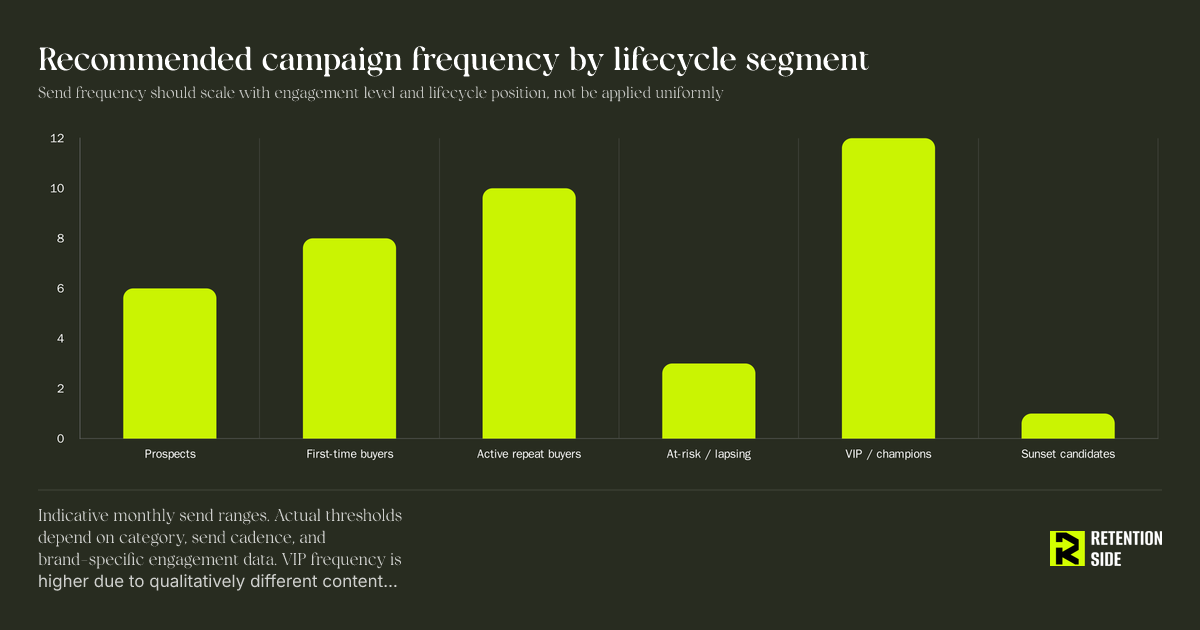
One of the most practical outputs of a working segmentation strategy is knowing how often to email each group. There’s no universal right answer for email send frequency. But the question changes entirely when you stop thinking about it as a program-wide variable and start thinking about it as a segment-level decision.
A few principles worth holding:
Active repeat buyers and VIP customers can handle higher frequency because they’re demonstrably responsive and the relationship is strong. For VIP customers specifically, the frequency should be higher because the content is qualitatively different – exclusivity, early access, genuine relationship-building – not because you’re simply sending more promotional emails.
New subscribers in a welcome sequence should receive concentrated communication early, during the highest-engagement window, followed by a falloff in frequency if they haven’t converted. Front-loading the sequence is correct here because engagement is highest in the first 7-14 days.
At-risk and lapsed segments should receive significantly lower frequency. Multiple campaigns per week to someone who hasn’t engaged with you in 90 days accelerates the deliverability damage from their non-engagement. Two to three sends per month with a clear re-engagement frame is the right approach – enough to be present, low enough not to compound the negative sender reputation signal.
Prospects sit in the middle. They need enough communication to convert, but not so much that they unsubscribe before the welcome series has had a chance to work. Suppression from general campaign sends while they’re active in the welcome flow is good practice.
Sunset candidates receive only the structured final re-engagement sequence – one or two emails in a defined sunset flow, then suppression. Not campaign sends, not promotional blasts, not the same messages everyone else receives.
The key principle: frequency is always calibrated to engagement level and lifecycle position. A rigid “we send four campaigns per week” applied uniformly across a 100,000-person list is a deliverability risk waiting to materialize.
Building segmentation that holds in Klaviyo
Knowing the right segments conceptually and building them correctly in Klaviyo are different things. Here’s how the architecture maps to the tool.
Build on event-based conditions, not profile properties alone. The most powerful Klaviyo segments are built on behavioral events: “Has placed order,” “Has not placed order in the last 60 days,” “Has clicked email in last 30 days,” “Predicted next order date is within 14 days.” These conditions reflect what the customer has actually done, and they update dynamically as behavior changes. Profile properties like location or a stored skin type are stable and valuable for personalization, but they don’t capture the dynamic movement of a customer through lifecycle stages.
Use dynamic segments, not static lists. Unlike a static Shopify customer export imported manually, Klaviyo’s dynamic segments update automatically as customers meet or stop meeting conditions. A customer who makes their fifth purchase today automatically joins the VIP segment if you’ve built the conditions correctly. A customer who hasn’t opened anything in 90 days drifts into the sunset candidate pool without anyone manually moving them. This is what makes behavioral segmentation scalable.
Design suppression logic as carefully as inclusion logic. A campaign segment isn’t just “who should receive this email.” It’s “who should receive this email AND hasn’t received a similar message through a flow in the last 14 days AND is not in an active promotional flow right now.” The exclusion conditions prevent overlap, stacked discounts, and disjointed experiences that erode the customer relationship over time.
Wire zero-party data to custom properties. Every preference answer, survey response, and declared intent captured in a form or flow should populate a custom property on the subscriber’s Klaviyo profile. Those properties then become segment dimensions: “Skin type = oily AND has placed order in last 60 days” gives you a precise send list that combines declared preference with purchase recency. The infrastructure for this needs to be set up correctly from the start – check that your form embed code, survey response tracking, and click-based property updates are all populating profiles as intended.
Audit segments periodically. A segment built 12 months ago based on conditions that made sense then may not reflect the right population today. Catalog changes, audience mix shifts, acquisition channel changes – all of these affect who is in your segments if the conditions aren’t reviewed. A quarterly audit of the core segments (not every week, but consistently) is the right rhythm for most brands operating at scale.
Common mistakes that cost Shopify brands real revenue
Treating “engaged” as a binary condition
Most brands segment by “opened in last X days” or “clicked in last X days” and call it an engagement segment. That’s better than nothing. But it misses critical nuance. A subscriber who has opened five emails but never clicked is different from one who clicks regularly but hasn’t purchased in six months. A customer who engages with every email but hasn’t bought in a year is a different problem than one who consistently buys but rarely opens.
Build engagement logic that accounts for both depth (clicks, not just opens) and purchase behavior. An engaged subscriber who is also an active buyer is a different send target from an engaged subscriber who has never purchased – and the message appropriate for each is fundamentally different.
Segmenting campaigns but ignoring flow suppression
Brands that carefully segment their campaign sends often leave flow suppression logic incomplete. The result: a customer in the middle of a post-purchase sequence also receives a promotional campaign that ignores everything the post-purchase emails established. The experience is disjointed. The customer feels like the brand isn’t paying attention – which, architecturally, it isn’t.
Every active flow should have suppression conditions preventing conflicting campaign sends to customers who are inside it. Every campaign should exclude profiles currently receiving flows with overlapping messaging or offers. This coordination doesn’t happen automatically in Klaviyo – it requires deliberate design.
Building segments once and never maintaining them
A segment is not a one-time build. Catalog changes, audience composition shifts, and acquisition channel changes all affect whether your segment conditions are still capturing the right population. Segments should be reviewed quarterly at minimum. The gap between what a segment is supposed to contain and what it actually contains often grows silently over time – and that drift affects every campaign send targeted at it.
Using discounts to compensate for bad segmentation
When a campaign underperforms, the instinctive response is often to add a discount and resend. But if the campaign underperformed because it reached the wrong segment – people for whom the message was irrelevant – adding a discount doesn’t fix the relevance problem. It purchases a few more conversions from price-sensitive subscribers while accelerating the conditioning that makes those subscribers harder to convert at full price in the future.
The correct diagnostic question is: did this campaign underperform because the message was wrong, or because the audience was wrong? Better segmentation fixes the audience problem. Better creative fixes the message problem. Discounts fix neither.
Treating list size as a success metric
Many brands avoid proper segmentation and list hygiene because removing subscribers from active send pools makes the list size look smaller. This is a vanity metric problem. A list of 55,000 with 38,000 active, engaged subscribers who drive repeat purchases is more valuable – and more deliverable – than a list of 90,000 with 55,000 dormant profiles dragging down every metric and eroding sender reputation with every send.
Segmentation that removes the wrong people from your active send audience is not shrinking your audience. It’s making your real audience cleaner – and that compounds in your favor on every subsequent send.
The metrics that tell you if segmentation is working
Segmentation doesn’t have its own metric. Its impact shows up in the metrics that reflect whether your email program is actually building the business.
Returning customer rate. The clearest high-level signal. If segmentation is improving relevance, more customers should be coming back. A well-segmented program – targeted campaigns, properly branched flows, lifecycle communication that meets customers where they are – should produce a rising returning customer rate over time. This is the number Retention Side tracks as the primary accountability metric for retention program performance. For reference, the cross-vertical DTC average repeat purchase rate sits around 28%, but benchmarks vary significantly by category – consumables top performers reach 40-55% while durables sit much lower.
Flow-level conversion rates. Each core flow has a conversion metric that tells you whether it’s doing its job. Welcome series: first-purchase conversion rate. Abandoned cart: recovery rate. Post-purchase: second-purchase rate within 30-60 days. Cross-sell: uptake on the recommended product. When these numbers improve after a segmentation or flow-branching change, you’re seeing segmentation’s direct impact on customer behavior.
Deliverability indicators. Inbox placement rate and spam complaint rate improve when segmentation is applied properly to campaign sends. As of February 2024, both Google and Yahoo now formally require bulk senders to keep spam complaint rates below 0.3% – making list hygiene and proper segment targeting a technical requirement, not just a best practice. If your complaint rate approaches that threshold or your inbox placement is degrading, send segmentation should be the first thing you examine. Monitor these through Google Postmaster Tools and Klaviyo’s Deliverability Hub – not from within the campaign dashboard alone, which doesn’t show you the inbox provider’s view.
List growth rate with lead-to-customer conversion. More subscribers is only useful if those subscribers eventually buy. Segmenting new subscribers into proper welcome sequences and tracking their conversion to first purchase within 30 days gives you a real signal about list quality, not just volume. This is the real KPI for list growth.
Revenue attributed to retention channels. What share of total store revenue is driven by email and other owned channels over time? When segmentation improves campaign relevance and flow conversion rates, this number should reflect it at the program level.
What not to use as segmentation quality indicators: campaign open rate, click rate, or revenue per recipient. These are visible, but none of them directly tell you whether your segmentation is building customer lifetime value. At best they’re directional diagnostic signals. At worst they’re misleading proxies that shift focus away from the metrics that actually matter.
Segmentation as the foundation, not the finish line
Segmentation doesn’t have a completion point. The brands that do it best aren’t the ones who built a perfect segmentation architecture in a single sprint and moved on. They’re the ones who treat segmentation as a continuous practice – adding new dimensions as new behavioral data accumulates, refining segment conditions as audience behavior shifts, testing whether new splits improve conversion at the flow or campaign level.
For Shopify brands building an email program from scratch, start with the six core lifecycle segments above. Get the behavioral tracking layer clean in Klaviyo – events firing correctly, profile properties updating dynamically, flow filters using behavioral conditions rather than just trigger logic. Add zero-party data collection at the signup form and map it to custom properties immediately, so the data starts populating from day one.
For brands with an existing program, the starting point is almost always an audit. Which segments actually exist and which ones are theoretical? Which flows have meaningful branching logic and which fire uniformly to everyone? Where is suppression logic incomplete? The gap between what the segmentation should be and what it actually is inside the Klaviyo account tells you exactly where to invest next. The full Klaviyo segmentation strategy for ecommerce – including how the core lifecycle segments map to Klaviyo’s native tooling – is covered in its own dedicated guide.
The segmentation decisions made early shape what’s possible for the rest of the retention system. At Retention Side, the foundational work of building accurate, dynamic segment architecture is what makes every subsequent campaign, flow test, and channel expansion more precise – because the customer intelligence underneath it is actually reliable.
Conclusion
A Shopify email segmentation strategy that moves business metrics isn’t built on engagement windows and list blasts. It’s built on purchase behavior, lifecycle stage, RFM scoring, and zero-party data – four layers that together produce a genuine picture of who each subscriber is and what kind of communication makes sense for them right now.
The mechanics are available to every Klaviyo user connected to Shopify. What separates programs that use them well is the strategic intent behind the build: understanding that segmentation exists to make communication relevant at scale, not to add targeting complexity for its own sake.
For Shopify brands doing meaningful revenue, the gap between a segmentation system built on these principles and one built on loose engagement windows is measurable – in returning customer rate, in flow conversion, and in the long-run health of the list. Customers who receive relevant communication buy more often and stay engaged longer. Customers who receive generic blasts tune out or unsubscribe. The list gets cleaner. Revenue per send improves. Deliverability holds.
The foundation doesn’t need to be complex to be correct. Six clearly defined lifecycle segments, behavioral conditions that update dynamically, suppression logic that prevents overlap, and zero-party data collected at the signup point – that’s the core. Everything else builds on top of it as the program matures. Build the foundation right, and the compounding effect takes care of the rest.