


Picking a Klaviyo agency feels like a vendor decision. It is not. For a brand doing $300K or more a month, the agency you hire determines whether email becomes a compounding retention asset or another recurring invoice that quietly underperforms. The wrong agency will still send campaigns on time, still build the abandoned cart flow, still show you an open rate that looks fine. What it will not do is build a system that grows lifetime value, protects deliverability, and adapts as your list and product mix change.
That is the real evaluation question, and it is one most “best Klaviyo agency” lists skip entirely. They rank by badge tier, follower count, or how loud an agency markets itself as a Klaviyo partner. The right question is not “who are the biggest agencies.” It is “which agency has demonstrated results for brands that look like yours, tracks metrics that reflect actual business health, and can build a retention system rather than just manage email sends?” This article walks through how the Klaviyo partner program actually works, profiles the agencies that hold verifiable top-tier status, and gives you a framework for vetting any agency beyond its badge.
What you’ll learn in this guide
- How Klaviyo’s partner tier system works and what each tier actually measures
- An evaluation framework that goes beyond badge status
- Profiles of the top-tier Klaviyo agencies operating in 2026, organized by fit
- Why flow-versus-campaign revenue data explains agency quality
- The questions to ask any agency before you sign a contract
- When hiring an agency makes sense versus building the function in-house
How the Klaviyo partner program actually works
Klaviyo runs its partner ecosystem through what it now calls the K:Partners Program, launched in March 2025 to unify agency and technology partners under one structure with shared badges and awards. The scale is large: Klaviyo reports more than 6,500 agency partners and over 260 integration partners supporting a platform with 193,000-plus brands.
Within the agency track, partners climb a ladder: Silver Master, Gold Master, Platinum Master, and Elite Master (some agencies flip the wording to “Master Elite,” which is the same tier). The last publicly available breakdown of what each tier requires comes from a 2022 partner program document, which Klaviyo no longer publishes in full. Treat these figures as a directional baseline rather than a current rate card:
- Silver Master: $250 in referred monthly recurring revenue (MRR) plus $250 in managed MRR, a signed partner agreement, and basic certifications
- Gold Master: $2,500 referred and $2,500 managed MRR, with at least $500 of referred MRR coming from SMS
- Platinum Master: $10,000 referred and $10,000 managed MRR, $1,000 of SMS MRR referred, and a requirement to display the Klaviyo badge on the agency’s website
- Elite Master: $20,000 referred and $20,000 managed MRR, SMS live in at least 25% of managed accounts, one published case study per year, an average client health score of 65 or higher, and at least half the team Klaviyo-certified
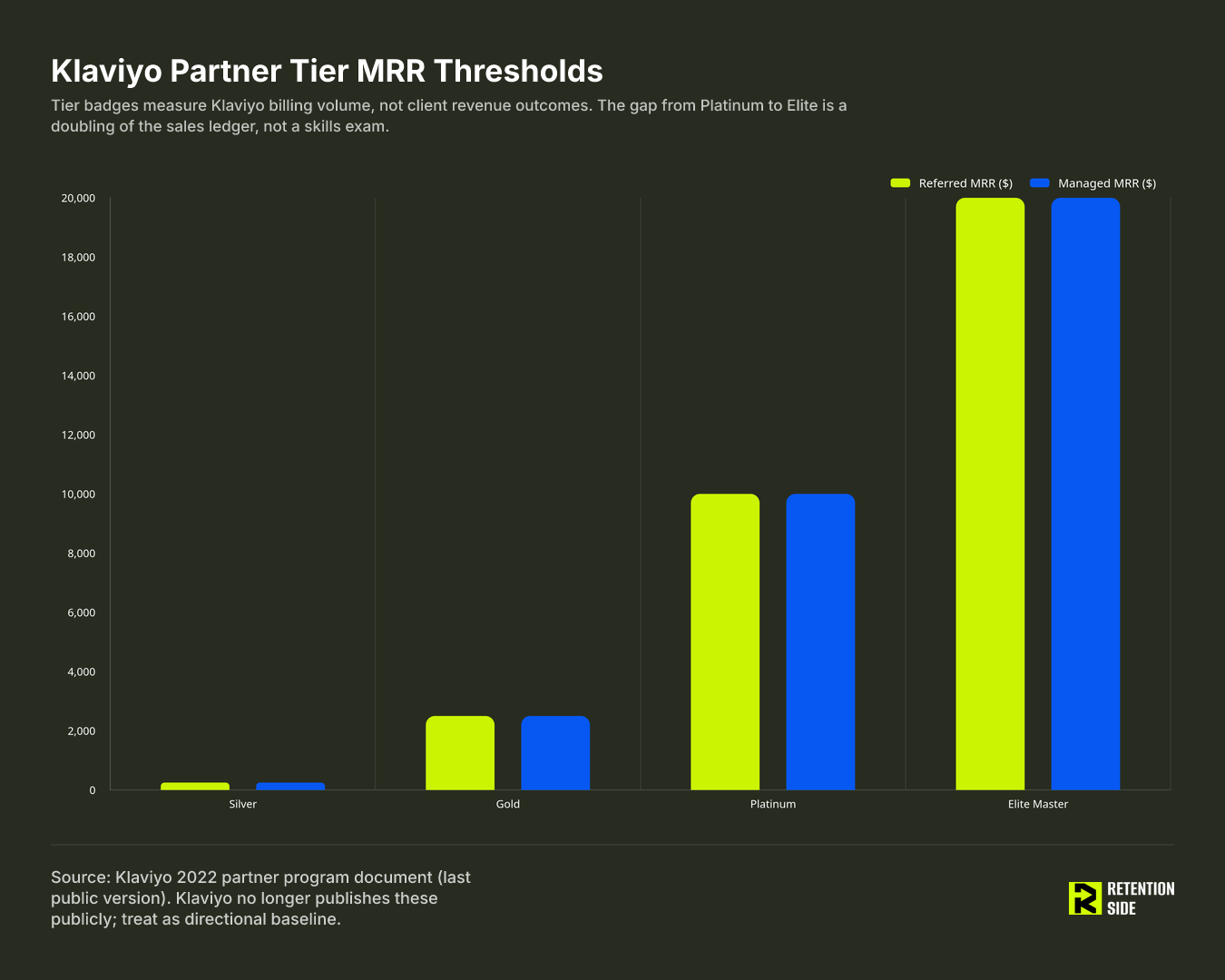
Here is the part most brands miss: these thresholds measure how much Klaviyo billing an agency generates and manages, not how well that agency’s clients perform. Elite status itself is not earned automatically once a threshold is hit. It is granted twice a year, on April 1 and October 1, after an agency’s Klaviyo partner manager nominates it and an internal advisory committee reviews the application. That committee grades loyalty signals to Klaviyo: testimonials, case studies, marketing activity that promotes the platform, and how well the agency represents Klaviyo in market. It does not directly grade the agency’s client revenue outcomes.
None of this makes tier status meaningless. Reaching Elite Master requires managing a meaningful book of Klaviyo accounts well enough to keep them active and growing in spend, and Klaviyo itself notes that partners report at least $3 in implementation, strategy, and managed services revenue for every $1 of Klaviyo MRR they manage, which reflects genuine service depth. But tier is a floor, not a guarantee. Tier status should be treated as a filter that narrows your shortlist, not a substitute for due diligence.
What “best” actually means for an ecommerce brand
A badge tells you an agency clears a billing threshold. It does not tell you whether that agency understands your category, your margin structure, or your customer journey. Building on the vetting logic we use when brands ask us whether they even need a DTC retention agency, here are five criteria that matter more than the badge itself.
Verifiable tier status in the actual directory. Anyone can claim “Klaviyo Elite Partner” on a homepage. Check the Klaviyo partner directory directly and confirm the tier, the certification count, and whether the listing is current.
Published case studies in your category and revenue band. A skincare brand doing $400K a month has different flow logic, replenishment cycles, and margin tolerance than a $5M apparel brand running constant new drops. An agency with strong fashion results and no beauty experience is not automatically wrong for you, but you want evidence they have solved problems that resemble yours, not a generic portfolio of logos.
The revenue metrics they actually report. If an agency’s proof points lean on open rate and list growth, that is a signal. Open rate has been unreliable since Apple Mail Privacy Protection, and list size says nothing about buying behavior. Agencies that report revenue per recipient, flow revenue contribution as a percentage of total email revenue, and attributed revenue by segment are measuring what the business actually needs to know.
Retention system thinking versus single-channel execution. Does the agency talk about how email connects to SMS, loyalty, and the rest of the customer journey, or do they only talk about send calendars? A brand’s retention problem is rarely solved by email alone once it scales past a certain point, and an ecommerce email marketing agency that only knows one channel will optimize that channel in isolation from the rest of your lifecycle.
Deliverability as a first-class discipline, not an afterthought. Ask how the agency monitors inbox placement, warms new sending domains, and responds to spam complaint spikes. An agency that cannot explain its deliverability process in specific terms is not equipped to protect the asset you are paying them to grow.
The agencies: top Klaviyo partners to evaluate in 2026
These profiles are organized by verified tier, starting with Elite Master partners. Tier and client rosters reflect what each agency has published; always confirm current status in the Klaviyo directory before engaging.
Elite Master partners
Underground Ecom holds Elite Master status and was named Klaviyo Agency of the Year for 2025. Based across the UK and US, the agency runs full-service Klaviyo account management, including strategy, content, split testing, technical implementation, and reporting, for clients spanning AG1, Virgin, Britvic, Huda Beauty, Oh Polly, Chilly’s, and Wild. Their client range from roughly $1M to $500M-plus in revenue makes them a fit for brands that want an agency comfortable operating at genuine scale.
Domaine is another Elite Master partner built around retention-first lifecycle marketing across email, SMS, push, and WhatsApp. Clients include Milk Makeup, Alpinestars, Daily Harvest, Laura Mercier, The Row, Dollar Shave Club, Karl Lagerfeld, The Body Shop, Olaplex, and Marc Fisher. Domaine offers full-service, augmented, and à la carte engagement models, which makes them a fit for brands that already have some internal retention capability and want a partner that can flex around it rather than replace it outright.
Chronos Agency reports working with more than 500 brands and generating over $400M in email-attributable revenue with an 80-plus person specialist team, holding a 4.9-star rating on Clutch. They typically serve DTC brands doing $100K or more per month and run full-service retention across email, SMS, and push, making them a reasonable fit for mid-market brands scaling past their first retention hire.
Email Optimize takes a narrower focus: Klaviyo-only, ecommerce-only. Founded in 2017 by an aeronautical engineer, the agency reports $180M-plus in attributed email and SMS revenue across more than 800 DTC brands, typically in the $500K to $50M-plus annual revenue range. Their proprietary “DORTA” five-layer diagnostic method signals a systemized audit process rather than a one-size template, which fits brands that want rigor over flash.
PAASE is a UK-based agency (Milton Keynes) founded in 2019 that became the first UK agency to reach Klaviyo Platinum Master and later the first Elite Master headquartered in EMEA. Their AI-driven approach has produced results like a reported 233% increase in automated revenue for client Okanui, and they work with brands including CurlSmith, PÄRLA, Dalstrong, and Mous. PAASE is a strong option for EMEA-based brands wanting an agency embedded in that regional ecosystem.
ECD Digital brings more than 20 years of broader marketing experience into its Klaviyo practice, claiming 64% of partner brand revenue coming from email and SMS combined with an 8.7X return on ad spend figure. They offer a 30% increase in Klaviyo-attributed revenue within 90 days for qualified brands, a guarantee structure that suits operators who want defined accountability built into the engagement.
Platinum-tier and certified partners
Email Kong holds Klaviyo Platinum Partner status, which the agency notes places it in the top 2.5% of partners. Working exclusively with Shopify brands, they report more than $58.2M in Klaviyo attributed value across 140-plus DTC clients, with services spanning campaigns, flows, SMS, WhatsApp, deliverability, and list growth. Their Shopify-only focus makes them a clean fit for brands that want an agency deeply specialized in that specific tech stack.
Threadpoint, a Platinum Master partner, brings more than 20 years of performance marketing experience into email and SMS strategy, lifecycle and retention work, design, optimization, and fractional email leadership. That fractional leadership offering is worth noting for brands that need senior strategic oversight without a full in-house hire.
Retention Harbor operates at Platinum tier with a proprietary “Revenue Anchor” system and has worked with more than 20 ecommerce brands, including several doing over $50M a year. Their stack covers flow rebuilds, campaign management, segmentation, popups, zero-party data collection, subscription flows, and ESP migrations into Klaviyo, positioning them well for brands migrating from another platform or rebuilding a neglected flow architecture.
Melusine Studio, a UK-based Klaviyo Platinum Master Partner with more than a decade of experience, reports generating £33.4M in revenue for clients over the past year with a 350% ROI figure and 174.89% average account growth. Their client list includes REFY, Daniel Wellington, Grown Alchemist, and Fable & Mane, giving them meaningful depth in beauty and fashion.
Signify Studio holds Klaviyo Certified Partner status and brings 15 years of experience managing more than 150 ecommerce brands and over 10 million subscribers. Notably, they ran more than 700 days of daily Klaviyo production for Leap Retail across 25-plus DTC brands including ThirdLove, Rent the Runway, Faherty, and True Classic, which demonstrates real operational stamina for brands that need consistent day-to-day execution at volume.
Why agency quality shows up in flow revenue, not open rates
Here is the benchmark data that explains why the evaluation criteria above matter more than badge tier. Across Klaviyo’s 2026 benchmark data, drawn from more than 183,000 brands, automated flows generate roughly 41% of total email revenue while accounting for only about 5.3% of total sends. Campaigns, by contrast, generate the remaining 59% of revenue but require 94.7% of send volume to get there.
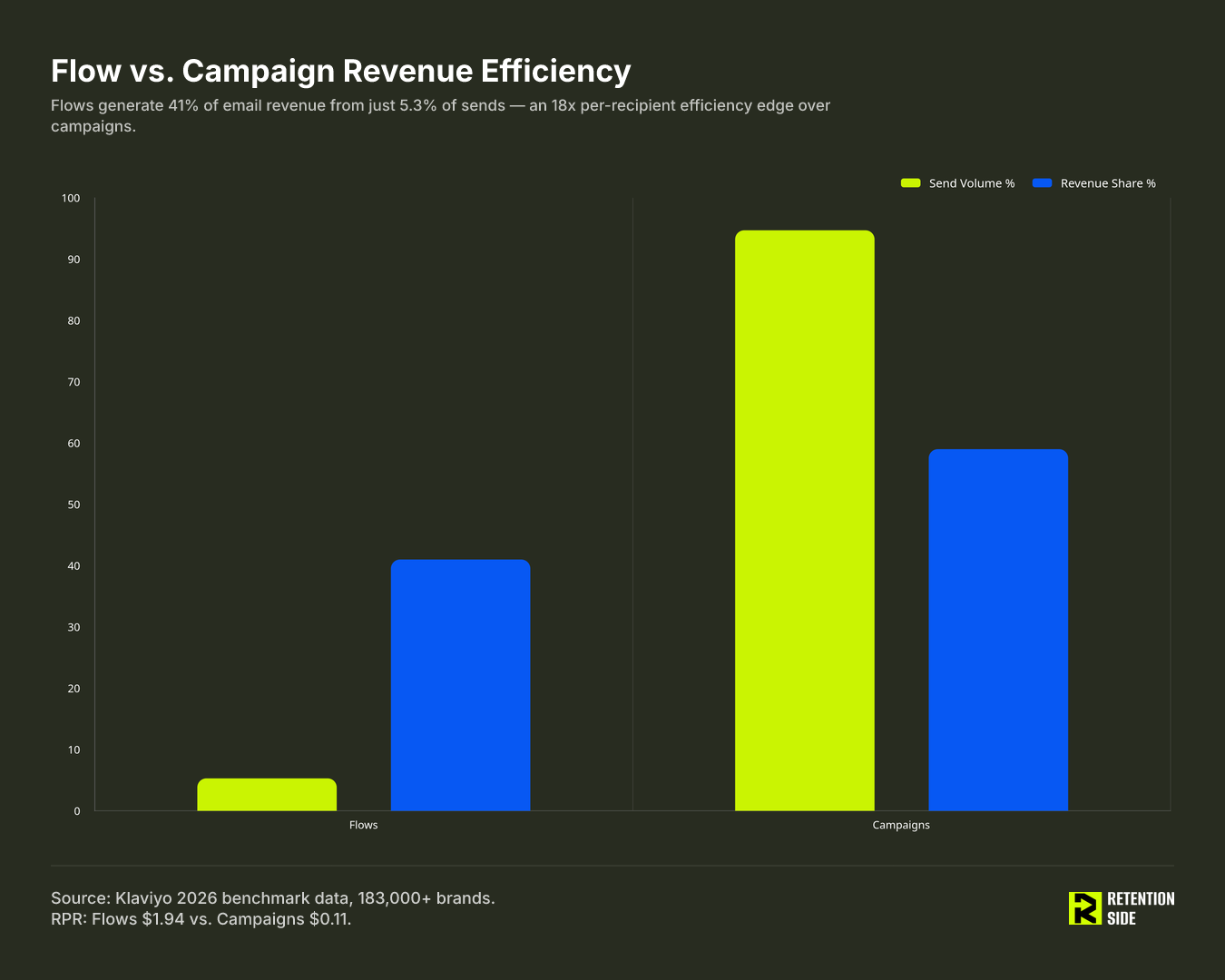
Break that down to a per-recipient basis and the gap widens further. Flows average $1.94 in revenue per recipient compared to $0.11 for campaigns, an 18x efficiency edge. Understanding Klaviyo revenue attribution helps clarify why this split matters so much when evaluating agency performance. Flows also produce roughly 3x higher click rates than campaigns (5.58% versus 1.69%) and roughly 13x higher placed order rates. Flows also do more acquisition work than most operators assume: about 48% of flow-driven revenue comes from new buyers, compared to roughly 16% for campaigns.
This is the practical reason an agency that sells you a content calendar full of designed newsletters is optimizing the smaller, less efficient half of your email program. An agency that treats flow architecture and segmentation as the core deliverable is optimizing the half that is already outperforming on a per-send basis, and that outperformance compounds as your list grows. Third-party analysis of Klaviyo’s benchmark data suggests flow revenue share climbs with brand maturity: brands under $5M in revenue typically see 25-35% of email revenue from flows, brands between $5M and $20M see 40-50%, brands above $20M see 50-60%, and the top decile of performers sees 58-65%. These ranges are directional rather than official Klaviyo targets, but the pattern is consistent: the brands generating the most efficient retention revenue lean harder on flows, not campaign volume.
When you evaluate an agency, ask directly what percentage of your total email revenue they expect to come from flows within six months, and how they plan to move that number. An agency with a real answer is thinking about your retention system. An agency that pivots to talking about design output is thinking about billable hours.
How to vet beyond the badge: questions to ask any Klaviyo agency
Use this checklist in every discovery call, regardless of tier:
- What tier are you, and can I verify it directly in the Klaviyo partner directory? Do not accept a screenshot or a homepage claim.
- Do you audit before you pitch strategy? An agency that proposes a flow rebuild before reviewing your current account, list health, and deliverability history is guessing. A thorough Klaviyo audit checklist should cover deliverability, list growth, flows, and campaigns before any recommendations are made.
- What revenue metrics do you report, and how often? You want revenue per recipient, flow contribution percentage, and segment-level attributed revenue, not just opens and clicks.
- How do you handle deliverability, specifically? Ask about domain warming for new sends, spam complaint monitoring, and what they do when inbox placement drops. Delivery and deliverability are not the same thing: an email can be technically delivered and still land in spam or the promotions tab, where it does nothing for your business.
- What is your flow maintenance cadence? Flows are never “done.” Ask how often they revisit and test welcome series, abandoned cart, post-purchase, and win-back flows, and what changed in the last quarter for a comparable client.
- Do you work across channels, or only email? Even if you are hiring for Klaviyo specifically, an agency that understands how SMS, loyalty, and other channels interact with email will build flows that fit into a broader system instead of competing with your other retention efforts.
- What brand sizes and categories do you typically work with? Match their comfort zone to your actual revenue band and product type, not their biggest logo.
When to hire an agency versus build in-house
The decision is less about company size and more about where your retention program actually stands. Hiring an agency tends to make sense when acquisition is working but lifetime value has gone flat, when email exists but has never been treated as a system with clear flow logic, when repeat purchase rate sits below roughly 30%, or when your internal team is stretched thin managing campaigns reactively instead of building proactively.
It may not make sense yet if you are sub-scale and still finding product-market fit, or if a founder-led, hands-on approach is still generating strong results without the complexity an agency is built to handle. The right agencies are built for brands that have already proven demand and now need someone to systematize the retention side of the business, not brands still figuring out what to sell.
For brands above roughly $300K a month with acquisition working and retention underbuilt, email marketing via Klaviyo is typically where the system starts, but it should not be where it ends. The strongest agencies extend that foundation into SMS, loyalty, and the other channels your customers actually use.
The takeaway
The badge narrows your list; it does not make the decision for you. Verify tier status directly, then evaluate agencies on the metrics that reflect real business health, category-relevant case studies, and evidence they think in systems rather than send calendars. The agencies profiled here all clear that bar in different ways, and the right fit depends on your revenue band, category, and how much of your retention system already exists.
If you want a second opinion on where your Klaviyo account currently stands, or you are trying to decide whether your team needs an agency partner at all, Retention Side works with ecommerce brands that have the acquisition side working and need a real retention system built around it, starting with email and expanding wherever the data says it should.