

If you already know what lifecycle marketing is, you don’t need another explanation of the five stages and a diagram with arrows pointing at a funnel. You need to know why your repeat purchase rate has been stuck at the same number for three quarters while your acquisition spend keeps climbing, and what to actually do about it.
Customer acquisition cost has risen roughly 60% since 2019, and iOS 14 signal loss alone knocked Meta attribution accuracy down by an estimated 15 to 40%. Acquiring a new customer still costs 5 to 25 times more than retaining an existing one. And yet, according to Salesforce’s State of Marketing research, only about half of marketers actually take a lifecycle approach to personalization. Most brands are still running campaigns and flows as separate exercises instead of one connected system.
That gap is the opportunity. This article is not about defining lifecycle marketing. It’s about the advanced mechanics: the second-purchase inflection point that determines whether a customer becomes profitable, the segmentation logic that goes past “engaged” and “unengaged,” the post-purchase architecture that actually changes repeat behavior, and the measurement framework that tells you whether your system is compounding or quietly leaking revenue every month.
What this article covers
- The economics that make lifecycle marketing a financial necessity, not a nice-to-have
- Why the second purchase is the highest-leverage event in the entire customer relationship
- How to map a lifecycle system around customer behavior instead of arbitrary campaign calendars
- The post-purchase architecture built to engineer a second purchase, not just say thank you
- Advanced segmentation beyond “engaged” and “unengaged”
- How to coordinate email, SMS, push, direct mail, and loyalty without fragmenting the experience
- Loyalty programs as structural infrastructure rather than a bolt-on feature
- The metrics that actually reveal whether your lifecycle system is working
- Common failure modes that quietly cap LTV even in programs that look sophisticated on the surface
The economics that make lifecycle marketing non-optional
Frederick Reichheld’s research at Bain & Company, now one of the most cited findings in retention economics, found that increasing customer retention by just 5% can increase profits by 25% to 95%, depending on the industry. For ecommerce specifically, the math is even more pointed. Bain’s research on online retail found that acquisition costs run 20 to 30% higher than in traditional retail, which means many new customers stay unprofitable for two to three years unless they come back.
That’s not a rounding error. It’s the entire business model.
Shopify’s enterprise research backs this up with a distribution problem that most operators underestimate: repeat customers make up only about 21% of the customer base but generate 44% of total revenue and 46% of orders. A small slice of the file is doing almost half the work. If your lifecycle system doesn’t actively grow that slice, you’re leaving the highest-margin part of the business flat while acquisition costs climb.
Bain’s older but still relevant Mainspring study on online customer loyalty found that the average apparel shopper wasn’t profitable for the retailer until their fourth purchase, taking roughly 12 months to break even. Online grocers spending $80 or more to acquire a customer needed 18 months. Break-even isn’t a first-order event. It’s a lifecycle outcome, which means the marketing that happens after the sale determines profitability more than the marketing that generated the sale in the first place.
Against that backdrop, most brands are underperforming. A 2024 analysis of more than 1,500 Shopify stores by Little Stream Software found an average repeat purchase rate of just 25%, with an average of 1.8 orders per customer. If your number sits near that median, you’re not behind, you’re average, and average is exactly where the margin gets left on the table. The brands compounding faster than their acquisition spend are the ones treating everything after the first sale as a deliberate system, not a series of disconnected automations.
The second purchase is the most important conversion in the lifecycle
If you had to pick one event to obsess over in your entire customer journey, it should be the second purchase, not the first.
RJ Metrics analyzed 176 ecommerce retailers and 18 million customers and found that after a first purchase, a customer has roughly a 32% chance of buying again. Once they make that second purchase, the probability of a third jumps to 53%. A fourth purchase follows 64% of the time. By the ninth or tenth order, the probability of continuing to buy climbs to 83%. Retention Side’s own client data lands close to this pattern, generally putting first-to-second purchase probability around 27 to 32%, with that number roughly doubling once the second purchase happens.
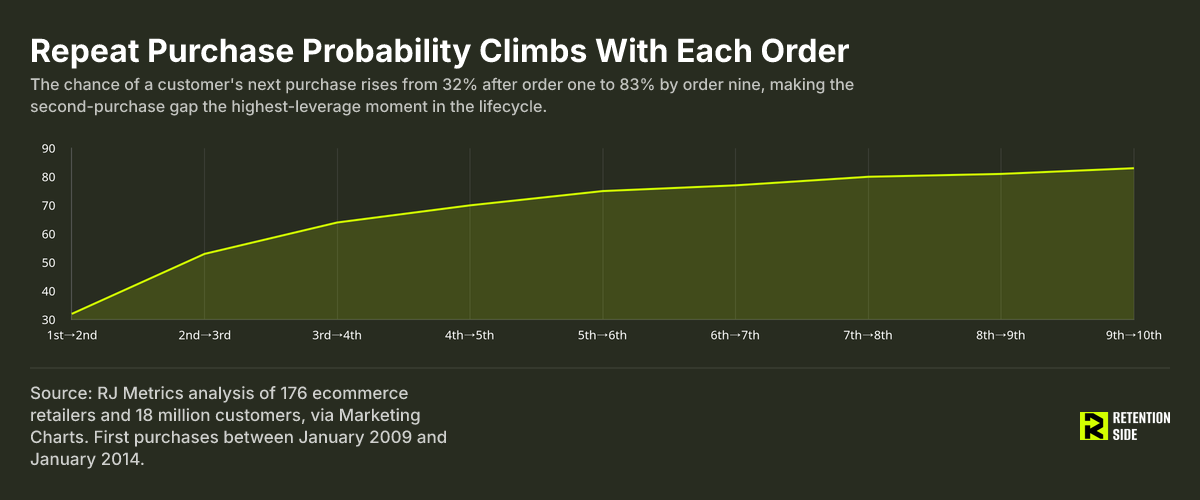
This is the core mechanic of advanced lifecycle marketing: retention doesn’t grow linearly, it compounds. Every successive purchase makes the next one more likely. That means the highest-leverage moment in your entire customer lifecycle isn’t the welcome series or a big VIP campaign, it’s the narrow window between order one and order two.
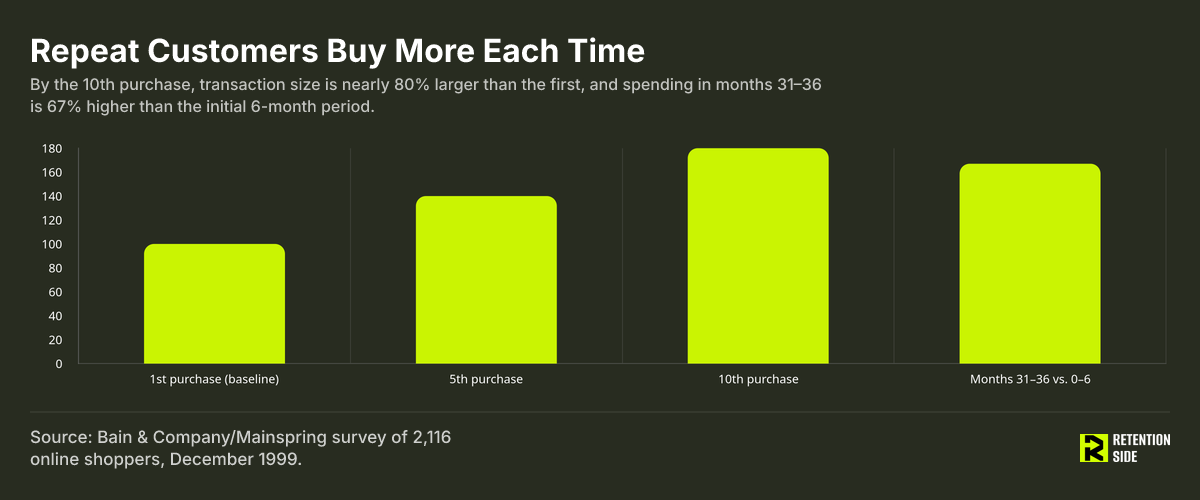
The value math backs this up hard. A customer who reaches five or more purchases carries roughly 7.3 times the lifetime value of a one-time buyer. And that trajectory isn’t gradual either. Bain’s Mainspring research on apparel shoppers found that a customer’s fifth purchase was 40% larger than their first, and their tenth purchase was nearly 80% larger. Repeat customers spent 67% more in months 31 to 36 of the relationship than they did in months zero to six. Retention doesn’t just accumulate revenue, it accelerates it.
Timing matters just as much as probability. Roughly 67% of a customer’s 90-day retention window concentrates in the first 30 days after purchase, and RJ Metrics found that 69% of a customer’s entire first-year spend happens within their first 30 days as a customer, averaging $106 out of $154 total. A more recent DTC-specific study covering 156,110 customers found that of buyers who do repurchase, 50.3% do it within 30 days and 76.4% within 90 days.
Put those numbers together and the strategic implication is clear: the post-purchase window isn’t a “nice touch” period for thank-you emails. It’s the window where your entire lifecycle system either compounds or leaks. Everything downstream, loyalty, win-back, VIP treatment, depends on how well you engineer that first 30 to 90 days.
Mapping the lifecycle system: stages, channels, and flows
Every lifecycle model uses roughly the same stages: awareness, acquisition, conversion, retention, advocacy. The labels matter less than understanding the actual marketing job happening at each point, and more importantly, understanding the distinction between the system that stores customer data and the system that acts on it.
A CRM stores and organizes customer data. Customer lifecycle marketing is the discipline of actively using that data to move customers from one stage to the next with the right message at the right time. A brand can have an immaculately organized CRM and still have a weak lifecycle program if nothing in that data actually triggers action.
Email remains the foundation of most lifecycle systems, and it holds together around four pillars: deliverability, list growth, automation (flows), and campaigns. Skip any one of these and the rest of the system underperforms no matter how good your segmentation or creative is. Deliverability determines whether messages land anywhere useful at all. List growth determines the size and quality of the audience you’re managing through the lifecycle. Flows handle the behavioral, always-on moments. Campaigns maintain the ongoing relationship between those moments.
Flows and campaigns are not substitutes for each other. Flows are behavior-triggered and continuous, covering welcome sequences, abandoned cart, post-purchase, browse abandonment, win-back, and replenishment. Campaigns are manual, planned sends built around segments and calendar moments. A brand with excellent flows but no campaign strategy will convert new signups well but fail to maintain full-price purchasing behavior over time. A brand with strong campaigns but weak flow coverage will win short-term revenue spikes but lose the compounding effect entirely.
The mistake advanced operators make is optimizing individual flows in isolation while leaving coverage gaps in the lifecycle. A brilliantly converting abandoned cart flow doesn’t matter if there’s no win-back sequence catching lapsing customers, and no post-purchase sequence pushing first-time buyers toward a second order. Lifecycle coverage matters more than any single flow’s conversion rate, because a gap in coverage means an entire segment of customers receives no lifecycle-appropriate message at all.
Advanced post-purchase architecture: engineering the second purchase
Given how much leverage sits in the first 30 to 90 days after purchase, the post-purchase sequence deserves more architecture than most brands give it. A generic “thanks for your order” email followed by a generic newsletter is not a post-purchase system, it’s a missed opportunity dressed up as one.
A more deliberate structure looks like this:
- Day 0-1: Reinforce the purchase decision. Confirm the order, set expectations, reduce buyer’s remorse.
- Day 2-5: Product education post-delivery. Help the customer actually use what they bought, which reduces returns and increases satisfaction.
- Day 7-10: Replenishment or cross-sell, depending on product category and observed behavior.
- Day 14-21: Review request, timed after the customer has had real experience with the product.
- Day 18-25: The second-purchase bridge, a dedicated push designed specifically to convert the highest-probability window into an actual second order.
The content of that Day 7-10 message is where most brands guess wrong. Analysis of over 7,000 second-purchase journeys found that 77% of repeat buyers purchase the same product again rather than something new. In consumable categories, reorder rates run between 82 and 93%. That means the default recommendation in most post-purchase flows should be a replenishment prompt, not a curated cross-sell grid built on category assumptions. Save the expanded product discovery for later in the relationship, once the customer has demonstrated loyalty to the core product.
First-time buyers and returning customers also need different paths entirely. A customer on their fourth order doesn’t need the same education sequence as someone who just made their first purchase. Running one post-purchase flow for everyone, regardless of order history, treats a five-time buyer the same as a stranger, which wastes the exact behavioral data that should be shaping the message.
Channel choice matters here too. SMS works well for time-sensitive post-purchase nudges, shipping delays, replenishment reminders timed to actual consumption cycles, flash restocks. Push notifications are effective for delivery-day reinforcement, catching the customer at the moment of highest product excitement. Email remains the backbone for the longer-form education and review requests that don’t need instant attention.
Advanced segmentation: moving beyond broadcast thinking
Most brands segment on the basics: engaged versus unengaged, purchasers versus non-purchasers. That’s a starting point, not an advanced system. A more complete segmentation model separates the file into six core groups: new subscribers who haven’t purchased yet, engaged active buyers, VIP customers, lapsed customers who are win-back candidates, unengaged subscribers who are sunset candidates, and long-term non-purchasers who never converted at all.
Each of these groups needs a different message cadence and a different strategic goal. Treating them all the same, sending the same weekly promotional email regardless of where someone sits in that structure, is one of the fastest ways to flatten engagement and train your list to only respond to discounts.
RFM segmentation, recency, frequency, monetary value, adds a layer that static segments miss. It identifies which customers are drifting before they fully lapse. This matters because the danger zone is more specific than most brands assume: customers who haven’t purchased in 60 to 90 days are entering real churn risk. A targeted reactivation sequence triggered at that threshold, rather than a generic quarterly win-back blast, is one of the highest-ROI investments most retention programs aren’t making.
Zero-party data, information customers volunteer directly through quizzes, preference centers, or post-purchase surveys, lets you segment on declared intent rather than inferred behavior alone. This becomes especially valuable for brands with diverse product catalogs where purchase history alone doesn’t reveal what a customer actually wants next.
Cohort analysis is non-negotiable at this stage. Aggregate metrics like “average repeat purchase rate” tell you almost nothing about direction. Cohort curves, tracking how each acquisition month’s customers behave over the following three to six months, tell you whether retention is actually improving or whether recent gains are masking a slower decline in a different part of the funnel.
Channel coordination: making the system feel intentional
Adding channels without coordinating them creates a fragmented experience, not a stronger one. A brand running email, SMS, push, direct mail, and a loyalty program simultaneously, with none of them aware of what the others are sending, isn’t running an advanced lifecycle system. It’s running five uncoordinated campaigns that happen to target the same customer.
When a lifecycle program underperforms, the diagnostic order matters. Start with deliverability, because if messages aren’t reaching the inbox, nothing downstream matters. Then list health, because a bloated, unengaged list drags down sender reputation and skews every performance metric. Then flow coverage and trigger reliability, because gaps here mean entire behavioral moments go unaddressed. Only after those layers are solid does creative and offer quality become the relevant lever. Fixing offer copy on top of a broken deliverability foundation produces, at best, a temporary bump that fades once inbox placement reasserts itself.
One structural problem shows up constantly in brands with flat LTV despite growing spend: promotional campaigns have conditioned the list to wait for a discount before purchasing. If every campaign is a sale, customers learn to ignore full-price messaging entirely, which erodes margin on every order and makes loyalty programs fight an uphill battle against a habit the brand created itself.
The right approach to channel expansion is sequential, not simultaneous. Get email working well first: deliverability solid, flows covering the core behavioral moments, campaigns balanced between promotional and value-driven content. Then look at where the behavior data shows actual coverage gaps, customers who don’t open email but respond to SMS, high-intent buyers who’d value a direct mail touch, VIPs who’d engage with a loyalty tier. Add channels because the data shows a gap, not because a channel is trendy.
Loyalty as structural retention infrastructure
Loyalty programs get treated too often as a feature to bolt on rather than infrastructure that touches nearly every part of the lifecycle system. There are three common models, and each rewards a different behavior: points-based programs reward transaction frequency, tiered or VIP programs reward cumulative spend and status, and paid membership programs reward upfront commitment in exchange for ongoing perks.
The model you choose should match your repeat purchase economics, not just competitor benchmarks. Consumable products benefit from programs that reward reorder cadence. Fashion and apparel benefit from programs that protect full-price frequency rather than encouraging markdown-chasing. High-ticket, low-frequency categories benefit more from referral-generation mechanics than from points redemption, since the purchase cycle is too long for points accumulation to feel meaningful.
Done correctly, a loyalty program isn’t a separate initiative sitting next to your email program, it changes the welcome flow (introducing the program early), the post-purchase sequence (prompting point redemption or tier progress), campaign segmentation (VIP-only sends, tier-upgrade nudges), and the discounting math across the entire calendar. A well-designed program should reduce dependency on markdowns, not add another discount mechanism on top of the ones you already run. Customers who actually redeem points tend to repeat-purchase at dramatically higher rates than those who accumulate points but never cash them in, which means the redemption experience itself deserves as much attention as the earning structure.
Measurement: what tells you the system is working
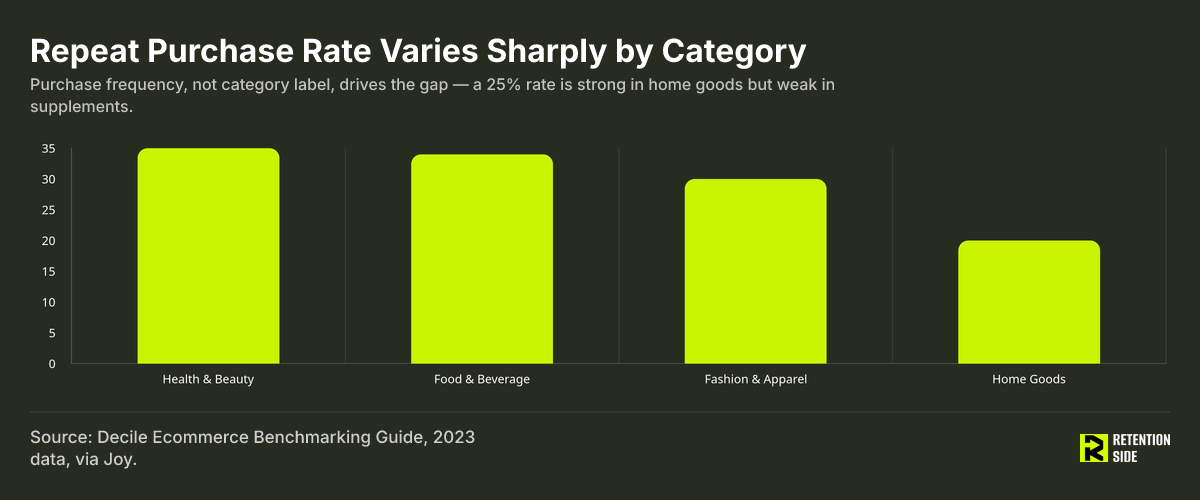
Repeat purchase rate is the clearest top-line outcome metric for a lifecycle system, but it only means something when interpreted against your category. A 25% repeat purchase rate looks average against the broad Shopify benchmark, but category data from Decile shows real range: health and beauty brands average around 35%, food and beverage around 34%, fashion and apparel around 30%, and home goods closer to 20%. Purchase frequency, not the category label itself, drives most of that gap. A 25% rate is a real problem in supplements and a solid result in home goods.
Beyond the headline number, a few metrics separate advanced measurement from surface-level reporting:
- Flow conversion rate segmented by buyer type and product category, not blended across the whole list, since blended averages hide which segments are actually underperforming.
- LTV to CAC ratio, interpreted carefully. The 3:1 benchmark comes from SaaS, where contract structures and churn dynamics look nothing like ecommerce. DTC brands need a framework built around actual repeat purchase timelines and margin structure, not a borrowed SaaS ratio.
- Cohort retention curves over rolling three-to-six-month windows, which reveal trend direction that a single point-in-time metric can’t.
- Median time to second purchase, not average, since a handful of outlier fast repurchasers can distort an average and mask the real distribution most customers fall into.
When LTV stays flat despite continued investment in retention, the cause is usually one of three structural issues: gaps in lifecycle coverage that leave entire customer segments without a relevant message, win-back timing that doesn’t match actual repurchase data (triggering too early or too late relative to when customers realistically return), or a list that’s been conditioned by discount-heavy campaigns to wait for a deal before buying again. None of these show up clearly in a single dashboard metric. They show up when you trace the system end to end.
Common failure modes in advanced lifecycle programs
A few patterns show up repeatedly in programs that look sophisticated on paper but underperform in practice:
- Treating loyalty as a bolt-on feature rather than connective tissue that should touch flows, campaigns, and discounting strategy.
- Suppressing recent buyers from promotional campaigns during the exact 30-day window when roughly half of all repeat purchases happen, effectively silencing the brand during its highest-leverage moment.
- Running identical abandoned cart flows for first-time site visitors and five-time repeat buyers, ignoring the behavioral history that should shape the message entirely.
- Sending the same weekly promotional email to the entire list regardless of lifecycle stage, which trains VIPs to expect discounts and trains new subscribers to see the brand as one long sale.
- Letting channels run in silos with overlapping offers and competing messages, so a customer gets a full-price email campaign and a 20%-off SMS on the same day.
- Staying on a shared sending domain indefinitely, which caps deliverability ceiling and puts an otherwise well-built lifecycle system at risk from day one.
Every one of these is fixable, and none require ripping out the existing system. They require someone actually tracing the customer journey end to end and asking where the behavior data and the messaging logic have drifted apart.
Where this leaves your program
Advanced lifecycle marketing isn’t a more complex version of basic email marketing, it’s a different way of thinking about the relationship between customer behavior and message timing. The brands compounding revenue faster than their acquisition spend aren’t necessarily running more flows or more channels than everyone else. They’re running a system where the second purchase gets engineered deliberately, segmentation reflects real behavioral distinctions instead of broad buckets, and every channel reinforces the same customer story instead of competing for attention.
If your repeat purchase rate has plateaued despite continued investment, the fix usually isn’t a new campaign idea or a better subject line. It’s tracing the system itself, from deliverability up through post-purchase sequencing to loyalty design, and finding where the coverage gap or the misaligned trigger is quietly capping what the rest of the program can achieve. That’s the work Retention Side does with ecommerce brands built past the point where basic flows are enough.