

Most DTC brands that hit $300K/month in revenue have already cracked acquisition. Paid social works. Google converts. Their products sell. The problem is that every month starts at zero – because they haven’t built a system that brings customers back.
That’s where a DTC email marketing agency earns its place. Not as a design team that sends newsletters, but as a retention infrastructure partner that builds the systems, flows, and campaigns that turn one-time buyers into a sustainable revenue base.
This article breaks down what DTC email marketing is, how it actually works at a strategic level, and what separates agencies that move the needle from those that just log billable hours.
Key takeaways
- DTC (direct-to-consumer) marketing means selling directly to end customers with no retail intermediary, which gives brands full ownership of their customer data and communication channels.
- Email is the highest-leverage owned channel in a DTC retention stack – not because of any benchmark, but because it allows precise, personalized, behavior-triggered communication at essentially zero marginal cost.
- A specialist DTC email marketing agency works across four pillars: deliverability, list growth, automation (flows), and campaigns. All four must function for the channel to perform.
- The metrics that matter are repeat customer rate, revenue attributed to retention channels, list growth rate, and deliverability health. Not open rate. Not click rate.
- When vetting an agency, the most important questions are about their case studies, which metrics they hold themselves accountable to, and how they think about email’s role within your wider marketing ecosystem.
What is DTC in marketing?
DTC stands for direct-to-consumer. In a DTC model, a brand sells its products directly to end customers – through its own website, app, or owned channels – without relying on wholesale partners, retail intermediaries, or third-party marketplaces.
This is distinct from the traditional retail model, where a manufacturer sells products to a wholesaler, who sells to a retailer, who finally sells to a customer. In DTC, that entire chain collapses. The brand owns the transaction, the relationship, and the data.
The practical implications are significant. A DTC brand has full visibility into who is buying, what they bought, how often they return, and what prompted each purchase. That data is yours. It doesn’t live inside Amazon’s ecosystem or Walmart’s reporting dashboard – it lives in your CRM, your email platform, and your analytics stack.
This is exactly why retention marketing matters so much to DTC brands. You’ve invested in acquiring each customer. You own their data. And you have the infrastructure to communicate with them directly, for the full lifetime of the relationship. Failing to capitalize on that is leaving real margin on the table. As BCG notes in their analysis of first-party data in retail, brands that fail to leverage their first-party data in a structured way are sitting on a fortune they’re not using.
DTC vs. B2C: a clarification worth making
These terms are often used interchangeably but they’re not the same. B2C (business-to-consumer) is broader – it describes any company selling to individual consumers, including those selling through third-party retailers. DTC is a subset of B2C that specifically refers to brands selling through their own channels. A brand can be B2C without being DTC. All DTC brands, however, are by definition B2C.
What is DTC email marketing?
DTC email marketing is the practice of using email as an owned communication channel to drive customer acquisition (via list building), activation, repeat purchase, and long-term retention – within a direct-to-consumer brand context.
That definition sounds simple, but the execution is not. DTC email marketing is distinct from generic B2B email, newsletter marketing, or promotional blasting in a few important ways.
It’s behavior-driven, not schedule-driven
The most valuable email programs for DTC brands are not built around a content calendar. They’re built around what customers actually do – and don’t do. Someone browses a collection page and leaves? A browse abandonment flow activates. A customer makes their first purchase? A post-purchase sequence begins, designed to cement the relationship before the product even arrives. A subscriber goes 90 days without engaging? A winback flow tries to recover them before they’re gone for good.
These aren’t emails that go out because Tuesday is newsletter day. They’re triggered by real customer behavior against the backdrop of a mapped customer journey.
It’s built on first-party data
DTC brands own their customer data in a way that brands selling through intermediaries do not. That ownership creates the foundation for personalized, segmented, and highly relevant email communication. A customer who has bought your vitamin C serum three times is a different recipient than someone who bought once eight months ago and hasn’t been back. DTC email lets you treat them differently at every touchpoint.
It’s the backbone of your retention system
Retention isn’t a single channel – it’s a system. But email is typically the highest-leverage component of that system because it operates at almost zero marginal cost per send, integrates natively with most eCommerce platforms (particularly Klaviyo on Shopify), and supports every stage of the customer lifecycle from first purchase through loyalty.
When you build the email channel correctly, it doesn’t just generate revenue on its own – it amplifies the impact of your paid media, your loyalty program, your SMS, and your direct mail. Every retention channel works better when email is the foundation underneath it.
What is a DTC marketing agency?
A DTC marketing agency is a service provider that helps direct-to-consumer brands grow their customer base, increase repeat revenue, and improve profitability – typically by managing one or more owned and performance marketing channels.
That broad definition covers a wide range of agencies. Some focus on paid acquisition. Some do brand strategy. Some handle full-funnel creative. A DTC email marketing agency, specifically, focuses on the retention and lifecycle side – building and managing the email infrastructure that keeps existing customers buying.
Here’s where things get important: not every agency that uses the word “retention” in its positioning is actually a retention specialist. Many are generalist performance agencies that added email as a service line, or email agencies that rebranded without meaningfully changing their approach. The terminology shifted; the work didn’t.
A true DTC retention agency – like Retention Side – understands that email is an entry point into a broader retention system. That system might include email, SMS, push notifications, direct mail, loyalty programs, and channels like WhatsApp or Viber depending on the brand’s audience and geography. Each channel plays a different role. Email is typically the anchor, but it doesn’t operate in isolation.
What a DTC email marketing agency actually does
There are four pillars that define what a competent email agency manages. They are not interchangeable, and weakness in any one of them limits what’s possible in the others.
Deliverability
Deliverability is the foundation everything else sits on. If your emails aren’t landing in inboxes, no amount of creative excellence or segmentation matters.
Deliverability encompasses domain authentication (SPF, DKIM, DMARC), sender reputation management, list hygiene, bounce rate monitoring, and spam complaint rates. According to Validity’s email deliverability research, one in every six emails never reaches the inbox – meaning a meaningful share of your sends may be getting silently filtered before a subscriber ever sees them. A good agency monitors these proactively – not reactively after you’ve already landed in Gmail’s promotions tab or, worse, spam.
One of the most common deliverability killers that agencies address is over-sending to disengaged subscribers. Sending to subscribers who haven’t engaged in 6-12 months is not harmless. It actively damages sender reputation and suppresses inbox placement for your entire list. This is why sunset flows – automated sequences designed to remove chronically unengaged subscribers from active sends – are a critical list hygiene tool, even though they don’t generate direct revenue. Litmus’s guide to email list hygiene explains clearly how sending to invalid or disengaged addresses creates a compounding reputation problem that goes well beyond a single misfired campaign.
List growth
Email list growth is the acquisition side of retention. It’s how new subscribers enter your ecosystem before they become customers – or shortly after their first purchase.
A sophisticated list growth strategy goes beyond a basic pop-up form. It includes on-site capture optimization (timing, offer, placement, copy), zero-party data collection (preferences, product quiz results, purchase intent signals), and the management of that data within your email platform so it can power segmentation from day one.
The quality of how subscribers enter your list shapes the health of your program for years. An agency that treats list growth as “install a pop-up and collect emails” is missing most of the strategy.
Automation (flows)
Automated flows are pre-built email sequences that trigger based on customer behavior or lifecycle stage. They run 24/7 without manual intervention and generate revenue continuously in the background.
The flows that matter most for a DTC brand include:
- Welcome series – activates when someone subscribes but hasn’t yet purchased. Its job is to move a new subscriber toward their first transaction by communicating brand value, social proof, and a relevant incentive.
- Abandoned cart flow – triggers when a shopper adds to cart but doesn’t complete checkout. Most brands set this up, but few optimize the full sequence beyond a single reminder. The flow’s real purpose is to identify and remove purchase friction at a critical decision point.
- Post-purchase flow – begins after a first or repeat order. This is where relationship-building happens. The sequence should confirm the order, set expectations, build trust, introduce the broader product range, and encourage a second purchase – before the customer has time to forget about you.
- Browse abandonment flow – fires when a visitor views product pages without adding to cart. Less intent than cart abandonment, but a meaningful signal that warrants a gentle, product-specific follow-up.
- Cross-sell and up-sell flows – triggered after purchase, designed to introduce complementary products or higher-value alternatives based on what the customer bought. These are often under-built but represent a significant revenue opportunity in brands with multi-SKU catalogs.
- Winback flow – activates around the time a customer is historically expected to repurchase but hasn’t. That timing is based on your brand’s average order frequency data – not a generic 90-day timer. In most DTC categories, this is well within the first three months. In furniture, it might extend longer given the purchase cycle. The flow’s goal is re-engagement before the customer becomes fully lapsed.
Note: sunset flows are also important but serve a different purpose – list hygiene rather than revenue generation. They should not be grouped with revenue-driving flows in your architecture.
Campaigns
Campaigns are manually planned, scheduled sends – your broadcast channel. They are equally important to flows, not subordinate to them. A strong campaign program handles new product launches, seasonal promotions, content-driven newsletters, and customer education. It’s where your brand voice shows up consistently and where you drive volume revenue on a predictable cadence.
The best DTC email programs balance automated flows (which convert reliably in the background) with campaigns (which create topical relevance and drive spikes). Neither replaces the other.
The DTC retention stack: email is the anchor, not the whole system
Email is the most proven retention channel for DTC brands. But treating it as the only retention channel is a ceiling on your growth.
Retention Side’s approach starts with email – specifically Klaviyo for brands on Shopify and similar platforms – because it’s where the highest-leverage, lowest-cost-per-send retention infrastructure lives. But a complete retention system for a brand doing $300K+ per month typically layers in additional channels as the email program matures.
SMS marketing handles time-sensitive, high-urgency messages that benefit from near-100% visibility – flash sales, back-in-stock alerts, shipping notifications that warrant a direct nudge. Klaviyo’s research on combining SMS and email makes the case clearly: SMS and email are complementary, not competitive. The strategy should define which messages belong in which channel.
Push notifications extend retention communication to mobile app users, creating a touchpoint that doesn’t compete with inbox clutter.
Direct mail re-enters the picture for brands with higher AOVs or segments where digital channels have reached saturation. A well-timed physical piece can move a lapsed high-value customer in a way a fifth winback email simply won’t.
Loyalty programs build long-term retention mechanics – points, tiers, referral incentives – that give customers ongoing reasons to return beyond product satisfaction alone.
WhatsApp and Viber are increasingly relevant for brands with international audiences, particularly in markets where these platforms have higher engagement rates than email.
Each channel has a specific role. The system works because the channels reinforce each other – email feeds data to SMS, loyalty behavior informs flow triggers, direct mail targets high-value segments that email couldn’t re-engage. This is what a retention infrastructure looks like when it’s built rather than assembled.
Repeat purchase rate: the metric that tells the real story
If you want one metric that summarizes the health of your retention system, it’s repeat customer rate (also called returning customer rate). It measures the percentage of your customer base that has made more than one purchase.
This is the metric that separates brands building sustainable businesses from those riding an acquisition treadmill. High acquisition, low repeat rate means you’re growing a leaky bucket. Every customer you win costs you acquisition spend, and you’re getting one purchase out of them. That’s a difficult unit economics problem that no paid media optimization fully solves.
What “good” looks like varies significantly by category. A repeat rate that would be concerning in health and beauty might be outstanding in furniture. Context matters.
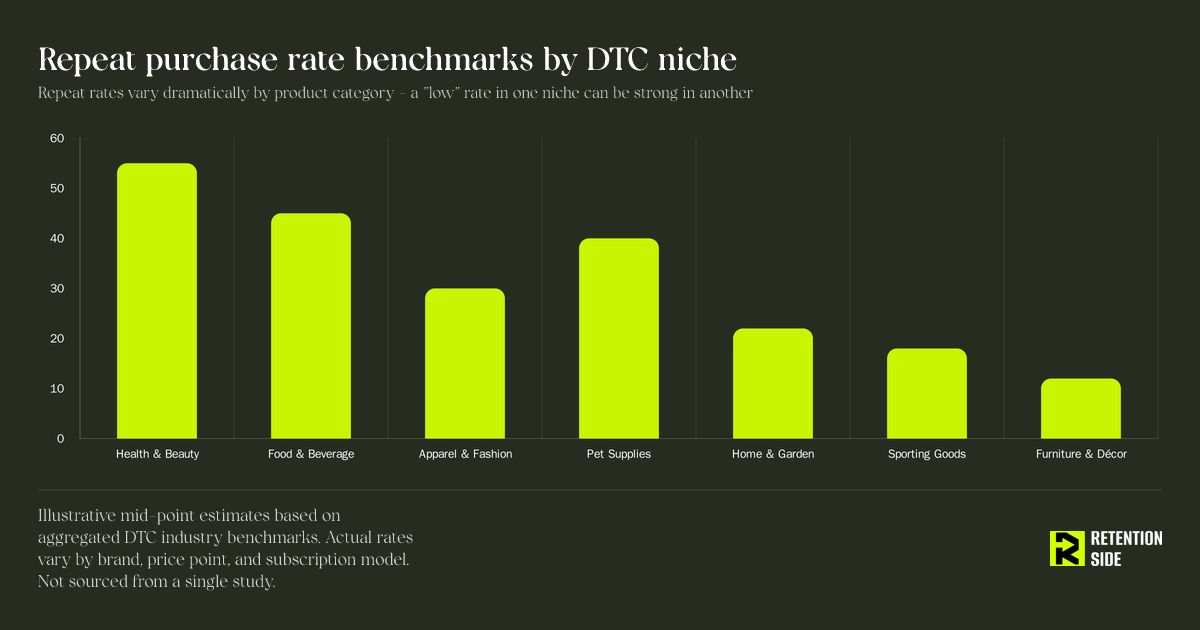
Health and beauty – supplements, skincare, haircare – inherently carries higher repeat rates because the products are consumable. Customers run out and need to reorder. The retention job is to make sure they reorder from you, not a competitor. That’s a different challenge than, say, a furniture brand where repeat purchase cycles are naturally longer and a 12-15% repeat rate might represent strong retention performance.
The point is this: any agency that applies a universal benchmark across all DTC niches doesn’t understand the businesses they’re working with. Your repeat rate target should be set relative to your category, your AOV, your subscription penetration, and your purchase frequency.
Is email marketing legitimate?
Yes – and the question itself is worth addressing directly, because it sometimes surfaces from brand owners who’ve had bad experiences with agencies or in-house programs that delivered inconsistent results.
Email marketing is one of the most mature, measurable, and structurally sound marketing channels available to DTC brands. It’s not a workaround or a “growth hack” – it’s a fundamental infrastructure layer for any brand that wants to build customer lifetime value.
Several things make email structurally sound as a channel:
You own the relationship. Unlike social media followers or paid traffic audiences, your email list is an asset you control. It doesn’t disappear if a platform changes its algorithm or increases CPMs. In an environment where Meta ad costs have risen materially over the past several years and attribution has become harder to trust, owned channels have never been more strategically important.
It integrates directly with customer data. On platforms like Klaviyo, your email program is connected to your Shopify store data in real time. That means every trigger, every segment, every personalized product recommendation is powered by actual purchase and browsing behavior – not demographic guesses.
The economics are sound. The cost per send is essentially fixed and does not scale with your list size at the same rate that paid acquisition costs scale with target audience size. As your list grows and your automation library deepens, the channel’s efficiency compounds.
It’s measurable at a business level. Unlike vanity metrics – open rate tells you whether someone opened an email, not whether you built a better business – the real metrics of email performance are tightly connected to business outcomes: repeat customer rate, revenue attributed to the retention channel, and list growth rate. These move with business fundamentals, not algorithmic quirks.
The reasons email gets a bad reputation are usually operational: brands over-send to disengaged lists and destroy deliverability, agencies report on vanity metrics to obscure weak results, or the program gets set up once and never optimized. None of these are problems with the channel. They’re problems with how the channel is managed. As Harvard Business Review has noted, the key variable in email’s effectiveness is not the channel itself – it’s the degree to which senders earn and sustain subscriber trust.
How to evaluate a DTC email marketing agency
If you’re generating $300K+ per month and you’re considering bringing in a specialist agency, the evaluation criteria matter. Here’s what to actually assess.
1. Case studies with verifiable, contextually relevant results
The most important question is whether an agency has achieved meaningful results for brands that look like yours. Not just “eCommerce brands” in general – brands in your category, at a similar revenue scale, with comparable purchase frequency and product catalog structure.
Ask for case studies that show movement in business-level metrics: repeat customer rate, revenue growth attributed to retention, list growth trajectory. If an agency’s primary case study evidence is open rate improvements, that’s a signal about how they think about success.
2. Which metrics they’re accountable to
This is diagnostic. Ask an agency directly: “What metrics do you hold yourselves accountable to?”
A strong answer looks like: repeat customer rate, revenue attributed to retention channels, list growth rate, deliverability health indicators (bounce rate, spam rate, inbox placement). These connect email performance to business performance.
A weak answer looks like: open rate, click rate, revenue per recipient (RPR). These metrics don’t tell you whether the channel is building your business. They tell you whether people clicked a link. An agency that leads with these metrics is optimizing for the wrong thing – and in some cases, using them as a smokescreen for results that don’t translate to revenue.
3. Channel depth and retention philosophy
The right agency for a DTC brand isn’t a full-stack acquisition agency that also offers email, nor a pure email agency that has never thought about how email connects to SMS, loyalty, or direct mail.
The right agency understands all the channels in the retention stack and knows how to build an interconnected system. They should be able to articulate clearly why they’d recommend layering in SMS at a certain point, what role loyalty plays in extending customer lifetime value, and how email data informs decisions across other channels.
4. How they think about the wider marketing ecosystem
Retention doesn’t exist in a silo. An agency that operates as if email is the only thing that matters – and never asks about your paid acquisition strategy, your average order frequency, or your customer segmentation across other channels – isn’t thinking about your business. They’re thinking about their deliverable.
Strong agencies ask about your acquisition channels because email reinforces paid. They share data between channels. They think about what information flows from email behavior back into your ad targeting, and what insight from your paid media should inform how you segment and message your retention list.
This cross-channel philosophy isn’t a nice-to-have. For brands at scale, it’s the difference between a retention program that compounds and one that just generates a line item on a report. McKinsey’s research on D2C ecommerce growth consistently points to integrated data and channel coordination – not any single channel in isolation – as the driver of sustainable retention economics.
Red flags to watch for
Not every agency that calls itself a “DTC email marketing agency” is one. Here are signs to take seriously during evaluation:
- They report primarily on open rate and click rate as success metrics, without connecting performance to revenue or repeat purchase behavior.
- Their case studies are all from one category or don’t include brands at a similar revenue scale to yours.
- They pitch flows as the primary focus and treat campaigns as secondary or optional. Both are equally important, and any agency that dismisses campaign strategy doesn’t understand the full channel.
- They apply universal benchmarks (“email should drive X% of your revenue”) without understanding your category, purchase frequency, or business model.
- They describe sunset flows as a revenue driver. Sunset flows are list hygiene. An agency that doesn’t know this distinction doesn’t have a firm grasp of flow architecture.
- They never ask about your acquisition channels. Email and paid media are connected. If an agency isn’t curious about what’s upstream, they’re not thinking about the full system.
Frequently asked questions
What is DTC email marketing?
DTC email marketing is the use of email as an owned retention and lifecycle channel within a direct-to-consumer brand. It encompasses both automated flows triggered by customer behavior (welcome series, post-purchase, abandoned cart, winback, cross-sell) and manually planned campaigns (launches, promotions, newsletters). The goal is to build a communication infrastructure that turns first-time buyers into repeat customers and maximizes revenue from your existing customer base – without paying again for the acquisition.
What is a DTC marketing agency?
A DTC marketing agency helps direct-to-consumer brands grow by managing one or more marketing channels. The category is broad. Some agencies focus on paid acquisition; others on brand and creative; others specifically on retention channels like email, SMS, loyalty, and direct mail. A DTC email marketing agency specifically builds and manages the owned channel infrastructure that drives repeat purchase and customer lifetime value. The best ones – like Retention Side – think across the full retention stack rather than treating email as an isolated service.
Is email marketing legitimate?
Yes, unambiguously. Email is one of the most structurally sound, measurable, and durable channels available to DTC brands. You own the list, the economics scale favorably as the program matures, and the channel integrates directly with your customer data for personalized, behavior-triggered communication. The skepticism around email usually comes from poorly managed programs – over-sending, deliverability neglect, or agencies that optimize for vanity metrics. None of that is the channel’s fault. When managed correctly by people who understand retention infrastructure, email is the backbone of a DTC brand’s long-term growth system.
What is DTC in marketing?
DTC stands for direct-to-consumer. It describes a business model where a brand sells its products directly to end customers, bypassing retail intermediaries, wholesalers, and third-party marketplaces. DTC brands own the customer relationship from first click to repeat purchase, which gives them full access to first-party data and direct control over their marketing and communication channels. That ownership is what makes retention marketing – and email specifically – so high-leverage for DTC brands.
Conclusion
If you’re running a DTC brand at scale, you already know the acquisition side. You know how to get new customers in the door. The harder, more durable problem is building systems that bring them back.
A strong DTC email marketing agency doesn’t just send emails. It builds the infrastructure – across deliverability, list growth, automated flows, and campaigns – that converts your existing customer base into a compounding revenue asset. It measures the right things (repeat customer rate, retention revenue, list health), connects email to your wider retention stack, and operates with a clear philosophy about what the channel is actually for.
The agencies worth working with are the ones that ask hard questions about your business before they pitch deliverables. They want to understand your category, your purchase frequency, your acquisition channels, and what your retention metrics currently look like – because without that context, they can’t build a system that actually fits.
That’s the bar. Hold agencies to it.