


Most Klaviyo accounts we audit have flows that were built once, turned on, and never touched again. The welcome series was set up eighteen months ago. The abandoned cart flow uses the default Klaviyo template with the default timing. Nobody has looked at flow-level revenue per recipient since the account was first set up. That’s not a Klaviyo problem. That’s an operator problem, and it’s the single biggest reason flow revenue plateaus even as list size and campaign volume grow.
Flow revenue optimization isn’t about finding one missing automation or swapping in better subject lines. It’s about treating flows as a living system that maps to how customers actually behave, then testing and rebuilding that system on a cadence, the same way you’d treat paid acquisition or site conversion rate. Brands that get this right treat flows as their most efficient revenue channel in Klaviyo, often outperforming campaigns on a per-send basis by a wide margin because flows are triggered by intent and behavior instead of a calendar date.
This article walks through how we think about flow revenue optimization at Retention Side, from the underlying architecture to the specific levers that move revenue per recipient, and where flows fit inside a broader retention system that eventually stretches beyond email into SMS, push, and other channels.
Key takeaways
- Flow revenue is a function of coverage, timing, segmentation, and message quality, not just copy and design.
- Abandoned cart, browse abandonment, and post-purchase flows typically carry the highest revenue density, but welcome and win-back flows shape long-term list health.
- Deliverability problems will suppress flow performance in ways that look like a content problem but aren’t.
- Flows should be audited on a quarterly cadence at minimum, using revenue per recipient as the primary diagnostic metric, not just open and click rate.
- A/B testing inside flows needs to be structured differently than campaign testing because sample sizes accumulate slowly and results take longer to reach significance.
- Flows are not a one-time build. Every flow should have an owner and a review schedule.
What we’ll cover
We’ll go through flow architecture and coverage gaps, the metrics that actually diagnose flow health, segmentation and personalization inside flows, timing and cadence decisions, deliverability’s effect on flow revenue, a practical testing framework, and how flows fit into the wider retention system once email alone stops moving the needle.
Start with coverage, not optimization
Before you optimize a flow, check whether you have the right flows in the first place. A lot of “flow revenue optimization” requests we get are really coverage gaps wearing an optimization disguise. If a brand doesn’t have a browse abandonment flow, a sunset flow, or a post-purchase cross-sell sequence, no amount of subject line testing on the welcome series will close that gap.
Map flows against the customer journey, not against a generic template list. The core stages every DTC brand needs covered are:
- Pre-purchase intent: welcome series, browse abandonment, cart abandonment
- Purchase confirmation and fulfillment: order confirmation, shipping updates, delivery follow-up
- Post-purchase engagement: review requests, replenishment reminders, cross-sell and upsell
- Retention risk: win-back, sunset, and re-engagement flows for subscribers going cold
The chart below shows typical revenue per recipient across common flow types. This isn’t a universal benchmark since it varies heavily by price point, purchase frequency, and category, but the pattern holds across most accounts we’ve worked in: cart abandonment and replenishment flows tend to carry the highest revenue density because they’re triggered by the strongest buying signals.
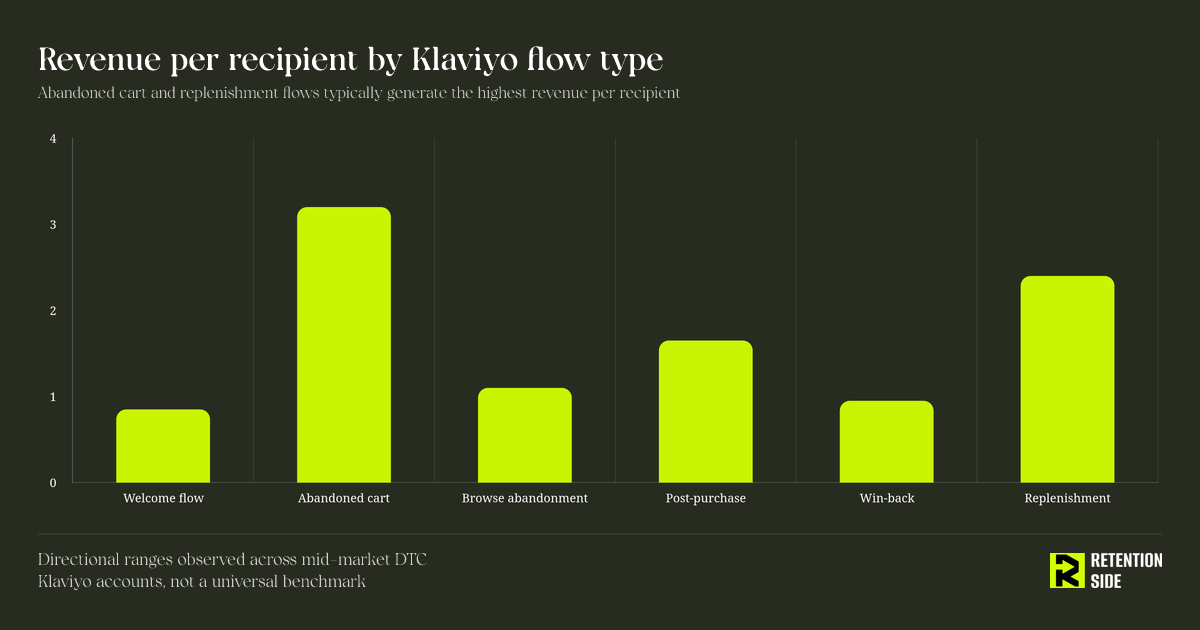
Notice that browse abandonment sits well below cart abandonment. That’s expected. Someone who added a product to cart has expressed stronger intent than someone who viewed a product page. But a lot of brands either skip browse abandonment entirely or treat it identically to cart abandonment, which wastes the lower-intent signal by pushing too hard, too fast. The flow should exist, but the messaging and incentive strategy inside it need to match the weaker intent signal.
The metrics that actually diagnose flow health
Open rate and click rate tell you almost nothing about whether a flow is doing its job. They tell you whether the email arrived somewhere a person could see it and whether the subject line and preview text worked. They don’t tell you whether the flow is converting.
Revenue per recipient (RPR) is the metric that matters for flow diagnosis. It captures the full picture: how many people entered the flow, what they were shown, and how much revenue came out the other end. When RPR drops on a flow that used to perform well, it’s a signal to investigate, not a signal to panic and rewrite the whole sequence.
Conversion rate per email in the sequence matters too, especially for multi-email flows like abandoned cart or post-purchase series. If email one in a three-part cart abandonment flow is converting well but email three is barely moving revenue, that’s useful diagnostic information. It might mean the incentive in email three isn’t strong enough, the timing is off, or the audience has already decided not to buy and email three is reaching people who were never going to convert regardless of content.
Placed order rate from the flow, unsubscribe rate at each step, and spam complaint rate by flow are the secondary metrics we watch closely. A flow with high engagement but rising complaint rates over time usually signals frequency fatigue, not a content problem, and the fix is spacing or exit conditions, not a copy rewrite.
Segmentation inside flows is where most revenue gets left on the table
A flow is not a single email sequence sent identically to everyone who triggers it. The brands seeing the strongest flow revenue treat each flow as a segmented experience layered on top of the trigger event.
Take cart abandonment as the clearest example. A first-time visitor who abandoned a $40 cart behaves differently than a repeat customer who abandoned a $200 cart. The messaging, incentive strategy, and even send timing should reflect that difference. Splitting cart abandonment by new versus returning customer, or by cart value tiers, is one of the highest-leverage changes we make in flow rebuilds because it lets you protect margin on high-intent repeat buyers while still using incentives where they’re actually needed to convert first-time, price-sensitive visitors.
Product category is another underused segmentation layer. A skincare brand sending the same browse abandonment content to someone who viewed a $22 cleanser and someone who viewed a $95 serum is missing an obvious opportunity to tailor social proof, ingredient education, or bundling logic to the actual product and price point in question.
This is also where Klaviyo’s flow filters and conditional splits earn their keep. Instead of building five near-identical flows, build one flow with conditional branches based on customer profile properties, purchase history, or predicted metrics like customer lifetime value. It’s more work upfront but far easier to maintain and test over time than five parallel flows drifting out of sync with each other.
Timing and cadence decisions inside flows
Default Klaviyo timing is a starting point, not a strategy. The default one-hour, twenty-four-hour, seventy-two-hour cart abandonment cadence works reasonably well as a baseline, but it’s rarely the optimal spacing for every brand and every price point.
Higher consideration purchases, think furniture, mattresses, or higher-ticket beauty devices, usually benefit from a longer runway between emails because the customer needs more time and more information before deciding. Impulse categories, like snacks, apparel basics, or accessories, often convert better with tighter spacing because urgency and immediacy matter more than deliberation.
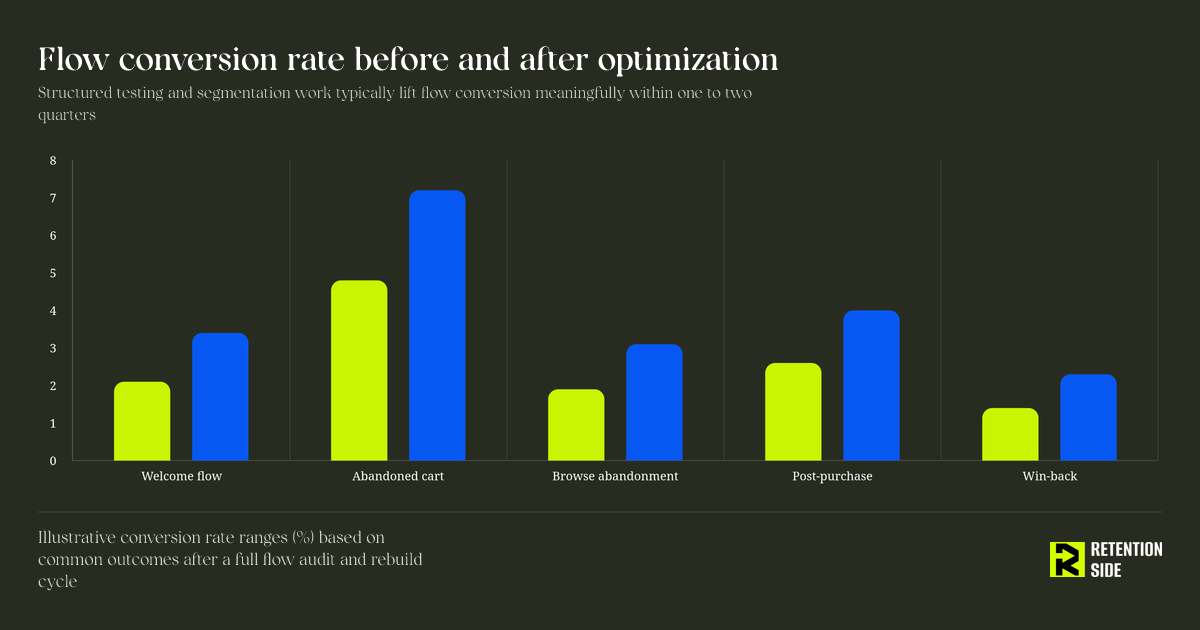
The same logic applies to win-back and sunset flows. A win-back flow that fires at 60 days of inactivity for a brand with a 45-day average repurchase cycle is targeting people too early, before they’ve actually gone cold. That flow will underperform not because the content is weak but because the timing doesn’t match the real purchase cycle. Pull actual repurchase cycle data from Klaviyo or your order platform before setting win-back and sunset triggers. Guessing at these windows is one of the most common and most fixable mistakes we see.
Deliverability will quietly cap your flow revenue
We say this in nearly every piece of content we write because it’s true and because operators consistently underweight it: if the email doesn’t reach the inbox, none of the optimization work above matters. Delivery and deliverability aren’t the same thing. Delivery means the mail server accepted the message. Deliverability means it landed somewhere a person will actually see and engage with it, not buried in spam or filtered into a promotions tab nobody checks.
Flows are especially vulnerable to deliverability problems because they’re evergreen. A campaign with a deliverability issue affects one send. A flow with a deliverability issue quietly suppresses revenue every single day, for every new subscriber who enters it, often for months before anyone notices because the flow “looks fine” in the Klaviyo dashboard. Open rate can look acceptable while a meaningful share of sends are landing in spam and simply not being counted as opens because the recipient never saw the email at all.
If flow RPR has been declining gradually across multiple flows at once, and it’s not explained by a segmentation or timing change you made, check sender reputation, authentication records (SPF, DKIM, DMARC), and complaint rates before rewriting flow copy. This is especially relevant given how Gmail and Yahoo have tightened bulk sender requirements over the past few years. A content fix applied to a deliverability problem won’t move the number, and it wastes a testing cycle that could have gone toward something that actually matters.
A practical testing framework for flows
Flow testing needs a different rhythm than campaign testing. Campaigns generate data fast because you’re sending to a full segment at once. Flows accumulate data slowly because they only fire as customers hit the trigger event, which means a low-traffic flow like a sunset sequence might take months to reach a statistically meaningful sample size on a subject line test.
A few principles we apply:
- Test one variable at a time within a flow, and let it run long enough to reach a meaningful sample before calling a winner. For low-volume flows, this might mean testing for six to eight weeks, not six to eight days.
- Prioritize testing on high-volume, high-RPR flows first. Abandoned cart and welcome series generate data faster than win-back or sunset flows, so they’ll surface reliable results sooner and usually carry more total revenue at stake.
- Test structural elements before cosmetic ones. Testing send timing, number of emails in the sequence, or incentive structure tends to move revenue more than testing button color or hero image. Save cosmetic testing for after structural questions are settled.
- Separate testing for new versus existing customers. An incentive that works well for converting a first-time cart abandoner might actively hurt margin if applied identically to a repeat customer who would have purchased at full price anyway.
- Document results somewhere durable. Flow tests get forgotten if the only record lives inside a Klaviyo test that gets archived. Keep a running log of what was tested, what won, and why, so the next person working in the account (including future you) isn’t repeating tests from eighteen months ago.
Flows don’t all need to drive direct revenue
Not every flow exists to sell something in the next email. A shipping delay flow, a review request flow, a loyalty points reminder, or a first-purchase onboarding sequence might generate little or no direct attributed revenue while still protecting the customer relationship in ways that show up later in repeat purchase rate and lifetime value.
We see brands cut these flows during “optimization” exercises because they don’t show revenue in the flow report, then wonder why support tickets go up or why review volume drops. Judge each flow against its actual job. A flow built to reduce support inquiries about shipping should be judged on support ticket deflection, not revenue per recipient. A flow built to collect zero-party data through a preference quiz should be judged on data capture rate and how that data improves segmentation downstream, not on whether it directly sold a product in the moment.
Where flows fit inside the bigger retention system
Klaviyo flows are usually the first retention system a brand builds, and for good reason: they’re behavior-triggered, they run without daily management, and email remains the most cost-efficient channel most brands have access to. But flow optimization has a ceiling. Once your flows are well-segmented, well-timed, and deliverability is solid, the next gains often come from expanding the channel mix around those flows rather than continuing to squeeze the same email sequences.
SMS flows running in parallel to email, particularly for cart abandonment and shipping updates, can recover revenue from subscribers who don’t check email as often but respond quickly to a text. Push notifications can catch browser-based intent that never made it into an email list at all. For higher-AOV brands, direct mail can extend win-back efforts to customers who’ve gone fully unresponsive across digital channels. We go deeper into how to sequence these channels based on audience behavior and cost efficiency in our piece on what channels make a good eCommerce retention strategy, which is worth reading once your Klaviyo flows are in solid shape and you’re deciding what to build next.
This is also the point where a lot of internal teams and generalist agencies plateau. Flow revenue optimization inside Klaviyo is a specific skill set, and it’s different from the skill set needed to decide when a brand should add SMS, when direct mail makes sense for win-back, or how to sequence WhatsApp for markets where it’s the dominant messaging channel. Retention Side approaches Klaviyo flows as the foundation of a retention system, not the entire system, which is part of why flow work here is usually paired with a broader look at deliverability health, list quality, and channel mix rather than treated as an isolated project.
Common mistakes that quietly suppress flow revenue
A few patterns show up again and again in accounts we inherit:
- Running incentives in every flow by default. If the welcome series, cart abandonment, and win-back flow all offer the same 15% discount, you’re training subscribers to wait for a flow trigger instead of buying at full price, and you’re compressing margin across your highest-intent moments.
- No exit conditions between flows. A customer who just purchased shouldn’t still be sitting in an active cart abandonment flow for the item they bought. Overlap like this creates confusing, sometimes contradictory messaging and quietly erodes trust.
- Ignoring flow-level suppression for engaged campaign buyers. If someone just converted from a campaign, make sure flows respect that so you’re not sending a redundant cart reminder for a purchase already completed.
- Treating the welcome flow as “done” after launch. Welcome flows set the tone for the entire subscriber relationship and deserve regular testing on offer structure, email count, and cadence, not a one-time setup.
- Never revisiting flow entry criteria. As list growth sources and audience mix change, the type of person entering your flows changes too. Entry criteria set two years ago for a very different audience may no longer match who’s actually signing up today.
Conclusion
Klaviyo flow revenue optimization isn’t a one-time project you finish and move past. It’s an ongoing discipline built on solid coverage across the customer journey, segmentation that respects different customer intents, timing based on real purchase cycles rather than defaults, and a deliverability foundation strong enough that your optimization work actually reaches an inbox. Layer in a structured testing rhythm and a habit of reviewing flow performance quarterly, and flows become the most consistent, efficient revenue channel most eCommerce brands have.
The brands that keep growing flow revenue year over year aren’t the ones with a clever one-off tactic. They’re the ones who treat flows as a system that gets reviewed, tested, and rebuilt as the business and audience change, and who understand that email flows are the starting point for a broader retention system, not the finish line.