


Supplement and wellness brands sit on the best retention economics in eCommerce and the most constrained channel environment at the same time. Consumable products with a predictable usage cycle should be the easiest category to build a durable email program around. Instead, most operators find that the category punishes generic playbooks faster than almost any other vertical, because the thing that makes supplements structurally attractive for retention, the ~30-day repurchase cycle, collides with a compliance layer that other categories never have to think about.
That collision is the actual subject of this article. Not “email best practices for supplements,” which is mostly the same advice as every other vertical with a different logo pasted on top, but the specific ways this category changes how you write copy, time flows, and measure success. If you run retention for a supplement or wellness brand doing real volume, the four-pillar framework we use across eCommerce, deliverability, list growth, flows, and campaigns, still applies. What changes is the constraints inside each pillar.
What you’ll learn in this article
- Why the FTC and FDA treat supplement email copy differently than almost any other product category, and what that means for subject lines, claims, and CTAs
- How the 30-day replenishment cycle should reshape your flow timing, from post-purchase through win-back
- Why the first reorder, not the first purchase, is the real retention battleground in this category
- Where trust-building has to do more work in welcome sequences than in most other verticals
- How to coordinate lifecycle email with subscribe-and-save mechanics
- Which metrics actually indicate health in a fast-cycle consumable category, and which ones lie to you
The compliance layer no other vertical carries
Most eCommerce categories treat legal review as a formality. Supplements and wellness products don’t get that luxury, and treating compliance as an afterthought here is how brands end up with FTC letters instead of repeat customers.
The FTC Health Products Compliance Guidance, published in December 2022 to replace the outdated 1998 supplement advertising guide, explicitly defines “advertising” to include promotional materials and digital content, which means your Klaviyo campaigns, flow copy, and even abandoned cart subject lines fall under the same scrutiny as a television ad. Any health benefit or safety claim you make needs to be backed by competent and reliable scientific evidence, not customer anecdotes or internal confidence. The FTC has brought more than 200 enforcement actions since 1998 involving false supplement and health claims, and liability doesn’t stop at the brand. Agencies, distributors, retailers, and even endorsers can be named in an action, which is exactly why your email partner needs to understand this space rather than treat it like a generic DTC account.
Layered on top of that is the FDA’s structure-function framework under DSHEA. You’re allowed to say a product “supports normal joint function” or “supports healthy digestion,” but only with substantiation on file, a notification filed with the FDA within 30 days of first marketing the claim, and a mandatory disclaimer stating the claim has not been evaluated by the FDA and that the product isn’t intended to diagnose, treat, cure, or prevent disease. Cross that line into a disease claim, “reverses insulin resistance,” “cures anxiety,” and the product legally becomes an unapproved drug. That’s not a copywriting nuance. That’s the difference between a defensible marketing program and a federal problem.
Worth noting for currency: in December 2025 the FDA indicated it would exercise enforcement discretion on the requirement that the DSHEA disclaimer appear on each individual advertising panel while it considers amending the underlying regulation. The disclaimer itself isn’t going away. The placement rule is what’s under review. Don’t read that as a green light to drop the disclaimer from your flows.
And underneath both of those sits plain CAN-SPAM law, which applies to every commercial email regardless of company size, with no B2B exception. Each violating email can carry penalties up to $53,088, and the requirements aren’t exotic: accurate headers and subject lines, a valid physical postal address, opt-outs honored within 10 business days. Both the brand and the sending agency carry responsibility here. If your current email partner has never mentioned any of this to you, that’s a signal worth paying attention to.
The “educate, don’t claim” copy model
Once you accept the compliance layer as a real constraint rather than legal noise, it changes how you actually write. The brands that perform well in this category aren’t the ones that found a clever way around the rules. They’re the ones that built a copy model where education does the selling that outcome promises would otherwise do.
Practically, that means leading with ingredient mechanisms instead of results. Instead of “finally sleep through the night,” you explain what magnesium glycinate does and why it’s dosed the way it is, then let the customer draw their own conclusion. Instead of “clear skin in 30 days,” you talk about what zinc and the specific botanical blend are formulated to support, with the required disclaimer doing its job quietly at the bottom. This isn’t a workaround. It’s a genuinely different sales mechanism, and it tends to build more durable trust than promise-driven copy anyway, because customers in this category have been burned by overclaiming brands before and are quietly skeptical by default.
Reviews and testimonials still work, but they need the same scrutiny as your own copy. A customer review that says “cured my anxiety” and gets featured in your email without commentary is your brand’s claim now, not just theirs. The safer pattern is curating reviews that describe experience and sensation rather than medical outcomes, and adding context where needed.
The operational fix most brands skip: a claims-check pass on every subject line and CTA before it ships, not just the body copy. Subject lines get written fast and reviewed loosely because they feel like a minor detail. In this category they’re not. “Reverse your gut issues in a week” as a subject line is a bigger liability than the same phrase buried in paragraph three, because it’s the most visible, most screenshotted line in the entire email.
The 30-day clock: replenishment dictates flow architecture
Here’s where the category’s compliance burden gets balanced out by a genuine structural advantage: the repurchase cycle is short and predictable. Recharge’s analysis of over 20,000 subscription brands found that 53.7% of supplement replenishment reorders land within two days of the 30-day mark, making it the most forecastable reorder cadence of any consumable category measured. That predictability should be driving your flow timing far more precisely than it currently does in most accounts.
Map this onto the four-pillar structure. Deliverability and list growth work the same way they do everywhere else, that part of the framework doesn’t change. Flows are where the category logic kicks in. Post-purchase education needs to be timed to the actual usage cycle, not a generic template: day 0-1 confirms the order and sets expectations, day 2-5 teaches proper usage and dosing (this is where structure-function language matters most), day 7-10 introduces replenishment and cross-sell once the customer has had time to form early impressions, day 14-21 asks for a review once they’ve had a real usage window, and day 18-25 opens the second-purchase bridge before the 30-day mark hits.
Win-back timing is the clearest example of category-specific thinking done right. For products with repurchase cycles under 60 days, supplements and other consumables, a win-back flow triggered at 45 days is doing its job correctly, not the 90-to-120-day windows that make sense for apparel or home goods. Wait for the generic benchmark window and you’re re-engaging someone who already lapsed weeks ago and may have already ordered from a competitor or just stopped taking the product. Expected unsubscribe rates for a well-built win-back flow in this window sit around 0.25-0.50%, which tells you the timing isn’t aggressive, it’s appropriate.
The leaky first reorder: the real battleground
This is the single most important data point for anyone running retention in this category, and it reframes where you should be spending your attention.
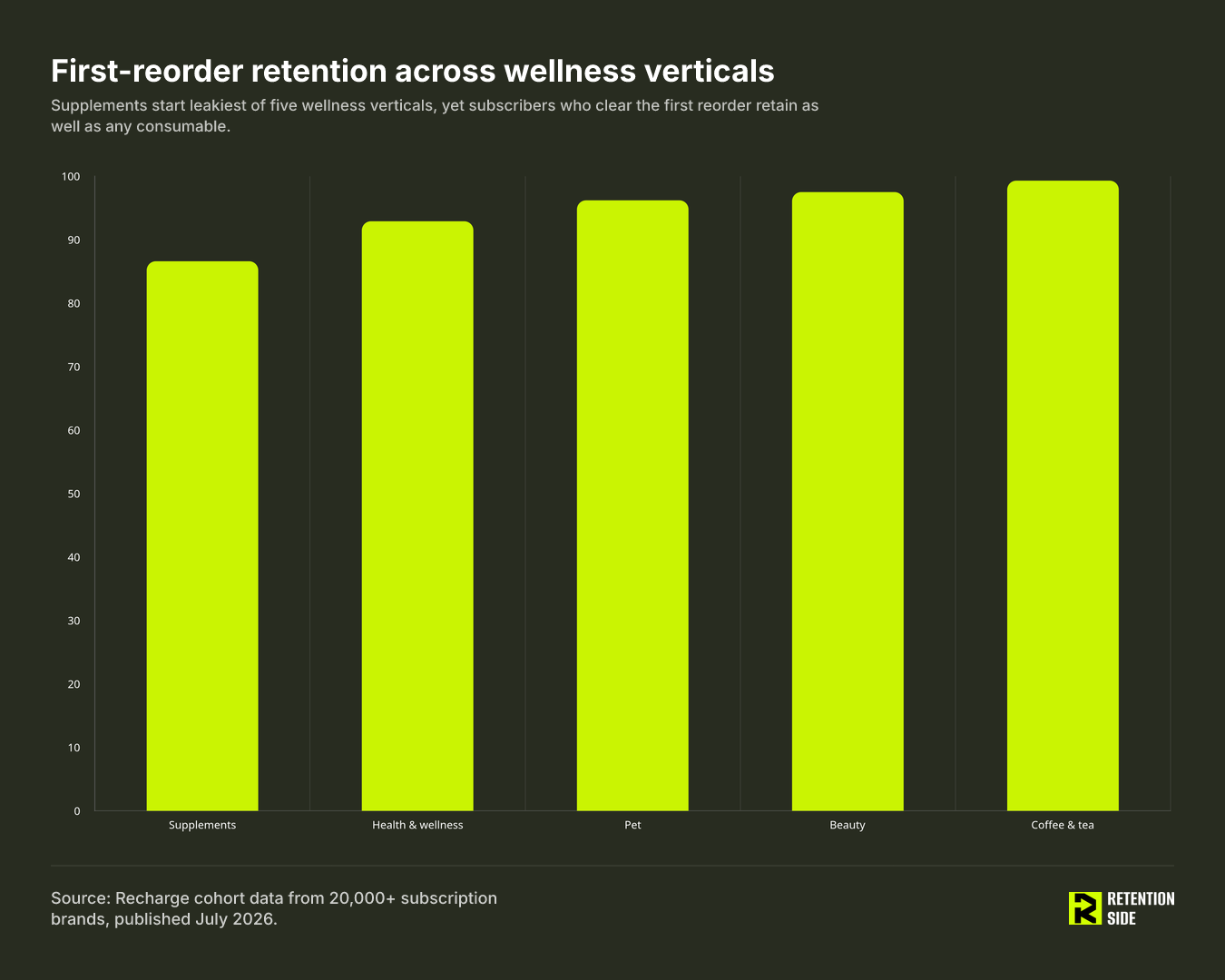
Recharge’s cohort data across more than 20,000 subscription brands shows supplements have the leakiest first reorder of any wellness vertical measured. Only 86.6% of first-time supplement subscribers complete a second order, compared to 92.9% for health and wellness, 96.2% for pet products, 97.5% for beauty, and 99.3% for coffee and tea. Supplements start behind every comparable consumable category.
But here’s the part that should actually change your strategy: customers who clear that first reorder retain about as well as any other consumable category, and the curve flattens sharply after the third reorder. First reorder 86.6%, second reorder 57.6%, third reorder 33.8%, and by the sixth reorder it’s down to 9.8%, ninth reorder 3.7%, twelfth reorder 1.4%. The steepest drop by far happens right at that first reorder threshold. Everything after reorder three is comparatively stable.
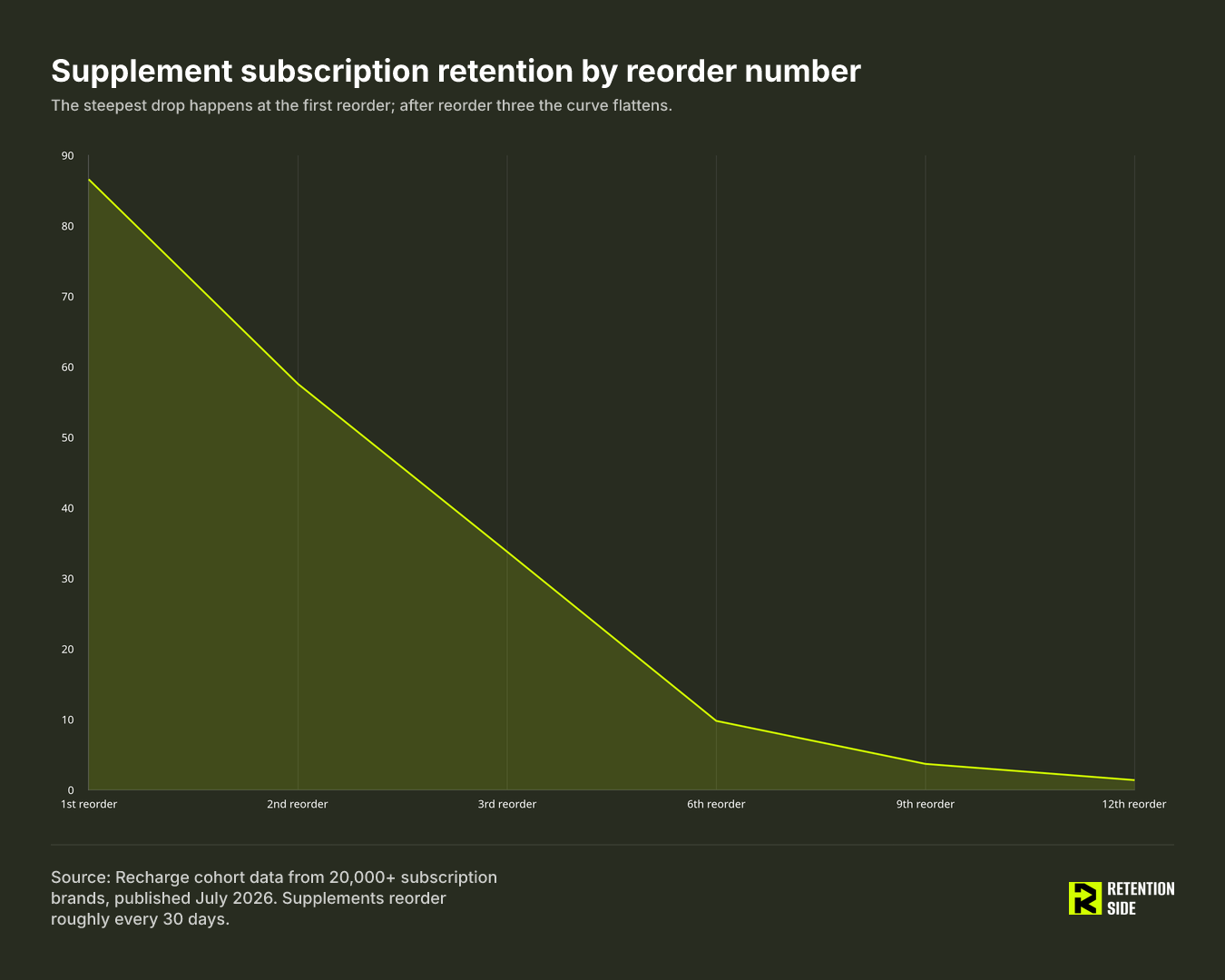
That data point should reorganize your entire retention roadmap. The post-purchase window, the one most brands treat as a light-touch confirmation sequence, is actually the highest-leverage moment in the supplement customer lifecycle. This is exactly why the post-purchase flow architecture matters more here than in almost any other category: the education phase builds the habit, the habit produces the second order, and the second order is what determines whether this customer becomes a long-term subscriber or a one-time buyer who churns before the product even runs out.
Trust as the conversion mechanism
Because customers in this category are inherently more skeptical of health claims, and because the compliance layer limits how directly you can promise outcomes, your welcome sequence has to do more trust-building work than in almost any other vertical. A fashion brand’s welcome flow can lean on aesthetics and social proof. A supplement brand’s welcome flow needs to answer “why should I trust this company with something I’m putting in my body” before it asks for a sale.
That means sourcing and manufacturing transparency (where ingredients come from, how the product is made), third-party testing results where they exist, and a founder or brand story that explains the “why” behind the formulation. This content needs to come before the promotional push, not alongside it. A new subscriber who gets a discount code in email one and a health claim in email two hasn’t been given a reason to believe you yet.
Zero-party data collected at signup, health goals, specific concerns, current supplement stack, lets you segment welcome content by what the customer actually cares about rather than sending the same generic sequence to someone interested in sleep support and someone interested in joint health. This ties directly into broader DTC segmentation strategy: the six core segments that matter for most eCommerce brands apply here too, but health-goal segmentation is an added layer that’s specific to wellness, and it’s one of the highest-leverage list growth investments a supplement brand can make.
Email x subscription interplay
Most supplement brands run subscribe-and-save alongside one-time purchase, and the email program needs to actively coordinate with that subscription layer rather than operate as a separate channel.
Pre-refill nudges timed to that 30-day cadence give customers a heads-up before the charge hits, which reduces surprise cancellations and support tickets far more effectively than reacting after the fact. Save-rate and churn-save messaging deserves its own flow logic, distinct from a standard cart abandonment or browse abandonment sequence, because the intent signal is different: someone canceling a subscription they’ve already used is a different problem than someone abandoning a first-time cart. And win-back specifically for cancelled subscribers, as opposed to lapsed one-time buyers, should acknowledge that history rather than pretending it’s a cold lead.
Given that over half of supplement reorders land within two days of the 30-day mark, this is one of the cheapest optimization opportunities available in the category. The timing precision is already handed to you by the data. Most brands just aren’t using it.
What doesn’t change
It’s worth being direct about this: none of the above replaces the fundamentals. Deliverability is still the floor everything else sits on. If your emails aren’t reaching the inbox, none of this compliance nuance or timing precision matters, because the message never arrives. List hygiene still governs sender reputation. And the flow-versus-campaign economics that hold across all of eCommerce hold here too.
Klaviyo’s 2026 benchmark data, drawn from more than 183,000 brands, shows automated flows generate roughly 41% of total email revenue from just 5.3% of total sends, with about 18 times higher revenue per recipient than campaigns, roughly triple the click rate, and about 13 times the placed-order rate. Nearly half of flow revenue comes from new buyers, which reinforces why the welcome and post-purchase sequences carry so much weight in this category specifically. Supplements don’t get an exception from this pattern. If anything, the short repurchase cycle makes flow automation even more valuable, because the behavioral triggers (first purchase, usage milestones, approaching reorder date) repeat every 30 days instead of every 6 months.
Metrics that matter in this category
Generic eCommerce benchmarks will actively mislead you here, and this is worth internalizing before you compare your numbers to a cross-category dashboard.
A 22% 90-day repeat purchase rate might be acceptable, even solid, for a fashion brand. In supplements, that same number represents a serious retention problem, because the category’s replenishment cycle means a healthy customer should be back well before the 90-day mark, not barely clearing a quarter of your list once. The returning customer rate benchmark for supplements needs to be judged against that higher floor, not against cross-vertical averages. Consumable categories overall, supplements, beauty, and food, run 365-day repeat purchase rates of 45-55%, well above the 20-25% typical of home goods or electronics, and roughly double the 28.2% cross-vertical average. If your numbers are tracking closer to the general eCommerce average than the consumables average, that’s a diagnostic flag, not a category quirk.
Flow placed-order rate deserves particular attention given how much of the category’s revenue should be running through automation rather than campaigns. And when performance dips, the diagnostic order still matters more than the instinct to blame the newest campaign: check deliverability first, then list health, then flow coverage, then creative and offer. A drop in supplement email performance is just as likely to trace back to a deliverability issue or a stale segment as it is to weak copy, and skipping straight to a copy rewrite when the real problem sits upstream wastes time you don’t have in a 30-day cycle.
Where this leaves supplement and wellness operators
The category rewards precision more than almost any other vertical in eCommerce, and punishes generic execution faster too. The compliance layer forces a copy model built on education rather than promises. The 30-day cycle demands flow timing that’s tighter than standard benchmarks suggest. And the leaky first reorder means the post-purchase window, not the welcome discount or the win-back flow, is where most of the real money gets made or lost.
None of that changes the underlying system. Deliverability, list health, flows, and campaigns still govern outcomes the way they do for any eCommerce brand. What changes is how much precision each pillar demands once you’re operating on a cycle this short, with constraints this specific. Brands that treat supplement email like a generic Klaviyo build tend to plateau early. The ones that build around the actual shape of this category, the compliance reality, the replenishment clock, and the first-reorder cliff, are the ones that turn a structurally strong category into an actual retention advantage.