

Most ecommerce brands have a welcome series. A discount code lands in the first email, maybe a second email follows up a day later, and that is about as far as the architecture goes. The series exists, technically, but it was designed to tick a box – not to do a job.
The welcome series is the highest-leverage automation in your entire email program. It runs during the only window in the subscriber relationship where engagement is at its natural peak – before habituation, before inbox conditioning, before the subscriber has filed your brand mentally into the “promotional noise” category. What you do with that window defines a large portion of your eventual lead-to-customer conversion rate.
This article goes into what a properly built welcome email series looks like for ecommerce brands: the strategic intent behind each stage, how to structure the sequence, how to use zero-party data to make it meaningfully personal, what testing actually moves the needle, and how the welcome series connects to the broader retention system it feeds into.
Key takeaways
- The welcome series is not just a discount delivery mechanism – it is the first real conversation you have with a new subscriber, and it happens during the highest-engagement window that relationship will ever have.
- The goal is not to close every subscriber on the first email. It is to give people with genuine purchase intent enough reasons to buy before that intent naturally cools.
- Sequence length, timing, and content should reflect your product category, your average customer’s decision complexity, and how much your subscriber already understands about your brand.
- Zero-party data collected at signup is the single biggest unlock for welcome series personalization – and it should be built into the architecture from the start, not retrofitted later.
- Welcome-to-first-purchase conversion rate is the metric that tells you whether the flow is working. Not open rate. Not click rate.
- A welcome series is never finished. It requires the same continuous testing discipline that your campaigns do.
What we’ll cover
- Why the welcome series is your highest-leverage flow
- The strategic intent behind a welcome series – what it is actually trying to accomplish
- Sequence structure: how many emails, what order, what timing
- Email-by-email breakdown: what each email should do
- Zero-party data and personalization in the welcome series
- Incentive logic: when to discount, when not to, and how much
- Segmentation inside the welcome series
- Testing what actually moves conversion rate
- The metrics that tell you whether it is working
- How the welcome series connects to the rest of your retention system
Why the welcome series is your highest-leverage flow
Subscriber engagement follows a decay curve that begins the moment someone joins your list. On day one, that person just interacted with your brand and chose to give you their email address. Their consideration is warm. Their memory of why they signed up is fresh. They have not yet learned to skip your subject lines.
That engagement level will not return – not through campaigns, not through re-engagement sequences, not through anything you do later. The only way to get the equivalent of that attention again is to acquire a new subscriber.
VerticalResponse research confirms that new leads are most engaged within the first 48 hours of subscribing – a pattern that holds consistently across industries and list sizes. According to Campaign Monitor, welcome emails generate read rates 42% higher than the average email, and 74% of consumers expect to receive a welcome email the moment they subscribe.
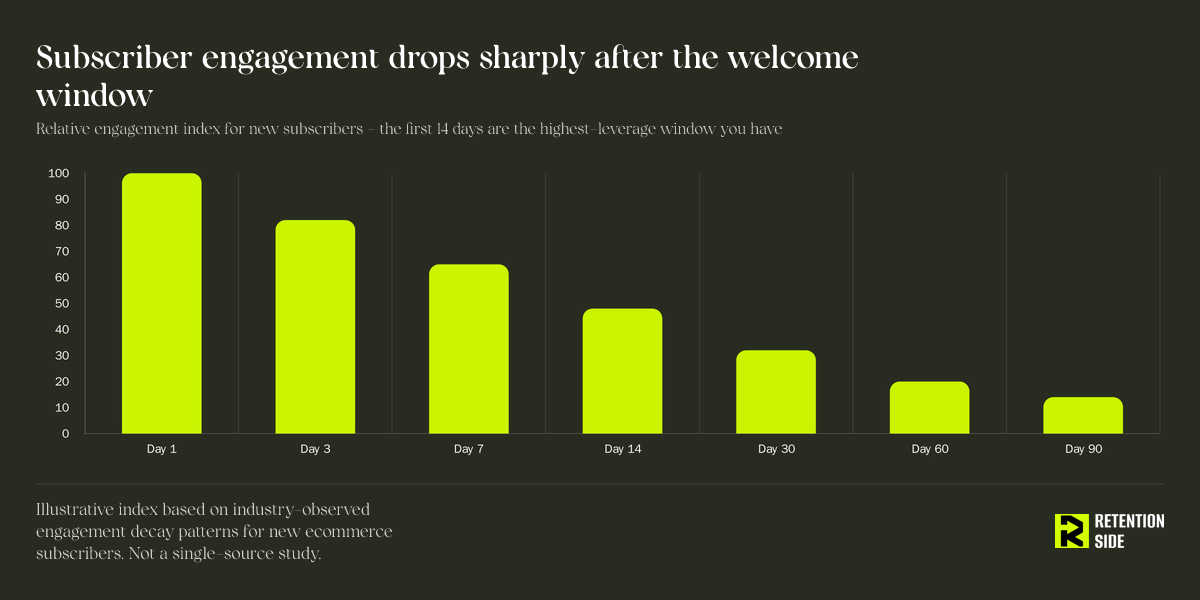
What this means practically: every email you send in the first 10-14 days after signup lands in a fundamentally different context than emails sent to a subscriber who has been on your list for six months. The first email has a real shot at reaching someone who is still actively thinking about your brand. The sixth campaign they receive three months from now is competing with months of inbox conditioning.
This is why the welcome series is your highest-leverage flow – not because it is technically sophisticated, but because it operates during a window nothing else can replicate. The investment of time and testing you put into this flow pays compound returns for every new subscriber who joins the list, indefinitely.
Most ecommerce brands do not treat it this way. They build a serviceable welcome series at launch and leave it untouched for 18 months. Meanwhile, the abandoned cart flow gets ongoing attention, campaigns get A/B tested, and the welcome series keeps running the same copy, the same timing, and the same incentive structure it launched with.
What the welcome series is actually trying to accomplish
Understanding the real job of a welcome series changes how you build it.
The obvious job is to convert subscribers into first-time buyers. But framing it only as a conversion sequence misses the layer underneath: the welcome series is also building the subscriber’s mental model of your brand. What do you stand for? Why are your products worth paying attention to? What kind of emails should they expect from you going forward?
If the welcome series does nothing but push a discount, you have communicated something specific to the subscriber: this brand sends discount emails. That mental model then shapes how they interact with everything you send afterward. Full-price emails from that point forward are swimming against a current the welcome series itself created.
A welcome series that works at the retention level – not just the conversion level – does a few things simultaneously:
It delivers on the signup promise cleanly. Whatever you offered at the form (a discount, early access, a guide, a quiz result) needs to arrive immediately and unambiguously in the first email. This is the trust-building moment. A clunky delivery, a broken code, or a discount that requires awkward steps poisons first impressions in a way that copy can’t fully recover.
It establishes a reason to stay even if the subscriber doesn’t buy immediately. A new subscriber who doesn’t convert in the first 10 days is not necessarily a lost cause. But they will stop paying attention to your emails if nothing in the welcome series gave them a reason to care about the brand beyond the offer. The series that is purely transactional (“here’s your code, here’s a reminder, time is running out”) has nothing to hold a non-converter’s attention after the discount logic runs out.
It sets expectations about the kind of emails you send. A welcome series that mixes value-driven content with commercial intent signals to the subscriber that your brand is worth having in their inbox, not just worth using for a one-time discount. That matters enormously for long-term list health and deliverability. Research from Litmus shows that 46% of unsubscribes are driven by irrelevant or non-personalized content – a direct consequence of welcome series architecture that never established a meaningful reason to stay.
It opens a personalization dialogue. The signup moment and the first few emails are your best opportunity to collect preference data from a subscriber who is actively paying attention. That data shapes every subsequent communication – welcome series, future flows, and campaigns – if you build the collection architecture properly.
Sequence structure: how many emails and when
There is no universal welcome series length that is correct for every ecommerce brand. The right structure depends on three things: the complexity of the purchase decision, the price point, and how much the subscriber already knows about your brand before they signed up.
A brand selling a $35 personal care product to warm traffic from a well-known Instagram following can convert a meaningful share of subscribers through a tight 3-email series. A brand selling a $180 nutritional supplement to cold traffic from paid social needs more time to build the case – the objections are different, the trust threshold is higher, and the decision is more considered.
As a working framework:
3 emails (5-7 days): Appropriate for lower-price-point products, simple product categories, and audiences that are already warm to the brand. The sequence needs to be tight because there is less real estate for narrative development.
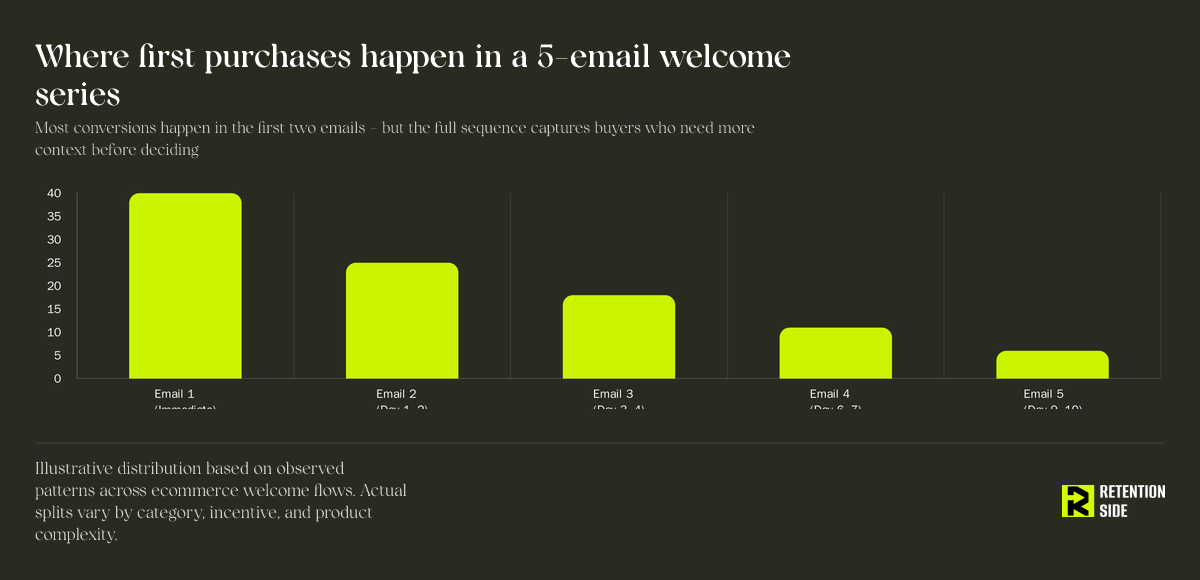
4-5 emails (8-12 days): The range that works for most DTC brands. Enough space to establish brand voice, communicate value, address objections, show social proof, and run a final urgency send – without overstaying the welcome window.
5-7 emails (10-15 days): Suitable for higher-ticket products, complex supplement stacks, skincare regimen brands, or any category where the customer’s decision involves real deliberation. Each email earns its place by doing a specific job.
On timing: the first email should send immediately on signup. Not “within an hour.” Immediately. The subscriber’s attention is freshest in the first minutes after they gave you their email address. Delays beyond 15-20 minutes are measurable drop-offs in engagement.
After the first email, spacing of 1-2 days between sends is appropriate for most brands. Tighter than 24 hours can feel aggressive. Longer than 3 days loses the continuity of the conversation.
Email-by-email breakdown
Email 1: deliver the promise, set the tone (send immediately)
The first email has one primary job: fulfill the signup promise cleanly and set the subscriber’s expectation for what comes next. If you offered a 10% discount, the code needs to be prominent, clear, and working. If you offered early access to a product, that access needs to materialize. If you offered a quiz result or a personalized recommendation, it needs to appear here.
Beyond delivering the offer, email 1 is doing something equally important: establishing brand voice. The subscriber just joined because something about your brand or your offer caught their attention. This first email is your chance to confirm that instinct – or to immediately disappoint it with a generic, template-looking message that could have come from any brand in your category.
Keep it focused. The first email is not the place to tell your entire brand story, show your full catalog, and explain your loyalty program. It is the place to (a) deliver what you promised, (b) give one clear reason to use the offer now, and (c) create enough curiosity about what is coming next to earn the second open.
Email 2: brand story and reason to believe (day 1-2)
By the second email, the transactional part of the welcome is done. Now you are doing the work of building genuine purchase intent in the subscribers who didn’t convert immediately.
Email 2 is the brand story email. Not a polished corporate history – a direct explanation of why this brand exists, what problem it solves, and what makes the product or approach meaningfully different from alternatives the subscriber could easily find. This is where you give the subscriber the “why” that transforms casual interest into consideration.
The mistake brands make here is writing from the inside out – what the founder cares about, the sourcing story, the certifications. All of that is potentially interesting, but it needs to be framed around the subscriber’s problem and the brand’s solution to it. Brand story emails that convert are ones that make the reader think “that’s why I should buy this and not something else.”
Email 3: social proof and credibility (day 3-4)
New subscribers who haven’t purchased yet are still in the trust-building phase. They want evidence that the product delivers on what the brand claims. Email 3 is the credibility email.
The most effective format here depends on your product and price point. For most DTC brands, customer reviews are the primary vehicle – specific, outcome-focused testimonials that reflect the subscriber’s own situation. “I tried three other products for the same problem” type reviews are worth a lot more than star ratings.
If you have press coverage, notable brand partnerships, clinical studies, or a meaningful community following, this is the email where those signals land with the most impact. The subscriber is already warm enough to care. They just need confirmation they are not making a mistake.
Email 4: education and use case (day 5-7)
This email exists for the subscriber who is genuinely interested but not yet convinced they know how to get value from your product. The job of email 4 is to reduce the friction of imagined complexity.
For supplement brands, this might be how to take the product and when. For skincare brands, it might be how to build a routine. For apparel brands, it might be a styling guide or a fit explainer. For any brand with a product that benefits from use-context clarity, this email does real work in closing the gap between “I like this” and “I know this will work for me.”
It also serves a secondary function: it signals to the subscriber that your brand is genuinely useful to have in their inbox, not just commercially motivated. An email that teaches something earns a different kind of engagement than one that asks for a purchase.
Email 5: urgency close (day 8-10)
The final email in a standard welcome series is the urgency close – typically a reminder that a time-limited offer is expiring, or a final nudge with a slightly stronger incentive if you have built that into your logic.
The mistake here is manufactured urgency that the subscriber knows is fake. “Hurry, your discount expires soon!” for a code that has been sitting in their inbox for 10 days, with no actual expiry, is a trust-degrading move that is noticeable to anyone paying attention. Genuine scarcity – a real deadline, a product that actually goes out of stock – converts better than implied urgency that does not have substance behind it.
If you are not using a hard expiry on your discount code (which is technically straightforward in Klaviyo), this email can take a different approach: a direct, no-frills question. “Did something stop you from trying us?” A short paragraph that acknowledges the subscriber has seen your emails but hasn’t bought, and asks them to reply if there is something specific holding them back. This approach occasionally surfaces objections you didn’t know existed – and the replies are genuinely useful data.
Zero-party data and personalization in the welcome series
Zero-party data is information your subscribers actively choose to share with you. Unlike behavioral inferences (which are probabilistic), zero-party data is explicit: you asked, they told you. For ecommerce brands, this is the difference between segmenting by assumed interest and segmenting by declared intent.
The welcome series is the most efficient place in your entire retention system to collect and activate zero-party data – because the subscriber is paying close attention and the ask carries low friction when it is presented as part of the signup experience.
The most common approach is a single qualifying question embedded in the form or the first email: “What is your primary goal?” or “What best describes your skin type?” or “What are you shopping for today?” One question. One explicit data point that immediately opens the door to a branched welcome series.
A branched welcome series means Email 3, 4, and 5 change based on what the subscriber told you at signup. The skincare brand subscriber who said “anti-aging” receives a different education email than the one who said “acne.” The supplement brand subscriber who said “weight management” receives different product recommendations than the one who said “energy and focus.” The messaging reflects what the subscriber actually told you about their situation.
The lift from this kind of personalization is not marginal. Experian’s email research found that personalized emails generate six times higher transactional rates than non-personalized emails. When an email’s content visibly reflects what a subscriber shared about themselves, it changes the relationship. It signals that you were listening – that this is not a broadcast system dressed up as something personal. That signal compounds over time as the subscriber continues to receive communications that feel relevant rather than generic.
The important note on implementation: zero-party data collection needs to be built into the welcome series architecture from the start. Retrofitting it into a program that already has thousands of profiles without the relevant custom properties is significantly more work than getting it right initially. For brands that are building or rebuilding their welcome series, this is the decision that pays forward into every other flow and campaign in the program. Our Klaviyo email marketing setup guide covers how to properly configure custom properties and flow triggers to support this kind of branched personalization architecture.
Incentive logic: when to discount, when not to, and how much
The discount-at-signup model is the default for most ecommerce brands because it demonstrably increases form conversion rate. More sign-ups per 100 visitors. More email addresses in the database. More subscribers entering the welcome series.
The problem is that “more sign-ups” and “more customers” are only correlated, not identical – and optimizing for one without watching the other is how brands end up with large lists that convert poorly.
The real question when evaluating your welcome incentive is not “what gets the most sign-ups?” It is “what incentive attracts subscribers who are likely to become customers, and does the math work at my margin?”
A 20% off welcome discount on a product with 35% gross margin leaves very little room. If those converted subscribers rarely return for a second purchase, the acquisition economics are deeply unfavorable – you have essentially paid for a customer who only came for the discount. The incentive has done something more like acquisition than retention.
There are situations where a discount is clearly the right call: categories where products are commoditized and price sensitivity is high, brands where competitors are freely offering welcome discounts and opting out creates a perceived disadvantage, or situations where the product genuinely needs to be tried once before the value is understood.
There are also many situations where a non-discount incentive works as well or better: early access to a new product drop for an audience that cares about exclusivity, a free sample or a product bundle threshold, a genuinely useful piece of content (a guide, a quiz result, a personalized recommendation), or a free shipping offer for categories where that is the actual conversion barrier. Research compiled by Invesp shows that welcome emails with offers can boost revenue by 30% per email compared to welcome emails without offers – but the type of offer matters as much as its presence.
The discipline is to treat your incentive as a variable to test, not a default setting to deploy once. The brands that have optimized their welcome incentive over time – testing offer type, percentage level, expiry timing, and delivery format – typically find there is real conversion difference between a carefully designed offer and the category default.
One additional principle: whatever incentive you use in the welcome series, your suppression logic in other flows needs to prevent the same subscriber from also triggering an abandoned cart discount, a browse abandonment offer, and a promotional campaign discount in the same two-week window. Stacked incentives train behavior in a way that is difficult to reverse.
Segmentation inside the welcome series
The welcome series is not a monolith. Even within a new subscriber cohort, there are meaningful differences in who is entering the flow and what they need to hear.
The most important branch point is whether the subscriber has already purchased before the welcome series finishes. This is more common than it sounds – particularly for brands with a strong paid social presence where a subscriber might see a retargeting ad and complete a purchase on day 2 of the welcome sequence. Continuing to send “reasons to buy your first product” emails to someone who already bought is a disjointed experience. Klaviyo’s flow filters let you exit customers from the welcome series once a purchase event fires – and that logic should always be in place.
The second meaningful branch is subscribers who came in through different acquisition sources. Someone who signed up after seeing a specific product featured in an Instagram ad has a different entry point than someone who found the brand through organic search and signed up from a blog post. These two subscribers are in different stages of brand familiarity, and the welcome series can reflect that if you are passing source data into Klaviyo as a custom property at signup.
The third branch is the zero-party data personalization described above – product interest, goal, preference type, or whatever qualifying question you use at signup. This is the branch that generates the most meaningful content differentiation within the sequence.
These branches do not need to be built all at once. A welcome series that exits buyers at purchase and uses one zero-party data split for email content is already significantly more sophisticated than one that sends the same five emails to everyone. You add branches as the program matures and as you have enough subscriber volume on each branch to test and learn.
Testing what actually moves conversion rate
Testing in the welcome series is not optional – it is what separates a welcome series that improves over time from one that calcifies. The welcome series has enough consistent traffic (every new subscriber enters it) to generate statistically meaningful test results faster than almost any other flow.
The variables worth testing, roughly in order of impact:
Incentive type and amount. Does a 10% discount outperform 15%? Does free shipping outperform a dollar-amount discount for your category? Does an early access offer produce a better lead-to-customer conversion rate even if it generates fewer sign-ups? These tests have downstream economics implications, so they are worth the investment to run properly.
Email 1 content and format. Subject line and preview text. The design approach (heavy visual template vs. plain-text-style). The placement and presentation of the offer. Whether a “welcome to the brand” message or a direct product pitch converts better for your specific audience.
Sequence timing. Does moving email 2 from day 2 to day 1 improve or hurt conversion? Does adding a gap between emails 4 and 5 produce better results than sending them one day apart? Timing tests are often underestimated – the same email at a different time can produce meaningfully different outcomes.
Sequence length. Does a 5-email series produce measurably better welcome-to-first-purchase conversion than a 4-email series? Or does adding the fifth email come at the cost of unsubscribes that hurt long-term list health? The answer varies by brand and category, and it is not obvious without testing.
Brand story angle. In the email 2 slot, does leading with founder story outperform leading with problem-solution framing? Does a video format outperform a text-and-image format for your audience?
Social proof format. Does a testimonial-led email (email 3) convert better with written reviews, star ratings with excerpts, before/after imagery, or press logos? The right format is category-specific.
The testing discipline that matters most: run one variable at a time, give each test enough time to reach statistical significance across a real subscriber cohort, and document the results somewhere that the next person who touches the welcome series can actually learn from. The compounding effect of consistent, documented welcome series testing over 12 months is substantial.
The metrics that tell you whether it is working
The welcome series has a clear primary metric: welcome-to-first-purchase conversion rate. What percentage of subscribers who enter the series make a first purchase within the flow window?
This is the number that tells you whether the flow is doing its core job. It accounts for everything – the incentive design, the copy, the sequence structure, the timing, the personalization. A higher conversion rate means more subscribers are becoming customers. A lower conversion rate means something in the flow is not working, and you need to diagnose where the drop-off is happening.
Track this at the aggregate level and at the individual email level. Aggregate tells you the flow’s overall health. Per-email conversion contribution tells you which emails are doing work and which ones are essentially dead weight.
What not to use as your primary success metric: open rate and click rate. These are diagnostic signals – useful for understanding whether subscribers are engaging with specific emails. They are not accountability metrics. A welcome series with a 60% open rate on email 1 but a 2% welcome-to-purchase conversion rate is not a successful welcome series. A flow with a more modest open rate that converts 8% of subscribers into first purchases is. For context on what first-purchase rates actually look like in practice, Litmus’s ecommerce email research puts the welcome stage first-purchase rate for well-built programs in the 10-25% range – a wide band that reflects just how much architecture and testing quality matter.
Lead-to-customer conversion rate for new list cohorts is the upstream metric that validates whether the welcome series is attracting the right subscribers in the first place. If the welcome-to-purchase rate is healthy but the list growth strategy is producing low-intent subscribers at scale, the flow is doing its job in difficult conditions – and the real fix is upstream at the sign-up form.
Unsubscribe rate within the welcome series window is worth monitoring as a health check. A spike in unsubscribes at a specific point in the sequence – say, between email 3 and email 4 – is useful information about pacing or content relevance at that stage.
How the welcome series connects to the broader retention system
The welcome series does not operate in isolation. It is the entry point into a lifecycle communication system, and the decisions you make inside it shape how the rest of that system works.
The most direct connection is to post-purchase flows. A subscriber who converts during the welcome series immediately exits the welcome flow and enters the post-purchase sequence. The handoff between these two flows needs to be clean. If the welcome series ends with “welcome to the family” and the first post-purchase email opens with a generic “thanks for your order,” you have a discontinuity that the subscriber will feel even if they cannot articulate why.
Designing the welcome-to-post-purchase handoff means ensuring the post-purchase sequence picks up the brand voice and the context that the welcome series established – including any zero-party data that was collected. A subscriber who identified themselves as a “beginner” during signup should not receive the same post-purchase education sequence as one who identified as “experienced.” That data should follow them through the entire lifecycle.
For subscribers who do not convert during the welcome series, the flow exit behavior also matters. What segment do they land in when the welcome sequence ends? Are they treated as engaged non-buyers who should receive standard campaign sends? Or do they enter a secondary nurture path that continues building the relationship at lower frequency?
The welcome series is also the first data-generating stage of the retention system. Every split test you run, every email-level conversion contribution you map, every zero-party data response you collect feeds into a clearer understanding of your subscriber base. That understanding informs segmentation across all flows, shapes campaign targeting logic, and gives you a real signal about what your acquisition channels are actually producing in terms of subscriber quality.
The brands that get the most out of their welcome series are the ones that treat it as a connected system component – not a standalone piece of automation that runs independently of everything else. That connection is what makes the retention program compound rather than plateau.
Conclusion
A welcome email series for ecommerce is not a technical setup task with a finish line. It is a living, testable, refineable system that runs during the most important window in the subscriber relationship – and its quality directly determines what percentage of your list ever becomes customers.
The brands that consistently get strong welcome-to-purchase conversion rates are not doing anything exotic. They have a clear understanding of what each email in the sequence is trying to accomplish, they have built zero-party data collection into the architecture from the start, they have incentive logic that balances conversion lift with margin protection, and they treat testing as a continuous practice rather than a launch activity.
The welcome series is also where the retention story begins. The brand voice established here, the expectations set, the personalization dialogue opened – all of it carries forward into post-purchase flows, campaigns, win-back sequences, and every other touchpoint in the customer lifecycle. Getting it right is not just about converting more first-time buyers. It is about building the kind of relationship from day one that makes second and third purchases natural rather than hard-won.
If your welcome series was set up at launch and hasn’t been meaningfully rebuilt since, that is where Retention Side typically starts when working with an ecommerce brand. The leverage is there. Most programs just haven’t claimed it yet.