


Most ecommerce brands already have Klaviyo installed. The Shopify app is connected, a welcome series was set up at some point, and there is probably an abandoned cart flow doing some recoveries in the background. But “installed” and “actually built” are two completely different things.
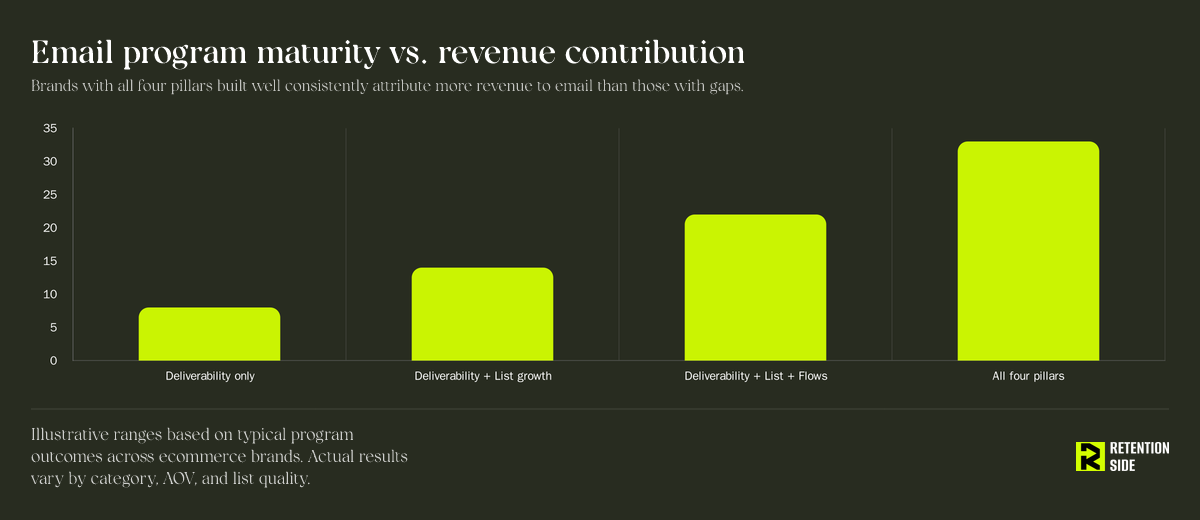
The brands generating the most revenue from this channel are not doing anything exotic. They have the infrastructure right: deliverability protected, list growing with quality subscribers, flows covering the full customer lifecycle, and campaigns running with real segmentation behind them. That combination is what makes Klaviyo compounding rather than just functional.
This guide covers what a properly built Klaviyo program looks like, why each layer matters strategically, and how to set up the pieces that most brands skip or under-build.
Key takeaways
- Klaviyo email marketing for ecommerce rests on four non-negotiable pillars: deliverability, list growth, automated flows, and campaigns. Each one affects the others.
- Deliverability is not a technical detail – it is the foundation. Without inbox placement, nothing else performs.
- The real KPI for list growth is lead-to-customer rate, not form submission volume.
- Flows and campaigns are equally important to a well-functioning program. Neither should be treated as secondary.
- The metrics that move your business are repeat customer rate, revenue attributed to retention channels, list growth rate, deliverability indicators, and flow-level conversion – not open rate or click rate.
- Klaviyo is the starting point, not the whole system. As retention matures, it connects to SMS, push notifications, direct mail, loyalty programs, and other channels.
What we’ll cover
- Why Klaviyo dominates serious ecommerce email and what that means for setup
- Pillar 1: Deliverability – the prerequisite before anything else
- Pillar 2: List growth – building a list that actually converts
- Pillar 3: Automated flows – mapping automation to the customer journey
- Pillar 4: Campaigns – sending with purpose, not just frequency
- Segmentation: the thread connecting all four pillars
- Zero-party data: what it is and why it matters early
- The metrics that tell you if the program is working
- Klaviyo as part of a wider retention stack
- Common setup mistakes and how to avoid them
Why Klaviyo dominates serious ecommerce email
Klaviyo is not just a popular tool – it is architecturally different from generic email platforms in ways that matter enormously once you start building anything beyond basic newsletters.
The core difference is how it treats customer data. Every behavioral event from your Shopify store – a product view, an add to cart, a checkout start, a purchase, a return visit – flows into Klaviyo in near real-time and is stored on a unified customer profile. That profile becomes the trigger layer for your entire automation system.
On a generic email platform, you send emails to contact lists. In Klaviyo, you send emails in response to what individual customers actually do. The distinction is the difference between broadcasting and responding – and responding is where the revenue lives.
The second advantage is Klaviyo’s predictive analytics layer. Using behavioral data across a large network of customer profiles, Klaviyo surfaces signals like predicted next purchase date, churn risk, and estimated lifetime value. These are not decorative dashboard numbers – they are inputs for segmentation and flow logic that can meaningfully change the timing and relevance of what you send.
For Shopify brands specifically, the native integration is as tight as it gets: product catalog syncs automatically, order events populate immediately, and the Klaviyo-Shopify data bridge supports the kind of flow branching – “send this cross-sell if they bought product A, but not if they already have product B” – that makes retention automation genuinely useful rather than just automated.
That said, the platform’s sophistication means setup decisions made early have lasting consequences. A shallow Klaviyo integration – where only the most basic purchase events fire, where custom properties aren’t populated, where sending infrastructure isn’t properly configured – produces shallow results, regardless of how good the creative is or how experienced the person writing the copy is.
The setup guide below is built around getting those foundational decisions right.
Pillar 1: Deliverability – the prerequisite for everything
Before flows, before campaigns, before segmentation: inbox placement. If your emails are routing to spam or the promotions tab rather than the primary inbox, every other investment in the program is working against a ceiling that caps what’s possible.
Delivery vs. deliverability: an important distinction
These are not the same metric. Delivery means the receiving server accepted the email and didn’t bounce it. Your Klaviyo dashboard will show this as a percentage, and it will usually look fine – 97%, 99%. That number tells you nothing about where the email actually landed.
Deliverability is whether the email reached the primary inbox. You can have a 99% delivery rate and 40% of those emails going directly to Gmail’s spam folder. From a revenue standpoint, those are lost. The subscriber never saw them.
The technical foundation
For a Klaviyo account to have any shot at inbox placement, three technical elements need to be correctly configured.
A dedicated sending subdomain. By default, new Klaviyo accounts are placed on a shared sending infrastructure. Other brands on that shared domain can damage your reputation through their own sending behavior. Setting up a dedicated subdomain – something like send.yourbrand.com or email.yourbrand.com – isolates your sender reputation and protects your root domain if anything goes wrong. In Klaviyo, this lives under Account Settings > Account > Domains.
Authentication records (SPF, DKIM, DMARC). These DNS records prove to Gmail, Yahoo, and Outlook that you are who you say you are. SPF authorizes which mail servers can send on your behalf. DKIM adds a cryptographic signature to each email. DMARC ties them together and tells inbox providers what to do when an email fails those checks. As of February 2024, Google requires all bulk senders to have SPF, DKIM, and DMARC configured – this is no longer optional. A DMARC policy of p=none is a safe starting point; move to p=quarantine and then p=reject once you’ve confirmed all legitimate sending streams are properly authenticated.
Domain warmup. A new sending subdomain has zero sending history. Sending at full list volume immediately looks identical to what spam senders do, and inbox providers will treat it accordingly. Warm up gradually – start with your most engaged subscribers first (people with multiple recent opens and clicks), increase send volume slowly over 3-4 weeks, and only open up to broader segments once reputation signals are positive.
Ongoing list hygiene
Inbox placement is not just a setup task – it’s maintained through ongoing behavior. Every time you send to subscribers who never engage, that disengagement pattern accumulates as a negative signal with inbox providers. The practical implication: never send campaigns to your full list. Always send to segments of engaged subscribers, and manage the inactive population through a sunset path that ultimately suppresses them from active sends.
Monitor your sender reputation using Google Postmaster Tools (free, covers Gmail) and Microsoft SNDS (free, covers Outlook and Hotmail). These give you the inbox-provider view of your sending behavior that Klaviyo’s own dashboard cannot show you.
One clear signal to watch for: per Google’s sender guidelines, spam complaint rate should stay consistently below 0.10% and you should never reach 0.30% or higher. Above that threshold, Gmail’s filtering becomes increasingly aggressive, and reputation damage can take weeks or months to reverse.
Why this comes first: Retention Side has audited enough ecommerce accounts to say this with confidence – a team of world-class marketers can’t do much with your email program if deliverability is broken. The lever is upstream. Every other pillar depends on it.
Pillar 2: List growth – building a list that converts
A large list looks like an asset. Whether it actually is one depends entirely on the quality of who’s on it and what percentage of them eventually buy.
The right KPI for list growth
Form submission rate is not it. The number that tells you whether your list-building strategy is working is lead-to-customer rate: what percentage of new subscribers make a purchase within a defined window (typically 30-60 days)? A month where 1,200 people sign up and 7% buy within 30 days is a stronger outcome than a month where 2,500 sign up and 1.5% ever convert.
This reframe changes how you evaluate every list-building decision. A pop-up that fires on every page after 2 seconds will accumulate subscribers. It will also accumulate a lot of low-intent visitors who inflate the count and drag down the quality of every segment that includes them.
Forms: design and placement that attracts buyers
The goal of a signup form is not to capture every possible email address – it is to capture email addresses from people with enough interest in your products to become customers. That distinction shapes every form decision.
Behavioral triggers outperform time-based triggers. A form that fires after 30+ seconds on a product detail page – when someone has already shown intent by reading about a specific product – captures a meaningfully different subscriber than one that fires 2 seconds after landing on the homepage.
Exit intent placement is worth testing. Visitors actively leaving the site without purchasing are a better target for an incentive-driven signup form than visitors who just arrived.
Placement beyond the pop-up matters. Forms embedded in blog content about a problem your product solves capture readers who are already in a consideration mindset. A form in the footer or sidebar consistently performs below a well-placed inline form, because the footer is where low-intent visitors end up.
Incentive design
Discount codes are the default incentive – they work and there is no need to overthink them. But “works” needs to be measured by whether the subscribers they attract actually buy, not just by form conversion rate.
A 15% off offer that brings in subscribers who convert at 8% within 30 days is genuinely valuable. A 20% off offer that drives high form submission rates but 2% purchase conversion has questionable economics – especially when those one-time buyers also train the list to expect discounts.
Alternative incentives worth testing for the right categories: early access to product launches, free shipping offers, a genuinely useful downloadable guide or quiz, or a product recommendation tool. The goal is to attract subscribers whose signup intent reflects actual purchase consideration.
Traffic quality affects list quality
This point is often missed: the quality of subscribers coming into your list is downstream of the quality of traffic coming to your site. High-intent paid social or organic traffic produces better lists than broad-targeting acquisition campaigns. If your list is growing quickly but lead-to-customer rate is trending down, the problem may be in the acquisition channels, not the email program.
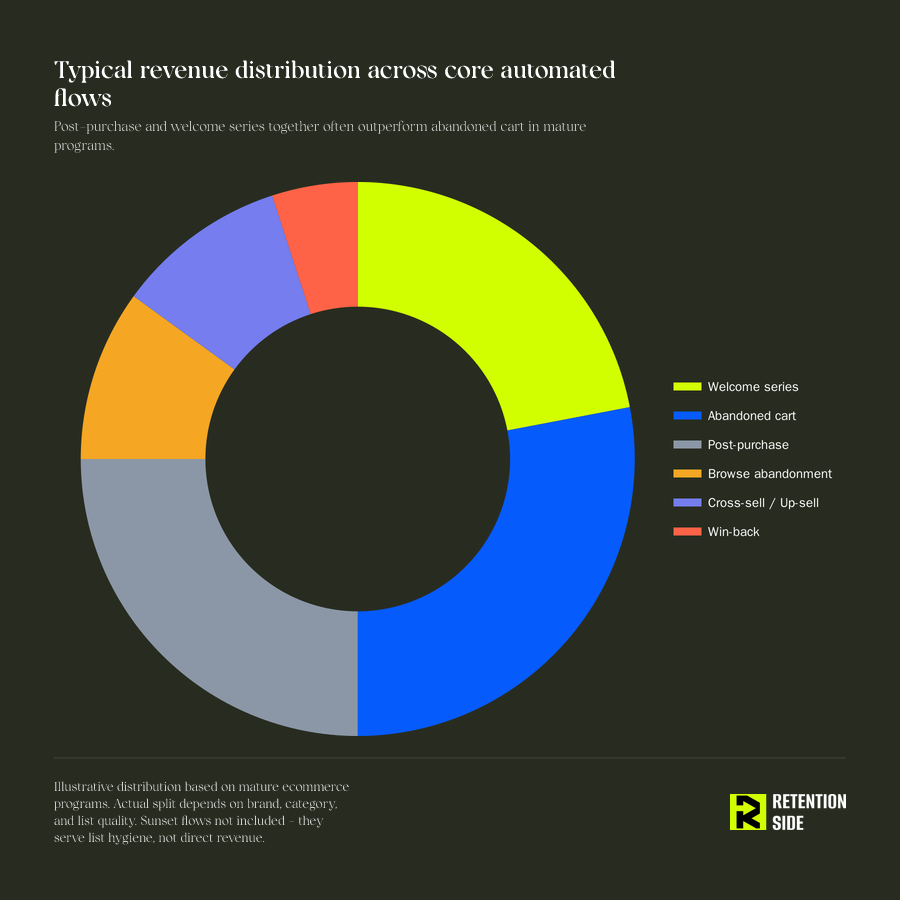
Pillar 3: Automated flows – the architecture of the customer journey
Flows are the behavior-triggered automation layer of your program. They fire in response to specific customer actions – a signup, a product view, a cart abandonment, a purchase, a lapse in activity – and they run continuously without requiring anyone to hit “send.”
The strategic purpose of flows is not “automated emails.” It is mapping communication to the exact moments in the customer journey where a well-timed, relevant message changes behavior. Each flow corresponds to a specific drop-off point or progression opportunity in that journey.
Welcome series
Triggered when someone joins your list – the first real conversation you have with a new subscriber. The goal of the welcome series is not just to deliver a discount code. It is to establish the brand’s voice, give the subscriber genuine reasons to buy, and move them toward a first purchase before the window of peak engagement closes.
A well-built welcome series uses zero-party data collected at signup to personalize from the first email. It earns attention over 3-5 emails rather than dumping everything in one, and it sets expectations about what kind of emails you send – so future sends feel like continuations, not intrusions.
Subject line testing, send timing tests, and incentive structure tests should be continuous in the welcome series, because it is the highest-leverage flow you have. The welcome window is the only time in the subscriber relationship where engagement is at its absolute peak.
Abandoned cart
Someone added products and left without purchasing. The job of this flow is to address that specific, identified intent – not just remind them the cart exists.
The version that actually performs is segmented and structured. First email within 1-2 hours while purchase intent is still warm. Second email 12-24 hours later, addressing common objections (shipping, returns, trust signals). Third email with a stronger offer if no conversion. The messaging a first-time visitor abandoning a $30 item receives should not be the same as what a previous customer abandoning a $250 order receives.
Incentive logic matters here too. Many cart abandons happen for logistical reasons (distraction, unexpected shipping cost, wanting to compare elsewhere) that copy can address without a discount. Defaulting to “here’s 10% off” trains your customer base to abandon carts expecting a coupon.
Browse abandonment
The most commonly missing flow from programs that are otherwise functional. Someone viewed a product page and left without adding to cart. That is a buying signal – weaker than cart abandonment, but real and worth following up on.
The challenge is that browse abandonment flows require clean event tracking to work correctly. If “viewed product” events are not firing reliably in Klaviyo because the Shopify integration was set up shallowly, the flow can’t do its job.
When built properly – showing the specific product browsed, adding relevant social proof or a review for that product, framing the message as helpful rather than pressuring – browse abandonment captures a large pool of mid-funnel intent that no other flow touches.
Post-purchase sequence
The window immediately after a purchase is the highest engagement moment in the customer lifecycle. Most brands waste it with transactional logistics (order confirmed, shipping update, delivered) and nothing else.
A post-purchase sequence built around retention objectives does four things. First, product education – helps the customer get maximum value from what they bought, which increases satisfaction and reduces the likelihood of returns. Second, cross-sell recommendations based specifically on what was purchased, timed while the customer is still in a transaction mindset. Third, a review request timed for when the customer has had the product long enough to form an opinion. Fourth, and most importantly: a deliberate path toward the second purchase.
The second purchase is the single most predictive indicator of long-term customer retention. DTC data across 162,112 customers shows that only 21.2% of first-time buyers make a second purchase – but once they do, the conversion rate to a third purchase nearly doubles to 38.8%, and continues accelerating from there. A customer who buys five or more times is worth 7.3x a one-time buyer. The post-purchase sequence is your best tool for engineering that transition – and it’s the most underbuilt flow in most ecommerce programs.
Critically, retention curve data from 78,714 first-time buyers shows that 67% of 90-day retention happens within the first 30 days. Most brands run 3-5 post-purchase emails over two weeks, then go silent – which means they’re covering only the steepest part of the curve and leaving the rest to campaigns. Your post-purchase flow should run at minimum 60-90 days to match where retention actually concentrates.
Cross-sell and up-sell flows
These deserve their own architecture beyond the general post-purchase sequence. Triggered after a purchase, they target specific product relationships in your catalog – if customers who buy product A consistently also buy product B within 60 days, that is a pattern you should build a dedicated flow around.
Effective cross-sell flows are not guesswork. They’re built on actual purchase data from your customer base. The specificity of the recommendation is what makes them convert – “complete your routine with X” based on exactly what was purchased outperforms generic “you might also like” messaging every time.
Win-back flow
A win-back flow is triggered when a customer who has previously purchased goes quiet for longer than their expected repurchase window. The timing needs to be based on actual repurchase frequency data for your brand – not a generic industry number. For a supplements brand with a 30-day product cycle, the win-back window might open at 45-60 days. For a premium homewares brand with a 6-month buying cycle, that timing shifts considerably.
The strategic purpose of win-back is to re-engage customers before they fully disconnect – while there is still residual brand recognition and relationship equity to build on. A win-back flow triggered 180 days after the last purchase for a brand with a 60-day repurchase cycle is largely a wasted effort; that customer has moved on. Get the timing right first.
Sunset flow
Sunset flows do not generate revenue – and they should not be expected to. Their purpose is list hygiene. Chronically disengaged subscribers who have not opened or clicked in 90-180 days (depending on your send cadence and category) are a liability to your deliverability. Inbox providers track disengagement patterns across your full list.
A sunset flow gives non-engagers one final chance to re-engage before being suppressed. Those who don’t respond get removed from active sends. This keeps your deliverability signals clean and ensures that performance metrics actually reflect the behavior of an engaged audience – not the averaged-down behavior of a list carrying dead weight.
A note on flow maintenance
No flow is ever “finished.” A welcome series written at launch with the original brand voice, original incentive structure, and original product catalog should be revisited, tested, and updated regularly. Audience behavior shifts. Creative gets stale. Product mixes change. A flow that was performing well 18 months ago may be significantly underperforming today simply because nothing has been done to it. Continuous A/B testing across copy, timing, incentive logic, and sequence length is what separates programs that compound from programs that plateau.
Pillar 4: Campaigns – sending with purpose, not just frequency
Campaigns are manual sends to selected segments of your list. They cover your promotional calendar, product launches, seasonal moments, and content-driven communications. They are equally important to the program as flows – not a secondary layer that gets addressed after automation is “sorted.”
The problem with discount-only campaign calendars
A campaign calendar built entirely around promotional offers does two things over time, both damaging. It trains subscribers to wait for discounts before purchasing – eroding full-price conversion. And it degrades deliverability as engagement between sale windows drops, signaling to inbox providers that your emails are only relevant when there is a deal attached.
The fix is not fewer promotional campaigns. It is a content mix that balances promotional sends with educational, entertainment, and relationship-building content. A behind-the-brand story, a product education piece, a customer spotlight, a genuine recommendation – these sends do not always produce immediate revenue attribution, but they maintain engagement between promotional cycles, which is what protects deliverability and sustains the ability to run effective sales campaigns when they matter most.
Segmentation is not optional
Sending the same campaign to every subscriber on your list is a deliverability risk and a missed conversion opportunity simultaneously. Active buyers with purchase history in the last 90 days respond differently to promotional campaigns than one-time purchasers from two years ago. VIP customers who have bought five or more times should not receive the same message as subscribers who have never purchased.
The minimum segmentation framework for campaign sends:
- Engaged subscribers – people who have opened or clicked within the last 60-90 days
- Recent purchasers – customers who bought in the last 90 days, with messaging that acknowledges the relationship
- Lapsed subscribers – have not engaged recently, lower send frequency, re-engagement framing
- Historical buyers – purchase history older than 90 days without recent activity, eligible for win-back sequences
Overlaying purchase behavior on engagement data gives you enough precision to make every campaign more relevant than a full-list blast. That relevance shows up in engagement metrics, which protect deliverability over time.
Campaign-flow overlap needs management
When a customer is currently in an abandoned cart flow, receiving an unrelated promotional campaign from the same brand within hours is a disjointed experience. Flow suppression and campaign filtering need to be designed together so the communication a customer receives makes sense in the context of where they are in their lifecycle. Klaviyo’s flow filters and campaign exclusion segments are the tools for this – but they only work if someone has thought through the logic deliberately.
A/B testing is a continuous practice
Testing in campaigns should be systematic rather than ad-hoc. One variable per test: subject line, send time, content format, CTA placement, offer vs. no offer. Document results. Apply learnings to future sends. The compounding effect of consistent, deliberate campaign testing over 6-12 months is substantial. It only works, though, if results are actually acted on – not just observed.
Segmentation: the connective thread
Segmentation touches all four pillars. It determines who receives your campaigns, which flows a customer enters, how their experience gets personalized within those flows, and how deliverability is protected across the list.
The brands that do segmentation well do not simply split their list into “engaged” and “unengaged.” They build meaningful audience buckets that reflect how customers actually behave: purchase recency and frequency, product category affinity, AOV tier, lifecycle stage, acquisition source, and zero-party data attributes.
A few principles worth holding:
Segmentation should be dynamic. Customers move between stages. Someone who was an active repeat buyer six months ago may now be a win-back target. A subscriber who has never purchased is now in their third browse abandonment flow. Static segments miss the movement that tells you something important about where the relationship is heading.
Not every segment needs its own campaign. Segmentation is not about fragmentation for its own sake – it is about relevance. The question for each send is whether there is a genuinely meaningful reason to say something different to a particular group. If there is not, segment fewer.
RFM scoring gives you a useful strategic lens. Recency, Frequency, and Monetary Value together tier your customer base in a way that informs how you prioritize communication – which groups get the highest send frequency, which get win-back treatment, which warrant exclusive early access. Academic research published in the Journal of Electronic Commerce Research consistently validates RFM as a reliable segmentation framework for ecommerce customer classification. RFM is most powerful as a strategic thinking tool, not as a rigid automated classification system.
Zero-party data: the personalization foundation you build early
Zero-party data is information your customers actively choose to share with you – preferences, goals, skin type, fitness level, style preferences, whatever is relevant to your product category. Unlike behavioral inferences (which are probabilistic), zero-party data is explicit and consent-driven. Forrester, which coined the term, defines it as data a customer intentionally and proactively shares with a brand. It is what makes personalization feel like genuine helpfulness rather than surveillance.
The best time to collect zero-party data is at the signup moment – a single qualifying question embedded in the form flow adds almost no friction while immediately giving you a personalization anchor. “What are you shopping for today?” “What’s your primary goal?” “Tell us your skin type.” One question. One data point that can branch your entire welcome series, flow logic, and campaign segmentation from that point forward.
Build zero-party data collection into the form and welcome series architecture from the start. Retrofitting it into a program that was built without it is significantly more work than getting it right early – and the personalization lift it enables compounds over time as your list grows.
The metrics that tell you if the program is working
The metrics Klaviyo shows most prominently on its dashboard – open rate, click rate – are not the metrics that tell you whether your email program is building your business. They are useful for diagnosing specific issues within a flow or campaign. They are not accountability metrics.
The metrics that matter:
Repeat customer rate (returning customer rate) – The most important retention metric for an ecommerce brand. What percentage of customers in a given period placed more than one order? If email is doing its job, this number should trend upward over time as the program matures. If it is flat or declining despite email investment, something structural is not working – and the problem may not even be in email.
Revenue attributed to retention channels – What share of total store revenue is being driven by email and other owned channels? Track this over time and in relation to investment. The specific percentage that’s “right” varies significantly by category and business model, so apply skepticism to universal benchmarks. The more useful question is whether the number is growing in proportion to investment.
List growth rate – Tracked alongside lead-to-customer rate to confirm that what’s being added to the list has actual commercial value, not just inflating subscriber counts.
Deliverability metrics – Inbox placement rate, spam complaint rate, hard bounce rate. These are the leading indicators that warn you of problems before those problems show up as revenue drops. Use Google Postmaster Tools and MXToolbox to monitor authentication health and domain reputation from the inbox provider’s perspective.
Flow-level conversion metrics – For each core flow, what percentage of customers who enter it complete the desired action? Welcome-to-first-purchase rate, abandoned cart recovery rate, post-purchase cross-sell conversion – these tell you precisely which parts of the automation layer are working and which need attention.
Average time between orders – Not a standard dashboard metric, but one of the most meaningful signals for whether your post-purchase and cross-sell sequences are genuinely accelerating the customer lifecycle. If the gap between first and second purchase is shortening over time, the retention system is working.
What to deliberately not report on: open rate as a KPI, click rate as a performance benchmark, and revenue per recipient as a strategic accountability metric. None of these directly measure business outcomes. All of them can be misread in ways that lead to poor decisions.
Klaviyo as part of a wider retention stack
Klaviyo is the right starting point for almost every ecommerce retention system. It has the widest addressable reach, the deepest personalization tooling, the most mature behavioral automation infrastructure, and the most reliable direct attribution of any retention channel. Getting it right before expanding to other channels is the correct sequence.
But email alone has coverage gaps – and for brands at meaningful revenue levels, those gaps become increasingly costly over time.
Some customers simply do not engage with email consistently. They check it infrequently, or they have conditioned themselves to filter marketing messages. SMS reaches a different moment in their day – mobile, immediate, and often better suited to time-sensitive communications like flash sales or shipping notifications. Klaviyo handles SMS and email on the same platform, which means flows can make intelligent decisions about which channel to use based on subscriber behavior and preferences.
Push notifications catch customers when they are actively browsing and create a re-engagement touchpoint without requiring an email inbox check. Direct mail creates a physical touchpoint that no digital channel can replicate – for higher-AOV categories where the purchase decision benefits from a premium brand experience arriving in the mailbox, a well-timed direct mail piece at the right lifecycle moment can have outsized impact.
Loyalty programs deserve their own consideration. When meaningful repeat purchase behavior already exists in the customer base, a loyalty program shifts the relationship structure by giving your best customers structural, ongoing reasons to choose you over alternatives. It is an infrastructure investment, not a quick win – but for brands with the right category economics, it changes what customer lifetime value looks like over a 2-3 year horizon.
WhatsApp and Viber are increasingly relevant in certain geographies and product categories where messaging app usage is higher than email engagement.
At Retention Side, the entry point is always email via Klaviyo. The question of what to add next – SMS, push, direct mail, loyalty, WhatsApp, Viber – depends on what the audience behavior data shows and where the most cost-effective coverage gaps are. It is not a formula. It is a system that gets built deliberately, one layer at a time, with the email foundation always preceding the expansion.
Common setup mistakes and how to avoid them
These are the patterns that consistently underperform, and the reason behind each one.
Using the shared sending domain indefinitely. This is the most common deliverability mistake for brands that have been on Klaviyo for a while. Setting up a dedicated subdomain is a 30-minute task that protects your sender reputation from every other brand on Klaviyo’s shared infrastructure.
Skipping or misconfiguring authentication records. SPF, DKIM, and DMARC are non-negotiable in 2026. One-click unsubscribe is mandatory for bulk senders. Check your current authentication setup with MXToolbox – it takes two minutes and will surface any gaps. Then verify your domain reputation directly in Google Postmaster Tools.
Building flows once and never revisiting them. A welcome series written at launch and untouched for two years is almost certainly underperforming relative to what’s possible. Schedule quarterly flow audits. Treat testing as a permanent operating practice, not a launch activity.
Sending campaigns to the full list. Every time you send to subscribers who haven’t engaged in months, you are accumulating negative signals with inbox providers. Segment your sends to engaged audiences. Manage the inactive segment separately.
Treating campaigns as the entire program. Campaigns are visible and easy to report on. Flows compound quietly in the background. Programs that are 80% campaign-driven and 20% flow-driven are working harder than they need to, and leaving a significant portion of automation-driven revenue on the table.
Building without zero-party data collection. The signup moment and the welcome series are your best opportunities to collect preference data from new subscribers. Building these without data collection built in means retrofitting it later – more work, and you’ve already missed the highest-engagement window with every subscriber who joined before you added it.
Expanding to new channels before fixing the email foundation. SMS, push, and direct mail are all genuinely valuable additions to a retention stack. Adding them before email deliverability is clean, flows are covering the full lifecycle, and campaign segmentation is meaningful usually means distributing the same foundational problems across more channels. The sequence matters: fix the foundation, then expand.
Attributing poor email performance to the channel. A drop in email attribution or conversion does not automatically mean email is broken. Traffic quality shifts, acquisition source mix changes, and website conversion issues all show up as email underperformance – because email is where the customer relationship continues after acquisition. Diagnosing the root cause before rebuilding email strategy prevents a lot of wasted effort.
Conclusion
A properly built Klaviyo program is not a collection of flows and a weekly send schedule. It is a system – four interconnected pillars that need to function well individually and work together to produce results that compound over time.
Deliverability is the foundation. Without inbox placement, none of the rest matters. List growth is the fuel, but quality determines how far it goes. Flows are the behavioral engine that runs continuously in the background, responding to what customers actually do. Campaigns are the consistent touchpoint layer that maintains relationships and drives commercial moments.
The gap between a functional Klaviyo account and a well-built one is significant – and it usually shows up in repeat customer rate, not in any individual email metric. Brands that get the architecture right see that number trend upward quarter over quarter. Brands that keep patching a shallow program with more campaigns stay stuck at the same ratio.
For ecommerce brands above $300K/month that have the acquisition side working, email marketing via Klaviyo is where the retention system starts. The investment in getting it built correctly pays compound returns for as long as the program runs.
If your current program has been set up but not really built – flows that haven’t been touched in over a year, campaigns sending to full unsegmented lists, deliverability that’s never been properly monitored – that’s exactly the kind of structural work that Retention Side specializes in.