

If your eCommerce brand is already doing solid numbers on paid acquisition and your email program is functional, SMS starts looking like an obvious next step. And if you’re running Klaviyo, you already have the infrastructure to launch it.
The problem is not the platform. The problem is that a lot of brands either underuse SMS (treating it as a broadcast channel for discount codes) or hand it to the wrong agency and let it run on autopilot. Neither approach builds retention.
This article is for brands that want SMS to actually earn its place in the retention system – not just send texts, but drive repeat revenue, support customer lifetime value, and work in coordination with email, not in competition with it. If you’re evaluating a Klaviyo SMS agency or deciding whether to keep it in-house, this is the framework you need.
Key takeaways
- SMS and email are complementary channels in a retention system. A Klaviyo SMS agency should be building both in coordination, not treating them as separate programs.
- The right agency tracks business-building metrics – repeat customer rate, revenue attributed to retention channels, and deliverability health – not vanity metrics like open rate or click rate.
- SMS is high-intent and high-interruption. It earns its value in specific moments: urgency, immediacy, and VIP treatment. Overuse destroys trust.
- Evaluate agencies on verifiable case studies, metrics discipline, channel philosophy, and how they collaborate with your existing acquisition channels.
- A complete retention system covers four pillars: deliverability, list growth, automation (flows), and campaigns. SMS plugs into all four – it does not replace any of them.
Why SMS is not a standalone strategy
Let’s be direct: SMS is not a retention strategy. It is a channel inside a retention strategy.
Brands that treat SMS as a separate program – with its own budget, its own flow architecture, and its own calendar – end up with two things that don’t talk to each other. The customer gets an abandoned cart email and a redundant abandoned cart text within twenty minutes of each other, from two different tones of voice, with two different offers. That is not retention. That is noise.
The reason Klaviyo works so well for eCommerce retention is that it centralizes customer data across email and SMS (and increasingly push notifications and on-site behavior) into unified profiles. A Klaviyo SMS agency that understands this will not separate SMS strategy from email strategy. They will map a single customer journey and assign each channel its appropriate role within it.
SMS earns its place in the retention system because of three specific properties: immediacy, intimacy, and high perceived attention. A text message lands in a fundamentally different cognitive space than an email. According to Braze’s 2024 Global Customer Engagement Review, which analyzed interactions across 9 billion users, brands that add SMS to their channel mix see purchases per user increase by 2.2X compared to brands using other channels without SMS. That uplift comes from attention, not volume. What matters is that SMS creates urgency in a way email often cannot – and that property has to be deployed intentionally.
The four pillars of a complete retention system – and where SMS fits
When Retention Side builds a retention program for an eCommerce brand, we anchor everything to four core pillars: deliverability, list growth, automation (flows), and campaigns. If you want to understand how these pillars apply more broadly to the eCommerce retention agency model, that framework is the same regardless of which channel you’re adding. SMS does not sit outside this structure – it operates within each pillar in coordination with email.
Deliverability
SMS deliverability is a real concern that many agencies underplay. Carrier filtering, TCPA compliance in the US, and list hygiene all affect whether your texts actually reach subscribers. A Klaviyo SMS agency should have a clear position on consent management (double opt-in is standard for US audiences), send cadence to avoid carrier spam triggers, and how they manage opt-outs to protect your sender health long-term.
On the compliance side: the FTC’s Telemarketing Sales Rule and the FCC’s TCPA regulations set the legal floor for commercial text messaging in the US. Violations carry statutory damages of $500–$1,500 per unsolicited message. Any agency that treats compliance as a secondary concern is a liability, not a partner.
This is not a set-it-and-forget-it system. SMS deliverability degrades fast when list hygiene is poor. Any agency that doesn’t have a routine for monitoring opt-out rates, bounce rates, and carrier filtering events is running your program blind.
List growth
Your SMS list will almost always be smaller than your email list, and that is fine. The mechanics are different. Consent requirements are stricter, and subscribers have higher expectations about the value they will receive per message. This means list growth strategy has to be intentional.
The scale of the opportunity is real: SimpleTexting’s 2026 SMS Marketing Report, based on a survey of 1,000 consumers and 400 SMS marketers, found that 85.6% of consumers are currently opted in to texts from at least one business – a nearly 40% growth since 2021. For eCommerce specifically, 47% of consumers say they’re most likely to subscribe to texts from retail and eCommerce brands. But the same survey found that messaging too frequently is the top reason consumers opt out (cited by 55% of respondents). That tension between scale and restraint is exactly where a good agency adds value.
An effective Klaviyo SMS agency will build list growth through multiple touchpoints: pop-up forms with explicit SMS opt-in, post-purchase SMS consent capture, email-to-SMS campaigns (targeting existing email subscribers who haven’t yet opted into texts), and where relevant, in-store or QR-code-based sign-up flows.
Zero-party data plays a significant role here. During the opt-in sequence, you have a moment to ask subscribers what they want to hear from you – product categories, preferences, frequency preferences. Brands that capture this at sign-up can use it to personalize SMS in ways that dramatically reduce opt-out rates.
Automation (flows)
This is where most of the SMS work lives, and it is where the channel’s intimacy is most valuable. A well-built Klaviyo SMS flow architecture covers the key stages of the customer journey.
The most important automated SMS flows for revenue are:
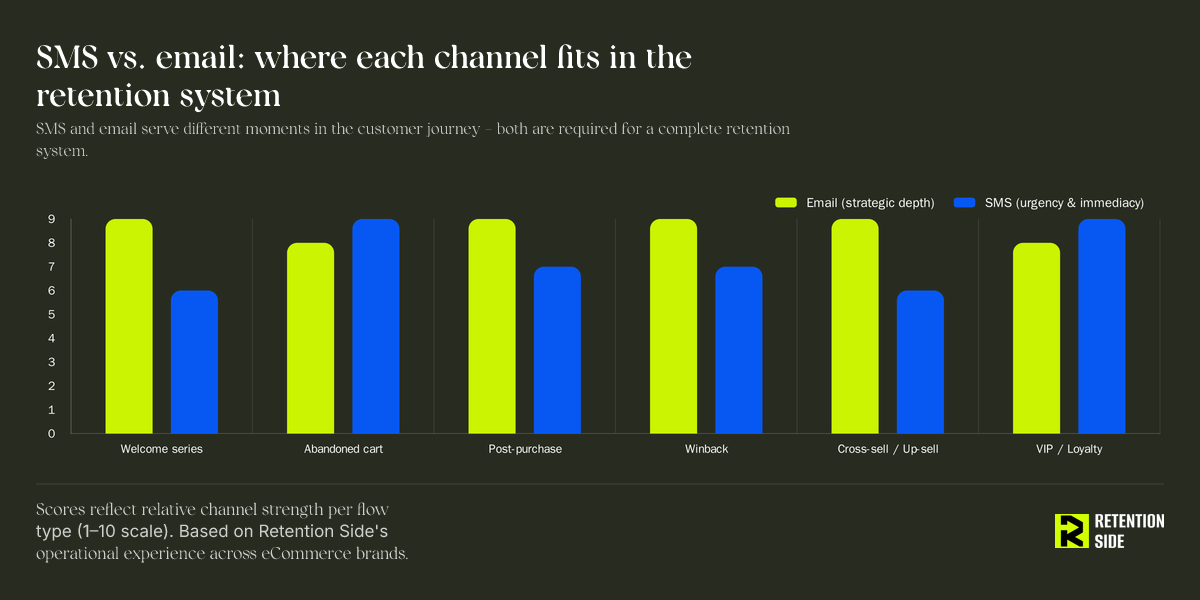
Welcome series – The first message a subscriber receives after opting in sets the tone for the entire relationship. It should deliver on whatever value was promised at sign-up (a discount, early access, exclusive content) and establish what they should expect going forward. SMS welcome messages need to be more immediately valuable than their email counterparts, because the permission threshold is higher.
Abandoned cart – This is the highest-urgency application for SMS. When a customer abandons a cart, they are at peak intent. A text – sent within one to two hours of abandonment – can recover a sale that an email arriving hours later would miss. The key is coordination: if someone is subscribed to both email and SMS, the flows need to be aware of each other. You do not want to send an abandoned cart email at hour one, and then an SMS discount at hour two. Sequence them intentionally.
Post-purchase – The post-purchase window is one of the most valuable and most wasted moments in eCommerce. A short SMS confirming shipment, with a personal tone, reinforces the purchase decision and creates the emotional foundation for a second order. Later in the sequence, an SMS nudging toward a related product (cross-sell) or a higher-tier version of what they bought (up-sell) can meaningfully lift repeat purchase rate.
Cross-sell and up-sell flows – These flows are triggered by purchase history and behavioral signals. A customer who just bought a skincare cleanser is a natural target for a serum recommendation two weeks later. SMS makes this feel like a personal tip, not a broadcast campaign. Done well, this is where SMS generates some of its highest-ROI moments.
Winback – A winback flow is triggered when a customer who should be repurchasing based on historical order frequency hasn’t returned. For most eCommerce brands, this kicks in well before 90 days. SMS is a useful tool here because it commands attention in a way that a winback email buried in a full inbox may not. Keep the message direct, the offer clear, and the tone warm rather than desperate.
VIP and loyalty flows – Customers who have made multiple purchases or hit a loyalty tier threshold deserve acknowledgment through the highest-attention channel you have access to. SMS is ideal for this. Early access drops, loyalty point reminders, and personalized “thank you” moments work especially well via text.
One flow you should not see listed under revenue-generating automations: the sunset flow. Sunset flows serve a list hygiene purpose – removing chronically disengaged subscribers from your active list to protect deliverability. This matters for SMS, but it is a maintenance function, not a revenue driver.
Campaigns
Campaigns are one-time sends to a segment of your list, and SMS campaigns are not lower-priority than email campaigns. They serve different functions in the calendar.
The highest-value applications for SMS campaigns are: flash sales with a short expiration window, limited product drops, BFCM and peak season promotions, and VIP early access. The common thread is urgency. SMS campaign cadence should be restrained – SimpleTexting’s consumer research found that 50% of consumers prefer to receive texts from businesses once every other week. Overuse trains subscribers to ignore texts or, worse, opt out.
Coordinating SMS campaigns with the email calendar is not optional. Both channels need to know what the other is doing, when, and to which segments. A Klaviyo SMS agency that builds email and SMS in the same platform with shared segmentation logic has a structural advantage over one managing them in separate tools.
What to look for in a Klaviyo SMS agency
The SMS agency market is crowded, and the quality gap is wide. Here is how to evaluate the agencies you’re considering. This framework applies whether you’re looking purely at SMS capability or evaluating a broader Klaviyo agency relationship.
1. Case studies with context
Generic “we helped a DTC brand increase SMS revenue” claims are easy to make and impossible to evaluate. What you need are verifiable case studies that describe the specific challenge, the strategy applied, the flows and campaigns built, and the outcome in terms that connect to real business results – repeat customer rate, customer lifetime value, revenue attributed to the retention channel.
Ask: “Can you walk me through a specific brand in a similar category where you ran the SMS program? What did the list look like before you started, how did you build it, what flows did you set up, and what happened to retention metrics over twelve months?”
If the answer is vague, or if the case study only shows SMS revenue in isolation (without context for how it contributed to the brand’s overall retention picture), that is a red flag.
2. Metrics discipline
The metrics an agency tracks tell you a lot about their philosophy.
Agencies that report on open rate and click rate as primary KPIs are optimizing for engagement signals, not business outcomes. These are useful internal diagnostic signals, but they are not accountability metrics.
The metrics that matter for a Klaviyo SMS agency are: repeat customer rate (sometimes called returning customer rate), revenue directly attributed to SMS-triggered flows and campaigns, list growth rate, and deliverability health indicators like opt-out rate and carrier filtering events. If an agency cannot tell you what they move the needle on at the business level, they are not operating at the right level of accountability.
3. Channel philosophy – retention, not just SMS
There is a meaningful difference between an SMS agency and a retention agency that uses SMS as one of several tools. The former will build you a text messaging program. The latter will build you a retention system where SMS earns its role.
The right Klaviyo SMS agency understands that retention as a discipline includes email, SMS, push notifications, direct mail, loyalty programs, and potentially channels like WhatsApp or Viber depending on your customer geography. These are not competing channels – they are different instruments in the same orchestra. Research by Bain & Company, cited in Harvard Business Review, consistently shows that even a 5% increase in customer retention can boost profits by 25–95% – a number that only materializes when retention strategy is integrated across channels, not run as a series of separate programs.
An agency that presents SMS as the primary retention lever, or that treats email and SMS as interchangeable rather than complementary, is likely to underdeliver. The brief is not “run SMS well.” The brief is “increase the percentage of customers who come back.”
4. Cross-channel collaboration and data sharing
SMS does not live in a vacuum. A Klaviyo SMS agency that is not thinking about how their work connects to your paid acquisition, SEO, and social channels is leaving value on the table.
Specifically: what data is your retention program feeding back to your paid channels? Klaviyo integrates with Meta and Google – customer profiles, purchase behavior, and segment membership can be used to suppress existing customers from acquisition campaigns, build lookalike audiences from high-LTV customers, and create remarketing windows that are informed by email and SMS engagement. An agency that isn’t actively using this integration is running a siloed program.
Ask: “How do you collaborate with our paid team? What data does your work generate that improves performance in other channels?”
How to structure the SMS and email relationship
The question most brand operators get wrong is: should we run SMS separately from email, or together?
The answer is together, always. Not just on the same platform – though Klaviyo makes this natural – but under the same strategic framework, with shared customer journey mapping, shared segmentation logic, and a clear rationale for which channel carries each moment.
A useful mental model: email is the deep relationship channel. It is where you can share story, build brand, educate, and run multi-email sequences that move someone through a decision. SMS is the high-attention interrupt. It is where you say “this is happening right now and you need to see it.”
When this distinction is clear, channel coordination becomes straightforward. The abandoned cart flow does not become an email-then-SMS shotgun. It becomes a decision: is this customer most likely to convert from email, from SMS, or from both in sequence? Klaviyo’s conditional splits make this logic executable at scale.
Braze’s cross-channel data reinforces why this matters: customers who receive SMS campaigns have 38% higher average user lifetimes compared to those who receive outreach via other channels but not SMS. That uplift is not from SMS alone – it is from SMS working alongside other channels to reach customers at the right moment. Brands that have built this coordination see the combined system generate meaningfully more repeat purchases than either channel in isolation.
The list-building foundation that most brands skip
Most brands launch SMS with the goal of getting as many subscribers as fast as possible. This is the wrong objective. A smaller, high-quality SMS list with genuine opt-in and clear value expectations will dramatically outperform a larger list built through aggressive pop-ups and unclear consent.
The reason is structural. SMS is a high-trust channel. When someone gives you their phone number, they are extending a level of permission that is qualitatively different from sharing an email address. Violating that trust – by sending too frequently, by failing to deliver the value you promised, or by sending irrelevant messages – generates opt-outs that damage your deliverability and your brand simultaneously.
The brands that do SMS list growth well front-load the value proposition. They make the offer at sign-up clear and worth it. They use the opt-in moment to capture zero-party data – a concept Forrester defines as information customers proactively and intentionally share, including preferences, purchase intentions, and personal context. And they deliver on the first interaction in a way that sets a high bar for every message that follows.
This same discipline applies when you’re thinking about the broader DTC retention agency relationship: owned list quality, across both email and SMS, is the asset being built. Growth without quality undermines everything downstream.
What good Klaviyo SMS management actually looks like in practice
A lot of brands sign with an SMS agency and receive a deliverable: a set of flows built in Klaviyo, a campaign calendar, and a monthly report. That is not management – that is setup.
Genuine Klaviyo SMS management looks like this: ongoing monitoring of opt-out rates by flow and campaign to identify friction points before they become deliverability problems; monthly A/B testing of message copy, offer structure, and send timing; segmentation refinement based on evolving purchase behavior; coordination meetings with the email team before each campaign window; and quarterly reviews of retention metrics to assess whether SMS is contributing to the right business outcomes.
It also looks like restraint. One of the most important jobs of a Klaviyo SMS agency is knowing when not to send. The brands with the healthiest SMS programs send fewer messages than their competitors – and each one is more likely to drive a purchase because subscribers trust that a text from that brand is worth opening. According to SimpleTexting’s 2026 report, 76% of businesses say text message marketing is effective or very effective at driving revenue – but the same data shows opt-out as the primary consumer response to over-messaging. The constraint is the strategy.
Common mistakes brands make when launching SMS
Treating SMS as an email duplicate. If every SMS campaign is just a shorter version of the email campaign sent on the same day, you are not adding channel value – you are increasing subscriber fatigue. The channels need to serve different moments.
Discounting too early. Sending a discount in the first SMS to a new subscriber anchors their expectation. They will wait for discounts before buying. Reserve offers for specific strategic moments – late in the abandoned cart sequence, for a winback, or for a flash sale event.
Ignoring compliance. TCPA compliance in the US is not optional and the penalties for violations are significant. The FTC’s Telemarketing Sales Rule guidance and FCC regulations govern consent requirements, opt-out handling, and quiet hours. These are not box-ticking exercises – they are risk management. Any Klaviyo SMS agency that treats compliance as a secondary concern is a liability.
Scaling too fast. Rapid list growth through aggressive acquisition tactics often produces a list with high opt-out rates, which damages sender reputation with carriers. Build the list at the speed your brand credibility can support.
Running SMS and email in separate silos. Whether this means separate agencies, separate platforms, or just separate strategies that never coordinate – this is the most expensive mistake, because it wastes the compound value that comes from both channels working together. The same principle applies to the broader eCommerce email marketing agency relationship: retention channels need unified strategy, not siloed execution.
Conclusion
SMS is not a shortcut to retention, and a Klaviyo SMS agency is not a fix for a brand that hasn’t built the structural foundations of a retention program. But for brands that have strong acquisition, a functional email channel, and a genuine product that customers come back for – SMS is a powerful addition to the system.
The agency you choose should understand SMS as a channel within a larger retention architecture, not as a standalone program. They should track metrics that matter at the business level. They should have verifiable results. And they should be thinking about how your SMS program connects to email, paid acquisition, and the broader customer journey – not just how many texts they are sending per month.
At Retention Side, SMS is one of several retention channels we deploy for eCommerce brands – alongside email as the foundation, plus loyalty programs, direct mail, push notifications, and where relevant, WhatsApp and Viber. We build these as a system, not a collection of separate tactics. If you want to understand what a coordinated retention program could look like for your brand, that is the conversation worth having.