


Most Klaviyo accounts we audit are technically “integrated” with a dozen tools and strategically integrated with almost none of them. There’s a difference between installing an app from the marketplace and actually building the data pipeline that makes Klaviyo smarter. For a brand doing $300K or more a month, that difference shows up directly in revenue per recipient, segmentation accuracy, and how much manual work your team does that Klaviyo should be doing automatically.
Klaviyo’s own marketplace lists 350+ integrations across categories like advertising, loyalty, helpdesk, shipping and logistics, subscriptions, and quizzes and surveys. That’s a lot of options, and most brands only need a handful of them working well rather than all of them installed. This article breaks down which integrations actually move retention metrics, what data flows through each one, and how to sequence them so your Klaviyo setup gets smarter as you scale rather than just more crowded.
What you’ll learn
- Why the Klaviyo-Shopify connection is the foundation every other integration depends on
- Which loyalty, review, helpdesk, and shipping integrations feed real segmentation data into Klaviyo
- How advertising integrations close the loop between retention and acquisition spend
- When data warehouse syncs and Advanced KDP actually become necessary
- A practical sequence for building your integration stack instead of installing everything at once
The Klaviyo-Shopify integration is the foundation
If you’re running Shopify, this connection determines the ceiling for everything else you build in Klaviyo. The integration syncs order data, catalog data, and customer data in real time, with two minor exceptions: Markets price changes sync every 14 days and Collections sync every 12 hours. On initial connection, Klaviyo pulls in the last 90 days of Shopify history, then completes a full historical sync so your flows and segments have context beyond just new activity.
The events that flow through this integration are what make behavioral segmentation possible: Checkout Started, Placed Order, Ordered Product, Fulfilled Order, Fulfilled Partial Order, Cancelled Order, Refunded Order, Confirmed Shipment, Delivered Shipment, Marked Out for Delivery, Active on Site, Viewed Product, Viewed Collection, Submitted Search, and Added to Cart. That’s 15 distinct signals, and most brands we onboard are only using three or four of them in their flow logic.
This is where “installed” and “built” diverge. A shallow integration technically fires Placed Order and calls it done. A properly built one uses Viewed Product and Viewed Collection to power browse abandonment, uses Submitted Search to catch high-intent shoppers who never added anything to cart, and uses custom properties on the order object to segment by product category, AOV tier, or subscription status. The best klaviyo integrations for ecommerce brands run all start here, because every downstream integration (loyalty, reviews, helpdesk) is only as useful as the base event data it gets layered onto.
If you’re still setting this foundation up correctly, our Klaviyo setup guide for ecommerce brands walks through the flow architecture that depends on this data being clean.
Shopify isn’t the only platform Klaviyo connects to natively. BigCommerce and WooCommerce sync in real time, Magento 2 syncs every 30 minutes, Wix syncs in real time, and Salesforce Commerce Cloud syncs orders and customers hourly with catalog updates every 8 hours. The sync frequency matters more than people assume: a brand on Magento running flash sales needs to know that a 30-minute lag exists before building time-sensitive automations around inventory or pricing changes.
Loyalty and rewards integrations turn purchase history into lifecycle triggers
Loyalty platforms solve a problem Klaviyo can’t solve on its own: they track points, tiers, and redemption behavior that live outside your order data.
Smile.io connects through Klaviyo’s Campaigns, Flows, and Segments APIs to welcome new loyalty members, automate point-and-tier messaging, segment customers by VIP status, and incentivize reviews at the right moment in the lifecycle. Once that data lives in Klaviyo, you can build flows that treat a customer differently based on whether they’re three points from a tier upgrade or sitting on an unused reward.
Yotpo plays a similar role from the loyalty side while also pulling review content into customer profiles. Thirdlove’s Klaviyo integration pipes loyalty program data through Yotpo and segments messaging based on loyalty status, which is part of how the brand built out its broader lifecycle program using Yotpo’s loyalty integration.
The strategic value here isn’t the loyalty program itself, it’s what the data enables downstream. A VIP tier flag lets you exclude your best customers from generic discount campaigns and instead offer early access. A points balance close to a redemption threshold is a legitimate win-back trigger that outperforms a blanket “we miss you” email. If loyalty data isn’t feeding your segmentation, you’re running a loyalty program and a Klaviyo account as two separate systems instead of one retention engine. Our loyalty program strategy guide covers how to structure the program itself so the data it generates is actually useful.
Review platform integrations feed both flows and social proof
Okendo, Yotpo, and Stamped all serve a dual function in a Klaviyo-connected stack. First, they let you trigger review requests directly from Klaviyo flows, usually positioned as email four or five in a post-purchase sequence, timed after enough usage has passed that the customer has an actual opinion. Second, they sync review data back into the customer profile, which means you can segment by “left a 5-star review” versus “never reviewed” and adjust messaging accordingly.
This second part gets overlooked constantly. Most brands set up the review request and stop there. But a customer who left a glowing review is a candidate for referral or UGC outreach, while a customer who left a 3-star review with a specific complaint should probably not receive your next promotional blast without some kind of service recovery first. The integration only creates value once that data is actually used in segment logic, not just stored. We go deeper on where review requests fit in the broader sequence in our post-purchase email flow breakdown, including how Klaviyo’s product analysis report informs which cross-sell products to feature alongside the review ask.
Helpdesk integrations protect the customer experience during send decisions
This is the integration category most retention teams skip, and it’s the one that quietly damages customer experience the most when it’s missing.
Zendesk is used by 6,900+ brands connected to Klaviyo to sync SMS and email replies into support tickets, trigger win-back flows off a “Ticket Resolved” event, and convert support conversations into sales opportunities when the timing is right. Gorgias offers similar real-time SMS conversation syncing for brands running support through that platform.
The practical use case is straightforward but rarely built: pause promotional sends to customers with an open support ticket, and exclude anyone mid-complaint from your next campaign entirely. Sending a “20% off, don’t miss out” campaign to someone who’s currently frustrated about a damaged order or a delayed refund is how brands generate unsubscribes and spam complaints that have nothing to do with email creative or subject lines. It’s a sequencing failure, and it’s fixable with a helpdesk integration and a simple exclusion segment.
Returns and shipping integrations turn logistics events into retention moments
Loop is used by 2,800+ brands connected to Klaviyo for automated return status notifications, personalized return instructions based on the product involved, and incentives that nudge a customer toward an exchange instead of a refund. AfterShip covers real-time shipment tracking for brands that want delivery status feeding directly into flow logic.
These integrations matter because shipping and returns events are natural triggers for two things brands underinvest in: post-purchase cross-sell timing and replenishment flows. A “Delivered Shipment” event is a better trigger for a usage-education email than an arbitrary “3 days after purchase” timer, because it’s tied to when the customer actually has the product in hand. Similarly, an exchange-over-return incentive delivered through the right flow at the right moment recovers revenue that a generic return confirmation email never would.
Advertising integrations close the loop between retention and acquisition
Meta Ads and Google Ads integrations sync custom audiences from Klaviyo into your ad platforms and sync lead ad subscribers back into Klaviyo. TikTok integrations serve a similar function. The most common use, and the one most brands get wrong, is exclusion: making sure your paid acquisition budget isn’t being spent chasing people who already receive your emails and texts.
Helen of Troy, which runs Klaviyo integrations for OXO, Osprey, and Hydro Flask on Adobe Commerce, uses Facebook, Google, and TikTok integrations for building lookalike audiences off retention data, which is the higher-leverage use case beyond simple exclusion. If your best customers share behavioral traits Klaviyo already tracks (high AOV, specific category affinity, subscription behavior), that same segment becomes a far more precise seed audience for paid acquisition than generic purchaser lookalikes.
This is also where the “retention doesn’t operate in isolation” reality shows up most clearly. A drop in flow revenue sometimes isn’t a flow problem at all, it’s an acquisition quality shift showing up downstream. Advertising integrations give you the visibility to tell the difference.
Quiz and survey integrations turn onboarding data into segmentation properties
Digioh and Typeform integrations let you capture structured data at signup and push it directly into Klaviyo profiles as custom properties. Thirdlove’s fitting room quiz pulls 10 or more custom data points into Klaviyo profiles through Digioh, then triggers automations the moment a quiz is completed.
The strategic value is precision. A quiz answer about fit preference, skin type, or use case gives you a segmentation property no purchase event could ever generate, because it captures intent and self-reported context rather than inferred behavior. Quiz completion itself is also a legitimate flow trigger, separate from any purchase, letting you start a personalized welcome sequence based on stated preference before the first order ever happens.
Subscription integrations extend the lifecycle beyond the first purchase
Recharge and Chargebee integrations sync subscription, payment, and invoice data into Klaviyo, with Chargebee updating roughly every 5 minutes. The practical application is converting first-time buyers into subscribers through targeted post-purchase messaging, and automating the operational side of subscription changes like upcoming renewal notices, payment failures, and plan updates.
For consumable or replenishable products, this integration category often has more long-term revenue impact than any single flow, because it shifts the retention conversation from “will this customer come back” to “how do we retain them at a fixed cadence with less friction each cycle.”
Data warehouses and Advanced KDP for complex first-party data needs
Klaviyo supports sync to Snowflake, BigQuery, and Azure, along with open APIs and webhooks for custom builds. This tier is not relevant for most brands in the $300K to $1M/month range, but it becomes necessary once you’re running multiple brands, multiple sales channels, or a data complexity level that a single native integration can’t handle cleanly.
Klaviyo’s Advanced Klaviyo Data Platform (KDP) extends this further with custom data objects, no-code data transformation, and more advanced marketing analytics. Helen of Troy used Advanced KDP specifically to replace a separate CDP, consolidating tools rather than adding another platform to their stack, which is generally the right instinct at that scale: fewer systems, more precise data flow, not more dashboards.
How to prioritize your Klaviyo integration stack
Don’t install everything at once. Sequence it based on what your current bottleneck actually is.
Start with your platform’s native integration (Shopify, BigCommerce, WooCommerce, or whichever CMS you’re on) and confirm every relevant event is firing and every custom property you need is populating correctly. This step alone fixes more underperforming Klaviyo accounts than any flow redesign. From there, add loyalty and review integrations to enrich post-purchase data, since this is usually the highest-leverage next step for brands with repeat-purchase potential. Add a helpdesk integration once you have enough support ticket volume that send timing is actually risking customer experience. Add advertising integrations when your paid acquisition spend is significant enough that audience overlap and lookalike precision meaningfully move CAC. Save data warehouse and Advanced KDP investment for when your data complexity, not your marketing ambition, demands it.
FAQ
Can Klaviyo integrate with Shopify?
Yes, and it’s one of the deepest native integrations Klaviyo offers. Order, catalog, and customer data sync in real time, with only two exceptions: Markets price changes update every 14 days and Collections update every 12 hours. When you first connect the two platforms, Klaviyo imports the last 90 days of Shopify history before running a complete historical sync. Fifteen-plus event metrics flow through the connection, including Checkout Started, Placed Order, Viewed Product, Added to Cart, and Submitted Search, which is what makes granular behavioral segmentation and browse abandonment flows possible in the first place.
What is the best email marketing platform for ecommerce?
Klaviyo is consistently ranked as the top choice for ecommerce-specific use cases, particularly for stores generating $200K or more in annual revenue where email is treated as a serious revenue channel rather than a newsletter tool. The differentiators are the depth of its Shopify and WooCommerce integrations, predictive analytics like predicted next order date and predicted CLV tier, and behavioral segmentation across order count, AOV, total spend, product category, and days since last purchase. A Forrester Consulting Total Economic Impact study found Klaviyo delivers a 228% average ROI for a composite organization. Omnisend is a reasonable alternative for brands wanting unified email, SMS, and push at a lower price point, though its segmentation isn’t as deep. Brevo is the budget option, priced by sends rather than contacts, but its ecommerce automation is shallower. Mailchimp, once a default choice, is no longer competitive for ecommerce-first retention strategies.
What are the 5 essential email flows every ecommerce brand should have?
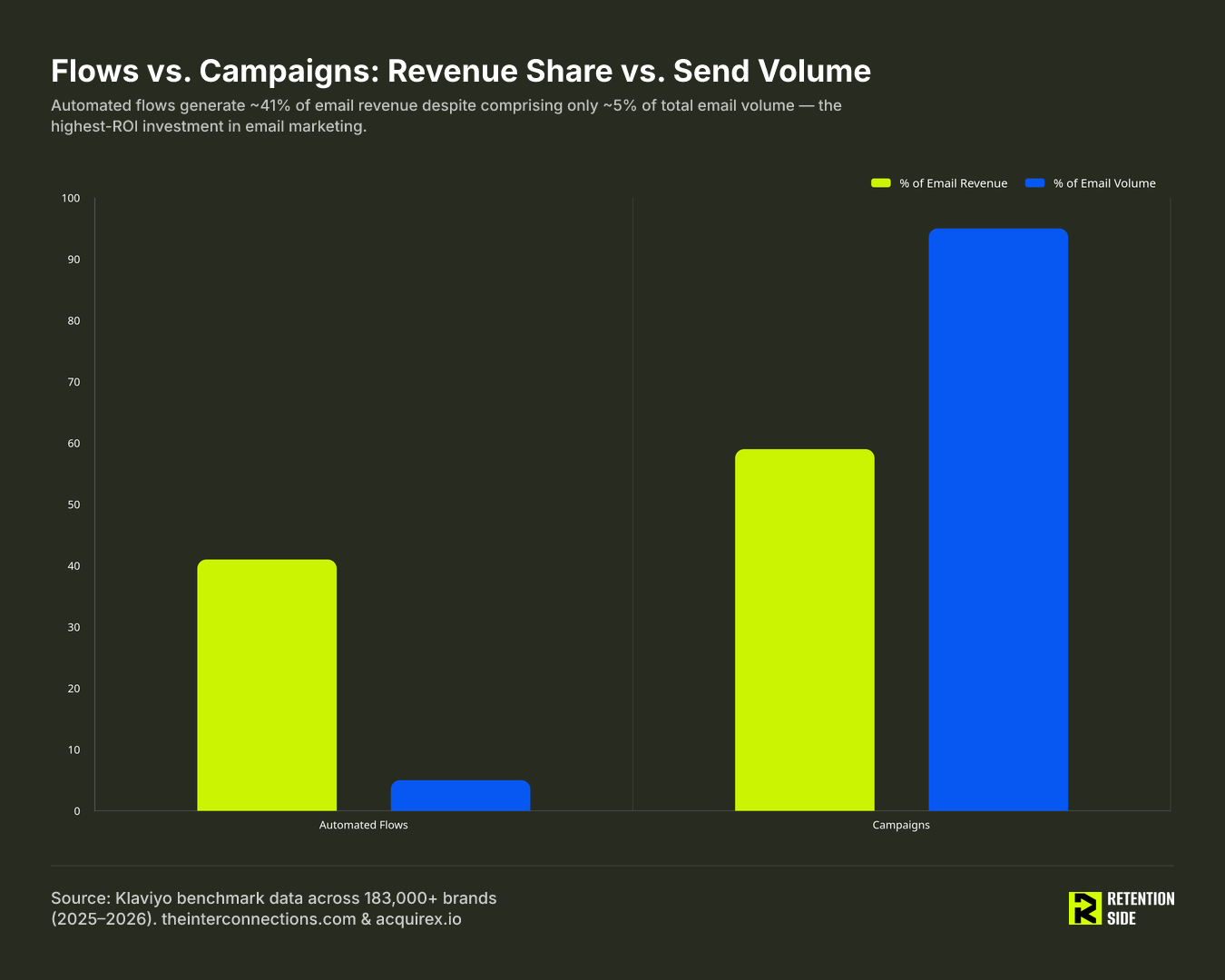
The welcome series, abandoned cart, browse abandonment, post-purchase sequence, and win-back/sunset flow form the core five that consensus across ecommerce email research consistently points to. Klaviyo benchmark data shows these automated flows generate roughly 41% of total email revenue from just 5% of total email volume, which is the clearest argument for why flows should be built and refined before campaign volume is scaled up.
Revenue per recipient varies meaningfully by flow: abandoned cart leads at $3.65, followed by welcome at $2.65, browse abandonment at $1.07, and post-purchase at $0.41, with win-back generally trailing behind the other four.
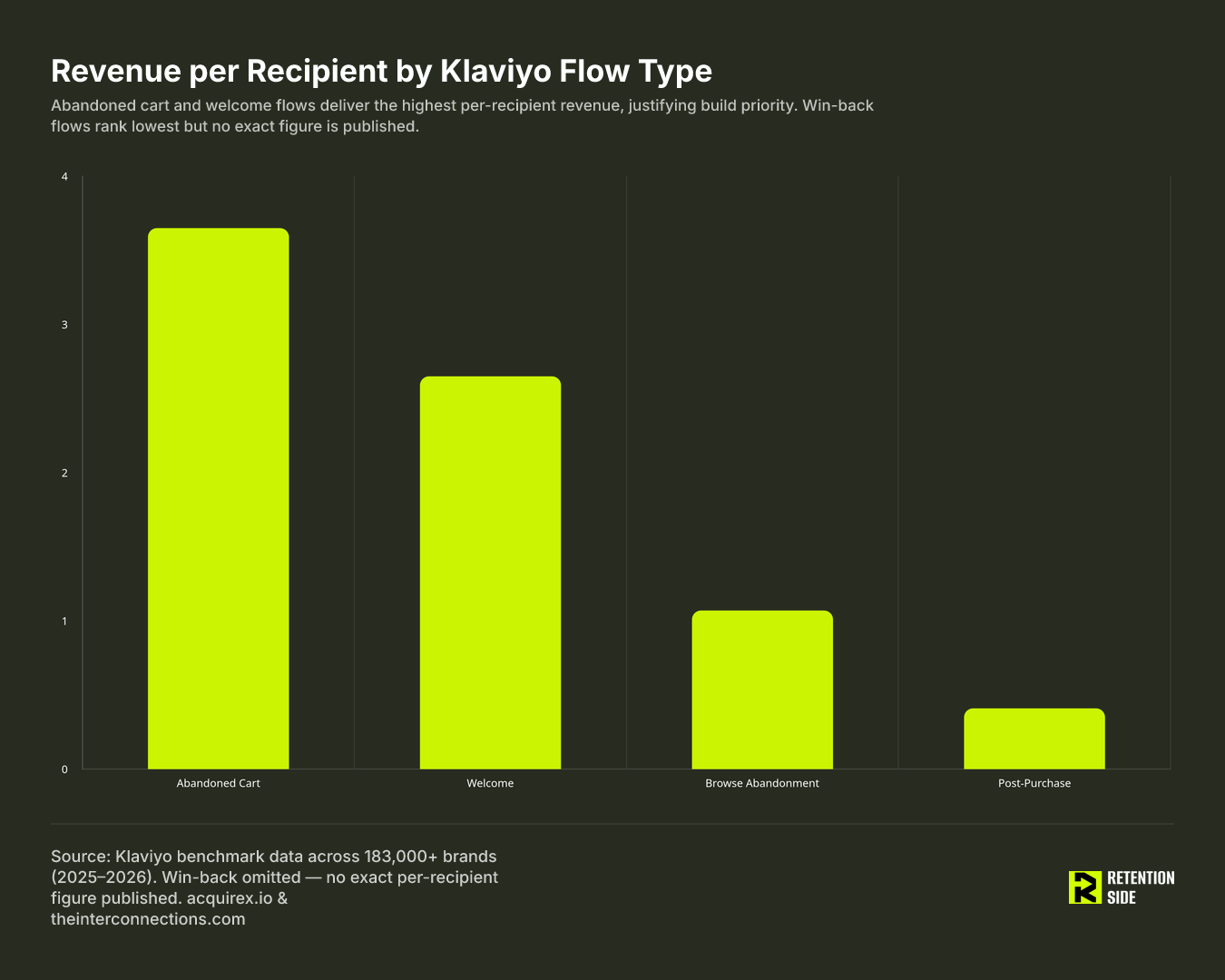
That doesn’t mean win-back isn’t worth building, it means its role is different: recovering marginal revenue from an audience that’s already disengaging, not driving peak conversion. Our Klaviyo setup guide covers how to sequence and build all five properly.
What big brands use Klaviyo?
Klaviyo’s customer base spans platforms and verticals well beyond Shopify. DKNY runs on Shopify with 1.2 million-plus active subscribers, generating 30% of Klaviyo-attributed value from flows alone while cutting total email sends 24% year over year and still growing click rate 8%. Dollar Shave Club consolidated its CRM stack in Klaviyo and cut total cost of ownership by more than 30%. Helen of Troy, which manages OXO, Osprey, and Hydro Flask on Adobe Commerce/Magento, achieved 40%+ TCO savings and migrated three brands in about a month. Thirdlove reports 15x SMS ROI in the first half of 2025 on Shopify. Huda Beauty, running on Salesforce Commerce Cloud, posted 55%+ year-over-year subscriber growth and more than doubled Klaviyo-attributed revenue. Half Magic achieved 5x growth in repeat purchasers using Klaviyo’s email, SMS, and Customer Hub together. The range across Shopify, Magento, and Salesforce Commerce Cloud makes one thing clear: the integration architecture matters more than the underlying commerce platform.
The takeaway
Integrations aren’t a feature checklist, they’re the data pipeline your entire retention system runs on. A brand with three well-built integrations feeding clean, actionable data into Klaviyo will consistently outperform a brand with fifteen integrations installed but never actually used in flow logic or segmentation.
The brands generating outsized revenue from Klaviyo, from DKNY to Thirdlove to Huda Beauty, aren’t winning because of better subject lines. They’re winning because their integration architecture gives Klaviyo the data it needs to make every send more precise than the last one. Get the foundation right, sequence the rest deliberately, and the creative work you’re already doing will finally have the targeting behind it that it deserves.