


Most Shopify brands growing past $300K/month have the same structural gap: acquisition is working, the product is strong, but a significant share of buyers never come back. Every month starts from scratch. The revenue is real – the retention is missing.
This is not a Klaviyo problem or a campaign problem. It’s a system problem. Shopify retention marketing is the practice of building the infrastructure that closes that gap – across channels, across the customer lifecycle, and across the data layer that connects it all.
This article is a practical guide to how that system works, what it’s built on, and what Shopify-specific context shapes the decisions at every stage.
Key takeaways
- Shopify retention marketing is a multi-channel system built on customer behavior data, not a collection of standalone tactics.
- Email via Klaviyo is the most proven starting point and is structured around four pillars: deliverability, list growth, automated flows, and campaigns. All four matter equally.
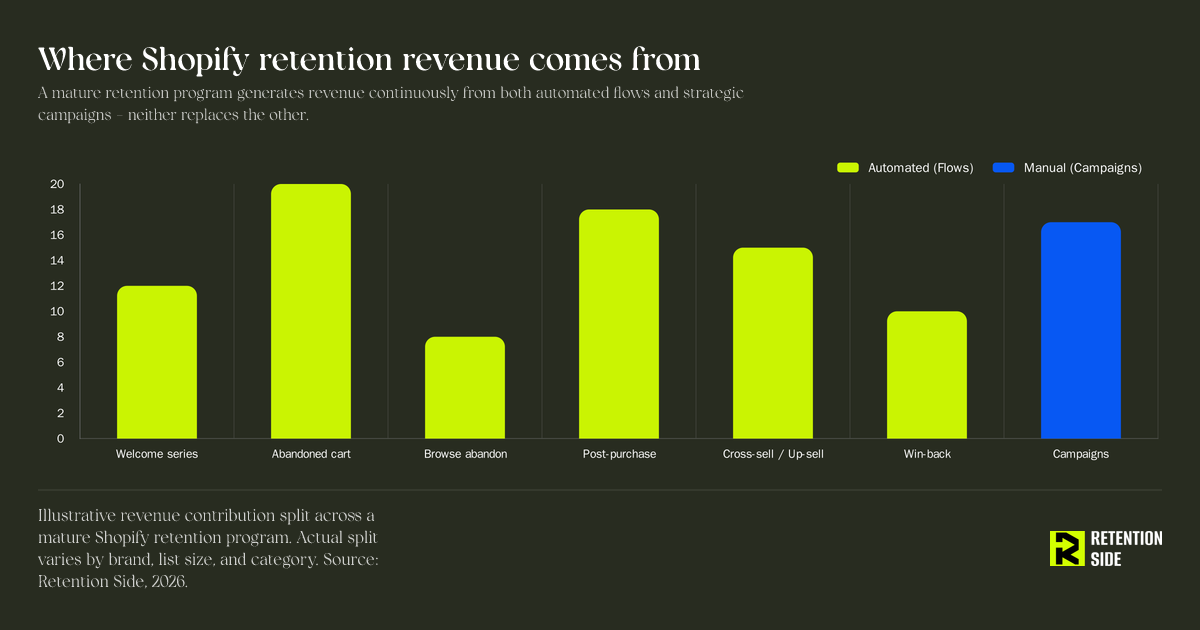
- Flows and campaigns are equally important. Neither is a substitute for the other.
- The metrics that tell you whether retention is working are repeat purchase rate, revenue attributed to retention channels, list growth rate, and deliverability health. Not open rate or click rate.
- Repeat purchase rate benchmarks differ significantly by product category. A rate that’s strong in one niche may be underperforming in another.
- A retention system built on Shopify + Klaviyo is only as strong as its data infrastructure – if Shopify events aren’t tracking cleanly into Klaviyo, the entire automation layer is compromised.
What Shopify retention marketing actually means
Shopify is the operating system most serious DTC brands run on. It handles the store, the checkout, the orders, the customer data. But Shopify itself is not a retention platform – it’s a commerce platform. What it does exceptionally well is generate the behavioral data (checkout events, product views, order history, repurchase predictions) that a retention system needs to function.
Retention marketing in this context is the system built on top of that data. Its job is to take a customer who bought once and give them a systematic, well-timed reason to buy again – across the right channels, with the right messaging, at the right moment in their lifecycle.
The distinction matters because many Shopify brands think they have retention marketing when they have something much narrower: a welcome flow, maybe an abandoned cart sequence, and a weekly campaign. Those are components. They’re not the system.
A true Shopify retention marketing system has three layers working together:
The communication layer – reaching the right customer, on the right channel, at the right time with a relevant message. This is where email, SMS, push notifications, direct mail, loyalty programs, WhatsApp, and Viber live.
The automation layer – behavior-triggered sequences that run continuously, based on what customers actually do in the Shopify store. These fire without manual input and map to specific stages in the customer lifecycle.
The data layer – the Shopify-Klaviyo integration that keeps customer profiles, behavioral events, and purchase history flowing cleanly between platforms. Without this, the other two layers are guessing.
Why Shopify-specific retention thinking matters
The reason it’s worth framing retention in Shopify terms isn’t just technical – it’s strategic.
Shopify’s native tooling (Shopify Email, Shopify Audiences, Shopify Analytics) gives a useful starting picture, but has clear ceilings. Shopify Email’s built-in automation covers basic abandoned checkout recovery and a handful of standard notifications. It doesn’t support the behavioral logic, segmentation depth, or lifecycle branching that a serious retention program needs.
For brands doing meaningful monthly revenue, the Klaviyo-Shopify integration is effectively standard. Klaviyo reads every Shopify behavioral event in real time: “viewed product,” “checkout started,” “order placed,” “fulfilled,” “predicted next order date.” Those events are what allow automated flows to behave intelligently rather than just sending time-delayed reminders.
Shopify’s repeat purchase rate data, available natively in the analytics dashboard, is also one of the clearest diagnostic signals for how a retention system is performing. Shopify’s own data puts the average repeat customer rate for online retailers at approximately 30%. If your store is below that, and your product has genuine repeat purchase potential, the gap is a retention system problem – not a product problem.
The four pillars of email: where Shopify retention starts
Email is where Shopify retention marketing almost always begins, and for a clear reason. It’s owned, algorithm-free, and when properly configured with Klaviyo, it becomes the most flexible and cost-efficient channel in the retention stack. But “doing email” and building a functional email program are not the same thing.
A functional Shopify email retention program is built on four pillars. They’re interdependent – a weakness in any one limits what the others can produce.
Pillar 1: Deliverability
Deliverability is not about whether your email was sent. It’s about whether it reached the inbox.
Delivery (the email was technically accepted by a receiving server) and deliverability (the email landed in the primary inbox, not spam or promotions) are different things. A brand can have a 99% delivery rate and still have 40% of sends routing to spam. That’s a program that isn’t working regardless of how good the copy is.
Inbox placement is determined by sender reputation signals: authentication records (SPF, DKIM, DMARC), consistent sending behavior, list hygiene, and spam complaint rates. Google’s bulk sender requirements – enforced from February 2024 – make proper SPF, DKIM, and DMARC authentication mandatory for any sender exceeding 5,000 sends per day to Gmail addresses. Non-compliance means rejection or spam routing. Brands also need to maintain spam complaint rates below 0.10% as measured in Google Postmaster Tools to stay in good standing.
The most common deliverability killer on Shopify brands is over-sending to disengaged subscribers. Inbox providers treat persistent non-engagement as a trust signal: if your emails aren’t being opened or clicked, the signal is that recipients don’t want them. A list full of chronically unengaged subscribers drags down sender reputation on every send. List hygiene – suppressing hard bounces, removing long-term non-engagers through a structured sunset process – is ongoing maintenance, not a one-time task.
Pillar 2: List growth
List growth is the acquisition side of retention. It’s how new contacts enter the email ecosystem, ideally before or shortly after a first Shopify purchase.
The metric most brands track is form submission rate. The metric that actually matters is lead-to-customer rate: what percentage of new email subscribers make a purchase within a defined window after signing up? A smaller list with a high lead-to-customer rate outperforms a larger list of low-intent subscribers on every meaningful business measure.
This reframe changes how you should think about signup form design. Forms that fire immediately on every page for every visitor grow raw subscriber counts efficiently – and collect a lot of low-intent traffic that inflates numbers while degrading list quality. Forms triggered by behavioral signals (exit intent, scroll depth, time-on-site thresholds) capture fewer people but better ones.
Incentive design shapes subscriber quality too. A discount code attracts price-sensitive subscribers. A product education resource, quiz, or preference survey attracts people who are genuinely interested in the category. Neither is always right – the choice should reflect what kind of subscriber your margin structure and product category can afford to acquire.
Zero-party data collected at signup is where list quality compounds. Product preferences, use cases, purchase intent signals – data that customers choose to share rather than behavioral inferences you make later – powers segmentation from the first email and improves the relevance of every flow and campaign that follows. Forrester has written extensively about zero-party data as a foundational trust mechanism: brands that ask customers directly what they want generate stronger engagement than those that rely entirely on behavioral inference.
Pillar 3: Automation (flows)
Flows are the always-on layer of Shopify retention. They’re behavior-triggered sequences that fire based on what customers actually do in the store – what they view, what they add to cart, what they buy, how long it’s been since their last order. They generate revenue continuously without requiring manual input.
The core principle is that a flow isn’t an automated email – it’s a mapped customer lifecycle moment. Each flow has a specific job to do at a specific point in the customer journey. Building them with that framing changes what you build, how you sequence the emails within each flow, and what you test.
The flows that every Shopify brand at meaningful scale should have built, maintained, and actively tested:
Welcome series – activates when a new subscriber joins without purchasing. The job isn’t just to deliver the signup incentive. It’s to build the case for a first purchase: establish brand voice, communicate product value, handle common pre-purchase objections, and use zero-party data collected at signup to personalize from email one.
Abandoned cart flow – triggers when a shopper adds to cart but doesn’t complete checkout. Research from the Baymard Institute consistently puts the average cart abandonment rate above 70% – meaning the vast majority of shoppers who show genuine purchase intent never complete the transaction. The flow’s job is to identify and address the specific friction that stopped the purchase – whether that’s shipping cost anxiety, product uncertainty, distraction, or trust gaps. A generic “you left something behind” reminder is better than nothing. A well-structured sequence that branches by cart value, customer history, and product type recovers meaningfully more. The first email should go out within 1-2 hours of abandonment while intent is still warm.
Browse abandonment flow – fires when a visitor views product pages without adding to cart. The intent signal is softer than cart abandonment, but it’s real – and the audience pool is considerably larger. A thoughtfully timed, product-specific sequence captures intent signals the cart flow entirely misses.
Post-purchase sequence – begins immediately after an order is placed. This is the most underused window in most Shopify email programs. A customer who just bought is at peak engagement with the brand. A strong post-purchase sequence uses that moment to deliver product education, set expectations, build trust, introduce the broader catalog, collect reviews at the right time, and engineer the second purchase – which is the single most predictive indicator of long-term retention.
Cross-sell and up-sell flows – triggered after purchase to introduce complementary products or higher-value alternatives based on what the customer just bought. These should be built on actual Shopify purchase data – catalog relationships derived from what customers who bought product A also buy within 60-90 days. Not assumptions.
Win-back flow – activates around the point where a customer would historically be expected to repurchase but hasn’t. The timing is calibrated to your brand’s specific order frequency data, not a generic calendar. For most Shopify brands with replenishable products, that window is well within 90 days. The flow’s purpose is to re-engage a drifting customer before they disconnect entirely – with messaging that acknowledges the gap and offers a genuine reason to return.
One important clarification: sunset flows serve a different purpose. Their job is list hygiene – systematically removing chronically disengaged subscribers to protect deliverability. They don’t generate revenue and should never be grouped with revenue-driving flows when evaluating your automation architecture.
Pillar 4: Campaigns
Campaigns are the broadcast layer – manually planned sends to selected list segments, covering product launches, seasonal promotions, educational content, and relationship-building sends between promotional cycles.
Campaigns and flows are equally important. A program that relies entirely on flows will eventually feel mechanical. A program that’s entirely campaign-driven works harder than necessary and misses the compounding value of always-on automation. Neither substitutes for the other.
The mistake most Shopify brands make with campaigns isn’t the volume – it’s reducing them to a promotional calendar. A campaign strategy built around discount announcements conditions subscribers to wait for offers before buying. Over time, this erodes full-price purchasing and depresses engagement outside of sale windows – which compounds into a deliverability problem as engagement signals degrade between promotions.
A durable campaign strategy balances promotional sends with value-driven content: product education, brand storytelling, customer spotlights, seasonal context that isn’t purely commercial. These maintains the subscriber relationship without requiring a discount to justify the send.
Segmentation is what makes campaigns genuinely effective. The same message sent to your entire Shopify customer list – regardless of purchase history, engagement level, or product category interest – is a missed opportunity. Active buyers need campaigns that acknowledge their existing relationship with the brand. Subscribers who haven’t yet purchased need different messaging. VIP customers warrant early access or exclusivity. The list is never one audience.
Retention channels beyond email
Email is where a Shopify retention system starts. It’s not where it ends.
As the foundation matures, the retention stack should expand into channels that extend reach, serve different communication functions, and meet customers on the platforms they actually respond to. The key is that each channel serves a distinct role – and they need to be coordinated, not just running in parallel.
SMS is the urgency layer. Text messages get read within minutes, which makes SMS the right channel for time-sensitive, high-intent moments: flash sales, back-in-stock alerts, shipping notifications, and abandoned cart recovery where speed is a factor. SMS lists on Shopify brands are typically smaller than email (most brands see SMS consent rates at 20-30% of their email list size), and frequency sensitivity is higher. Overuse burns the channel faster than any other. Klaviyo’s SMS benchmark data confirms that SMS consistently outperforms email on immediate engagement metrics – which is precisely why restraint and list quality matter so much in this channel.
Push notifications function as a supporting channel. Browser and app push notifications extend retention reach to users who respond better to on-screen prompts than inbox messages – useful for cart recovery, price-drop alerts, and restock reminders. They don’t carry the narrative weight of email, but they create additional touchpoints that reduce pressure on the inbox.
Loyalty programs are a structural retention lever, not a communication method. A well-designed tiered loyalty program gives customers something to work toward – status, rewards, exclusivity – that makes switching to a competitor feel costly. The behavioral data a loyalty program generates feeds back into segmentation across every other channel. BCG research on loyalty programs highlights that customer expectations around loyalty have risen sharply – programs that offer genuine value and personalization outperform generic points-for-purchase structures by a significant margin.
Direct mail operates differently from digital channels. The physical mailbox has become considerably less crowded as digital marketing expanded – which is exactly why a well-timed direct mail piece can move a lapsed Shopify customer that five re-engagement emails couldn’t. The cost per piece ($0.30 to $3 depending on format and volume) makes it a precision tool best reserved for high-value customer segments and win-back of lapsed VIP customers.
WhatsApp and Viber matter depending on your geographic customer mix. For Shopify brands with strong European, Middle Eastern, or Southeast Asian customer segments, these platforms function where your customers actually communicate daily – and they support richer message formats than SMS. For primarily US-based audiences, these channels are worth monitoring. For brands with meaningful international presence in relevant geographies, they belong in the active retention stack.
The sequencing principle: establish a strong email foundation first. Layer in additional channels as the system matures, based on what your audience behavior and channel data tells you – not because a checklist says it’s time.
Repeat purchase rate: what “good” actually looks like on Shopify
Repeat purchase rate is the clearest single signal that a retention system is working. But interpreting it requires category context – one universal benchmark applied across all Shopify stores is not meaningful.
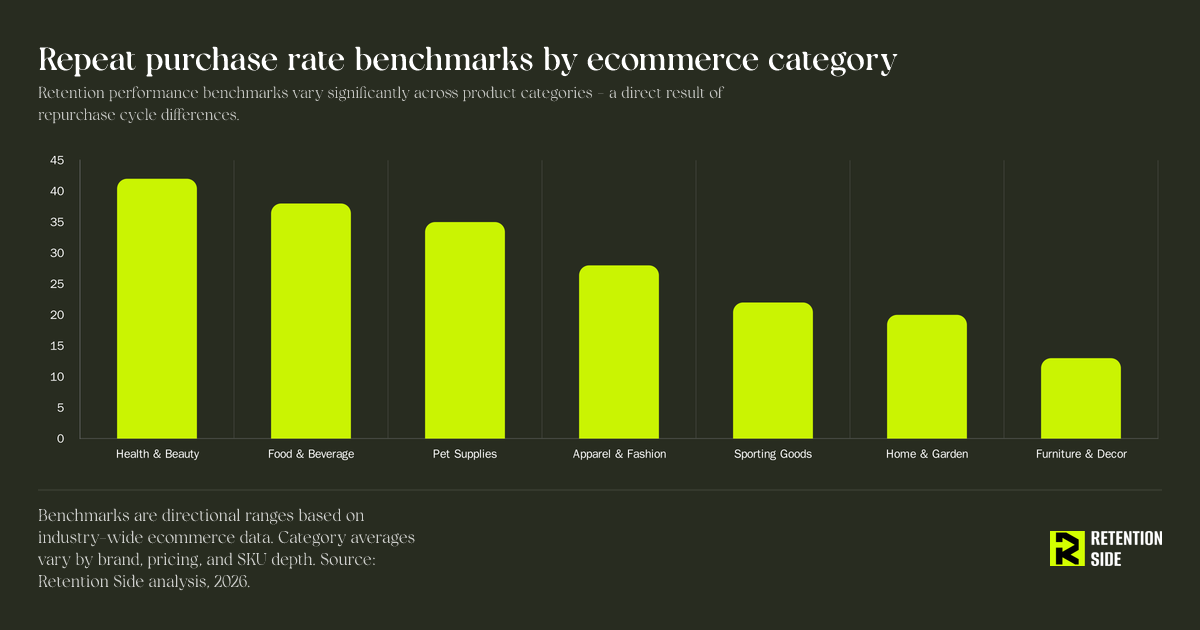
Health and beauty – supplements, skincare, haircare – structurally produces the highest repeat rates because products are consumable. Customers run out and need to reorder. The retention job in this category is ensuring they reorder from your Shopify store rather than a competitor’s. Rates below 35% in this category are worth investigating.
Food and beverage follows a similar replenishment logic with slightly shorter cycles in some sub-categories. Subscription structures are common and can significantly alter the rate if subscription revenue is included in the calculation.
Apparel sits in the middle range, where repeat purchasing depends more on brand affinity and the quality of the post-purchase experience than on product replenishment cycles. Rates in the mid-20s are competitive in many apparel segments.
Sporting goods and outdoor equipment tend to sit lower – purchases are more considered, product lifespans are longer, and category switching is less frequent. A rate in the low-20s can represent genuine retention strength here.
Furniture and home decor have structurally long repurchase cycles by the nature of the product. A 10-15% repeat rate in furniture can represent strong retention performance. Applying standard benchmarks to this category is a category mistake that any serious retention partner should recognize immediately.
The practical implication for Shopify brands: your repeat purchase rate target should be calibrated against your own category, your average order frequency, your catalog depth, and your own historical baseline. What matters most is whether the rate is trending upward over time – not where it sits relative to a cross-category average.
The Shopify data layer: what most brands get wrong
Retention system quality on Shopify is directly tied to the quality of the Klaviyo integration. And most brands underestimate how often this layer has silent gaps.
Klaviyo reads behavioral events from Shopify: “viewed product,” “checkout started,” “placed order,” “order fulfilled,” and more. These events are what trigger flows and power segmentation. If they’re not firing reliably, the automation layer is compromised – not broken in a way that generates error messages, but broken in a way that means flows are missing triggers, segments are built on incomplete data, and win-back timing is based on stale profile information.
Common data layer issues on Shopify-Klaviyo integrations:
- Browse abandonment flows that aren’t firing because “viewed product” events aren’t tracking consistently
- Post-purchase sequences that are triggering on the wrong order types or duplicating sends
- Win-back flows running on default timing because historical purchase frequency data isn’t feeding into the trigger logic
- Zero-party data collected through signup forms not mapping to profile properties that actually get used in segmentation
Before building out a complex flow architecture or launching a multi-channel retention stack, verifying the integrity of the Shopify-Klaviyo data connection is foundational work. The automation layer is only as smart as the data flowing into it.
Measuring whether your Shopify retention system is working
The metrics that tell you whether a retention system is genuinely building the business are not the ones most email platforms surface prominently.
Repeat purchase rate (returning customer rate) is the primary retention health metric. Shopify surfaces this natively in the analytics dashboard. If the percentage of customers making more than one purchase is growing over time, the system is working. If it’s flat despite email investment, something structural needs attention.
Revenue attributed to retention channels is what your email, SMS, and other owned channels are contributing to total Shopify store revenue. This is tracked over time relative to investment. Attribution in retention is never perfectly clean and should be interpreted with nuance rather than read as a hard number – but the directional trend tells you whether the system is earning its place.
List growth rate matters in combination with lead-to-customer rate. Raw subscriber count without conversion rate context is a vanity metric. What you want to know is whether the subscribers being added are converting to customers, and at what rate.
Deliverability indicators – inbox placement rate, spam complaint rate, hard bounce rate – are the early warning system. By the time inbox placement has visibly degraded, months of list health damage may already have accumulated. These should be checked proactively, not reactively.
Flow-specific conversion metrics – what percentage of customers entering each flow complete the target action. Abandoned cart conversion rate, welcome-to-first-purchase rate, post-purchase cross-sell conversion. These tell you which parts of the automation layer are working and which need testing and optimization.
Average time between orders – not a standard Shopify dashboard metric, but one of the most informative signals for whether email is genuinely accelerating the customer lifecycle. If the gap between first and second purchase is shortening over time, the post-purchase and cross-sell flows are doing their job.
Metrics to deliberately avoid using as primary KPIs: open rate, click rate. These are diagnostic signals – useful for identifying specific technical or creative problems – but they don’t directly measure business impact. An agency or team that leads reporting conversations with open rates is measuring the wrong thing.
Common mistakes Shopify brands make with retention
Building flows once and walking away. A welcome series or abandoned cart flow written at store launch, with original product copy and original brand voice, is probably misaligned with what the brand is today. Flows need regular audits, creative refresh cycles, and ongoing A/B testing. A flow that hasn’t been touched in 18 months is almost certainly underperforming.
Expanding channels before email is solid. SMS, push notifications, and direct mail are all legitimate additions to a Shopify retention stack. But layering them on top of a broken email foundation distributes the same structural problems across more channels. Get deliverability clean, flows built, and list quality up before extending into new channels.
Treating discounts as the default retention mechanism. Incentives in automated flows are often justifiable – only a small percentage of subscribers trigger any specific flow, and proper exclusion filters prevent overlap between sequences. But defaulting to a discount in every flow, without margin logic, trains customers to wait for offers and erodes full-price purchasing behavior over time.
Misreading performance signals. A decline in email-attributed revenue on Shopify doesn’t always mean the email program is broken. It may mean acquisition traffic quality has shifted, bringing lower-intent subscribers into the list. It may mean website conversion has dropped – which creates a floor problem that no amount of email optimization addresses. Diagnosing root cause before rebuilding strategy saves significant time and budget.
Ignoring how acquisition shapes retention. The quality of your paid traffic shapes the quality of your email list. A high-intent, well-targeted acquisition audience produces better leads and better retention rates. Email strategy should understand where customers are coming from and what acquisition channels are currently active – because a change in acquisition mix will show up in retention metrics within weeks.
How Shopify retention connects to the broader marketing system
Retention on Shopify doesn’t operate in isolation. The email program’s performance is downstream of what acquisition channels bring to the list, and upstream of the customer experience that determines whether someone comes back.
This means a serious Shopify retention strategy requires caring about acquisition – not managing it, but understanding it. What customers are currently being acquired? Through which channels? With what messaging? The answers shape everything from welcome series framing to win-back timing to campaign segmentation logic.
The relationship runs the other direction too. A strong retention system feeds acquisition in ways that compound over time. High-LTV customers provide lookalike audience data that improves paid targeting quality. Loyal customers refer others and leave reviews. Strong retention economics increase the LTV-to-CAC ratio – which determines how aggressively a brand can bid in acquisition channels.
At Retention Side, the entry point into every Shopify engagement is email via Klaviyo – because that’s where the most immediate, measurable retention infrastructure lives. But how the retention stack grows from there depends entirely on what the audience data and channel behavior indicate, not a fixed expansion sequence. The platform is Shopify. The foundation is email. The system is what compounds customer value over time.
Conclusion
Shopify gives you the data. A retention system is what you build on top of it.
The brands that consistently grow customer lifetime value on Shopify aren’t doing more marketing – they’re doing more systematic marketing. Flows that cover each stage of the customer lifecycle. Campaigns that maintain relationships between promotions. A channel architecture that meets different customers in different places without those channels competing for attention. A data layer that keeps the automation intelligent.
The gap between a Shopify brand with a functional email setup and one with a built retention system is measurable in repeat purchase rate and in the compounding economics that follow. A customer who buys three times is fundamentally different from a customer who buys once – in revenue terms, in referral behavior, and in the unit economics they produce relative to what it cost to acquire them.
If your Shopify repeat purchase rate is flat despite email investment, the issue is almost always structural. Either the data layer has gaps, the flow architecture doesn’t cover the full customer lifecycle, the campaigns are too promotional to sustain engagement outside of sales, or the channel mix hasn’t been built to meet your customers where they actually respond. None of those problems are fixed by sending more emails or adding another channel. They’re fixed by building the system correctly.
That’s exactly the kind of work Retention Side does.