


Pet is one of the few eCommerce categories where retention should be easy. Food runs out. Litter runs out. Flea and tick protection has a season. The product itself creates a reason to come back on a predictable schedule, and the emotional attachment behind the purchase is stronger than almost any other consumer category. Yet most pet brands still run email like every other DTC vertical: a welcome series, a few abandoned cart emails, and a promo calendar that fires whenever revenue dips.
That gap between what the category allows and what most programs actually do is the opportunity. This guide walks through how to think about email marketing for pet brands as a lifecycle system, not a campaign channel, and where the pet-specific mechanics (replenishment timing, subscription versus one-time buyers, multi-pet households) should change how you build flows, segments, and campaigns.
What this guide covers
- Why pet sits structurally ahead of most eCommerce verticals on retention potential, and what that means for how you should be measuring your program
- The subscription versus one-time buyer split that should shape your list strategy from day one
- How to apply Retention Side’s four-pillar system (deliverability, list growth, flows, campaigns) specifically to pet lifecycle timing
- What Chewy and BARK’s very different outcomes actually teach about replenishment versus discovery economics
- Where email fits into the broader retention channel mix for pet brands
- The most common mistakes pet brands make with their email programs, and when it makes sense to bring in a retention partner
Why pet email is a retention category, not a promotion channel
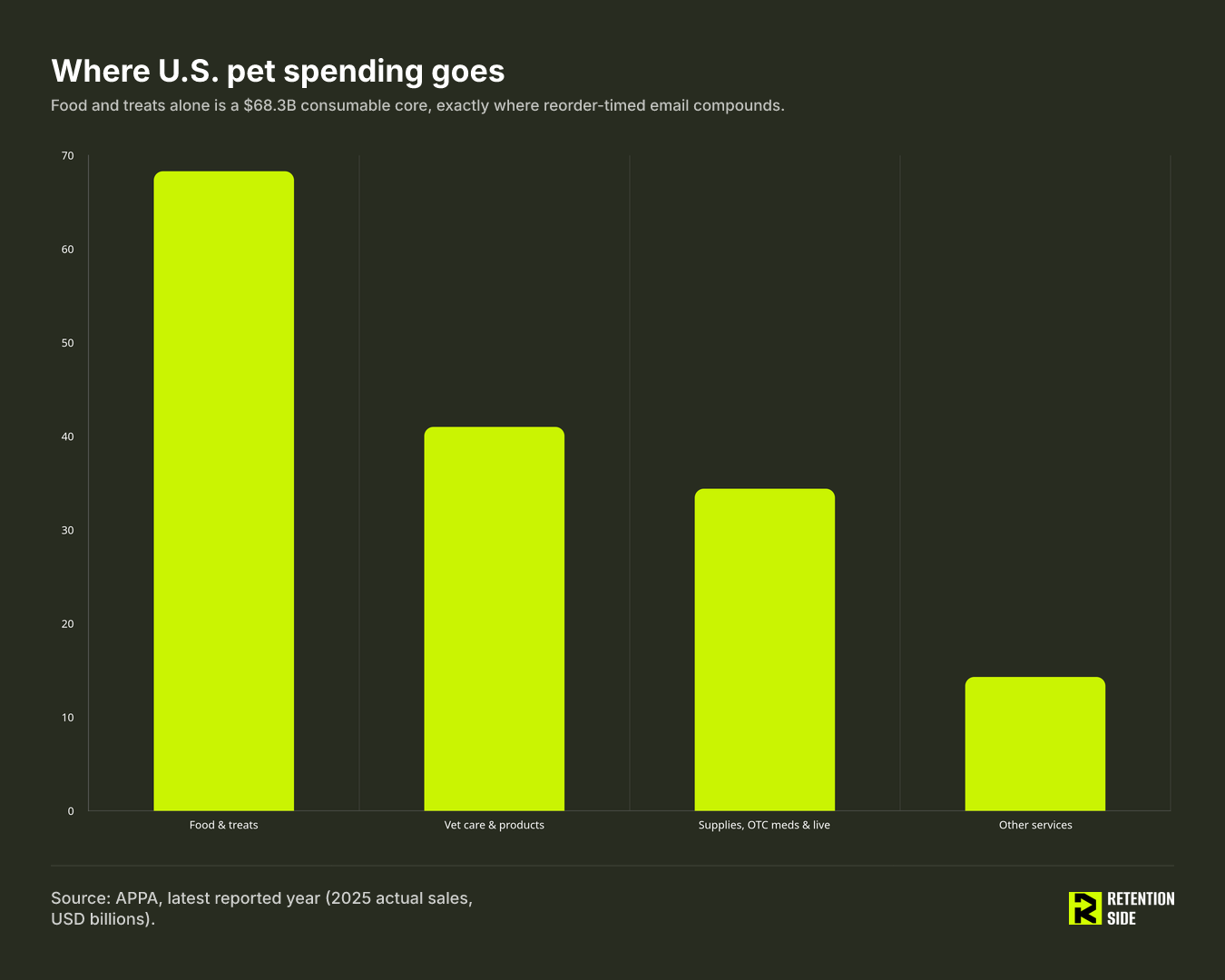
The U.S. pet industry is enormous and still growing. Total pet spending reached an estimated $158 billion in 2025, with a projected climb to $165 billion in 2026, according to APPA’s industry data. Food and treats alone account for $68.3 billion of that, more than vet care, supplies, and other services combined. Roughly 95 million U.S. households own a pet, and just over 71% of households have at least one.
That scale matters less than the shape of the spending. Food, treats, and consumables are recurring purchases by definition. A brand selling a consumable product has a built-in reason for the customer to come back that a brand selling a one-time durable good simply doesn’t have. This shows up directly in repeat purchase rate data: cross-vertical eCommerce repeat purchase rate averages around 28.2%, while consumable categories typically run 35% to 55%. Add subscription mechanics on top of a consumable product and that range can climb to 50-70%.
This is the part most pet brands miss. They treat their email program the way an apparel brand or a home goods brand would, chasing one-time conversion and treating repeat purchase as a nice side effect. But if your core product is a consumable, your email system should be built primarily around reorder timing, not primarily around discovery. Deliverability, segmentation, and flow logic all downstream from that decision.
The structural split that should shape your list: subscription vs. one-time buyers
Before you build a single flow, you need to decide how you’re treating two fundamentally different customer types, because pet brands almost always have both.
Subscription mechanics are already deeply embedded in online pet spending. Roughly 40% of U.S. online pet care dollars run through subscriptions, and in food and treats specifically, subscriptions contribute 55% of category online sales for dog products and 51% for cat products, according to Nielsen IQ data on pet subscription behavior. At the same time, half of pet consumers say they simply don’t want a subscription, preferring in-store purchases or wanting to control price and timing themselves.
That’s not a contradiction; it’s two customer populations that need two different lifecycle paths. Subscribers need confirmation, control, and low-friction management. One-time buyers need to be nudged toward their next purchase at the right moment, without the assumption that they’ll auto-renew anything.
The churn physics behind each group are also different, and this is where a lot of pet brands get their win-back timing wrong. Replenishment subscriptions (food, treats, autoship-style programs) average 5-8% monthly churn. Discovery or curation boxes average 8-12% monthly churn, a meaningfully higher rate driven by novelty fatigue rather than product dissatisfaction. Roughly 44% of subscription cancellations happen in the first 90 days, which makes that window the real diagnostic point for early-lifecycle email and SMS intervention, not an arbitrary “day 90 win-back” trigger copied from a generic flow template.
The reward for getting this right is real. Across pet brands on Recharge’s subscription platform, roughly 76% of pet subscriptions renew, and pet food and supplement subscribers place about 5.4 orders per year compared to roughly 3.7 for durable goods subscribers, a 45% difference in order frequency. Retention in pet isn’t only available to giants; it holds up across brand sizes when the mechanics are built correctly.
Pillar 1: deliverability for pet brands
None of the segmentation or flow logic below matters if your emails aren’t reaching the inbox. Delivery and deliverability are not the same thing. Delivery means the email was technically accepted by the receiving server. Deliverability means it actually landed somewhere useful, the inbox, not spam and not buried in promotions.
The technical baseline is non-negotiable: a dedicated sending subdomain, properly configured SPF, DKIM, and DMARC, and a spam complaint rate kept under Google’s guideline of 0.1%. Pet brands run into a specific deliverability trap here more than most categories: heavy reliance on discount-driven promo calendars. If your list only hears from you when there’s a sale, engagement drops, complaint rates creep up, and inbox providers start deprioritizing your sends. That’s a deliverability problem disguised as a campaign strategy problem, and it compounds over time.
Pillar 2: list growth built for zero-party pet data
Subscriber volume is not the goal. Lead-to-customer rate is the number that matters, not form submission rate. A lead magnet that pulls in thousands of unqualified emails does nothing for your revenue if none of them convert.
Pet brands have an advantage here that a lot of categories don’t: naturally useful lead magnets that double as data collection. Breed and size guides, feeding calculators, and puppy or kitten life-stage quizzes all give a visitor a reason to hand over information beyond an email address. That information, pet type, breed, age, weight range, is zero-party data you can’t get any other way, and it’s exactly what should power the segmentation and flow timing described below. A generic 10%-off popup gets you an email. A feeding calculator gets you a customer profile.
Pillar 3: flows mapped to the pet lifecycle
Flows are behavior-based, time-sensitive automations, and they should map to where customers actually drop off, not to a generic template pulled from a different vertical. For pet brands, the flow sequence looks structurally similar to any strong Klaviyo program, welcome, cart and browse abandonment, post-purchase, replenishment, cross-sell, win-back, sunset, but the timing inside each flow needs to be calibrated to actual pet-specific behavior.
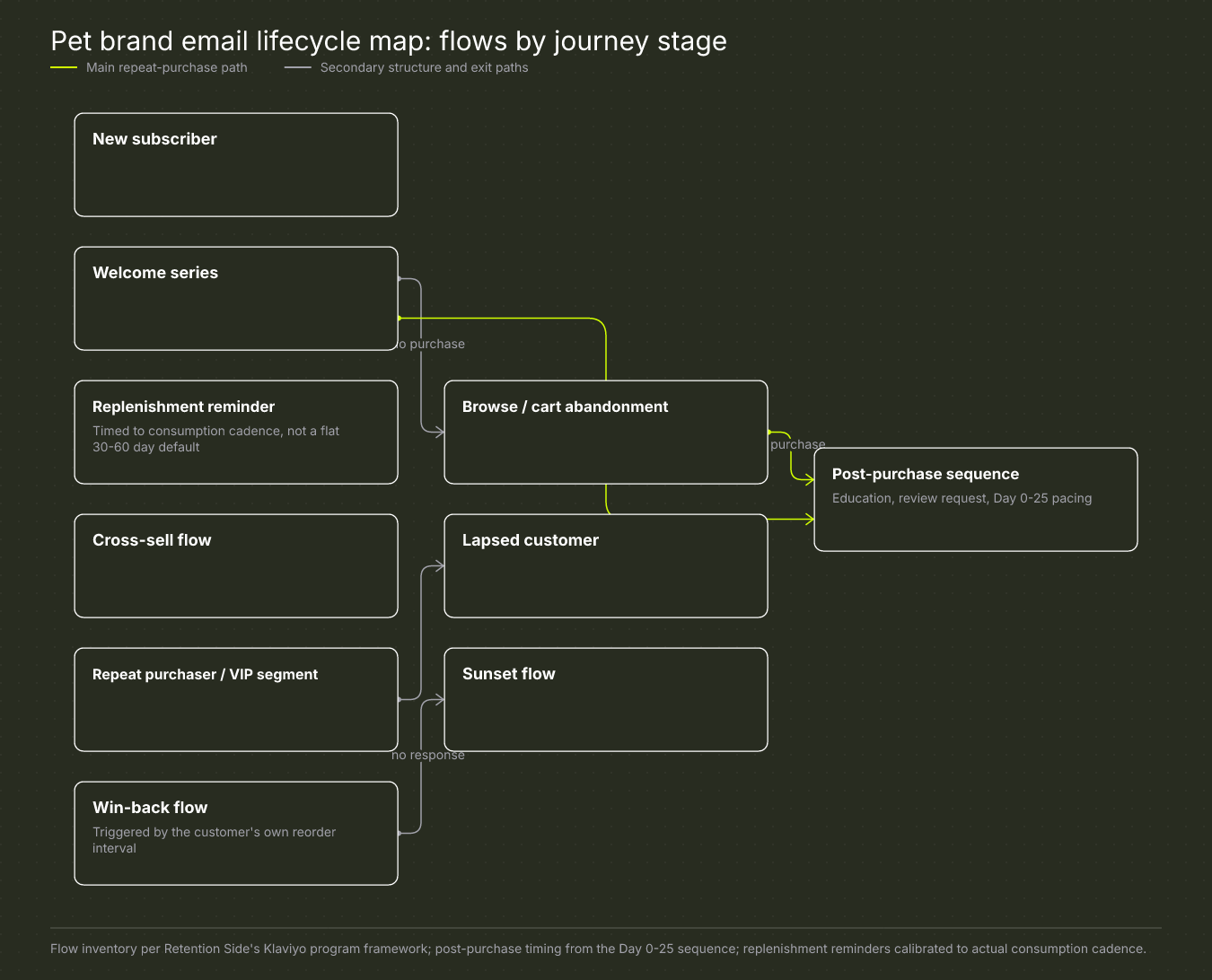
The post-purchase sequence is a good example of how this should be paced: order confirmation on day 0-1, product education on day 2-5 (feeding transition guidance, dosage information, product fit), replenishment or cross-sell messaging on day 7-10, a review request on day 14-21, and a second-purchase bridge on day 18-25. That’s a general eCommerce framework, but the single biggest pet-specific lever sits inside it: replenishment timing has to match actual consumption cadence, not a flat 30 or 60-day default.
A 40-pound bag of dog food lasts a different number of days for a Chihuahua household than a Great Dane household. A multi-pet household burns through consumables faster than a single-pet household, and that household should be treated as its own high-value segment, not folded into a generic “repeat customer” bucket. If your replenishment email fires two weeks before the customer actually runs out, it reads as noise. If it fires the day after they run out, you’ve already lost the sale to whoever was in front of them at that moment, often a marketplace, not your site. This is the one piece of flow logic that’s genuinely different in pet compared to most other consumable categories, and it’s worth building consumption-based logic into your Klaviyo flows rather than relying on default intervals.
Win-back timing should follow the same logic: trigger it relative to the customer’s own reorder interval, not a blanket 90-day rule. And remember flows are never finished. They should be tested and refined as you get more replenishment data per SKU.
Pillar 4: campaigns with real segmentation behind them
Campaigns are manual sends to selected segments, and campaign strategy depends entirely on how well you’ve segmented your list. Pet brands should be working from the same six core lifecycle segments that apply across eCommerce, new subscribers, engaged buyers, VIPs, lapsed customers, unengaged or sunset contacts, and non-purchasers, layered with RFM data and the zero-party pet data collected during signup.
Multi-pet households deserve specific attention as a VIP or high-RFM dimension. A customer buying food, treats, and supplies for three dogs has a fundamentally different lifetime value trajectory than a single-cat household, and your campaign cadence and offer strategy should reflect that rather than treating both as equivalent “repeat customers.”
The bigger strategic point is balance. If subscribers only hear from you during discounts, engagement and full-price purchasing decline over time, and pet is particularly vulnerable to this because there’s so much promotional noise in the category already. Educational content, seasonal hazard information, breed-specific tips, and social proof campaigns need to sit alongside promotional sends, not get crowded out by them.
What Chewy and BARK actually teach
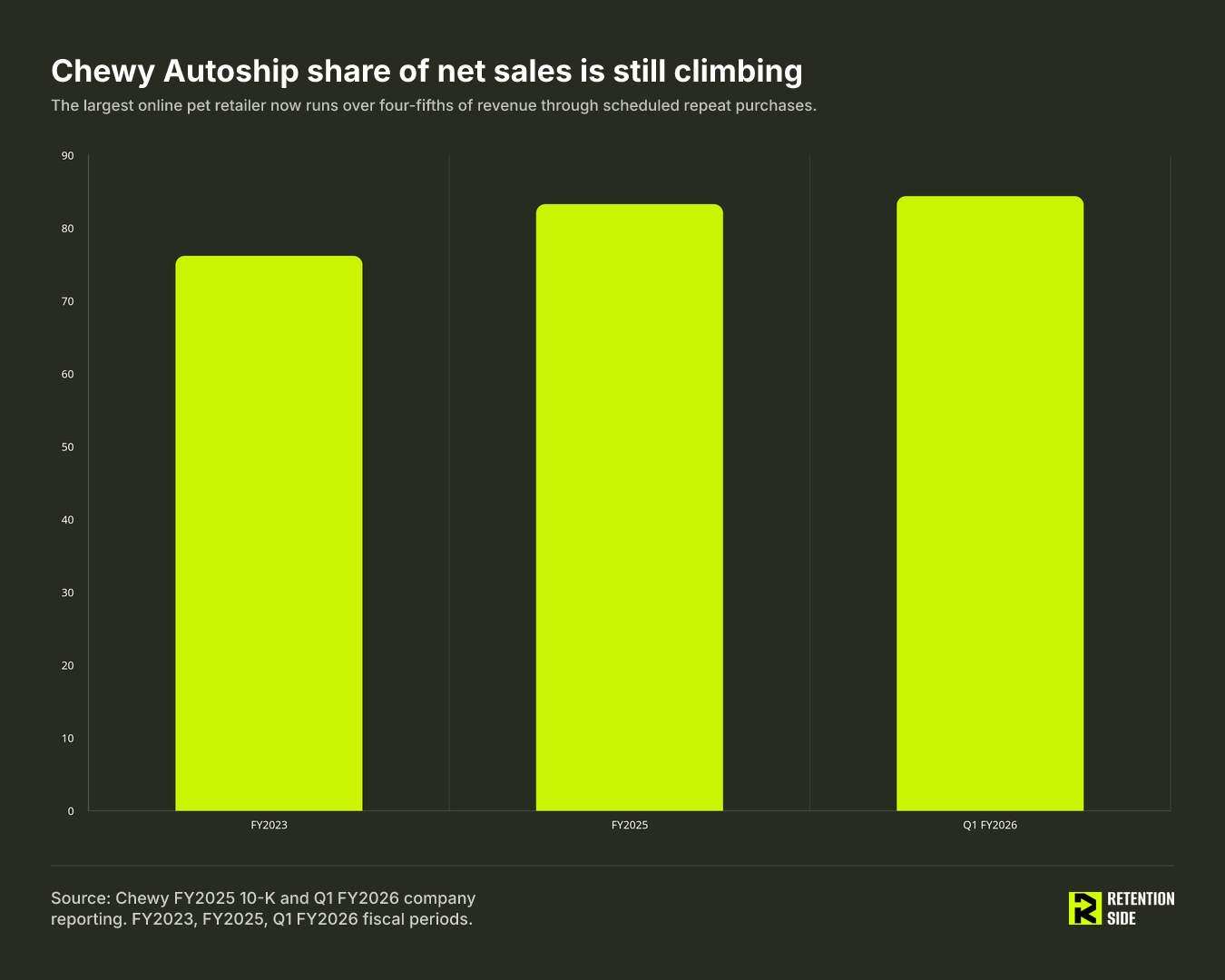
Chewy is the clearest proof point in the category for what replenishment-first email and lifecycle design can do at scale. Chewy’s Autoship program generated 83.3% of the company’s $12.6 billion in FY2025 net sales, up from 76.2% in FY2023, and climbed further to 84.4% in Q1 FY2026, across more than 21 million active customers. That’s not a discount mechanic. It’s pre-shipment notifications, customer-controlled scheduling, and communication built around convenience rather than urgency. Chewy’s ceiling is a useful benchmark, not a realistic near-term target for most brands, but the direction is the right one: the more of your revenue that runs through scheduled, predictable repeat purchases, the less your email program depends on constant discovery and discounting.
BARK offers a different lesson, and a cautionary one. BARK’s lifecycle team unified customer data across BarkBox, Super Chewer, BARK Eats, and BARK Bright into a single customer data platform so the brand could have one conversation with a customer instead of three or four disconnected ones, a smart move on data architecture. But BARK’s DTC revenue later fell nearly 22% in FY2026 after the company pulled back marketing spend on subscribers it couldn’t retain profitably. That’s the discovery-box churn problem showing up at scale: curation and surprise-driven subscriptions naturally churn faster (8-12% monthly) than pure replenishment subscriptions (5-8% monthly), and no amount of clever email segmentation fully offsets that structural difference. The lesson isn’t “don’t do discovery,” it’s “know which churn physics you’re building against before you scale spend.”
Beyond email: the channel mix for pet retention
Email is where most pet brands should start, but it isn’t where the retention system should end. SMS is a strong fit for time-sensitive replenishment reminders, “your dog’s flea and tick protection expires this month” travels well as a text in a way it can get lost as an email. Loyalty programs work best in pet when they’re explicitly tied to reorder cadence rather than generic points-per-dollar structures, since the behavior you actually want to reward is consistent replenishment, not just spend. Direct mail can make sense for high-value, multi-pet households where a physical touchpoint reinforces the relationship in a category defined by emotional loyalty.
The right mix depends on audience behavior, communication preference, and cost efficiency, not a template applied uniformly across every brand. That’s the retention-system view: email is the foundation, but it’s one channel in a coordinated system, not the whole system.
Common pet email program mistakes
A few patterns show up repeatedly in pet brands that haven’t built a real lifecycle system yet:
- One replenishment cadence for every product, regardless of how fast that specific SKU actually gets consumed by a given pet size or household
- Discount conditioning, where the list learns to wait for a sale instead of buying at full price, driven by an over-reliance on promotional campaigns
- Treating subscription and one-time buyers identically, using the same messaging and timing for two populations with very different churn behavior and expectations
- No zero-party pet data capture, missing the chance to collect pet type, breed, and life stage information that would make every downstream flow and campaign more relevant
Each of these is fixable, but they require treating email as infrastructure to be built deliberately, not a channel to be managed reactively.
When a pet brand needs a retention partner
Most pet brands hit a point where the acquisition side of the business is working, traffic and conversion are healthy, but revenue from existing customers isn’t compounding the way the category’s economics suggest it should. That’s usually a sign the retention system needs dedicated attention rather than another isolated campaign push.
It helps to know what kind of provider you’re actually looking at. Full-service DTC growth agencies treat email as one line item inside broader paid media work. Email-first agencies execute campaigns and flows well but rarely touch deliverability infrastructure, segmentation architecture, or the surrounding channel mix. Retention specialist agencies build around the same four pillars covered in this guide, deliverability, list growth, flows, and campaigns, and extend into SMS, loyalty, and other owned channels based on what the customer base actually needs.
Retention Side operates as a retention specialist, not an email execution vendor. For eCommerce brands doing at least $300,000 a month that already have acquisition working, Klaviyo email is typically where the retention system starts, but the actual work is diagnosing and rebuilding deliverability, list quality, segmentation, lifecycle flows, campaign strategy, and the channel mix around them. That system-level view is what a consumable, high-frequency category like pet actually needs: someone who’s building replenishment timing, subscription-versus-one-time logic, and multi-pet segmentation into the account, not just sending nicer-looking campaigns on the same generic cadence every other brand uses.
FAQ
What is the 80/20 rule for email marketing?
The 80/20 rule, borrowed from the Pareto principle, describes revenue concentration: roughly 80% of a brand’s revenue tends to come from around 20% of its customers. In email marketing, this isn’t a rigid statistic to prove, it’s a heuristic that should shape how you segment and where you invest. It means your VIP and high-RFM segments deserve disproportionate attention in post-purchase experience, loyalty design, and campaign targeting, rather than treating every subscriber on your list the same way. For pet brands specifically, multi-pet households and subscription customers often sit inside that top tier, which is exactly why they need dedicated flow and campaign logic rather than generic batch-and-blast treatment.
What brands have the best email marketing?
Rather than chasing an unranked “best” list, it’s more useful to look at verified mechanics from category leaders. Chewy built its email and lifecycle program almost entirely around Autoship convenience, pre-shipment notifications, customer-controlled schedules, and reorder timing, which is why Autoship now drives over 84% of its net sales. BARK took a different approach, using strong brand voice and humor in campaign copy while unifying customer data across its multiple subscription products (BarkBox, Super Chewer, BARK Eats) so customers get one coherent conversation rather than several disconnected ones. Both are worth studying for the specific mechanic behind their success rather than copying tone alone, since the mechanic (replenishment convenience vs. unified brand voice) is what actually drives the result.
What are the best affiliate programs for promoting pet products?
Several established pet retailers and brands run affiliate programs worth evaluating, though commission structures change and should always be verified directly in-platform before you plan around them. Chewy runs its program through Impact, with a Creator Track option for influencers. Petco’s Impact-based program typically offers a small base commission with higher rates on services and repeat delivery signups. PetSmart’s program has historically offered a longer cookie window than most competitors. Fresh pet food brands like The Farmer’s Dog, Ollie, and PetPlate tend to offer recurring commissions tied to their subscription models, which can be attractive if your audience matches their customer profile. Treat any specific rate you find as a planning estimate rather than a locked figure, since affiliate terms shift regularly.
How to get more clients for pet sitting?
Pet sitting is a trust-based, deadline-driven purchase, which means the marketing approach needs to be narrow and deep rather than broad. A well-maintained Google Business Profile with real photos and a steady trickle of reviews is foundational, since most searches for pet sitting happen close to the point of need. Presence in local community channels like Nextdoor and neighborhood Facebook groups tends to outperform broader paid advertising for this kind of service. The actual conversion event is usually a free meet-and-greet, so making that easy to book and following up personally the same day matters more than any single marketing channel. Referral programs work well here too, since pet owners trust recommendations from other pet owners more than most other endorsements. Route density (concentrating clients in a manageable geographic area) also affects both your margins and your ability to take on new clients reliably.
The takeaway
Pet brands sit on top of one of the best structural retention setups in eCommerce, consumable products, predictable reorder cycles, and genuine emotional loyalty, but that advantage only shows up in the numbers when the email program is built around it deliberately. Deliverability, list growth, flows timed to actual consumption cadence, and campaigns backed by real segmentation aren’t four separate projects; they’re one system, and skipping any of them caps what the other three can do.
If your acquisition is working and your program still feels like it’s leaving repeat revenue on the table, that’s usually not an email problem you fix with better subject lines. It’s a system problem, and it’s worth diagnosing as one.