


Klaviyo deliverability is the most important variable in your email program that you are probably not actively managing. Most ecommerce brands set up their Klaviyo account, connect Shopify, build a welcome flow, and start sending. Deliverability gets treated as a background concern – something to look at if performance drops. By the time performance actually drops, the damage is already compounding.
This guide is written for ecommerce operators who already understand the basics of email marketing and want a practical, honest picture of how deliverability works inside Klaviyo, what breaks it, what fixes it, and why it is ultimately a revenue question, not a technical one.
Key takeaways
- Delivery and deliverability are not the same thing. A 99% delivery rate can coexist with 40% of your emails landing in spam.
- Klaviyo’s default shared sending domain is a structural risk for any brand at meaningful email volume. A dedicated sending subdomain is non-negotiable.
- SPF, DKIM, and DMARC authentication are mandatory entry requirements in 2026, not optional best practices.
- Sender reputation is built by engagement signals. Sending to chronically unengaged subscribers damages reputation with every single campaign.
- The Klaviyo Deliverability Hub gives you a score, flagged campaigns, flagged flows, and provider-level breakdown – most brands barely use it.
- The 60/40 rule is widely cited but largely outdated. What inbox providers actually care about today is engagement, not image-to-text ratio.
- Klaviyo as a platform is growing fast and investing heavily in deliverability infrastructure. The tools exist. Most brands are simply not using them correctly.
What deliverability actually means in Klaviyo
Deliverability is not the same as delivery. This confusion is the root cause of most ecommerce brands running damaged email programs while believing everything is fine.
Email delivery means your email was accepted by the recipient’s mail server. It did not bounce. Klaviyo reports this as your delivery rate, and it usually looks good – 97%, 98%, sometimes higher. That number is not your deliverability. It tells you nothing about where your email landed once it was accepted.
Email deliverability is about what happens next. Did that email land in the primary inbox? The Promotions tab? Spam? Delivery rate does not distinguish between those three outcomes. You can have a 99% delivery rate and have the majority of your emails completely invisible to your customers.
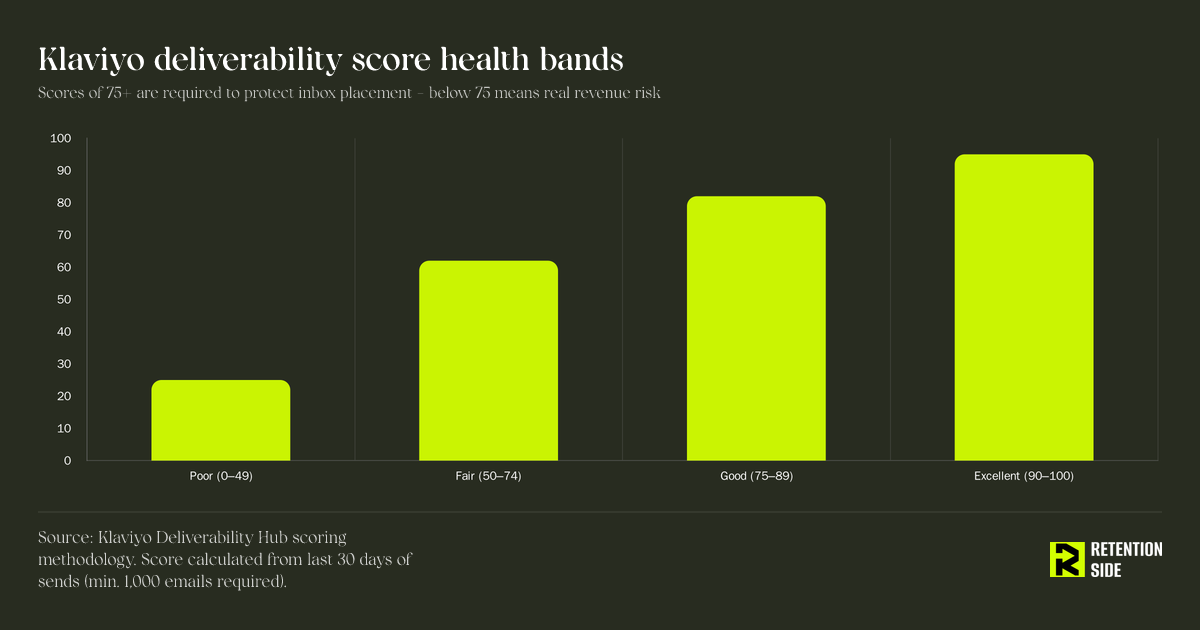
In Klaviyo specifically, deliverability health is measured through the Deliverability Hub under Analytics. It provides a composite score from 0 to 100, calculated from your spam complaint rate, bounce rate, unsubscribe rate, and engagement signals. The score is updated daily based on the last 30 days of activity and applies to any account sending at least 1,000 emails per month. The health bands are:
- Poor: 0-49
- Fair: 50-74
- Good: 75-89
- Excellent: 90-100
Below 75, you are operating in a range where inbox providers begin routing more of your mail away from the primary inbox. Below 50, you have an active crisis – campaigns and flows that looked fine on the sending side are reaching a fraction of the subscribers they should.
The mechanism behind this is sender reputation. Every inbox provider – Gmail, Yahoo, Outlook – maintains a reputation score for your sending domain and IP. That score determines the percentage of your emails that reach the primary inbox versus the Promotions tab or spam folder. Klaviyo’s deliverability score is Klaviyo’s internal signal, but the inbox placement decisions are made by Gmail, Yahoo, and Outlook, not by Klaviyo.
The practical takeaway: high Klaviyo delivery rate + poor deliverability score = a lot of paid-for email going directly to spam. Every one of those emails represents acquisition spend that already happened, creative resources that were committed, and a customer touchpoint that was wasted.
The three factors that determine your sender reputation
Sender reputation is not a fixed attribute. It is a dynamic score recalculated constantly based on how recipients actually interact with your emails. Three factors shape it more than anything else.
Authentication: the minimum entry requirement
SPF, DKIM, and DMARC are the authentication protocols that inbox providers use to verify your identity as a sender. If these are not in place, inbox providers have no technical guarantee that your emails are actually from you. They treat unauthenticated mail with automatic suspicion.
SPF (Sender Policy Framework) is a DNS record that lists the servers authorized to send email on behalf of your domain. If your emails come from a server not on that list, they fail SPF. In Klaviyo, this means adding the SPF record Klaviyo provides to your domain’s DNS settings.
DKIM (DomainKeys Identified Mail) adds a cryptographic signature to your email headers. Receiving servers use this to confirm that your email has not been tampered with in transit and genuinely originated from your sending domain. Klaviyo manages DKIM signing – you just need to publish the DNS records they provide. This is done during the dedicated sending domain setup flow.
DMARC (Domain-based Message Authentication, Reporting and Conformance) ties SPF and DKIM together and tells inbox providers what to do with emails that fail those checks. The right approach is to start at p=none (monitoring mode), analyze the aggregate DMARC reports to catch any misconfigured sending streams, then progress to p=quarantine and eventually p=reject once you have confirmed everything is correctly aligned.
None of these are optional in 2026. Google’s official email sender guidelines formalized authentication requirements for bulk senders starting February 2024, and Yahoo’s Sender Hub best practices align with the same requirements. DMARC at p=none was acceptable as a starting point; p=reject is the target.
Engagement quality: the dominant ranking signal
Authentication establishes identity. Engagement is what actually determines where your email lands.
Gmail, Yahoo, and Outlook weigh engagement signals heavily when making inbox placement decisions. The key signals are:
- Recipients opening or clicking (positive)
- Recipients deleting without reading (neutral to mildly negative)
- Recipients marking as spam (strongly negative)
- Recipients moving email to a different folder (directional signal)
This means the composition of your sending audience matters enormously. Sending campaigns to subscribers who have not engaged in 6 or 12 months – even if they technically haven’t unsubscribed – sends a stream of low-engagement signals with every campaign. Those signals damage your reputation for subsequent sends to your most active subscribers.
The business logic here is counterintuitive but important: sending to a smaller, genuinely engaged audience produces better inbox placement, which means better visibility, which means better conversion. Sending to a larger, partially disengaged list produces weaker reputation signals, which drives down inbox placement across the board and undermines performance even for your engaged subscribers.
Spam complaint rate: the single most damaging signal
A spam complaint happens when a subscriber hits “report spam” in their inbox. This is the clearest possible negative signal a recipient can send to an inbox provider.
Gmail’s threshold is well understood: per Google’s published sender guidelines, a spam complaint rate above 0.1% starts impacting reputation. Above 0.3%, Gmail begins actively filtering your mail. These thresholds apply to the spam rate as measured by Google Postmaster Tools, not Klaviyo’s internal unsubscribe reporting.
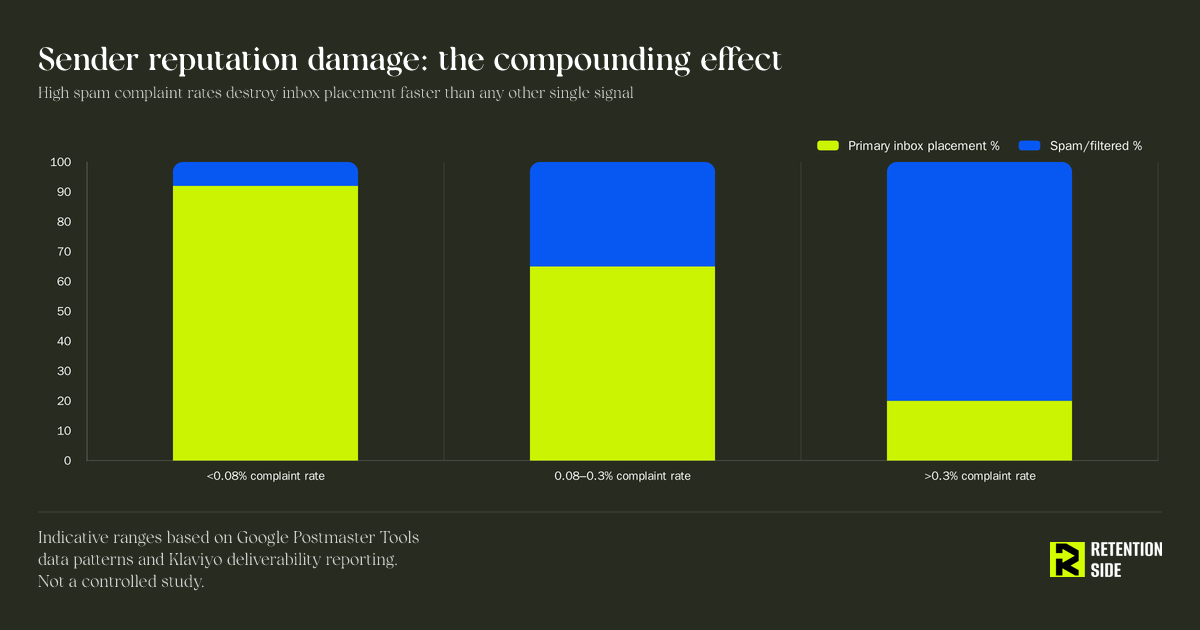
Keeping complaint rates low requires two things. First, only send relevant, expected email to subscribers who opted in with genuine intent – not bought lists, not scraped contacts, not outdated sign-ups from pop-ups that offered discount codes three years ago. Second, make unsubscribing frictionless. One-click unsubscribe is a mandatory sender requirement in 2026 per Google’s bulk sender rules. If subscribers find it hard to unsubscribe, they hit “report spam” instead. That outcome is far worse for your reputation.
Klaviyo-specific deliverability setup: what to get right from day one
Klaviyo’s infrastructure is built around deliverability, but that infrastructure only protects you if you set it up correctly. There are four areas where brands most commonly get this wrong.
1. The shared sending domain problem
When you create a Klaviyo account, you are by default assigned a shared sending domain. This means your email sends share a sending reputation with potentially thousands of other Klaviyo accounts. Their behavior affects you. If other brands on that shared domain generate high spam complaint rates or low engagement, you absorb part of that damage – even if your own sending practices are impeccable. As Google’s sender guidelines explicitly note, a shared IP’s negative reputation impacts every sender on it.
A dedicated sending subdomain (for example, send.yourstore.com or email.yourstore.com) isolates your sending reputation entirely. Your domain, your reputation, your control. This is set up in Klaviyo under Account Settings > Account > Domains, and it requires adding Klaviyo’s DNS records to your domain manager.
The subdomain approach has an additional benefit: it protects your root domain from email marketing reputation risk. If you ever need to repair your sending reputation, the damage stays contained to the subdomain rather than affecting the root domain that your website and other business emails depend on.
2. Domain warm-up after switching to a dedicated subdomain
A new subdomain has no reputation history. Sending at full volume immediately signals the same pattern as a spam operation. The solution is a structured warm-up period that starts with your most engaged subscribers and scales volume gradually over several weeks. Litmus’s guide to IP and domain warm-up covers the mechanics in detail if you want to go deeper on the scheduling logic.
A practical warm-up sequence looks like this:
- Week 1: Subscribers with multiple recent opens and clicks – your highest-engagement cohort
- Week 2: Broader engaged segment, relaxing the recency requirement somewhat
- Week 3: All subscribers active in the last 60-90 days
- Week 4 and beyond: Full engaged list, expanded to 120-150 day activity window
If you are migrating from another ESP rather than starting from scratch, you still need this process. Platform migration does not carry your sender reputation with it. Plan for at least two to four weeks of structured warm-up before going to full volume. Our Hedonism Wines case study shows exactly what a proper warm-up can achieve: average open rates went from 11.2% to 79.65% after structured warm-up and list hygiene following a Mailchimp-to-Klaviyo migration.
3. Klaviyo deliverability hub: use it actively
Most brands navigate to the Deliverability Hub once, look at the score, and leave. The Hub is actually a diagnostic system – it surfaces which specific campaigns and flows are damaging your score, breaks performance down by inbox provider, and gives you bounce analysis at the category level.
The three tabs in the Deliverability Hub – Score, Reports, and Bounce Details – each give you different signal types:
- The Score tab shows your composite deliverability health, trending over time, and an action center with specific recommended fixes. It also flags campaigns and flows individually as “Healthy” or “Needs attention.”
- The Reports tab breaks performance down by inbox provider (Gmail, Yahoo, Outlook) and email domain, showing you send volume, engagement rates, complaint rates, and bounce rates per provider. This is where you discover that your Yahoo deliverability is fine but your Gmail deliverability is damaged – which points to completely different remediation strategies.
- The Bounce Details tab shows what categories of bounces are occurring and from which inbox providers. This is where you catch list hygiene problems early.
The correct behavior is to check this data at least weekly, not only when performance appears to be dropping.
4. Building and maintaining proper suppression and exclusion segments
Beyond list hygiene, Klaviyo segments can act as deliverability protection layers. There are two worth building explicitly:
Exclusion segments – Subscribers who have marked your email as spam in the past should be excluded from all future sends. Klaviyo does suppress these automatically in some cases, but building an explicit exclusion segment gives you more control and visibility.
Unengaged suppression – Subscribers who have not opened or clicked in a meaningful window (typically 90-180 days depending on your sending frequency) should be removed from your active sends or moved into a sunset flow before full suppression. These subscribers are dead weight on your engagement metrics and drag down the reputation signals from every campaign.
The sunset flow exists for list hygiene, not for revenue generation. Its purpose is to give chronically unengaged subscribers one final re-engagement opportunity before they are suppressed. It is not a revenue flow. It should not be in the same category as your abandoned cart, post-purchase, or cross-sell flows. For a fuller picture of how flows should be structured to protect deliverability while driving revenue, see our Klaviyo flows guide for ecommerce brands.
What is the 60/40 rule in email, and does it still apply?
The 60/40 rule is a widely cited email marketing guideline that suggests email content should be approximately 60% images and 40% text (or sometimes the inverse, 60% text, 40% images depending on the source). The idea behind it was that image-heavy emails with minimal text were harder for spam filters to read and therefore more likely to be flagged.
This rule was based on how spam filters worked several years ago. The current reality is more nuanced.
Modern spam filters do not primarily filter based on image-to-text ratio. Gmail, Yahoo, and Outlook are now making placement decisions based on engagement signals – whether recipients open, click, move emails around, or mark them as spam. An email composed entirely of one image with solid ALT text and a clear unsubscribe link will not automatically land in spam because of its ratio. And an email with a high proportion of promotional text is arguably at more risk of triggering keyword-based filters than an image-heavy one.
Litmus research on email deliverability reinforces this: once an email exceeds 500 characters of HTML content (including header, footer, ALT text, and legal copy), the image-to-text ratio has no statistically meaningful impact on deliverability. Most well-structured Klaviyo templates clear this threshold without any special effort.
What actually matters for content-related deliverability:
- ALT text on all images – This gives inbox providers and accessibility tools something to read when images are blocked. It also contributes to your HTML character count.
- Sliced images rather than single large files – A single giant image is a red flag across several spam filter heuristics. Sliced layouts resolve this.
- Avoid aggressive promotional language in body text – Phrases like “Buy now,” “Limited time,” and “Act fast” can still contribute to keyword scoring, especially in subject lines and pre-header text.
- HTML code quality – Sloppy HTML with broken tags, excessive nesting, or injected code from copy-paste operations is a deliverability risk independent of image-text ratio.
- Personalization and relevance – The more your content reflects what that specific subscriber actually wants to see, the more likely they are to engage positively, and engagement is the real deliverability driver.
The 60/40 rule is not wrong as a general composition principle for user experience. A balanced layout tends to render well across clients and screen sizes. But treating it as a deliverability safeguard in 2026 misunderstands how inbox filtering currently works.
How to improve Klaviyo deliverability: a structured approach
Improving deliverability is not a single fix. It is a system that needs to be built and then maintained consistently. Here is how to think about it in order of priority.
Fix authentication first
Before anything else, confirm that SPF, DKIM, and DMARC are correctly configured for your sending subdomain. Use MXToolbox or Klaviyo’s own domain setup checker to verify. If DMARC is not yet at p=quarantine or p=reject, the path from p=none should be on your roadmap with a defined timeline.
If you are still sending from a shared Klaviyo sending domain, setting up a dedicated subdomain is the single highest-leverage deliverability change you can make. It is a configuration task, not an ongoing process. Our email deliverability guide for 2026 covers the step-by-step setup in detail.
Segment your active audience properly
Stop sending every campaign to your full list. Build segmentation logic in Klaviyo that reflects actual engagement recency. A defensible campaign send architecture looks roughly like this:
- Core engaged segment: Active in the last 30-60 days – this is your primary audience for every campaign
- Broader engaged segment: Active in the last 60-120 days – include for high-relevance campaigns, exclude from purely promotional ones
- Lapsed segment: Last active more than 120 days ago – enter these into your sunset or re-engagement flow, not your campaign list
Campaign engagement quality is what protects and builds sender reputation. Blasting unengaged subscribers to inflate reach numbers has the opposite effect. For a complete framework on segmenting correctly before each send, our Klaviyo audit checklist walks through the deliverability pillar in full.
Monitor Google Postmaster Tools and Microsoft SNDS
Klaviyo’s internal deliverability score is useful, but it does not give you the external view that inbox providers actually see. Google Postmaster Tools shows domain reputation, IP reputation, spam rate as Gmail measures it, and authentication pass rates for Gmail traffic specifically. Microsoft SNDS provides equivalent data for Outlook and Hotmail mailboxes.
Both tools are free. They give you the ground truth that no internal platform metric can replicate. If Klaviyo’s deliverability hub shows a good score but Google Postmaster shows a low domain reputation, something in your sending practice is creating Gmail-specific damage. That discrepancy is exactly what you need to catch.
Build provider-specific segments in Klaviyo
Gmail, Yahoo, and Outlook use different filtering algorithms with different sensitivity levels. If you are experiencing deliverability problems, they may not be uniform across all providers. Building segments filtered by email domain (@gmail.com, @yahoo.com, @outlook.com, @hotmail.com) lets you identify which providers are underperforming and focus remediation on the right audience.
This is also useful for warm-up sequences. Starting a warm-up with your most engaged Gmail subscribers and tracking their performance gives you clean signal before you expand volume.
Clean your list consistently, not once
List cleaning is a process, not a project. The brands that maintain strong deliverability are running list hygiene as an ongoing practice, not a fire drill after performance drops. Mailgun’s research on list hygiene shows that sending to invalid or disengaged addresses creates a compounding reputation problem that extends well beyond a single misfired campaign. In practice, this means:
- Suppressing hard bounces immediately and permanently
- Suppressing soft bounces that repeat across multiple sends
- Running a sunset flow for subscribers who cross the unengagement threshold
- Excluding spam complainers from future sends
- Reviewing bounce detail categories in the Klaviyo Hub monthly to catch emerging patterns
The short-term psychological barrier to list cleaning is that it reduces your subscriber count. The practical reality is that it improves the performance of every campaign and flow you send from that point forward, because you are sending to an audience that inbox providers have evidence is receptive to your emails.
Align content and send frequency with subscriber expectations
Deliverability is not only a technical problem. Subscriber experience drives the engagement signals that determine inbox placement. Two behavioral patterns accelerate reputation damage faster than almost anything else:
Frequency mismatch – A subscriber signed up for a 10% discount, received one welcome email, and then started receiving four campaigns per week. They did not expect that frequency. They do not open those emails. Eventually they hit “report spam” because that is easier than unsubscribing. Frequency escalation needs to be managed against engagement data. If sending frequency increases, watch complaint rates and unsubscribe rates closely by segment.
Promotional monotony – If your email program is structurally always promotional, subscribers become conditioned to ignore or delete your emails unless they actively want to buy. Long-term, this erodes engagement baselines and damages reputation over time. A content mix that includes product education, brand storytelling, and value content alongside promotional campaigns produces stronger engagement patterns and a healthier long-term sending reputation.
Is Klaviyo doing well as a platform?
The question is worth addressing directly because the health of your ESP infrastructure is not trivial – it affects the deliverability infrastructure you are operating on.
Klaviyo went public on the NYSE in 2023 and has continued to grow consistently as a business. In fiscal year 2025, Klaviyo reported 32% revenue growth. Q1 2026 showed 28% revenue growth with record operating margins, and the company raised its full-year 2026 revenue outlook following the results. The platform now processes over 900 million customer profiles and serves over 167,000 paying customers globally.
This is not just corporate financial context. It means Klaviyo is actively investing in platform infrastructure, deliverability tooling, and predictive analytics capabilities. The Deliverability Hub itself has been significantly expanded, the dedicated sending domain setup flow has been improved, and Klaviyo’s predictive CLV and churn risk models – which support smarter segmentation for deliverability-safe sends – are features of a platform that is reinvesting in its own product.
For ecommerce brands building their retention infrastructure on Klaviyo, platform stability and investment direction matter. The tools available inside Klaviyo today are meaningfully more capable than they were two years ago, and the roadmap suggests that continues.
That said, platform capability is only useful if you actually use it. Klaviyo being a high-growth, well-resourced platform does not improve your deliverability by default. Your setup, segmentation practices, and sending behavior are still what determine your inbox placement.
Deliverability problems that come from outside your email program
One point that gets underemphasized in purely technical deliverability guides: some deliverability problems are not caused by anything in your email program. They are caused by what is happening upstream of it.
Traffic quality and list acquisition – If your email list is being grown primarily through aggressive popups on low-intent traffic, discount codes being shared outside your brand context, or any form of co-registration, the quality of those subscribers is low. They signed up for an incentive, not for an ongoing relationship with your brand. Low-quality subscribers produce low engagement signals regardless of how well your emails are written or how correctly your authentication is configured.
Seasonal engagement patterns – Brands that see a large volume of new subscribers during Q4 often experience engagement and deliverability dips in Q1. The holiday buyers who subscribed for promotional campaigns have a different engagement profile from subscribers who joined during normal acquisition periods. This is a list composition issue, not a sending technique issue.
Website issues affecting subscriber quality – If your website is converting visitors into email subscribers through pre-ticked form fields, embedded form defaults, or forced account creation, you are building a list of people who did not actually choose to subscribe. These subscribers produce the worst possible engagement signals, because they do not recognize your brand, did not want your email, and will mark it as spam when it arrives.
Deliverability is ultimately a downstream expression of how your entire acquisition and retention system is operating. Fixing authentication and segmentation addresses the technical layer. Building genuine subscriber relationships through high-quality acquisition and relevant communication is what produces durable, compounding inbox placement over time. For a broader view of how these systems connect, see our Klaviyo email marketing setup guide for ecommerce brands.
Monitoring deliverability: the ongoing practice
Building a deliverability system and then ignoring it is how brands quietly accumulate reputation damage. Here is a working monitoring cadence:
Weekly:
- Review Klaviyo Deliverability Hub score and trend
- Check for flagged campaigns or flows in the “Needs attention” view
- Review spam complaint rates in the previous week’s sends
Monthly:
- Review Google Postmaster Tools domain and IP reputation
- Check Microsoft SNDS for Outlook/Hotmail performance
- Review bounce detail categories in the Klaviyo Hub
- Assess whether any segments need to be moved to sunset or suppression
Quarterly:
- Full list hygiene review – active versus lapsed versus suppressed ratios
- Authentication setup verification (SPF, DKIM, DMARC alignment)
- Review sending frequency against engagement patterns by segment
- Assess whether warm-up sequences are needed for any new sending domains or subdomains
At Retention Side, deliverability monitoring is not a quarterly audit. It is a continuous practice integrated into ongoing account management. The cost of catching a reputation issue early – before it compounds across multiple sends and segments – is dramatically lower than repairing it after the damage has spread.
Conclusion
Klaviyo deliverability is not a technical footnote in your email marketing setup. It is the infrastructure that determines what percentage of your campaigns and flows actually reach the people you are paying to reach.
The foundation is non-negotiable: a dedicated sending subdomain, correctly configured SPF/DKIM/DMARC authentication, and a structured warm-up for any new sending domain. Without these, every other optimization you make to your email program – subject line testing, segmentation, content strategy – is operating at a fraction of its potential.
The ongoing practice is equally important: send to engaged audiences, keep complaint rates below 0.1% as Google’s own spam rate guidelines specify, monitor Google Postmaster Tools and Klaviyo’s Deliverability Hub actively, and treat list hygiene as a continuous process rather than a rescue operation.
The brands that take this seriously have a compounding advantage. Better inbox placement means better visibility. Better visibility means more engagement. More engagement means stronger reputation signals. Stronger reputation signals mean better inbox placement. The cycle runs in both directions – toward excellence and toward failure – and the direction you are heading becomes clear before the revenue impact shows up, if you are watching the right signals.
If you want to audit your current deliverability setup and understand where the gaps are, contact Retention Side for a structured email program assessment.