

Key takeaways
- After a first purchase, a customer has roughly a 27% chance of buying again. Once they place a second order, that probability doubles to 54%. Everything you invest in earning that second purchase compounds forward.
- Increasing repeat purchases is not a campaign problem. It is a system problem. The brands that struggle with flat repeat rates usually have a structural gap, not a creative one.
- Email is the most practical starting point for any repeat purchase strategy, but it only works when deliverability, list quality, automation architecture, and campaign discipline are all working together.
- The second purchase is the most predictive indicator of long-term customer loyalty. It deserves a dedicated strategy, not a generic post-purchase thank-you email.
- Repeat purchase benchmarks vary significantly by category. Never compare your rate against a universal average without accounting for your niche, product type, and repurchase cycle.
- Metrics that actually matter: returning customer rate, revenue attributed to retention channels, and average time between orders. Metrics that do not: open rate, click rate, revenue per recipient.
What we’ll cover
- Why the second purchase is the most important purchase you’ll ever make
- The foundational conditions that must exist before tactics work
- How the email channel – built across its four core pillars – drives repeat purchases
- The automated flows most directly tied to repeat buying behavior
- Campaign strategy that doesn’t train customers to wait for discounts
- How loyalty programs and direct mail extend the repeat purchase system
- The role of SMS, push notifications, WhatsApp, and Viber
- Metrics to track and metrics to ignore
- Common reasons repeat purchase rates stay flat
Most ecommerce brands talk about repeat purchases as a goal. Very few build systems that actually pursue it.
The difference between a brand doing $300K/month with a 22% repeat purchase rate and the same brand doing 35%+ is rarely the product. It is rarely the price. It is rarely even the marketing budget. It is almost always the architecture behind how the brand communicates with customers after they buy.
That architecture is what this article is about. Not a list of isolated tactics, but the strategic logic behind building a system that turns one-time buyers into customers who come back, buy more often, and eventually account for the majority of your revenue.
Why the second purchase changes everything
After a customer’s first order, their probability of buying again sits around 27%. That number is not encouraging on its own, but it contains a critical insight: getting that customer to a second purchase roughly doubles their likelihood of making a third.
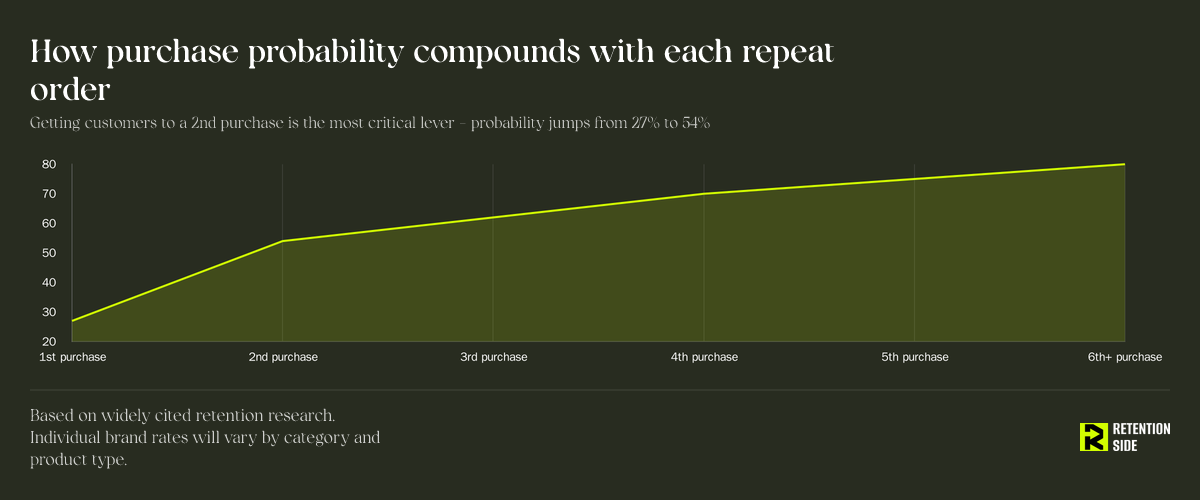
The compounding effect is the whole game. A customer on their sixth or seventh order is not just loyal – they are structurally different from a first-time buyer. Their average order value is higher. Their acquisition cost is effectively zero. Their lifetime value is multiples of someone who ordered once and never came back. And they are significantly more likely to refer someone else.
This means that the single highest-leverage moment in your entire customer lifecycle is the window between the first and second purchase. What happens in that window – how you communicate, what you show them, how you make them feel about their original purchase – largely determines which direction a customer goes.
Most ecommerce brands spend almost nothing on this window. They send a shipping confirmation, maybe a review request, and then wait. The customer drifts. The moment passes.
A brand with a real repeat purchase system does something entirely different.
The conditions that have to exist first
Before any channel, flow, or campaign can move your repeat purchase rate meaningfully, three foundational conditions need to be in place. Skipping them and jumping to tactics is the most common reason repeat purchase programs underperform.
A genuine reason to come back
The most uncomfortable question in retention: does your customer actually have a reason to repurchase within a reasonable timeframe?
If your product is consumable or replenishable – supplements, skincare, food, cleaning products – the answer is usually yes, and your job is to time your outreach around that repurchase window. If your product is durable or seasonal, the path to repeat purchase runs through cross-sell. Building a product ecosystem where customers have natural reasons to come back across multiple categories is what turns a one-product brand into a retention-ready business.
A brand selling a single, long-lasting item with no adjacent products is fighting against the structure of its own catalog. No email sequence or loyalty program will solve that. The solution is upstream, at the product level.
A purchase experience worth remembering
Repeat buying is driven by positive emotional memory. If the experience of ordering from you was forgettable – standard packaging, no communication between order and delivery, a generic confirmation email – there is nothing to come back for, emotionally.
The window between purchase and delivery is one of the most neglected in ecommerce. Customers are at peak engagement right after buying. They are excited. If you go quiet during that window and then reappear six weeks later with a promotional email, you have already lost momentum.
Packaging, unboxing details, a thoughtful note, even a well-designed follow-up email that acknowledges the excitement of the purchase – these are small moves that create the kind of impression customers remember when it is time to buy again. McKinsey research confirms this: 78% of consumers say personalized post-purchase touchpoints make them more likely to repurchase.
Product education that creates confidence
A customer who fully understands how to use your product and gets genuine results from it is far more likely to repurchase. This sounds obvious, but the execution is where most brands fall short.
Education is not a one-email onboarding. It is a deliberate communication strategy built around helping customers extract maximum value from what they already bought. For a complex product, that means features, use cases, and advanced techniques. For a simple product – a T-shirt, a candle, a body lotion – it means styling, pairing, care, and context. There is no product category where education is irrelevant.
Post-purchase education delivered through well-timed email sequences does two things simultaneously: it improves satisfaction with the current purchase and it builds the relationship that makes future purchases feel natural rather than transactional.
Email: the most practical channel for driving repeat purchases
Email is where most repeat purchase systems should start. It has the widest reach into your existing customer base, the most flexibility for behavioral automation, and the lowest cost per communication of any owned channel.
But email only produces consistent repeat purchase revenue when all four of its core pillars are functioning. Weakness in any one of them caps what the others can achieve. A full breakdown of how these pillars fit together is covered in our ecommerce email marketing strategy guide.
Deliverability: the silent prerequisite
There is a distinction that matters more than most brands realize: delivery and deliverability are not the same thing. An email is delivered when the receiving server accepts it. It is deliverable when it lands in the inbox – not in spam, not in the promotions tab – where a real person sees it.
A brand with strong flows and well-segmented campaigns can still have a flat repeat purchase rate if those emails are routing to spam at scale. Deliverability is invisible when it is working and devastating when it is not. We cover the most common ecommerce deliverability mistakes – and how to fix them – in our email deliverability guide.
The signals that determine inbox placement – authentication records (SPF, DKIM, DMARC), sender reputation, list hygiene, and send consistency – require ongoing management, not a one-time setup. Chronic non-engagers drag down sender reputation across the whole list. Erratic volume spikes before major sales events create noise that inbox providers flag. Hard bounces need to be suppressed immediately.
Deliverability management is not glamorous work. But without it, every other element of the repeat purchase strategy is operating at a fraction of its potential.
List growth: quality over subscriber count
The subscriber count on your email list is one of the least meaningful metrics you can track. What matters is the quality of who is on it – specifically, how many of them actually buy.
The right KPI for list growth is lead-to-customer rate: of the new subscribers who joined your list in a given month, what percentage made a purchase within a defined window? If 2,000 people join and 1.5% buy, the list is growing but not performing. If 800 people join and 8% buy, you have a quality list growing at a pace that directly supports repeat purchases.
This reframes how you think about signup incentives, form placement, and traffic quality. A 20% off popup that fires on every page for every visitor will grow a list quickly. It will also capture a significant volume of low-intent subscribers who inflate numbers, weaken deliverability, and never buy. A better-designed form that fires on scroll depth or exit intent, with an incentive calibrated to your margins, builds a smaller but commercially valuable list.
Zero-party data – preferences, product interests, and purchase intent collected directly from subscribers at signup – also belongs in this phase. Flows and campaigns built on data customers explicitly shared outperform broadcasts because they are relevant from the first email. McKinsey’s personalization research puts it plainly: companies that excel at personalization generate 40% more revenue from those activities than average players.
Automated flows: the engine of repeat purchasing
Automated flows are behavior-triggered email sequences that fire in response to specific customer actions. When they are built to cover the full customer lifecycle, they generate repeat purchase revenue continuously – without anyone manually hitting send.
The strategic intent is not “email automation.” It is mapping communication to the exact moments in the customer journey where a timely, relevant message changes behavior. Each stage of the lifecycle has a different job.
The post-purchase sequence is the highest-priority flow for any brand trying to increase repeat purchases. A customer who just bought is at their peak engagement. The post-purchase window is not the place for a single thank-you email. It is the place for a multi-email sequence that serves several distinct purposes: product education that helps them get full value from what they bought, a cross-sell recommendation based on what was purchased, a review request timed for when they have actually used the product, and – critically – a deliberate bridge toward the second purchase.
Cross-sell and upsell flows deserve their own dedicated architecture, separate from the general post-purchase sequence. They are triggered after purchase and designed to expand the customer’s product footprint within your catalog. The most effective ones are built on actual purchase behavior patterns – if customers who buy product A consistently also buy product B within 60 days, that relationship should be built into a flow, not guessed.
The win-back flow is triggered around the point where a customer would be expected to repurchase based on your brand’s average repurchase interval but has not. For most ecommerce categories, this happens well within 90 days. The flow’s job is to re-engage a drifting customer before they fully disconnect – with messaging that acknowledges the gap and gives them a genuine, compelling reason to come back. A win-back flow triggered at 180 days in a category with a 45-day repurchase cycle is not a win-back flow. It is an afterthought.
The browse abandonment flow captures a layer of purchase intent most brands leave unaddressed. Someone visiting a product page is not as committed as someone who added to cart, but their intent is real. A well-timed follow-up that provides helpful context about the product – not just a pushy “still thinking about it?” – recovers revenue that otherwise disappears.
The abandoned cart flow remains one of the highest-converting automations in any stack. The key is not the existence of the flow but its quality. A single generic email with a 10% coupon is a safety net. A properly sequenced flow that adjusts messaging based on cart value, purchase history, and the time elapsed since abandonment is a revenue system.
A note on flow maintenance: flows are not set-and-forget infrastructure. Copy gets stale. Incentives lose their edge. Audience behavior shifts. A flow built 18 months ago without meaningful testing or revision is almost certainly underperforming relative to what it could do. Continuous optimization – subject lines, sequence structure, timing, incentive logic – is what separates programs that compound from ones that plateau.
Campaigns: consistent communication between promotions
Campaigns are manual sends to defined segments of your list. They cover your promotional calendar, product launches, seasonal moments, and content-driven sends. They are equally as important as flows – not more, not less.
The most common mistake brands make with campaigns is reducing them to promotional broadcasts. A calendar built entirely around “X% off for the next 48 hours” messages does two damaging things over time. First, it trains subscribers to wait for discounts before buying, eroding full-price purchasing. Second, it degrades deliverability as engagement outside sale windows drops.
A more durable campaign strategy alternates promotional sends with educational and relationship-building content. Product education, behind-the-scenes content, customer stories, usage tips, and seasonal context that isn’t purely commercial – these sends don’t always produce direct revenue, but they maintain engagement and keep the brand top of mind between promotion cycles. Subscribers who hear from a brand only when it wants something from them develop very low engagement over time.
Campaign segmentation is non-negotiable at any meaningful scale. Sending the same message to your entire list, regardless of purchase history or lifecycle stage, is a wasted opportunity on one side and a deliverability risk on the other. Active buyers need messages that acknowledge their relationship with the brand. Subscribers who have never purchased need a different approach. VIP customers warrant different treatment than first-time buyers still evaluating whether they’ll return.
Repeat purchase benchmarks by category
Before benchmarking your repeat purchase rate against any external number, the category context matters enormously.
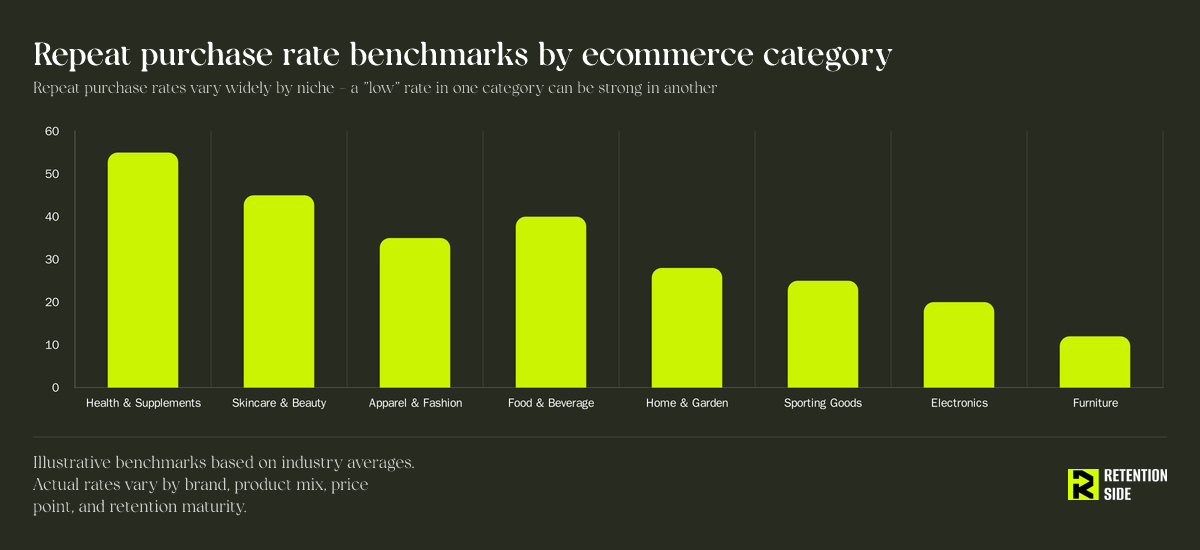
Health and supplements brands with strong replenishment cycles can realistically target 50%+ repeat rates. A furniture brand doing 12% might be performing well for its category. Apparel sits in the middle, heavily dependent on catalog breadth and how effectively the brand cross-sells. The key is understanding where your brand sits relative to its own category and repurchase cycle – not comparing against a universal benchmark that ignores those variables.
What matters more than the absolute percentage is the direction of travel. Is your repeat purchase rate improving quarter over quarter? Is the average time between orders shortening? Those directional signals tell you whether your retention system is working, regardless of what the category average says.
Loyalty programs as a structural retention layer
A loyalty program is not a communication channel. It is a retention structure – a reason for customers to stay engaged with the brand between purchases and a behavioral incentive to consolidate spending with you rather than spreading across competitors.
The programs that actually move retention metrics are built around customer behavior, not just transactions. A basic points-per-dollar structure is the starting point, not the finish line. The programs that produce meaningful repeat purchase lift add tiered status (so customers have something to progress toward), experiential rewards that go beyond discounts, and event-based incentives like double points or early access that create urgency around specific moments.
According to Smile.io’s 2025 State of Ecommerce Customer Loyalty report — which analyzed 585 million orders across 100,000+ merchants — loyalty-generated value grew year-over-year across every major ecommerce industry in 2024, with CPGs seeing a 13.95% increase in purchase frequency among loyalty members. That kind of compounding engagement is exactly what a well-structured program unlocks.
The psychological driver is important to understand. Once a customer has accumulated points or reached a tier, leaving means walking away from value they have already built. That anchoring effect is a retention lever that no email sequence can replicate on its own.
The integration with the rest of your communication stack is where loyalty programs become most powerful. Email reminders about points balances. SMS alerts when a customer is close to a reward threshold. Campaign sends tied to loyalty milestones. When the loyalty program feeds into the communication channels, the entire retention system becomes more cohesive.
One practical constraint worth stating clearly: loyalty programs only make financial sense when you have enough customers at each spend tier for the program to generate positive ROI. If you have a handful of customers per tier, the cost of building and running a sophisticated loyalty program outweighs the benefit. Fix the fundamentals of your repeat purchase system first.
Direct mail for high-value segments
Direct mail earns its place in a repeat purchase strategy not through volume but through impact. As digital inboxes have become noisier, the physical mailbox has become quieter. A well-designed postcard can sit on a customer’s counter for days. A premium unboxing insert gets handled multiple times. These are touchpoints that digital channels simply cannot replicate.
According to Lob’s 2024 State of Direct Mail Marketing report, 85% of ecommerce marketers say direct mail produces the highest ROI of any of their marketing channels — and 30% of direct mail campaigns in ecommerce are specifically designed for customer retention.
The use cases that justify the cost of direct mail in ecommerce are fairly specific:
- Win-back campaigns for lapsed high-LTV customers who have stopped responding to email
- Premium thank-you cards after a first order, targeted to customers above a certain AOV threshold
- Personalized offers for customers approaching a loyalty tier, sent as a physical prompt rather than a digital one
- Reactivation of VIP segments that have gone quiet across all digital channels
Direct mail costs significantly more per piece than any digital channel, which is exactly why it should be used as a precision tool rather than a broadcast mechanism. Applied to the right segments at the right moments, it creates a physical impression that compounds the brand’s overall retention effort.
SMS, push notifications, WhatsApp, and Viber
Each of these channels plays a distinct role in a multi-channel repeat purchase strategy. The decision about when and how to add them should always be driven by the same question: who in your customer base is not responding to email, and what is the most cost-effective way to reach them? A detailed breakdown of how all these channels fit together is in our guide to ecommerce retention channels.
SMS is high-intent and time-sensitive. Open rates are near-instant, which makes it effective for flash sale notifications, back-in-stock alerts, and cart recovery reminders. The constraint is consent – SMS lists are typically 20-30% the size of email lists because the bar for opt-in is higher. Frequency matters; excessive SMS sends burn through subscriber goodwill faster than any other channel. According to Postscript’s 2026 SMS benchmarks — drawn from 17,000+ Shopify stores — back-in-stock triggered SMS messages achieve 36–58% click-through rates and 7–13.8% conversion rates, underscoring the power of intent-based sends over broad promotional blasts. Use SMS for moments where urgency is genuine. You can explore Retention Side’s approach in the SMS marketing service.
Push notifications serve a complementary role for brands with a mobile app or significant website traffic. They do not require an email address or phone number – just a permission tap – which makes them accessible to visitors who haven’t subscribed to email yet. They work well as a light nudge for cart abandonment, price drops, and restock alerts. The risk is notification fatigue; once a customer disables push, you have lost that channel entirely. See how Retention Side deploys push notifications for ecommerce brands.
WhatsApp and Viber are not optional extras for brands with meaningful customer bases in Latin America, Eastern Europe, the Middle East, and Southeast Asia. In these regions, WhatsApp and Viber are often the default communication channel – they function like SMS but with richer formats including product carousels and interactive response buttons. For brands primarily selling to US audiences, these channels are worth monitoring but rarely a near-term priority.
The principle across all of these channels is coordination. A customer who converted from an SMS campaign should not receive the same offer via email two hours later. A loyalty member who just redeemed a reward should not immediately enter a win-back flow. Channels that do not communicate with each other create friction and erode trust, regardless of how well each individual channel is set up.
What to measure (and what to stop measuring)
Most ecommerce email platforms present open rate and click rate as primary performance indicators. They are not. They are diagnostic signals – useful for identifying problems with subject lines or content, but not indicators of whether your retention system is actually building the business.
Metrics that matter for repeat purchase performance:
Returning customer rate is the most direct measure of whether your retention work is actually working. If this number isn’t moving in the right direction over a 3-6 month window despite investment in retention channels, the system has a structural problem.
Revenue attributed to retention channels tells you what email, SMS, and other owned channels are contributing to total store revenue. This should be tracked over time and evaluated relative to investment. Understand that attribution here is never perfectly clean – cross-channel assists are real and meaningful.
Average time between orders is one of the most powerful signals available to any brand with a replenishable product. If the average gap between first and second purchase is shortening month over month, your post-purchase and cross-sell sequences are doing their job. This metric can also reveal whether your win-back timing is appropriately calibrated to your actual repurchase cycle.
List growth rate with lead-to-customer rate as a companion metric – because a list that grows in volume but not quality is a deliverability liability, not a business asset.
Flow-level conversion for each core automation. What percentage of customers who enter the post-purchase sequence make a second purchase within 60 days? What is the conversion rate on the win-back flow? These granular metrics tell you which parts of the automation layer are working and which need attention.
Metrics that should not drive strategy:
Open rate, click rate, and revenue per recipient are not accountability metrics. They measure activity and engagement in isolation from business outcomes. An agency or internal team that leads every performance conversation with open rates is optimizing for the wrong thing.
Common reasons repeat purchase rates stay flat
When brands invest in retention but the repeat purchase rate does not move, the root cause is almost always one of these:
The lifecycle coverage has gaps. Flows are present but do not cover the full customer journey. There is a welcome series and an abandoned cart flow, but no meaningful post-purchase sequence, no cross-sell architecture, and a win-back flow triggered so late it is rarely effective. The moments where the brand could most influence a second purchase are either automated with thin, generic content or not automated at all.
Campaigns are all discount, all the time. A customer base that only hears from a brand when there is a sale learns to wait for sales. Full-price purchasing drops. Engagement outside of promotional windows deteriorates. Deliverability follows. This is a slow structural erosion that often gets misread as “email just doesn’t work anymore.”
Flows were built once and never revisited. A post-purchase sequence written at launch with an old offer, old copy, and a product catalog that has since expanded is not doing the job it could do. Flows need regular auditing, testing, and updating. Static automation decays.
The performance drop is not actually an email problem. A drop in repeat purchase rate is not always caused by a problem in the email channel. It may reflect a change in acquisition traffic quality – lower-intent customers from a new ad campaign who were never likely to return. It may reflect a website issue affecting the purchase experience. It may reflect a product quality problem showing up in reviews and post-purchase satisfaction. Diagnosing root cause before rebuilding the email strategy prevents a lot of misdirected effort.
Channels are running in silos. Email, SMS, and push are all active, but none of them know what the others are doing. The result is message overlap, competing offers, and a fragmented customer experience that reads as disorganized rather than attentive.
Deliverability is degraded. Flows and campaigns are firing, but inbox placement has deteriorated. Revenue looks flat not because the strategy is wrong but because the emails aren’t getting through. This is the hardest problem to diagnose without deliberate monitoring, because the symptoms look the same as poor content performance. As Harvard Business Review notes, acquiring a new customer costs five to 25 times more than retaining an existing one — which makes every deliverability failure disproportionately expensive.
Building a system, not running tactics
The brands that consistently improve their repeat purchase rate share one characteristic: they treat retention as infrastructure, not a series of one-off campaigns.
Infrastructure means flows that run automatically and get better over time. A list that grows in quality, not just volume. Campaigns that build the relationship between promotion cycles. Channels that are coordinated around a shared understanding of where each customer is in their lifecycle. Metrics that measure business outcomes, not activity.
At Retention Side, we work with ecommerce brands that have strong acquisition but a repeat purchase rate that has not kept pace with their revenue growth. The entry point is almost always email marketing via Klaviyo, because that is where the most immediate, measurable retention lift comes from. But the system we build from there – whether that expands into SMS, push notifications, direct mail, loyalty programs, WhatsApp, or Viber – depends entirely on what the customer behavior data tells us about where to invest next. You can read more about how this full system comes together in our overview of what an ecommerce retention agency actually does.
The goal is a retention system that compounds. More customers coming back. Coming back sooner. Spending more. And making the unit economics of acquisition more efficient because the customers already in the database are generating value without requiring additional acquisition spend.
Conclusion
Increasing repeat purchases in ecommerce is not a campaign problem. It is not a discount problem. It is a systems problem – one that requires getting the foundational conditions right, building the email channel across all four of its core pillars, automating the moments in the customer lifecycle where communication has the most impact, and coordinating that communication across channels in a way that feels intentional rather than automated.
The brands that solve this problem grow differently from the ones that don’t. Their margins improve as repeat buyers replace the need for constant new customer acquisition. Their LTV grows. Their paid acquisition becomes more efficient because they can afford to bid higher when customers actually come back.
If your repeat purchase rate has been flat despite investment in email and other retention channels, the issue is almost certainly structural – a gap in lifecycle coverage, a campaign strategy that has trained customers to wait for discounts, or flows that were built and never meaningfully improved. That is the kind of gap a properly built retention system closes.
If you want to understand what that system looks like for your specific brand and customer base, that is exactly what Retention Side is built to work through.