

Customer lifecycle marketing is one of those terms that gets used constantly but executed inconsistently. Most ecommerce brands at meaningful revenue understand the idea. Far fewer have actually built the system behind it.
The concept is straightforward: different customers are at different stages in their relationship with your brand, and they need different communication at each stage. The reality of building that system – mapping flows, campaigns, loyalty mechanics, and cross-channel sequencing to actual lifecycle moments – is where most programs fall short.
This article breaks down what customer lifecycle marketing looks like in practice for ecommerce brands doing serious revenue, how to structure the key stages, which channels and tools do the work at each point, and how to measure whether the system is actually building the business.
Key takeaways
- Customer lifecycle marketing is not a campaign type. It is a system that maps communication to where each customer is in their relationship with your brand.
- After a first purchase, a customer has roughly a 27% chance of buying again. Once they make a second purchase, that probability roughly doubles to 54%. The second purchase is the most important conversion in the lifecycle.
- Email, built across four core pillars – deliverability, list growth, automation, and campaigns – is the practical foundation. No other channel has the same reach, cost efficiency, and behavioral automation capability.
- Flows and campaigns are equally important. Neither replaces the other. Flows cover behavioral moments continuously; campaigns maintain the relationship and create commercial events.
- Lifecycle coverage matters more than individual flow optimization. Gaps in the journey cost more than underperforming flows at stages you have covered.
- Repeat purchase rate (also called returning customer rate) is the single clearest measure of whether your lifecycle marketing system is working. It should always be interpreted within your specific category – not against a universal benchmark.
- CRM stores and manages customer data. CLM is the practice of actively using that data to guide customers through lifecycle stages. They are related but serve different purposes.
What customer lifecycle marketing actually means for ecommerce
Customer lifecycle marketing is the discipline of structuring your marketing communication around where each customer is in their relationship with your brand – and what they actually need at that point to move forward.
That sounds obvious until you look at how most brands operate. They send weekly promotional emails to their entire list regardless of whether someone bought yesterday or lapsed three months ago. They run the same abandoned cart flow for a first-time visitor and a five-time repeat buyer. They treat their customer base as one audience when it is really a dozen different audiences at different stages, with different needs, different levels of trust, and different purchase probabilities.
The value of a lifecycle marketing approach is that it ends broadcast thinking. Instead of “what should we send this week,” the frame becomes “what does this specific customer need right now, based on where they are in their journey?” That shift changes everything downstream: which flows you build, how you segment campaigns, what you measure, and how you evaluate whether the system is working.
For ecommerce brands at scale, the stakes are real. The economics of customer acquisition keep getting more expensive. The brands that grow sustainably are the ones that make more of the customers they already have, rather than spending their way into acquisition-dependent growth that resets every quarter.
The customer lifecycle stages: how to think about them for ecommerce
The most commonly referenced lifecycle model covers five stages. It is a useful frame, though the specific labels matter less than understanding what each stage actually represents in ecommerce terms – and what the marketing job is at each point.
Stage 1: awareness
A potential customer discovers the brand. This could come through paid social, organic search, a friend’s referral, an influencer, or any number of acquisition channels. The customer is not yet on your list and has not yet purchased.
The lifecycle marketing job at awareness is not usually owned by the retention team. This is acquisition territory. But it matters for lifecycle marketing because the quality of who enters awareness shapes everything downstream. High-intent traffic from well-targeted acquisition produces higher lead-to-customer rates and better long-term retention outcomes. Low-quality traffic inflates vanity metrics and drags down list health.
This is one reason Retention Side always cares about acquisition context, even though we do not manage paid channels. Understanding what kind of customer is being brought in through the top of the funnel shapes how we build the rest of the system.
Stage 2: consideration and first subscription
The prospect shows enough interest to subscribe – through a signup form, a quiz, a gated offer, or organic behavior. They are on the list. They have not purchased yet.
This is where email lifecycle marketing formally begins. The welcome series is the primary tool at this stage – not as an incentive delivery mechanism, but as a deliberate sequence that builds the case for a first purchase. Brand voice, product value, social proof, objection handling, and zero-party data collection all happen here.
The metric that actually matters at this stage is lead-to-customer rate: what percentage of new subscribers make a purchase within a defined window? Form submission rate is a secondary signal. A large list of low-intent subscribers produces high numbers and thin commercial value. A smaller list of well-qualified subscribers compounds faster.
Stage 3: first purchase (conversion)
The customer places their first order. The retention relationship has officially started – and most brands immediately go quiet at precisely the moment they should be most active.
The window between first purchase and first delivery is the highest-engagement period in the entire customer lifecycle. According to Narvar’s 2025 State of Post-Purchase Report, two-thirds of shoppers feel anxious after clicking “buy” – and that anxiety manifests as support tickets, cancellations, and declining brand loyalty when brands go silent. If the communication they receive during this window is generic logistics updates and nothing else, the brand has missed the most valuable engagement moment it will ever have with that customer.
A proper post-purchase email flow starts building toward the second purchase from the moment the first order is confirmed – through product education, unboxing context, review requests timed appropriately, and a deliberate bridge toward what comes next. The goal is not just delivering a good experience. It is engineering the conditions that make a second purchase feel natural.
Stage 4: active customer and repeat purchasing
The customer has purchased more than once. They are in the zone where retention investment compounds most efficiently. A customer who has bought twice has already demonstrated that they trust the brand and find value in returning. The cost of earning subsequent purchases, through owned channels, is a fraction of what first acquisition cost.
The lifecycle marketing focus at this stage shifts to extending purchase frequency, deepening product engagement through cross-sell and up-sell, and building the structural loyalty that makes switching to a competitor feel costly. Loyalty programs belong here – not as a communication tool, but as a retention structure that gives customers a reason to consolidate their spending with the brand.
This is also where campaign strategy matters most. The segments within the active customer base are meaningfully different. Someone on their third purchase in six months needs different messaging than someone who made two purchases a year apart. Treating both identically is a personalization failure at the stage where personalization produces the highest return.
Stage 5: lapsing and loyalty
Every customer eventually reaches a decision point: come back or go quiet. The lifecycle marketing job at this stage splits into two tracks.
For customers who are showing early lapsing signals – their gap since last purchase is approaching their historical repurchase window but they have not bought yet – the win-back flow is the tool. The timing is critical. A win-back triggered at the moment a customer’s absence becomes statistically unusual (based on your brand’s actual purchase frequency data) is still a retention play. The same flow triggered six months after a customer in a 45-day repurchase category last bought is an afterthought.
For customers who have become genuinely loyal – who have a track record of repeat purchasing and are generating meaningful LTV – the focus shifts to recognition, exclusivity, and ongoing relationship depth. VIP flows, loyalty tier mechanics, early access, and personalized communication that acknowledges their history with the brand are the tools here. Your best customers deserve more than the same post-purchase email a first-time buyer receives.
Why the second purchase is the leverage point in the entire lifecycle
The purchase probability data tells the story clearly. After a first order, a customer has roughly a 27% chance of buying again. Once they make that second purchase, the probability of a third approximately doubles.
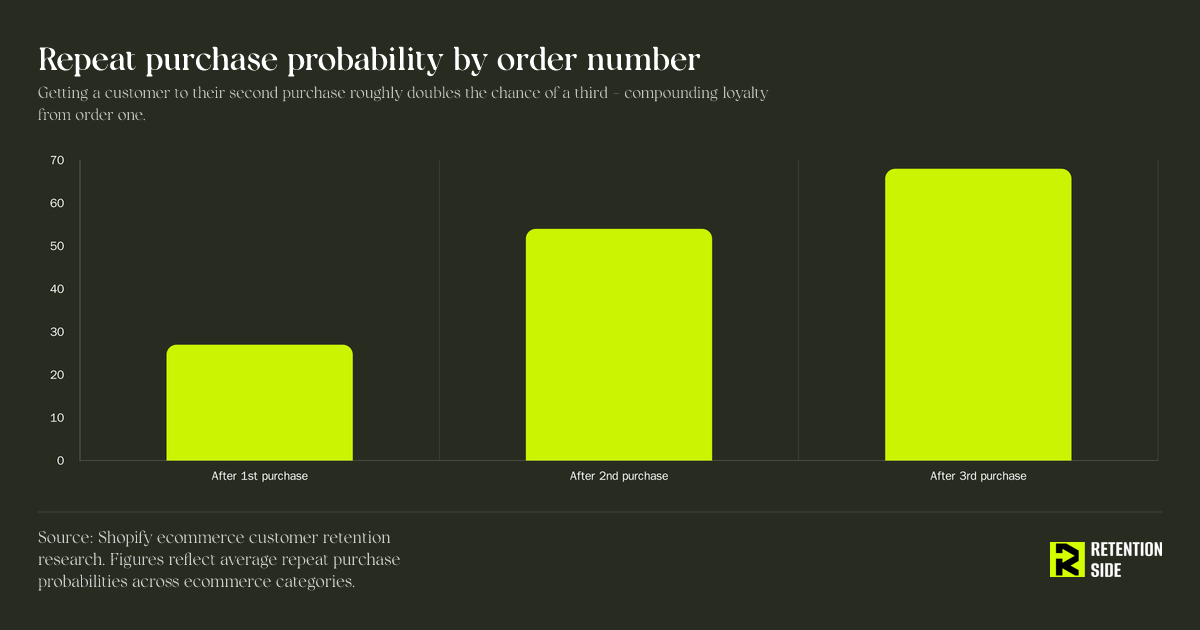
This has a direct implication for how you structure lifecycle marketing investment. The highest-leverage communication window is not at awareness. It is not even at conversion. It is in the days and weeks immediately following the first purchase – when the customer is most engaged, when the brand has the most credibility, and when the post-purchase sequence has the best chance of engineering a second order.
Most brands underinvest here precisely because it feels less urgent than acquiring new customers or recovering abandoned carts. The post-purchase email flow gets a shipping confirmation and maybe a review request. The opportunity to build on the first purchase – to educate, to cross-sell thoughtfully, to make the customer feel like the brand actually knows what they bought and cares how they use it – goes largely untaken.
This is the structural gap that a lifecycle marketing system is designed to close.
Email as the foundation: the four pillars
Email is where lifecycle marketing systems almost always start for ecommerce brands, and for a reason that goes beyond channel cost or reach. Email is the channel with the most behavioral automation capability – it can fire different sequences based on what someone browsed, bought, abandoned, or ignored, at a level of personalization and segmentation that no other owned channel matches.
But “doing email” and having a functional email lifecycle program are different things. A properly built ecommerce email program rests on four pillars. They work as a system, not a hierarchy. This is the same framework that underpins our Klaviyo email marketing setup guide for ecommerce brands.
Deliverability
Deliverability is the prerequisite. The distinction that matters more than most brands realize: delivery and deliverability are not the same thing. Delivery means the email was technically accepted by the receiving server. Deliverability means it landed in the inbox – not spam, not the promotions tab – where a real person actually sees it.
A program with excellent flow architecture and well-segmented campaigns can still have flat lifecycle metrics if those emails are routing to spam at scale. Deliverability is invisible when it is working and expensive when it is not. The signals that determine inbox placement – authentication (SPF, DKIM, DMARC), sender reputation, list hygiene, and consistent send behavior – require ongoing management. Google’s bulk sender requirements, updated effective February 2024, make SPF, DKIM, and DMARC authentication mandatory for high-volume senders and cap spam complaint tolerance at 0.10% as measured in Postmaster Tools. These are not optional compliance items. They are the floor condition for every other piece of lifecycle marketing to function.
List growth
List growth is the acquisition side of lifecycle marketing. It is how new subscribers enter the ecosystem before or shortly after their first purchase.
The metric most teams track is form submission rate. The metric that actually matters is lead-to-customer rate. What percentage of new subscribers make a purchase within a defined window after joining the list? This reframe changes how you think about form placement, incentive design, and traffic quality.
Zero-party data collection at signup – product preferences, purchase intent, relevant category information that subscribers actively share rather than behavioral signals inferred later – powers lifecycle personalization from the very first communication. A subscriber who has told you their skin type before the welcome series even begins receives different product recommendations than one you know nothing about. That difference in relevance, compounded across thousands of subscribers, is a meaningful lifecycle marketing advantage.
Automation (flows)
Flows are the always-on behavioral layer of lifecycle marketing. They fire based on what customers actually do – browsing, adding to cart, purchasing, going quiet – without anyone manually hitting send. A well-built flow architecture covers every meaningful stage of the customer journey continuously. For a full breakdown of how to build each of these, see our guide on the best Klaviyo flows for ecommerce brands.
The core flows that every ecommerce brand at scale should have built and actively maintained:
- Welcome series – activates when a new subscriber joins without purchasing. Its job is building the case for a first purchase, not just delivering a discount code.
- Browse abandonment flow – fires when a subscriber views a product page without adding to cart. A real buying signal that most brands leave unaddressed.
- Abandoned cart flow – triggers when checkout is started but not completed. The job is identifying and addressing the specific friction behind the abandonment, not just sending a reminder.
- Post-purchase sequence – the highest-leverage automation in any lifecycle stack. Activates after delivery, not after purchase, to build education, collect reviews, and engineer the second purchase.
- Cross-sell and up-sell flows – triggered after purchase to introduce complementary or higher-value products based on what the customer actually bought. Should be built on real purchase pattern data, not catalog assumptions.
- Win-back flow – activates when a customer’s gap since last purchase approaches their historical repurchase window. Timing should be based on your brand’s actual average order frequency data. For most ecommerce categories, the relevant window is well within 90 days.
One important distinction: sunset flows are not lifecycle marketing tools. Their purpose is list hygiene – removing chronically disengaged subscribers to protect deliverability. They belong in a separate operational category from the revenue-driving flows listed above.
Campaigns
Campaigns are the broadcast and relationship layer – manually planned sends to defined segments. They cover product launches, seasonal promotions, educational sends, content-driven communication, and the ongoing relationship-building work that keeps the brand top of mind between purchase cycles.
Campaigns are equally important as flows. A program built entirely on automation will eventually feel robotic. A program built entirely on manual sends requires constant effort and misses continuous behavioral conversion opportunities. The right balance distributes meaningful revenue contribution between both.
The most damaging campaign mistake at the lifecycle level is reducing the calendar to pure promotions. A brand that only communicates during discount events trains subscribers to wait for discounts before buying. Over time, this erodes full-price purchasing and degrades engagement between sale windows – which then damages deliverability. A durable campaign strategy mixes promotional sends with educational, editorial, and relationship-building content that maintains engagement without requiring a discount to justify the send.
The lifecycle-to-channel mapping: what goes where
Understanding the lifecycle stages is one thing. Mapping the right channel to each stage is where the system gets built.
Email marketing handles the deepest, most sustained communication at every stage – from the welcome sequence through post-purchase education, cross-sell automation, and win-back campaigns. Its behavioral automation capability and near-zero marginal send cost make it the practical backbone of the lifecycle.
SMS marketing earns its place at the moments where timing is the primary variable: abandoned cart recovery where speed matters, back-in-stock alerts, flash sale notifications, and shipping updates. SMS lists are typically 20-30% the size of email lists because the consent bar is higher. The channel is best used for high-intent, time-sensitive moments rather than general relationship-building – and frequency sensitivity is real. Over-sending via SMS burns the channel faster than any other.
Push notifications work as a reinforcing layer for email and SMS at key behavioral moments: a cart recovery nudge, a price-drop alert, a restock reminder. They reach customers without requiring inbox access, which extends lifecycle coverage to subscribers who are less active in email. The risk is notification fatigue – once a customer disables push, that channel is gone.
Loyalty programs operate differently from every other channel in this list. They are not a communication method. They are a retention structure – a reason to stay. A well-designed tiered loyalty program gives customers something to build toward (status, rewards, exclusivity) that makes switching to a competitor feel costly. The psychological anchoring effect of accumulated points or tier status is a retention lever that no email sequence can replicate on its own. For this reason, loyalty programs work best at the active customer stage and beyond – they are a tool for deepening commitment, not for converting first-time buyers.
Direct mail operates at the precision end of lifecycle marketing. Its cost per piece ($0.30 to $3 depending on format) makes it a targeted tool, not a broadcast one. It works at specific lifecycle moments where a physical touchpoint creates an impression that digital channels cannot: win-back campaigns for lapsed high-LTV customers who have stopped responding to email, premium thank-you cards after high-AOV first orders, personalized re-engagement of VIP segments that have gone quiet across all digital channels.
WhatsApp marketing and Viber marketing serve the lifecycle marketing function in markets where they are the default communication channel – Latin America, Eastern Europe, the Middle East, Southeast Asia. For brands with significant audience presence in these regions, they are active lifecycle tools with richer message formats than SMS. For brands primarily serving US audiences, they are worth monitoring but rarely a near-term priority.
The goal is not to activate all of these channels simultaneously. It is to understand what each one does well in the lifecycle, and to coordinate them so a customer moving from one stage to another experiences coherent communication rather than overlapping or competing messages from channels that do not know what each other is doing.
Repeat purchase rate: reading the lifecycle health signal
Repeat purchase rate – sometimes called returning customer rate – is the clearest single metric for whether your lifecycle marketing system is working. If the percentage of customers who make more than one purchase is growing over time, the system is doing its job. For a detailed look at what drives this metric by niche and how to diagnose when it stalls, see our breakdown on ecommerce customer retention rate requirements.
Interpreting it requires category context. There is no single benchmark that applies across ecommerce niches.
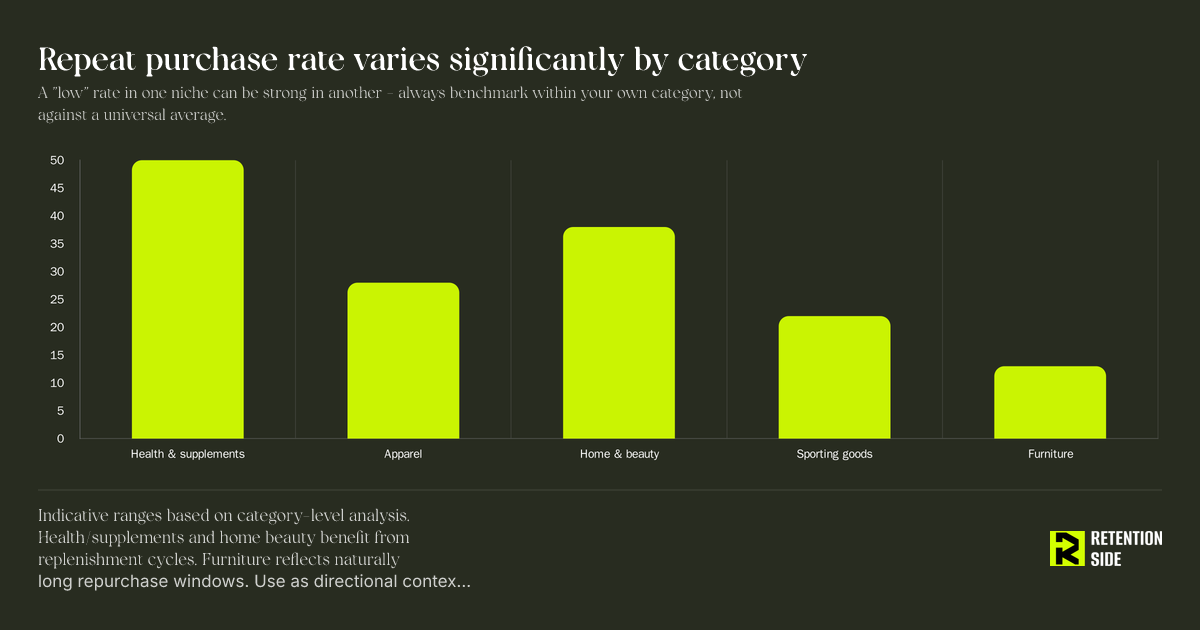
Health and beauty – supplements, skincare, haircare – structurally produces higher repeat rates because products are consumable. Customers run out and need to reorder. The retention job in this category is ensuring they reorder from you rather than a competitor. A repeat rate below 35% in supplements warrants serious attention.
Apparel and home goods sit in the middle range, where repeat purchasing depends more heavily on catalog breadth, brand affinity, and the quality of the cross-sell architecture than on replenishment cycles.
Furniture and large home goods have structurally long repurchase windows by nature of the product. A 12-15% repeat rate in furniture can represent genuinely strong lifecycle performance. Applying the same benchmark expectations across these categories is an analytical error that no serious retention partner should make.
What matters most is the direction of travel relative to your own baseline. Is the rate improving quarter over quarter? Is the average time between first and second order shortening? Those directional signals tell you whether your lifecycle system is working, regardless of what any external benchmark says.
The metrics to deliberately deprioritize: open rate, click rate, and revenue per recipient. These are diagnostic tools, useful for identifying specific problems in specific emails. They are not accountability metrics and they do not reflect business outcomes at the lifecycle level. For a full breakdown of which metrics actually matter, see our guide on the top email marketing metrics for ecommerce.
What lifecycle marketing requires before tactics work
Before any channel, flow, or campaign can move lifecycle metrics meaningfully, certain foundational conditions need to exist. This is where a lot of brands get stuck – investing in platform tooling and campaign execution without the underlying product and experience conditions that give customers a reason to respond.
A genuine reason to repurchase. The most direct question in lifecycle marketing: does your customer actually need to buy again within a reasonable timeframe? For consumable products, the answer is usually yes and the job is timing outreach around the natural repurchase window. For durable products, the path to repeat purchase runs through cross-sell – building a product ecosystem where customers have adjacent reasons to come back. A single durable item with no catalog depth gives lifecycle marketing very little to work with regardless of how well the flows are built.
A purchase experience worth remembering. Repeat buying is driven by positive emotional memory. Research from Narvar shows that two-thirds of shoppers feel anxious immediately after placing an order – and that anxiety converts to loyalty or churn depending entirely on what the brand does next. If the experience of ordering from you was forgettable – standard packaging, generic confirmation emails, silence between order and delivery – there is nothing emotional to build on. The post-purchase window, from order confirmation through delivery, is the highest-engagement period in the lifecycle. Going quiet during it and reappearing weeks later with a promotional email is a missed opportunity.
Product education that actually helps. Post-purchase education reduces buyer’s remorse, improves product satisfaction, and builds the trust that powers repeat purchasing. This applies in every category, not just complex products. The question is not whether your product needs education – it is whether you have found the right educational angle and built communication around it.
Timing based on actual repurchase data. Replenishment communication that arrives before a customer runs out is a retention lever. The same communication arriving two months after they have already reordered from a competitor is noise. Understanding how your actual customers use and repurchase your product – through purchase frequency data and direct customer research – is what makes lifecycle timing work. This is directly tied to understanding customer lifetime value at the cohort level.
The 4 stages of the customer lifecycle: an alternative framing
Alongside the five-stage model, a four-stage framework is also commonly used in ecommerce. The two are not in conflict – they are different levels of granularity over the same journey. The four-stage version collapses engagement and consideration into a single pre-purchase phase and often appears in lifecycle marketing documentation in the following form:
Acquisition – the brand earns a new subscriber or first-time visitor. Awareness channels and list-building tools operate here. The metric is lead quality, not raw volume.
Conversion – the subscriber makes their first purchase. The welcome series, browse abandonment flow, and abandoned cart flow are the primary lifecycle tools that bridge the subscriber-to-buyer gap.
Retention – the customer makes subsequent purchases. This is where the bulk of lifecycle marketing infrastructure lives: post-purchase sequences, cross-sell and up-sell flows, win-back flows, campaign segmentation, loyalty programs, and direct mail at key moments.
Loyalty – the customer becomes a repeat, high-value buyer and potentially a brand advocate. VIP flows, tiered loyalty mechanics, referral incentives, and the communication that acknowledges and deepens their relationship with the brand operate at this stage.
The practical value of the four-stage frame is clarity about where most retention investment should go. Stages three and four – retention and loyalty – are where the highest-LTV customers live. They are also where most brands underinvest relative to what acquisition and conversion receive.
CRM vs CLM: what the difference means in practice
Q: What is the difference between CRM and CLM?
Customer relationship management (CRM) and customer lifecycle management (CLM) are related but serve different functions. Understanding the distinction matters practically because it determines which tools and which processes belong in each category.
A CRM is primarily a data system. It stores customer profiles, purchase history, contact information, interaction logs, and any other data points the business chooses to track. For ecommerce, platforms like Klaviyo operate as a combined ESP and CRM – they hold the behavioral and transactional profile that powers everything downstream. The CRM’s job is data: capturing it, organizing it, making it accessible.
CLM is the practice that uses the CRM’s data. It is the strategic and operational discipline of assigning communication to each stage of the customer lifecycle, measuring performance at each stage, and actively managing customers through the journey from first subscriber to loyal repeat buyer. CLM is the answer to the question: “Given everything the CRM knows about this customer, what should we do next?”
In ecommerce, this means CLM is what determines which flow fires when, which campaign segment a customer falls into, how loyalty tier progression is structured, and when a win-back communication should be sent relative to a customer’s personal purchase history. The CRM stores the data. CLM is the system that acts on it.
The two are deeply interdependent. A CLM strategy is only as good as the data quality in the underlying CRM. And a CRM loaded with clean behavioral data produces nothing on its own if there is no CLM architecture that translates that data into timed, relevant communication.
For most ecommerce brands operating on Klaviyo, this distinction is operational: Klaviyo holds the profile data (CRM function) and also fires the flows and campaigns that act on it (CLM execution layer). Understanding where one ends and the other begins helps when evaluating what is broken in an underperforming system – is it a data quality problem, a strategy problem, or both? Our Klaviyo audit checklist walks through this diagnostic across all four pillars.
The 3-3-3 rule in marketing: what it means and where it applies
Q: What is the 3-3-3 rule in marketing?
The 3-3-3 rule is a content and attention framework built around the three psychological windows a potential customer passes through when encountering a marketing message: 3 seconds, 30 seconds, and 3 minutes.
The first 3 seconds are the gut-reaction window. The brain makes an immediate relevance assessment – is this worth continued attention? At the website level, this is determined by headline clarity, visual hierarchy, and whether the value proposition is immediately legible. At the email level, it is the subject line and preview text. At the ad level, it is the opening visual and hook. If the message does not clear this threshold, everything that follows is irrelevant.
The next 30 seconds are the narrative engagement window. The visitor or subscriber has decided to stay – now the communication needs to deliver on the initial hook with a story or explanation that builds toward action. This is where copy clarity, social proof placement, and logical flow determine whether engagement converts into deeper consideration.
The 3-minute window is the commitment phase. A prospect who has stayed engaged for three minutes is deep in consideration mode. The analytical brain is now active, evaluating trust signals, specifics, and risk factors. Detailed content – product education, case studies, testimonials, clear return policies, specific product descriptions – earns its place here.
In the context of ecommerce lifecycle marketing, the 3-3-3 framework is most directly useful as a diagnostic for welcome series and post-purchase sequence design. A welcome email that clears the 3-second threshold with a strong subject line but loses the reader in the body because the narrative does not connect is failing at the 30-second window. A product detail page that hooks the visitor but cannot close because trust signals are buried is failing at the 3-minute stage.
The practical application: each piece of lifecycle communication should be evaluated against all three windows. Does the subject line create immediate relevance? Does the opening paragraph build on that relevance with a clear narrative? Does the full email, landing page, or sequence give someone in the 3-minute consideration phase everything they need to act?
The 3-3-3 rule does not replace lifecycle stage thinking. It adds a layer of communication craft to it. Knowing which lifecycle stage a customer is in determines what message to send. The 3-3-3 framework shapes how to write that message in a way that moves the customer through the attention arc rather than losing them at any of the three psychological checkpoints.
Common ways lifecycle marketing breaks down in practice
Lifecycle coverage gaps rather than performance gaps. The most expensive problem in lifecycle marketing is usually not a poorly performing flow – it is an entire lifecycle stage with no automated coverage. A brand that has a well-built abandoned cart flow but no post-purchase sequence, no cross-sell architecture, and a win-back flow set to fire at 180 days in a 40-day repurchase category is investing effort at one lifecycle stage while leaving the highest-value windows unaddressed. A structured Klaviyo audit is often the fastest way to surface these gaps systematically.
Treating every subscriber as the same audience. Sending the same campaign to the entire list regardless of lifecycle stage is broadcast, not lifecycle marketing. First-time buyers who have never purchased need different messaging than five-time repeat buyers on the verge of VIP status. Subscribers who have not opened anything in 60 days should not receive the same promotional campaign as your most engaged recent buyers. The gap between a well-segmented program and an undifferentiated one is measurable in revenue terms and in deliverability health.
Discount-only communication. A campaign strategy built entirely around promotional sends trains the customer base to wait for discounts before buying. Over time, this erodes full-price purchasing behavior and reduces engagement outside of sale windows. It is a lifecycle problem that compounds – by the time the damage is visible in repeat purchase rate or deliverability metrics, the pattern has already been reinforced across thousands of sends.
Static flow architecture. Flows built at launch and never revisited are one of the most common causes of plateaued lifecycle performance. A post-purchase sequence written 18 months ago with the brand’s original product lineup and original voice is probably misaligned with where the brand is now. Flow content goes stale. Incentive structures lose effectiveness. Catalog changes create broken cross-sell logic. A flow audit – reviewing conversion performance, testing new angles, updating product references – should happen regularly, not just at setup.
Misdiagnosing performance drops. A decline in repeat purchase rate or email-attributed revenue is not always caused by a problem in the email channel. It may reflect a change in acquisition traffic quality – lower-intent customers who were never likely to return entering the list through a new campaign. It may reflect a website conversion problem that creates friction at the purchase stage. It may reflect a product quality issue that appears in post-purchase satisfaction. Diagnosing root cause before rebuilding the lifecycle strategy saves significant time and avoids solving the wrong problem.
Channels operating independently. A customer who converted through an SMS flash sale should not receive the same promotional offer via email two hours later. A loyalty member who just redeemed a reward should not immediately enter a win-back sequence. Multiple channels firing without coordination is not a multi-channel retention strategy – it is a collection of isolated workflows that create a fragmented customer experience. Coordination across the lifecycle, with shared awareness of what each channel has done and when, is what separates a system from a stack.
Building the system, not assembling tactics
The brands that compound their repeat purchase rate over time share one operational characteristic: they treat lifecycle marketing as infrastructure, not a set of campaigns to run.
Infrastructure means flows that fire continuously and get tested and improved over time. A list that grows in quality alongside volume. Campaigns that maintain the relationship between promotions rather than only communicating when there is a discount to announce. Channels that are coordinated around a shared understanding of where each customer is in their lifecycle. Metrics that track business outcomes – returning customer rate, revenue attributed to retention channels, average time between orders – rather than activity signals.
It also means understanding that the lifecycle system does not operate in a silo. The quality of acquisition traffic shapes the quality of the list. Website conversion quality determines what percentage of subscribers ever reach the post-purchase stage. Product satisfaction determines whether first-time buyers have an emotional reason to come back. A lifecycle marketing system that never asks these upstream questions is optimizing within a constraint it does not acknowledge. Understanding customer lifetime value at the cohort level is what makes those upstream questions answerable in revenue terms.
At Retention Side, the entry point into every engagement is email marketing via Klaviyo – because that is where the most immediate, measurable lifecycle infrastructure lives for ecommerce brands. How the system builds from there – into SMS, push notifications, direct mail, loyalty programs, WhatsApp, or Viber – is always driven by what customer behavior data and channel response tell us, not a standard channel expansion checklist.
The core operating principle stays constant regardless of which channels are active: meet each customer at the right stage of their lifecycle, on the channel they actually respond to, with a message that reflects where they are in their relationship with the brand. That is what customer lifecycle marketing looks like when it is genuinely built – and for brands at scale, building it correctly is one of the highest-return investments available.
Frequently asked questions
What are the 5 stages of the customer lifecycle?
The five stages of the customer lifecycle are awareness, engagement (or consideration), conversion, retention, and loyalty.
At awareness, a potential customer first discovers the brand through paid acquisition, organic search, referrals, or social channels. At engagement, they are actively considering – browsing products, subscribing to a list, evaluating options. At conversion, they make their first purchase. Retention is the stage where the brand works to bring that customer back for a second and subsequent purchases – this is where most lifecycle marketing investment belongs. At loyalty, the customer has a track record of repeat purchasing, higher LTV, and meaningful brand affinity. Loyal customers often refer others and are more likely to consolidate spending with the brand rather than splitting across competitors.
For ecommerce, the most underinvested stage in most programs is retention – specifically, the early part of it, which is the window between a customer’s first and second purchase. That is where the probability of long-term loyalty is most directly influenced by what the brand does.
What is the 3-3-3 rule for marketing?
The 3-3-3 rule is a framework for designing marketing communication around three attention windows: 3 seconds, 30 seconds, and 3 minutes.
The 3-second window is the immediate gut-check. The subject line, headline, or opening visual must establish relevance fast enough that the brain decides to keep engaging. The 30-second window is narrative engagement – the story or explanation that builds on the initial hook and moves the reader toward deeper consideration. The 3-minute window is the commitment phase, where a prospect in active evaluation mode needs trust signals, specific details, and social proof to resolve their remaining hesitation.
In ecommerce lifecycle marketing, the 3-3-3 rule is most usefully applied as a diagnostic tool for email design, landing page structure, and welcome sequence pacing. It does not replace understanding lifecycle stage – knowing what to communicate to a first-time subscriber versus a lapsing customer is the strategy. The 3-3-3 framework shapes how to communicate it effectively once the strategic intent is clear.
What are the 4 stages of the customer lifecycle?
The four-stage customer lifecycle model is a slightly simplified version of the five-stage framework, and it is widely used in ecommerce marketing. The four stages are acquisition, conversion, retention, and loyalty.
Acquisition covers everything that happens before a customer makes their first purchase – awareness, list-building, and pre-purchase consideration. Conversion is the first purchase, plus the flows and campaigns designed to bridge subscribers to buyers. Retention is the active work of bringing customers back for second and subsequent purchases – post-purchase sequences, cross-sell flows, win-back automation, loyalty programs, direct mail, and coordinated campaign strategy all operate here. Loyalty is the stage where the highest-LTV customers are recognized, rewarded, and given structural reasons to deepen their relationship with the brand.
The practical implication of the four-stage frame for ecommerce brands: stages three and four – retention and loyalty – are where the highest-value customers live, and where most brands significantly underinvest relative to acquisition and conversion. A brand that spends heavily to acquire customers but has no meaningful post-purchase lifecycle architecture is generating first-time buyers and then losing them.
What is the difference between CRM and CLM?
CRM (customer relationship management) refers to the system that stores, organizes, and makes accessible customer data – contact information, purchase history, behavioral signals, interaction logs. In ecommerce, Klaviyo operates as both an ESP and a CRM, holding the behavioral and transactional profiles that power lifecycle marketing.
CLM (customer lifecycle management) is the practice built on top of that data. It is the strategic and operational discipline of mapping communication to each lifecycle stage, assigning the right channel and message to each customer moment, measuring performance at each stage, and actively managing customers through the journey from first subscriber to loyal repeat buyer.
The relationship between the two is one of infrastructure and practice. CRM is where the data lives. CLM is the system that acts on it. For ecommerce brands, understanding this distinction matters when diagnosing underperformance: a program that has clean customer data in Klaviyo but no flows covering post-purchase or win-back stages has a CLM problem, not a CRM problem. A program with strong lifecycle flows but unreliable event tracking or stale profile data has a CRM problem that is limiting what the CLM strategy can do.
Conclusion
Customer lifecycle marketing is not a campaign format, a single channel, or a feature of an email platform. It is the discipline of understanding where each customer is in their relationship with your brand – and building the communication, automation, and channel coordination that delivers the right message at each stage.
For ecommerce brands doing meaningful revenue, the practical starting point is almost always email marketing, built across the four pillars of deliverability, list growth, flows, and campaigns. The lifecycle system extends from there based on what customer data and channel behavior actually warrant – not a standard checklist of channels to activate.
The brands that get this right stop treating lifecycle marketing as a tactical to-do list and start treating it as infrastructure. The second purchase is engineered, not hoped for. The post-purchase window is used rather than wasted. Win-back timing is calibrated to actual repurchase data. Campaigns build relationships between promotions rather than eroding them. And every channel in the stack knows what the others are doing.
That compounding effect – where each lifecycle stage investment makes the next stage more efficient – is what separates brands with growing repeat purchase rates from ones that restart from zero every month.
If your lifecycle coverage has gaps, if your flows were built once and never meaningfully updated, or if your repeat purchase rate has been flat despite investment in retention channels, the issue is almost always structural. That is exactly where Retention Side works.