

Most Klaviyo accounts have flows turned on. That part is not the problem.
The problem is that most of those flows were set up once, never seriously tested, and have been quietly running in whatever state they were built in – sometimes 18 months ago, sometimes longer. Meanwhile, the brand sends weekly campaigns, calls it email marketing, and wonders why repeat purchase rate is flat.
Flows are not a checkbox. They are the automation layer that either compounds retention over time or wastes the behavioral signals your store generates every day. Built well, they run continuously and bring customers back without requiring manual input. Built poorly, or half-built, they do just enough to justify keeping Klaviyo on the tech stack.
This article covers the core Klaviyo flows every serious eCommerce brand should have, what each one is actually trying to accomplish in the customer lifecycle, how to build them in a way that creates real retention value, and the principles that separate functional flows from genuinely well-engineered ones.
Key takeaways
- Each Klaviyo flow exists to address a specific moment or gap in the customer journey – not just to “send an automation.”
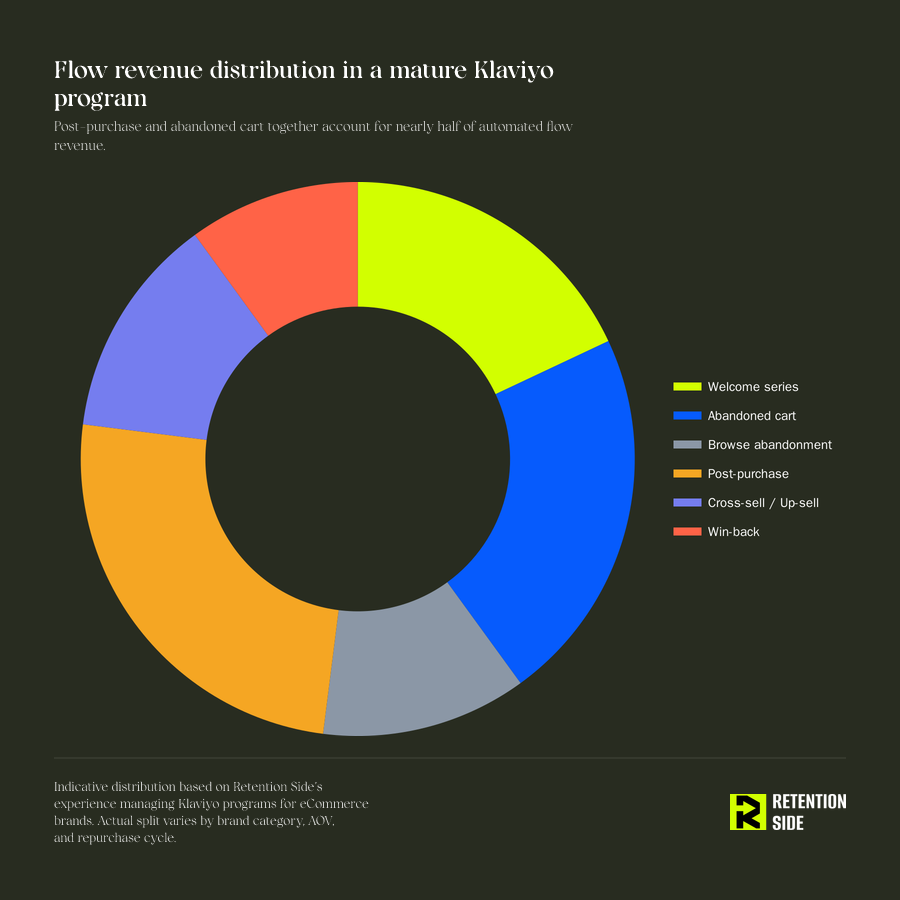
- Post-purchase flows are the most consistently underbuilt category. They are also among the most important for driving repeat purchase rate.
- Win-back triggers should be based on your brand’s actual repurchase cadence, not a generic 180-day rule.
- No flow should ever be considered finished. The flows that compound over time are the ones that get continuously tested, filtered, and refined.
- Sunset flows exist for list hygiene, not revenue. Keep them separate from your revenue-driving automation architecture.
- Cross-sell and up-sell flows deserve their own sequence, not a single email buried in the post-purchase stack.
- The goal is full lifecycle coverage – flows that address each stage from first subscription through to reactivation.
What we’ll cover
- Why flows are the infrastructure layer of email marketing
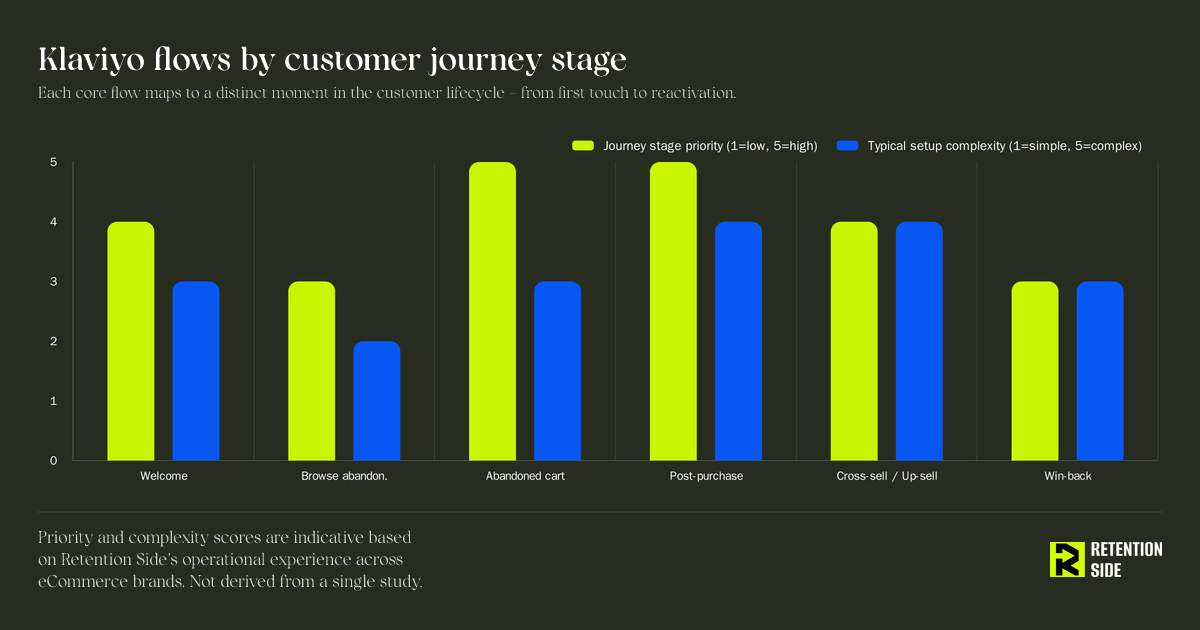
- The customer journey map every flow architecture should reflect
- Welcome series – the most important first impression you send
- Abandoned cart flow – recovery logic that actually works
- Browse abandonment – capturing intent before the cart
- Post-purchase flow – the highest-leverage sequence in retention
- Cross-sell and up-sell flows – turning one purchase into many
- Win-back flow – when and how to re-engage lapsing customers
- VIP and loyalty escalation flow – your highest-LTV segment deserves more
- Sunset flow – list hygiene is not a revenue strategy
- How flows and campaigns fit together
- The principles that separate good flow architecture from great
Why flows are the infrastructure layer of email marketing
Campaigns are active. Someone writes them, someone schedules them, someone hits send. They have value – they create commercial moments, tell stories, drive urgency, and keep your brand present in the inbox.
Flows are different. They fire based on customer behavior. No one hits send. A subscriber visits a product page, starts a checkout, makes a purchase, or goes quiet – and the right message goes out automatically, timed to that specific action. The logic runs 24 hours a day, seven days a week, without your team doing anything.
This is what makes flows the infrastructure of email marketing. They are the part that compounds quietly in the background. A well-built welcome series introduces your brand to every new subscriber, in the right sequence, at the right pace, forever. A well-built post-purchase flow brings first-time buyers back for their second purchase without anyone lifting a finger. That scale of consistent, personalized communication is not something a campaign calendar can replicate.
The practical implication: brands that invest seriously in their flow architecture get leverage. Every new subscriber that comes in from a paid ad, an organic search, or an influencer recommendation enters the same well-built welcome sequence. Every customer who buys gets the same considered post-purchase experience. You build it once, and it runs.
The brands that treat flows as an afterthought – that see them as the automated version of a campaign, less important than the weekly sends – are spending more effort for fewer returns. If you want a complete picture of where flows sit within a broader ecommerce email marketing strategy, it helps to understand how campaigns and automation are meant to divide the work between them.
The customer journey map every flow architecture should reflect
Before looking at individual flows, it is worth stepping back to the question they are all answering: where are customers in their journey with your brand, and what do they need at that moment?
Every eCommerce customer moves through a recognizable sequence of stages:
- Discovery and first subscription – They found you somehow, showed enough interest to sign up, but haven’t bought yet.
- Pre-purchase consideration – They are browsing, comparing, returning to product pages. Intent is building.
- Checkout-stage drop-off – They started the purchase process and stopped.
- First purchase – They bought. The retention relationship has officially started.
- Post-purchase engagement – The window right after a purchase, where trust is built or lost.
- Second purchase – The most critical conversion in the lifecycle. Customers who buy twice are statistically far more likely to buy a third time.
- Repeat customer – They have a track record. Cross-sell, up-sell, and loyalty mechanics apply here.
- At-risk lapsing – They haven’t bought in longer than their historical repurchase window.
- Chronically disengaged – They haven’t engaged with email in 90+ days and show no sign of returning.
A complete Klaviyo flow architecture has automated coverage for every one of these stages. Most brands have gaps at stages two, five, six, seven, and eight. Those gaps are where the retention revenue is leaking.
According to Shopify’s ecommerce customer retention research, loyal customers generate 44% of total revenue and 46% of orders despite making up just 21% of the customer base – a data point that puts the stakes of lifecycle coverage into sharp relief. Each gap in your flow architecture is a stage where a customer can quietly disengage before reaching that loyal-buyer tier.
Welcome series – the most important first impression you send
What it does and why it matters
The welcome series is triggered when a new contact joins your list. Its job is not simply to deliver a discount code and move on. The welcome series is the first real conversation you have with someone who has expressed interest in your brand but hasn’t committed to buying yet. It sets the tone for everything that follows.
In terms of engagement, the welcome window – typically the first 7 to 14 days after subscription – is the highest-engagement period in the subscriber lifecycle. New contacts are more likely to open, more likely to click, and more receptive to your brand story than they will be at almost any later point. This is the window to use.
What a strong welcome series actually does
A well-built welcome series for an eCommerce brand typically runs three to six emails over the first seven to ten days. Each email has a specific job:
- Email 1 delivers any promised incentive immediately, but its real purpose is the first brand impression. Tone, voice, and what makes this brand different from the ten other brands the subscriber also follows.
- Emails 2-3 build credibility and reduce purchase hesitation. Social proof, bestsellers, the story behind the product, or the problems it solves – depending on your category and customer intent.
- Emails 4-5 create a reason to act. If the subscriber hasn’t purchased yet, these emails can introduce urgency around the incentive, highlight a specific product, or use social proof and reviews to move them past hesitation.
- A branching path for subscribers who convert during the series. Someone who buys during email two should exit the welcome series and enter the post-purchase flow. Continuing to send welcome emails to a paying customer is both irrelevant and signals that your system doesn’t know who it’s talking to.
The incentive question
The incentive structure in a welcome series is a genuine strategic decision, not a default. A blanket 10% discount grows the list but attracts deal-seekers. If your brand has strong organic demand, a value-add incentive – early access, content, a quiz result, product education – often attracts higher-quality subscribers who convert at better rates and have higher LTV.
Whatever incentive you use, the timing and filter logic matters. If the discount is meant to close the sale in email four or five, it should not be visible until then. Subscribers who see it in email one have no incentive to act quickly. This timing principle applies equally to the Shopify email marketing strategy layer that sits alongside your automation – the two need to work in concert, not duplicate the same offer on different timelines.
Abandoned cart flow – recovery logic that actually works
What it actually addresses
Cart abandonment is the most visible flow in Klaviyo, and the most commonly built. The trigger is straightforward: someone started checkout and did not complete it. The flow’s job is to bring them back.
But framing it as “recovery” misses the strategic point. People don’t abandon carts randomly. They leave for reasons: unexpected shipping costs, second-guessing the purchase, getting distracted, comparing with a competitor, or needing more information to feel confident. According to Baymard Institute’s aggregated checkout research – based on over 150,000 hours of usability testing across major ecommerce sites – the average documented online cart abandonment rate sits around 70% across industries. A well-built abandoned cart flow doesn’t just remind someone they left something in their cart – it addresses the actual friction point behind that abandonment.
Sequencing and personalization
A basic abandoned cart flow is two or three emails. The first arrives within one to two hours and is a simple, clean reminder – no discount yet. The majority of recoverable carts come back at this stage. The second email, sent roughly 12 to 24 hours later, often includes a trust signal: reviews for the specific product, a return policy reminder, or an answer to a common purchase hesitation. The third email, if needed, introduces an incentive – but only if the subscriber hasn’t purchased and hasn’t engaged with the first two.
The flows that perform best segment by context:
- Has this person bought before? A first-time customer needs more trust-building. A repeat buyer needs less friction removal and often just needs a gentle nudge.
- What is the cart value? A $250 cart justifies different messaging and a different incentive structure than a $40 cart.
- What is in the cart? Product-specific copy and social proof outperforms generic “you left something behind” messaging.
Klaviyo’s behavioral event data makes all of this segmentation possible. The question is whether it’s actually being used. For a deeper breakdown of sequencing logic, incentive structure, and what to measure inside the flow, our full guide to abandoned cart emails for ecommerce stores covers the architecture in detail.
Browse abandonment – capturing intent before the cart
Why this flow is underbuilt in most accounts
Browse abandonment is the most commonly missing flow in Klaviyo accounts we audit. The trigger fires when a subscriber views a product page but doesn’t add it to the cart. No cart abandonment event, no purchase – just a browse.
That browse is a buying signal. It is not as strong as starting a checkout, but it is far from passive. Someone who returns to the same product page multiple times is doing comparison research, thinking about a purchase, or waiting for the right moment. Treating that signal as noise is a missed opportunity.
How to build it correctly
Browse abandonment flows typically contain one to three emails. The first email goes out within one to four hours – same-session triggers tend to perform worse because the subscriber may still be actively shopping. The message is product-specific: showing the viewed item, surfacing reviews, and making it easy to return to the page.
The flow should filter for subscribers who also triggered an abandoned cart event during the same session. There’s no need to send a browse abandonment email to someone who already has a cart abandonment sequence running – that creates redundant touchpoints and can feel aggressive.
Browse abandonment converts at lower rates than abandoned cart – because the intent signal is weaker – but it addresses a significantly larger pool of visitors. At the volume levels typical for brands doing $300K+/month, the revenue contribution is meaningful. It is also worth noting that this flow requires clean event tracking to function. If the “Viewed Product” event isn’t firing reliably in your Klaviyo account – which often happens after Shopify theme updates or tag management changes – the flow will either miss triggers or fire incorrectly. This is worth auditing before building the flow, and our Klaviyo audit checklist for ecommerce stores covers exactly what to check.
Post-purchase flow – the highest-leverage sequence in retention
Why most brands underinvest here
If you want to know where retention actually gets built or lost, look at what happens after the first order. This is the most consistently underbuilt flow category in eCommerce email, and it is also the most consequential for repeat purchase rate.
Most brands send transactional emails – order confirmation, shipping notification, delivery confirmation – and treat that as the post-purchase experience. Those are not the same as a marketing post-purchase flow. Transactional emails confirm logistics. The marketing post-purchase flow converts first-time buyers into repeat customers.
The architecture of a strong post-purchase flow
The post-purchase flow should activate after delivery – not after purchase, because the customer is focused on logistics until the package arrives. After that, the window opens.
A well-structured post-purchase flow does several distinct jobs:
Product education and onboarding. For brands in health, beauty, supplements, or any category with a learning curve, the first post-purchase emails should help the customer get real value from what they bought. A customer who uses a product correctly and gets results is far more likely to buy again than one who uses it incorrectly and feels disappointed.
Review request. The right time to ask for a review is one to two weeks after delivery, when the product experience is fresh. This should be a dedicated email – not buried in a multi-purpose send.
Cross-sell introduction. Once the customer has had time to experience the product, an email that introduces complementary products – with a clear rationale for why they pair well – performs better than a generic “you might also like” catalogue. This is where category knowledge matters: the cross-sell logic should reflect what your customers actually buy together.
Path to second purchase. The second purchase is the most important conversion in the customer lifecycle. Customers who buy twice are substantially more likely to become long-term repeat buyers than one-time buyers. Smile.io’s 2025 State of Ecommerce Customer Loyalty report, which analyzed 585 million orders across 100,000+ merchants, found that repeat customer rates are increasing year-over-year across all major ecommerce industries – a signal that the brands investing in post-purchase engagement are pulling ahead. The post-purchase flow should actively guide first-time buyers toward that second purchase – through product recommendations, a relevant incentive, or simply a well-timed nudge based on your typical repurchase window.
First-time vs. repeat buyer branching. First-time buyers and repeat buyers need different sequences. A customer buying for the third time doesn’t need product education. They need a loyalty acknowledgement, a cross-sell relevant to what they’ve already purchased, and potentially an invitation to a VIP tier. Serving both with the same flow sequence is a personalization miss at the most valuable moment in the lifecycle.
Cross-sell and up-sell flows – turning one purchase into many
Why these deserve their own sequence
Cross-sell and up-sell logic often gets collapsed into the post-purchase flow as a few product recommendation emails. That works at a basic level, but it misses the real opportunity. A dedicated cross-sell or up-sell flow – triggered by a specific product purchase – can be much more targeted, much more relevant, and much more likely to convert.
The trigger is a purchase event for a specific product or product category. The flow’s job is to introduce the next natural product in that customer’s journey: a complementary item, a higher-tier version, a bundle that reflects how other customers use the original purchase.
Building the logic
The cross-sell flow should be timed based on what makes sense for the specific product. If someone buys a skincare cleanser, a cross-sell for a matching moisturizer makes sense two to three weeks after delivery – not the same day. The timing reflects how the product cycle actually works.
For categories with strong up-sell potential – supplements with subscription tiers, apparel with product lines, software-adjacent DTC – the up-sell flow can be structured around social proof from customers who upgraded, a clear explanation of the added value, and a low-friction conversion path.
The key principle: cross-sell and up-sell messages should feel like a natural continuation of the customer’s relationship with the brand, not a sales push. When the recommendation genuinely fits the customer’s purchase history, it lands as helpful. When it doesn’t, it reads as broadcast. This is one of the reasons cross-sell flows deserve their own dedicated sequence – rather than being appended to an already busy post-purchase stack – and it’s a distinction that matters when evaluating what a Klaviyo email marketing agency should be building for your account.
Win-back flow – when and how to re-engage lapsing customers
Timing is everything here
Win-back flows are triggered when a customer who has previously purchased goes a defined period without buying again. The strategic purpose is to re-engage customers before they fully disengage – before the brand becomes out of sight and out of mind.
The timing of the trigger is the most important variable, and it is one most brands get wrong. A win-back flow should fire at the point where a customer’s absence becomes statistically unusual given their purchase history. If your brand’s average order frequency is 45 days, a customer who hasn’t purchased in 60 days is lapsing. Triggering a win-back at 60 or 75 days makes sense.
What does not make sense is the default approach many brands take: setting a win-back trigger at 180 days. By then, the vast majority of customers who were going to come back have already come back on their own, and those who haven’t have largely moved on. A 180-day win-back is not a retention tool – it is a Hail Mary. The exception is categories with genuinely long repurchase cycles, like furniture or large appliances, where long gaps between purchases are the norm.
What to put in the sequence
A win-back flow typically runs two to four emails. The first email opens the conversation with a relevant reason to return – a new product, a seasonal moment, a reminder of what made the first purchase worth it. It should not lead with a discount. The second email introduces social proof or new arrivals. The third, if the customer is still unresponsive, can include an incentive. The final email, if there’s still no engagement, is the last outreach before suppression.
The offer logic should reflect what the customer previously bought. A customer who spent $200 on a single item deserves a different re-engagement approach than a customer who bought a $30 product once. Klaviyo’s customer profile data makes this level of personalization possible at scale.
VIP and loyalty escalation flow – your highest-LTV segment deserves more
Why this flow gets skipped
Most brands invest heavily in acquisition flows – welcome, abandoned cart – and give relatively little thought to the experience their best customers receive. The customers who have bought four or five times, who have the highest lifetime value, and who are the most likely to refer new customers get the same post-purchase sequence as someone buying for the first time.
That is a missed opportunity at the end of the funnel where value is highest. According to Smile.io’s loyalty data, it’s estimated that 35% of an ecommerce store’s revenue is generated by the top 5% of customers – which makes the experience you deliver to that segment a direct lever on your revenue ceiling.
Building the VIP escalation trigger
A VIP escalation flow triggers when a customer crosses a spending or order count threshold that you define based on your AOV and customer data. The flow’s job is to acknowledge their loyalty in a way that feels meaningful, introduce them to experiences or benefits your regular customers don’t receive, and give them structural reasons to stay.
The content depends on your brand’s approach to loyalty. If you have a formal loyalty program, this is the entry point. If you don’t, it can be a curated early access experience, a personal note from the brand, or exclusive product access.
The underlying principle: customers who are already your best customers are also your most cost-effective retention target. A relatively small investment in their experience can meaningfully extend their purchase horizon and increase referral likelihood.
Sunset flow – list hygiene is not a revenue strategy
What it actually does
The sunset flow is often listed alongside revenue-generating flows, but it operates on completely different logic. Its purpose is not to recover revenue. Its purpose is to protect deliverability by removing chronically disengaged subscribers from your active sending audience.
A sunset flow triggers for subscribers who have not engaged with any email over a defined window – typically 90 to 120 days, depending on your send frequency. The flow makes a final re-engagement attempt with a transparent, low-friction message: “We haven’t heard from you – do you still want to receive our emails?” If they engage, they stay. If they don’t respond after two or three attempts, they get suppressed.
This matters because inbox providers – Gmail, Outlook, Yahoo – use engagement signals to determine where your emails land. Sending to a list with a high proportion of chronically unengaged subscribers drags down your sender reputation and gradually pushes more of your emails into spam. Suppressing those contacts improves your deliverability for the subscribers who actually want to hear from you.
The important distinction: do not include the sunset flow in your count of revenue-driving automations. It does not drive revenue. It protects the channel that does.
How flows and campaigns fit together
Flows handle the behavioral layer. Campaigns handle the broadcast layer. Both are essential. Neither makes the other redundant.
A common mistake is treating campaigns as the “active” work and flows as the “passive” background. That framing leads to over-investing in campaigns and under-investing in flow architecture. The result is a program where performance depends entirely on how many emails your team sends each week, rather than on automated systems running continuously.
The healthier framing: flows are your consistent, always-on retention engine. Campaigns are the strategic layer on top – they create commercial moments, drive urgency, share brand stories, launch products, and build the relationship depth that makes customers receptive to the automated messages they also receive.
A well-built Klaviyo program should distribute revenue meaningfully between flows and campaigns. If the overwhelming majority of email revenue is coming from manual campaign sends, the automation layer is not doing its job – and the program is fragile. Understanding this balance is central to building a Shopify email marketing strategy that doesn’t collapse the moment your team takes a week off.
The principles that separate good flow architecture from great
Flows are never finished
The single most important operating principle for anyone building Klaviyo flows: the flow is not done when it goes live. It is done when it stops being improved. A welcome series that was built 18 months ago and hasn’t had a subject line test since is leaving measurable performance on the table. Every flow has testable variables – subject lines, timing, incentive structure, email count, branching logic – and every test produces learnings that sharpen the sequence.
A/B testing should be continuous, not occasional. The brands that compound flow performance over time are the ones running at least one test on each major flow in any given quarter.
Filters and smart sending prevent overlap
Multiple flows running simultaneously create the risk of a subscriber receiving too many emails in a short window, or receiving messages from sequences that are no longer relevant to where they are in the customer journey. Flow filters – conditions that determine who can enter a flow – and smart sending settings – rules that limit how many automated emails a subscriber can receive in a given period – are the mechanics that prevent this.
If a subscriber just placed an order, they should be filtered out of the abandoned cart flow that fires based on a browse event from the same session. If someone is in the middle of the welcome series, they should not be pulled into a browse abandonment flow for a product they viewed while reading email one. These details are not edge cases. In a mature account with multiple active flows, they determine whether the subscriber experience feels coherent or chaotic. Running a structured Klaviyo account audit is the clearest way to surface which flows are overlapping and which filters are missing before they become a deliverability or subscriber experience problem.
Incentive discipline prevents training customers to wait
When incentives appear in flows, they should be deliberately positioned – not defaulted to the first email simply because it’s easier. If every first email contains a discount, you train subscribers to wait for the discount before engaging. If the discount only appears after a subscriber has not responded to two earlier emails, it does its job: it’s the last push, not the first move.
The same principle applies across sequences. A customer who sees a discount in the first post-purchase email after every order learns to expect that discount as a loyalty benefit. That’s not retention – it’s conditioning.
Coverage before optimization
There is a sequencing principle worth applying to flow architecture: building coverage across the full customer journey is more valuable than deeply optimizing a single flow. A brand with a perfectly optimized abandoned cart flow but no post-purchase sequence is investing most of its effort at one stage of the journey while leaving major stages uncovered.
The audit question to ask regularly is not “how can we make this flow better?” but “are there stages in our customer journey where we have no automated coverage?” Answering that question honestly usually surfaces higher-priority work than another round of subject line testing on the welcome series.
Zero-party data makes flows smarter over time
Most Klaviyo flows rely on behavioral signals: what someone browsed, added to cart, or purchased. That is the foundation, and it is powerful. But behavioral data only accumulates after interactions occur. In the early stages of the subscriber relationship – before a purchase, before a browse pattern has formed – the only signals you have are what the subscriber has voluntarily shared.
Zero-party data – information a subscriber gives you directly, through a quiz, a preference form, or a question in the welcome series – makes flows smarter from the start. A skincare brand that knows a subscriber’s skin type before their first purchase can send product recommendations that are relevant from email one, rather than waiting for a purchase pattern to emerge. A pet brand that knows what species and breed a subscriber has can tailor the welcome sequence and cross-sell logic from the beginning.
Collecting zero-party data is a strategic infrastructure decision, not just a personalization tactic. It sits at the intersection of list growth and flow architecture, and the brands that invest in it early get a compounding advantage as their lists grow. Smile.io’s 2025 loyalty research specifically identifies this intersection – brands that combine loyalty data with behavioral signals are the ones seeing the most durable gains in purchase frequency and customer lifetime value.
Conclusion
Klaviyo flows are not a feature of your email program. They are the architecture of it. Each one exists to address a specific stage in the customer lifecycle – a moment where the right message, sent at the right time, does meaningful retention work.
The brands that get the most from their flow architecture share a few common traits. They have coverage across the full customer journey, not just the obvious stages. They treat every flow as an ongoing optimization project, not a one-time build. They use behavioral data, purchase history, and zero-party signals to make each sequence genuinely relevant. And they distinguish clearly between flows that drive revenue – welcome, browse abandonment, abandoned cart, post-purchase, cross-sell, win-back, VIP – and flows that protect the channel, like the sunset flow.
Getting all of that right is not a one-sprint project. It is an ongoing operational discipline. The brands doing it consistently are the ones with repeat purchase rates that reflect the investment.
If you are auditing your current Klaviyo flow setup and want to understand where the gaps are and what closing them would do for your retention metrics, that is exactly the kind of diagnostic work Retention Side does every time we take on a new eCommerce brand.