

Every ecommerce brand has an abandoned cart flow. Most of them are underbuilt.
The typical version looks like this: one email, sent an hour after abandonment, with a generic subject line and a 10% discount code at the bottom. It goes to every abandoner regardless of cart value, purchase history, or what they were actually looking at. The incentive fires on the first touch, before any objection has even been raised.
That setup captures some revenue. It also leaves a significant portion of recoverable purchase intent untouched – and it hands out discounts to customers who would have bought anyway.
This guide is about building an abandoned cart email system that does the actual job: addressing the real reasons people leave, using the right message at the right moment, and recovering more revenue without reflexively discounting your way through every abandonment.
Key takeaways
- Abandoned cart emails are one of the highest-leverage flows in any ecommerce email program – but only when they’re built with strategic intent, not just set up and left running.
- The single-email approach misses most of the recoverable opportunity. A multi-touch sequence with a clear role for each email consistently outperforms.
- Timing of the first email matters more than almost anything else. Within 1-2 hours is not a suggestion – it’s the window where purchase intent is still active.
- Segmentation by cart value, purchase history, and abandonment reason changes what each email should say – and whether it should include an incentive at all.
- The flow should be treated as a living system: tested, updated, and optimized continuously. What worked at launch is rarely the best version 12 months later.
- Cart recovery is one piece of a larger retention system. The customers you recover need a post-purchase sequence, a cross-sell path, and eventually a win-back mechanism. Cart emails are the entry point, not the end goal.
What we’ll cover
- Why cart abandonment happens – and what that means for your messaging
- The anatomy of a high-performing abandoned cart flow
- Email 1: the recovery anchor
- Emails 2 and 3: escalation and close
- Segmentation that actually changes behavior
- The incentive question – when to offer a discount and when not to
- Copy and design principles that move people
- What to measure (and what not to)
- Browse abandonment: the flow most brands skip
- How abandoned cart fits into a broader retention system
Why cart abandonment happens – and what that means for your messaging
Abandonment is not one problem. It’s a cluster of different problems wearing the same label.
According to Baymard Institute’s aggregated cart abandonment research, the average documented cart abandonment rate across ecommerce sits around 70%. But the reasons behind that number vary considerably – and the variation matters for how you write recovery emails.
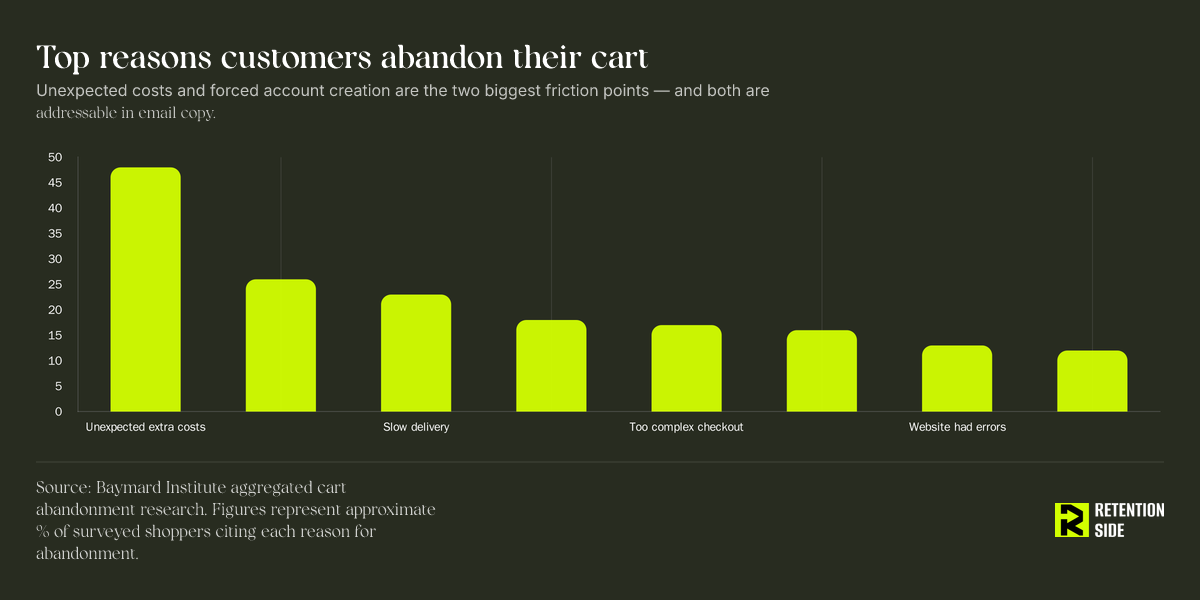
The most common reason people cite is unexpected extra costs – shipping fees or taxes that only appear at checkout. The second most common is being forced to create an account before purchasing. Others include delivery being too slow, concerns about payment security, or simply not being ready to buy yet (comparison shopping, saving for later, distracted mid-session).
Notice that most of these reasons have nothing to do with the product itself. The customer wanted what was in the cart. Something in the checkout experience or the decision environment created friction or doubt. As Baymard’s checkout usability research consistently shows, even well-intentioned UX choices – like requiring account creation before purchase – can be the exact thing that kills a near-certain sale.
This is the insight that changes how you write recovery emails. Your job is not to simply remind people that they left something behind. Your job is to address the specific type of friction that caused them to leave – and do it in a way that doesn’t make the abandonment feel like a surveillance event.
A generic “you left something in your cart” email with a 10% code treats all abandoners identically, regardless of why they actually left. A well-built sequence uses email 1 to remove the most common frictions (shipping cost transparency, guest checkout reminder, trust signals), email 2 to restate product value and social proof, and email 3 – where relevant – to offer a closing incentive calibrated to cart value.
The sequence should feel like a helpful nudge from a brand that knows what you were looking at and wants to make it easy to come back – not a countdown timer pushing you toward a panic purchase.
The anatomy of a high-performing abandoned cart flow
The question most brands start with is “how many emails?” That’s the wrong place to start. The right question is “what does each email need to accomplish?”
A well-structured abandoned cart flow typically involves three emails. Each one has a distinct role:
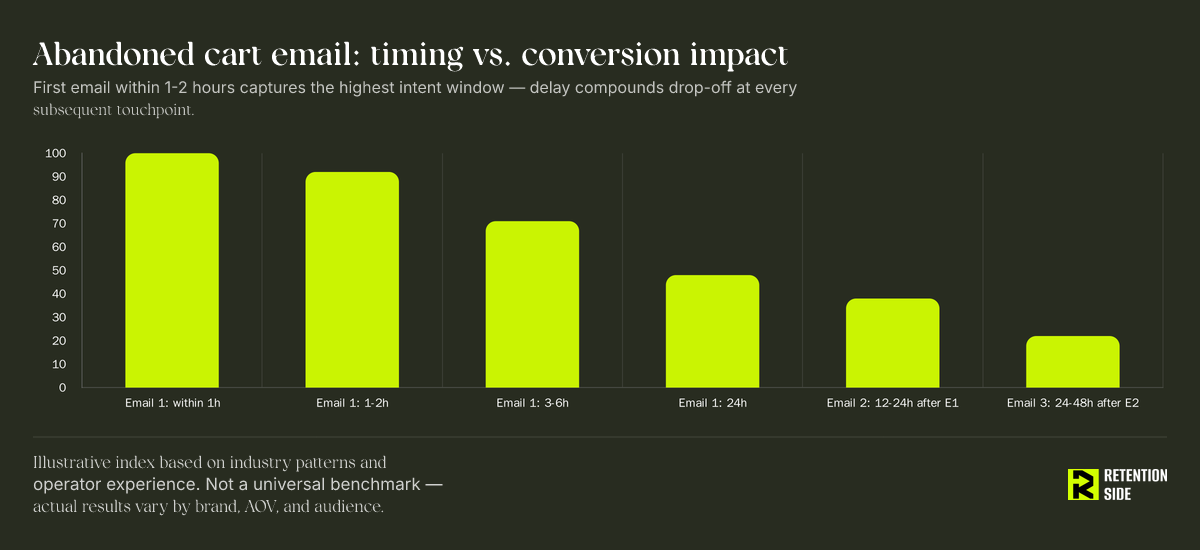
Email 1 is the recovery anchor. It arrives while purchase intent is still warm – within 1-2 hours of the abandonment. Its job is simple: get back in front of the customer, show them what they left, and remove the most obvious barrier to completing the purchase. No panic. No pressure. No discount yet.
Email 2 is the value reminder. It arrives 12-24 hours after the first email, for subscribers who haven’t converted. Its job is to reinforce why this product is worth buying – through social proof, specific benefits, a review or two, or a gentle restatement of what makes the brand different. It can also address common pre-purchase hesitations relevant to this product category.
Email 3 is the close. It arrives 24-48 hours after email 2, only for people who have still not converted. This is where a targeted incentive can make sense – but only for specific segments, which we’ll get to. For others, email 3 is a final, low-pressure nudge that creates a soft urgency framing without a manufactured countdown.
This structure works because it mirrors what a skilled human salesperson would do. They don’t lead with a discount. They show up, restate the value, address concerns, and only then – for the most hesitant buyers – offer something to close the gap.
Email 1: the recovery anchor
The first email is the most important by a significant margin. It has the highest conversion rate of the three, and for good reason – the customer’s intent is freshest, the product is still in their mental working memory, and no significant time has passed for competing offers to displace it.
Timing is non-negotiable. Send within 1-2 hours of the abandonment event. Not 6 hours. Not next morning. The decay curve on purchase intent is steep – every hour of delay meaningfully reduces the probability of recovery.
In Klaviyo, this trigger is the “Checkout Started” event. Make sure your Shopify integration is tracking this event reliably. If “Checkout Started” events aren’t firing correctly – which happens more often than it should, particularly after site redesigns or platform migrations – your entire abandoned cart flow is running on broken data. This is one of the most common technical gaps we surface in Shopify email marketing audits.
What email 1 should contain:
- A clear display of the abandoned cart items, including product image, name, and price
- A direct, easy-to-use link back to the cart (a single click should restore the session)
- Transparent shipping information – if you offer free shipping above a threshold, make that visible. If the cart is close to the threshold, surface that explicitly (“You’re $12 away from free shipping”)
- Trust signals relevant to first-time visitors: return policy, secure checkout indicators, customer service access
- A tone that’s helpful rather than pushy – you’re not hounding them, you’re making it easy to come back
What email 1 should not contain:
- A discount code (this should be reserved for later in the sequence for most segments)
- Urgency that isn’t real (“Your cart is about to expire!” for a product that’s clearly in stock)
- Multiple competing CTAs – one button, one destination
For returning customers who have already bought from you before, email 1 can lean on the brand relationship. They know your products. You don’t need to sell the category again. A simple, direct “here’s what you left behind” tone often converts better than a full persuasion sequence for this cohort.
Emails 2 and 3: escalation and close
Email 2: social proof and value reinforcement
By the time someone receives email 2, they’ve seen email 1 and not acted. That means the easy conversions are done. What’s left is the segment that had a genuine question, objection, or distraction that the first email didn’t resolve.
Email 2 is the place to bring in the evidence. Not generic evidence – specific, relevant social proof for the product or category that was abandoned.
This might look like:
- A customer review that speaks directly to the hesitation most relevant to this product category (fit and sizing for apparel, efficacy for supplements, durability for equipment)
- A reminder of what makes the brand’s products different from alternatives
- An answer to a common pre-purchase question that may have stalled the decision
- A “here’s what other customers who bought this also loved” approach that broadens the appeal without losing focus
The framing should still be warm and low-pressure. The customer hasn’t unsubscribed. They’re still reachable. They just needed something email 1 didn’t give them.
For Shopify brands using Klaviyo, the product detail content you populate in your catalog matters here. If the review integration (Yotpo, Okendo, or Stamped) is set up correctly, you can pull dynamic review content directly into flow emails – surfacing reviews for the specific product the customer abandoned, not a generic testimonial. That specificity is what converts.
Email 3: the close
Email 3 should only go to subscribers who haven’t converted after emails 1 and 2. It’s the last touchpoint before you suppress this abandonment event and let the customer either re-enter the flow organically (via a new abandonment) or shift into regular campaign communication.
The tone of email 3 depends entirely on the segment (covered below). For high-cart-value, first-time visitors who’ve shown strong intent, a modest incentive makes sense. For returning customers with purchase history, a softer urgency framing – “still thinking it over?” – often performs as well without the discount cost.
What email 3 should avoid: false scarcity that isn’t true (“Only 2 left!” for a product you have 500 units of), aggressive pressure language, and stacked CTAs that create decision paralysis.
Segmentation that actually changes behavior
This is the part most abandoned cart flows skip entirely – and it’s the lever with the most upside for brands with reasonable list sizes and purchase history data.
Not every abandoned cart represents the same type of customer or the same type of opportunity. Treating a first-time visitor abandoning a $35 item the same as a 4x repeat customer abandoning a $220 item doesn’t just produce suboptimal messages – it actually undermines trust with the customers who matter most.
Segmentation dimensions worth building into your flow:
First-time visitor vs. returning customer
First-time visitors need more convincing. They don’t know your brand yet. They need trust signals, social proof, and a reason to take a chance on a brand they’ve never bought from. The messaging leans heavier on brand credibility and product specifics.
Returning customers already trust you. The friction is usually situational – timing, distraction, a price consideration. The messaging can be more direct: “you know us, here’s what you left, come back when you’re ready.”
Cart value
High-value cart abandons (typically above $150-200, depending on your AOV) deserve a different experience. These customers were making a considered purchase. They may have questions that email copy alone can’t fully resolve – especially in categories like premium wellness, jewelry, or home goods where the decision involves real money.
For high-AOV abandons from first-time visitors, email 2 might include a direct “reply if you have questions” CTA or a link to a product FAQ. A small but targeted incentive in email 3 can close the final gap without feeling generic.
Low-value cart abandons often convert on a simple, clean reminder. Heavy persuasion sequences can actually reduce conversion for small-ticket items where the decision should be easy.
Number of sessions / engagement depth
Klaviyo can track whether someone has visited your site multiple times before this abandonment. A customer who has visited three times over two weeks and finally added to cart – then abandoned – is expressing a very specific kind of hesitation. They want the product. Something specific is stopping them. Email 2 for this cohort should do more work on addressing the objection.
Product category
Category-specific messaging matters, especially for brands with diverse catalogs. Someone abandoning a skincare subscription has different questions than someone abandoning a one-time purchase of a gadget. Branching your flow by product category – or at minimum by purchase type (subscription vs. one-time, high-consideration vs. replenishment) – produces more relevant messages without requiring an entirely separate flow structure. If you want a deeper look at how segmentation fits inside a full ecommerce email marketing strategy, that framework covers the entire lifecycle.
The incentive question
The default behavior in most abandoned cart flows is to drop a discount code in the second or third email. Sometimes in the first. This is where a lot of margin walks out the door quietly.
The question isn’t whether discounts work in cart recovery. They do. The question is: for which customers, at which point in the sequence, at what value?
Here’s the framework we recommend at Retention Side:
Email 1: No incentive for most segments. The incentive is ease of return – free shipping visibility, trust signals, a clean path back to the cart. For some very high-AOV, first-time-visitor scenarios, a low-friction offer (free shipping upgrade) might belong here. A percentage-off discount almost never belongs in email 1.
Email 2: No incentive unless there’s a strong brand-specific reason. Lean on social proof and value restatement instead.
Email 3: Targeted incentive only for segments where it makes commercial sense – typically high-cart-value first-time visitors. Keep it proportional to the cart size. A flat $10-15 offer on a $200 cart is more defensible than blanket 15% off everything.
What about returning customers? Be careful. A returning customer who abandoned a cart probably doesn’t need a discount – they’ve already demonstrated willingness to buy at full price. Sending a discount to this cohort in every flow trains them to expect one, which erodes full-price purchasing over time. This isn’t a hypothetical – as DMNews noted in their analysis of abandoned cart email strategies, discount-dependent recovery “trains shoppers to abandon carts deliberately, waiting for the inevitable coupon,” citing research that has documented how this pattern erodes margin and conditions price-sensitive behavior. Harvard Business Review’s research on price-sensitive customers reinforces this point: once customers anchor to a discounted price as the “real” price, reversing that expectation is costly.
The right safeguard is a flow filter that excludes subscribers who have already received a discount via a previous abandoned cart flow within a rolling 60-90 day window. If a customer got 10% off last month to close an abandoned cart, they shouldn’t get the same offer again this month without a deliberate decision on your part.
One more important point: because only a subset of customers trigger any specific abandoned cart flow sequence, incentives used here are more financially contained than campaign-wide discounts. A 15% off code in an email campaign to your full active list is a different proposition from a 15% off code in email 3 of an abandoned cart sequence going to a narrow segment. The scale difference matters when you’re evaluating margin impact.
Copy and design principles that move people
The mechanics above work. But the copy is what determines whether the mechanics actually convert – and this is where a lot of otherwise well-built flows fall flat.
Subject lines
The biggest mistake in abandoned cart subject lines is being too cute. “Your cart misses you” reads as performative. “Don’t forget!” is generic. The highest-performing subject lines in this flow are usually the most direct: they either name the product, reference the cart value, or ask a useful question.
Examples of approaches that tend to work:
- “[Product name] is still waiting for you”
- “Did something go wrong at checkout?”
- “Before you decide – here’s what other customers say”
- “Still thinking it over?” (for email 3)
These work because they’re specific, low-pressure, and written from a place of genuine helpfulness rather than commercial desperation.
Email body copy
Keep it focused. One product highlight, not five. One CTA, not three. The visual design should make the product the hero – large product image, clear price, easy-to-click return button. Text copy should be brief but purposeful: one or two sentences that reinforce why this product is worth finishing the purchase.
The brand voice matters here. If your brand is warm and conversational, the abandoned cart email should be warm and conversational. If your brand is crisp and utilitarian, the recovery email should match that register. A mismatch between the tone of your other communications and the tone of your abandoned cart emails is a missed opportunity to deepen brand recognition.
Personalization depth
Klaviyo’s Shopify integration lets you pull product-level data into email templates dynamically – the abandoned product image, name, price, and review data. Use all of it. A generic “you left items in your cart” email with no product visuals converts at a fraction of what a visually personalized email converts at.
If the customer has purchased from you before, you can also surface relevant cross-sell items below the fold – not as the primary CTA, but as a secondary nudge: “customers who bought [abandoned product] also loved [complementary product].” This adds commercial value without distracting from the primary recovery goal.
Mobile rendering
The majority of these emails will be read on mobile. Every design decision – button size, image aspect ratio, font size – needs to be tested against mobile rendering first. An abandoned cart email that requires horizontal scrolling or has a CTA button that’s too small to tap reliably on a phone is leaving conversion on the table for no reason other than execution quality. This applies beyond just cart emails: every flow in your Shopify email marketing strategy should be built mobile-first from the ground up.
What to measure in your abandoned cart flow
The metrics Klaviyo surfaces most prominently – like open rate – are the least useful for evaluating whether your cart recovery system is actually working. Here’s what actually matters:
Flow conversion rate – the percentage of customers who enter the flow and complete a purchase, attributed to the flow. This is your top-line health metric. It tells you whether the sequence, in aggregate, is working.
Revenue generated per trigger – how much revenue the flow produces each time it fires. Track this over time to see whether optimization work is moving the needle. If you rebuilt email 2 to include dynamic reviews and revenue per trigger went up, you have a real signal.
Conversion by email – which email in the sequence is doing the most recovery work? If email 1 is converting most of your revenue and emails 2 and 3 are adding very little, either your email 1 is doing exceptional work or your later emails need to be reconsidered. If email 3 is doing most of the heavy lifting, you may be over-relying on the incentive.
Incentive cost as % of recovered revenue – are you recovering margin or just converting revenue at a loss? Track the full picture, not just gross revenue attributed to the flow.
Segment-level performance – do first-time visitors convert at different rates from returning customers? Does email 3 close high-cart-value abandons but barely move low-cart-value ones? This is the data that drives meaningful optimization, not just broad flow-level stats.
What to avoid treating as meaningful: absolute open rate, click rate as a proxy for conversion intent, and any single-email performance metric in isolation from the full sequence. For a complete look at which metrics actually tie to business outcomes in a retention program, see our guide on ecommerce email marketing strategy.
Browse abandonment: the flow most brands skip
Browse abandonment is the abandoned cart flow’s less-appreciated sibling – and for many brands with significant organic or paid traffic, it’s the highest-volume intent signal they’re not acting on.
A browse abandonment flow fires when someone views a product page but doesn’t add anything to cart. The intent signal is weaker than a cart abandonment – the customer looked, but didn’t commit to even expressing purchase intent. But it’s still a signal, and in aggregate, it represents a much larger pool of potential customers than cart abandonment does.
The mechanics are straightforward in Klaviyo: trigger on the “Viewed Product” event, filtered to exclude people who have already started checkout (those belong in the cart flow). Timing is typically 1-4 hours after the page view.
What makes browse abandonment emails different from cart recovery:
- The tone is more exploratory and less recovery-oriented. You’re not recovering a near-purchase – you’re nudging someone who was curious.
- Social proof and product education do more of the work here. The customer hasn’t committed enough to need a reminder of what they left behind – they need reasons to go further.
- The product image should anchor the email just as it does in cart recovery, but the supporting copy leans into “here’s what you might not know about this product” territory.
- Incentives belong even later in the sequence here, if at all. The browse abandoner’s decision calculus is different from the cart abandoner’s.
Browse abandonment requires clean event tracking to function. If the “Viewed Product” event isn’t firing reliably in your Klaviyo account – which often happens with tag management issues or Shopify theme updates – the flow will either miss triggers or fire incorrectly. This is worth auditing before building the flow. We cover this in more detail in our breakdown of what a Klaviyo email marketing agency actually handles during a proper account audit.
Common mistakes worth correcting before you optimize
Before getting into optimization work, it’s worth running your existing flow against this checklist. These are the patterns that consistently underperform:
Sending the discount too early. Email 1 should not contain a discount in most cases. Leading with a discount trains customers to abandon carts deliberately to receive the offer. It also reduces the perceived value of your pricing – if the “real” price is always 10% lower for anyone who abandons, your full price becomes a fiction.
One email only. A single recovery email is still better than nothing, but it leaves the majority of recoverable revenue on the table. Customers who don’t convert on email 1 are not necessarily lost – they often need more time, more evidence, or a different framing. The sequence exists to serve them.
Sending to everyone, always. If a customer hasn’t consented to marketing emails (they’re a guest checkout abandoner without email opt-in), they should not be in your abandoned cart flow. Beyond compliance – particularly relevant given GDPR in Europe and CCPA in California – sending to unconsentable contacts damages your sender reputation and pollutes your flow metrics. Klaviyo’s flow filters can exclude non-opted-in profiles – use them.
Not filtering for recent purchasers. A customer who placed an order in the last 24 hours shouldn’t receive an abandoned cart email for a separate browsing session. Make sure your flow excludes anyone who has already placed an order recently. This is a basic but easily missed filter.
Never testing anything. Subject line testing alone – running systematic A/B tests on email 1 subject lines over a 6-month period – produces compounding improvements that far outweigh any individual creative decision. If your abandoned cart flow has never had a deliberate A/B test applied to it, that’s the first optimization to run.
Ignoring deliverability. A well-built abandoned cart flow that routes to Gmail’s spam folder is generating zero revenue. Deliverability – authenticated sending infrastructure, healthy list hygiene, suppressed non-engagers – is a prerequisite for every flow performing as intended. If your overall inbox placement rate is poor, flow optimization is the wrong place to start. Deliverability is covered in depth as one of the four foundational pillars in our ecommerce email marketing agency breakdown.
How abandoned cart fits into the broader retention system
Cart recovery is a revenue flow. It’s not a retention strategy.
The distinction matters because a customer who converts from an abandoned cart email is a first-time buyer or a returning buyer with a potential second purchase. What you do with that customer after they convert determines how much long-term value the recovery actually generated.
Here’s what needs to exist downstream of a successful cart recovery:
Post-purchase sequence. A customer who just converted from an abandoned cart email is at the highest engagement point they’ll be at for a while. A strong post-purchase sequence – product education, cross-sell recommendations, review request, path to second purchase – turns a recovered sale into a retained customer. Without it, you’ve done the hard work of recovery and left the easy work of retention undone. For brands running on Shopify and Klaviyo, this is one of the highest-leverage gaps we see in our Shopify email marketing agency work.
Cross-sell flow. Based on what the customer bought, what complementary product does the data show they’re likely to want next? This flow fires after the purchase and serves the customer’s expanding relationship with your catalog. It’s also where a lot of the lifetime value from a recovered cart is actually realized.
Win-back mechanism. If this customer goes quiet after their purchase – doesn’t engage with campaigns, doesn’t return to the site, doesn’t buy again – they’ll eventually enter a win-back flow. That flow should be timed to their expected repurchase window, based on your brand’s actual average order frequency data, not a generic 90-day trigger.
The broader point is that the abandoned cart flow exists inside a lifecycle, not as a standalone mechanism. Brands that treat it as the full retention picture are always surprised when recovered-customer LTV is lower than expected. The recovery was a starting point – the system is what builds the value from there.
At Retention Side, we build cart recovery as part of a full flow architecture that covers the entire customer lifecycle – welcome, cart recovery, browse abandonment, post-purchase, cross-sell, win-back, and sunset. Each flow has a defined role and connects to the next stage. Cart recovery without a post-purchase sequence is like winning a customer you then don’t keep. You can see this in action in our Hedonism Wines case study, where browse abandonment, cart recovery, and post-purchase flows worked together as a connected system rather than isolated tactics.
Conclusion
Most abandoned cart flows are built once, set live, and never seriously revisited. That’s the gap where meaningful revenue lives.
The brands recovering the most from cart abandonment aren’t doing anything exotic. They have a multi-touch sequence with a clear role for each email, segmentation that treats first-time visitors differently from returning customers, incentive logic calibrated to cart value rather than applied universally, and a testing cadence that improves the system incrementally over time.
They also treat cart recovery as what it actually is: an entry point into a longer customer relationship. A recovered cart that leads to a second purchase, then a third, compounds in value far beyond the initial recovery. That’s the version of abandoned cart emails worth building.
If your current flow is a single email with a blanket discount going to every abandoner on the same schedule, the rebuild is not complicated – it just requires treating cart recovery with the same strategic intent you apply to your acquisition channels. The revenue is already there. It just needs a better system to collect it.