

Most Shopify brands treat the post-purchase window as a logistics checkpoint. Order confirmed, shipping sent, delivered. Then silence – until the next promotional campaign drops into the inbox. It’s a pattern that consistently leaves the most valuable real estate in the entire customer lifecycle sitting empty.
The post-purchase window is the highest-engagement moment you’ll ever have with a customer. They just made a decision. They spent money with you. Their emotional investment in the outcome of that purchase is at its peak. What you do with that window – what you say, when you say it, and what you ask them to do next – is one of the most important strategic decisions in your retention system.
This article is a deep-dive into building a Shopify post-purchase email strategy that goes well beyond order confirmations and shipping notifications. It covers sequence architecture, email-level objectives, cross-sell logic, review request timing, path-to-second-purchase mechanics, and how the post-purchase flow connects to the rest of your retention system. If you’re already running Klaviyo on Shopify and you want to understand what a mature post-purchase setup actually looks like, this is where to start.
Key takeaways
- The post-purchase window is the single highest-engagement moment in the customer lifecycle. A logistics-only sequence is a missed retention opportunity.
- After a first purchase, customers have roughly a 27% chance of buying again. Get them to a second order and that probability roughly doubles. The post-purchase sequence is where that compounding starts.
- Every email in the post-purchase sequence should have one primary job. Stacking too many objectives into a single message dilutes performance on all of them.
- Cross-sell recommendations belong in the post-purchase flow – but only when they’re grounded in actual purchase behavior patterns, not category-wide guesswork.
- Review request timing is frequently wrong. A request that arrives before a customer has used the product generates weaker responses and misses the satisfaction window.
- The post-purchase flow is never finished. It should be tested, updated, and optimized continuously as your catalog evolves and customer behavior data accumulates.
- Metrics that matter for post-purchase flow performance: repeat customer rate, flow conversion rate, and average time between first and second order. Not open rate.
What we’ll cover
- Why the post-purchase window is strategically different from every other lifecycle stage
- The compounding math that makes second-purchase strategy non-negotiable
- Post-purchase flow architecture in Klaviyo – what each email should do
- The order confirmation email – transactional vs. strategic
- Product education as a retention lever
- Cross-sell logic that’s actually based on data
- Review request timing and why most brands get it wrong
- Building a deliberate path to the second purchase
- Segmentation within the post-purchase sequence
- How the post-purchase flow connects to the rest of your lifecycle system
- Metrics that tell you if the flow is working
Why the post-purchase window is different
Every stage of the customer lifecycle has a different psychological context. A welcome subscriber is curious but uncommitted. A cart abandoner is hesitant. A lapsed customer is disconnected. The customer who just bought is none of those things.
They made a decision. They acted on it. Their attention is genuinely focused on your brand in a way that will not repeat itself unless you earn it again. The anticipation of receiving the product creates a window of peak receptivity – a period where your brand has genuine permission to communicate, and where the customer is actually interested in what you have to say.
That window closes. Not instantly, but predictably. Once the product arrives, the emotional peak begins to flatten. Once it’s been integrated into daily use, the brand becomes part of the background. The gap between purchase and delivered product – and the weeks immediately after – is when the work of converting a one-time buyer into a repeat customer is most efficiently done.
Most Shopify brands fill that window with an order confirmation and a shipping notification. Both are necessary. Neither is a retention strategy.
A deliberate post-purchase email strategy uses that window to accomplish several specific things: reinforce the purchase decision so the customer feels good about what they bought, educate them so they get real value from the product, introduce complementary products while the transaction mindset is still active, and build a foundation that makes a second purchase feel like a natural next step rather than a separate acquisition event.
The compounding math behind second-purchase strategy
The data on repeat purchase probability is one of the most important frameworks in ecommerce retention, and it’s worth internalizing before building any post-purchase system.
After a customer’s first order, their probability of making a second purchase sits around 27%. That’s not a high number. But it contains a critical insight: get that customer to a second purchase and the probability of a third order roughly doubles to around 54%. By the fourth order, the customer is approaching 70%+ likelihood of ordering again. These customers are structurally different from first-time buyers – their acquisition cost is effectively zero, their average order value is typically higher, and they’re significantly more likely to refer someone else.
Research from Bain & Company reinforces why this compounding matters so acutely in ecommerce: repeat customers in the apparel category spent 67% more in months 31–36 of their shopping relationship than in the first six months – and by their tenth purchase, transaction sizes were nearly 80% larger than the first. The economics of retention aren’t linear; they accelerate.
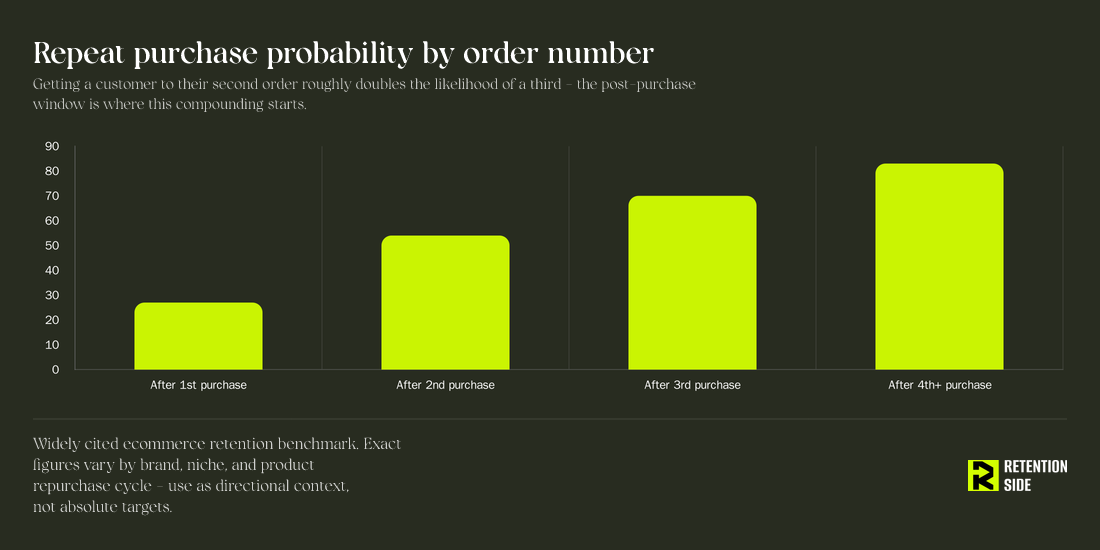
This compounding structure means that the highest-leverage moment in your entire customer lifecycle is the gap between first and second purchase. What happens in that gap – what you send, how you position it, and whether you give the customer reasons to come back – determines whether the 27% number becomes a conversion or a defection.
The post-purchase email sequence is your primary tool for influencing that gap. Not the only tool – product quality, packaging, and the overall purchase experience all feed into it – but the most controllable and most scalable mechanism for shaping what happens after someone buys. For a broader look at how post-purchase fits inside a full lifecycle system, our guide to increasing repeat purchases in ecommerce covers the complete framework.
Post-purchase flow architecture in Klaviyo
The most common version of a Shopify post-purchase flow is a 2-3 email sequence that goes: order confirmation, shipping update, maybe a review request a few weeks later. That structure is better than nothing. It’s nowhere near what the flow is actually capable of.
A mature post-purchase sequence is typically 4-6 emails spread across the first 30 days after purchase. Each email has a single primary objective. The sequence as a whole moves the customer from “just bought” to “actively using and satisfied” to “ready for the next purchase” – while collecting the social proof (reviews) and behavioral data (cross-sell conversion) that makes the broader retention system more effective.
Here’s how that architecture typically looks:
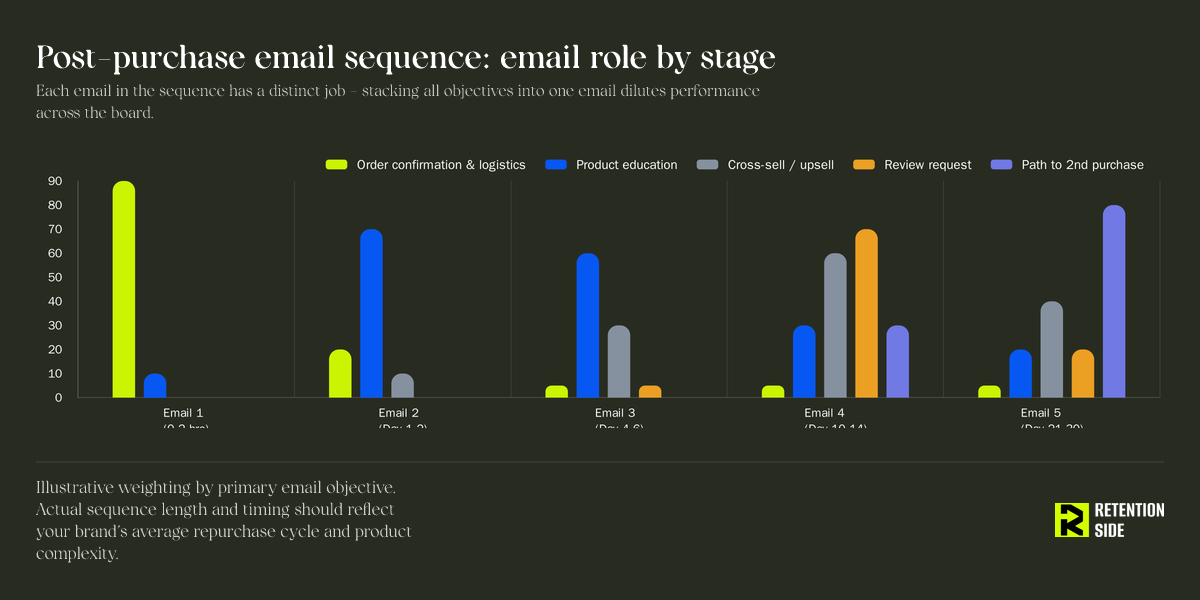
The key principle in the chart above is that each email has a dominant purpose – and as you move through the sequence, the emphasis shifts from logistics and reassurance toward relationship building and commercial bridging. Stacking all of these objectives into a single email – or trying to educate, cross-sell, request a review, and invite loyalty program enrollment in one message – splits attention in a way that undermines performance across all of them.
Email 1: the order confirmation – transactional and strategic
The first email in the sequence is the order confirmation – and it’s the most opened email your brand will ever send. That’s not an accident. The customer is in the transaction window. They want to know their order went through. This email will be read.
Most brands use this attention for exactly one thing: confirming the order details. That’s the floor, not the ceiling.
A strategically designed order confirmation still contains everything the customer needs: order number, itemized details, payment confirmation, expected delivery window, and a clear path to customer support if something is wrong. That’s non-negotiable. But it also does a few additional things that purely transactional confirmations don’t:
Reinforce the purchase decision. A sentence or two that acknowledges the customer’s choice and creates anticipation for the product arriving builds positive emotional momentum. This isn’t hollow flattery – it’s the psychological reinforcement that reduces purchase regret and increases the likelihood the customer stays receptive to future communication.
Set expectations for what comes next. Tell the customer you’ll be in touch with tips, recommendations, or something useful over the coming days. This primes them for subsequent emails in the sequence so they’re not arriving cold.
Introduce brand differentiation simply. A brief, non-pushy mention of what makes your brand different – a sourcing commitment, a quality guarantee, a community – gives the customer a frame through which to experience the product when it arrives.
What to leave out of the order confirmation: cross-sell offers, discount codes for future orders, loyalty program enrollment prompts, and review requests. None of these belong here. The customer just bought. The transaction mindset is winding down. Introducing the next commercial step in the same email as the order confirmation is a timing error that converts poorly and creates a slightly dissonant experience.
Email 2: the shipping notification and pre-arrival engagement
The shipping confirmation is another guaranteed-open email. The customer is tracking their order mentally, and knowing it’s on the way generates a fresh moment of engagement.
The logistics must come first: tracking number, carrier link, revised delivery estimate. But this email has additional surface area that most brands leave blank.
For many product categories, the gap between purchase and delivery is the right moment to begin product education. Not the full education – just enough context to build anticipation and set up for a better first experience. A skincare brand might include a brief primer on how to layer the product for maximum efficacy. A supplement brand might include a note on what to expect in the first two weeks. A home goods brand might offer a brief styling suggestion.
This kind of pre-arrival content does two things simultaneously: it increases the customer’s confidence in what they bought, and it makes the brand feel like a genuine resource rather than a storefront that goes quiet after the sale.
Keep this email short and focused. The dominant job is shipping confirmation. The secondary job is pre-arrival engagement. Don’t confuse the two roles – one sentence or a brief visual callout is enough for the educational layer at this stage.
Email 3: product education – the most underinvested email in the sequence
Once the product has been delivered – typically 2-4 days after confirmation for domestic shipments – the first dedicated product education email should arrive. The customer now has the product in hand. The educational context you provide in this email directly shapes how they experience it.
Education is not a nice-to-have soft retention gesture. It’s a direct driver of product satisfaction, and product satisfaction is one of the most reliable predictors of repeat purchase behavior. A customer who gets full value from what they bought has a genuine reason to come back. A customer who bought something but isn’t using it correctly, or didn’t realize what it could do, drifts.
The specific content of this email depends entirely on the product:
For consumables and replenishable products (supplements, skincare, food), the education email focuses on usage protocol, expected timeline for results, and how to integrate the product into an existing routine. The goal is to create a habit around the product before the repurchase window opens.
For considered purchases (electronics, home goods, specialty equipment), the education email focuses on setup, advanced use cases, and lesser-known features that justify the purchase price. This email reduces return probability and increases perceived value.
For category-agnostic products (apparel, accessories), the education email becomes contextual content – styling, pairings, care instructions, and ways to get more use out of what they bought. Even for straightforward products, there is always an educational angle that adds value.
One practical note on timing: the education email should arrive after delivery is confirmed – or at minimum, after the expected delivery window has passed. An education email that arrives before the product does is poorly timed. Klaviyo allows you to use Shopify’s fulfillment events to trigger emails based on delivery confirmation if your carrier integration passes that data through. For brands where delivery tracking is inconsistent, a fixed time delay set to the average delivery window for your primary shipping zones is a reasonable substitute.
Email 4: cross-sell – data-driven, not catalog-wide
Cross-sell belongs in the post-purchase sequence. But the effectiveness of cross-sell recommendations is almost entirely determined by how well they’re grounded in actual purchase behavior – not how prominently they’re placed or how often they’re sent.
The question every cross-sell email should be answering is: based on what this customer bought, what do the customers who are most similar to them tend to buy next? This is a behavioral question, not a category question. The answer comes from your purchase history data, not from someone deciding which products to feature.
In Klaviyo, this logic can be built in a few ways depending on your catalog and data maturity:
Purchase-specific branching. If a customer bought product A, flow them into a branch that shows the most common complement to product A. This requires knowing the complement relationships across your catalog, but for brands with clear product logic – a foundation, a primer, and a setting spray; a protein powder and a shaker bottle; a coffee machine and a grinder – the relationships are often obvious from order history. Klaviyo’s product analysis report can surface these purchase-pair patterns directly from your Shopify data.
Dynamic product recommendations. Klaviyo’s product feed integrations allow you to pull dynamic product blocks into email templates. When combined with purchase history filters, this surfaces category-relevant recommendations without manual maintenance per product.
Catalog expansion logic. For customers who bought from one category, the cross-sell objective is expanding their footprint in your catalog. Show them adjacent categories rather than the same category they just purchased from.
Timing matters for cross-sell placement. Too early – in the order confirmation or shipping email – and the customer is still in the transaction wind-down phase. Too late – 30+ days after purchase – and the transaction mindset that makes cross-sell easier to convert has long dissipated. The sweet spot is typically 5-10 days after the estimated delivery date. The customer has the product, is using it, and the positive association with the purchase is still active.
Cross-sell in the post-purchase sequence is not about pushing the next sale aggressively. It’s about introducing a customer to more of what your brand does while the relationship is at its warmest. The framing matters: “customers who bought X also love Y” lands differently than “buy more of our products.” One is social proof. The other is a sales push.
Email 5: the review request – timing changes everything
Most Shopify brands request reviews either too early or too randomly. A review request sent 3 days after purchase – before the product has arrived, let alone been used – gets a different quality of response than one sent at the peak of product satisfaction.
Research published in the Journal of Marketing across two randomized field experiments with over 300,000 consumers found that “requesting a review as soon as possible is not the best strategy.” Specifically, review reminders triggered before customers have had sufficient time to evaluate a product produce lower-quality responses – and for experience goods like apparel or beauty products, early reminders can actually generate an adverse reaction that reduces the likelihood of any review being written at all. The study also found that the negative impact of premature review requests is disproportionately greater for younger consumers.
The right timing for a review request depends on three variables:
Delivery window. The review request should never arrive before the product has been received. This sounds obvious but is frequently violated when brands set a fixed post-purchase timer without accounting for delivery lag.
Product usage cycle. For a body lotion, a customer might form a meaningful opinion after 5-7 days of use. For a supplement, a fair evaluation might take 14-21 days. For a kitchen appliance, the customer might not cook with it until the weekend after it arrives. Understanding when your customer would have a genuine opinion to share – not just a first impression – should determine when the request goes out.
Position in the sequence. The review request should arrive after the education email. A customer who has been helped to understand the product, use it correctly, and get real value from it is more likely to leave a positive, substantive review than a customer who received only a logistics notification before being asked to review.
In Klaviyo, this means the review request email is typically email 4 or 5 in the sequence, arriving somewhere between 10-21 days after purchase depending on your product category. For Shopify brands using review platforms like Okendo, Yotpo, or Stamped, Klaviyo’s integrations allow you to trigger review requests through the flow and pull review data back into customer profiles.
The review request email itself should be direct, low-friction, and easy to respond to. One primary CTA to the review platform. Brief context on why reviews matter to your brand and future customers (social proof for the next buyer). No competing CTAs for products, campaigns, or other objectives in this email. Its only job is collecting the review.
Email 6: the second purchase bridge
The explicit path to a second purchase is the most commonly missing element in post-purchase sequences – and the most strategically important.
Most brands let the second purchase happen passively: the customer returns to the store when they feel like it, if they feel like it. A deliberate second-purchase bridge email changes that dynamic by making the next step explicit and easy to take while the customer’s experience with the first purchase is still positive and fresh.
What this email looks like depends on the product and category:
For replenishable products, the second purchase bridge is a replenishment reminder timed to the expected consumption timeline. If you sell a 30-day supply of a product, this email arrives at day 25 – when the customer is likely starting to think about whether to reorder, but hasn’t acted yet. The timing is grounded in your brand’s actual average consumption data, not a generic 30-day assumption. Different customers use products at different rates, and zero-party data collected at signup (or post-purchase via a short preference question) can help segment replenishment timing more accurately.
For non-replenishable products, the second purchase bridge is a cross-sell or catalog introduction framed around the customer’s relationship with what they already have. “Now that you have X, here’s what our best customers add next.” This bridges from the current purchase to the brand’s broader catalog without feeling like a cold acquisition pitch.
For considered purchases in long buying cycles, the second purchase bridge might focus on referral rather than direct repurchase – converting a satisfied customer into a brand advocate while the satisfaction is highest, and offering a referral incentive that generates new customer acquisition at a lower CAC than paid channels.
The second purchase bridge should include one well-framed incentive in cases where the margin allows it. Not a blanket discount – but a purchase-specific offer tied to a complementary product or a loyalty program enrollment benefit. The incentive’s job is to reduce the activation energy of the second purchase, not to condition the customer to expect discounts permanently.
Segmentation inside the post-purchase flow
A single linear post-purchase sequence sent identically to every customer is a starting point, not a mature strategy. The most significant segmentation variables that should eventually drive branching logic in your post-purchase flow are:
First-time vs. returning buyer. A customer buying from you for the first time needs a different post-purchase experience than a returning customer who’s already familiar with your brand. First-time buyers need more education, more reassurance, and a more deliberate path to the second purchase. Returning buyers can be moved more quickly toward cross-sell and catalog expansion, with less foundational brand building in the sequence.
Product or category purchased. A customer who bought a complex, high-consideration product needs different post-purchase education than someone who bought a straightforward consumable. Branching the flow by product or category lets you serve genuinely relevant content rather than sending the same generic education to customers whose products have nothing in common.
Order value. High-AOV customers warrant additional attention – a more personalized post-purchase experience, potentially including a follow-up from a customer success rep or a handwritten thank-you insert. Low-AOV customers are a larger volume but need more efficient sequencing. The economics of each group are different and the post-purchase investment should reflect that.
Subscription vs. one-time purchase. A customer who just enrolled in a subscription has already committed to a repurchase cadence. Their post-purchase sequence is primarily about onboarding them to the value of the subscription and reducing churn, not building a path to a second one-time order. These two customer types need fundamentally different sequences.
In Klaviyo, this segmentation is implemented through flow branching – using conditional splits based on Shopify order data. Each branch inherits the same structural logic but delivers product-specific, buyer-type-appropriate content at each stage.
Connecting post-purchase to the rest of the lifecycle
The post-purchase sequence doesn’t operate in isolation. It’s one node in a broader lifecycle system, and how it connects to the flows that come before and after it determines how much compounding value it generates.
Connection to abandoned cart recovery. A customer who converted from an abandoned cart flow is a recovered sale – meaning they were already hesitant before buying. Their post-purchase sequence should be aware of that context. Higher emphasis on purchase reassurance and product education. Slightly different framing for the cross-sell (don’t push too hard too fast with a customer who was already cautious). Klaviyo’s flow filters allow you to tag customers who converted from specific flows and deliver modified sequences to them.
Connection to cross-sell and upsell flows. In some flow architectures, the cross-sell and upsell logic lives inside the post-purchase sequence itself. In more mature setups, a dedicated cross-sell flow is triggered separately by specific purchase events, with the post-purchase sequence focused on education and relationship building. Both approaches work. The key is that the logic isn’t duplicated – a customer shouldn’t receive the same cross-sell recommendation in both their post-purchase sequence and a separate cross-sell flow within a short time window.
Connection to the win-back flow. If a customer completes the post-purchase sequence and still doesn’t make a second purchase, they’ll eventually reach the expected repurchase window for their category – at which point the win-back flow should activate. The win-back timing should be calculated from the expected repurchase interval for your brand, not from a generic time trigger. For a brand with a 45-day average repurchase cycle, the win-back opens around day 50-60. For a brand with a 90-day cycle, it opens proportionally later. The post-purchase sequence and the win-back flow together define the full lifecycle arc for any customer who doesn’t self-convert.
Connection to campaigns. Customers who have completed the post-purchase sequence enter the general campaign stream. The segmentation logic for campaigns should account for their purchase history, recency, and which stage of the lifecycle they’re in. A customer who just completed a post-purchase sequence and didn’t convert to a second purchase should not immediately receive a promotional campaign for a product they already bought.
For a full picture of how these flows fit together inside a broader Shopify email program, the Shopify email marketing strategy guide covers the complete lifecycle architecture – from deliverability foundations through campaigns.
Common post-purchase sequence failures
Before getting into optimization, there are structural errors that show up consistently in Shopify brand post-purchase flows. If any of these are true for your current setup, fixing them is worth more than any copy or design optimization.
The sequence is just logistics. Order confirmation, shipping update, delivered. No education, no cross-sell, no review request, no path to second purchase. This is not a post-purchase strategy – it’s a service communication sequence. It’s fine for customer expectation management but contributes nothing to repeat purchase rate.
Everything is in one email. A single “post-purchase” email that combines education, a cross-sell recommendation, a loyalty program invitation, a review request, and a discount code for the next order. Every element competes for attention. Conversion on all of them suffers. The psychological principle here is simple: when you ask for everything, you get nothing. Each objective needs its own focused communication.
The cross-sell isn’t grounded in data. Recommending products based on category, bestseller lists, or editorial judgment rather than actual purchase behavior patterns. Cross-sell that reflects what customers who bought this product actually buy next converts at a meaningfully higher rate than cross-sell based on what the brand thinks they should want. Build the recommendation logic from your Shopify order data, not from a gut instinct.
Review requests are arriving too early. A review request that arrives 3 days after purchase – while the product is still in transit – generates lower-quality reviews and misses the peak satisfaction window. Time it to the product usage cycle.
The flow hasn’t been updated since it was built. A post-purchase sequence built 18 months ago with copy referencing old products, outdated offers, or a catalog that has since expanded is delivering a worse experience than when it launched. Flows are not infrastructure that gets installed and forgotten. They need regular auditing and iterative improvement.
No branching for different buyer types. First-time buyers and returning buyers going through the same sequence, with the same framing and the same path to second purchase. Returning buyers who already know the brand don’t need the same brand-building content as first-time buyers. Undifferentiated sequences underperform what targeted branching can achieve.
What to measure in the post-purchase flow
The metrics Klaviyo surfaces most prominently – open rate, click rate – are diagnostic signals. Useful for identifying specific email-level issues, but not meaningful as accountability measures for whether the post-purchase system is doing its actual job.
The metrics that matter:
Repeat customer rate (returning customer rate). This is the top-line outcome. Is the percentage of customers who place more than one order increasing over time? The post-purchase sequence is one of the primary levers for moving this number. If it’s trending up, the system is working. If it’s flat despite investment in the post-purchase flow, the problem may be elsewhere – product quality, acquisition traffic quality, or a gap in the broader lifecycle system.
Flow conversion rate. Of the customers who enter the post-purchase sequence, what percentage make a second purchase? This tells you the aggregate effectiveness of the sequence. Segment this by buyer type (first-time vs. returning) and product category to understand where the flow is performing and where it’s leaking.
Average time between first and second order. If the post-purchase sequence is working, this number should shorten over time. A reduction in the average gap between first and second purchase is one of the clearest signals that the bridge-to-second-purchase logic in the sequence is functioning.
Revenue generated per sequence entry. What does a customer who enters the post-purchase sequence generate in the 30-60 days following their first purchase? This gives you a single-number view of the commercial value the sequence is producing, which helps prioritize optimization work and justify investment in flow improvements.
Cross-sell conversion rate by recommendation. Of the customers who receive a cross-sell email in the post-purchase sequence, what percentage convert to the recommended product? Breaking this down by product pair (what was bought, what was recommended) tells you which cross-sell relationships are strong and which need to be rethought.
Review rate and review quality are worth tracking separately from the flow metrics – a review request timing that generates more reviews, or higher-rated reviews, is contributing to future conversion through better social proof, which compounds downstream.
What not to treat as accountability metrics: open rate, click rate, and any metric that measures activity without connecting to a business outcome. A post-purchase flow with high open rates and poor conversion to a second purchase is a well-read sequence with a structural problem. For a deeper look at which metrics actually matter and which are noise, see our breakdown of the top email marketing metrics for ecommerce brands.
When the post-purchase flow alone isn’t enough
A mature post-purchase email sequence is one of the most efficient retention investments a Shopify brand can make. But there are scenarios where email alone doesn’t cover the full opportunity – and where adding additional channels to the post-purchase experience creates meaningful lift.
SMS for time-sensitive post-purchase moments. Delivery confirmation, back-in-stock alerts for a companion product, and replenishment reminders for consumables work particularly well as SMS messages because they’re immediate and high-intent. A replenishment reminder sent via SMS to a customer who has been unresponsive to email in the post-purchase sequence reaches a segment that email doesn’t. The constraint is consent – SMS opt-in rates are lower than email, so this only applies to the customers who have explicitly opted into text communication.
Direct mail for high-AOV first-time buyers. For brands with a high average order value – premium apparel, wellness products, home goods – a physical post-purchase touchpoint creates a brand impression that digital channels can’t fully replicate. A well-designed product care card, a handwritten-style thank you, or a lookbook arriving in the mailbox a week after delivery hits differently than any inbox message. The economics only work at certain AOV thresholds, but for brands where the margin supports it, a targeted direct mail piece to first-time buyers above a spend threshold is a measurable retention investment.
Loyalty program enrollment as part of the sequence. If you have a loyalty program, the post-purchase sequence is the best natural moment to introduce it – specifically after the first product education email, when the customer has a positive association with the brand and is psychologically receptive to the idea of an ongoing relationship. Enrollment in a loyalty program after the first purchase changes the customer’s relationship with the brand structurally – they now have points accumulating, a tier to progress toward, and a reason to return that doesn’t depend only on needing the product again.
The channel expansion decisions should always be driven by your customer base’s actual behavior and communication preferences, not by what’s available in the tool stack. A post-purchase SMS flow to a customer segment that responds more to email than SMS is adding cost and complexity without adding reach. If you’re evaluating how all of these channels fit together into a coherent retention system, our guide on what an ecommerce retention agency actually does walks through the full channel architecture and how each layer connects.
Continuous optimization: why post-purchase flows decay
The most important principle for long-term post-purchase flow performance is that optimization is never finished.
A flow built at launch reflects the state of your catalog, your average order value, your repurchase cycle data, and your customer base at the time it was built. All of those things change. New products get added. Average order values shift. Seasonal patterns alter repurchase timing. Customer acquisition channels change – and with them, the demographic and behavioral profile of the customers entering the flow.
A post-purchase sequence that hasn’t been meaningfully revised in 12+ months is almost certainly underperforming relative to what it was producing when it launched, and underperforming relative to what an updated version would produce.
Systematic testing is what prevents that decay. Specifically:
Subject line testing. Small improvements in subject line performance compound across every email in the sequence for every customer who enters the flow. Running systematic A/B tests on email 1, 3, and 5 subject lines over a 6-month period – one test per email at a time, with clear documentation of results – produces meaningful cumulative lift.
Education content testing. Does a usage guide format outperform a Q&A format for the product education email? Does video content (or a thumbnail linking to video) outperform static images? Does a more personal, narrative format outperform a structured tips format? These questions have brand-specific answers that can only be discovered through testing.
Cross-sell recommendation testing. Testing different product recommendations in the cross-sell email – or testing whether a single recommended product outperforms a “shop by category” approach – directly affects the revenue contribution of the sequence.
Timing tests. The timing guidance in this article is directional, not prescriptive. Your brand’s customers may respond differently. Testing email 3 at day 4 vs. day 7 post-delivery, or testing the review request at day 14 vs. day 21, yields brand-specific timing data that should eventually override the general recommendations.
At Retention Side, post-purchase flow optimization is a continuous process across every brand we work with – not a project with a completion date. The baseline gets built first. Then the testing cadence takes over.
Conclusion
The Shopify post-purchase window is the most underinvested moment in most ecommerce retention systems. The customer is engaged, the relationship is fresh, and the psychological conditions for building long-term loyalty are better than they’ll be at any other point in the lifecycle.
A mature post-purchase email strategy turns that window into a deliberate system: an order confirmation that reinforces the purchase decision, a shipping notification that begins the educational arc, a dedicated product education email that increases satisfaction and builds habit, a cross-sell recommendation grounded in purchase behavior data, a review request timed to the satisfaction peak, and an explicit second-purchase bridge that closes the gap between first and repeat buyer.
Each of these emails has a specific job. Done well, they work together to move the customer from “just bought” to retained – and to set up the cross-sell, win-back, and loyalty architecture that generates compounding lifetime value from there.
The brands that get this right don’t see the post-purchase window as a logistics phase. They see it as the starting point of a customer relationship – and they build systems that treat it accordingly.
If you’re running Shopify with Klaviyo and your current post-purchase flow is primarily a logistics sequence, the rebuild is not complicated. It requires clear objectives for each email, a segmentation structure that reflects different buyer types, cross-sell logic grounded in your order data, and a testing cadence that keeps the sequence improving over time. That’s the post-purchase flow that actually moves your repeat customer rate in the right direction – which is the number that tells you whether the whole retention system is working.