
Most ecommerce brands have an abandoned cart flow. Far fewer have a browse abandonment flow – and of those that do, many built it once, never revisited it, and have no idea whether it’s actually tracking correctly.
That gap is worth paying attention to. The pool of visitors who land on a product page and leave without adding to cart is significantly larger than the pool who get all the way to checkout and abandon there. Browse abandonment sits at the widest part of the funnel, and for brands with meaningful traffic, leaving that signal unaddressed is leaving recoverable revenue on the table every single day.
This article is about building browse abandonment emails that do real work – not just because the flow exists, but because it’s architected correctly: clean event tracking, appropriate intent-matched messaging, right timing, and proper exclusion logic that keeps it from overlapping with your cart recovery sequence.
Key takeaways
- Browse abandonment fires on the “Viewed Product” event in Klaviyo and only reaches identified profiles already in your list – which makes list growth a prerequisite for this flow to scale.
- The intent signal is meaningfully weaker than a cart abandonment, and the messaging has to reflect that. This is not a recovery email. It is a nudge toward a decision the customer hasn’t made yet.
- Browse abandonment addresses a far larger audience than cart abandonment – more visitors browse product pages than add to cart. The per-email conversion rate will always be lower, but the volume makes the flow commercially significant.
- Exclusion filters are the most commonly broken piece of browse abandonment flows. Without them, customers receive overlapping emails from both the browse and cart sequences simultaneously.
- The flow should never lead with a discount. Product-specific social proof, education, and relevance close more browse abandoners than reflexive incentives do.
- Browse abandonment is a foundational flow, not an advanced one. Brands at $300K+ per month who don’t have this running are almost certainly missing a meaningful revenue stream.
What we’ll cover
- What browse abandonment actually signals – and why it matters
- Browse abandonment vs. cart abandonment: what separates them strategically
- The technical foundation: event tracking and flow triggers in Klaviyo
- Exclusion filter logic: keeping the flow system coherent
- Flow architecture: how many emails, what each one does, and when
- Messaging and copy: matching tone to the intent level
- Incentive strategy: when to offer something and when not to
- Segmentation inside the browse abandonment flow
- What to actually measure
- Where browse abandonment fits inside the broader retention system
What browse abandonment actually signals
A product page view is not a strong buying signal. But it is a signal.
The customer was browsing your site – either from paid traffic, organic search, email, or direct – landed on a specific product, spent some time there, and left without taking any further action. That’s different from a homepage bounce. They found something specific. They just didn’t commit to it.
Understanding what that “didn’t commit” means changes how you build the flow. There’s a wide range of intent inside browse abandonment:
- A visitor who landed from a branded search ad and spent four minutes reading the product description, scrolling reviews, and checking sizing before leaving is showing near-purchase behavior.
- A visitor who clicked through from a Meta ad, scrolled to the first image, and bounced in 15 seconds is probably not recoverable by an email.
You can’t filter perfectly for these differences – but you can design a flow that serves the higher-intent portion of this audience without aggressively pursuing the lower-intent portion. Keeping the sequence short (two to three emails over roughly 48 hours), not leading with discounts, and ensuring the flow exits cleanly when someone moves to higher-intent actions all work together to make the flow relevant rather than intrusive.
The key mental model here: browse abandonment email is not trying to do what a cart recovery email does. It is not closing a near-purchase. It is re-engaging a visitor who expressed interest and giving them a reason to go further. The framing of every email in this flow should reflect that.
Browse abandonment vs. cart abandonment: what separates them strategically
These two flows are related, but they are not doing the same job. Conflating them – or building browse abandonment with cart-recovery-style messaging and urgency – is one of the most common reasons the flow underperforms. Our full breakdown of abandoned cart emails for ecommerce stores covers that flow’s architecture in detail, but the strategic differences between the two are worth being explicit about here.
Intent level. Cart abandonment fires after someone has added a product and started the purchase process. The intent is clear and recent. Browse abandonment fires after a product page view – earlier in the decision arc, and with no expressed commitment to purchase. The copy needs to match where the customer actually is, not where you want them to be.
Audience size. Every brand that drives traffic sees more product page views than cart adds. Browse abandonment addresses a larger pool of potential buyers, which is why it belongs in the flow architecture even though the per-email conversion rate will be lower than cart recovery.
Urgency mechanics. Cart recovery emails can credibly create urgency – the cart is real, the saved state is real, there may be genuine stock considerations. Browse abandonment has none of that. A “your cart is about to expire” message sent after a product page view with no cart activity is inaccurate and erodes trust. Remove urgency language from browse abandonment emails entirely.
Discount logic. Cart recovery can introduce a targeted incentive in the later emails because the customer was already close to buying. Browse abandonment incentives belong even further back in the sequence, if they appear at all. Leading with a discount in a browse abandonment flow trains price-sensitive visitors to browse and leave specifically to receive the offer.
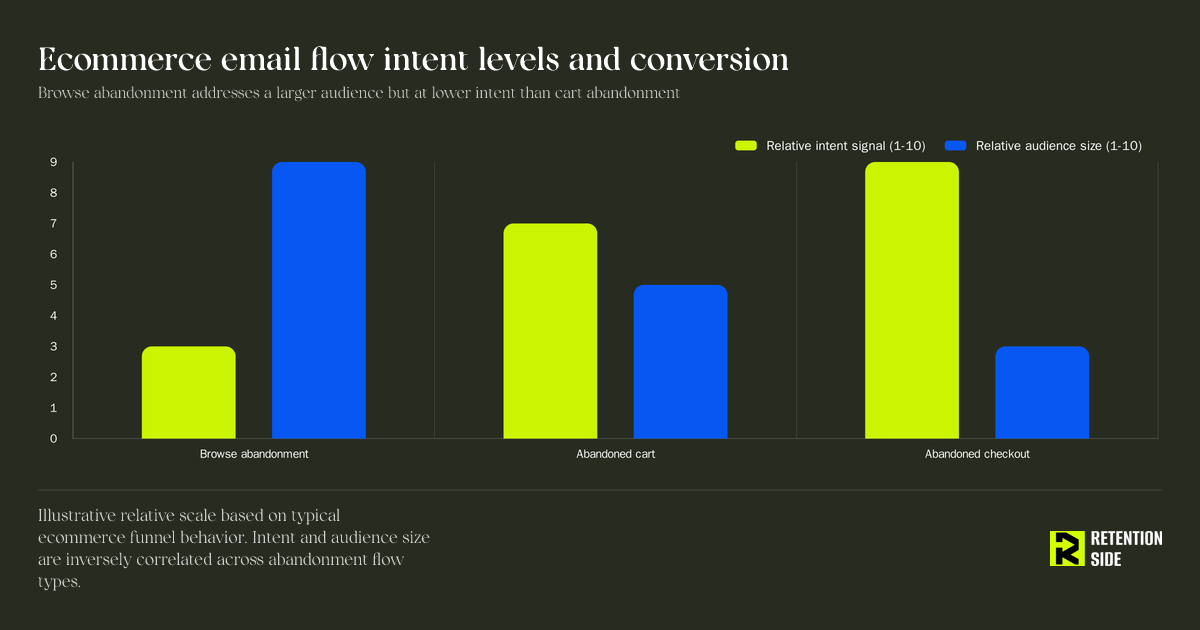
The job separation is this: browse abandonment emails help a customer go from interest to decision. Cart recovery emails help a customer go from decision to purchase. Write them accordingly.
The technical foundation: event tracking and flow triggers
Browse abandonment in Klaviyo is powered by the “Viewed Product” metric. This event fires when an identified subscriber views a product page on your Shopify store. The word “identified” is important – anonymous visitors who aren’t already in your Klaviyo list cannot trigger this flow. Only subscribers whose email address is already known to Klaviyo can enter it.
This has a direct implication for how you think about list growth. Browse abandonment is one of the flows that scales directly with your subscriber base. A brand with a small list and high traffic volume will see far fewer entries into this flow than a brand with a larger, well-maintained list. Investing in on-site email capture – properly designed pop-ups, embedded forms, quiz-based capture – isn’t just a list growth tactic. It’s what determines how much of your product page traffic the browse abandonment flow can actually reach.
Verifying tracking before building
The most common reason browse abandonment flows underperform is broken event tracking – not poor copy, not wrong timing, not incentive structure. The “Viewed Product” event simply isn’t firing reliably.
This happens more often than most brands realize. Shopify theme updates, app installations, tag management changes, or platform migrations can all break the event tracking without an obvious error message. The flow stays live, it just isn’t triggering for most visitors.
Before building or auditing your browse abandonment flow, verify that “Viewed Product” events are firing in Klaviyo’s metrics. The practical test: navigate to a product page on your store, then check Klaviyo’s activity feed to confirm the event appears. Do this for multiple products across your catalog. If the event isn’t showing up consistently, fix the tracking first – everything downstream depends on it.
In Klaviyo, “Viewed Product” is enabled through the Klaviyo app embed on your Shopify theme. For Shopify 2.0 themes, this requires the embed to be explicitly activated under Theme > Customize > App embeds. Klaviyo’s official documentation on creating a browse abandonment flow covers the exact setup steps for Shopify and BigCommerce. After any significant site change, this is worth re-verifying.
Flow trigger configuration
The trigger for the browse abandonment flow is the “Viewed Product” event in Klaviyo. The timing delay between trigger and first email is one of the most discussed variables in browse abandonment setup, and the honest answer is that it depends on your traffic behavior.
The standard recommendation – and a reasonable default – is 1 to 4 hours after the product view. The reasoning: sending within the first 30-60 minutes risks catching the customer while they’re still actively shopping. A visitor who viewed one product might still be browsing your site, or have multiple tabs open. An email arriving in that window can feel intrusive rather than helpful. Waiting the full 4 hours gives the customer time to finish their session and creates a natural re-entry moment.
Higher-AOV brands where purchase decisions involve more consideration often see better results at the 2-4 hour mark. Lower-AOV impulse-buy stores sometimes perform better at the 1-hour mark. This is a variable worth testing – but start with 2 hours as a neutral baseline before optimizing.
Exclusion filter logic: keeping the flow system coherent
This is where most browse abandonment setups go wrong, and it creates real problems when it does. Without proper exclusion filters, a customer can simultaneously be receiving emails from the browse abandonment flow and the cart abandonment flow for the same session. That’s a disjointed experience – two different sequences, possibly with conflicting messaging, both trying to address the same shopper at the same time.
The exclusion filters that must be on every browse abandonment flow:
- Has not added to cart since triggering the flow
- Has not started checkout since triggering the flow
- Has not placed an order since triggering the flow
These filters create a logical handoff: if the customer moves to a higher-intent action after viewing the product, they exit the browse abandonment sequence and become eligible for the cart abandonment or post-purchase flow instead. The system recognizes their progress and responds accordingly, rather than continuing to send browse-level messaging to someone who has already moved further along.
Beyond the overlap filters, add a profile-level filter that excludes anyone who has placed an order within the last 30 days. A recent buyer landing on a product page is almost certainly browsing with post-purchase intent – comparing accessories, checking on a replacement, researching a complementary product. Sending them a browse abandonment email for that session treats them like a prospect, which is the wrong frame entirely. That customer belongs in a cross-sell or post-purchase sequence, not a browse recovery flow.
A practical note: Klaviyo’s “smart sending” setting provides an additional safeguard by limiting how frequently any given subscriber can receive automated emails across all flows. Enable this across your flow architecture. It won’t replace proper filter logic, but it does prevent the worst-case scenario of a single subscriber receiving four flow emails in one day because multiple flows triggered simultaneously.
Flow architecture: how many emails, what each one does, and when
Browse abandonment flows are shorter than cart recovery flows. The intent signal is weaker, which means the window of relevance is shorter and the cadence should be proportionally lighter. A three-email sequence over roughly 48 hours is the right architecture for most brands. For a broader view of how this fits alongside every other automated flow your brand should have running, our guide to Klaviyo flows for ecommerce covers the full flow architecture.
Email 1: the product re-introduction (1-4 hours after trigger)
The first email does one thing: puts the viewed product in front of the customer in a way that makes returning to it easy. It is not a reminder. It does not say “you forgot something.” It acknowledges that the customer was looking at a specific product and offers them a reason to take another look.
The structure is simple: product image, product name, a few key details that were visible on the product page (key benefits, materials, use case), and a single CTA back to the product page. The copy is light. The tone is helpful. There is no discount, no urgency language, no countdown timers.
What this email is actually doing: it’s extending the customer’s awareness window. Most visitors who don’t convert on first session haven’t decided against the product – they just didn’t complete the purchase in that session. The first browse abandonment email creates a second touchpoint that brings the product back into active consideration.
Dynamic product content is essential here. Klaviyo’s product block pulls the viewed product’s image, name, and price directly from your catalog using template tags like {{ event.Name }}, {{ event.Price }}, and {{ event.URL }}. An email that shows the specific product the customer was looking at dramatically outperforms a generic “we noticed you were browsing” email that shows nothing in particular. Use the dynamic block. Make the product the visual anchor of the email.
Email 2: social proof and depth (24 hours after email 1)
By the time email 2 arrives, the customer has already seen the first email and not acted. Generic repetition won’t move them. What might is evidence.
Email 2 is where customer reviews earn their place. Not generic brand testimonials – reviews for the specific product the customer viewed. If your review platform (Okendo, Yotpo, Stamped, or others) is integrated with Klaviyo, you can pull dynamic review content tied to the specific product viewed. A real customer quote about the product’s efficacy, fit, or quality addresses the uncertainty that’s most likely keeping this particular browser from committing.
This is also the right place for supplementary product information that may not have been obvious on the product page: how it’s made, how it fits into a routine, what it pairs with, what problem it solves. The goal isn’t to repeat the product description – it’s to add a layer of context that gives the customer a new reason to engage.
Email 2 should also still not include a discount. The customer who converts on email 2 will do so because the social proof or education resolved their hesitation, not because they were offered money off.
Email 3: the closing nudge (48 hours after email 2)
The third email is optional and should only run for brands where the economics and audience behavior support it. If emails 1 and 2 are doing their job, email 3 is for the subset of browsers who needed the most consideration time.
Email 3 can include a light incentive – free shipping being preferable to a percentage discount, both because it addresses a real friction point (shipping cost uncertainty is one of the leading reasons shoppers abandon without purchasing, according to Baymard Institute’s checkout research) and because it’s less margin-destructive than a blanket discount. Alternatively, email 3 can shift the frame entirely: instead of pushing the original viewed product harder, introduce two or three related products. Some browsers weren’t quite sold on the specific item they viewed, but would convert on a similar one. A “you might also like” block at this stage serves that audience.
Keep the sequence at three emails. Adding a fourth or fifth email beyond 48-72 hours from the original view produces diminishing returns and increases unsubscribe risk for minimal revenue gain. The buying intent tied to a product page view has typically cooled significantly by the 72-hour mark.
Messaging and copy: matching tone to the intent level
The most consistent copy mistake in browse abandonment emails is carrying over the urgency and pressure tone from cart abandonment messaging. A customer who viewed a product once is not in the same psychological position as someone who added it to their cart, entered their shipping details, and then left. The copy needs to reflect that difference.
Browse abandonment copy should feel exploratory and genuinely helpful rather than recovery-oriented. The implicit message is: “We noticed you were interested – here’s something that might help you decide.” Not: “Your cart is about to expire” (there is no cart). Not: “Don’t miss out” (on what?).
Subject lines
Product-specific subject lines consistently outperform generic ones for this flow type. A subject line that references the product name or category signals to the customer that this email is actually about something relevant, not a generic marketing blast.
Approaches worth testing:
- “Still thinking about [product name]?”
- “A closer look at [product name]”
- “What other customers are saying about [product name]”
- “Questions about [product name]?” (useful for higher-consideration categories)
The subject line for email 2, when it leads with social proof, can reference that directly: “Here’s what [X] customers say about [product name].” This sets an accurate expectation for what the email contains and earns the open on merit.
Avoid subject lines that imply urgency that isn’t real. “Last chance to get [product name]” is inaccurate if the product isn’t actually low in stock. Customers notice these inconsistencies, and the trust damage compounds over repeated sends.
Email body copy
Keep it short. Browse abandonment emails are already arriving in a context where the customer hasn’t fully committed – a long email compounds the cognitive load rather than reducing it. Two to three sentences of copy per email, structured around the product image and a clear CTA, outperforms elaborate copy treatments.
The one exception is email 2, where the social proof content naturally adds length. A review quote, a star rating, and a brief supporting sentence are all appropriate. But the structure should still lead with the product image and the review, not a long brand narrative.
Brand voice matters here more than most brands realize. The browse abandonment flow is still a brand communication. A brand that leads with warmth and personality in its campaigns should bring that same register to the browse abandonment sequence. Mechanical, transactional copy in a flow that otherwise delivers human-voiced campaigns creates a jarring inconsistency that undermines the experience. Write these emails like your brand writes – not like a shopping cart notification.
Incentive strategy: when to offer something and when not to
The instinct to lead with a discount in browse abandonment emails is understandable. Discounts drive conversion, conversion is the goal. But the logic falls apart when you trace the downstream consequences.
A browse abandonment flow that consistently delivers discounts to product page viewers quickly becomes a mechanic that price-sensitive visitors learn to exploit. If your audience figures out that browsing a product page triggers a discount email, they’ll browse and leave specifically to receive it. The flow then becomes a discount delivery mechanism for customers who would have bought anyway – at a margin cost that compounds across every session.
Beyond the conditioning risk, an early discount signals that your product’s list price isn’t the real price. For brands that sell premium products or compete on quality rather than price, that signal is actively damaging.
The framework that works better:
Email 1: No discount. Ever. The incentive for returning is ease of re-engagement and the product itself. If the product is worth buying, a clear re-introduction should be enough to move the highest-intent browsers.
Email 2: No discount. The incentive here is information and evidence – social proof, product depth, reviews. This is a content incentive, not a price incentive.
Email 3: Light incentive, selectively. If you include email 3, a free shipping offer is more defensible than a percentage discount. It addresses a real friction point (shipping cost uncertainty) without conditioning customers to treat your listed prices as negotiable. A percentage discount in email 3 is appropriate only for high-AOV, high-margin products where the economics justify it, and only with a meaningful expiry attached.
One important operational note: if you also run a cart abandonment flow with an incentive in its later emails, make sure the browse abandonment flow’s email 3 incentive is not the same offer. A customer who views a product, gets 10% off in the browse abandonment sequence, and then sees the same 10% offer again in the cart abandonment sequence has learned that the “loyalty” price is 10% below list. Build different offer logic for each flow – or use a different type of incentive in browse abandonment versus cart recovery.
Segmentation inside the browse abandonment flow
The basic browse abandonment flow sends the same sequence to every subscriber who triggers it. That works as a starting point. But for brands with enough data to segment meaningfully, two splits in particular create a material improvement in relevance.
First-time visitor vs. repeat buyer
A first-time visitor who views a product has no prior relationship with the brand. They don’t know whether the brand is trustworthy, whether the product quality is what it claims to be, or whether returns are painless. The browse abandonment email for this cohort needs to do more trust-building work – brand credibility signals, return policy visibility, and social proof that establishes the brand as a legitimate choice, not just proof of the product itself.
A repeat buyer who views a product has already bought from you and knows the brand. The browse abandonment email for this cohort can be significantly more direct. They don’t need trust signals. They need a product-specific reason to act, or a reminder that this product pairs well with what they’ve already purchased.
In Klaviyo, you can build this split with a conditional split on “placed order at least once” inside the flow. First-time visitors follow one path; existing customers follow another. The email content differs, the tone differs, and in some cases the offer logic can differ too – existing customers don’t need a trust-building intro, and they may not need an incentive at all.
Category-based messaging
For brands with diverse catalogs – multiple product categories, significantly different price points, or products that involve materially different consideration processes – a category-based split inside the browse abandonment flow produces more relevant messaging than a single generic sequence.
Someone who viewed a $200 supplement protocol has different questions than someone who viewed a $40 skincare product. The $200 consideration involves efficacy evidence, ingredient trust, dosage guidance, and a cost-benefit calculation. The $40 consideration is simpler – does this product suit my skin type, and does the brand seem credible?
This level of flow sophistication isn’t necessary on day one. Start with a single well-built sequence, verify the tracking is clean and the exclusion filters are working, and let the flow run for 30 days before layering in conditional splits. The data you accumulate in that first month will tell you which segments are converting and which aren’t – and that’s the right basis for deciding where segmentation effort is worth the build time.
What to actually measure
Browse abandonment flow performance is best evaluated at the flow level, not the individual-email level. The metric that tells you whether the flow is doing its job is flow conversion rate: the percentage of subscribers who enter the flow and complete a purchase, attributed to the flow within a defined attribution window.
Track this at the flow level over time. A well-built browse abandonment flow will compound modestly as you optimize – subject line tests, timing adjustments, copy refinements, and segmentation improvements each add a layer. The baseline you establish in the first 60 days becomes the benchmark against which you measure improvement.
A few secondary metrics worth tracking:
Revenue per trigger – how much revenue the flow generates each time it fires. This is more meaningful than aggregate flow revenue because it accounts for volume changes in traffic and list size.
Conversion by email – which email in the sequence is doing the most conversion work? If email 1 alone accounts for the overwhelming majority of flow revenue, emails 2 and 3 aren’t adding much and should be reconsidered. If email 3 is responsible for most conversions, the sequencing may need adjustment or the incentive logic revisited.
Flow exit rate by reason – how many subscribers exit the flow because they purchased, versus because they reached the end of the sequence without converting, versus because they unsubscribed? This breakdown tells you whether the flow is effectively capturing buyers or mostly running to completion with no action.
What not to track as a meaningful KPI here: flow-level open rate, or individual email click rate in isolation. These numbers are easy to generate but don’t tell you whether the flow is building revenue or compounding retention value. What matters is whether subscribers who enter the flow convert at a meaningful rate and what their subsequent purchase behavior looks like.
Where browse abandonment fits inside the broader retention system
Browse abandonment doesn’t exist independently. It occupies a specific position in the customer lifecycle, and understanding that position changes how you build it and what you expect from it.
Earlier than cart, later than welcome
Browse abandonment sits between the welcome series and the cart abandonment flow in the lifecycle sequence. A subscriber who just received their welcome series and then visits a product page is in an early consideration phase. Browse abandonment can do double duty here – re-engaging a new subscriber with a specific product interest while also nudging the first purchase.
The key: welcome series and browse abandonment should not overlap. If a subscriber is still moving through the welcome series, the browse abandonment flow creates redundant touchpoints that compete with the welcome messaging. Use smart sending settings and flow timing to prevent this overlap – most of the time, a subscriber who is still within the welcome series window should complete that sequence before browse abandonment emails begin.
The handoff to cart abandonment
When a browse abandonment subscriber adds to cart during the flow, the exclusion filter exits them from browse abandonment and they become eligible for the cart abandonment flow. This handoff should be clean and invisible to the customer. They experience a natural progression from “here’s a closer look at what you were viewing” to “here’s what’s still in your cart” – not two overlapping sequences both fighting for their attention.
For Shopify brands in particular, reviewing Shopify abandoned cart email best practices alongside this guide will help you design a handoff that works cleanly across both flows without creating duplicate touchpoints.
For brands doing significant volume, this handoff moment is worth auditing periodically. Check whether subscribers who exit browse abandonment (due to cart activity) are actually entering the cart flow as expected. If the cart flow has its own filtering that’s blocking these subscribers, the handoff breaks down and a high-intent customer falls through the gap.
What happens after a browse abandonment conversion
A subscriber who converts after receiving browse abandonment emails is now a buyer. They should exit the browse abandonment flow and enter the post-purchase sequence. This is where the retention work actually begins – the browse abandonment flow got them to the first purchase, and the post-purchase sequence needs to get them to the second.
This downstream connection is where many brands lose value they just recovered. The browse abandonment flow does its job, the customer buys, and then… nothing purposeful happens. Transactional emails confirm the order, a shipping notification goes out, and the brand falls quiet. The customer who just converted from a browse abandonment email is at peak receptivity. A post-purchase sequence that delivers product education, a relevant cross-sell, and a path to the next purchase is what turns that conversion into a retained customer rather than a one-time transaction.
The retention system works as a connected sequence: browse abandonment captures intent and converts it to a first purchase; post-purchase converts that first purchase into a repeat; cross-sell and win-back flows sustain the relationship across the broader customer lifecycle. At Retention Side, this is how we think about every flow we build – not as isolated tactics, but as stages in a system that compounds over time.
The list growth dependency
One more structural point worth emphasizing: browse abandonment scales with your subscriber list, not your traffic volume. Brands that invest in on-site email capture – well-designed pop-up forms, quiz funnels, post-purchase subscription prompts – are building the pool of identified visitors that the browse abandonment flow can actually reach.
A brand that drives 50,000 product page views per month with a 2% email capture rate has roughly 1,000 identified visitors who could enter the browse abandonment flow. A brand with the same traffic and a 6% capture rate has 3,000. The browse abandonment flow output is directly proportional to that number – which makes the email capture layer a legitimate lever on this flow’s performance, independent of copy, timing, or incentive logic. Research consistently shows that popup conversion rates vary significantly by design and offer type, making the capture mechanism itself worth optimizing alongside the flow.
The common gaps worth auditing first
Before treating browse abandonment as an optimization project, it’s worth checking whether the foundations are actually in place. In auditing Klaviyo accounts at Retention Side, these are the gaps that appear most consistently:
Tracking isn’t firing reliably. The “Viewed Product” event is missing for a significant percentage of actual page views, usually due to a theme update or app conflict. The flow exists, but most of its potential audience never enters it.
No exclusion filters. Browse abandonment and cart abandonment are running simultaneously for the same subscribers in the same session. The customer experience is incoherent; the data is contaminated.
The flow runs as a single email. One email, sent after a fixed delay, with no sequence. The majority of recoverable browse abandoners who didn’t convert on the first email simply don’t receive a follow-up.
Generic product blocks. The dynamic product block isn’t configured correctly, so every browse abandonment email shows the same hero product regardless of what the subscriber actually viewed. Personalization is the core value proposition of this flow – an unconfigured product block erases it.
The incentive is in email 1. A percentage discount in the first browse abandonment email trains price-sensitive subscribers to browse and leave. The flow becomes a discount dispenser rather than a conversion mechanism.
Each of these is a fixable structural issue, not a creative problem. The correction doesn’t require rebuilding the entire flow – it requires going back to the foundation: tracking verification, filter logic, sequence structure, and content logic. Once those are solid, optimization work on copy, timing, and segmentation compounds properly.
Conclusion
Browse abandonment email is one of the highest-leverage flows available to any ecommerce brand with meaningful traffic and a maintained subscriber list – and it’s among the most commonly underbuilt.
The reason it stays underbuilt isn’t complexity. It’s that the flow is easy to set up in a surface-level way that gives the impression of being done, while leaving most of the structural work incomplete. Tracking that fires on 40% of actual page views. No exclusion filters. A single email with a generic product block and a discount in the first message. That configuration exists in many Klaviyo accounts and produces just enough revenue to avoid scrutiny.
The version worth building is different: tracking verified across your full catalog, exclusion filters that create a clean handoff between browse abandonment and cart abandonment, a sequence where each email does a distinct job matched to the intent level, and copy that sounds like your brand rather than a shopping cart reminder. That version compounds over time, scales with your list, and creates a genuine conversion layer on top of the traffic you’re already paying for.
The flow won’t move your retention metrics on its own. It sits at the front of a system that needs post-purchase, cross-sell, and win-back sequences downstream to fully realize the LTV of every customer it converts. But as a component of that system, a well-built browse abandonment flow does something nothing else does: it addresses the widest slice of your audience at the earliest moment of measurable intent.
For brands at serious scale, that’s not optional coverage. It’s table stakes.