

Most ecommerce brands that invest in email already have some version of a post-purchase sequence. Few of them have a cross-sell strategy – and there is a meaningful difference between the two.
A post-purchase sequence manages the relationship immediately after a transaction. A cross-sell email strategy is something more deliberate: a system of automations and campaigns built to expand a customer’s product footprint, accelerate their next purchase, and structurally increase the revenue each customer generates over time. When it is working, it makes customer lifetime value compound. When it is missing, or when it is treated as a single email bolted onto the end of a confirmation sequence, it produces nothing.
This article breaks down what a real cross-sell email strategy looks like – the architecture behind it, the decision logic that makes it work, the segmentation it depends on, and how it connects to the wider retention system. If your brand is doing $300K/month or more and you are leaving cross-sell to a generic product recommendations block in email three of your post-purchase flow, this is where to start.
Key takeaways
- Cross-sell email strategy is not one email. It is an architecture of automations and campaigns that map to specific moments in the customer lifecycle.
- The most effective cross-sell recommendation in most ecommerce categories is a replenishment prompt – not a different product. Reserve catalog expansion for durables and for customers further along the lifecycle.
- Cross-sell and post-purchase flows are related but structurally distinct. Collapsing them into one sequence means both jobs get done poorly.
- Cross-sell email performance depends on the quality of the product relationship data behind it. Generic “you might also like” modules are not cross-sell strategy.
- Segmentation governs everything: who receives what recommendation, when, and with what incentive structure.
- The metric that tells you whether a cross-sell email strategy is working is cross-sell conversion rate and average time between orders – not open rate or click rate.
- Cross-sell is one of the highest-leverage levers for customer lifetime value in ecommerce. Customers who buy across multiple product categories have materially lower churn risk and higher retention rates.
What this article covers
- Why cross-sell email strategy gets collapsed into the post-purchase flow – and why that matters
- The two types of cross-sell email: in-sequence and dedicated flow
- How to build product relationship data that makes cross-sell recommendations actually relevant
- Segmentation logic: who gets what recommendation and when
- Timing and incentive structure across the cross-sell architecture
- Campaign-level cross-sell vs. flow-level cross-sell
- How the cross-sell system connects to LTV and the broader retention stack
- Metrics that tell you whether it is working
Why cross-sell gets collapsed into post-purchase – and what gets lost
The reason most brands don’t have a true cross-sell email strategy is structural. When email programs are built for the first time – or when an agency builds a Klaviyo account at launch – the typical output is a set of core flows: welcome series, abandoned cart, browse abandonment, post-purchase, and win-back. Cross-sell tends to get folded into the post-purchase sequence as email three or four, usually as a product recommendations block pulled from a catalog feed.
That is not cross-sell strategy. That is a product grid placed inside a sequence that was built to do a different job.
The post-purchase email flow has its own set of objectives: reinforce the purchase decision, educate the customer on the product they bought, collect a review at the right moment, and create a bridge toward the next purchase. Those are four distinct jobs. Asking the same flow to also introduce a meaningfully different product from a different part of the catalog – with the right context, the right timing, and the right framing – is too much to ask of one sequence.
When cross-sell is collapsed into post-purchase, what usually happens is this: the recommendation goes out at day seven or ten, before the customer has even fully engaged with what they bought. It gets a modest click rate. Nobody treats that as a problem because there is no benchmark to compare it against and no dedicated conversion metric being tracked. The cross-sell opportunity effectively disappears into the background of the post-purchase flow.
What a proper cross-sell strategy does instead is separate the intent. The post-purchase flow focuses on what the customer just bought. The cross-sell architecture – a dedicated flow, or a sequence of flows triggered by specific purchase events – focuses on what they should buy next, timed around when that recommendation is most likely to land, and built on actual data about purchase behavior in the catalog.
The practical implication: if your Klaviyo account has a post-purchase flow with a product recommendations block, that is a starting point, not a cross-sell system. The gap between the two is where a significant share of your repeat revenue either gets captured or left on the table.
The two types of cross-sell email: in-sequence and dedicated flow
Understanding where each type of cross-sell email lives – and what it is trying to accomplish – is the foundation of building the architecture correctly.
The in-sequence cross-sell
This is the cross-sell email that sits inside the post-purchase flow, typically in the day seven to fourteen window. Its purpose is not to deliver the full cross-sell effort. Its purpose is to introduce the possibility of an adjacent product while the customer’s relationship with the brand is still at peak warmth after their first or recent purchase.
Because it sits inside the post-purchase sequence, the in-sequence cross-sell should feel like a natural continuation of the onboarding experience – not a sudden pivot to a different product. The framing is genuinely helpful: “most customers who bought this also use this” or “this is how customers typically build on what you bought.” It earns its place in the sequence by being a logical next step, not by being promotional.
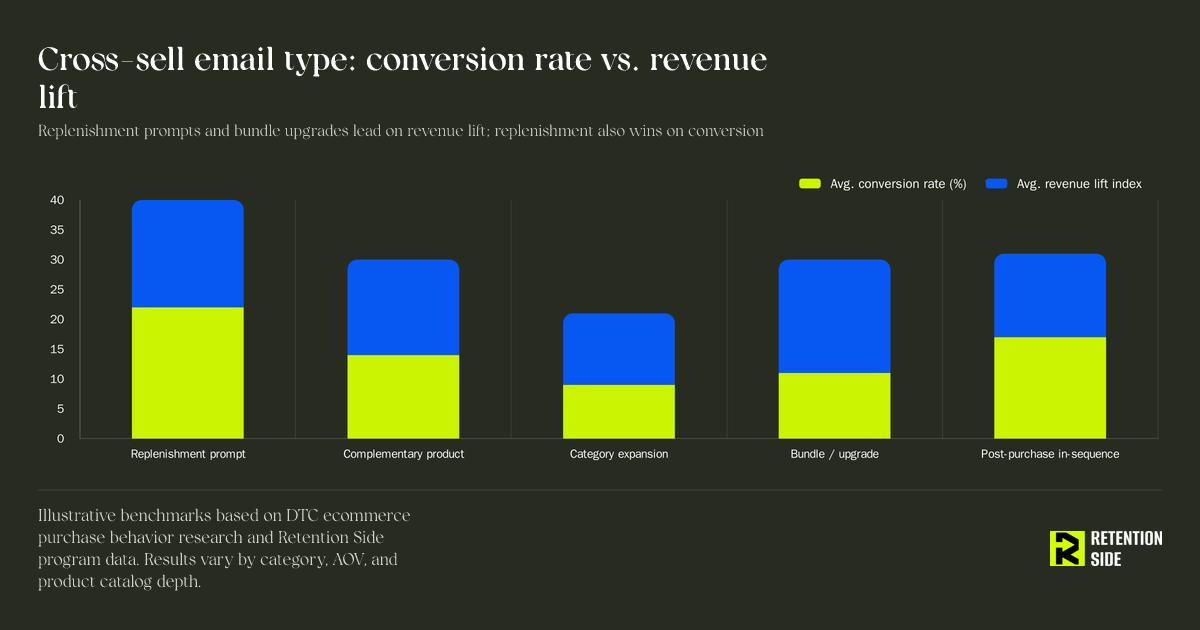
For consumable categories – supplements, skincare, haircare, food – the most effective in-sequence recommendation is not a cross-sell at all. It is a replenishment prompt. According to vertical-level repeat purchase data from Eightx, consumable categories run 365-day repeat purchase rates of 45-55%, with food and beverage compressing 64% of its annual repeat into the first 30 days. For these categories, the in-sequence cross-sell email should lead with replenishment and save catalog expansion for a later touchpoint in the dedicated flow.
For durable categories – home goods, apparel, gear, accessories – where replenishment is not logical, the in-sequence recommendation should focus on natural complements to the specific product that was purchased, not a product from a different category.
The dedicated cross-sell flow
This is where the real cross-sell strategy lives. A dedicated cross-sell flow is a separate automation – not part of the post-purchase sequence – triggered by a specific purchase event, running on its own timeline, with its own messaging logic calibrated to the product that was bought and the purchase patterns that follow it in your catalog.
The dedicated flow runs on a longer timeline than the post-purchase sequence. Where the post-purchase flow is typically 15-25 days, the cross-sell flow can extend to 45-60 days, covering the window where a second product purchase is most probable based on your data. It has more emails, each with a distinct job – introduction, social proof from customers who have both products, a timed incentive if the margin supports it, and a final close.
The key differentiator between a dedicated cross-sell flow and a generic product recommendation email is what the recommendations are based on. A generic module pulls from a catalog feed based on category similarity or manual curation. A properly built cross-sell flow is based on observed purchase behavior – specifically, which products customers consistently buy after purchasing a given item, and how long the typical gap between purchase A and purchase B actually is in your data.
That data-driven foundation is what makes the recommendation feel relevant rather than promotional. And relevance is what drives conversion. As McKinsey’s research on personalization shows, 71% of consumers expect companies to deliver personalized interactions, and 76% get frustrated when it doesn’t happen.
Building product relationship data that makes cross-sell recommendations work
The single biggest gap in most ecommerce cross-sell strategies is not the email itself. It is the absence of meaningful product relationship data behind it.
A cross-sell email is only as relevant as the recommendation it contains. And a recommendation is only relevant if it reflects how customers in your catalog actually behave – which products they buy in combination, which ones follow a first purchase, and over what timeframe the subsequent purchase typically happens.
This data exists in your order history. Pulling it does not require advanced analytics. What it requires is looking at repeat purchase behavior by product: for every SKU in your catalog, which other SKUs appear most frequently in the purchase history of customers who also bought that SKU, and within what time window?
The output of that analysis is a product relationship map – a set of “if bought A, then likely to buy B within X days” relationships that become the backbone of your cross-sell flow architecture. For most ecommerce brands, a handful of strong product relationships account for the majority of cross-sell revenue potential. You do not need to map every possible pairing. You need to identify the patterns that are statistically meaningful.
Klaviyo’s integration with Shopify gives you the behavioral data to build these flows dynamically. Klaviyo’s own dynamic cross-sell flow feature – built around its “Best cross-sell date” property from the product analysis report – lets you trigger a flow on the day Klaviyo calculates each customer is most likely to buy next, with a “Next best product” block that surfaces individualized recommendations per profile. A cross-sell flow triggered by “Placed Order where product = A” can reference the specific products that follow product A in your customers’ purchase history, use dynamic product blocks or personalization tokens to surface those recommendations, and time the sequence around the median gap between the two purchases in your data.
This is meaningfully different from a product recommendations block that surfaces items based on category tags or popularity. The former is built on actual customer behavior. The latter is a UI element doing a job that a proper flow should be doing.
A few things to watch for when building the product relationship map:
Category vs. product specificity. In some brands, the cross-sell relationship is at the product level – customers who buy SKU X specifically tend to buy SKU Y. In others, the relationship is at the category level – customers who buy in category A tend to expand to category B within a certain window, regardless of the specific SKU. Know which pattern is operative in your catalog before building the flow logic.
Replenishment vs. expansion. As noted above, many brands discover that their strongest “cross-sell” pattern is actually replenishment – the same product. Do not fight this in the data. Build the replenishment prompt as a dedicated email, separate from the catalog expansion recommendation, because the two have different framing and different timing.
Seasonality. In some categories, the cross-sell relationship is seasonal. A customer who bought a winter product may be a candidate for a spring product, but only if the timing is right. Build seasonal logic into the flow filters rather than letting it fire year-round on a fixed delay.
Segmentation logic: who gets what recommendation and when
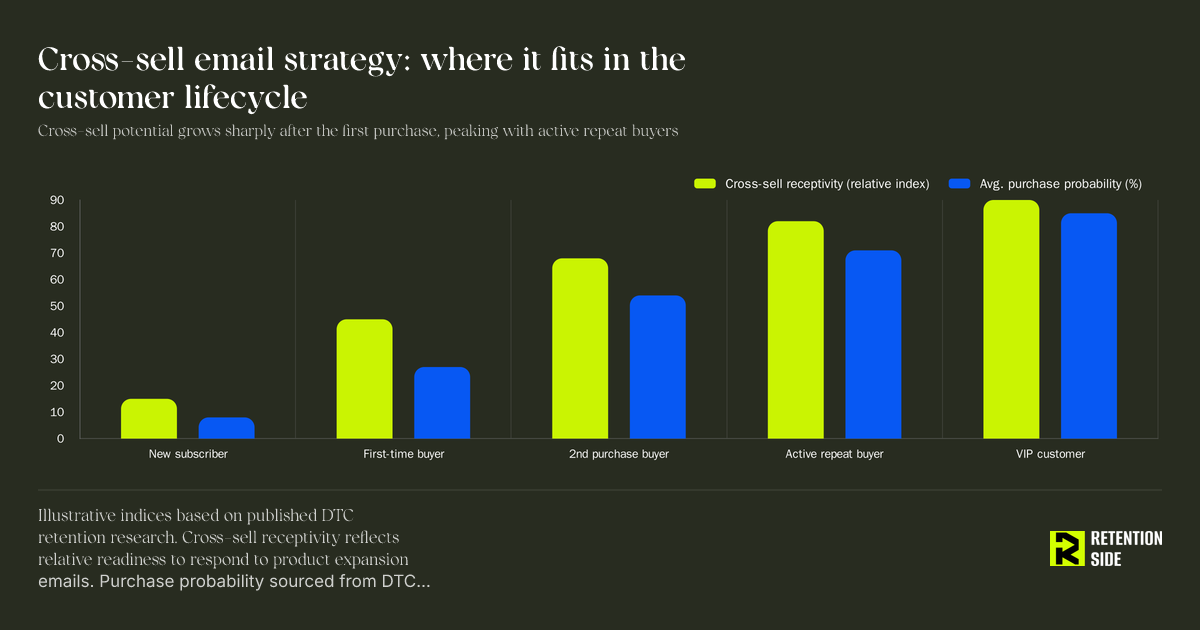
Cross-sell email strategy cannot function without a deliberate Klaviyo segmentation strategy. The recommendation that is appropriate for a first-time buyer is different from the one that belongs in front of a fourth-order repeat buyer. The timing that works for a 30-day replenishment product is wrong for a 90-day one. And the presence or absence of a prior cross-sell interaction should govern whether the flow fires at all.
The core segmentation decisions that govern a cross-sell email architecture:
Purchase history as the primary gate
The most fundamental segmentation question for any cross-sell email is: has this customer already purchased the product you are recommending? If they have, sending them a recommendation for it is not cross-sell. It is noise, and it signals that your system does not know who it is talking to.
In Klaviyo, this is a flow filter condition: the cross-sell flow should fire only for customers who have purchased the trigger product but have not yet purchased the recommended product. This seems obvious, but it is routinely missing from cross-sell flows built without a clear segmentation layer.
First-time vs. repeat buyer framing
A customer receiving a cross-sell email after their first purchase is in a different relationship with the brand than a customer receiving one after their fourth. The framing of the recommendation should reflect that.
For a first-time buyer, the cross-sell email needs to do more work. It needs to introduce the recommended product in the context of the brand’s broader range, establish why this product is the natural next step, and handle any objections a new customer might have about expanding their purchase commitment before they have fully evaluated what they already bought. The tone is educational.
For a repeat buyer, less explanation is needed. They know the brand. The recommendation can be direct, built on the relationship already established, and positioned as an insider tip rather than a product introduction. The tone is more conversational.
Lifecycle timing: calibrate to the repurchase window
The timing of a cross-sell email should reflect where the customer is in their purchasing lifecycle relative to the specific product they bought – not a fixed delay from the purchase date.
For a product with a 30-day natural use cycle, a cross-sell email at day 14 lands while the customer is actively using the product and at a point where expanding their product portfolio is contextually relevant. A cross-sell email at day five is too early. A cross-sell email at day 45 arrives after the customer has likely already made a decision about whether to repurchase or expand.
The practical approach is to build the delay in your cross-sell flow around the median repurchase window for the trigger product, pulled from your order history data – not a default number in the Klaviyo flow editor. Eightx’s analysis of average time to second purchase by vertical puts the cross-vertical median at 15-35 days – considerably shorter than most brands assume when they use fixed 45-day delays.
Incentive segmentation
Not every cross-sell email should include a discount. Not every segment warrants one. The segmentation logic for incentives in cross-sell flows should be based on:
- Whether the customer has received a discount elsewhere in an active flow in the last 30 days (if yes, exclude the incentive to avoid stacking)
- Whether the customer’s AOV and margin profile on the cross-sell product support the incentive economics
- Whether the recommended product is a replenishment (where incentives are often appropriate because the goal is to establish the habit) or an expansion product (where social proof and contextual framing may convert better without discounting)
A flat discount applied to every cross-sell email regardless of context is not a strategy. It is a habit that gradually erodes full-price purchasing and conditions customers to wait for offers.
Timing and incentive structure across the cross-sell architecture
Cross-sell email timing is not just about the delay from the purchase event. It is about the sequence of touchpoints and what each one is trying to accomplish.
A well-structured dedicated cross-sell flow might look like this:
Email 1 – Introduction (day 10-14 after trigger purchase): The opening email in the cross-sell flow establishes the connection between what the customer bought and what you are recommending. This is where you do the product introduction work – the story of why these two products belong together, ideally with customer quotes or social proof from buyers who have both. No discount in email one. The goal is to create awareness and desire, not to trigger a transaction.
Email 2 – Deepened case (day 17-21): If the customer did not act on email one, email two builds the case further. This is where specific use cases, how-to context, or a more detailed look at results or outcomes from the recommended product do the heavy lifting. The email acknowledges that the customer has already bought the trigger product – “you are already doing X, this is how to do it better” is a frame that works in most categories.
Email 3 – Incentive or urgency trigger (day 24-28): This is the point where an incentive enters, if the margin supports it. A time-limited offer, a bundle discount, or a loyalty points multiplier on the cross-sell product gives the customer a reason to act now rather than continue to defer. The urgency should be real, not manufactured. If the customer has engaged with the previous two emails but not converted, a genuine offer at this stage is the most effective conversion lever.
Email 4 – Final close (day 32-38): The last email in the sequence should be short and direct. The customer has seen the full case for the product across the previous three emails. This is not the place for another product introduction. It is a clear, simple prompt – “this is the last reminder about this” – that respects the customer’s time and closes the sequence without repeating content they have already received.
This four-email architecture is a template, not a prescription. For categories with longer consideration cycles, extending the sequence with additional educational touchpoints is appropriate. For high-AOV products where purchase consideration is significant, adding a testimonial-heavy email between emails two and three improves conversion. For brands where the product relationship is very straightforward – a complementary accessory that costs $20 – a two-email sequence may be sufficient.
What matters most is that the sequence has a clear progression from awareness to conversion, with each email serving a distinct purpose, and that it ends rather than running indefinitely. A cross-sell flow that runs for 90 days without a clear end point produces diminishing returns and risks becoming noise in the customer’s inbox.
Campaign-level cross-sell vs. flow-level cross-sell
Cross-sell email strategy lives in both the flow layer and the campaign layer, and the two serve different purposes. Conflating them produces a fragmented experience. Coordinating them produces a system.
Flow-level cross-sell
Flows handle individual-level, behavior-triggered cross-sell. The customer bought product A. A flow fires, personalized to that specific purchase event, delivering a recommendation for product B at a timing calibrated to that customer’s purchase history and the typical gap between those two purchases in your catalog data.
This is high-relevance, low-reach communication. It reaches every customer who bought product A, with a recommendation built around their specific purchase – but it only reaches those customers. It cannot be used to push a cross-sell to a broader segment of customers who bought product A three months ago and are now potential candidates for an expansion purchase.
For a full picture of how flow-level cross-sell fits within the broader Klaviyo flows for ecommerce architecture – alongside win-back, browse abandonment, and replenishment – the principles are the same: automation should feel like it knows the customer, not like it is broadcasting at them.
Campaign-level cross-sell
This is where campaign strategy picks up the cross-sell job for the audience that flows cannot address. A well-segmented campaign to customers who purchased a specific product six months ago – and who have not yet purchased the complementary product – is a cross-sell campaign. It is not a promotional blast. It is targeted, informed by purchase history, and aimed at a specific behavioral gap in the catalog.
Campaign-level cross-sell is also appropriate for seasonal product introductions, catalog expansions, and new product launches directed at customers whose purchase history makes them the natural first audience. A new product that complements your best-selling SKU should not launch to your entire list. It should launch first to the segment of customers who bought that SKU and are statistically the most likely to want the new product.
The coordination between the two layers is important. A customer who has already been through the dedicated cross-sell flow for product B should be excluded from campaign-level cross-sell sends about product B. Duplication is not reinforcement – it is noise, and it signals a broken system.
In Klaviyo, this suppression logic is straightforward to build: a campaign segment condition that includes customers who purchased product A but excludes customers who have already purchased product B OR have been active in the product B cross-sell flow in the last 45 days.
How the cross-sell system connects to LTV and the broader retention stack
The reason cross-sell email strategy is worth building properly – not just adding a product recommendations block to a flow – is what it does to customer lifetime value.
Customers who buy across multiple product categories in your catalog are structurally different from single-product buyers. They have a broader relationship with the brand. Each additional product they use increases the switching cost of going elsewhere. And because their engagement is distributed across more SKUs, they are less vulnerable to the specific churn risk that hits single-product buyers when that one product becomes less relevant or is replaced by a competitor.
The compounding dynamic is well-documented at the vertical level. Per Eightx’s 2026 repeat purchase rate benchmarks, the cross-vertical average repeat purchase rate sits at 28.2% – but the spread underneath is enormous. Consumables (supplements, beauty, food and beverage) run 365-day repeat rates of 45-55%, while home and electronics trail at 20-25%. Every additional product a customer adopts as part of their relationship with the brand deepens that relationship and compresses the repurchase cycle. A cross-sell email strategy, executed well, is the primary mechanism for engineering that product breadth.
The LTV impact is also visible in average order value over time. A customer who starts with a single $40 product and adds a second $35 product within 60 days is now at $75 average – and their subsequent orders are more likely to include multiple items because the habit of buying across your catalog has been established.
This is why cross-sell is not just a revenue tactic. It is a retention lever. A customer with two or more products in their purchase history is a materially better retained customer than one with a single purchase, regardless of how much that single purchase was worth. For more on the mechanics behind this, our customer lifetime value guide for ecommerce covers the full compounding math.
The connection to win-back and lifecycle timing
Cross-sell email strategy also intersects with win-back email campaign logic in a way that most brands do not account for.
A customer who has purchased two products from your catalog has a different win-back profile than a single-product buyer. If they go quiet, the re-engagement message should acknowledge the breadth of their purchase history – not treat them as a generic lapsed buyer. The fact that they have engaged with multiple products is a signal worth using in the win-back framing.
More importantly, the timing of a win-back flow for a multi-product buyer should be calibrated to their most recent purchase event across all products – not just the most recent order. If a customer bought product A four months ago and product B two months ago, the win-back window should be calculated from the product B purchase date, not product A. Getting this wrong means triggering win-back too early or too late, either interrupting an active cross-sell engagement or missing the re-engagement window entirely.
The connection to loyalty programs
For brands with a loyalty program, cross-sell behavior creates natural tier progression opportunities. A customer who has purchased three products from your catalog and has accumulated points across multiple orders is close to a tier threshold that unlocks meaningful rewards. A targeted cross-sell email that surfaces the points they would earn from the recommended purchase – and how that brings them toward their next tier – combines the cross-sell motivation with the loyalty program motivation in a single touchpoint.
This is a genuine example of channel coordination producing more than either channel could produce independently. The loyalty program creates the structural incentive. The cross-sell email delivers it at the right moment, with the right product context. Smile.io’s data shows loyalty programs that are actively marketed can lift repeat purchase rate by 20-27 percentage points among active redeemers – a meaningful multiplier when cross-sell is doing the job of putting those customers into the loyalty loop in the first place.
The role of zero-party data in cross-sell personalization
Cross-sell email strategy that relies entirely on purchase history has a significant gap: it only works for customers who have already bought something. For subscribers who have not yet made a first purchase, the product relationship data does not exist.
Zero-party data – declared intent collected from subscribers at signup or in the early stages of the welcome series – bridges this gap. A subscriber who has told you their skin type, their primary wellness goal, or the specific problem they are trying to solve is giving you the context to make a relevant product recommendation even before they have purchased. EY’s research on zero-party data strategy describes this as the next frontier in consumer strategy – particularly relevant as brands navigate a landscape where third-party signals are increasingly constrained.
This matters for cross-sell because the welcome series is not just an introduction sequence. It is also the best opportunity to collect the data that will make future cross-sell recommendations precise. A question in the welcome flow asking which product category a subscriber is most interested in creates a profile property in Klaviyo that can be used to inform both the welcome-to-first-purchase recommendation and the post-purchase cross-sell sequence that follows.
The practical architecture: collect one or two qualifying questions at signup or in the second email of the welcome series. Map the answers to custom profile properties in Klaviyo. Reference those properties in flow conditions and campaign segment filters to ensure that every cross-sell recommendation – from the first email after purchase to the dedicated flow months later – reflects what the customer has told you about themselves.
Zero-party data does not replace purchase behavior data as the primary cross-sell signal. It supplements it. For customers with a purchase history, behavioral data is more reliable than declared preferences. For customers in the early lifecycle, zero-party data is often the only personalization signal you have.
Metrics that tell you whether it is working
Cross-sell email programs produce clean, measurable outcomes when they are built correctly. The problem is that most brands track the wrong metrics – or do not track cross-sell performance separately from the general email program.
Cross-sell conversion rate is the primary metric: what percentage of customers who entered a cross-sell flow (or received a cross-sell campaign) purchased the recommended product within a defined window? This number tells you whether the recommendation itself is working and whether the sequence is doing its job. A low cross-sell conversion rate despite strong engagement signals a product selection or framing problem. A low conversion rate with low engagement signals a timing or segmentation problem.
Average time between first and second order is a program-level metric that reflects the cumulative effect of cross-sell, post-purchase, and replenishment automation. If this number is shortening over time as you improve the cross-sell architecture, the system is working. If it is holding flat or lengthening, there is a gap in the communication that is not being addressed.
Multi-product purchase rate – what percentage of your customers have purchased from more than one product category or bought more than one SKU – is the highest-level signal of whether the cross-sell system is building the kind of catalog breadth that translates into meaningful LTV lift. Tracking this metric by cohort (customers acquired in the same month, measured at 90-day and 180-day windows) shows you whether the system is improving over time.
Returning customer rate at the program level is the ultimate signal. A well-executed cross-sell strategy that is deepening product relationships and accelerating the repurchase cycle should show up as a rising returning customer rate in your Shopify analytics. If it is not, the issue is either in the flow architecture, in the segmentation logic, or upstream in acquisition quality.
What not to track as cross-sell success metrics: open rate, click rate, and revenue per recipient. These are activity signals. They can look strong even when the cross-sell conversion rate is weak, which makes them actively misleading as accountability metrics for a program that is supposed to be building long-term customer value.
Common cross-sell email mistakes that cost brands real revenue
Sending the same cross-sell recommendation to everyone. A product recommendations block that shows the same four products to every customer, regardless of what they bought or where they are in the lifecycle, is not cross-sell strategy. It is a catalog widget. The revenue it produces is incidental.
Timing cross-sell too early. A cross-sell recommendation that arrives before the customer has had time to use and evaluate what they bought creates friction rather than motivation. The customer has not established value from purchase one. Why would they commit to purchase two? In most categories, the window for introducing a cross-sell recommendation opens between day seven and day fourteen post-purchase – after the initial product experience has had time to form.
Ignoring replenishment as the primary cross-sell signal. For consumable categories, the biggest cross-sell opportunity is not a different product – it is the same product. Treating replenishment as a separate automation entirely, and investing all the cross-sell effort in catalog expansion, misses the highest-probability conversion in the program.
Stacking incentives. A customer in an active post-purchase flow who is also receiving a cross-sell campaign with a discount, while simultaneously being targeted by a promotional campaign, has received too many overlapping incentives. The signal is disorganized and the economics are broken. Suppression logic and flow filters need to prevent this at the architecture level.
Building the cross-sell flow once and not testing it. A cross-sell flow built at launch, run for 12 months without systematic A/B testing, and never updated to reflect catalog changes or audience behavior shifts is not a working system. It is a static sequence running in the background. Testing subject lines, email one vs. email two conversion rates, incentive timing, and product selection is what turns a static flow into a compounding revenue driver.
Forgetting to exclude customers who already bought the product. This one is embarrassingly common. A cross-sell flow firing for customers who already own the recommended product is a broken experience that signals the brand does not know its customers. Klaviyo flow filters should exclude this segment before the flow is ever live.
Conclusion
A cross-sell email strategy is one of the most direct levers ecommerce brands have for raising customer lifetime value without increasing acquisition spend. The mechanics are well-understood: identify the product relationships in your catalog, build dedicated flows triggered by specific purchase events, time them to the customer’s natural repurchase window, and segment the recommendations by lifecycle stage and purchase history.
What most brands are missing is not the idea of cross-sell. It is the architecture. A product recommendations block inside a post-purchase flow is not a cross-sell system. A properly built dedicated flow – with product relationship data behind the recommendations, segmentation logic governing who receives what and when, and a tested incentive structure calibrated to the margin and behavior of the specific audience – is a materially different thing.
For brands at $300K/month or more, the economics of building this architecture are clear. Customers who buy across two or more product categories have lower churn risk, higher LTV, and a stronger relationship with the brand that persists through competitive pressure and market shifts. The cross-sell email system is how you build that customer base deliberately, rather than leaving it to chance.
At Retention Side, cross-sell flows are part of the core automation architecture we build for every client on Klaviyo. They sit alongside post-purchase sequencing, win-back timing calibrated to actual repurchase data, and the campaign strategy that coordinates what flows cannot cover. The entry point is always email. What the full system looks like beyond that depends on the brand, the audience, and what the data tells us about where the next highest-value lever actually is.