

Most ecommerce brands have a post-purchase flow. Very few have one that actually does the job it should. There is a wide gap between a sequence that confirms an order and dispatches a shipping notification, and a sequence that deliberately engineers a second purchase, builds lasting brand affinity, and turns a one-time transaction into the start of a profitable customer relationship.
That gap is where a disproportionate share of long-term ecommerce revenue either gets captured or lost.
This article breaks down how to build a post-purchase email flow that works strategically – not just technically. The focus is on the thinking behind each stage, the objectives that each email in the sequence should serve, and the practical decisions that separate a conversion-driving flow from a forgettable one.
Key takeaways
- A post-purchase email flow is not a logistics sequence. Shipping confirmations are transactional email. The marketing post-purchase flow activates after delivery and serves a completely different set of objectives.
- The window between first and second purchase is the highest-leverage moment in the customer lifecycle. What you do in that window largely determines whether a first-time buyer becomes a repeat customer.
- A well-built post-purchase sequence is a multi-email flow with distinct jobs at each stage: product education, cross-sell recommendation, review collection, and a deliberate bridge toward the second purchase.
- First-time buyers and returning customers should not receive the same post-purchase sequence. Their relationship with the brand is different, and the email logic should reflect that.
- The metric that tells you whether a post-purchase flow is working is not open rate. It is the percentage of customers who enter the flow and place a second order within a defined window.
- Post-purchase is where retention begins – but it does not end there. A complete retention system connects the post-purchase flow to loyalty structure, cross-sell automation, and win-back sequencing.
What we’ll cover
- Why most post-purchase flows are significantly under-built
- The strategic objectives the flow must serve – and in what order
- How to structure the sequence email by email
- First-time vs. repeat buyer logic – why they need separate paths
- Cross-sell and up-sell as part of the post-purchase architecture
- Review collection timing and why it matters
- How the post-purchase flow connects to the broader retention system
- Metrics that tell you whether the flow is working
Why most post-purchase flows are significantly under-built
The post-purchase flow is, structurally, the most commonly neglected automation in ecommerce email programs. It is not that brands skip it entirely – most have something live. The problem is what “something live” usually looks like: an order confirmation, a shipping update, and maybe a generic “hope you love it” email that closes the loop on the transaction without doing anything to extend the relationship.
That version of a post-purchase flow treats the period after purchase as a logistics handoff. It communicates the same information a courier tracking page communicates, in email form. Nothing about it tries to accomplish what the flow is uniquely positioned to accomplish.
Here is the context that makes this more specific: DTC data across 162,112 customers and 13 brands shows that only 21.2% of first-time buyers make a second purchase within a 720-day window. That number feels modest. But the strategic significance is that getting a customer to a second purchase nearly doubles their likelihood of placing a third – the conversion rate jumps from 21.2% to 38.8%, then accelerates further to 50.9% on the third-to-fourth step and 58.9% on the fourth-to-fifth. The compounding effect of that second purchase is the whole retention game. A customer on their fifth or sixth order is structurally different from a one-time buyer – their average LTV is $1,553.78 versus $211.57 for a one-time buyer, a 7.3x difference – their acquisition cost is effectively zero, and their lifetime value is multiples of someone who bought once and drifted away.
The post-purchase window is where that second purchase gets made or lost. And the window is shorter than most brands assume: data across 40,397 repeat buyers shows that 50.3% of second purchases happen within 30 days of the first order, and 76.4% happen within 90 days. Most brands run three to five emails over two weeks, then go quiet – covering only the steepest part of the repurchase curve, then leaving the rest to campaigns or silence.
Most brands spend almost nothing on it. A well-built flow changes that equation.
The strategic objectives the flow must serve
Before mapping individual emails, it is worth being precise about what the post-purchase flow is actually trying to accomplish – because most under-built versions collapse all objectives into one undifferentiated send.
A properly designed post-purchase email flow serves four distinct objectives, roughly in sequence:
1. Reinforce the purchase decision and build confidence
A customer who just bought is at peak engagement, but they are also at peak vulnerability to buyer’s remorse. The window between purchase and delivery is emotionally loaded. What you send during this period should make the customer feel good about the decision they made – not by being promotional, but by being genuinely helpful and reassuring.
This is not a marketing job in the traditional sense. It is a relationship job. The email that lands in the first day or two after purchase should make the customer feel attended to, not sold to again.
2. Educate the customer on how to get value from what they bought
Product education is the single most underused lever in post-purchase email. A customer who fully understands how to use a product, knows what results to expect, and gets genuine utility from it is far more likely to repurchase than one who uses it in isolation and is left to draw their own conclusions about whether it worked.
For a complex product, this means features, use cases, and advanced techniques. For a simple product, it means care instructions, styling suggestions, usage ideas, or contextual knowledge that adds value to the purchase. There is no product category where post-purchase education is irrelevant.
Educating customers also reduces returns. A customer who knows what to expect does not return a product because their expectations were misaligned. We documented this effect in detail in our case study on cutting return rates with email for a women’s fashion brand – the email touchpoints surrounding a purchase are some of the highest-leverage moments in the entire customer lifecycle, and using them to inform and reassure customers directly reduces return rates.
3. Drive cross-sell and create a path toward the second purchase
Cross-sell is often treated as a separate automation entirely – and a dedicated cross-sell flow with its own architecture is genuinely valuable. But introducing a complementary product or a natural next step within the post-purchase sequence itself is both appropriate and high-converting, particularly in the 7-14 day window when the customer’s relationship with the brand is still fresh.
One finding worth holding clearly: analysis of 7,454 second-purchase journeys shows that 77% of repeat buyers purchase the same product again rather than a cross-sell. For consumable categories, reorder rates hit 82-93%. This means for most verticals, the most effective “cross-sell” recommendation in the early post-purchase window is actually a replenishment prompt – making it easy to reorder what they already bought – rather than a curated product grid. Save the catalog expansion for later in the sequence, or for durables where cross-sell is the only logical play.
The framing matters regardless. Whether the recommendation is a reorder or a complementary product, it should feel like a genuinely helpful nudge, not a sales push.
4. Collect a review at the right moment
Review requests belong in the post-purchase flow – but only when they are timed correctly. Asking for a review two days after dispatch, before the product has arrived, produces poor reviews or no response. The right timing is after the customer has had enough time to actually use the product and form an opinion.
For most categories, that window opens somewhere between 7 and 21 days after delivery. The exact timing depends on the product type: a skincare product might need 14-21 days of use before the customer can speak to results; a clothing item might only need a few days. Klaviyo integrates natively with most major review platforms including Yotpo, Okendo, and Stamped, which means the review request can be triggered based on a fulfilled order event with a delay matched to your product’s usage cycle.
How to structure the sequence, email by email
The architecture below reflects how Retention Side approaches post-purchase sequencing for ecommerce brands. The specific timing, copy angle, and incentive logic should be adapted to your product category, average order value, and customer profile – but the underlying sequence logic holds across most ecommerce contexts.
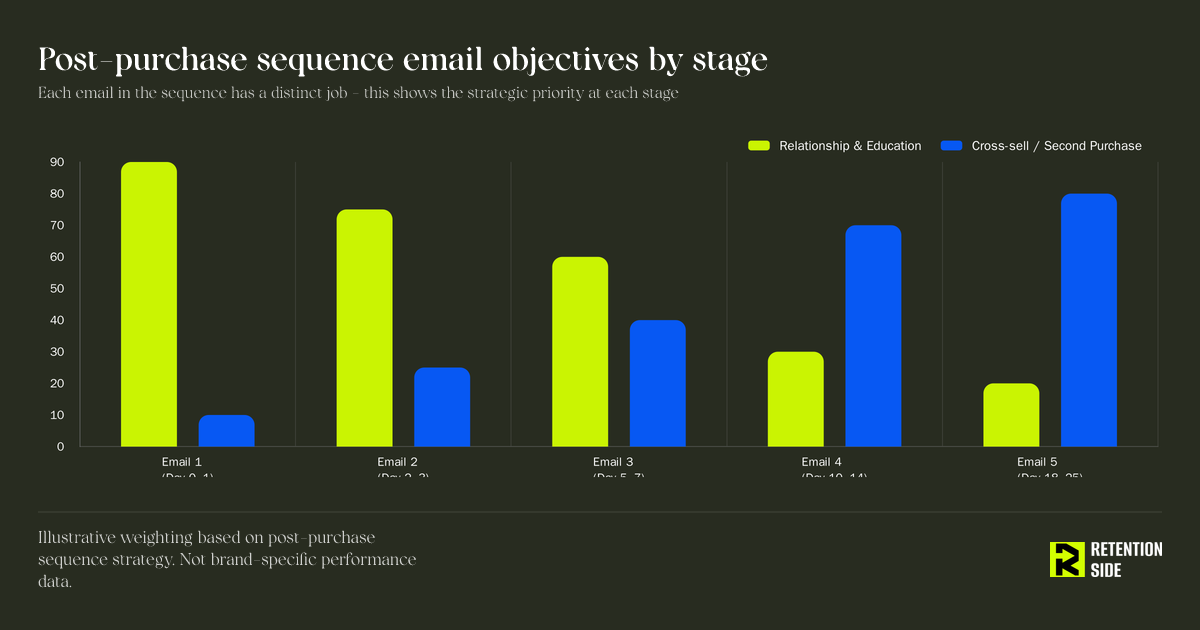
Email 1 – Immediately after order confirmation (Day 0-1)
The first email in the marketing post-purchase flow should fire after the transactional order confirmation that your Shopify or ecommerce platform sends automatically. These are different emails with different jobs. The transactional confirmation covers order details and logistics. This first marketing email has one objective: make the customer feel good about what they just did.
The tone should be warm, unhurried, and personal. It is not a second receipt. It is not an upsell. It acknowledges the purchase, sets expectations about what is coming (delivery timing, what to expect when the package arrives), and perhaps begins the education arc – a first glimpse of what to expect from the product or how to make the most of it.
Keep this email short. The customer has just made a purchase decision. This is not the moment for long-form content. It is the moment to confirm that they made the right call.
Email 2 – Post-delivery, product education (Day 2-5, after delivery confirmation)
This is the most important email in the sequence for brands selling functional products – anything from supplements to skincare to kitchen equipment. Its job is to give the customer the knowledge they need to get full value from what they bought.
If your Klaviyo integration with Shopify includes fulfilled order events (which it should), this email can be triggered by delivery confirmation rather than a fixed delay. That makes it meaningfully more relevant – it arrives when the customer has the product in hand, not before.
The content should be genuinely useful. Usage instructions, common mistakes to avoid, tips for getting the best results, and any context that makes the product more valuable to actually use. Keep the commercial intent low here. This email earns trust. Trust produces repeat purchases.
Email 3 – Replenishment prompt or cross-sell recommendation (Day 7-10)
By this point, the customer has had the product for a few days. They are forming opinions. The first two emails have established the brand as attentive and helpful. This is the right moment to introduce a replenishment prompt or a cross-sell recommendation.
For consumable brands, lead with the reorder. The data is unambiguous on this: 77% of second purchases across DTC verticals are reorders of the same product. A simple “running low?” email with a frictionless one-click reorder link outperforms a product recommendation grid for most categories. The most effective recommendations for cross-sell scenarios are built on actual purchase behavior patterns in your catalog – if customers who buy Product A consistently add Product B within 60 days, that relationship should be encoded into the flow with dynamic product logic rather than a generic “you might also like” module.
Incentives here are contextual. If the customer is a first-time buyer and the recommended product has enough margin to support a modest offer, a small incentive can be appropriate. But incentives should not be reflexive – the recommendation itself, presented with enough product context and social proof, should carry the conversion weight.
Email 4 – Review request (Day 14-21 after delivery)
The review request should arrive when the customer has had time to form a real opinion. Send it too early and you get superficial reviews or no response at all. Send it too late and the emotional freshness of the purchase has faded.
The email should make the review request feel like a contribution to the community rather than a task you are imposing. Acknowledge that you are asking for a moment of their time and make the path to leaving a review as frictionless as possible – ideally a single click that takes them directly to the review submission interface for the specific product they purchased.
If you are using Yotpo, Okendo, or a similar platform, the review link should be dynamic and product-specific. A generic “leave us a review” link that takes the customer to a general store page, rather than directly to the product they bought, creates unnecessary friction that reduces completion rate.
Email 5 – Second purchase bridge (Day 18-25)
The final email in the core sequence has one job: give the customer a reason to come back. By this point, the post-purchase engagement window is starting to narrow. The first order experience is recent but not fresh. This is the last high-probability conversion opportunity before the customer moves into the general campaign audience and eventually, if they do not repurchase, toward win-back territory.
This email can take several forms depending on your brand and catalog:
- A replenishment reminder if the product has a predictable usage cycle (supplements, skincare, consumables)
- A featured product recommendation from a different category, expanding the customer’s footprint in the catalog
- A loyalty program invitation if you have a program that rewards repeat buying behavior
- A time-limited offer that creates genuine purchase urgency without conditioning the customer to expect discounts indefinitely
The framing should feel like a natural continuation of the relationship the first four emails established – not a promotional break from it. A customer who has received genuinely helpful onboarding and education emails is receptive to a recommendation from the same brand. A customer who has only received transactional updates followed by a promotion is being sold to by a stranger.
One important note on flow length: the five-email sequence above covers the first 25 days. Retention curve data across 78,714 first-time buyers shows that 67% of 90-day retention happens in the first 30 days – but meaningful repurchase activity continues through day 90. A post-purchase flow that ends at day 25 covers the steepest part of the curve but leaves the remainder to campaigns. For brands with a replenishment or consumable product, extending the flow with one or two additional touchpoints at days 45-60 – a nudge, a social proof email, or a loyalty milestone – captures the tail of the repurchase window before it fades.
First-time buyers vs. returning customers – why they need different paths
One of the most common structural gaps in post-purchase flows is the absence of branching logic based on purchase history. A customer buying from you for the first time and a customer placing their fourth order are in fundamentally different places in their relationship with the brand, and a sequence that serves them identically misses that entirely.
For a first-time buyer, the post-purchase sequence needs to accomplish everything described above: reassurance, education, cross-sell introduction, review collection, and a path toward the second purchase. The relationship is new and the brand investment has not been established. Every email is building something from scratch.
For a returning customer, the calculus is different. They already know the brand. They do not need a product introduction or a reassurance that they made the right choice. What they need is acknowledgment of their relationship, relevant cross-sell or up-sell based on their specific purchase history, and possibly an early signal about loyalty status or tier-based benefits.
In Klaviyo, this branching is straightforward. A conditional split at the entry point of the flow – checking whether the customer has placed more than one previous order – creates two paths with distinct email sequences. The entry trigger (Placed Order) remains the same. The experience diverges immediately based on the customer’s history.
Brands that invest in this split consistently see better conversion on the returning customer path, where the message can be more direct and the recommendation more precise. And they see better relationship-building on the first-time buyer path, where the full education and onboarding arc does more for long-term retention than any single promotional message could. This logic is covered in more detail in our Klaviyo email marketing setup guide for ecommerce brands, which walks through how to structure the conditional split and what each path should contain.
Cross-sell and up-sell as part of the post-purchase architecture
Cross-sell and up-sell deserve specific attention because they are so frequently collapsed into a single email rather than built out as an intentional layer of the post-purchase architecture.
The distinction between a cross-sell email inside the post-purchase sequence and a dedicated cross-sell flow is worth holding clearly. The in-sequence cross-sell (typically Email 3) is a contextually timed recommendation that capitalizes on the customer’s active engagement with the brand. It works because the customer is still in the post-purchase window and emotionally connected to the purchase.
A dedicated cross-sell flow is a separate automation – triggered by the specific product purchased – that may run on a different timeline, with different products, and different messaging logic. It is product-specific and uses purchase event data to make highly relevant recommendations that are calibrated to the natural repurchase or add-on cycle for what was bought. This is not the same thing as a generic “here are some products you might like” email. For a more complete look at how this architecture fits within a broader Klaviyo setup, our ecommerce email marketing strategy guide covers how cross-sell flows relate to the general post-purchase sequence and when each is the right tool.
For brands with a catalog deep enough to support it, the combination of an in-sequence cross-sell recommendation and a dedicated cross-sell flow produces materially better results than either does in isolation. The in-sequence recommendation captures the early window. The dedicated flow extends the cross-sell arc over a longer timeline with product-specific relevance.
Up-sell logic can sit within the same architecture. A customer who has bought a base-level version of a product, or who has placed multiple orders in a category that has a premium tier, is a natural up-sell candidate. The timing and framing of that up-sell should reflect where the customer is in their relationship with the product – not just where they are in the sequence calendar.
Review collection timing and why it matters beyond the obvious
Review requests in post-purchase flows are usually framed as a conversion tactic: get more reviews, improve social proof, help future customers buy with confidence. That is true and it matters. But the strategic value of review collection inside a post-purchase flow goes beyond aggregate review count.
Reviews generated through a well-timed post-purchase sequence are different in quality from reviews solicited through a generic campaign. They arrive when the customer’s experience is specific and recent. They tend to be more detailed, more authentic, and more useful as content. They also tend to arrive from customers who have had a positive enough experience to stay engaged through a full post-purchase sequence – which means they skew positive in ways that matter for your product page conversion rate.
The timing principle is simple: ask when the customer is in the best position to give a genuinely useful answer. That is after they have had the product long enough to use it, but not so long that the experience has faded. For most ecommerce categories, that window falls between 10 and 21 days after delivery. Products with longer utility cycles – skincare that shows results over weeks, supplements with cumulative effects – may warrant a longer delay before the review request.
One additional tactic worth building in: if a customer leaves a low rating, use that signal to trigger a follow-up that redirects them to your support or customer service team. A negative review on your product page is hard to undo. A proactive support intervention after a negative experience can turn a dissatisfied customer into a recovered one – and occasionally into a loyal one.
How the post-purchase flow connects to the broader retention system
The post-purchase flow is not a standalone automation. It is the first structured touchpoint in a retention system that needs to extend well beyond the initial purchase window.
When a customer exits the post-purchase sequence – whether or not they have converted to a second purchase – their lifecycle status should dictate what happens next. This is where the flow architecture connects to the broader retention infrastructure.
A customer who purchased during the flow enters the cross-sell or up-sell flow at the appropriate trigger point. Their repurchase window should be tracked, and if they go quiet beyond their expected repurchase cycle, the win-back flow should activate based on brand-specific average order frequency data rather than a generic 90-day or 180-day trigger. A win-back flow triggered well after the customer’s natural repurchase window is largely ineffective – the moment to re-engage is when the gap between expected repurchase and actual repurchase first opens, not months after it has become a permanent lapse. As our Klaviyo audit checklist makes clear: if most customers repurchase within 45 days, a win-back at 60 days is appropriate – waiting until 180 days means most customers have already fully moved on.
A customer who did not purchase during the sequence – one who engaged with the flow emails but did not convert on the cross-sell or second purchase prompt – should be segmented differently in campaign sends going forward. They are not yet a retained customer. They are a first-time buyer who has shown engagement but not yet demonstrated loyalty. Campaigns targeting this segment should prioritize the bridge toward a second purchase, not promotional events that treat them as if they are already a multi-purchase customer.
For brands with a loyalty program, the post-purchase flow is the most natural and highest-conversion placement for a loyalty enrollment invitation. A customer who has just had a positive first experience with a brand and received genuinely helpful onboarding is at peak receptiveness to an invitation to join a structure that rewards continued buying. A loyalty invite sent six weeks later, to a customer who has already cooled, produces materially weaker enrollment rates.
This is why the architecture of a post-purchase flow needs to be designed with the whole retention system in mind. The flow does not end. It hands off to the next stage. Our Shopify email marketing strategy guide maps out how this handoff works in practice – from the post-purchase window into cross-sell automation, replenishment flows, and the broader lifecycle.
What makes a post-purchase flow go stale – and what to do about it
One of the most consistent patterns across ecommerce email programs is the post-purchase flow that was built at launch, reviewed once, and then left running indefinitely without meaningful updates. On the surface, it looks like a functioning automation. In practice, it is a static sequence that may be misaligned with the brand’s current product catalog, current pricing, current offers, and current customer expectations.
Flows are not finished when they are launched. They are starting points.
The copy in a post-purchase sequence written 18 months ago may reference products that have been discontinued, use a brand voice that has since evolved, or offer an incentive that is no longer viable at current margins. The cross-sell recommendation may have been relevant when the flow was built but may no longer reflect the actual purchase patterns in the catalog. The review request may be going to the wrong platform after a review tool migration.
These are not theoretical risks. They are the actual state of most post-purchase flows at brands that have grown and evolved without treating their flows as living systems.
The practical discipline is regular flow auditing and continuous A/B testing. Auditing means reviewing the content, logic, timing, and incentive structure of every email in the sequence at least quarterly. Our Klaviyo audit checklist provides a detailed framework for exactly this – covering every flow category including post-purchase architecture, timing logic, and the branching splits that separate first-time from returning buyer paths. Testing means running systematic experiments on the variables that most influence conversion: subject line, first email timing (relative to delivery confirmation), cross-sell product selection, review request timing, and the framing of the second purchase bridge.
A/B testing in post-purchase flows requires patience because the relevant conversion metric – second purchase within a defined window – takes time to accumulate. But the learnings from a well-structured test compound over time in ways that a static flow simply cannot.
The metrics that tell you whether the flow is actually working
The wrong way to evaluate a post-purchase flow is to look at open rate or click rate as proxies for performance. These metrics are available and visible inside Klaviyo’s dashboard, but they tell you whether emails are being opened – not whether the flow is doing its actual job.
The metric that matters most is second purchase conversion rate: what percentage of customers who enter the post-purchase flow make a second purchase within a defined window (typically 30-60 days from the first order)? This is the number that tells you whether the sequence is succeeding at its core objective.
Secondary metrics that add strategic context:
Average time between first and second order – If this number is shortening over time, your post-purchase sequence is accelerating the repurchase cycle. That is one of the clearest signals that the flow is contributing to retention, not just processing post-purchase logistics. DTC retention curve data shows the median time to second purchase clusters between 15 and 35 days – if your average is significantly higher, the post-purchase sequence likely has timing or content gaps in the critical first 30-day window.
Cross-sell conversion rate from Email 3 – What percentage of customers who receive the cross-sell email in the sequence actually purchase the recommended product? This tells you whether your cross-sell selection and framing are working. Low conversion on the cross-sell email, combined with strong engagement, usually signals a product selection or framing problem rather than a reach problem.
Review completion rate – Not the most critical metric for revenue, but a useful indicator of how engaged the post-purchase audience is with the brand. A low review completion rate on a well-timed, well-framed review request sometimes signals that the earlier emails in the sequence have not built enough trust or engagement to motivate the action.
Returning customer rate at the program level – This is the highest-level signal. If the post-purchase flow is doing its job well, alongside the rest of the retention system, the returning customer rate should trend upward over 3-6 month rolling windows. If it is flat or declining despite investment in the flow, the issue may be upstream – in acquisition quality, product experience, or website conversion – rather than in the email sequence itself. Our guide on how to increase repeat purchases in ecommerce covers the full range of levers that contribute to this metric beyond email alone.
What to deliberately not track as a primary KPI: open rate, click rate, and revenue per recipient. These are diagnostic signals at best. They cannot tell you whether the flow is building the retention outcomes that actually move the business.
Post-purchase flow and the multi-channel retention system
Email is the right channel for the post-purchase flow in most ecommerce contexts. It has the content flexibility to deliver product education, the behavioral trigger capability to time sequences precisely against order events, and the reach into an audience that has explicitly opted in and recently demonstrated buying intent.
But for brands that have built out a broader retention stack, the post-purchase window is an opportunity to coordinate across channels rather than relying exclusively on email.
SMS can support the post-purchase flow for time-sensitive nudges – a delivery notification that generates excitement, a replenishment reminder when the product is likely running low, or a flash cross-sell offer that has genuine urgency. SMS is not the place for long-form product education. It is the place for short, high-intent messages that complement the email sequence rather than duplicating it. Our ecommerce SMS marketing guide goes deeper on how to structure SMS touchpoints within a post-purchase sequence and what to avoid when running email and SMS in parallel.
Push notifications serve a similar role for brands with a meaningful mobile audience. An in-app push notification on delivery day, followed by an email with deeper product education, creates a layered touchpoint that reinforces the brand experience without overwhelming the customer.
For higher-AOV categories – premium apparel, home goods, wellness products at significant price points – a physical touchpoint within the post-purchase experience can create an impression that no digital channel replicates. A well-designed thank-you card, an insert with genuinely useful product information, or a premium brand booklet arriving in the same package as the product sets the tone for the email sequence that follows. Direct mail as a post-purchase touchpoint is not about volume. It is about depth of impression in the moments where it matters most.
The principle across all of these channels is the same one that governs the email sequence itself: meet the customer where they are in the lifecycle, with a message that reflects where they are in their relationship with the brand, at the moment when that message has the most potential to change behavior. The post-purchase window is that moment.
Conclusion
The post-purchase email flow is the most structurally important automation in an ecommerce email program – and one of the most consistently under-built. The gap between a logistics sequence and a genuine retention engine is not a creative gap. It is an architectural one.
A well-built post-purchase sequence understands what the first-time buyer needs to hear and in what order. It distinguishes between first-time and returning buyers and serves them different paths. It introduces replenishment prompts or cross-sell recommendations with enough product context to feel useful rather than opportunistic. It collects reviews when the timing is right. And it ends with a deliberate, well-framed bridge toward the second purchase – the moment that, once crossed, nearly doubles the probability of a third.
The data makes the stakes concrete: 21.2% of first-time buyers make a second purchase. Of those who do, the conversion rate to a third purchase jumps to 38.8%, and the LTV of a five-plus-purchase customer is 7.3x a one-time buyer. The post-purchase window – specifically the first 30 days, where 67% of 90-day retention concentrates – is where that compounding either starts or doesn’t.
At Retention Side, we see the post-purchase flow as the beginning of the retention conversation, not its entirety. The flow connects to cross-sell automation, to win-back sequencing timed against actual repurchase cycle data, and to loyalty structures that give the brand’s best customers a structural reason to keep coming back. That is the system that makes retention compound.
If your current post-purchase flow is a shipping confirmation and a thank-you email, you are not in a small minority. But the brands that have rebuilt this layer of their program – with proper sequence architecture, first-time vs. returning buyer logic, genuine product education, and a tested replenishment and cross-sell strategy – see measurable improvement in returning customer rate within the first few months. That improvement is not because email suddenly works better. It is because the most valuable window in the customer lifecycle finally has a system designed to make the most of it.