


Most ecommerce brands run an email audit the same way they run a car through inspection: pop the hood, glance around, check whether the engine turns over, hand back the keys. That is not an audit. That is a glance.
An ecommerce email marketing audit done properly is a structured diagnosis of every layer of your Klaviyo program: whether your emails are actually reaching inboxes, whether the subscribers on your list have any commercial intent, whether your flows cover the moments in the customer journey that actually matter, and whether your campaigns are built around segmentation or just sent to everyone at once. Deliverability, list growth, flows, and campaigns. If any one of those four pillars is broken, the others cannot compensate for it.
At Retention Side, this is the diagnostic sequence we run on every account we take over: deliverability first, then list health, then flow coverage and trigger reliability, and finally creative and offer quality. The order is not arbitrary. Fixing a downstream layer while an upstream problem persists produces a temporary bump at best, and it often masks the real issue for another quarter.
Key takeaways
- A real ecommerce email marketing audit evaluates four connected pillars: deliverability, list growth quality, flow architecture, and campaign strategy. Checking whether flows are “live” tells you almost nothing on its own.
- Deliverability comes first because it sits upstream of everything else. An email that lands in spam has zero conversion value, regardless of how strong the segmentation or creative is.
- Open rate and click rate are diagnostic signals, not accountability metrics. Repeat customer rate, lead-to-customer rate, and placed order rate by flow type tell you whether the program is actually working.
- Most underperforming programs share the same structural gaps: shared sending domains, missing mid-to-late lifecycle flows, unmanaged list hygiene, and campaigns sent to unsegmented lists.
- An audit is only useful if it produces a prioritized, sequenced action list. A report that sits in a shared drive changes nothing.
Why an audit needs a framework, not a checklist
Ask ten agencies what an email audit involves and you will get ten different answers. Some treat it as a Loom walkthrough of the Klaviyo dashboard. Some send a generic ten-item checklist. Neither approach tells you anything about whether the program is structurally sound. Our own Klaviyo audit checklist goes deeper into the specific line items worth checking inside the platform, but the framework underneath it matters more than any single checklist item.
The problem with a surface-level review is that email programs fail in layers. A brand can have flows that look complete on paper: welcome series, abandoned cart, post-purchase, win-back. But if the sending domain has never been properly warmed, or the welcome series has not been touched since it was built two years ago, those flows are running on a broken foundation. A flow that looks finished is not the same as a flow that is working.
A proper audit works through the same four pillars every time, in the same order, because the order reflects real dependency. You cannot meaningfully evaluate campaign performance if half your sends are landing in spam. You cannot evaluate flow conversion rates if the list feeding those flows is full of subscribers who never had purchase intent. Each layer either supports or undermines the one above it, which is why a diagnosis that skips straight to campaign creative usually treats symptoms instead of causes.
Step 1: Audit deliverability before touching anything else
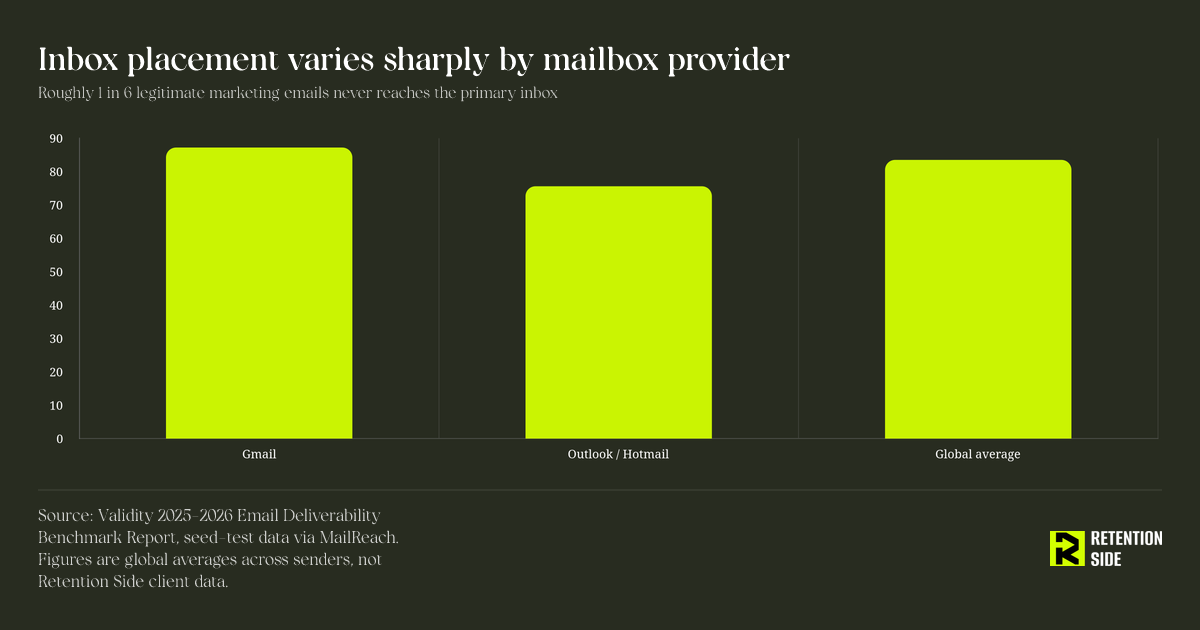
Deliverability is not the same as delivery. Delivery means the receiving server accepted the email. Deliverability means it actually landed somewhere a human would see it. According to Validity’s 2026 Email Deliverability Benchmark Report, inbox placement rates still vary widely by mailbox provider, and the gap between delivery rate and inbox placement rate is where most ecommerce email revenue quietly disappears. A brand can show a 99 percent delivery rate in Klaviyo and still have a meaningful share of sends routed to spam or Promotions, with no indication of it anywhere in the dashboard.
Provider behavior varies enough that a deliverability audit has to look at platform-level data, not just blended averages. Gmail and Outlook handle sender reputation differently, and a domain that looks healthy in aggregate can be quietly losing ground with one specific provider.
Start the deliverability portion of your audit with these checks:
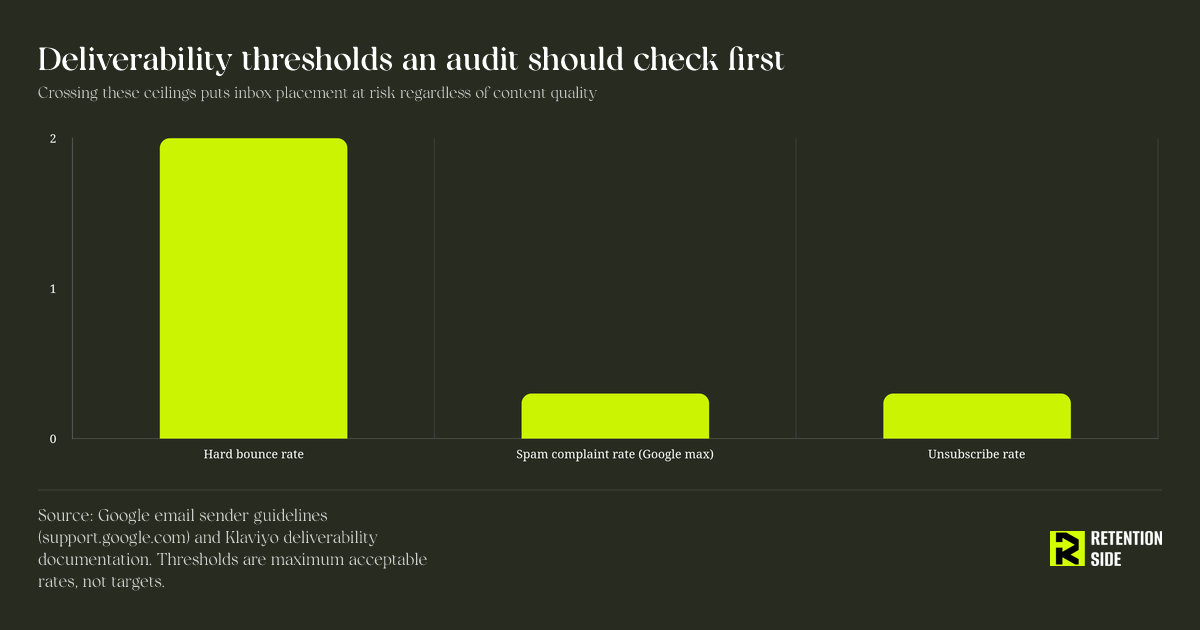
- Authentication status. Confirm SPF, DKIM, and DMARC are correctly configured on a dedicated sending domain, not a shared one. Gmail’s email sender guidelines require SPF or DKIM authentication for all senders and cap reported spam rates at 0.3 percent for anyone sending meaningful volume.
- Spam complaint rate. This is the single most damaging signal to sender reputation. Google’s own guidance sets the hard ceiling at 0.3 percent, and in practice anything above 0.10 percent deserves investigation before it compounds.
- Hard bounce rate. Above 2 percent signals a list quality problem, not a technical glitch.
- Provider-specific inbox placement. Check Google Postmaster Tools and Microsoft SNDS separately rather than relying on Klaviyo’s dashboard alone.
Deliverability problems are almost always invisible until revenue drops, which is exactly why they need to be checked first, not last, in any audit.
Step 2: Audit list growth and subscriber quality, not list size
A 100,000-subscriber list sounds like an asset until you ask what percentage of those subscribers ever converted to a first purchase. Form submission rate is the metric most brands watch, and it is close to useless on its own. The metric that actually tells you whether list growth is working is lead-to-customer rate: what percentage of new subscribers make a purchase within a defined window, typically 30 days.
A smaller list built from high-intent traffic will consistently outconvert a large list inflated by broad, discount-driven pop-ups. When auditing list growth, check whether your forms are collecting zero-party data at signup, whether incentive design is balancing conversion lift against margin protection, and whether the acquisition sources feeding your list are producing subscribers who actually buy. If your welcome series underperforms, the first question is not the email copy. It is whether the traffic behind those signups had any purchase intent to begin with, since no amount of flow optimization fixes a traffic problem.
Step 3: Audit flow architecture and coverage
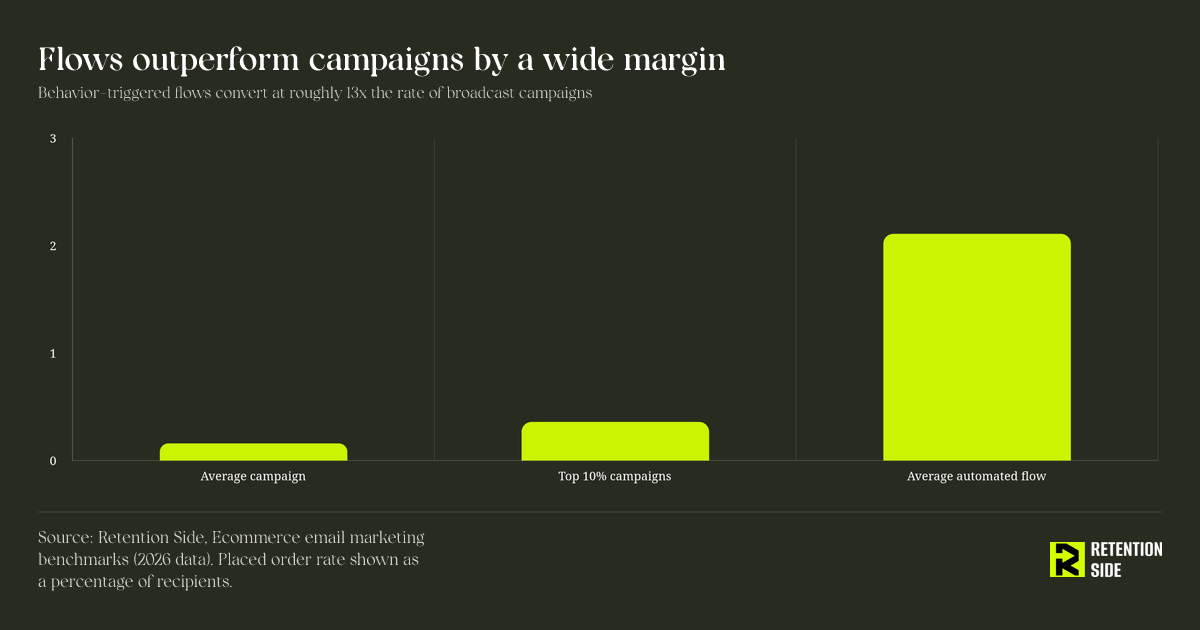
Flows are behavior-triggered sequences that fire based on what a customer does, not a date on a calendar. Because they reach subscribers at moments of active intent or lifecycle transition, they convert at dramatically different rates than broadcast campaigns.
The gap is not small. The average automated flow converts at a placed order rate of roughly 2.11 percent, compared to 0.16 percent for the average campaign – a 13x difference driven by timing and intent rather than creative quality.
When auditing flow coverage, map the full customer journey and check for gaps beyond the obvious flows:
- Welcome series, with zero-party data branching rather than a linear five-email sequence sent to everyone
- Abandoned cart, which matters enormously given that Baymard Institute’s long-running research puts the average documented cart abandonment rate at just over 70 percent
- Browse abandonment
- Post-purchase onboarding
- Cross-sell and upsell sequences
- Win-back flows timed to the brand’s actual repurchase cycle, not a generic 90-day default
- A sunset flow that suppresses chronically disengaged subscribers before they damage sender reputation
A flow built once and never revisited degrades over time even if it technically still fires. Not every flow exists to generate direct revenue, some exist to collect data, set expectations, or protect deliverability, so audit each one against its actual job instead of a single revenue benchmark.
Step 4: Audit campaign strategy and segmentation logic
Campaigns are manual sends to selected audiences, and campaign performance depends almost entirely on segmentation discipline. The top 10 percent of campaigns across categories, per Retention Side’s ecommerce email marketing benchmarks, land around a 0.36 percent placed order rate. If your campaigns are consistently sending below 0.10 percent, the cause is usually one of three things: segmentation that is too broad, an offer that does not match audience intent, or an underlying deliverability problem masquerading as a content issue.
When auditing campaigns, check whether every send goes to a defined segment rather than the full list, whether the calendar mixes promotional sends with educational and value-driven content, and whether VIP, engaged, and lapsed segments receive meaningfully different treatment. A campaign calendar built entirely around discounts trains subscribers to wait for the next markdown, which erodes full-price purchasing and engagement outside sale windows over time.
The metrics that actually tell you whether the program is healthy
Open rate and click rate are the numbers Klaviyo surfaces most prominently, and they are the numbers most audits fixate on. As we’ve covered in our breakdown of how to improve open rates in Klaviyo, Mail Privacy Protection has already inflated Apple Mail open rates to the point where the metric misrepresents actual engagement for a meaningful share of any list. Open rate is useful for diagnosing a specific send. It is not an accountability metric for the whole program.
The thresholds below define the ceiling, not the target, for the deliverability signals every audit should check before drawing conclusions from anything downstream.
The metrics worth building an audit around instead:
- Repeat customer rate – the percentage of customers who placed more than one order in a given period. This should trend upward as the program matures.
- Lead-to-customer rate – the real list growth KPI, distinct from raw subscriber count or form submission rate.
- Placed order rate by flow and campaign type – benchmarked against your own historical performance, not just industry averages.
- Deliverability indicators – inbox placement rate, spam complaint rate, and hard bounce rate, tracked continuously rather than checked once a quarter.
If repeat customer rate is flat despite active email sending, the flows are probably not triggering the way you think they are. If lead-to-customer rate has dropped, look at acquisition traffic before touching the welcome series. Retention does not operate in isolation – it depends on the quality of what is feeding it from acquisition and the site.
How often to audit versus how often to monitor
A full four-pillar audit makes sense on a quarterly cadence for most brands doing $300K or more per month, or any time there is a meaningful shift in acquisition strategy, a plateau in repeat customer rate, or a takeover of an existing Klaviyo account. But an audit is not a substitute for ongoing monitoring. Deliverability signals in particular need weekly attention: spam complaint rate, bounce rate, and Google Postmaster Tools data should be part of a standing routine, not a quarterly surprise.
Brands running Shopify specifically may find it useful to pair this framework with a platform-specific review; our Shopify email marketing audit walks through the same four pillars with Shopify-specific data sources and integration checks layered in.
What to do with your audit findings
An audit that ends in a long list of issues, ranked by nothing in particular, is not useful. The output that matters is a prioritized sequence: fix the deliverability issue first if one exists, because it caps the ceiling on everything else. Then address list hygiene, since a list carrying dead weight will continue dragging down engagement signals no matter how good the flows and campaigns become. Then close flow coverage gaps and fix broken triggers. Only then does creative and offer optimization move the needle in a meaningful way.
Prioritize by revenue impact and effort required, not by the sheer number of issues found. Three clear fixes that move repeat customer rate and email-attributed revenue in the next 90 days beat a 40-item report that never gets actioned.
Conclusion
An ecommerce email marketing audit is not a report you commission once and file away. It is a structured, sequenced diagnosis – deliverability, list quality, flows, campaigns – that tells you exactly where the program is leaking and what to fix first. Brands that treat it as a continuous discipline instead of an annual event are the ones that see repeat customer rate and email-attributed revenue actually move, quarter after quarter.