


Key takeaways
- A Shopify email marketing audit is not a subject line review. It is a structured evaluation of deliverability, list quality, flow architecture, segmentation, and campaign strategy, viewed together as one system.
- Most Shopify brands lose revenue not because email marketing is “broken,” but because one weak layer (usually deliverability or flow gaps) quietly drags down everything built on top of it.
- Delivery and deliverability are not the same thing. An audit has to separate “the email was technically sent” from “the email actually reached the inbox.”
- Flows typically carry a disproportionate share of email revenue relative to how much attention they get after launch. Most brands set them up once and never revisit them.
- The goal of an audit is not a list of problems. It’s a prioritized roadmap that tells you what to fix first, what to test next, and what’s actually driving (or blocking) revenue from existing customers.
Why a Shopify email marketing audit needs a different lens than a generic email review
Most “email audits” you’ll find online are checklists built for any ESP, any platform, any business model. That’s fine for a general read, but Shopify brands have specific mechanics that change what actually matters: order data flowing into Klaviyo in real time, product feeds that power dynamic recommendations, checkout and cart events that trigger flows, and a customer base that behaves very differently pre-purchase versus post-purchase.
When we audit a Shopify account at Retention Side, we’re not just scoring open rates against generic benchmarks. We’re looking at whether the Shopify-Klaviyo integration is actually feeding accurate signals (order value, product categories, discount codes used, subscription status), whether flows are built around real customer journey stages instead of generic templates, and whether the account’s structure could actually support the brand at its next revenue tier, not just its current one.
This matters more the bigger the brand gets. A $50,000/month store can survive sloppy segmentation. A brand doing $300,000+/month in revenue is running enough volume that small inefficiencies (a weak win-back flow, a suppressed list segment nobody noticed, a form that converts but drags average order value down) compound into real dollars, month after month.
When a Shopify brand actually needs an audit
You don’t need to audit email every quarter. But there are clear signals that it’s time:
- Email revenue as a share of total revenue has been flat or declining for two or more quarters despite site traffic holding steady.
- You switched ESPs, agencies, or in-house managers and inherited an account nobody fully understands.
- Open rates or click rates have dropped without an obvious reason, and you suspect deliverability rather than content.
- List growth looks fine on paper (form submission rate is healthy) but revenue from new subscribers hasn’t moved.
- Flows haven’t been touched since they were built, sometimes years ago.
- You’re about to increase send volume, launch SMS, or scale ad spend, and you want to know the retention foundation can handle it before you pour more traffic into it.
That last point matters more than people give it credit for. If your acquisition team is about to double paid spend, and your welcome flow, deliverability, and segmentation are all mediocre, you’re about to acquire a lot of customers into a leaky system. An audit before a scale-up is cheaper than fixing the damage after.
The deliverability layer: separating delivery from deliverability
This is the piece most audits skip, and it’s the piece that invalidates everything else if it’s broken. Delivery means Klaviyo successfully handed the email to the receiving server. Deliverability means the email actually landed somewhere a human would see it, the primary inbox, not spam, not a low-visibility promotions tab that functionally behaves like a second inbox.
A Shopify brand can have a “healthy” delivery rate of 99% and still have a deliverability problem, because delivery rate doesn’t tell you where the email landed. This is why open rate alone is a weak diagnostic tool on its own; it needs to be read alongside placement signals, domain reputation, and engagement trends by mailbox provider.
In an audit, we check:
- Domain and IP reputation, including whether SPF, DKIM, and DMARC are properly configured and aligned (a shockingly common gap, even on accounts that have been “professionally managed” for years).
- Sending domain history, especially if the brand switched ESPs or acquired the domain from a previous business.
- Engagement trends segmented by major mailbox providers like Gmail, since Google’s filtering behavior has grown more aggressive with bulk sender requirements and engagement-based placement.
- List hygiene: how long has it been since unengaged subscribers were suppressed or moved to a re-engagement track instead of continuing to receive full-volume sends.
- Spam complaint rate and unsubscribe rate trends relative to send volume, not just totals.
If a brand’s Gmail placement has quietly slipped over the last year, no amount of clever copywriting or offer testing in campaigns will fix that. The audit has to catch this before recommending changes further up the funnel.
List growth and quality: the KPI most brands are tracking wrong
Almost every Shopify brand we audit is proud of their form submission rate. Fewer of them can tell us their lead-to-customer rate, which is the number that actually matters. A popup that converts at 8% but pulls in subscribers who never buy is worse for the business than one converting at 4% with subscribers who convert into paying customers at twice the rate.
An audit looks at:
- Where forms are placed, what incentive they offer, and whether that incentive protects margin or just buys volume.
- Whether the incentive tier (10% off vs. a flat discount vs. a value-add like free shipping) matches the brand’s margin structure and average order value.
- Segmentation at the point of capture: are you collecting anything besides an email address that could inform flow logic later (product interest, birthday, SMS opt-in)?
- Whether the welcome flow’s offer matches what the form promised, and whether the flow escalates urgency appropriately across its steps.
- Double opt-in considerations and how they interact with deliverability, particularly for brands sending into markets with stricter consent expectations.
Subscriber quality, not subscriber volume, is the real growth metric. A list audit should tell you whether your acquisition engine is filling the funnel with the right people, not just more people.
Flow audit: mapping automation to actual customer behavior
Flows are behavior-based, time-sensitive automations. They should exist because a customer did (or didn’t do) something specific, not because a template said “you need this flow.” When we audit flows, we map every existing automation against the actual customer journey and ask where customers are dropping off that flows aren’t currently addressing.
Common gaps we see on Shopify accounts:
- A welcome flow that was built once and never adjusted for seasonality, new product lines, or shifts in the brand’s offer strategy.
- Abandoned cart and browse abandonment flows that use identical timing and messaging, when they should behave differently since cart abandoners have shown much stronger purchase intent.
- Post-purchase flows that stop at a shipping confirmation and never build toward the second purchase, cross-sell, or a review request timed to actual delivery.
- Win-back flows that treat every lapsed customer the same, regardless of their original purchase frequency or order value.
- No flow addressing subscription cancellations, replenishment timing, or loyalty tier movement, for brands where those apply.
Below is the kind of revenue distribution pattern we typically see across flow types before an audit-driven rebuild. Abandoned cart and welcome flows usually carry outsized weight, which is exactly why neglecting them costs more than neglecting a single campaign.
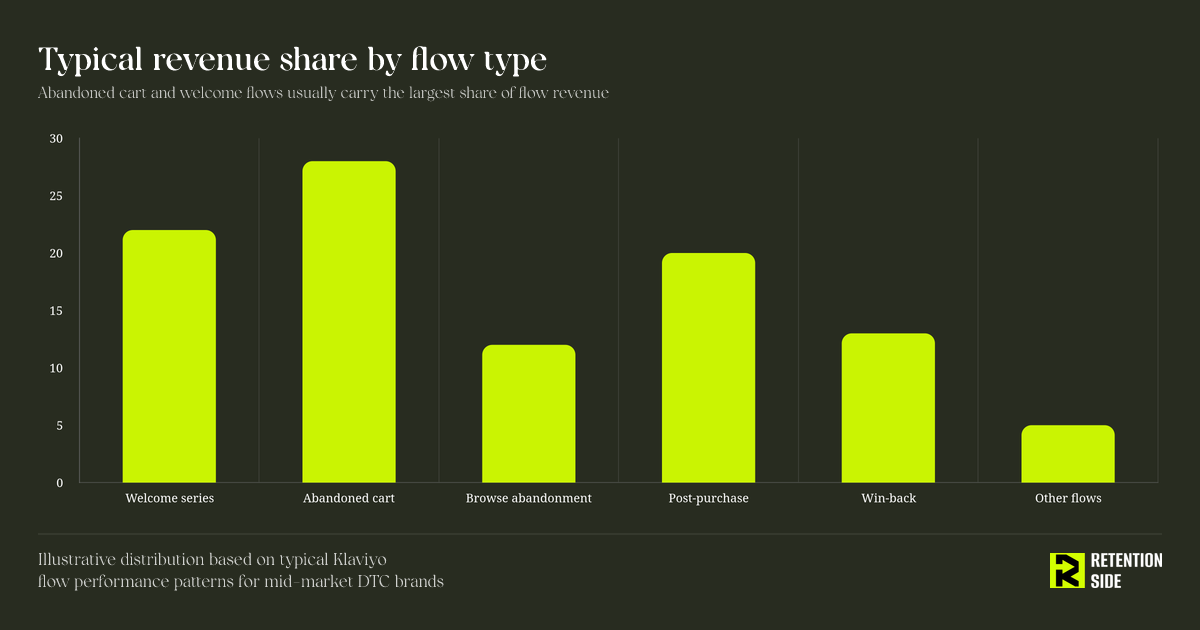
The point of showing this isn’t to tell you to copy the split exactly. It’s to make the case that flows aren’t a “set it and forget it” line item. If your abandoned cart flow hasn’t been touched in eighteen months while your catalog, pricing, and offers have all changed, it’s very likely underperforming relative to what it could be doing for you right now.
Campaign and segmentation audit
Campaigns are manual sends, and campaign strategy lives or dies on segmentation. An audit here looks at whether the brand is sending the same campaign to its entire list every time, or whether segments are built around actual behavior: purchase recency, category affinity, engagement level, VIP status, and lifecycle stage.
We also look at the balance between promotional and non-promotional sends. If subscribers only hear from a brand during sales, two things happen over time: engagement erodes because there’s no reason to open an email that isn’t a discount, and full-price purchasing declines because customers learn to wait. An audit tracks the ratio of promotional to educational or value-driven campaigns over a rolling period, not just a single month, since seasonal spikes (Black Friday, holiday) can distort a snapshot view.
Segmentation quality also determines whether A/B testing produces meaningful signal. Testing subject lines against a poorly segmented list mixes engaged and disengaged subscribers together, muddying the results. Before recommending a testing calendar, we check whether the underlying segments are clean enough for a test to actually mean something.
The metrics that actually tell you something
Part of any Shopify email audit is separating vanity metrics from decision-useful ones. Open rate by itself, without placement context, can be misleading post-iOS Mail Privacy Protection — the DMA’s own Email Benchmarking Report explicitly recommends moving away from open rates as a campaign KPI. Click rate matters more, but needs to be read against list size and segment quality. Placed order rate and revenue per recipient are usually the most honest indicators of whether an email is actually driving the business forward, because they connect activity to outcome.
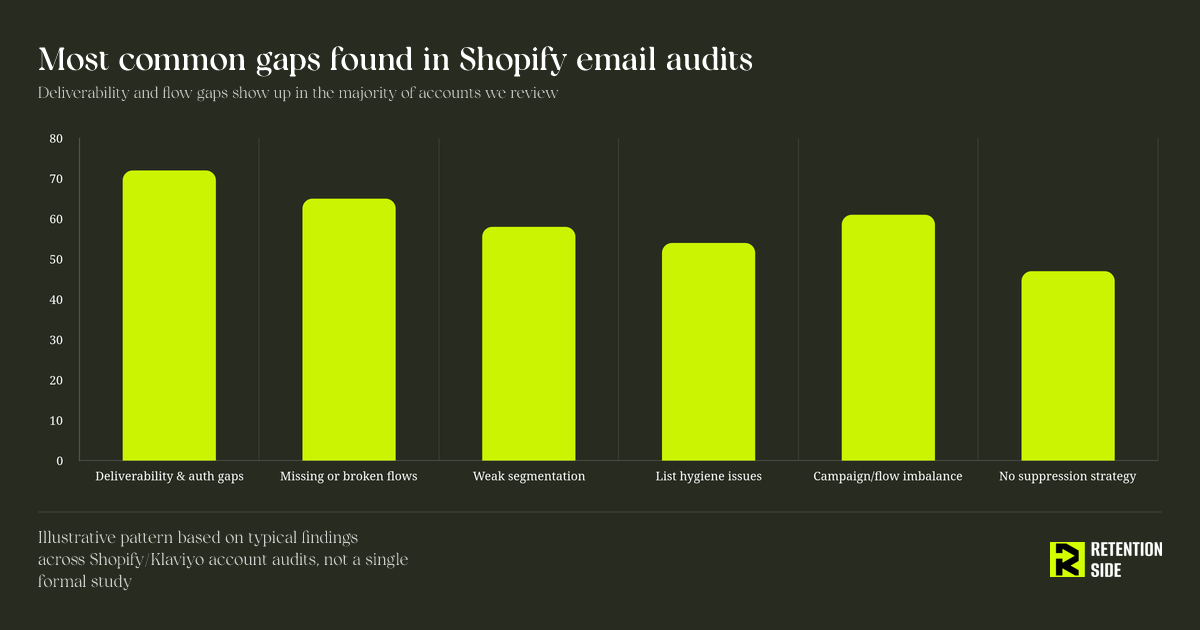
This pattern is worth sitting with. Deliverability and flow gaps show up more often than campaign-level issues, which tells you something important about where audit time should go first. Brands tend to obsess over subject line testing and send-time optimization while the foundation underneath (authentication records, suppression logic, flow structure) hasn’t been checked in years.
It’s also worth remembering that a drop in email performance doesn’t automatically mean email is broken. If traffic quality shifted because of a new ad channel, if the website’s conversion rate dropped independent of email, or if a product line change altered what customers expect to see, email metrics will move even though the retention system itself is sound. A proper audit checks upstream factors (acquisition quality, site conversion, customer behavior shifts) before concluding the fix belongs inside Klaviyo.
How we approach a Shopify audit at Retention Side
We treat retention as a system, not a channel, so an audit never stops at “here’s what’s wrong with your emails.” Email, and Klaviyo specifically, is usually the starting point because it’s where the data and behavioral signal already live. But the audit process is built to answer a bigger question: is this account structured to support the right channel mix for this specific customer base, whether that’s SMS, push, direct mail, loyalty, or something else, based on behavior, cost efficiency, and reach potential rather than what’s trendy.
Practically, that means our audits move through the same core layers covered above: deliverability and sender health, list growth and quality, flow architecture, segmentation, campaign cadence and balance, and reporting accuracy. We prioritize findings by revenue impact and effort to fix, not by how many issues exist, because a long list of minor issues is far less useful than three clear priorities that move the needle in the next 90 days.
A practical framework if you’re running the audit yourself
If you’re doing a first-pass audit internally before deciding whether to bring in outside help, work through these questions in order:
- Deliverability first. Check SPF, DKIM, DMARC alignment and review inbox placement trends by major provider, especially Gmail. If this is broken, fix it before touching anything else.
- List health second. Pull your suppression and engagement segments. How long has it been since unengaged subscribers were separated from active ones? Check lead-to-customer rate, not just form conversion rate.
- Flows third. List every active flow and map it against actual customer journey stages: pre-purchase, first purchase, repeat purchase, lapsing, lapsed. Where are the obvious gaps? When was each flow last updated?
- Segmentation and campaigns fourth. Review your last 90 days of campaigns. What percentage were purely promotional? Is segmentation behavior-based or just “send to everyone”?
- Reporting last. Confirm your revenue attribution windows, UTM structure, and whether Shopify order data is syncing accurately into Klaviyo. Bad data makes every other finding unreliable.
This won’t replace a full agency-level audit, but it will tell you quickly whether the problem is foundational (deliverability, data) or tactical (testing, cadence, offers), which changes everything about what to prioritize next.
What should happen after the audit
An audit that ends in a document nobody acts on isn’t worth doing. The output should be a prioritized roadmap: what gets fixed in the first 30 days (usually deliverability and any broken flows), what gets rebuilt in 60 to 90 days (flow logic, segmentation structure), and what becomes an ongoing testing program (subject lines, send times, incentives, campaign cadence). Flows are never finished. Even a well-built flow from a strong audit should be revisited quarterly as product lines, pricing, and customer behavior shift.
It’s also worth deciding, honestly, whether the findings point to a channel expansion conversation. If deliverability is capped by list fatigue and campaign frequency, SMS or push might carry weight that email currently can’t. If certain high-value segments respond better to a physical touchpoint, direct mail might belong in the mix. The audit shouldn’t just optimize what already exists; it should tell you whether the current channel mix is even the right one for this customer base.
Conclusion
A Shopify email marketing audit is worth doing when you treat it as a diagnostic for the whole retention system, not a scorecard for your last few campaigns. Deliverability determines whether anything else matters. List quality determines whether your top of funnel is actually feeding revenue. Flows determine whether you’re capturing behavior-based revenue you’re currently leaving on the table. Segmentation and campaign strategy determine whether your list stays engaged instead of eroding into pure discount-chasing.
Run through the layers in order, be honest about which ones haven’t been touched in over a year, and prioritize fixes by revenue impact rather than by what’s easiest to change. If the findings point to problems bigger than a Saturday afternoon can fix, that’s usually the signal that it’s time to bring in a team that lives inside Klaviyo and Shopify retention systems every day rather than trying to rebuild the whole thing in-house from scratch.