


Open rate comes up in almost every email marketing conversation. It appears front and center in Klaviyo’s dashboard. Agencies use it in their pitch decks. Brands set quarterly targets around it. And when it drops, it triggers urgency.
But here is the thing most of those conversations miss: open rate is not a goal. It is a symptom. When it falls or rises, something upstream changed – and chasing the number without understanding what that something is leads to a lot of effort with very little meaningful output.
That said, open rate is not completely useless. Persistently low open rates are one of the most reliable early signals of a deliverability problem – and a deliverability problem is a revenue problem worth fixing immediately. The confusion is not whether to pay attention to open rate at all. It is about knowing what it actually tells you, what it does not, and where the real levers are when you want your emails reaching more inboxes and getting more attention when they do.
This article covers all of that, in the order that actually matters.
Key takeaways
- Persistently low open rates usually signal a deliverability issue – not just weak subject lines. Fix the foundation before testing copy.
- Apple Mail Privacy Protection (MPP) inflates raw open rates across all Klaviyo accounts. Your true engagement numbers are lower than the dashboard suggests.
- List hygiene, engaged segmentation, and sending domain setup do more for inbox placement than any subject line test.
- Open rate benchmarks vary by industry and by email type (flows vs. campaigns). Context matters before you benchmark against anything.
- The metrics that actually track business performance are returning customer rate, list growth rate, and revenue attributed to retention channels – not open rate.
- Subject lines, preview text, sender name, and send timing all matter, but only after deliverability and list quality are in good shape.
What open rate is actually measuring (and what it is not)
Open rate in Klaviyo is calculated as the number of unique individuals who open an email divided by the number of recipients it was delivered to. Simple enough in concept – but since Apple’s iOS 15 Mail Privacy Protection update in 2021, the number has been unreliable as an absolute figure.
MPP allows Apple Mail users to block third-party open tracking pixels. Instead of tracking whether a real person opened the email, the tracking pixel gets pre-fetched by Apple’s servers regardless of whether the subscriber opened anything. That inflates open rates for every brand with a meaningful portion of Apple Mail users on their list – which, given Apple Mail’s roughly 53% market share among email clients, is nearly every eCommerce brand. According to Litmus’s ongoing MPP tracking data, more than 50% of email opens now happen on a device with Apple’s Mail Privacy Protection activated.
Klaviyo flags these events with an “Apple Privacy Open” property. You can filter by this to see non-MPP opens, which gives a truer picture of actual engagement. But most dashboards display the blended rate, which makes your numbers look better than they are.
What this means in practice: if your Klaviyo account shows a 42% open rate, the real engagement rate is almost certainly lower. That is not necessarily alarming – but it is important context when evaluating whether your numbers are genuinely strong or merely inflated by phantom opens.
Despite the MPP complication, open rate still serves a useful purpose: it is a directional signal, not a performance KPI. Use it to compare campaigns against each other within the same account. Use it to spot sudden drops that might indicate deliverability issues. Do not use it to benchmark your program’s overall health, and do not optimize toward it as a primary goal.
Why deliverability is the real conversation
Before any tactic around subject lines or send timing matters, one question takes priority: are your emails actually landing in the primary inbox?
There is a critical distinction that most eCommerce brands blur. Email delivery means your email was accepted by the recipient’s mail server without bouncing. Email deliverability means it reached the primary inbox rather than the Promotions tab or spam folder.
You can have a 99% delivery rate and still have 40% of your emails going directly to spam. Klaviyo’s delivery metrics will look healthy. Google Postmaster will tell a different story. And your open rate – which is already inflated by MPP – will look fine on the surface while a significant portion of your list never sees the message at all.
This is where low open rates most commonly come from, especially when they drop gradually over time rather than suddenly. Gradual erosion usually means your sender reputation is slowly degrading – from sending too broadly, from poor list hygiene, or from engagement patterns that inbox providers interpret as low-relevance sending. According to Validity’s 2025 Email Deliverability Benchmark Report, one in six legitimate marketing emails fails to reach the inbox – and global spam placement rates nearly doubled between Q1 and Q4 of 2024.
The detailed breakdown of how to diagnose and fix a deliverability problem is covered in our email deliverability guide for eCommerce brands. The short version:
- Authenticate your sending domain properly: SPF, DKIM, and DMARC are mandatory in 2026, not optional. Google’s own sender guidelines require all bulk senders to have all three configured.
- Use a dedicated subdomain for sending, not your root domain. This protects your main domain reputation and keeps you off shared sending infrastructure.
- Monitor Google Postmaster Tools and Microsoft SNDS regularly. These free tools show your domain and IP reputation directly from Gmail and Outlook’s perspective.
- Maintain spam complaint rates below 0.3%. Above that threshold, inbox providers will begin routing more of your mail to spam – and as of late 2025, Gmail enforces this as a hard 5xx rejection, not just a warning.
If your open rate has been trending down for 6-8 weeks and you have not changed your content or sending frequency, the problem is almost certainly deliverability, not subject lines. Fix that first.
List hygiene: the structural problem most brands ignore
Even with clean authentication and a dedicated sending domain, open rates degrade when inactive subscribers are consistently included in sends. The reason is straightforward: inbox providers track what happens after your emails are delivered. If a large percentage of recipients never open, never click, and occasionally mark you as spam, Gmail and Yahoo interpret that as a signal that your emails are not wanted.
Sending to 150,000 subscribers when only 60,000 are genuinely engaged does not produce the same result as sending to those 60,000 directly. The diluted engagement signal damages your sender reputation incrementally, and the open rate reflects it.
The fix is engaged segmentation, which in Klaviyo is exactly what it sounds like: building segments based on actual recent engagement and sending campaigns to those segments rather than your full list. A deeper breakdown of how to build and structure these segments is covered in our Klaviyo segmentation strategy guide.
A practical starting point for most brands:
- Last 30-day active segment – anyone who has opened or clicked in the last 30 days, plus anyone who subscribed in the last 15 days. This is your core engaged audience.
- Last 60-day active segment – widens the window while still filtering genuinely inactive profiles. Appropriate for brands with consistent, frequent sending.
- Last 90-day active segment – useful for brands that send less frequently, where engagement windows naturally stretch longer.
The key insight here is that your best deliverability comes from sending to people who actually engage with your emails – and that often means sending to a smaller portion of your list than feels comfortable. Resistance to this is natural: smaller send numbers look like lost reach. In practice, sending to 50,000 engaged subscribers almost always produces better inbox placement, better open rates, and more revenue than sending to 150,000 with half of them unengaged.
When to run a sunset flow
At the far end of disengagement, a sunset flow (also called a re-engagement or suppression flow) is the appropriate mechanism. Its purpose is not revenue – it is list hygiene. Subscribers who have not opened or clicked in a defined window (typically 90-180 days depending on your send frequency) get a final re-engagement sequence. Those who respond stay active. Those who do not are suppressed.
Suppressing chronically inactive subscribers reduces the drag on your engagement signals, which over time improves your inbox placement rate and, by extension, your open rate on every future campaign.
Benchmarks to understand before you compare
Because this article addresses open rates directly, it is worth giving you the industry context – with a clear caveat about what these numbers actually mean.
Klaviyo’s 2026 benchmark report, based on data from over 183,000 brands, puts the average campaign open rate across all industries at 31%, with top 10% performers reaching 45.1%. Flows see higher rates because they are behavior-triggered and therefore more contextually relevant to the individual.
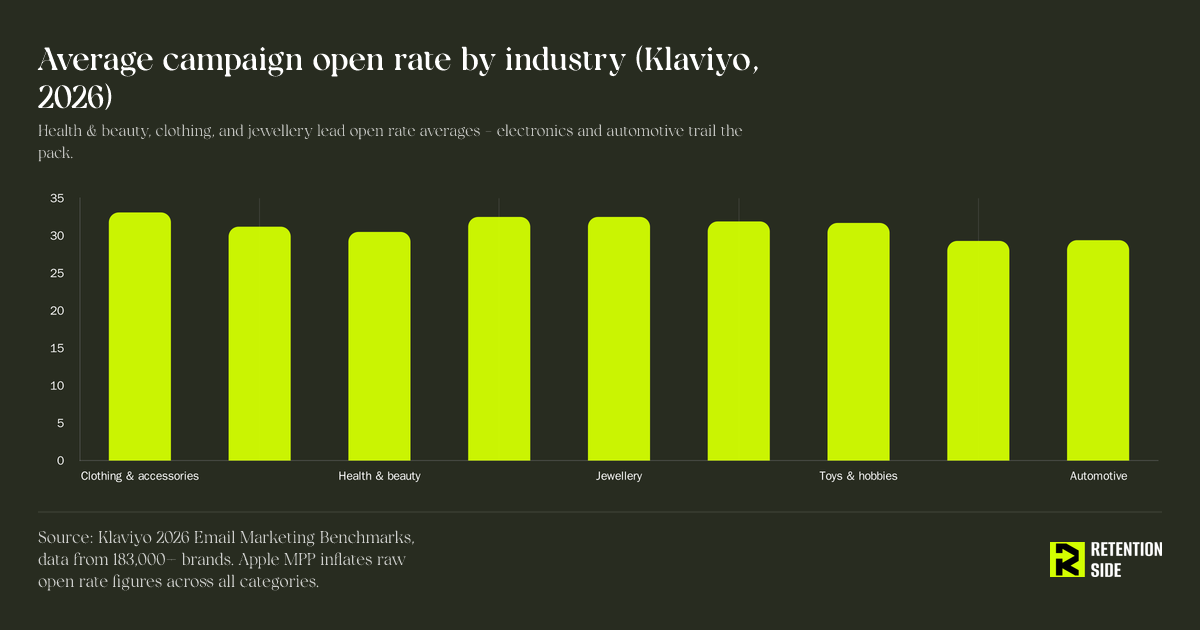
A few things worth knowing about these numbers:
- They are influenced by Apple MPP inflation. Every brand in the dataset has some portion of inflated opens from Apple Mail users, so the absolute percentages are not clean representations of true engagement.
- Industry variation exists but is narrower than you might expect for campaigns. The range sits between roughly 29% (electronics, automotive) and 33% (clothing, jewellery). This is directionally useful but not meaningful enough to use as a pass/fail test for your program.
- Flows consistently outperform campaigns on open rate because they reach subscribers at a moment tied to their own behavior – a browse, an abandoned cart, a purchase. The contextual relevance makes them more likely to be opened.
The more useful benchmark for your own program is your own historical trend. A campaign that used to open at 38% now opening at 26% is a meaningful signal worth investigating. A campaign that has always opened at 28% for your particular audience and niche is not necessarily a problem, even if a benchmark report suggests the average is higher.
Segmentation: targeting the right people, not just the engaged ones
Engaged segmentation protects deliverability. Behavioral segmentation improves relevance – and relevance is the underlying driver of whether someone opens an email.
The most common segmentation failure in eCommerce Klaviyo accounts is treating the entire subscriber list as one audience. A subscriber who bought three times in the last six months should not receive the same campaign as someone who signed up three months ago and has never purchased. The context is completely different. The offer that makes sense for one of them may not make sense for the other.
For a full breakdown of how to build segmentation logic around purchase behavior, RFM scoring, and lifecycle position, our advanced Klaviyo segmentation guide covers the architecture in depth.
Practically speaking, the segments that tend to produce the strongest open rates are:
- Purchasers by product category – someone who bought skincare will respond differently to a campaign featuring supplements. Segment by what they have actually bought and match the send to their known interests.
- High-engagement non-purchasers – people who open and click consistently but have never converted. This is a specific audience that wants to hear from you but has not been given the right reason to buy. A campaign that speaks directly to that tension will open better than a generic promotion.
- First-time buyers in the first 30-90 days – this window is critical. According to purchase behavior research across DTC brands, over 50% of customers who will ever repurchase do so within 30 days of their first order, and 76% within 90 days. Campaigns aimed at this segment during that window have higher relevance and therefore higher open rates.
- VIP customers – your highest LTV buyers open more, click more, and purchase more when you treat them accordingly. A dedicated VIP segment receiving exclusive early access or members-only communication tends to outperform general promotional sends.
What makes segmentation work for open rates specifically is the combination of relevance and expectation. When an email arrives that feels like it was written for the person receiving it – because behaviorally it actually was – they are more likely to open it.
Subject lines and preview text: where most brands start (and should not)
Subject lines are the most-discussed lever for improving open rates, and they do matter – just less than most brands assume, and only when the foundations are already solid.
A subject line cannot fix a deliverability problem. It cannot re-engage a burned-out, over-messaged list. It cannot make an email feel relevant to someone who is in completely the wrong segment. What a strong subject line does is convert inbox impressions into opens for emails that have already earned the right to be seen.
With that framing established, here is what actually moves the needle on subject lines:
Clarity beats cleverness
The job of a subject line is to tell the subscriber what is in the email, with enough specificity or intrigue that they want to open it. Clever wordplay often fails this test because it obscures the point. An email about a product restock performs better with “Your [product] is back in stock” than with an abstract line that requires context to decode.
This matters more in 2026 than it did previously, because Gmail’s Gemini AI and Apple Intelligence are now generating email summaries before subscribers open them. As covered in Klaviyo’s own analysis of this shift, AI models evaluate whether the subject line is an honest preview of the content. A curiosity-gap subject that does not match the email body is increasingly flagged – both by AI filtering and by subscribers who open once and feel misled.
Preview text is the second line of the pitch
Preview text is the short snippet that appears beside or below the subject line in inbox views. Most brands either leave it blank (at which point the inbox pulls the first text from the email body, often a navigation link or legal footer) or write it as a generic restatement of the subject line. Klaviyo’s own documentation notes that different email clients show between 35 and 140 characters of preview text depending on device and client – making front-loading critical.
A more effective approach is to treat the subject line and preview text as a two-part message. If the subject line creates the hook, the preview text delivers the qualification. “Your exclusive offer is inside” plus “Ends midnight Sunday – 30% off your next order” performs better than two lines saying essentially the same thing.
Keep preview text between 40-90 characters. Gmail mobile shows approximately 40-50 characters alongside the subject line, so front-load the relevant information.
Personalization has diminishing returns when used lazily
First name personalization in subject lines does slightly lift open rates on average – but the lift is small and decreasing. Klaviyo’s subject line research confirms that deeper personalization – behavioral signals, product category, lifecycle stage – outperforms simple first-name insertion. The more meaningful form of personalization is behavioral: a subject line that references something the subscriber actually did (viewed this product, bought this category, hasn’t bought in a while) is more likely to feel relevant than one that just inserts their first name into a generic promotional message.
Klaviyo makes behavioral personalization technically straightforward through its flow logic and dynamic tags. The constraint is usually strategic clarity around what signal to reference and why.
A/B testing subject lines in Klaviyo
Klaviyo’s native A/B testing for campaigns splits a portion of your send and automatically sends the winner to the remainder after a defined testing window. For flows, A/B tests run at the email or branch level.
A few principles worth applying:
- Test one variable at a time. Changing subject line, preview text, and sender name simultaneously produces a result you cannot explain and cannot replicate. Klaviyo’s own A/B testing guidance reinforces this as a non-negotiable.
- Choose a winning metric before the test starts. For most brands, the right metric for a subject line test is downstream of open rate – whether the email drove a click or a purchase – because an open that does not convert tells you very little.
- Volume matters. Tests on small lists (under 2,000 recipients per variant) rarely reach statistical significance. If your send volume is limited, it is better to run fewer, larger tests than many tests with unreliable results.
- Document everything. A subject line test that shows a result but gets filed nowhere is knowledge that disappears. Maintaining a simple test log – hypothesis, variable, result, decision – compounds into real strategic advantage over 12-18 months.
Sender name and send time: overlooked, but not unimportant
Sender name
The sender name is the first thing subscribers see in the inbox, before the subject line. Most eCommerce brands use their store name, which is correct – brand recognition drives opens in a way that no subject line can substitute.
The mistake happens when brands rotate sender names inconsistently, test “from” addresses in ways that erode recognition, or use unfamiliar variations (support@, noreply@, or team@) that do not clearly identify the brand. Consistency in sender name builds recognition over time, and recognition directly influences whether someone opens without needing to evaluate the subject line at all.
For transactional-feeling emails in flows (order confirmations, shipping notifications), a slightly more personal sender name can work well. For campaign sends, keep it consistent with the brand name subscribers recognized when they signed up.
Send time
Send time optimization is a real lever, but a secondary one. Klaviyo offers Smart Send Time, which analyzes your individual subscribers’ historical engagement patterns and sends at their predicted optimal time. For accounts with sufficient data, this typically produces a small but consistent lift.
The general rules for send time when you do not have enough data to use Smart Send Time:
- Tuesday through Thursday tends to outperform Monday and Friday for most eCommerce categories.
- Mid-morning (9-11am) and early evening (7-9pm) in the subscriber’s local timezone are the conventional high-engagement windows.
- Send time matters less for flows because they are triggered by behavior, not scheduled. A post-purchase email sent 2 hours after the purchase will open well regardless of whether it arrives on a Tuesday at 10am or a Saturday at 3pm.
When to use Smart Send Time in Klaviyo: any campaign with a list of at least 5,000 recipients and at least 3-6 months of send history. Below that threshold, the data is insufficient for meaningful personalization and the feature’s predictive value diminishes.
Flows vs. campaigns: why open rates differ between them
Flows see higher open rates than campaigns as a structural reality, not a mystery. When an email is triggered by something a subscriber just did – viewed a product, started checkout, placed an order – the email arrives in a context that is directly tied to that action. The subscriber is still in the decision-making or post-purchase mindset. The email is anticipated in a way that a broadcast campaign to 50,000 people is not.
This does not mean flows are more important than campaigns. It means they operate differently, and that difference shows up in engagement metrics. For a full view of how to get the most out of your automated sequences, our Klaviyo flow optimization guide covers the audit and testing process in detail.
Campaigns are broadcast sends – planned, scheduled, and sent to defined segments on a deliberate calendar. They drive commercial momentum for product launches, seasonal events, and promotional periods. Campaigns are also where most of a brand’s email volume lives: Klaviyo’s 2026 benchmark data notes that campaigns account for roughly 95% of total email sends. The average engagement per send is naturally lower because the contextual relevance is lower – you are reaching a segment, not responding to an individual action.
The implication for open rate analysis: do not compare your campaign open rates directly to flow open rates and conclude that campaigns are underperforming. They are different instruments. Compare each type to its own historical baseline and to relevant industry benchmarks for that email type.
What low open rates actually tell you (a diagnostic framework)
Rather than reacting to open rate as a single number, use it as a starting point for a more structured diagnosis. The cause of low open rates is almost always one of five things:
1. Deliverability issues
Sudden or gradual drops across multiple campaigns or flows, especially noticeable for Gmail or Outlook subscribers specifically. Check Google Postmaster Tools. Look at your spam complaint rate. Review your authentication setup. According to Mailgun’s State of Email Deliverability 2025 report, 48% of senders say staying out of spam is their top deliverability challenge – and 70% are not using free tools like Google Postmaster to monitor their sender reputation.
2. List quality problems
Open rates have been low since onboarding a specific traffic source, or since a specific list-building campaign. Subscribers from low-intent acquisition sources (giveaway entries, low-quality lead gen forms) produce structurally lower open rates because their intent was never about your brand. The fix is upstream: build a better list, not a better subject line.
3. Audience fatigue
Open rates that were healthy and have slowly declined over 3-6 months with no other obvious change. You may be over-sending to the same audience without enough content variety. Reduce frequency for the less engaged tier and increase the value proportion of what you are sending (educational content, useful information) relative to pure promotional sends.
4. Segment size creep
Campaigns that used to go to 30,000 subscribers now go to 60,000 because someone widened the segment definition. The additional subscribers are less engaged, which dilutes the open rate average. Re-examine who is included in each send. A structured eCommerce email segmentation strategy is the right tool for preventing this problem from recurring.
5. Subject line staleness
If your subject line formula has not changed in 12 months – same length, same structure, same tone – engagement may drop simply because the pattern has become expected. Introduce variety. Test different angles. Some of your subscribers have been on your list for years and need something different to re-engage their attention.
Where open rate fits in a real retention measurement framework
At Retention Side, we are direct about which metrics we track and why. Open rate is not one of our primary accountability metrics, and it is not one we would recommend building KPIs around.
The metrics that tell you whether your email program is actually working are:
- Returning customer rate – the percentage of customers who purchase more than once. This is the top-line indicator of whether retention is happening. For a full breakdown of what drives this metric, our guide on how to increase repeat purchases in eCommerce covers the mechanics in detail.
- Revenue attributed to retention channels – what email, SMS, push, and other owned channels are contributing to total store revenue.
- List growth rate – is your addressable audience expanding or contracting? A shrinking list is a future revenue problem.
- Deliverability metrics – inbox placement rate, bounce rate, spam complaint rate. These are the upstream health signals that everything else depends on.
Open rate has diagnostic value within this framework. If returning customer rate is flat but deliverability looks healthy and list growth is solid, the problem might be in email content or offer relevance – and that is where open rate, click rate, and conversion rate per campaign become useful data points. But they are inputs to a diagnosis, not the diagnosis itself.
The brands that build genuinely strong email programs are the ones that keep their attention on what they are ultimately trying to move: the number of customers who come back. Every decision about subject lines, send timing, segmentation, and list hygiene should connect back to that outcome. Our eCommerce retention strategy guide covers how each of these pieces fits into a system built around that goal.
Conclusion
Improving open rates in Klaviyo is not primarily a copywriting problem. It is a structural one.
The brands with the strongest inbox placement and highest true engagement rates are the ones that have gotten the foundations right: deliverability infrastructure that passes authentication and stays clean, an engaged segmentation strategy that limits sends to subscribers who actually want to hear from them, and regular list hygiene that removes the chronic disengagement dragging down their sender reputation.
Subject lines, preview text, sender name, and send timing all matter within that context. But they are refinements on a foundation that has to exist first. Testing subject line variations on a list that is partially going to spam is optimizing the wrong variable.
If your open rates are dropping and you are not sure why, the diagnostic path is: check deliverability first, then list quality, then frequency, then subject lines – in that order. Most of the time, the answer is in the first two.
And if the real goal is sustainable email revenue growth – not just higher open rate dashboards – the conversation shifts from “how do we get more people to open this email” to “how do we build a system that keeps the right customers coming back.” That is the shift from email as a broadcast tool to email as a retention asset. It is the difference between a metric and a business outcome.