

Most ecommerce email programs that underperform share a common thread: they treat the list as one audience. A campaign goes out to 80,000 subscribers. A few thousand buy. The rest tune out, unsubscribe, or – worse – stay subscribed but stop engaging. Deliverability quietly softens. Revenue per campaign flatlines. The program starts to feel like it’s working less than it used to, and nobody’s quite sure why.
The reason is almost always segmentation – or the absence of it.
Email segmentation is not a tactic you layer on top of a working program. It’s a structural decision that determines how the program works in the first place. When you send the right message to the right customer at the right time, you are describing a segmented email program. When you do the opposite, you are describing a broadcast list that happens to live inside Klaviyo.
This guide covers what ecommerce email segmentation actually involves, how to build the core segments that most $300K+/month brands need, how segmentation connects to all four pillars of a functioning email program, and what “good” actually looks like in practice.
What you’ll learn
- Why segmentation is structural, not tactical – and what that means for how you build it
- The difference between behavioral and demographic segmentation, and which one drives real retention results
- The six core segments every DTC email program needs to function properly
- How segmentation connects to deliverability, flows, campaigns, and list growth
- How to use RFM logic and zero-party data to segment beyond the basics
- What metrics actually tell you whether your segmentation is working
- Common segmentation mistakes and why they cost brands more than they realize
Why segmentation is structural, not tactical
There’s a version of email marketing where segmentation appears at the end of the process – you write a campaign, decide who to send it to, and add a filter. That approach treats segmentation as a finishing step rather than a foundational one.
The more accurate frame: segmentation is how you decide what to build, not just who to send to. It shapes which flows you create, how those flows branch, what data you collect from subscribers, how your list growth strategy is evaluated, and how your deliverability health is maintained.
Consider a brand doing $400K/month in revenue. Their email list has 60,000 subscribers. Without segmentation logic, every campaign send is essentially a coin flip on relevance – the message might land for some subscribers and be actively irrelevant for others. A promotional send that goes to first-time buyers who just converted yesterday, loyal VIP customers who buy at full price, lapsed subscribers who haven’t engaged in four months, and cold leads who never purchased in the first place – all in the same send – is doing something different to each of those groups. For some, it’s noise. For others, it trains a specific behavior. For the lapsed segment, it’s actively damaging your sender reputation because they will not engage, and inbox providers notice.
Segmentation is the system that prevents all of this. It’s how you ensure each message reaches a group of customers where the content has a plausible reason to be relevant.
This matters beyond campaigns. In Klaviyo, flow filters and conditions are a form of segmentation. Who enters the abandoned cart flow versus who gets excluded because they’re already in a promotional sequence – that’s a segmentation decision. Whether your post-purchase flow branches for first-time buyers versus returning customers is a segmentation decision. The data properties you collect from subscribers and attach to profiles determine what segmentation is possible downstream. If segmentation is an afterthought, every other part of the program is operating on incomplete logic.
Behavioral vs. demographic segmentation
Before getting into specific segments, it’s worth drawing a clear distinction between the two types of data you’ll use to build them.
Demographic segmentation uses attributes about who the subscriber is: location, age, gender, signup source, declared preferences. This data is either collected explicitly (through a form question) or inferred from profile data. It’s stable – a subscriber’s location doesn’t change, their declared skin type doesn’t change. It’s useful for relevance – a skincare brand sending product recommendations calibrated to a subscriber’s declared skin type is using demographic segmentation to improve relevance.
Behavioral segmentation uses what the subscriber has actually done: pages viewed, products browsed, emails clicked, purchases made, orders placed, time between orders, total spend. This data is dynamic – it changes as the customer’s relationship with the brand evolves. It’s usually more predictive of purchase intent than demographic data because it reflects actual decisions, not declared preferences.
The most effective segmentation in ecommerce combines both. A behavioral foundation (what has this person done?) with a demographic overlay (what do we know about who they are?) gets you to communication that is both contextually relevant and personally resonant.
In Klaviyo, behavioral data flows in from your Shopify integration in near real-time: Placed Order events, Viewed Product events, Checkout Started events, Fulfilled Order events. Each of these is a signal you can use to build dynamic segments that update automatically as customer behavior changes. The key word is dynamic. A customer who was “new subscriber, no purchase” last week might be “first-time buyer” this week and “active repeat buyer” in 45 days. Static segments that don’t update with behavior produce misfires. Segments built on event data and profile properties stay current.
The six core segments for DTC email programs
These six segments are the minimum segmentation infrastructure for an ecommerce email program doing meaningful volume. They’re not exotic – they’re the segments that most brands know they should have but often haven’t built cleanly.
1. New subscribers (pre-purchase)
This segment captures everyone who has joined the list but not yet made a purchase. They’re in your welcome series, being actively introduced to the brand, and should receive communication designed to convert a first order – not campaigns treating them as existing customers.
The tactical implication: exclude this segment from promotional campaigns that assume purchase history. Sending a “restock on your favorites” email to someone who has never bought is not only irrelevant – it signals a broken communication system to the recipient.
In Klaviyo: build this as a dynamic segment using the “Has not placed order” condition combined with a subscription date filter. The date filter is important – a subscriber who’s been on the list for six months without purchasing is in a different position than one who joined three days ago. You may want to split this further: active new subscribers (joined in the last 30 days, receiving the welcome series) and inactive non-converters (joined more than 60 days ago, never purchased – these belong in a re-engagement path or suppression queue, not your regular send pool).
2. Engaged buyers (active purchasers)
This is your core revenue segment – customers who have purchased recently and are actively engaging with your emails. The definition of “recently” depends on your category and average repurchase cycle, but as a working baseline: purchased in the last 90 days and opened or clicked at least one email in the last 30-60 days.
This segment should receive your full campaign cadence. They’re already customers. They’re engaged. They’re the group where educational content, product launches, loyalty invitations, and promotional campaigns all have the highest probability of converting.
The nuance worth building in: within this segment, it helps to distinguish by order count. A customer with one purchase is not the same as a customer with four. The post-purchase sequence for a first-time buyer is still active for the former. The latter is a candidate for VIP treatment and higher-value cross-sell sequences.
3. VIP customers
This segment is your highest-value cohort – defined by some combination of order frequency, total spend, and recency. The precise threshold is brand-specific. For a brand with an average order value of $80, a customer with five orders in 12 months and over $400 in lifetime spend might qualify as VIP. For a brand with an AOV of $250, the threshold for meaningful VIP treatment might be different.
VIP customers warrant a different communication approach: early access to new products, exclusive offers before they go public, acknowledgment of their loyalty that feels genuine rather than templated. Sending the same campaign to your VIP segment and your entire list is a missed relationship-building opportunity. These customers are structurally different from occasional buyers – and the way you communicate with them should reflect that.
In terms of deliverability, the VIP segment is your reputation anchor. High-engagement customers who consistently open and interact with your emails send positive signals to inbox providers. According to Mailgun’s State of Email Deliverability research, the more that subscribers open, read, and click your messages, the more apparent it is to mailbox providers that your emails belong in the inbox. This is the segment you want to protect.
4. Lapsed customers (win-back candidates)
A lapsed customer is someone who has purchased before but hasn’t come back within the expected repurchase window for your brand. Note: “expected repurchase window” is based on your actual average order frequency data – not an arbitrary 90-day cutoff applied universally.
For a supplements brand where customers typically reorder every 30-40 days, a customer who hasn’t ordered in 55 days is entering lapsed territory. For a premium cookware brand with naturally longer purchase cycles, 90 days without a repeat order may be normal behavior, not a warning sign.
This segment receives win-back flows and re-engagement campaigns, but with a key distinction: lapsed customers who are still opening your emails are different from lapsed customers who haven’t engaged in months. The former are still reachable through compelling content and offers. The latter are heading toward the sunset segment and should be treated as a deliverability risk if you continue mailing them at full frequency.
5. Unengaged subscribers (sunset candidates)
This segment is the part of your list that most brands either don’t manage actively or avoid dealing with because it makes the list size smaller. Neither approach is correct.
Chronically unengaged subscribers – those who haven’t opened or clicked in 90-120+ days, depending on your send frequency – are a deliverability liability. Inbox providers read non-engagement as a signal that your emails aren’t wanted. Continuing to mail this segment at full frequency drags down your sender reputation for every other send. As Mailgun’s guide to sunset policies explains: if you have low or no engagement, you enter a cycle of deliverability decline that is difficult to reverse once it compounds.
The right approach: a sunset flow that gives this segment a structured final chance to re-engage before being suppressed. The flow isn’t about revenue generation – it’s about list hygiene. Subscribers who re-engage get moved back into an active segment. Those who don’t get suppressed. A cleaner list is a better-performing list.
This is also worth saying directly: removing subscribers from your active send pool is not a loss. It’s how you protect the deliverability of the rest of the list.
6. Non-purchasers (long-term non-converting subscribers)
Separate from brand-new subscribers, this segment covers people who have been on the list for a meaningful period (60-90+ days) but have never purchased. They might be engaged – opening emails, clicking occasionally – but they haven’t crossed the purchase threshold.
These subscribers require a different approach than either new subscribers or lapsed buyers. The communication goal is to identify and address whatever is creating the friction. Is it price? Product uncertainty? Lack of urgency? A specific objection that hasn’t been addressed?
Content campaigns for this segment often work better than promotional ones. An educational email that resolves a specific objection, a social proof send that addresses the particular hesitation this audience segment tends to have, or a personalized product recommendation based on what they’ve browsed – these are more likely to convert a fence-sitter than another discount.
How segmentation connects to the four pillars
Segmentation is not its own isolated pillar of email marketing. It runs through all four – and understanding where each intersection happens is what separates a program that segments smartly from one that just creates a few lists.
Segmentation and deliverability
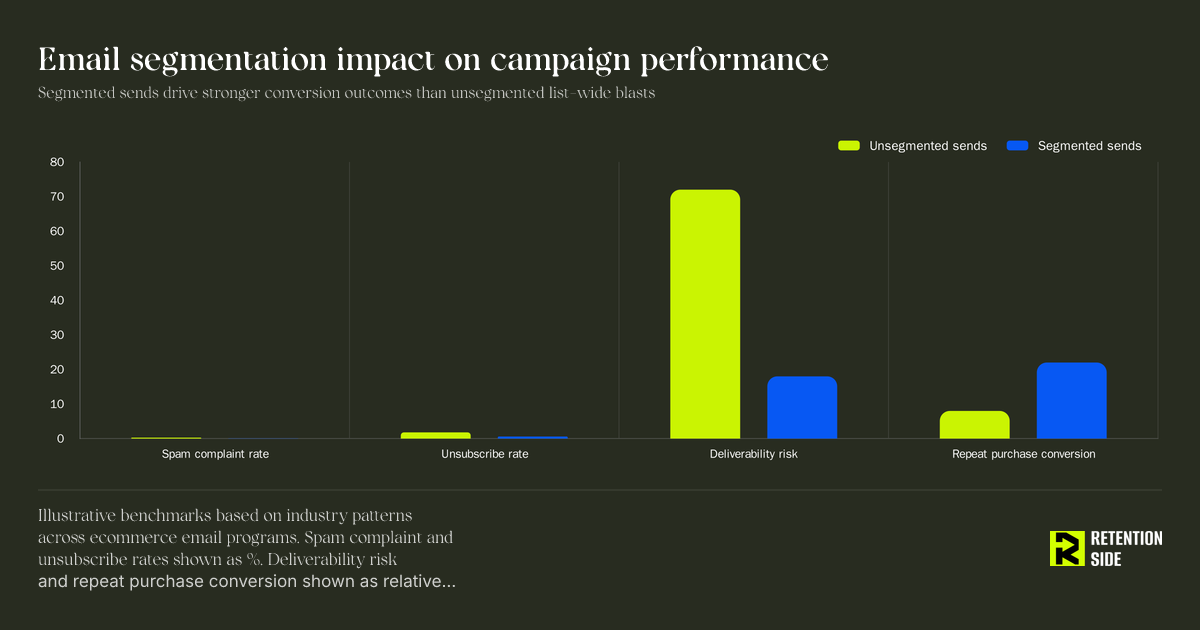
The single most important deliverability lever you have is who you send to. A campaign sent to your entire 80,000-person list – including 30,000 people who haven’t engaged in six months – is going to produce low engagement signals. Gmail and Yahoo interpret those signals as evidence that your email isn’t wanted. Sender reputation drops. Future emails route to spam or promotions at higher rates. Revenue from subsequent sends decreases.
Sending to an engaged subset of 40,000 people produces proportionally stronger signals. Higher engagement rates communicate to inbox providers that your email is desired. Reputation holds. Inbox placement stays strong.
This is why deliverability and segmentation are inseparable. Our email deliverability guide for ecommerce brands covers the most common mistakes brands make – including sending to unsegmented lists – and how to fix them. Every time you add an unsegmented blast to your sending pattern, you’re taking a deliverability risk that accumulates over time.
The practical rule at Retention Side: every campaign send should be to a segment, not a list. Even if that segment is “all engaged subscribers in the last 60 days,” that is better than an unfiltered full-list send.
Segmentation and list growth
List growth strategy determines the quality of the subscribers who enter your segments. If your list growth is driven primarily by broad, high-volume pop-ups offering a generic discount to every visitor, you’ll collect a lot of email addresses and a proportionally smaller number of people who actually intend to buy.
The lead-to-customer conversion rate of new subscribers is the real KPI for list growth – and that rate is determined partly by how well your segmentation captures and activates new subscribers quickly. A welcome series that branches based on zero-party data collected at signup (skin type, goal, product interest) converts new subscribers into customers at a meaningfully higher rate than a linear series sending the same five emails to everyone.
Segmentation at the list growth stage also means being thoughtful about which acquisition sources produce the best-quality subscribers. Traffic from a highly targeted paid social campaign for a specific product may produce better new-subscriber conversion rates than broad brand awareness traffic. That insight should inform where you invest most heavily in list-building.
Segmentation and flows
Flows are behavior-triggered automations that respond to what customers do. Every flow has implicit segmentation built into it – the trigger condition and flow filters define who enters the flow and when. But explicit segmentation logic within flows is what separates a generic flow from one that actually serves the customer’s position in the lifecycle. For a complete view of how to structure these automations, our guide to Klaviyo flows for ecommerce brands covers the full architecture and where each flow fits in the customer journey.
The most impactful flow segmentation decisions:
Post-purchase flow branching by purchase history. A first-time buyer entering the post-purchase sequence needs brand introduction, product education, and a deliberate path toward the second purchase. A returning customer placing their third order already knows the brand and doesn’t need the same onboarding content. Branching the post-purchase flow on purchase count is one of the highest-leverage segmentation decisions in the program.
Abandoned cart segmentation by cart value and customer history. A first-time visitor abandoning a $40 cart responds to different messaging than a loyal customer abandoning a $200 cart. High-value abandons from established customers may warrant a personal tone and a strong recovery offer. Low-value abandons from new visitors may need social proof and risk-reduction messaging more than a discount. Our full breakdown of abandoned cart email best practices covers how to structure this segmentation inside the flow.
Win-back timing based on actual repurchase data. Rather than firing a win-back flow at a fixed 90-day mark, segment by the expected repurchase window for that customer’s category or product type. A customer who bought a 30-day supplement supply and hasn’t reordered after 45 days is in a very different position than one who bought premium home goods and last ordered 60 days ago.
Welcome series branching by zero-party data. When a subscriber answers a preference question at signup – goal, skin type, intended use case – the welcome series can serve them content relevant to that declared interest from email 2 onward. The conversion lift from this kind of branching is consistently meaningful because the content feels personalized rather than broadcast.
Segmentation and campaigns
Campaigns are where segmentation is most visibly applied – and most often neglected. The default pattern at many brands is to send each campaign to the full engaged list (or worse, the full list), with occasional exceptions for major sale events.
A more precise approach: every campaign has a primary target segment defined before the content is written, not after. The segment definition shapes the content, the tone, and the call to action.
Some examples:
- A new product launch campaign could be sent first to VIP customers as an early-access send, then to the broader engaged buyer segment as a general announcement. The VIP version acknowledges their status. The general version doesn’t pretend everyone got early access.
- A promotional campaign offering 20% off should exclude customers who already received a discount through an active flow in the last 30 days. Stacked incentives teach customers to wait for offers before buying.
- An educational email about product usage can be sent broadly across the engaged list without the same deliverability sensitivity as a promotional send – because the goal is value, not conversion, and engagement tends to be higher.
Campaign segmentation also protects the relationship with specific segments over time. If your VIP customers keep receiving the same campaigns as everyone else, you’re not treating them like VIPs. If first-time buyers keep receiving loyalty-program content before they’ve had a reason to buy a second time, you’re creating a confusing experience that doesn’t reflect where they are in the relationship.
RFM segmentation: a framework worth using correctly
RFM stands for Recency, Frequency, Monetary value. It’s a framework for tiering your customer base by three behavioral dimensions simultaneously, and it produces a richer picture of customer quality than any single dimension alone. Shopify’s RFM analysis guide provides a useful foundation for how the scoring system works and how to apply it in practice.
- Recency – When did the customer last purchase? Recent buyers are more likely to respond to a campaign than those who haven’t bought in six months.
- Frequency – How many times has the customer purchased? Customers who buy repeatedly have demonstrated loyalty. First-time buyers haven’t yet.
- Monetary value – How much has the customer spent in total? High-value customers deserve different treatment than low-value ones.
By scoring customers on each dimension (typically on a scale of 1-5), you can categorize your entire customer base into segments that carry real strategic meaning:
- High R, High F, High M – your champions. These are your most engaged, most valuable, most loyal customers. They should receive VIP treatment, loyalty program invitations, and early access to new products.
- High R, Low F, Mid M – promising new customers. One or two purchases, recent. The priority here is the second or third purchase.
- Low R, High F, High M – at-risk former VIPs. These customers used to buy regularly and spend well, but they’ve gone quiet. A precisely targeted win-back with a personal tone and a meaningful offer is worth the investment here.
- Low R, Low F, Low M – lost or low-value customers. These require honest assessment about whether ongoing marketing investment is worthwhile.
RFM is most powerful as a strategic lens, not a rigid classification system. The goal is not to put every customer in a box – it’s to identify where the highest-value communication opportunities are and to prioritize investment accordingly.
In Klaviyo, building RFM-style segments involves combining conditions: “Placed order in last 60 days AND has placed at least 3 orders AND has total spend over $X.” You can get as precise as your data allows. For most ecommerce brands, three to five RFM tiers built dynamically in Klaviyo are sufficient to meaningfully differentiate campaign strategy.
Zero-party data and declared-intent segmentation
Zero-party data is information your subscribers have actively and explicitly shared with you – not behavioral inferences, but direct declarations. It’s the skin type they told you about on the signup form, the goal they shared in the welcome series questionnaire, the flavor preferences they indicated when they set up their subscription.
This data type is underused by most ecommerce brands, even though it offers something behavioral data alone can’t: intent without ambiguity. When someone browses three product pages in the skincare category, you can infer interest. When they tell you their skin type is combination and their primary concern is pigmentation, you know. The communication you build on top of that declared data can be specific in a way that inferred behavior-based segmentation often can’t.
The privacy context also matters here. As HubSpot’s analysis of zero-party data and email engagement notes, Apple’s Mail Privacy Protection and GDPR have accelerated the shift toward first- and zero-party data collection – making this approach not just more effective, but more future-proof than behavioral inference alone. According to Salesforce research cited in that piece, 71% of customers are more likely to share data with a brand if it clearly explains how the information will be used.
The most effective zero-party data collection happens at the signup form or in the first email of the welcome series – when the subscriber’s attention is highest and the ask carries the lowest friction. A single qualifying question embedded in the form flow (“What’s your primary goal?”, “Which category are you shopping for?”, “What brings you here today?”) creates a profile property in Klaviyo that becomes a segmentation anchor across every flow and campaign downstream.
The mechanism: when a subscriber answers that question, their response is stored as a custom property on their Klaviyo profile. Flow conditions and segment filters can then reference that property: “Skin type = combination” or “Primary goal = weight management” or “Shopping for = home decor.” Every email sequence that references that property is now segmented by declared intent rather than probabilistic inference.
The practical importance of building this architecture early: zero-party data segmentation is difficult to retrofit. If you’ve been running a program for two years with 50,000 subscriber profiles and no custom properties capturing preference data, you’re starting from scratch – because there’s no way to go back and ask all those subscribers what their preferences were when they signed up. For brands building or rebuilding, capturing zero-party data at the signup point and mapping it to Klaviyo profile properties from day one is a foundational decision that pays forward into every segmentation decision you make afterward.
Suggested send frequency by lifecycle segment
One of the most practical outputs of segmentation is knowing how often to email each group. There’s no universal right answer for email frequency – but the conversation changes dramatically when you stop thinking about frequency as a program-wide variable and start thinking about it as a segment-level variable.
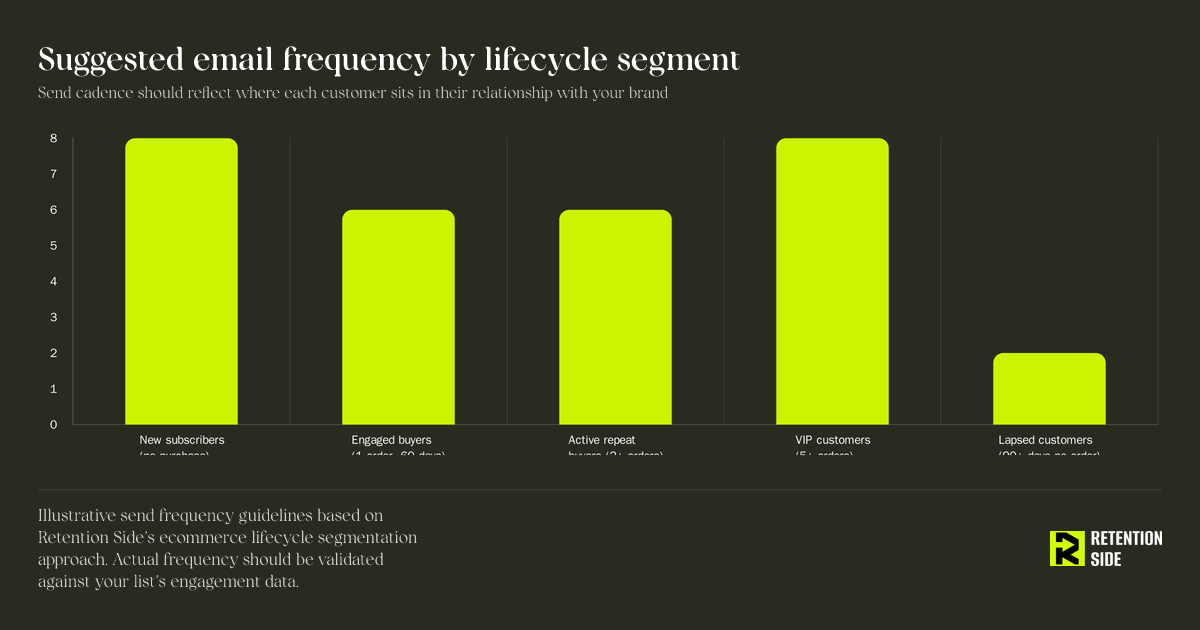
The chart above shows illustrative send frequency by lifecycle segment. A few principles worth holding:
- Active, highly engaged buyers can handle higher frequency because they’re demonstrably responsive and the relationship is strong. For this group, sending more often (within reason) is more likely to drive purchases than burn the relationship.
- New subscribers in a welcome sequence should receive concentrated communication early – the window where engagement is highest – followed by reduced frequency if they haven’t converted.
- Lapsed segments should receive low frequency. Multiple campaigns per week to someone who hasn’t opened in 90 days accelerates the deliverability damage from their non-engagement. Two emails per month with a clear re-engagement frame is usually the right approach.
- VIP customers benefit from a mix of higher-than-average frequency combined with qualitatively different content – exclusivity, early access, genuine recognition of their loyalty.
The key principle: frequency should always be calibrated to the segment’s engagement level and lifecycle position. A rigid “we send three campaigns per week” cadence applied uniformly across a 100,000-person list is a deliverability risk waiting to materialize.
What good segmentation actually looks like in Klaviyo
Knowing the right segments theoretically and building them in Klaviyo are different things. Here’s how a well-structured segmentation setup maps to the tool. Our Klaviyo setup guide for ecommerce brands covers the full account architecture – including how segments connect to flows, campaigns, and the deliverability layer.
Segment conditions use event-based logic, not just profile properties. The most powerful Klaviyo segments are built on behavioral events: “Has placed order,” “Has not placed order,” “Has clicked email in last 30 days,” “Predicted next order date is within 14 days.” These conditions reflect what the customer has actually done, and they update dynamically as behavior changes.
Segments are used as flow filters and campaign send lists. In flows, segment membership can gate who enters (everyone who is a current subscriber and hasn’t purchased in 30 days, for example). In campaigns, the send list is a saved segment that you build with intent before scheduling.
Suppression logic is as important as inclusion logic. A campaign segment isn’t just “who should receive this email.” It’s “who should receive this email AND hasn’t already received a similar message through a flow in the last 14 days AND is not in an active promotional flow right now.” The exclusion conditions prevent overlap, stacked discounts, and disjointed experiences.
Custom properties power the zero-party data layer. Every preference answer, survey response, and declared intent is stored as a custom property that Klaviyo can filter on. Profile properties like “skin_type = oily” or “goal = muscle_gain” become segment dimensions that you can cross with behavioral data (e.g., “Skin type = oily AND has placed order in last 60 days”) to produce laser-precise send lists.
Dynamic segments update in real time. Unlike static lists you export from Shopify and import manually, Klaviyo’s dynamic segments automatically update as customer behavior changes. A customer who makes their fifth purchase today automatically joins the VIP segment if you’ve built that segment correctly. A customer who hasn’t opened an email in 90 days drifts into the sunset candidate pool without anyone manually moving them. This is what makes behavioral segmentation scalable.
Common segmentation mistakes that cost brands real revenue
Treating “engaged” as a binary condition
Most brands segment by “opened in last X days” or “clicked in last X days.” That’s better than nothing, but it misses nuance. A subscriber who has opened five emails but never clicked is different from one who clicks regularly but hasn’t purchased. A customer who engages with every email but hasn’t bought in six months is a different problem than one who consistently buys but rarely opens.
Build engagement scoring that accounts for both depth (clicks, not just opens) and purchase behavior combined. An engaged subscriber who is also an active buyer is a different segment from an engaged subscriber who has never purchased.
Segmenting campaigns but ignoring flow suppression
Brands that carefully segment their campaign sends often leave flow suppression logic incomplete. The result: a customer in the middle of a post-purchase sequence also receives a promotional campaign that ignores everything the post-purchase emails established. The experience is disjointed. The customer feels like the brand isn’t paying attention – which, architecturally, it isn’t.
Every flow should have suppression logic preventing campaign sends to people who are in an active high-priority sequence. Every campaign should exclude profiles that are currently receiving flows with similar messaging or offers. A Klaviyo audit checklist is a practical starting point for identifying exactly where these gaps exist in an existing account.
Building segments once and not maintaining them
A segment built 12 months ago based on conditions that made sense then may not reflect the right population today. Catalog changes, audience mix changes, acquisition channel changes – all of these shift who is in your segments if the conditions aren’t reviewed. Segments should be audited periodically, just like flows. Not every week, but quarterly at minimum.
Using discounts to compensate for bad segmentation
When campaigns underperform, the instinctive response is often to add a discount and resend. But if the campaign underperformed because it went to the wrong segment – people for whom the message was irrelevant – adding a discount doesn’t fix the relevance problem. It just buys a few more conversions from price-sensitive subscribers while accelerating the conditioning that makes those subscribers harder to convert at full price over time.
The right diagnostic question is: did this campaign underperform because the message was wrong, or because the audience was wrong? Segmentation fixes the audience problem. Better creative fixes the message problem. Discounts don’t fix either.
Counting suppressed subscribers as a failure
Many brands avoid list hygiene and proper segmentation because removing people from send pools makes the list size look smaller. This is a vanity metric problem. A list of 60,000 with 40,000 active, engaged subscribers who regularly drive purchases is more valuable – and more deliverable – than a list of 90,000 with 60,000 dormant profiles dragging down every metric.
Segmentation that removes the wrong people from your active send pool is not shrinking your audience. It’s making your real audience cleaner, and that pays dividends on every subsequent send.
The metrics that tell you whether segmentation is working
Segmentation is not a metric in itself. Its impact shows up in the metrics that reflect whether your email program is driving business outcomes.
Returning customer rate – This is the clearest high-level signal. If segmentation is improving relevance, more customers should be coming back. A well-segmented program – with targeted campaigns, properly branched flows, and lifecycle communication that meets customers where they are – should produce a rising returning customer rate over time. Our guide on how to increase repeat purchases in ecommerce explains the system-level architecture that makes this number move.
Flow-specific conversion rates – Each core flow has a conversion metric that tells you whether it’s doing its job. Welcome series: first-purchase conversion rate. Abandoned cart: recovery rate. Post-purchase: second-purchase rate within 30-60 days. Cross-sell: uptake on recommended product. When these numbers improve after a segmentation or flow-branching change, you’re seeing segmentation’s direct impact on behavior.
Deliverability indicators – Inbox placement rate and spam complaint rate will improve when segmentation is applied properly to campaign sends. If your complaint rate is above 0.10% or your inbox placement is below 90%, send segmentation should be the first thing you examine. These numbers are monitored through Google Postmaster Tools and Klaviyo’s Deliverability Hub – not from within a campaign dashboard alone.
List growth rate with lead-to-customer conversion – More subscribers is only good news if those subscribers eventually buy. Segmenting new subscribers into proper welcome sequences and tracking their conversion rate to first purchase within 30 days gives you a real signal about list quality, not just volume.
Revenue attributed to retention channels – This is tracked at the program level, not the campaign level. What share of total store revenue is being driven by email and other owned channels over time? When segmentation improves campaign relevance and flow conversion, this number should reflect it.
What deliberately not to use as segmentation quality indicators: campaign open rate, click rate, or revenue per recipient. These metrics are visible, but none of them directly tell you whether your segmentation is building customer lifetime value. They’re at best diagnostic signals, at worst misleading ones.
Segmentation as the thread through the whole program
Segmentation doesn’t have a finish line. The brands that do it best aren’t the ones who built a perfect segmentation structure in Q1 and moved on. They’re the ones who treat segmentation as a continuous practice – adding new dimensions as new behavioral data accumulates, refining segment conditions as audience behavior shifts, testing whether new segment splits improve conversion at the flow or campaign level.
For brands building their program from scratch, start with the six core segments above. Get the behavioral infrastructure clean in Klaviyo – event tracking firing correctly, profile properties updating dynamically, flow filters using segment logic rather than just trigger conditions. Add zero-party data collection at the signup form and wire it to custom properties immediately, so the data starts populating from day one.
For brands with an existing program, the starting point is usually an audit. Which segments actually exist and which ones are theoretical? Which flows have branching logic and which fire to everyone uniformly? Where are suppression conditions missing? Our Klaviyo audit checklist maps exactly this – the gap between what the segmentation should be and what it actually is in the Klaviyo account tells you exactly where to invest next.
Either way, the direction is the same. Segmentation is what turns an email list into a retention system. Without it, you’re broadcasting. With it, you’re having a conversation – one that compounds over time as each subscriber’s data profile deepens, each flow branch narrows, and each campaign lands with more precision than the one before it.
That’s the email program that moves the returning customer rate. That’s the system Retention Side builds.
Conclusion
Ecommerce email segmentation is not a sophistication upgrade you add when you’re ready. It’s a structural requirement for a program that works at scale. Without it, deliverability is fragile, campaigns are noise for large portions of your list, and flows are doing blunt work in situations that require precision.
The good news is that the foundation doesn’t have to be complex. Six clearly defined lifecycle segments, behavioral conditions in Klaviyo that update in real time, suppression logic that prevents overlap, and zero-party data collected at signup – that’s the core. Everything else (deeper RFM tiering, product-affinity segmentation, channel-preference splits) builds on top of that foundation as the program matures.
The brands that get the highest returns from email don’t have the largest lists or the most creative campaigns. They have the most accurate picture of who is on their list at any given moment and what that specific person needs to hear next. Segmentation is what makes that picture possible. Everything else follows from it.