


Gear brands have a built-in trap. The year runs on a calendar of ski season, spring running, summer camping and Black Friday, so the email program slowly turns into a list of dates with a discount attached to each one. It works well enough until the list learns that nothing happens between promotions, and then engagement and full-price purchasing start to slip.
The case studies that circulate in this space rarely help with that problem. Most are highlight reels: a big percentage, a pull quote, and no baseline. So this article reads three published examples for something more useful than the headline number. We want to know what each brand actually changed, how the result was measured, and whether the mechanism can be rebuilt in a normal Klaviyo account.
One note before we start. These three cases are vendor-published and self-reported. They are not Retention Side client work, and we are not presenting them as ours.
What you’ll learn
- A five-step filter for reading any vendor-published case study.
- The mechanism behind Ruroc, SOAR Running and FLEXTAIL, rather than only their headline figures.
- Why the numbers cannot be averaged, ranked or benchmarked against each other.
- Which patterns transfer to a sports or outdoor program, and how they map to deliverability, list growth, flows and campaigns.
- A short audit you can run against your own account.
How we read a case study before we trust it
Our standard is simple. A case study is only useful if it tells you what changed, and compared with what. Without a before-state, a percentage is a mood. Without a mechanism, it is a story you cannot copy. And if you cannot rebuild the mechanism in your own stack, it is entertainment.
So each case below gets the same five questions: who published it and who benefits, what the baseline was, what mechanism actually changed, what the measurement window and attribution basis are, and what is rebuildable in your own Klaviyo account. Most of the time, the third question is where the value sits.
Publisher incentives matter more than people admit. Two of these cases come from Klaviyo and one from Omnisend, a competing ESP. All three companies have a commercial reason to publish a flattering customer story. That does not make the stories false, but it does mean the figures are best treated as claims and the tactics as the real content.
Ruroc: segmentation by product line and language
According to Klaviyo’s case study on Ruroc, the UK helmet and gear brand moved from Mailchimp to Klaviyo on Magento. Klaviyo reports that email-attributed revenue grew 80% year over year, that email drives 38% of total revenue, and that automated emails recorded click-through rates above 30%. The page gives no calendar dates, only “one year” and year-over-year framing, so none of this can be checked against a specific period.
The numbers are the weaker part of the story. The mechanism is the useful part.
- Product-line tagging. Each profile is tagged by what the customer is into, motorcycle or snow. A motorcycle rider and a snowboarder share a brand and almost nothing else, so a single broadcast is wrong for at least one of them most of the time.
- Language segmentation. Ruroc translates communications into eight languages and segments by language preference. That is a relevance decision, but it is also a list-health decision, because messages people can read get engaged with.
- Behavior-triggered journeys. Cart and browse abandonment flows respond to what a visitor actually did, instead of waiting for the next campaign date.

None of that depends on the season. A snow customer in July is still a snow customer, and the segment is ready when the brand has something worth saying.
There is a quieter lesson in the platform move. A migration changes more than the logo on the sending tool. In Retention Side’s own Hedonism Wines migration from Mailchimp to Klaviyo (a wine and spirits retailer, not a sports brand), structured warm-up and list hygiene restored inbox placement, and segmentation by product interest supported relevance and protected deliverability. We cite it only for the mechanism: a move works when sending reputation is managed deliberately, and a case study that skips that part is leaving out the hard bit.
SOAR Running: the event calendar as a retention engine
Klaviyo’s UK case study on SOAR Running describes a London-based performance running brand. Klaviyo reports 235x return on investment, 17% year-over-year growth in Klaviyo-attributed revenue, 65% of total ecommerce revenue attributed to Klaviyo, and a 32% repeat purchase rate that is up on the prior year. The page frames the period as the last 12 months without calendar dates.
Read the attribution carefully. “65% attributed to Klaviyo” depends on how the brand and platform credit orders, and “235x ROI” depends on what cost is in the denominator. Neither is a number to plan your own targets around.
The tactics are clearer than the metrics:
- Geo and event targeting. Runners near Boston during Boston Marathon week were invited to a pop-up store. London events were shown only to subscribers nearby. The calendar here is the running community’s calendar, not a retail one, and the audience is cut by place so the message is relevant to everyone who receives it.
- Earned discounting. Instead of blanket promotions, SOAR uses surveys, challenges and partner activations that deliver unique coupon codes through Klaviyo flows. The customer does something and then gets the code.
This is the clearest example of a point we make often: a promotional calendar should not become the whole strategy. When discounts are tied to a genuine reason and to an action the customer took, you collect data, build habit and avoid training the list to wait for the next sale. Earned rather than blanket discounting is a rule worth stealing even if your brand has no events at all.
FLEXTAIL: always-on automation as infrastructure
Omnisend’s customer story on FLEXTAIL covers an outdoor gear brand based in Shanghai and running on Shopify. State the context plainly: FLEXTAIL previously used Klaviyo and Mailchimp, and the story is published by Omnisend, which competes with Klaviyo. That does not disqualify the tactics, but it shapes which parts get emphasized.
Omnisend reports that the team estimates its automation strategy contributes around 8% of total website sales. That figure is the team’s own estimate, with no stated period. The welcome automation is the top workflow, with about $235K in attributed sales, 3,102 placed orders, $75.73 revenue per order and $0.52 revenue per message sent, described as measured over the last year. The brand also reports around 60% open rates across 150K+ subscribers, again without a stated period. Open rates are a weak signal at the best of times, so we would not build on that one.
The mechanism is where this case earns its place:
- Journey first. The workflows follow the customer journey: welcome, education, follow-up and winback.
- Stage-based segmentation. Subscribers are grouped by where they are in the relationship, not by when the next campaign goes out.
- Winback rules that reduce send pressure on cooled subscribers. Customers who have gone quiet receive less, not more, which protects engagement and sender reputation.
Notice what the story does not claim: that automation produces most of the revenue. An estimated 8% of sales from flows is modest, and it is a more believable picture than the big numbers elsewhere. Flows are infrastructure. They run quietly, and campaigns do the visible work on top of them.
What transfers to sports and outdoor programs
Set the three cases side by side and the overlap is not the results. It is the structure. Each brand stopped treating the calendar as the unit of planning and started treating the customer’s situation as the unit. Here is how the patterns map to the four pillars we use to build a retention system.
- Deliverability. Inbox placement is the foundation. Winback rules that reduce sends to cooled subscribers, and relevance from language and product-line segments, both protect sender reputation. Migrations need structured warm-up, as the Hedonism Wines work illustrates.
- List growth. Surveys, challenges and partner activations collect zero-party data while giving the customer a reason to engage. The aim is subscribers who buy, not subscriber volume.
- Flows. Welcome, education, cart and browse abandonment and winback are the behavioral engine. In gear categories, education between purchases matters because customers who know how to get full value from a product are more likely to come back.
- Campaigns. Event, community and geo-targeted sends are where a sports or outdoor calendar belongs. They work best when sent to a defined segment, with a reason that is real.
Winback needs a particular warning. Lead with value, introduce an incentive later, and make sure flow and campaign sends to the same lapsed segment share timing and suppression logic. Otherwise a lapsed customer gets three emails in a day from three different systems of thought.
Audit your own account against these patterns
Here is how to read a vendor case study honestly, and how to apply it to your own program.
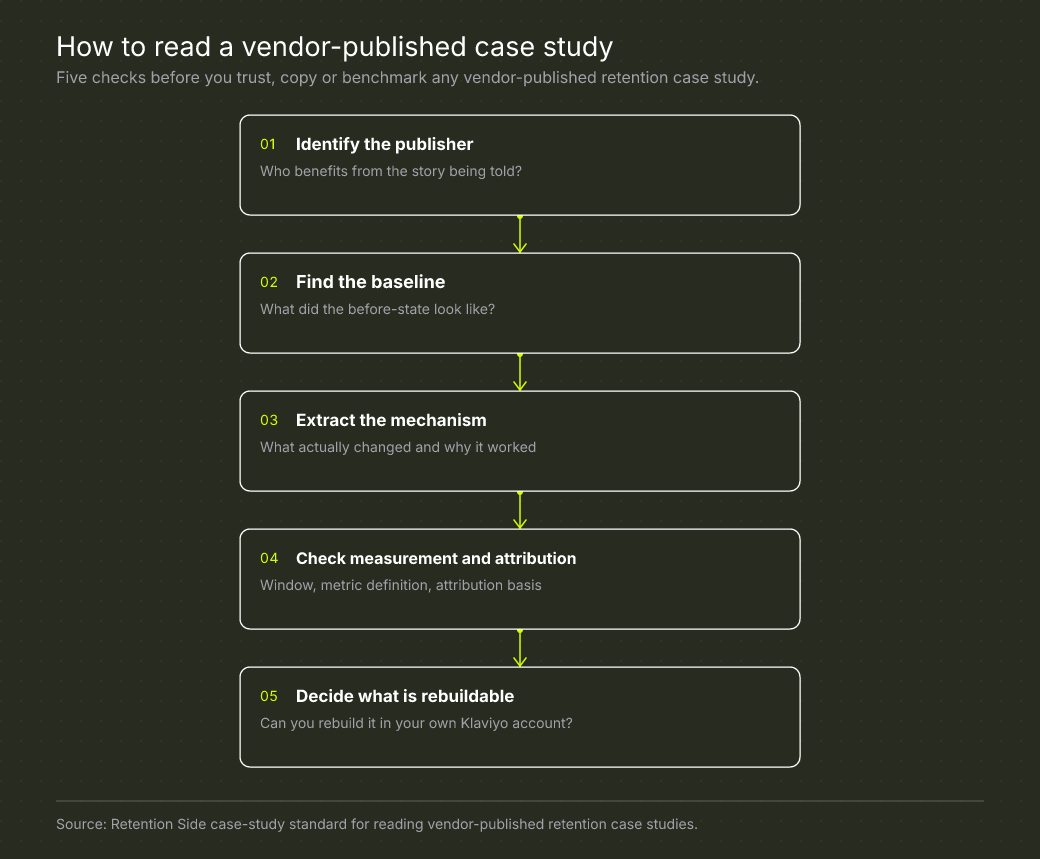
The sequence runs from publisher to rebuildability: identify the publisher, find the baseline, extract the mechanism, check the measurement window and attribution basis, then decide what is rebuildable in your own account.
Then run these checks in Klaviyo:
- Segments. Can you list your lifecycle segments by product interest, sport or activity, language and stage? If every send goes to “all subscribers,” you have a calendar, not a segmentation model.
- Flows. Do welcome, education, post-purchase, abandonment and winback all exist, and when were they last tested? Flows are never finished.
- Discounts. What share of your sends carry an offer? Could any be replaced by a challenge, survey or event that earns the code?
- Lapsed customers. Is there suppression logic between flows and campaigns for cooled subscribers?
- Attribution. Which figure do you trust, and what window does it use? Do not compare your numbers with another brand’s unless the definitions match.
Do not average the three cases above or rank them. Ruroc reports year-over-year revenue growth, SOAR reports a share of ecommerce revenue and a return multiple, and FLEXTAIL reports a flow-level dashboard and an internal estimate. They measure different things on different bases.
Build the system, not the calendar
The strongest takeaway from these cases is not a number. It is that sports and outdoor brands can build retention on customer context, such as the sport, the event, the stage and the language, and let seasonal moments sit on top of that foundation instead of replacing it.
If you want a second opinion on where your own program stands, Retention Side can audit your Klaviyo account across deliverability, list growth, flows and campaigns, and then extend the system into SMS, push, loyalty and other channels where they fit. Start with the audit above, and bring us what you find.