

Most collections of outdoor email marketing examples are really galleries. Big landscape photography, a clean hero, a bold button. Fun to scroll, but design is the least transferable part of an outdoor brand’s email program. Your product, your photography budget and your customer’s buying cycle are different.
What transfers is the structure underneath: how often a brand sends, what it sends between promotions, whether a welcome sequence exists, and how much of the calendar leans on discounts. You can see a surprising amount of that from the outside, if you read emails as the output of a system instead of as individual creative.
This article reads two outdoor brands that way, Patagonia and Cotopaxi, using public inbox captures. Then it turns what they show into a practical audit you can run on your own sends. One caveat up front: an outside observer sees what the brand chose to send, not revenue, list quality or test results. Treat everything here as a read, not proof of what works.
What you’ll learn
- How to read any brand’s email program through four lenses: deliverability, list growth, flows and campaigns
- What a captured Patagonia welcome series and send rhythm suggest about pacing
- What Cotopaxi’s cadence, timing and campaign mix suggest about promotional weight
- Which patterns are worth borrowing, and which are easy to copy badly
- How to map this to your own lifecycle architecture, including the add-on upsell framing that suits gear purchases
How to read an email program from the outside
At Retention Side we treat retention as a system, and we anchor email work to four pillars: deliverability, list growth, automation flows, and campaigns. Those same four pillars give you a usable lens for reading someone else’s program.
- Deliverability: What can you see? The sending platform and the domain authentication policy. You cannot see inbox placement, so be careful about conclusions.
- List growth: Is there a signup form, an incentive, a welcome reaction? How the list is acquired shapes everything downstream, and quality matters more than volume.
- Flows: Which emails are triggered by behavior (welcome, cart, order) versus scheduled by a person? Flow coverage is the part of a program that works while the team sleeps.
- Campaigns: How often, which days, which hours, and what mix of promotional and non-promotional content?
Keep one more rule in mind. We recommend judging a retention program on business outcomes such as returning customer rate, revenue from retention channels, deliverability health, list growth rate and flow-level conversion, not on open or click rate alone. From outside, you only get the behavior side of that picture. That is enough to generate questions for your own program, which is the useful part.
Patagonia: a slow welcome and a steady rhythm
Sequenzy signed up to Patagonia’s list and captured 12 emails between Sep 29, 2026 and Oct 13, 2026. One of them belonged to an automated sequence: a Patagonia welcome series of four emails over nine days. The first email, “Welcome to Patagonia”, arrived on day 4 after signup. The captured emails were mostly product launch, onboarding, seasonal and newsletter types.
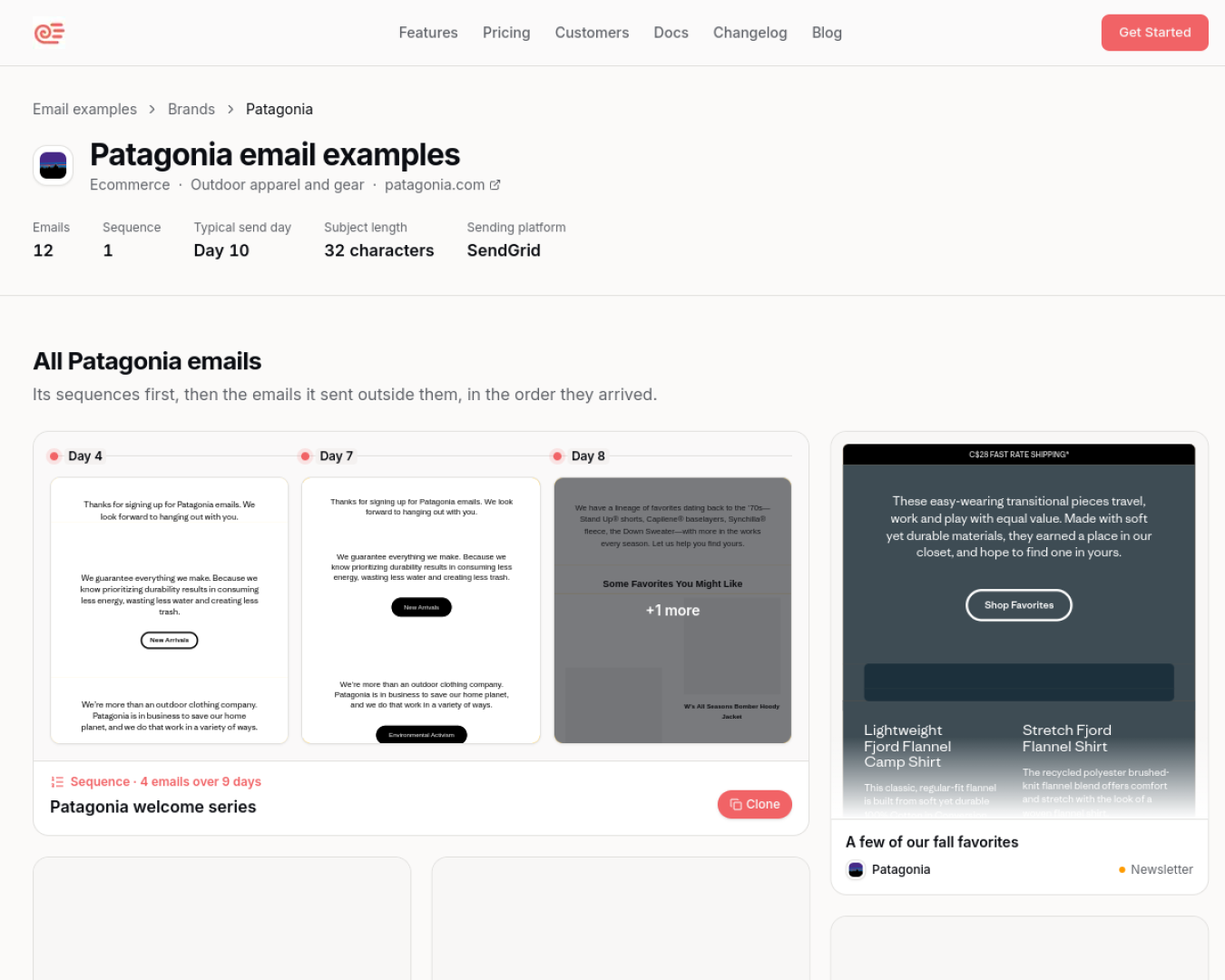
Source: Sequenzy’s Patagonia email examples page, which captured 12 emails between Sep 29 and Oct 13, 2026.
Three things stand out for a retention operator.
The welcome series is not instant. A four-day gap before the first welcome email is unusual enough to question. It could be a deliberate choice, a sign that the brand leans on the signup experience itself, or an artifact of a single test signup. One capture cannot tell you which. What it does give you is a test idea: if your welcome email goes out immediately, have you ever tested a delayed start or a longer spacing?
The send rhythm is regular. In the same capture window, Sequenzy reports roughly 5.5 emails a week, with Tuesday the busiest send day (33%) and sends typically around 3 PM UTC. A predictable slot is a deliverability and engagement habit as much as a scheduling one. Subscribers who learn when you show up are more likely to open consistently.
The subject line and layout habits are restrained. Median subject line length was 32 characters, none of the subject lines used emoji, and every email had preview text set. On layout, 67% used a product grid and 58% mentioned free shipping, while only 17% used a single call to action and 17% included video. Preview text set on every send is the quiet detail worth copying. It costs nothing and most programs leave it to chance.
The sending platform Sequenzy identified was SendGrid. That is simply a fact about this brand’s stack. The lesson is not the tool but the discipline: a sequence exists, a cadence exists, and the content types are mixed.
Cotopaxi: a lighter cadence and a promotion-led mix
Inbox Archive tracks Cotopaxi across 35 campaigns sent Jul 7 to Oct 13, 2026. Note that the archive classifies Cotopaxi under Fashion & Apparel, so its benchmarks compare it with that category, not with outdoor brands specifically.
Cadence and timing are very consistent. Cotopaxi sends about 2.5 campaigns a week, which Inbox Archive puts 31% below the typical Fashion & Apparel brand in its archive (a median of 39 brands, at 3.6 a week). Of 33 scheduled campaigns, 88% went out in the 11am US Eastern hour, with Tuesday (24%) and Thursday (27%) the busiest days. Welcome, cart and order emails are excluded from that timing analysis because subscriber actions trigger them.
Discounts show up in subject lines more than the archive norm. Inbox Archive reports that 20% of Cotopaxi’s campaign subject lines contain a discount, seven points above the typical Fashion & Apparel brand (13%). The median subject line is 32 characters, close to typical (30), and 29% carry an emoji. A caveat from the archive matters here: discounts are read from subject lines, so offers applied at checkout are missed.
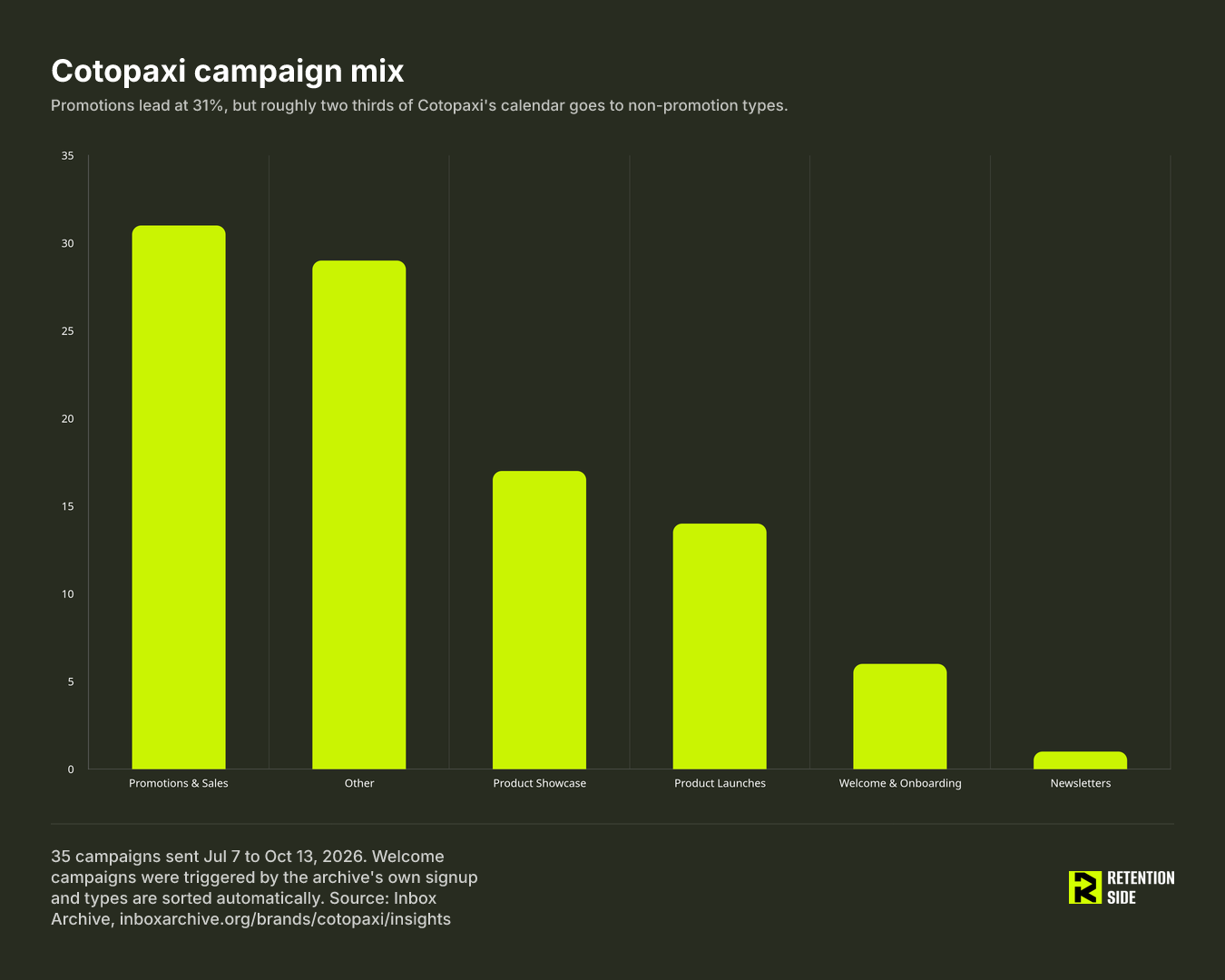
The campaign mix is led by promotions, but not dominated by them. Promotions & Sales is the most-sent type at 31% (11 campaigns). Other follows at 29% (10), then Product Showcase at 17% (6), Product Launches at 14% (5), Welcome & Onboarding at 6% (2) and Newsletters at 3% (1). No single type is a majority. The archive notes that the welcome campaigns were set off by its own signup, and that campaign types are sorted automatically, so treat the labels as approximate.
There are a few more details. The median campaign carries 18 images and 78 words, 53% fewer than the Fashion & Apparel archive median of 167. Cotopaxi sends with Bloomreach and publishes a DMARC “none” policy, which means failures are monitored but still delivered, so the policy is not enforced. That last point is a deliverability observation, not a verdict. It does show why authentication belongs in any audit, including your own.
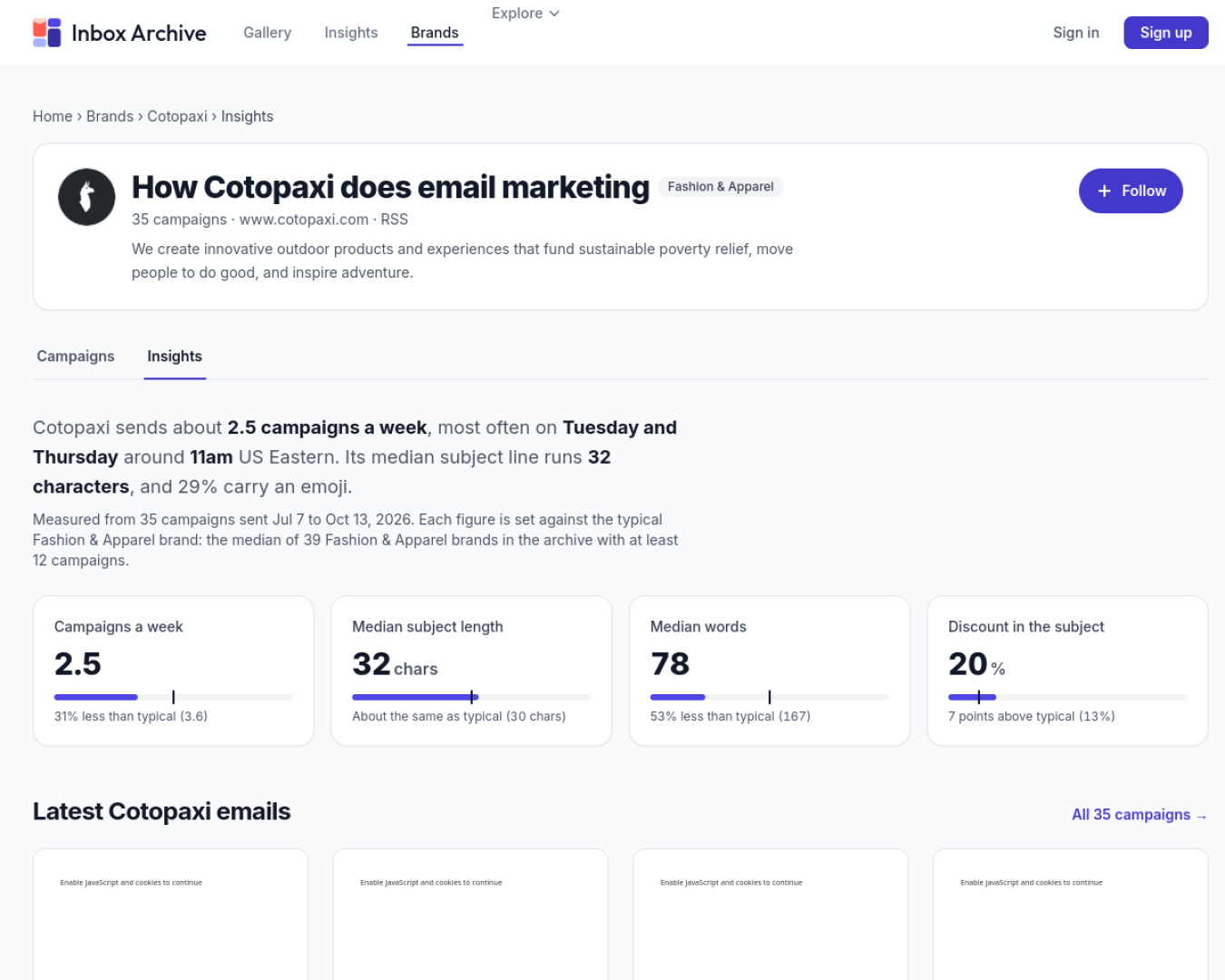
Source: Inbox Archive’s Cotopaxi insights page, based on 35 campaigns sent Jul 7 to Oct 13, 2026.
Here is the connection to retention strategy. A calendar built entirely on promotional discounts trains subscribers to wait for sales, lowers engagement outside sale windows, hurts deliverability and conditions your best customers to buy only at reduced margins. Cotopaxi’s mix is a useful reminder of the alternative: promotions are the biggest slice, yet roughly two thirds of the calendar goes to something else.
One warning about reading both brands together. Sequenzy and Inbox Archive use different capture windows, signup methods and classification rules, so Patagonia’s 5.5 emails a week and Cotopaxi’s 2.5 campaigns a week are not a clean head-to-head comparison. Read each on its own terms.
Patterns worth borrowing, and patterns to handle with care
Worth borrowing
- Predictable send slots. Both captures show a clear weekday and time habit. Pick slots you can defend with your own data and hold them long enough to learn from them.
- Non-promotional content between promotions. Launches, product showcases and newsletters appear in both programs alongside sales. That keeps full-price engagement alive. If subscribers only hear from you during discounts, engagement and full-price purchasing slide over time.
- Preview text on every send. A small default that adds up across hundreds of campaigns.
- A real welcome sequence. Even a slow one is a designed experience, not a single coupon email.
Handle with care
- Copying cadence. Two sends a week or five and a half is the outcome of each brand’s list, catalog and customer behavior. Benchmarks are a signal to investigate, not a directive to rebuild.
- Copying the discount subject line. A 20% discount share tells you nothing about margin impact or about how the offer was segmented.
- Copying short copy and heavy imagery. A 78-word, 18-image campaign works for a visual product with strong brand recognition. A technical product with fit, sizing or compatibility questions may need more words.
- Copying a delayed welcome. Test it, do not assume it.
How to apply this to your own program
Start with an audit, not a redesign. Pull your last 30 sends and score them on the four lenses.
- Deliverability: Is authentication in place and enforced? Are you sending to engaged subscribers? We diagnose underperformance in order: deliverability first, then list health and flow coverage, and only then creative and offer quality.
- List growth: Which form and incentive bring subscribers in, and do those subscribers become customers? Form submission rate is not the KPI. Lead-to-customer rate is.
- Flows: Which lifecycle moments have a flow, and which rely on a campaign to cover the gap?
- Campaigns: Count promotional versus educational or value-led sends. Check whether your sends are segmented or blasted to everyone.
Then check your lifecycle architecture against the full set. Our setup guide for Klaviyo covers a welcome series, abandoned cart, browse abandonment, a post-purchase sequence, cross-sell and upsell flows, a win-back flow and a sunset flow, plus segmented campaigns sent with purpose rather than just frequency. Most gaps show up in the post-purchase and win-back stages, which is where repeat purchases come from.
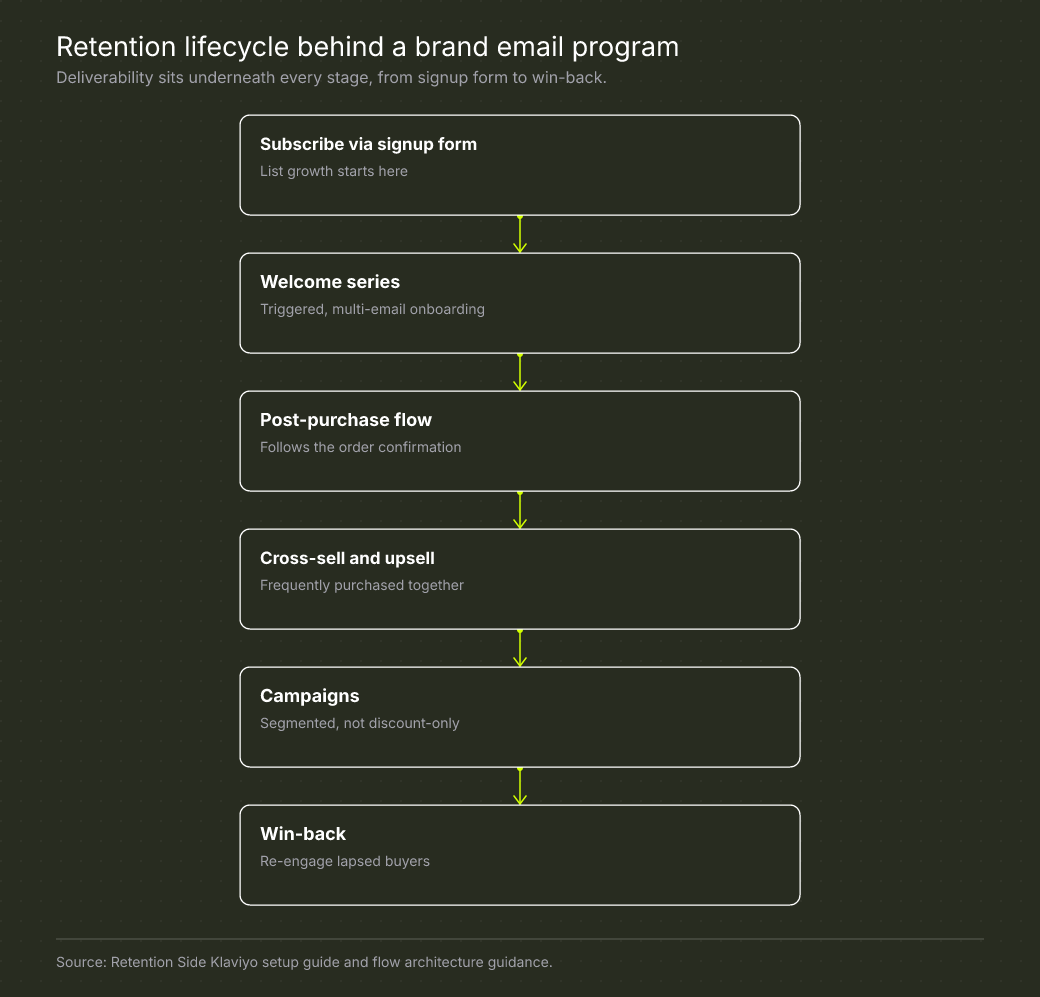
For post-purchase, the flow should follow the transactional order confirmation and open with a marketing email that has one job: make the customer feel good about their purchase. Add a conditional split between first-time and returning buyers, and coordinate SMS and push for time-sensitive nudges.
Gear brands have a natural advantage in the cross-sell layer. For outdoor and home-equipment purchases, an accessory or add-on email works well when it is framed as what most people wish they had ordered at the same time, backed by a genuine “most frequently purchased together” data point. The word genuine matters: made-up social proof damages trust faster than a missing upsell costs revenue. And treat upsell as one layer of the architecture, connected to welcome, post-purchase, win-back and campaigns, not a standalone tactic.
Email is the usual starting point, especially in Klaviyo. A mature system then extends into SMS, push notifications, direct mail, loyalty programs, WhatsApp and Viber, based on audience behavior and cost efficiency. That is the part no inbox capture can show you, and it is where most of the retention upside sits.
The takeaway
Patagonia and Cotopaxi teach the same thing from different angles: a good outdoor email program is a stack of well-built flows, a predictable campaign rhythm and a calendar that is not only discounts. The visuals are the part everyone sees. The system is the part that produces repeat purchases.
If you want more retention thinking built around real eCommerce operations, subscribe to Retention Side’s weekly newsletter. And if your own audit turns up gaps in flows, list quality or campaign balance, those are exactly the problems the system approach is built to untangle.