

Executive Summary: Supplement Retention Is a Trust Problem, Not a Formula Problem
Pick almost any hero ingredient in this category, magnesium, ashwagandha, collagen, creatine, and you’ll find dozens of brands selling something close to the same formula at wildly different prices.
Almost none of that price gap comes from the ingredients themselves.
Our research puts past-30-day dietary supplement use among US adults at 60.2 percent, the highest that measure has ever recorded, with usage climbing across nearly every age group. This is a genuinely durable category. Repeat purchase mechanics are strong, margins on core SKUs are healthy, and the subscription model fits the product almost perfectly.
None of that explains why one brand’s magnesium sells for three times another’s when the ingredient panel is nearly identical.
The honest answer is trust. Once the formula stops being a meaningful differentiator, credibility is the only thing standing between a brand a customer will pay a premium for and a bottle they’d swap out without a second thought.
That shows up in a strange way in the actual data. CRN’s own consumer research has found that 71 percent of supplement users describe themselves as loyal to their chosen brand.
In a category where the underlying formula is frequently interchangeable, that loyalty can’t really be loyalty to the ingredient list. It has to be loyalty to something else: the sourcing story, the third-party testing, the person who first recommended it, or the packaging and messaging that earned trust before the bottle was ever opened.
Retention Side spent this report looking at the supplements and nutrition category from that starting point: trust and commoditization, subscription economics, adherence behavior, loyalty, personalization, channel strategy, and the regulatory shift now reshaping how auto-ship programs are allowed to operate.
Here’s the core argument. In a category this commoditized, retention is won or lost on credibility before it’s ever won or lost on product performance.
That doesn’t mean formula and consumption stop mattering. They don’t: the gap between being subscribed and actually taking the product is real and expensive in its own right.
But trust is the thing sitting underneath both problems. It’s why a customer picks one brand over an identical, cheaper one in the first place, and it’s the reason they’ll forgive a missed week rather than cancel the moment they notice it.
Key Findings
| Finding | Strategic meaning |
|---|---|
| Trust, not the formula, is what customers are actually paying for | Because most formulas are nearly identical, credibility is the only thing stopping a customer from switching to a cheaper equivalent |
| Stated brand loyalty runs high even where the underlying product is commoditized | That loyalty attaches to sourcing, certification, and story, not to ingredients a competitor can copy |
| Being subscribed and actually consuming the product are two different things | Reorder rate alone hides customers who've quietly stopped using what they're paying for |
| Cancellation flow design is now both a customer-trust risk and a legal one | A hard-to-cancel subscription creates the exact resentment that shows up in chargebacks and complaints, and a shifting regulatory landscape adds real legal exposure on top |
| Subscription share of revenue depends heavily on business model, not just category | Subscription-native brands can responsibly run 60 to 80 percent of revenue through subscription; hybrid brands sit closer to 30 to 60 percent |
| Personalization quizzes drive conversion more reliably than they prove clinical outcomes | Brands should be honest with customers about what a quiz can and can't determine |
| GLP-1 medication use is creating a genuinely new, fast-growing customer segment | Still a minority of the market today, but growing quickly enough to plan around now |
| Third-party testing and certification increasingly shape how AI search tools describe a brand | Trust signals are becoming a discovery lever, not only a conversion lever |
| Format friction is an underrated churn driver | Pill count, swallowing difficulty, and timing complexity quietly push people out of a routine |
Supplements & Nutrition eCommerce in 2026
Supplements are no longer a niche wellness purchase. The US supplement industry crossed roughly 60 billion dollars in 2025, with online sales now accounting for close to 40 percent of that total, up from about a quarter just five years earlier. Nutrition Business Journal put the broader supplement market at 72.9 billion dollars in 2025, growing 5.5 percent year over year, with specialty supplements, gut health ingredients, and sports nutrition leading the gains.
Discovery has shifted just as much as the numbers have. A large and growing share of category growth is happening through TikTok Shop and influencer-led social commerce rather than search or display advertising. A customer today is about as likely to hear about a new magnesium brand from a fifteen-second video as from a Google search.
That shift matters because it has changed the competitive question. For years, the biggest challenge in this industry was getting noticed at all. Now the challenge is standing out once everyone already has.
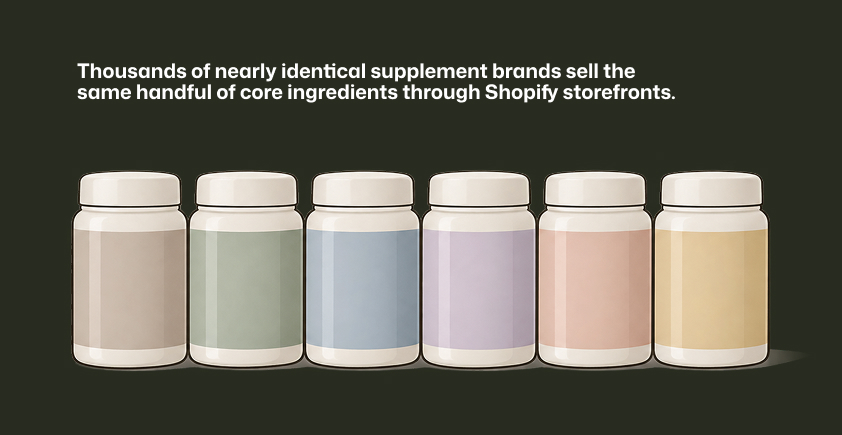
Thousands of nearly identical supplement brands sell the same handful of core ingredients through Shopify storefronts. Magnesium, vitamin D, collagen, ashwagandha, creatine, a greens powder. The formulations vary slightly. The claims almost never do.
Better sleep. More energy. Gut health. Immune support.
When every brand promises the same outcome, price becomes the only lever left, unless the brand has built something price can’t undercut: trust.
Why Price Becomes the Only Differentiator Left
This is the same commoditization problem from the executive summary, just visible at the level of an entire storefront. A customer comparing five nearly identical magnesium listings has almost nothing to go on except price, unless one of those five brands has given them a reason to trust it more than the others.
One emerging wrinkle worth watching, without overstating it: GLP-1 medications like semaglutide and tirzepatide have created a real, fast-growing customer segment with new nutritional needs around protein, fiber, and muscle preservation, since appetite suppression can mean under-eating on all three.
Gallup puts current GLP-1 use at 11 percent of US adults as of mid-2026, up from just 3 percent in 2024, a fast climb, but still a minority of the overall market for now.
The Supplement Aisle Is Not One Retention Problem
Not every supplement purchase behaves the same way. Lumping a prenatal vitamin and a pre-workout powder into the same retention logic, which happens constantly, is where a lot of otherwise smart strategy quietly falls apart.
A multivitamin is a daily habit. A prenatal vitamin is used for a defined, finite window. A pre-workout is tied to gym attendance, which rises and falls with motivation and season.
A joint supplement recommended by a physical therapist starts with a level of trust a cold DTC ad will never earn on its own. A collagen powder bought for its effect on skin and hair is judged on a visible cosmetic result rather than a felt internal one, which makes it behave more like a cosmetic purchase than a nutrition purchase. It gets a lighter treatment in the table below for that reason.
| Supplement category | Main retention driver | Main retention risk | Best retention angle |
|---|---|---|---|
| Daily foundational (multivitamins, greens powders) | Habit and simplicity | Silent non-adherence, not switching | Habit framing, one clear daily action |
| Protocol or cyclical (prenatal, sleep, joint support) | A defined use window with a clear reason to start | Customer graduates or gives up before results | Timeline education, honest expectation setting |
| Performance and sports nutrition | Community, results, training consistency | Motivation and training frequency drop | Community, stacking guidance, progress tracking |
| Condition-specific or practitioner recommended | Third-party trust already established | Price sensitivity once trust is assumed | Clinical-grade positioning, certification, provider channel |
| Appearance-focused ingestibles (collagen, biotin) | A visible cosmetic result the customer can check for themselves | Judged on appearance, not felt effect, so patience runs out faster | Set a visible-result timeline and pair with progress photos or check-ins |
This isn’t a small distinction. A brand selling a prenatal vitamin should expect and plan for graduation, a customer who stops buying not because they churned, but because their pregnancy ended.
A brand selling a daily multivitamin should expect almost the opposite problem: a customer who never has an obvious reason to stop, and therefore just quietly does.
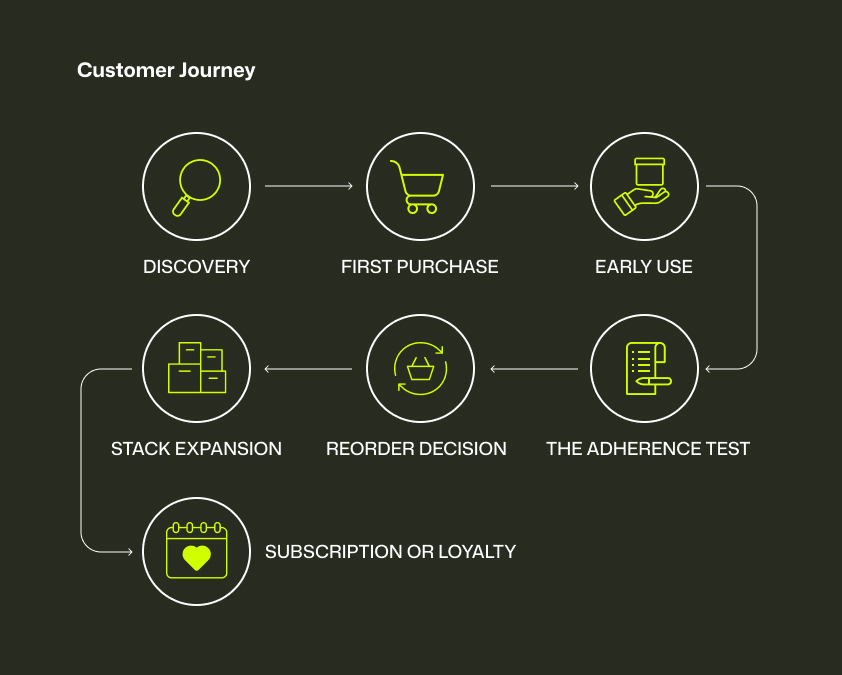
The Supplement Customer Journey
Supplement customers are quietly asking one hard question through most of their time with a product: how would I even know if this is working?
That question shapes almost everything downstream of it. A supplement customer is often optimizing for something invisible, like inflammation, energy, or long-term bone density. There’s rarely a mirror to check. The timeline is usually months, not days.
| Stage | Customer mindset | Brand goal | Retention opportunity |
|---|---|---|---|
| Discovery | "Could this actually help me?" | Establish credibility fast | Third-party testing, transparent sourcing, specific claims |
| First purchase | "I'll try it and see" | Reduce first-order risk | Money-back guarantee, clear dosing guidance |
| Early use | "How will I know this is working?" | Set an honest timeline | Explain what to expect, when, and what won't be visible |
| The adherence test | "Did I actually take this today?" | Make the habit easier than forgetting | Simple format, clear cue, low daily friction |
| Reorder decision | "Am I actually still taking this?" | Confirm real usage, not just inventory | Check-ins tied to likely consumption, not just delivery |
| Stack expansion | "What else should I be taking?" | Grow the routine responsibly | Honest cross-sell tied to stated goals |
| Subscription or loyalty | "Do I trust this enough to commit?" | Convert proven usage into commitment | Flexible terms, transparent cancellation |
The fork in the road is the adherence test. Most stages in most customer journeys come with a built-in reminder of some kind. This one doesn’t.
Nobody forgets they own a toothbrush, because the bathroom sink puts it in front of them twice a day. A supplement bottle doesn’t get that same daily cue. People genuinely forget they’re supposed to be taking it, and an unopened capsule doesn’t remind anyone of anything.
Supplements & Nutrition Retention Benchmarks
We built these ranges by stacking subscription platform data, DTC financial benchmarks, and category-specific research against each other, then presenting the result as our own working numbers rather than any single source’s raw figures. We lean on ranges like these constantly in our work with subscription-first health and wellness clients.
One caution matters here: a sports nutrition brand and a condition-specific supplement brand run on completely different purchase cadences. Comparing them side by side against the same number would be misleading.
Recharge’s subscription commerce data, along with several 2026 DTC benchmark analyses, consistently puts monthly subscription churn for supplements in the 5 to 8 percent range, noticeably lower than beauty boxes or meal kits, which commonly run 8 to 15 percent. Supplements also post a repurchase rate around 37.7 percent, reportedly the strongest of any consumer category tracked in recent DTC brand statistics.
| Metric | Average supplement brand | Strong supplement brand | Strategic meaning |
|---|---|---|---|
| Monthly subscription churn | 7% to 10% | Below 5% | Shows whether the subscription itself is holding |
| Overall repurchase rate | 25% to 35% | 37%+ | Shows whether customers are actually reordering, not just subscribed |
| 12-month subscriber LTV | $250 to $400 | $500 to $600+ | Shows real long-term value, not just first-order economics |
| Subscription share of revenue (hybrid brand) | 30% to 50% | 55% to 60% | Realistic target if subscription is one option among others |
| Subscription share of revenue (subscription-native brand) | 60% to 70% | 75% to 80% | Realistic only when subscription is the default purchase path, like AG1 or Ritual |
| Customer acquisition cost | $60 to $90 | $45 to $60 | Reflects the ad compliance premium this category pays |
| Conversion rate | 1.5% to 3% | 5%+ | Health and wellness categories often convert above general Shopify averages |
| First 90-day subscriber churn | 20% to 30% | Below 15% | Most subscription failure in this category happens early |
These numbers describe whether a customer keeps ordering. They don’t yet tell you whether that customer is actually still taking what they ordered, a real, expensive gap on its own, separate from the trust and commoditization problem driving so much of this category.
The Adherence Gap: Why Subscribed Doesn't Mean Retained
Even people who buy into this category enthusiastically don’t consistently follow through on it. Our research found that over 70 percent of supplement users take more than one product daily, real, active stacking behavior, yet only about two-thirds of them are highly adherent to even a single one of those products.
A missed dose doesn’t announce itself the way an empty gas tank does. A customer can miss three days, then a week, then simply stop, while the subscription keeps shipping to a shelf that already has product on it. The cancellation, when it eventually comes, is usually just the customer noticing what already happened weeks earlier.
That makes reorder rate and subscription churn incomplete on their own. But detecting the problem after the fact isn’t the only option, and it isn’t even the best one.
The more useful move is designing against the drop-off before it happens, rather than trying to spot it afterward. A simple one-tap check-in beats a full survey here: not “why did you stop,” which people rarely answer accurately anyway, but a plain “still on track this week, yes or no,” sent at the point in the cycle where drop-off is most likely.
It takes five seconds to answer and gives a real signal a monthly survey never could, since nobody has to sit down and reflect on their own habits just to tap one button.
Packaging and cueing help even more than tracking does. Tying the habit to something the customer already does daily, keeping the bottle next to a toothbrush, taking it with the same cup of coffee every morning, prevents the lapse in the first place instead of trying to catch it afterward.
A simple insert with the first bottle that asks the customer to pick their own daily cue is a cheap, one-time cost with a real shot at reducing the drop-off.
None of this fully solves the problem. But it moves a brand from guessing after the fact to actually doing something about it before the fact, and that’s the only version of this worth building.
Why Supplement Customers Actually Stop Buying
The quiet, invisible kind of drift is one problem. This is the more visible checklist: specific, addressable reasons a customer actively decides to stop buying.
| Churn driver | What happens | How to reduce it |
|---|---|---|
| Subscription fatigue | Customer feels weary of an ongoing commitment, separate from any dissatisfaction with the product itself | Offer flexible frequency, easy skipping, and pause options, which one industry analysis found cuts fatigue-driven churn by roughly 20 to 25 percent |
| No felt result | Customer can't tell if the product is working and loses conviction | Set an honest timeline upfront, and explain what changes are and aren't visible |
| Tolerability or side effects | GI discomfort, jitters, or an unwanted reaction discourages continued use | Recommend the better-absorbed or gentler formulation upfront when relevant |
| Pill fatigue and format friction | Too many capsules, difficulty swallowing, or a complicated multi-bottle routine | Offer simpler formats, food-first options, or fewer daily steps |
| Cancellation friction backlash | A hard-to-cancel subscription creates resentment even before the customer leaves | Build a cancellation flow that's genuinely easy, not just legally compliant |
| Stack doesn't fit real life | Customer bought based on a goal that changed, or a routine that was never realistic | Set expectations at signup about what a sustainable routine actually looks like |
Most of these are fixable with earlier information, not more discounting. A customer whose stomach is upset, or who never opens a check-in email, is telling the brand something useful well before they ever hit cancel.
Commoditization and the Subscription Trust Problem
The Click-to-Cancel Problem
This is where subscription design stops being a UX decision and becomes a compliance one. The FTC’s 2024 “click-to-cancel” rule was vacated by a federal appeals court in 2025 on procedural grounds, but the agency opened a new rulemaking process in March 2026 to try to revive it. In the meantime, roughly 30 states have already passed their own automatic-renewal laws, some of which go further than what the FTC originally proposed.
For a category built almost entirely on auto-ship, this isn’t background noise. Recent FTC enforcement actions against other subscription businesses have targeted cancellation flows requiring dozens of steps and multiple screens just to cancel.
A supplement brand that builds a cancellation flow like that isn’t just exposing itself to regulatory risk. It’s actively manufacturing the exact kind of resentment that shows up in chargebacks, one-star reviews, and public complaints, which is the opposite of retention.
The brands handling this best treat an easy cancellation as a trust signal, not a leak to plug. Ritual and Seed, for example, both let customers cancel entirely within their own account dashboard, with no phone call or email required.
That’s a stronger position, not a softer one. It’s retention that survives contact with a genuinely dissatisfied customer instead of trapping them into becoming a hostile one.
Retention Systems Supplement Brands Need in 2026
Supplement brands need systems that connect quiz data, product usage, and replenishment timing, built around one central question: is the customer still actually consuming what they’re paying for.
| System | Purpose | Why it matters in supplements |
|---|---|---|
| Consumption signal tracking | Estimate actual usage, not just delivery | Replenishment and reorder timing mean little if the last bottle was never finished |
| Cancel-save flow built for trust | Make cancellation easy while offering a genuine alternative | A forced-friction flow creates resentment and regulatory exposure at the same time |
| Honest personalization system | Route customers to the right product without overclaiming | Protects trust when a quiz-based recommendation doesn't fully hold up |
| Stack and cross-sell logic | Recommend additional products based on stated goals | Encourages a bigger, more considered routine instead of a single-SKU relationship |
| Certification and trust system | Surface third-party testing and sourcing information proactively | Trust is what actually differentiates otherwise identical formulas, and increasingly a factor in AI search visibility |
| Adherence check-in system | Reach out based on likely usage timing, not just delivery schedule | Catches silent drop-off before the subscription becomes the only remaining signal |
| Voluntary vs. involuntary churn separation | Distinguish a failed payment from a genuine cancellation before reporting on either | Blending the two into one churn number hides which problem actually needs fixing |
| Graduation and pause handling | Recognize when a customer's need has ended rather than treating every lapse as a loss | A prenatal customer whose pregnancy ended isn't a winback target, and treating her like one wastes effort and goodwill |
We’ve helped build versions of this exact connected system for more than one client in this category, and none of it requires an entirely new tech stack. Most of it runs through the same tools already doing the work for other consumable categories: an ESP like Klaviyo for education and check-ins, and a subscription platform handling the cancel-save and pause logic along with certification and trust messaging inside the customer’s own account portal.
None of this hinges on new software. It hinges on what the brand actually chooses to measure and act on.
Retention Marketing Channels for Supplement Brands
Email Marketing
Email in this category should do more work than most brands ask of it, and this is the one channel where generic advice hurts the most, since a welcome series plus a couple of abandoned-cart emails is not a retention system.
The welcome series needs a different job than usual. Instead of just introducing the brand, its later emails should set the result timeline directly, something like a week-one email that plainly says not to expect anything yet, followed by a separate email timed to when effects should first become plausible for that specific product, not a generic day-14 send reused across the whole catalog.
A magnesium brand’s honest timeline is days. A joint-support brand’s honest timeline is months. Using the same welcome series for both means one customer feels misled and the other gives up too early.
The post-purchase flow should be segmented by product type rather than treated as one flow for the whole catalog. A daily foundational customer needs a habit-formation nudge around day 7 to 10, when a new routine is most likely to break.
A protocol or cyclical customer, prenatal or sleep support, needs a check-in timed to when their result window actually lands, not a fixed day-30 send that arrives too early to mean anything to them.
Winback deserves its own rebuild too. The instinct is to lead with a discount. A stronger version leads with a diagnostic question first, closer to asking whether it was the results, the routine, or the price, since a customer who left over side effects or simple forgetfulness won’t be won back by a lower price, and offering one anyway just trains the whole list to wait for a discount before reordering.
Klaviyo’s 2026 benchmark data across more than 183,000 brands shows automated flows generating a disproportionate share of total revenue relative to how little send volume they represent. In this category specifically, that gap is usually a sign that a brand is still sending mostly launches and promotions, instead of running email as the education and trust-building system it should be here.
SMS Marketing
SMS earns its place here through timing, not volume. A plain restock alert is easy to justify. An adherence nudge is trickier territory and needs real care, since nobody wants a text that reads like a scolding parent.
A well-timed, low-pressure check-in, tied to when a customer likely finished a bottle rather than when the next one is scheduled to ship, can catch a lapsing customer before they’ve fully drifted away.
Loyalty Program
Points-for-purchase loyalty programs undersell what’s possible here. Some supplement brands have paired loyalty rewards directly with subscription tenure and quiz completion, and reported meaningful increases in subscription length as a result.
Education-based rewards, like early access to lab results or new research on an ingredient, tend to outperform generic discounts, because they reinforce the reason the customer started taking the product in the first place. Referral programs also do disproportionately well in performance and sports nutrition specifically, where recommendations move through gyms and training groups, not just social feeds.
Subscription
The best subscription programs in this category share a few traits: flexible pausing instead of forced cancellation, annual billing options that meaningfully reduce nominal monthly churn, and a strong first shipment that does more than deliver the product.
AG1, for example, ships a welcome kit with the scoop, shaker, and accessories needed to actually start the routine, which builds a small but real switching cost from the very first order. Ritual took the opposite but equally coherent approach, skipping the personalization quiz entirely and building trust through ingredient transparency instead. Both work.
What doesn’t work is subscription pressure applied before the customer has any reason yet to trust the product.
Quiz and Personalization
Quizzes drive real conversion lift in this category. Whether they drive real personalization is a separate, more honest question worth asking.
A quiz that gathers lifestyle and goal information without any biomarker or blood data can meaningfully improve product fit, but it isn’t the same thing as the clinical-grade personalization some brands imply in their marketing. The brands most likely to protect long-term trust are the ones that are plain about that distinction rather than overselling what a ten-question quiz can actually determine.
Reviews, UGC & Third-Party Testing
Trust is the real currency in this category, more than in almost any other consumer vertical. Third-party certifications like NSF Certified for Sport do more than reassure a skeptical customer at the point of purchase. They’re also increasingly a factor in whether AI search tools mention a brand by name at all when someone asks a supplement-related question, which makes certification a discovery lever now, not only a trust one.
Sampling also converts unusually well here. A well-targeted sample of a complementary product, included in an existing subscription, reportedly converts to a full purchase in the 20 to 25 percent range, turning an existing customer into a stacked, higher-LTV one at close to zero acquisition cost.
Profitability Analysis: Why Adherence Protects Supplement Margins
Health and wellness advertisers on Meta and Google operate under real restrictions on the claims they’re allowed to make. Platforms auto-reject a meaningful share of health-related ad creative before it ever runs.
That compliance friction shows up directly in cost per acquisition. Recent benchmark data puts the median cost per purchase for vitamins and supplements noticeably higher than general DTC categories, a structural tax most other consumer categories simply don’t pay.
That makes the retention side of the ledger even more important. Subscription customers in this category have been reported to convert and repeat at dramatically higher rates than one-time buyers, with LTV multiples several times higher. That’s exactly why the gap between subscribing and actually consuming matters financially, not just conceptually.
A subscriber who’s quietly stopped consuming the product is still costing the brand fulfillment and payment processing. They’re still occupying a seat in the subscriber base that inflates apparent health, and still likely to churn eventually anyway, just later and messier than if the brand had caught it early.
| Profit lever | Weak version | Stronger version |
|---|---|---|
| CAC | Absorbed entirely by first-order margin | Recovered across a subscription lifetime long enough to justify the compliance premium |
| Subscription churn | Measured only at cancellation | Measured against estimated consumption, catching drop-off earlier |
| Discounting | Used to win back any lapsed customer | Reserved for customers whose lapse has an identifiable, fixable cause |
| Loyalty | Rewards spend alone | Rewards subscription tenure and real engagement, not just checkout activity |
| Ad spend | Optimized purely for front-end conversion | Weighed against the compliance premium and true subscriber lifetime value |
The category’s economics reward brands that measure real usage. They quietly punish brands that only measure billing.
Supplements & Nutrition Predictions for 2026 and Beyond
1. GLP-1 companion nutrition becomes a mainstream acquisition channel
This won’t stay a niche positioning angle much longer. Expect protein, fiber, electrolyte, and muscle-preservation products built explicitly around GLP-1 use to become one of the fastest-growing acquisition channels in the category, not a side note on an existing product page.
Worth building in from the start: real-world discontinuation among GLP-1 users is reportedly high, with one 2025 study putting it at roughly 65 percent within a year for non-diabetic users. This segment needs its own retention plan, not just an acquisition funnel.
2. AI search visibility becomes a real discovery battleground
One 2026 analysis found that AI engines name no specific brand at all in response to roughly two-thirds of certain supplement-related queries, and that third-party testing certification correlates with meaningfully higher odds of being named when a brand is mentioned. Expect certification and transparent sourcing to start functioning as a discovery lever, not only a trust one.
3. Regulation pushes brands toward genuine retention, not friction-based retention
As the click-to-cancel landscape solidifies at the state level even without a finalized federal rule, brands still relying on hard-to-cancel subscriptions will find that approach increasingly expensive, both legally and reputationally.
4. Consumption-signal tracking becomes real software, not a nice-to-have
5. Format innovation becomes a retention lever, not just a preference trend
6. Personalization splits into two visible tiers
7. Third-party certification becomes a growth lever, not just a trust badge
8. Practitioner and B2B2C channels grow as a trust shortcut
Strategic Recommendations for Supplement Founders
1. Measure consumption, not just reorder rate
Reorder rate and subscription churn tell you what happened at checkout. They don’t tell you whether the product in the customer’s cabinet actually got used. Build a way to estimate the second number, even roughly.
2. Build cancel-save flows for trust, not friction
3. Separate voluntary churn from involuntary churn
A failed card and a genuine cancellation are different problems with different fixes. Blending them into one churn number hides which one actually needs attention.
4. Be honest about what your quiz can and can't prove
5. Pursue third-party certification for more than the trust badge
6. Design for the GLP-1 companion customer now
7. Use annual billing as a genuine retention lever
8. Let SMS support adherence without becoming a nag
FAQ
What is a good churn rate for a supplement subscription business?
Why do supplement customers stay loyal to a brand when the formula is often identical to a competitor's?
Because the loyalty usually isn’t really about the formula. In a commoditized category, customers attach their loyalty to sourcing transparency, third-party certification, and whoever or whatever first earned their trust, things a competitor can’t copy just by matching the ingredient list.
How can supplement brands improve customer retention and adherence?
Are personalization quizzes worth it for supplement brands?
What retention benchmarks should vitamin and supplement brands track?
How is the FTC's click-to-cancel rule affecting supplement subscriptions in 2026?
Do AI tools like ChatGPT and Google AI Overviews recommend supplement brands, and can that be influenced?
Increasingly, yes, and third-party testing certification appears to meaningfully improve the odds of being named. Brands investing in transparent sourcing and recognized certifications are more likely to show up when someone asks an AI tool for a recommendation.
Should every supplement product be sold on subscription?
No. Subscription works best for products with a clear, predictable consumption cycle, like a daily multivitamin. It fits less naturally with products used for a defined window, like a prenatal vitamin, where the honest expectation is that the customer will eventually stop for a good reason.
How can supplement brands increase LTV without discounting?
Focus on adherence and stack expansion instead. A customer who’s actually using the product and trusts the brand is a much better candidate for a second or third product than a discount is for a customer who’s already drifting away.