


Gear buying follows the sport, the activity and the season. A trail runner, a climber and a weekend angler can land on your store through the same ad, sign up with the same popup and still need completely different emails afterward. Generic eCommerce plays, like the same welcome discount and the same holiday sale calendar for everyone, read that behavior badly.
This guide covers how to build email marketing for sports and outdoor brands as a segmented, education-led system on Klaviyo. It is written for operators who already understand flows and campaigns and want to know how to adapt them to how gear customers actually buy.
Key takeaways
- Fix deliverability and list quality first. Segmentation and seasonal creative do nothing if emails do not reach the inbox.
- Ask one question at signup about sport or activity, store it as a profile property, and let it drive your welcome series and campaigns.
- Use gear education (fit, sizing, compatibility, care, maintenance) to balance promotions and give customers a reason to come back.
- Build the seasonal calendar around reasons the customer would recognize, not around discount dates.
- Judge the program on repeat customer rate, lead-to-customer rate and deliverability health, not open rate.
Start with the foundation, not the season
Seasonal creative is the fun part, so brands tend to start there. The order should be the reverse. Retention Side’s framework for an email program runs through deliverability, list growth, automated flows and campaigns, and deliverability is the prerequisite for the rest. The Klaviyo setup guide walks through that full structure.
In practice that means proper sender authentication, a clean list, and a willingness to stop mailing people who no longer engage. Retention Side’s benchmarks article states that the Gmail and Yahoo thresholds are now hard requirements rather than best practices, and that missing authentication and sending to unengaged lists are active liabilities. That is a first-party view, but it matches how most operators experience the problem. Sports and outdoor brands often feel it after a big seasonal push, when a large batch of low-intent signups gets mailed hard and inbox placement slips.
One related point on measurement. The same article explains that since Apple Mail Privacy Protection launched in late 2021, inbox providers preload tracking pixels through proxy servers, so an email can count as opened before the subscriber looks at it. Its conclusion is that open rate is not a performance benchmark. A consistently and unexpectedly low open rate is still worth noticing, but as a deliverability red flag rather than a verdict on your creative.
Activity-based segmentation
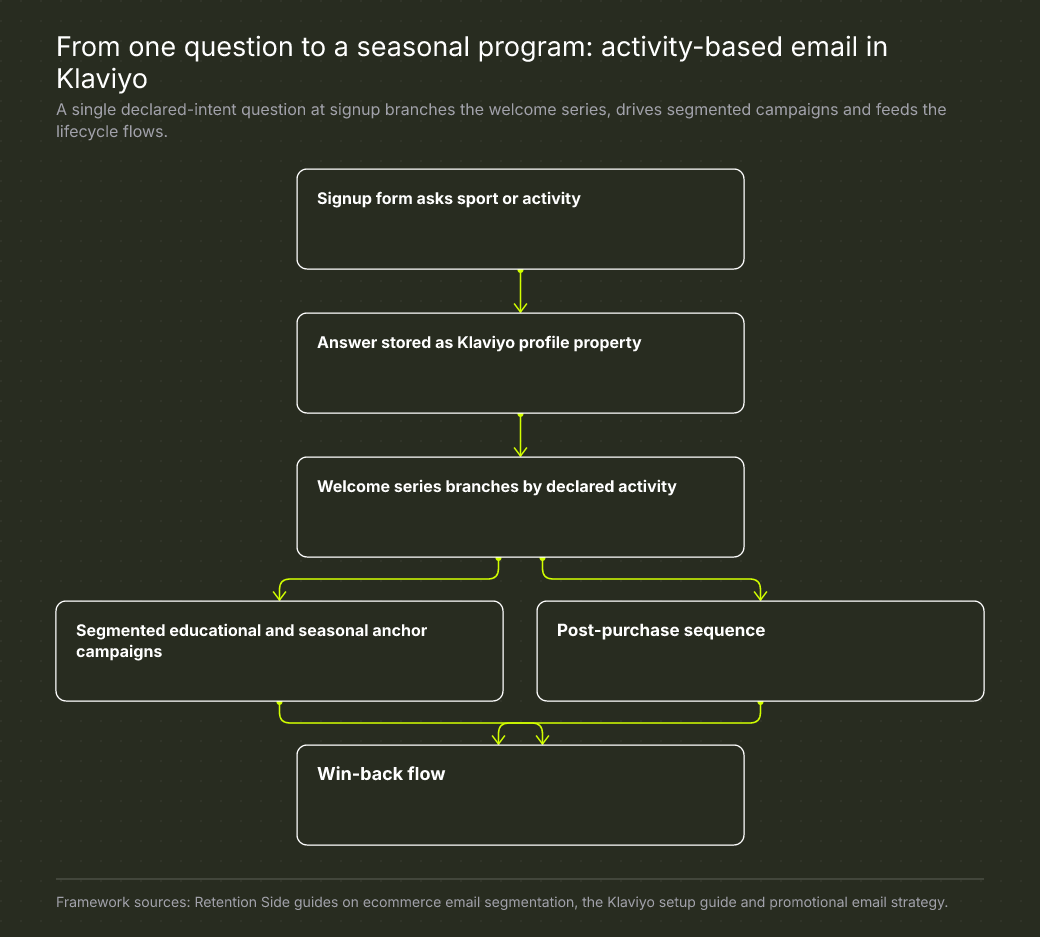
The most useful single move for a sports or outdoor brand is to ask about the activity directly. Retention Side’s guidance on zero-party data is that it should be built into the signup form and welcome series from the start, because a single question can branch the welcome series, flow logic and campaign segmentation. Declared preferences give you intent without ambiguity, which inferred behavioral segmentation often cannot match.
For a gear brand, the question is some version of which sport or activity do you shop for. Keep it to one question on the form. Store the answer as a Klaviyo profile property, then use it in three places:
- Welcome series branching. A new subscriber who picked trail running should not read about alpine touring in email two.
- Campaign segmentation. Product launches, care guides and seasonal sends go to the people the product is actually for.
- Flow logic. Post-purchase and win-back content can reference the activity, not just the last item bought.
Layer this on top of lifecycle segments rather than replacing them. The foundation Retention Side recommends is clearly defined groups (new subscribers, engaged buyers, VIP, lapsed, unengaged and non-purchasers), real-time behavioral conditions in Klaviyo, suppression logic and the zero-party data collected at signup. RFM tiering and product-affinity splits come later as the program matures. For the full approach, see the segmentation guide.
Do this early. Retrofitting activity data into a program built without it is significantly more work, and you end up guessing at the activity of a list you have already acquired.
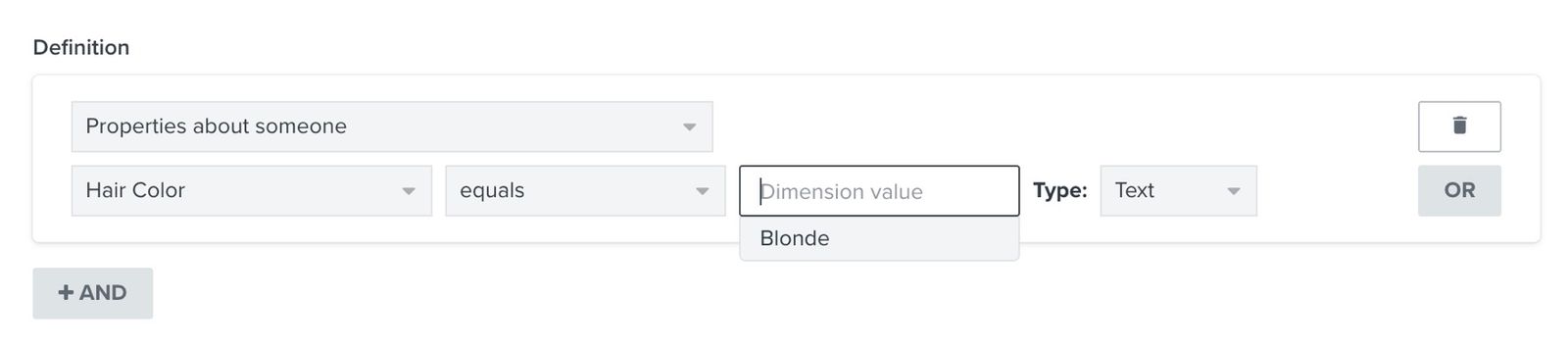
Image credit: Klaviyo Help Center.
Gear education as a retention lever
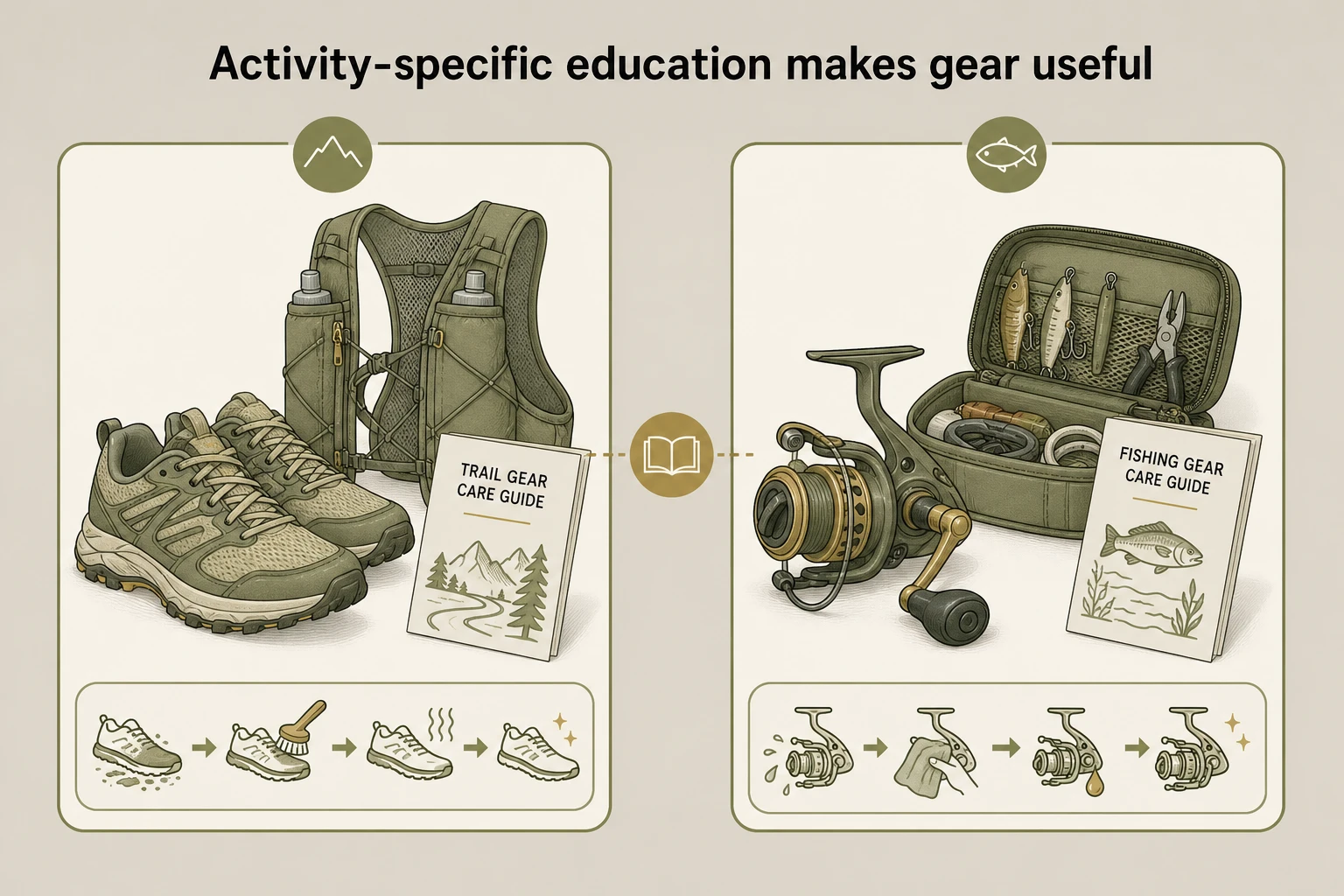
Gear is a considered purchase. Customers worry about fit, sizing, compatibility with what they already own, and whether they will look after it properly. Those worries are an email program waiting to be written.
Educational and value-driven campaigns are one of the core campaign types in a healthy send calendar, alongside promotional, product launch and social proof sends. Treat each educational email like a mini landing page with one job: how to size a pack, how to check that a binding or accessory fits, how to clean and maintain a shell or a pair of boots, or how to prepare equipment before the season opens.
This does three things at once. It helps the customer use what they bought, which supports repeat purchase. It gives you non-promotional sends that keep engagement up. And it makes the full-price emails more credible, because the list has been hearing from you for reasons other than a discount. If subscribers only hear from you during sales, engagement and full-price buying decline over time.
Segment these sends by activity. A care guide for waterproof layers belongs to the people who bought them or said they do the activity that needs them.
The seasonal campaign calendar
Seasonality is real in this category, and a calendar is useful. The risk is a calendar made only of discount dates. Retention Side’s promotional email guidance describes seasonal and lifecycle anchor campaigns as one type in the mix, and says promotions should be anchored to genuine reasons.
A workable approach:
- Start the calendar with non-promotional sends. Fill in education, launches and social proof first, then place promotions around them.
- Anchor each seasonal send to a reason the customer would recognize. Season opening, a trip-planning window, a pre-season maintenance moment or a new product line are all better hooks than a generic sale date.
- Vary the offer structure. Not every promotion should be a percentage off. Early access, bundles, gifts or free shipping thresholds keep the list from reading every send the same way.
- Space the promotions. Leave enough room between them that subscribers are not conditioned to wait for the next discount.
- Segment by activity. A snow-season campaign sent to the whole list wastes attention for everyone who does not ski or ride.
Also watch where campaigns and flows overlap. A subscriber in a welcome or post-purchase flow who gets hit with a major seasonal promotion the same day has a muddled experience, so manage that overlap deliberately.
Flows across the lifecycle
Campaigns carry the seasonal moments. Flows do the quieter work between them. For a sports and outdoor brand, four matter most.
Welcome series, branched by declared activity. This is where the signup question pays off. Each branch can introduce the brand through the lens of that activity, with the right products and the right educational content.
Post-purchase sequence. Gear needs setup, fitting and care, so this flow is mostly education. Not every flow exists to generate direct revenue. Some onboard, some collect information and some improve the customer experience, which in turn supports the next order.
Win-back flow. Customers lapse for reasons that are often seasonal or activity-related. Reference the activity and the last purchase, and treat lapsed buyers differently from people who never bought.
Sunset flow. For unengaged subscribers, a defined last-chance sequence followed by suppression protects deliverability. This links directly back to the foundation above.
Flows are never finished. Test the timing, the content and the branch logic, and revisit them as your catalog and customer mix change.
Measure what matters
Open rate and click rate are useful for diagnosing a specific flow or campaign problem. They are not accountability metrics. Retention Side positions repeat customer rate as the most important retention metric, and its benchmarks article lists the metrics that show whether an email program is working: repeat customer rate, revenue attributed to owned channels, list growth quality, deliverability indicators and flow-level conversion.
On list growth, the useful KPI is lead-to-customer rate, meaning the share of new subscribers who purchase within a defined window, rather than form submission rate. The list growth guide notes that the window is typically longer for higher-consideration categories. That matters here, since a customer buying a technical jacket, a bike component or a tent may research for a long time before ordering. Set your window to match how your customers buy.
Benchmarks deserve the same care. The benchmarks article says a single benchmark should never be applied across niches, because repeat purchase rate varies widely by category. A below-average number is a signal to investigate, not a directive to rebuild. This guide uses no category benchmark numbers for that reason: your own trend, by segment and by flow, tells you more.
When a retention partner makes sense
This section is first-party and describes Retention Side’s own approach.
Retention Side is a retention-specialist agency. Its primary entry point is Klaviyo email, because that is where retention infrastructure lives for most eCommerce brands, and it designs the system to extend to SMS, push notifications, direct mail, loyalty and conversational channels as a brand grows. Sports & Outdoors is listed among the niches Retention Side says it has experience in. We do not have a published sports-specific case study, and the case studies we have published, Hedonism Wines and Eliya the Label, are in other categories.
A partner makes the most sense when the pieces above exist in isolation: a signup form that does not feed segmentation, flows that were built once and never revisited, or a campaign calendar driven by discounts. The value of an outside team is in treating deliverability, list quality, segmentation, flows and campaigns as one system. Retention Side’s view on how to evaluate any partner is to look for verifiable case studies in a comparable context, business-outcome metrics rather than open or click rate, and real channel depth. Our guide to DTC retention agencies covers that evaluation in more detail.
FAQ
What should I ask at signup on a sports or outdoor store?
One question about the sport or activity the subscriber shops for. Store the answer as a Klaviyo profile property and use it to branch the welcome series and segment campaigns. Keeping it to a single question protects form conversion while giving you declared intent.
Is open rate still worth tracking?
Mostly as a diagnostic. Apple Mail Privacy Protection can cause emails to register as opened before anyone reads them, so open rate is not a performance benchmark. A consistently and unexpectedly low open rate is worth investigating as a possible deliverability issue.
How long should the lead-to-customer window be?
It depends on how your customers buy. The window is typically shorter for standard categories and longer for higher-consideration ones. Technical gear often sits toward the longer end, so set the window around your real consideration time.
Do I need a different seasonal calendar for every sport?
Not necessarily a separate calendar, but you should segment the sends. Build the master calendar around genuine seasonal reasons, then target each campaign to the activity segments it applies to.
Where to take this next
Start with the signup question and the deliverability basics, then let activity data shape the welcome series, the education and the seasonal sends. The brands that do this well are not sending more email. They are sending the right email to the right sport at the right point in the season, and measuring it on repeat customers rather than opens.