


Most DTC brands doing $300K or more per month have already solved the front end. Paid social works. Google converts. The product sells. But every month still restarts close to zero, because the back end – the system that brings customers back – was never properly built.
That’s the defining gap between brands that grow sustainably and brands that stay trapped on an acquisition treadmill. The cost of acquiring new customers keeps rising. The customers that do come through buy once and vanish. And no amount of ad creative or bid strategy changes the economics of a single purchase per customer. As Harvard Business Review notes, acquiring a new customer can cost five to 25 times more than retaining an existing one.
A deliberate ecommerce retention strategy changes that math. It turns each acquired customer into a recurring revenue asset, shortens the time between orders, increases the total revenue generated per customer, and builds a customer base that becomes increasingly efficient to market to over time.
This article covers what that strategy actually looks like in practice – not the surface-level version, but the structural thinking, lifecycle logic, channel architecture, and measurement discipline that separates programs which compound from those that plateau.
Key takeaways
- An ecommerce retention strategy is not a set of tactics. It’s a coordinated system built on customer lifecycle logic, behavioral data, channel architecture, and continuous testing.
- Email is the most practical starting point for DTC retention – built on four core pillars: deliverability, list growth, automated flows, and campaigns. All four must function for the channel to work.
- Automated flows and campaigns are equally important. Neither replaces the other.
- The metrics worth tracking are repeat purchase rate (returning customer rate), revenue attributed to retention channels, list growth rate, deliverability health, and flow-level conversion. Not open rate. Not click rate.
- Repeat purchase rate benchmarks vary significantly by category. A strong rate in furniture would be a serious concern in supplements. Never apply universal benchmarks across unrelated niches.
- Channels beyond email – SMS, push notifications, loyalty programs, direct mail, WhatsApp, and Viber – each serve a distinct role. Running them without coordination is not a retention strategy.
- The foundations that make retention possible (a reason to repurchase, a strong product experience, timely communication) must exist before any channel can do meaningful work.
What we’ll cover
- Why retention strategy is a system problem, not a channel problem
- The foundational conditions that must exist before any channel works
- Email: the four pillars and why each one matters
- The lifecycle automation layer: which flows belong in a complete retention architecture
- Building the broader retention channel stack
- Segmentation as the connective thread
- Measuring what actually matters – and ignoring what doesn’t
- Repeat purchase rate: what good looks like by category
- Where retention strategy commonly breaks down
- How retention connects to the wider marketing system
Why retention strategy is a system problem, not a channel problem
The brands that struggle most with retention usually have the same diagnosis: they’ve implemented tactics without a system connecting them. There’s a welcome flow. Someone sends a campaign every other week. There might be a loyalty app installed. But nothing is coordinated around how customers actually move through a lifecycle with the brand.
A retention strategy is the architecture that connects those parts. It defines which customers receive which communication at which point in their journey, through which channel, and what behavior you’re trying to influence at each stage. It accounts for the reasons customers drop off – and builds interventions timed to those specific moments. It’s tested, updated, and improved continuously rather than set up once and left to run.
The practical way to think about it: retention marketing operates on two levels at once. The first is communication – reaching the right customer at the right moment with a message that reflects where they are in their relationship with the brand. The second is structural – creating the actual conditions (product depth, purchase experience, incentive design, catalog logic) that give customers a genuine reason to respond to that communication with a purchase.
Communication amplifies a strong foundation. It doesn’t substitute for one. Brands that invest heavily in email execution while neglecting the structural conditions will find diminishing returns from even the best-designed flows and campaigns.
The foundational conditions that make retention possible
Before any channel does its job, eight foundational conditions need to exist. This is where many brands get stuck – investing in email platforms and campaign scheduling before asking whether the underlying conditions for customer return are actually in place.
A product-level reason to repurchase. The most basic question: does your customer have a practical reason to come back within a reasonable timeframe? Consumable products – supplements, skincare, food and beverage – carry a built-in repurchase trigger. Non-consumable products need a catalog deep enough to create natural next steps. A brand selling one seasonal product with a 12-month use cycle cannot engineer retention at the same pace as a skincare brand with a daily-use core product. The retention strategy must fit the product reality.
A purchase experience worth remembering. The window between order confirmation and product delivery is where most brands go quiet and where smart brands build loyalty. Proactive shipping updates, product education, and packaging that creates a genuine impression – these aren’t extras. They shape whether the customer’s first experience leaves them wanting to come back or simply satisfied with a completed transaction.
Product education that reduces churn. Post-purchase education reduces buyer’s remorse, increases the customer’s confidence in the product, and builds the trust that makes a second purchase feel obvious rather than risky. There is no product category with no educational angle – the question is whether you’ve found it and built communication around it.
Timing calibrated to real repurchase data. Win-back and replenishment communication that lands before a customer runs out is genuinely useful. Communication that arrives weeks after they’ve already reordered from a competitor is noise. Understanding how your actual customers use and repurchase your product – through purchase data and direct research – is what makes timing effective.
A cross-sell strategy built on actual purchase patterns. Cross-sell recommendations that come from observed purchasing behavior outperform those built on assumptions about what “should” go together. Look at what customers actually buy in sequence. Build cross-sell logic around those patterns, not your catalog intuition.
An incentive approach with margin logic behind it. Discounts aren’t inherently wrong in retention. But using them by default – in every flow, in every win-back, in every campaign – trains customers to wait for offers before buying and erodes full-price purchasing behavior. The question isn’t whether to use incentives, but when and at what cost relative to the margin you’re protecting.
A usage habit loop where possible. For consumable or routine-based products, actively helping customers build a habit around using the product creates a structural reason for repurchase. This isn’t about tricks – it’s about delivering enough real value in the product experience that the customer builds the brand into their routine.
A loyalty structure that gives customers something to work toward. A tiered loyalty program creates behavioral momentum. Customers who are close to the next tier make purchase decisions they otherwise wouldn’t, specifically to cross that threshold. The program needs to be designed so that benefits at each tier are meaningfully better than the previous one – and so the economics are sustainable.
Email: the four pillars
Email is where a DTC retention strategy almost always starts, and for good reason. It’s the channel with the widest addressable audience on any given list, the deepest content flexibility, the most mature behavioral automation tooling, and the lowest marginal cost per send. Building it correctly before expanding into other channels is sensible sequencing.
But “having Klaviyo” and “having a functional email program” are not the same thing. A properly built ecommerce email marketing strategy rests on four pillars. They’re not a hierarchy – they’re a system. Weakness in any one limits what’s possible in all the others.
Pillar 1: Deliverability
Deliverability is the prerequisite. Without inbox placement, the rest of the strategy is irrelevant.
The distinction that matters most: delivery and deliverability are not the same. An email is “delivered” when the receiving server accepts it and doesn’t bounce. It’s “deliverable” when it lands in the inbox – not the spam folder, not the promotions tab – where a real person actually sees it. A 100% delivery rate means nothing if a significant portion of your sends are routing to spam.
Inbox placement is determined by authentication (SPF, DKIM, DMARC records – now mandatory for bulk senders per Google’s 2024 sender guidelines), sender reputation built through consistent behavior and low complaint rates, and list hygiene. The most common deliverability killer is over-sending to chronically disengaged subscribers. Inbox providers interpret non-engagement as a signal that emails aren’t wanted – and they use that signal to route future messages away from the inbox. This is why suppressing hard bounces immediately and removing chronic non-engagers regularly isn’t optional. It’s maintenance.
Deliverability management is ongoing, not a one-time setup task. By the time inbox placement has visibly degraded, months of list health damage may already have accumulated. Our ecommerce email marketing benchmarks guide covers how to monitor deliverability indicators proactively, including what to look for in Google Postmaster Tools and Klaviyo’s Deliverability Hub before problems compound.
Pillar 2: List growth
List growth is the acquisition side of retention – how new subscribers enter the ecosystem before or shortly after their first purchase.
The metric most programs track is form submission rate. The metric that actually matters is lead-to-customer rate: what percentage of new subscribers make a purchase within a defined window after joining the list? A smaller list with a high lead-to-customer rate consistently outperforms a large list of low-intent subscribers on every meaningful business metric – including deliverability.
This reframe changes how you think about list-building decisions. Form triggers gated on behavioral signals (scroll depth, time on site, exit intent) collect fewer emails but better ones. Incentive design shapes subscriber intent – a discount code attracts price-sensitive shoppers; a product education resource attracts people genuinely interested in the category. Zero-party data collection at the signup moment – product preferences, purchase intent, frequency – powers personalization from day one instead of requiring behavioral inference later.
List quality is downstream of acquisition quality. If the paid traffic driving people to the site is high-intent and well-targeted, the email list reflects that. Traffic quality is upstream of retention performance in ways that are often misread as email problems.
Pillar 3: Automation (flows)
Automated flows are behavior-triggered email sequences that run continuously without manual input. When they’re built to cover the full customer lifecycle and actively maintained, they become the most reliable component of the program – generating returns in the background every day.
The strategic intent is not “automated emails.” It’s mapping the right communication to the moments in the customer journey where a timely, relevant message changes behavior. A shopper who abandoned a cart has a specific decision they haven’t made yet. A first-time buyer is at the highest point of engagement they’ll ever be with your brand. A customer who hasn’t repurchased in 70 days is drifting toward lapse. Each moment calls for a different intervention.
Flows are never finished. Copy goes stale, product catalogs change, incentive structures that worked 18 months ago may be actively underperforming now. A flow built at launch and never revisited is almost certainly leaving revenue on the table. Regular audits, testing, and updates are what separate programs that compound from those that plateau.
Pillar 4: Campaigns
Campaigns are manually planned sends to selected segments. They cover product launches, seasonal promotions, content-driven communications, educational newsletters, and relationship-building sends between promotional cycles.
Campaigns are equally as important as flows. A program that’s entirely automated eventually feels robotic. A program that’s entirely campaign-dependent works harder than it needs to. The mistake most brands make with campaigns isn’t sending them – it’s reducing them to a discount broadcast calendar. A campaign strategy built exclusively around promotional messages trains subscribers to wait for discounts before buying, which erodes full-price purchasing behavior and depresses engagement outside of sale windows.
A durable campaign strategy balances promotional sends with value-driven content: product education, brand storytelling, seasonal context that isn’t purely commercial. These emails maintain the relationship and keep engagement alive without requiring a discount to justify the send. Segmentation determines their effectiveness – the same message sent to the entire list regardless of purchase history, engagement level, or lifecycle stage is a missed opportunity.
The lifecycle automation layer: complete flow architecture
The flows that make up a complete retention architecture aren’t just technical automations – each one maps to a specific stage in the customer journey where a timely, relevant intervention can change behavior.
Welcome series
The welcome series activates when a new subscriber joins the list without purchasing. Its job isn’t just delivering the signup incentive – it’s building the case for a first purchase. Establishing brand voice, communicating product value, handling common objections, and using zero-party data collected at signup to personalize from the first email. A strong welcome series earns attention over multiple emails rather than dumping everything at once.
Abandoned cart flow
The abandoned cart flow triggers when a shopper adds to cart but doesn’t complete checkout. The flow’s strategic purpose is identifying and addressing the specific friction that stopped the purchase – which varies by cart value, purchase history, and product type. A first-time visitor abandoning a $30 order responds to different messaging than a returning customer abandoning a $150 order. The first email should go out while purchase intent is still warm. The full sequence structure, timing, and whether or how to introduce an incentive should be tested continuously rather than defaulted once.
Browse abandonment flow
Browse abandonment is the flow most often missing from programs that are otherwise functional. Someone viewing product pages is showing buying intent – weaker than cart abandonment, but real. A timely, product-specific follow-up that provides genuine context about what they viewed (not a surveillance-feeling re-targeting message) captures a meaningful slice of revenue most brands leave entirely unaddressed. This flow requires clean “viewed product” event tracking in Klaviyo to function correctly.
Post-purchase sequence
The post-purchase window is the most underutilized stage in most DTC email programs and arguably the most important. A customer who just bought is at peak engagement with the brand. The post-purchase sequence’s job is to convert that engagement into a lasting relationship – through product education that helps them get full value, cross-sell recommendations timed to natural usage progression, a review request calibrated to when they’ve had the product long enough to form a real opinion, and a bridge toward the second purchase. The second purchase is the most predictive indicator of long-term retention – getting a customer there efficiently is one of the highest-leverage things the email program can accomplish. Our full breakdown of how to increase repeat purchases in ecommerce covers this transition in detail.
Cross-sell and up-sell flows
Cross-sell and up-sell flows deserve their own architecture, distinct from the general post-purchase sequence. They’re triggered after purchase and designed to expand the customer’s product footprint within the catalog – increasing both order frequency and catalog engagement breadth. Effective cross-sell flows are built on actual purchase relationships in the data. If customers who buy product A consistently also buy product B within 60 days, that pattern should drive the flow logic – not assumptions about what “goes well together.”
Win-back flow
A win-back flow is triggered around the point where a customer would historically be expected to repurchase but hasn’t. That timing is specific to the brand’s average order frequency data – not a generic calendar. For most DTC categories, the relevant window falls well within 90 days. The flow’s purpose is re-engaging a drifting customer before they fully disconnect, with messaging that acknowledges the gap and offers a genuine reason to return. Win-back at 180 days or beyond only makes sense in categories with genuinely long repurchase cycles (furniture, for example). Applying that same delayed trigger to a supplement brand with a 30-day average cycle is a structural error.
One clarification worth making explicitly: sunset flows exist for list hygiene, not revenue. Their job is to systematically remove chronically disengaged subscribers before their chronic non-engagement damages deliverability across the rest of the list. Don’t group them with revenue-generating flows when evaluating your automation architecture.
Building the broader retention channel stack
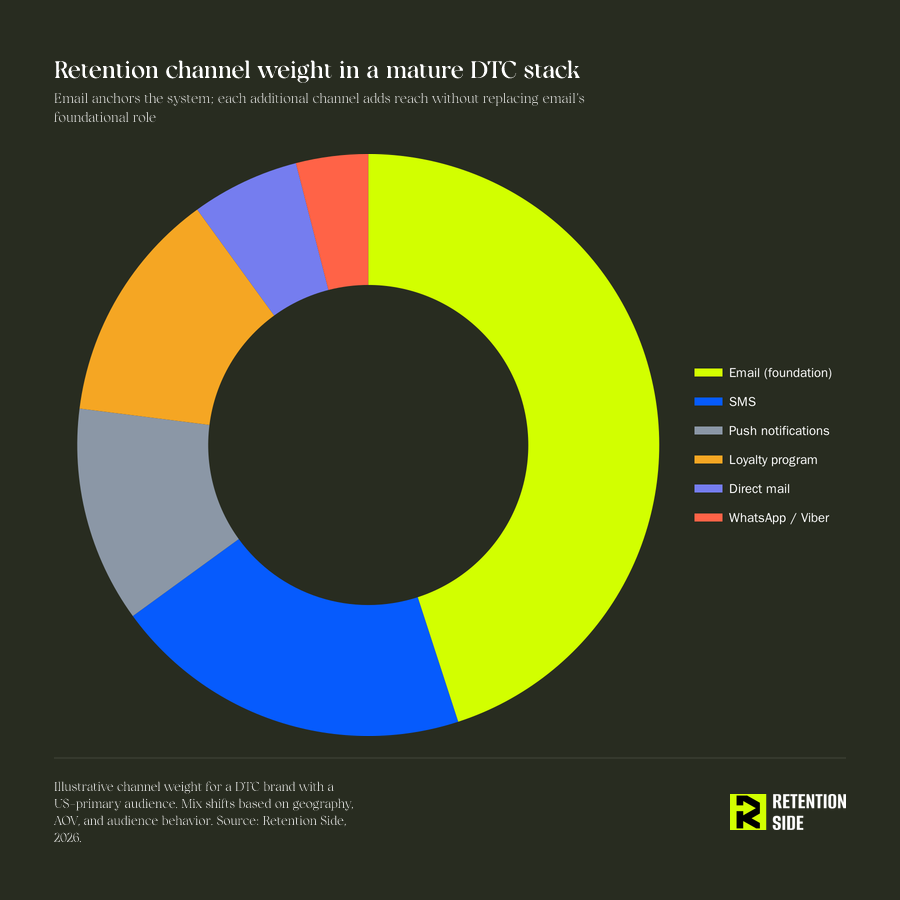
Email is the foundation. The rest of the retention stack extends reach to customers the email program can’t serve effectively, and adds channel-specific capabilities that email alone doesn’t offer.
The decision to add each channel should be driven by audience data, not by a preference for more channels.
SMS
Text messages are read within minutes. That makes SMS the right channel for time-sensitive, high-intent moments: flash sales, back-in-stock alerts, shipping notifications, and cart recovery where speed is a competitive advantage. SMS benchmarks consistently show significantly higher open and conversion rates than email – but the list is typically smaller (most DTC brands see SMS consent at a fraction of their email list size), and frequency sensitivity is higher. SMS is not a replacement for email – it serves a different function. Overusing SMS damages the channel faster than any other in the retention stack.
Push notifications
Browser and app push notifications extend retention reach without competing for inbox space. They work best as reinforcement – a gentle nudge for cart recovery, a price-drop alert, a restock reminder. They don’t carry the narrative or content depth of email, but they reach users who respond better to on-screen prompts than inbox messages, adding coverage without overlap.
Loyalty programs
A loyalty program isn’t a communication channel – it’s a structural incentive. A well-designed tiered program gives customers something to build toward (status, rewards, exclusivity) that makes switching to a competitor feel costly. Members consistently generate more revenue per year than non-members, and the behavioral data a loyalty program produces feeds back into segmentation and flow logic across every other channel. Design the tier economics carefully: benefits need to feel meaningfully better at each level while protecting margin. For a real-world example of how owned channel infrastructure and loyalty mechanics can combine to drive meaningful outcomes, the Hedonism Wines case study illustrates what clean list management and strong segmentation make possible even in a restricted advertising vertical.
Direct mail
The physical mailbox has become less crowded as digital channels expanded, which is exactly why a well-timed direct mail piece can move a customer that five re-engagement emails couldn’t. The higher cost per piece makes direct mail a precision instrument rather than a broadcast channel. It works best for high-value customer segments, win-back of lapsed VIPs, and moments where a physical experience creates an impression that digital simply can’t match.
WhatsApp and Viber
In markets where these platforms dominate daily communication – across Europe, the Middle East, and Southeast Asia – they open up conversational retention touchpoints with engagement rates that inbox-based channels rarely match. For brands with primarily US-based audiences, these channels are worth monitoring. For brands with meaningful international presence in the relevant geographies, they belong in the active retention stack.
The point isn’t to activate all of these channels simultaneously. It’s that each serves a specific function – and the system works when they’re coordinated around the customer lifecycle rather than operating as isolated workflows with no awareness of each other.
Segmentation as the connective thread
Segmentation runs through every part of the retention system. It determines which customers receive which campaigns, how flows branch based on purchase history, how customer data powers personalization, and how deliverability is protected by avoiding irrelevant communication at scale. A well-structured Klaviyo segmentation strategy is what connects the individual parts of the program into a coherent customer experience.
Brands that do segmentation well don’t just divide the list into “engaged” and “unengaged.” They build audience buckets that reflect how customers actually behave: purchase frequency and recency, product category affinity, AOV tier, lifecycle stage, acquisition source, zero-party data attributes. These segments inform campaign targeting, flow branching logic, and strategic decisions about what kind of communication different customers should receive.
A few principles worth holding:
Segmentation should be dynamic. Customers move between stages. Someone who was an active buyer six months ago is now a win-back target. A subscriber who never purchased is on their third browse abandonment touch. Static segments miss the movement.
Not every segment needs its own campaign. Segmentation isn’t about fragmentation for its own sake – it’s about relevance. The question for each send is whether there’s a meaningful reason to say something different to this specific group.
RFM scoring (recency, frequency, monetary value) is a useful strategic lens for tiering the customer base. It works best as a framework for prioritization rather than a rigid classification system. The goal is to ensure your most valuable customers receive communication that acknowledges their relationship with the brand, while lapsed customers receive intervention designed for their specific stage.
Zero-party data is the highest-quality segmentation input available. When a customer explicitly tells you their product preferences at signup, that information powers more accurate targeting than any behavioral inference – and it doesn’t require you to read between the lines of ambiguous engagement data.
Measuring what actually matters
The metrics most ESPs surface prominently – open rate, click rate – are diagnostic signals, not performance indicators. They’re useful for identifying specific problems (subject line testing, content relevance checks). They’re not indicators of whether the retention system is building the business. Our guide to ecommerce email marketing benchmarks breaks down which numbers are worth tracking and which ones are noise.
The metrics that actually matter for a DTC retention program:
Repeat purchase rate (returning customer rate) is the clearest single measure of whether retention is working. If the percentage of customers who make more than one purchase is growing over time, the system is doing its job. If it’s flat despite email investment, something fundamental isn’t working. This is the metric to anchor retention strategy conversations around.
Revenue attributed to retention channels measures what email, SMS, and other owned channels are contributing to total store revenue over time. Interpreted with nuance – attribution in retention is never perfectly clean – this shows whether the investment is producing proportional commercial output.
List growth rate tracked alongside lead-to-customer rate confirms whether the list is growing in quality, not just volume. A growing subscriber count that produces declining lead-to-customer conversion is a list quality problem, not a list growth win.
Deliverability indicators – inbox placement rate, spam complaint rate, hard bounce rate – are the early warning system for problems that become revenue drops if left unaddressed. Monitor these proactively. Reactive remediation is far more expensive than preventive maintenance.
Flow-level conversion metrics – for each core flow, the percentage of customers who complete the target action. Abandoned cart conversion rate, welcome-to-first-purchase rate, post-purchase cross-sell conversion. These tell you precisely which parts of the automation layer are working and which need attention.
Average time between orders is not a standard email dashboard metric, but one of the most informative signals for whether the email program is genuinely accelerating the customer lifecycle. If the gap between first and second purchase is shortening over time, the post-purchase and cross-sell sequences are doing their job.
What to deliberately exclude from primary KPI conversations: open rate, click rate, revenue per recipient. These metrics don’t directly measure business outcomes in a way that’s useful for strategic decision-making.
Repeat purchase rate: what good looks like by category
Repeat purchase rate is the metric that most directly tells the story of a retention program’s health. But interpreting it requires category context – there’s no single benchmark that applies across DTC niches.
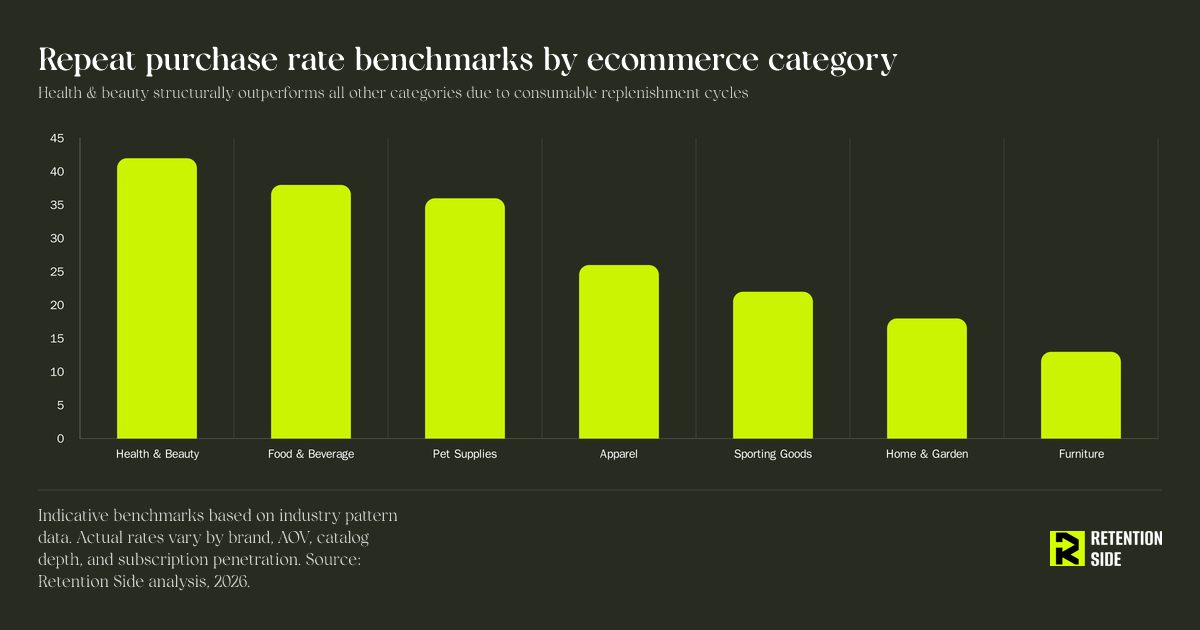
Health and beauty – supplements, skincare, haircare – structurally produces higher repeat rates because the products are consumable. Customers run out and need to reorder. The retention job in this category is ensuring they reorder from you rather than a competitor. A repeat rate that would be considered good in most other categories would be a concern here.
Food and beverage similarly benefits from consumable replenishment cycles, with repeat rates that reflect frequent purchasing windows. The challenge in this category is often breadth – building a catalog deep enough that the customer’s entire routine runs through your brand rather than just one SKU.
Apparel and sporting goods sit in the middle range, where repeat purchases depend more on brand affinity and product catalog depth than on physical depletion. Repeat rate benchmarks here are lower than health and beauty – and that’s expected, not a failure.
Home and garden customers buy on longer cycles, and the purchase decision is often more considered. Retention strategy in this category focuses heavily on the post-purchase experience, catalog expansion, and customer education rather than frequency optimization.
Furniture has the structurally longest repurchase cycles. A 12-15% repeat rate in furniture can represent genuinely strong retention performance. Applying health and beauty benchmark expectations to a furniture brand is a category context error that any serious retention partner should avoid.
The practical implication: your repeat purchase rate target should be calibrated against your category’s structural repurchase cycle, your average order frequency data, your subscription penetration, and your catalog depth. What matters is whether the rate is improving relative to your own baseline over time – not whether it matches a generic industry average that was probably aggregated across incompatible categories.
Where retention strategy commonly breaks down
Understanding the failure modes is often more useful than repeating what good looks like. Here are the patterns that consistently produce underperformance:
Flows built once and never revisited. A welcome series written at brand launch, using the original product lineup, original voice, and original incentive structure, is probably misaligned with what the brand is today. Flows need audits, testing, and updates. A flow that hasn’t been touched in 18 months is almost certainly leaving revenue on the table – not because the structure is wrong, but because the content, timing, and incentives haven’t been optimized against current performance data.
Treating all subscribers identically. Broadcasting the same message to the entire list regardless of purchase history, lifecycle stage, or engagement level is retention in name only. The gap between broadcast and a properly segmented program is meaningful – both in revenue terms and in the deliverability implications of sending irrelevant communication at scale.
Expanding channels before the email foundation is solid. SMS, push notifications, and direct mail are all valuable additions to a retention stack. But layering them on top of a broken email program usually distributes the same fundamental problems across more channels without fixing the root cause. Establish a functioning email program first. Then add channels based on what the audience data tells you.
Using discounts as a default rather than a deliberate tool. Incentives in flows can be appropriate – only a small percentage of subscribers trigger any specific flow at any given time, and proper filtering prevents overlap. But using a discount in every flow, every win-back, and every campaign without margin logic trains customers to wait for offers and progressively erodes full-price purchasing behavior.
Misreading performance signals. A decline in email-attributed revenue doesn’t always mean the email program is broken. It may mean acquisition traffic quality has changed, bringing lower-intent subscribers into the list. It may mean website conversion has dropped, creating a floor problem that no amount of email optimization addresses. Diagnosing root cause before rebuilding strategy saves significant time and budget.
Treating campaigns as secondary to flows. An email program that deprioritizes campaigns in favor of pure automation eventually loses the topical relevance and brand voice that keeps subscribers engaged over time. Campaigns and flows each serve a purpose that the other can’t replace. A complete program needs both running well simultaneously.
How retention connects to the wider marketing system
Retention doesn’t operate in a silo. The email program’s performance is downstream of acquisition quality and upstream of the customer experience that determines whether someone actually wants to return.
This means a serious retention strategy needs to account for what acquisition is sending to the list. Not to manage acquisition – but to understand whether the traffic quality is producing the subscriber quality the retention system depends on to function. A decline in list performance is sometimes a retention problem and sometimes an acquisition quality problem. The diagnostic matters.
It also means the retention system actively feeds acquisition in ways that are worth measuring. High-LTV customers produce better lookalike audiences for paid targeting. Loyal customers refer others at rates that new buyers don’t. Strong retention economics increase the LTV-to-CAC ratio, which determines how aggressively a brand can afford to bid in paid channels. These aren’t separate functions – they’re interconnected systems where improvement in one produces measurable downstream effects in the other. For a closer look at what working with a DTC retention agency actually involves – and how to evaluate whether you need one – that breakdown covers the diagnostics and engagement model in full.
At Retention Side, the entry point into every engagement is email via Klaviyo, because it’s where the highest-leverage, most immediately measurable retention infrastructure lives. How the retention stack builds from there – whether that means layering in SMS, push notifications, direct mail, a loyalty program, WhatsApp, or Viber – depends entirely on what the audience behavior data tells us. Not a standard expansion checklist. Not a preference for more channels. What the data shows about how actual customers in that specific brand’s ecosystem respond.
The underlying principle is consistent regardless of which channels are in the mix: meet each customer at the right point in their lifecycle, on the channel they actually respond to, with a message that reflects where they are in their relationship with the brand. Email is almost always where that starts. The full retention system is what makes it compound.
What “building” a retention strategy actually requires
There’s a version of retention strategy that exists on paper – a flow map, a campaign calendar, a tool stack. And there’s the version that actually changes the repeat purchase rate. The difference between them is almost always execution depth and continuous improvement discipline.
Building a retention strategy that compounds requires:
Foundational research before execution. Understanding where customers are dropping off, what the repurchase window actually is for your specific product, and what channels your existing customers respond to. This phase is not optional and it’s not fast. Skipping it means building strategy on assumptions that may not hold.
Customer journey mapping across lifecycle stages. Every flow, every campaign, every channel decision should map back to a specific moment in the customer journey and a specific behavioral outcome. This is different from picking templates from a library and scheduling sends.
Controlled A/B testing that validates before scaling. Assumptions should be tested before they’re scaled. A controlled testing framework ensures results are meaningful – not just noise from a single campaign or a week of unusual traffic.
Continuous behavioral data analysis. What worked in month one may not be optimal by month six. Customer behavior changes, seasonality shifts, product catalog evolves. Ongoing analysis is what keeps the system improving rather than stagnating.
Cross-channel coordination. Messaging, timing, promotions, and customer experience should be aligned across channels. A customer in the middle of an abandoned cart flow who receives a campaign that doesn’t acknowledge their abandonment is getting a disjointed experience. Flow suppression logic and campaign filtering need to be designed with awareness of each other.
This is the scope of what a properly built ecommerce retention strategy requires. For brands doing serious revenue, it’s one of the most ROI-positive investments available – precisely because the compounding economics of improved retention are so different from the linear economics of acquisition spend. If you’re evaluating what this looks like in practice, our overview of what an ecommerce email marketing agency actually does covers the execution model in detail.
Conclusion
An ecommerce retention strategy isn’t a campaign type, a tool, or a loyalty app. It’s a system – one built on customer behavior data, coordinated across multiple channels, grounded in the four pillars of email, and measured against outcomes that directly reflect business health.
For DTC brands doing meaningful revenue, the gap between having an email account and having a functioning retention system is measurable in repeat purchase rate, customer lifetime value, and whether the unit economics of growth are improving or compounding in the wrong direction.
The brands that get this right stop treating retention as a line item and start treating it as infrastructure. Flows run continuously and are tested regularly. Campaigns maintain the relationship between promotional cycles. Each additional channel layer extends reach to customers the email program alone can’t serve. Customer data improves targeting across every channel – including paid acquisition. The system compounds.
That compounding is what separates retention strategy from retention activity. And for brands at the scale where a few percentage points of improvement in repeat purchase rate represents hundreds of thousands in incremental annual revenue, the distinction is worth getting right.
If your repeat purchase rate isn’t moving, or your email program has been running for a while without being meaningfully rebuilt, the issue is almost always structural. That’s exactly where Retention Side works.